15 October 2012

Pakistani girl shot for advocating education for girls.

Malala Yousafzai [born 1997, shot on 9 October 2012 and now in hospital]
The photo that I originally used here, taken from Wikipedia, has been removed from the latter.

Fourteen-year-old Malala Yousafzai was flown to the United Kingdom today in an air-ambulance provided by the United Arab Emirates. My Columban confrere here in the Philippines, Fr Shay Cullen, writes in his weekly Reflections about her:


The only way out of grinding poverty and a life of child labor in the developing world is to give the children an education. Millions of children grow up unable to read and write and are locked out of a life of knowing, enlightenment and human development. They have to struggle and endure the hardship of working for a living from an early age. 

Eleven-year-old Grace was one child among thousands whose parents were so poor that they could not afford to send her to a public school. After Grade Two, they sent her to the beaches of Puerto Galera in the Philippines to sell necklaces and bangles made from sea shells. This uneducated child was easily lured into a beach hut by a rich foreign child-sex tourist and gravely abused. If Grace had been in school like most children, it would never have happened. She would have been smarter and wiser too about the dangers to children from the child-sex tourists who prey on innocent, ignorant, uneducated children. That child-abuser was arrested and brought to justice. 
Getting vulnerable children into school is one of the most important and effective ways to overcome poverty; it breaks the otherwise endless cycle of child exploitation and abuse.

[My own comment: How many of us priests speak about what God will ask of us on the day of judgment?]

What could be worse for a child than growing up ignorant, illiterate, and unable to read or write?  What could be worse is to be a 14-year-old girl child student in the Swat Valley of Pakistan or any Taliban infested country and advocate child education. Brave and courageous 14-year-old Malala Yousafzai made child education her mission until a Taliban extremist went up to her school van last week and shot her at point blank range. As I write this she is struggling in hospital with a bullet removed from her head and back. She had been warned to stop but she continued her mission. 
What drives extremists to such barbaric acts of attempted child murder in the name of religion is the lack of moral and true spiritual education, ignorance and fear. These makes youth easily vulnerable to extremist persuasions and easily converted to simplistic religious views that advocate violent acts disguised as acts of piety and religious zeal. 

The vast majority of Muslims condemned the attempted child murder as un-Islamic and against the Koran which honors persons as children of Allah. The vast majority of Muslims love and cherish their children and strive and sacrifice to have them educated in the true religion of Islam that we all respect. 

Yet some children never make it to school and the lack of mental and intellectual development leaves the uneducated child likely to grow up physically but not humanely. The male is prone to be violent and oppressive. What education did for Malala Yousafzai and thousands of others is that it gave her more than knowledge about things and a variety of subjects, it gave her happiness, and a zest for living, compassion, love and concern for others. That's what education did for her, the lack of it in another brought about her near assassination. She loved to learn and wanted all children to have that chance, she loved others as a result. 
Education can give all a sense of the true value of the human person, one that helps us all to have respect for each other. Malala Yousafzai was determined that every girl child like her should go to school and learn, grow and develop their personalities and characters to lead useful meaningful lives as it is their right. She spoke out for these rights at 14 years of age and paid a terrible price. 

Those few who detest the education of girls fear what knowledge can do to empower the person. Knowledge is empowerment. Knowledge and learning is what opens the mind and heart to see the world, and understand it. It sparks self-awareness and knowledge and that kindles a spirit of freedom, joy and exuberance of life.  It frees the human will to decide its free choice and course in life. Good education frees us from the dark dungeon of ignorance and unknowing. Knowledge of one’s self is knowledge of one’s rights, dignity, equality and independence. That is what real education does; it leads us forward to a better life. 
 In a girl or woman, all this is anathema to a chauvinistic extremist male view of life where men wrongly demand and enjoy dominating, controlling and subjugating girls and women. The brave and courageous girls and women who do fight back for freedom and dignity are often beaten and battered. Many cannot overcome this dominance which violates their freedom of choice to have or not have more children than they can bear, feed and educate. That lack of choice can perpetuate the cycle of endless poverty, hunger, disease, ignorance and early death after a brutal short existence. 
Education for the child, especially girls, is the way out, the journey to enlightenment, empowerment and freedom from dominance and abuse. Educating children is ensuring their right to a life of dignity and decency, respect and freedom. Educating a child is among the greatest acts of charity we can do for the poor and the downtrodden. If we can educate even one child, we have saved a life, hers and perhaps even our own. 


+++

Please pray for the full recovery of this remarkably brave young girl.

12 October 2012

'Jesus looking upon him loved him . . .' Sunday Reflections, 28th Sunday in Ordinary Time Year B


From Jesus of Nazareth, Franco Zeffirelli's TV mini-series of 1977.

Readings(New American Bible: Philippines, USA)

Readings (Jerusalem Bible: Australia, England & Wales, India [optional], Ireland, New Zealand, Pakistan, Scotland, South Africa)

Gospel Mark 10:17-30 (Revised Standard Version – Catholic Edition)

And as Jesus was setting out on his journey, a man ran up and knelt before him, and asked him, "Good Teacher, what must I do to inherit eternal life?" And Jesus said to him, "Why do you call me good? No one is good but God alone. You know the commandments: 'Do not kill, Do not commit adultery, Do not steal, Do not bear false witness, Do not defraud, Honor your father and mother.'" And he said to him, "Teacher, all these I have observed from my youth." And Jesus looking upon him loved him, and said to him, "You lack one thing; go, sell what you have, and give to the poor, and you will have treasure in heaven; and come, follow me." At that saying his countenance fell, and he went away sorrowful; for he had great possessions. 

And Jesus looked around and said to his disciples, "How hard it will be for those who trust in riches to enter the kingdom of God!" And the disciples were amazed at his words. But Jesus said to them again, "Children, how hard it is for those who trust in riches to enter the kingdom of God! It is easier for a camel to go through the eye of a needle than for a rich man to enter the kingdom of God." And they were exceedingly astonished, and said to him, "Then who can be saved?" Jesus looked at them and said, "With men it is impossible, but not with God; for all things are possible with God." 

Peter began to say to him, "Lo, we have left everything and followed you." Jesus said, "Truly, I say to you, there is no one who has left house or brothers or sisters or mother or father or children or lands, for my sake and for the gospel, who will not receive a hundredfold now in this time, houses and brothers and sisters and mothers and children and lands, with persecutions, and in the age to come eternal life". 

+++

This incident is also recounted in the gospels of St Matthew and St Luke. It is Matthew who tells us that the man who approached Jesus was young. Luke describes him as a ruler or aristocrat, depending on the translation. But it is only Mark who writes, Jesus looking upon him loved him . . .

John Profumo (1915 - 2006) [Wikipedia]

During my second summer vacation after entering the seminary, the summer of 1963, the biggest story in Britain and Ireland was that of a senior member of the Conservative Party and of the British government, John Profumo. He had served with distinction in the British army in World War II, reaching the rank of Brigadier (General). He was independently wealthy. He became involved with a prostitute, Christine Keeler, who also had relations with  the senior Soviet naval attaché in London. Profumo denied in parliament that he had an improper relationship with Keeler. This was later shown to be untrue. He was later forced to resign for having lied to parliament. Before resigning from all his positions he confessed to his wife, Valerie Hobson, and she stood by him.

John Profumo disappeared from public life and spent many years as a volunteer cleaning toilets in a place called Toynbee Hall, a charity in the East End of London. I do not know anything about the faith of John Profumo, whose paternal ancestors were Italian aristocrats. He had the inherited title 'Fifth Baron Profumo', though he didn't use it. But Lord Longford (1905 - 2001), a Labour politician and social reform campaigner whose Catholic faith - he was a convert from Anglicanism - was the bedrock of everything he did, was quoted as saying that he, felt more admiration [for Profumo] than [for] all the men I've known in my lifetime'.

Unlike the man in the gospel, John Profumo had sinned. He lost his reputation but regained it as years later people came to know what he had been doing.


Fr Charles de Foucauld was assassinated in the Sahara on 1 December 1916 when John Profumo was almost two. Like Profumo, he was born into wealth. Unlike the man in the gospel, he became a notorious playboy and was thrown out of the French army because of his behaviour. He went through a conversion experience at 28 and, again unlike the man in today's gospel, gave up everything. His subsequent journey in the Catholic faith led him to the priesthood and to the Sahara to live the life of Nazareth as he understood it.

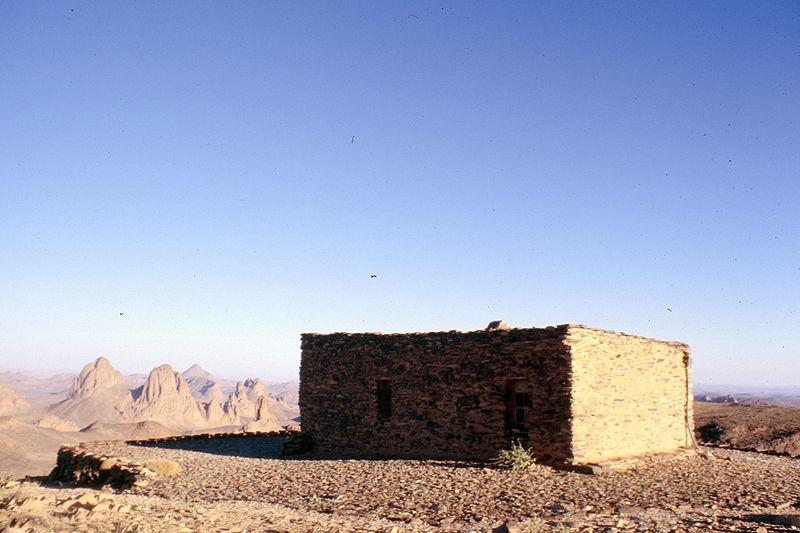
Hermitage of Blessed Charles de Foucauld in southern Algeria

Brother Charles, as he was known, died alone. He had drawn up a rule for a religious congregation to live the life of Nazareth in the desert. I think that one person joined him for a short while. But in the 1920s his life and writings led to the founding of two religious congregations, the Little Brothers of Jesus and the Little Sisters of Jesus, both of which are here in the Philippines. There are a number of other congregations that adapted the rule that Brother Charles wrote. 

The Little Brothers and the Little Sisters live among the poor, support themselves by taking manual jobs. The January-February 2005 issue of Misyon carried an article, Working Sisters, in which Little Sister Goneswary Subramaniam LSJ from Sri Lanka writes about working as a sewer in a garment factory in Quezon City, Metro Manila, and Little Sister Annarita Zamboni LSJ from Italy about working as a lavandera, a laundry woman. Adoration of the Blessed Sacrament is at the heart of the life of each community of the Little Brothers, some of whom are priests, and of the Little Sisters and neighbours are invited to join.

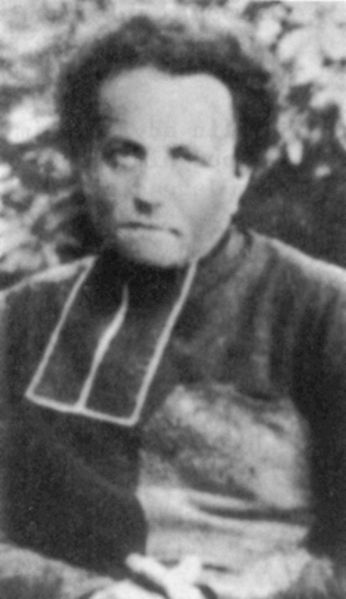
Abbé Henri Huvelin (1830 - 1910)

Blessed Charles was a diocesan priest, though definitely not a conventional one. But a more conventional diocesan priest, played a central role in his conversion, Fr Henri Huvelin.

Among the groups inspired by Blessed Charles is the Jesus Caritas Fraternity of Priests, a movement that adapts his spirituality to the lives of pastoral priests, mainly diocesan, though not exclusively. [That website has links to other branches of the De Foucauld family, including the Little Brothers and the Little Sisters.]

Peter, troubled by the words of Jesus, said, Lo, we have left everything and followed you. Jesus replied, Truly, I say to you, there is no one who has left house or brothers or sisters or mother or father or children or lands, for my sake and for the gospel, who will not receive a hundredfold now in this time, houses and brothers and sisters and mothers and children and lands, with persecutions, and in the age to come eternal life.

Charles de Foucauld experienced the joy of doing God's will, with persecutions in his violent death, but the houses and brothers and sisters . . . didn't come till some years after his death. And when Cardinal José Saraiva Martins beatified Brother Charles in Rome on 13 November 2005 the Church confirmed that he had indeed attained eternal life from the moment of his death and that he was a model of holiness who could guide us as we try to follow Jesus. 

Blessed Charles saw clearly what the young man in the gospel, who didn't sin but had no idea of the riches he was spurning, didn't see - that Jesus was looking upon him and loved him. 


1959 French stamp in honour of Blessed Charles de Foucauld [Wikipedia]

Prayer of Abandonment of Blessed Charles de Foucauld

Father,
I abandon myself into your hands;
do with me what you will.
Whatever you may do, I thank you:
I am ready for all, I accept all.

Let only your will be done in me,
and in all your creatures -
I wish no more than this, O Lord.

Into your hands I commend my soul:
I offer it to you with all the love of my heart,
for I love you, Lord, and so need to give myself,
to surrender myself into your hands without reserve,
and with boundless confidence,
for you are my Father.

This coming week, 15-19 October, the Philippine members of the Jesus Caritas Fraternity of Priest will have their annual gathering near Manila. Unfortunately, I'm unable to attend, Please keep the members in your prayers.

A friend of mine in Cebu City, Simeon Dumdum Jr, a married man with adult children and a judge who has written a number of books of poetry and beautiful prose, had a column last February in the Cebu Daily News on the spirituality of Blessed Charles, Desert. It is well worth reading.

10 October 2012

96th Anniversary of Maynooth Mission to China, the Society of St Columban

Statue of St Columban, Luxeuil, France, where he founded a monastery c. 585-590.

Ninety-six years ago today, on 10 October 1916, the bishops of Ireland gave their assent to the proposed Maynooth Mission to China that became the Society of St Columban on 29 June 1918, the feast of Sts Peter and Paul. You can read a brief synopsis of our origins and history here.

It is quite extraordinary that the Irish bishops let two young diocesan priests, Fr Edward Galvin ordained seven years and Fr John Blowick only three, start this movement to set up a mission of the Irish Church in China, the original intent. this was a few months after the Easter Rising in Dublin against British rule, in the middle of the Great War and in a country where poverty, much of it very harsh, especially in the cities, was widespread.

Fr John Blowick, Co-founder (1888 - 1972)

Bishop Edward Galvin, Co-founder (1882 - 1956)

St Columban's Cemetery, Dalgan Park, Navan, Ireland, where our two co-founders are buried along with many other Columbans.

Today I received an email from a Columban colleague which included the text of a homily given some years ago by Fr Cathal Coulter during the Cemetery Sunday Mass, celebrated in the cemetery above on the first Sunday of June each year. Families, relatives and friends of all deceased Columbans are invited. It was first published in Columban Intercom, the Columban in-house magazine.

Father Coulter, ordained in 1954, has been battling with cancer for some years, so a prayer for him won't go astray. Thank you.

Although this homily was given in Dalgan on Pentecost Sunday last year, it remains relevant for our reflections during this November.  What has increased in the meantime is the number of Columbans now buried in Dalgan (up by nine) and in other graves around the world (up by six).  Their graves remind us of how perseveringly they strove to convey to many nations 'the mighty works of God'.

Another view of the cemetery

One little quotation from today's Pentecost readings seem to have been written for our Cemetery Sunday liturgy: Each of us hears them telling in our own tongue about the mighty works of God. The people of the different missions where they served, could say that about our deceased Columbans.

They told the mighty works of God, not only in the language they mastered, but by their living, and indeed, many of them by dying, for their people.

And so we gather today for several reasons . . . to REMEMBER and to GIVE THANKS; and perhaps also to FIND SOME COURAGE to live out our own Christian lives. There is something inside all of us that wants to keep in touch with the past, to REMEMBER. For Christians, REMEMBERING is a sacred thing.  We have the example of Jesus: In giving us the Eucharist, Jesus told us to do this in MEMORY of him.

When I was growing up, there was a Latin phrase on a stained glass window in one of our parish churches.  The phrase was ABSENTES ADSUNT; it intrigued me and it was a great distraction. One day the curate [assistant priest] explained that it meant THE ABSENT ARE PRESENT.  This puzzled me more because if I was absent from school, I certainly wasn't present . . .  
The curate explained . . .it refers to THE DEAD . . .

St Columban's College, Dalgan Park, where most Irish Columbans studied and where many retired Columban priests now live.

Take a look around you at the names on the crosses and names on this wall behind me . . .   We miss these people.  They shared our journey in life with us.   And YES, they are PRESENT.  They live on in our memories, they live on in the ways that they influenced us, and they live on in the COURAGE they give us to lead our Christian lives . . . whatever our vocation.

We certainly need large doses of courage to follow Jesus today . . . I believe we can draw inspiration from our deceased.  I think of Bishop Galvin . . . setting out to bring the Gospel to China . . . alone . . . with no support system.

John Blowick. built this college in the depression of the 1930s, with the five bobs and half crowns of the people of Ireland . . . at a time when nobody in our Ireland had very much.    Every grave stone here is a marker to men of courage.


The very much alive 88-year-old Fr Patrick Hurley who went home to Ireland last year  after more than sixty years in the Philippines, nearly all of them in Negros Occidental. His two brothers, now deceased, Father Dermot and Father Gerard, worked in Fiji and their sister, Sister Catherine, still happily with us, served a term as Superior General of the Columban Sisters.

Q.  Where did they get their courage?
A.  They were filled with the Spirit of Pentecost . . . which gave them confidence in the gifts God gave them so the power of God could work through them.  For them, courage meant:
- being brave enough to face what life sent them;
- enduring the hardships of mission life without bitterness or disillusionment;
- struggling for the rights of their people and for what needed to be changed;
- holding to the vision of Pentecost, despite the risk of rejection or failure.

Q.  Now, when we look into our own lives . . . where do we find courage?
A.  We can find our strength in the Holy Spirit and find inspiration from the courageous men buried all around us.

It's hard for the modern world to understand WHY these men gave up Ireland and family to follow this vision of Pentecost: called Mission.

Padraig Pearse had, I think, a good answer: The Fool:

I have squandered the splendid years that the Lord gave to my youth
In attempting impossible things, deeming them alone worth the toil.
Was it folly or grace?  Not men shall judge me, but God.

Lord, I have staked my soul, I have staked the lives of my kin,
On the truth of Thy dreadful word.
Do not remember my failures.
But remember this, my faith.

Yes, today we remember their faith, their generosity and their courage.

And more than remembering, we come to give THANKS . . .
Each one of us can give thanks for that special Columban we commemorate today . . . brother, uncle, cousin, friend . . . (Let's STOP STOP STOP. Call that man to mind.)

With all their human limitations, these were good men . . . they did not take themselves too seriously.  But they did take the promises of Christ seriously . . . And they did extraordinary things.


The crucifix in the cemetery

There are 189 men buried here.  Another 250  deceased Columbans await the RESURRECTION in far away places around the world.

A few days ago I came down here, with my notebook, added up records and discovered that the men buried here together gave about 6,000 years service on mission. What a tremendous gift from the families and people of Ireland.

It is said that God's best gifts to us are good people. These men were gifts from God to you, their families — and gifts from you to our Columban family.

So, we thank God . . . for our deceased Columbans . . . for their gifts, for their faith, for their courage.

Today also, the Columbans give thanks to you, the families of our deceased Columbans . . .
they came from you . . . you nurtured and supported them.

Sunset over Dalgan Park

There is a new hymn being sung in some of our churches; called COMPANIONS ON THE JOURNEY.

The words apply to us Columbans and the Columban Families:

We are companions on the journey breaking bread and sharing wine.
And the love we share,
Is the hope that we bear.
We believe in the love of our God.

It is not easy to let go of people who touched our lives and walked the journey with us.  The challenge now, for us, the living, is to realize how we, in turn, affect the lives of others... because all of us are, indeed 'companions on the journey'. 


The young Fr Edward Galvin, the young Fr John Blowick, the men buried in St Columban's Cemetery above, two of them still students, some of them still in their 20s, were all men of faith, desiring to share the gift of our Catholic faith with others. May their lives inspire us as we begin the Year of Faith tomorrow and may they rest in peace.


Photos from Columban Missionaries, the Facebook account of the Columban Vocations Office, Philippines.

08 October 2012

'Long ago, I used to be a young man / And dear Margaret remembers that for me.'


When I was in Britain, from 200 to 2002, I got involved, on the fringes, with Pastoral Care Project, founded by Frances Molloy, who's originally from Rathlin Island, off the coast of County Antrim in Northern Ireland.


Frances (above) explains on the website of Pastoral Care Project how she got into ministry to persons with dementia and to those who take care of them:

In 1989, I was leading a Spiritual Development programme (Light Out of Darkness written by Sr Kathleen O’Sullivan SSL) and the theme of that particular week was ‘finding God in my weakness’, Romans 8:26-27. I met a lady with dementia in an EMI (Elderly and Mentally Infirm) Ward at the George Eliot Hospital in Nuneaton, while visiting as a church volunteer. She was also blind and yet seemed to have an awareness which captured my attention.
She couldn't remember her name – and yet she had this great awareness of God and others. Reflecting on the scripture and the visit, I became aware of how special and unique each person is. The visit highlighted that God still communicates his love through people with dementia and that listening was the way of understanding and meeting their spiritual needs. This was an inspirational visit, which led to the Project taking off in 1994, after many years of prayer and research.
Irish singer Liam Clancy (1935-2009) sings The Dutchman, written by Michael Peter Smith, the only song I know of that deals with dementia. At the heart of the various forms of dementia is loss of memory, sometimes a total loss. That can be very distressing for those close to the person. But they remember. The song captures this poignantly: Long ago, I used to be a young man /And dear Margaret remembers that for me.
+++


As happens with ballads, the singer's words are not always exactly the same as the original lyrics.

The Dutchman's not the kind of man
Who keeps his thumb jammed in the dam
That holds his dreams in,
But that's a secret that only Margaret knows.

When Amsterdam is golden in the summer,
Margaret brings him breakfast,
She believes him.
He thinks the tulips bloom beneath the snow.

He's mad as he can be, but Margaret only sees that sometimes,
Sometimes she sees her unborn children in his eyes.

Let us go to the banks of the ocean
Where the walls rise above the Zuider Zee.
Long ago, I used to be a young man
And dear Margaret remembers that for me.

The Dutchman still wears wooden shoes,
His cap and coat are patched with the love
That Margaret sewed there.
Sometimes he thinks he's still in Rotterdam.

And he watches the tug-boats down canals
An' calls out to them when he thinks he knows the Captain.
Till Margaret comes
To take him home again

Through unforgiving streets that trip him, though she holds his arm,
Sometimes he thinks he's alone and he calls her name.

Let us go to the banks of the ocean
Where the walls rise above the Zuider Zee.
Long ago, I used to be a young man
And dear Margaret remembers that for me.

The winters whirl the windmills 'round
She winds his muffler tighter
And they sit in the kitchen.
Some tea with whiskey keeps away the dew.

And he sees her for a moment, calls her name,
She makes the bed up singing some old love song,
A song Margaret learned
When it was very new.

He hums a line or two, they sing together in the dark.
The Dutchman falls asleep and Margaret blows the candle out.

Let us go to the banks of the ocean
Where the walls rise above the Zuider Zee.
Long ago, I used to be a young man
And dear Margaret remembers that for me.


Lord, thank you for your presence this moment, 
holding us in your love.
Help us to share your love with those who live among us with dementia,
that we may see your beauty in them. 
Amen.

05 October 2012

'The two shall become one.' Sunday Reflections. 27th Sunday in Ordinary Time Year B

From The Gospel of John (2003)  Directed by Philip Saville. Jesus played by Henry Ian Cusick; narrator, Christopher Plummer.

Readings (New American Bible: Philippines, USA)

Readings (Jerusalem Bible: Australia, England & Wales, India [optional], Ireland, New Zealand, Pakistan, Scotland, South Africa)

Gospel Mark 10:2-16 [2-12, shorter form] (Revised Standard Version – Catholic Edition)

Pharisees came up and in order to test Jesus asked, "Is it lawful for a man to divorce his wife?" He answered them, "What did Moses command you?" They said, "Moses allowed a man to write a certificate of divorce, and to put her away." But Jesus said to them, "For your hardness of heart he wrote you this commandment. But from the beginning of creation, 'God made them male and female. For this reason a man shall leave his father and mother and be joined to his wife, and the two shall become one.' So they are no longer two but one. What therefore God has joined together, let not man put asunder." And in the house the disciples asked him again about this matter. And he said to them, "Whoever divorces his wife and marries another, commits adultery against her; and if she divorces her husband and marries another, she commits adultery."

[And they were bringing children to him, that he might touch them; and the disciples rebuked them. But when Jesus saw it he was indignant, and said to them, "Let the children come to me, do not hinder them; for to such belongs the kingdom of God. Truly, I say to you, whoever does not receive the kingdom of God like a child shall not enter it." And he took them in his arms and blessed them, laying his hands upon them.]

+++

I didn't know Manong Eustaquio, known as 'Bakyot', who died on 2 January 1976. But when I was assigned to his parish nearly two years later I came to know his widow Manang Regina, known as 'Inday Hina', because she was at Mass every morning and always greeted me at the door afterwards with a big smile and a cheerful word. Before I moved to their parish I had already known some of their family.

Their youngest daughter Fe confirmed for me yesterday through Facebook the story I had heard many years ago about the death of her father, Manong Bakyot. (Manong and Manang are titles of respect and affection in the Visayan language for a man and woman older than yourself, including older brothers and sisters.) When he was dying he said goodbye to all his children and grandchildren and then asked to spend his last moments alone with his wife. I was very touched when I heard this story and it confirms for me what I have long been convinced of: the most important relationship of a married person is with the spouse, not with the children. The children are caught up in the love of husband and wife who for them are father and mother.

Fe added, My parents' legacy to me is that I did not experience them quarreling in front of us . . . they just showed how they listened to and made fun of each other [laughing with each other]. I thought successful marriages are when the couple do not quarrel. I found out this was not always true . . . Nevertheless, they showed us what love was . . . At first I thought that giving in to each other was a sign of weakness. I only realized [later] that it was a form of loving.

Jesus quotes Genesis 2:24, For this reason a man shall leave his father and mother and be joined to his wife, and the two shall become one. St Matthew gives us the same story and that same quotation (Mt19:5) as does St Paul (Ephesians 5:31).

As we mark the 50th anniversary of the opening of the Second Vatican Council on 11 October we may look at what the Council said about marriage. Gaudium et Spes, The Pastoral Constitution on the Church in the Modern World, promulgated by Pope Paul Vi on 7 December 1965 at the end of the Council, says in No 48: 

The intimate partnership of married life and love has been established by the Creator and qualified by His laws, and is rooted in the conjugal covenant of irrevocable personal consent. Hence by that human act whereby spouses mutually bestow and accept each other a relationship arises which by divine will and in the eyes of society too is a lasting one. For the good of the spouses and their off-springs as well as of society, the existence of the sacred bond no longer depends on human decisions alone. For, God Himself is the author of matrimony, endowed as it is with various benefits and purposes. All of these have a very decisive bearing on the continuation of the human race, on the personal development and eternal destiny of the individual members of a family, and on the dignity, stability, peace and prosperity of the family itself and of human society as a whole. By their very nature, the institution of matrimony itself and conjugal love are ordained for the procreation and education of children, and find in them their ultimate crown. Thus a man and a woman, who by their compact of conjugal love "are no longer two, but one flesh" (Matt. 19:ff), render mutual help and service to each other through an intimate union of their persons and of their actions. Through this union they experience the meaning of their oneness and attain to it with growing perfection day by day. As a mutual gift of two persons, this intimate union and the good of the children impose total fidelity on the spouses and argue for an unbreakable oneness between them.

It is the bride and groom who confer the sacrament of matrimony on each other, ie, who give Christ to each other, when they exchange their wedding vows. The priest is a witness, not the one who gives the sacrament. It is through the way they live their marriage, of which Jesus Christ the Risen Lord is the foundation, that a couple may become saints.

Blessed Luigi Quattrocchi (1880-1951) and his wife Blessed Maria Corsini (1884-1965) in 1905. [Photo from Wikipedia]

To highlight this, Blessed John Paul II beatified a married couple, Luigi Quattrocchi and Maria Corsini, in the presence of three of their children - the fourth had died - on 21 October 2001, Mission Sunday. In his homily on that occasion the Pope said: 


The riches of faith and love of the husband and wife Luigi and Maria Beltrame Quattrocchi, are a living proof of what the Second Vatican Council said about the call of all the faithful to holiness, indicating that spouses should pursue this goal, "propriam viam sequentes", "following their own way" (Lumen gentium, n. 41). Today the aspiration of the Council is fulfilled with the first beatification of a married couple:  their fidelity to the Gospel and their heroic virtues were verified in their life as spouses and parents. [Notice the sequence here: being spouses comes first. Being parents is a consequence of that.]

In their life, as in the lives of many other married couples who day after day earnestly fulfil their mission as parents, one can contemplate the sacramental revelation of Christ's love for the Church. Indeed, "fulfilling their conjugal and family role by virtue of this sacrament, spouses are penetrated with the spirit of Christ and their whole life is permeated by faith, hope, and charity; thus they increasingly further their own perfection and their mutual sanctification, and together they render glory to God" (Gaudium et spes, n. 48).

Dear families, today we have distinctive confirmation that the path of holiness lived together as a couple is possible, beautiful, extraordinarily fruitful, and fundamental for the good of the family, the Church and society.

This prompts us to pray the Lord that there be many more married couples who can reveal in the holiness of their lives, the "great mystery" of spousal love, which originates in creation and is fulfilled in the union of Christ with his Church (cf. Eph 5:22-33). 


The parents of St Thérèse of Lisieux, Louis and Zelie Martin, were beatified on 19 October 2008, again, Mission Sunday, in Lisieux, France, by Cardinal Jose Saraiva Martins.

By these beatifications the Church is underling that the sacrament of matrimony calls and enables every married couple to become saints.

The Quattrocchi and Martin couples lived their married life generously, open to the generosity of Jesus himself shown at Cana when he turned water into around 360 litres or 500 bottles of the very best wine. Pope Paul VI in Humanae Vitae underlines the generosity to which every married couple is called:

It is a love which is total—that very special form of personal friendship in which husband and wife generously share everything, allowing no unreasonable exceptions and not thinking solely of their own convenience. Whoever really loves his partner loves not only for what he receives, but loves that partner for the partner's own sake, content to be able to enrich the other with the gift of himself.


Married love is also faithful and exclusive of all other, and this until death. This is how husband and wife understood it on the day on which, fully aware of what they were doing, they freely vowed themselves to one another in marriage. Though this fidelity of husband and wife sometimes presents difficulties, no one has the right to assert that it is impossible; it is, on the contrary, always honorable and meritorious. The example of countless married couples proves not only that fidelity is in accord with the nature of marriage, but also that it is the source of profound and enduring happiness.


Finally, this love is fecund. It is not confined wholly to the loving interchange of husband and wife; it also contrives to go beyond this to bring new life into being. "Marriage and conjugal love are by their nature ordained toward the procreation and education of children. Children are really the supreme gift of marriage and contribute in the highest degree to their parents' welfare."


Pope Paul goes on to speak of the 'inseparable connection' between 'the unitive significance and the procreative significance' 'inherent to the marriage act':

This particular doctrine, often expounded by the magisterium of the Church, is based on the inseparable connection, established by God, which man on his own initiative may not break, between the unitive significance and the procreative significance which are both inherent to the marriage act.

The reason is that the fundamental nature of the marriage act, while uniting husband and wife in the closest intimacy, also renders them capable of generating new life—and this as a result of laws written into the actual nature of man and of woman. And if each of these essential qualities, the unitive and the procreative, is preserved, the use of marriage fully retains its sense of true mutual love and its ordination to the supreme responsibility of parenthood to which man is called. We believe that our contemporaries are particularly capable of seeing that this teaching is in harmony with human reason
.

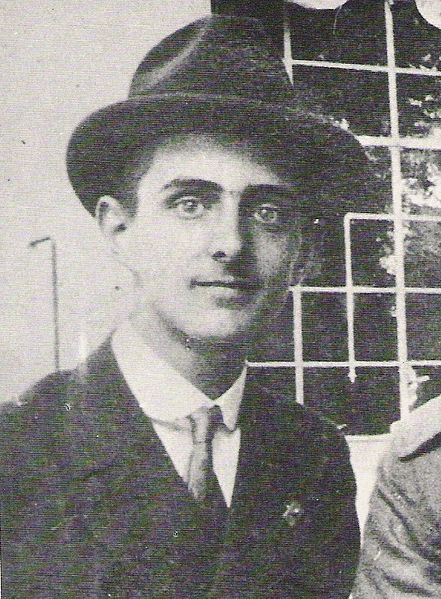
Giovanni Battista Montini, the future Pope Paul VI, in 1919 when he turned 22.

For many people Pope Paul's HumanaeVitae was a hard saying. For the disciples Jesus' teaching on divorce was also a hard saying. But he didn't back off. when Pope Paul wrote hi letter in 1968 who could have imagined that in our time 'marriage' between two person of the same sex would be demanded as a 'right' and that Catholic legislators would vote for such? who could have imagined that the demand for abortion as a 'human right' would be so widespread and given in to, with Christian legislators approving?

Pope Paul insisted on respecting human nature in the context of marriage as so many are asking us today to respect nature in a wider context, eg, in the area of climate. If we refuse to respect nature by cutting down the forests, for example, or polluting rivers, we have to live with the consequences.

We see the consequences of not respecting our sexuality, of not seeing its proper expression within the context of a lifelong marriage, within the context of husband and wife becoming one. Despite the widespread availability of contraceptives, abortion has risen to frightening levels in many Western countries. More and more are living with 'partners' rather than spouses and more and more children grow up with a sometimes 'revolving door' of step-parents.

This is in stark contrast to the vision of Pope Paul in the opening lines of Humanae Vitae:

The transmission of human life is a most serious role in which married people collaborate freely and responsibly with God the Creator. 

And contrary to what one often reads in opinion columns, the Church does not ask married couples to keep having children. this is what Humanae Vitae says:

Married love, therefore, requires of husband and wife the full awareness of their obligations in the matter of responsible parenthood, which today, rightly enough, is much insisted upon, but which at the same time should be rightly understood. Thus, we do well to consider responsible parenthood in the light of its varied legitimate and interrelated aspects.

With regard to the biological processes, responsible parenthood means an awareness of, and respect for, their proper functions. In the procreative faculty the human mind discerns biological laws that apply to the human person. 
With regard to man's innate drives and emotions, responsible parenthood means that man's reason and will must exert control over them.

With regard to physical, economic, psychological and social conditions, responsible parenthood is exercised by those who prudently and generously decide to have more children, and by those who, for serious reasons and with due respect to moral precepts, decide not to have additional children for either a certain or an indefinite period of time.

In other words, true responsible parenthood demands a relationship of deep trust, of open communication and of unquestioning love and commitment between husband and wife, based on the reality of the total commitment of the Risen Lord Jesus to the couple as the source of their love for each other.
+++


Hollywood isn't a place you'd go to to look for examples of outstanding marriages, though there are such to be found. But in earlier days the movies produced there reflected the aspirations of the majority about such things as marriage. It was nearly always 'boy meets girl' and 'until death do us part'. The movie For Me and My Gal, from which the video above is taken, was made in 1942, the year my parents married.

The song For me and my gal goes back much further. It puts a wedding in a community context, just like that in Cana. It puts it in the context of a church celebration. It puts it in the context of many being involved in the preparations: For weeks they've been sewing, every Suzie and Sal. There's the hope of a growing family: And some time we're goin' to build a home for two, or three or more . . .

I'm not suggesting that this be used as an 'opening hymn' or as a 'liturgical dance'! But I am suggesting that the values espoused in the song and dance - and as a classmate pointed out to me, Jesus would have danced in Cana, since at Jewish weddings men do so as a group during the celebration - would be those of the community there.