14 March 2014

'This is my Son, the Beloved . . . listen to him!' Sunday Reflections, 2nd Sunday of Lent Year A

Paolo Veronese, 1555-56 [Web Gallery of Art]

Readings (New American Bible: Philippines, USA)  à                             

Readings (Jerusalem Bible: Australia, England & Wales, India [optional], Ireland, New Zealand, Pakistan, Scotland, South Africa)


Six days later, Jesus took with him Peter and James and his brother John and led them up a high mountain, by themselves. And he was transfigured before them, and his face shone like the sun, and his clothes became dazzling white. Suddenly there appeared to them Moses and Elijah, talking with him. Then Peter said to Jesus, “Lord, it is good for us to be here; if you wish, I will make three dwellings here, one for you, one for Moses, and one for Elijah.” While he was still speaking, suddenly a bright cloud overshadowed them, and from the cloud a voice said, “This is my Son, the Beloved; with him I am well pleased; listen to him!” When the disciples heard this, they fell to the ground and were overcome by fear. But Jesus came and touched them, saying, “Get up and do not be afraid.” And when they looked up, they saw no one except Jesus himself alone.

As they were coming down the mountain, Jesus ordered them, “Tell no one about the vision until after the Son of Man has been raised from the dead.”
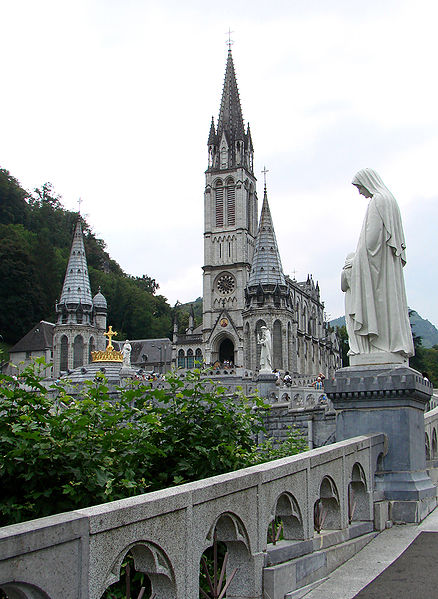

Basilica of the Immaculate Conception, Lourdes [Wikipedia]

Like Peter, James and John, I caught a glimpse of something of the Purity of God on a hill. Tradition tells us that Jesus was transfigured on Mount Tabor, Israel. My 'Mount Tabor' was a hotel at the top of a hill in Lourdes, France.

During Holy Week 2001 I took part in the international pilgrimage of Faith and Light to Lourdes which takes place every ten years. Faith and Light was born of a desire to help people with an intellectual disability and their families find their place within the Church and society. This was the main purpose of the organized pilgrimage to Lourdes at Easter of 1971. The founders of the movement were Jean Vanier and Marie-Hélène Mathieu.


A message from Jean Vanier to an international meeting of Faith and Light, 2013

I was based in Britain at the time and travelled with a group from the north of England. However, I had been invited to be chaplain to the small contingent from the Philippines, as I had been on the fringes of Faith and Light in the Philippines between 1992 and 2000.

The Filipinos were staying in a hotel at a distance from the shrine and at the top of a hill. There was also a group of Faith and Light pilgrims from Hong Kong in the same hotel. (I was with the English pilgrims in a hotel close to the shrine.)


One of those from Hong Kong was a girl of about eleven with Down Syndrome (Trisomy 21). Her face had the delicate beauty of Chinese ceramics. But she had an extraordinary inner beauty, a purity that could have come only from God. Though I had no Cantonese and she had no English, we were able to communicate simply by looking at one another. She showed complete trust in me. She had a vulnerability that called forth the deepest respect.

In Irish there's an expression used for a person with a severe mental or learning disability, duine le Dia, 'a person with God'. This young girl was such for me, in a very full sense of that phrase: she was a clear expression of the beauty and of the purity of God for me.

The Opening Prayer of today's Mass reads:

O God, who have commanded us
to listen to your beloved Son,
be pleased, we pray,
to nourish us inwardly by your word,
that, with spiritual sight made pure,
we may rejoice to behold your glory.
Through . . .

When Peter, James and John went up Mount Tabor with Jesus they had no idea that would see the divinity of Jesus there. They had no idea they would hear God the Father say This is my Son, the Beloved; with him I am well pleased; listen to him! The Entrance Antiphon [below], taken from Psalm 26 [27], prays, It is your face, O Lord, that I seek; hide not your face from me. I have no doubt that I saw the face of the Lord in that young girl with Down Syndrome from Hong Kong whom I met in Lourdes in Holy Week 2001.

Jesus may speak to us at any time, unexpectedly, as he revealed his presence to me in that hotel in Lourdes. May we make the Opening Prayer our own so that, with spiritual sight made pure, we may rejoice to behold your glory.

)


Antiphona ad introitum  Cf. Ps 26[27]:8-9; [1]

Tibi dixit cor meum:
quæsívi vultum tuum, 
vultum tuum, Dómine, requíram:
ne avértas fáciem tuam a me.

[Dóminus illuminátio mea, 
et salus mea: quem timébo?
Gloria Patri, et Filio, et Spiritui Sancto.
Sicut erat in principio, et nunc, et semper, 
et in saecula saeculorum. Amen.

Tibi dixit cor meum:
quæsívi vultum tuum, 
vultum tuum, Dómine, requíram:
ne avértas fáciem tuam a me.]

Entrance Antiphon

Of you my heart has spoken:
Seek his face.
It is your face, O Lord, that I seek;
hide not your face from me.

[The Lord is my light,
and my salvation. Whom should I fear?
Glory to the Father, and to the Son, and to the Holy spirit.
As it was, is now, and will be for ever.Amen.

Of you my heart has spoken:
Seek his face.
It is your face, O Lord, that I seek;
hide not your face from me.]


A younger Jean Vanier speaking about the early days of L'Arche

L'Arche and Faith & Light are sister movements where the VIPs are persons with learning disabilities.


Responsorial Psalm [New American Bible Lectionary]

07 March 2014

‘Worship the Lord your God, and serve only him.’ Sunday Reflections, 1st Sunday of Lent Year A


Landscape with the Temptation of Christ (detail)
Joos de Momper [Web Gallery of Art]

Readings (New American Bible: Philippines, USA)  à                             

Readings (Jerusalem Bible: Australia, England & Wales, India [optional], Ireland, New Zealand, Pakistan, Scotland, South Africa)

Gospel Matthew 4:1-11 (New Revised Standard Version,Catholic Edition, Canada)

Then Jesus was led up by the Spirit into the wilderness to be tempted by the devil. He fasted forty days and forty nights, and afterwards he was famished. The tempter came and said to him, “If you are the Son of God, command these stones to become loaves of bread.” But he answered, “It is written,

‘One does not live by bread alone,
    but by every word that comes from the mouth of God.’”

Then the devil took him to the holy city and placed him on the pinnacle of the temple, saying to him, “If you are the Son of God, throw yourself down; for it is written,

‘He will command his angels concerning you,’
    and ‘On their hands they will bear you up,

so that you will not dash your foot against a stone.’”


Jesus said to him, “Again it is written, ‘Do not put the Lord your God to the test.’”

Again, the devil took him to a very high mountain and showed him all the kingdoms of the world and their splendor; and he said to him, “All these I will give you, if you will fall down and worship me.” Jesus said to him, “Away with you, Satan! for it is written,
‘Worship the Lord your God, and serve only him.’”

Then the devil left him, and suddenly angels came and waited on him.


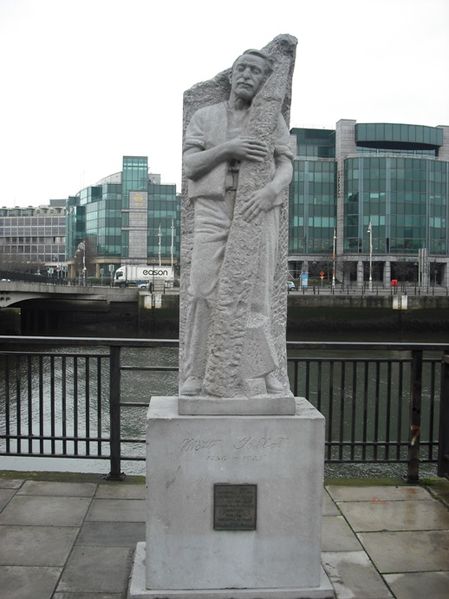
Statue of the Venerable Matt Talbot (1856 - 1925), Dublin [Wikipedia]

I remember vividly a homily given on the First Sunday in Lent in St Columban's College, Dalgan Park, the Columban seminary in Ireland where I studied from 1961 to 1968, by the late Fr Edward McCormack, who taught us Latin. We all recognised Father Ted, as we called him, as a saintly man. It was clear from his preaching that he was experiencing something of the horror of the very idea of the Devil tempting Jesus, God who became man. It was as if the very soul of Father Ted was shuddering.


Matt Talbot was a Dubliner who had become an alcoholic by the age of 13 or 14 and spent the next fourteen years as a drunkard. He went to the extreme once of stealing a fiddle from a beggar and pawne it to get money for drink. It was his only living, Matt tells us in the video, and I think that was the worst thing I ever did in my life. Matt made many efforts later to trace the beggar but never succeeded.

Yet during his fourteen years of drinking Matt hardly ever missed Sunday Mass, though he didn't receive Holy Communion, and always said a Hail Mary before sleeping. I think that's what saved me in the long run, he tells us.


At the beginning of the second video Matt, masterfully played by Irish actor Seamus Forde, goes through a soul-wrenching temptation right at Communion time, something that happens the same Sunday morning at Mass in three different churches, a temptation that drives him out of each, until he falls on his knees outside one of them and prays Jesus, mercy; Mary help, a prayer that most Dubliners would have been familiar with.

Matt Talbot [Wikipedia]

The second video shows Matt sending a donation to the Maynooth Mission to China, as the Columbans were first known in Ireland, some time in the mid-1920s. The note he enclosed is in the Columban archives in Ireland. The amount, one pound from himself and ten shillings (half of a pound) from his sister, was considerable for poor people.

Towards the end of the video Matt speaks of the things God had asked him to do. He put these thoughts in my mind when I was praying - and I knew they came from him. Only the priest in confession knew about these special things, small things God wanted me to do. They weren't for anybody else.

Among the special things, small things were the chains he wore on certain occasions. It was these very chains, found on his body when he died, that led to people asking questions about me . . . God must have wanted it that way . . . using me to say something to people today, now.

Lent is a gift that God gives the Church each year, a personal gift to each member of the Church, a time when he wants to put these thoughts in my mind when I am praying.

Matt Talbot was the farthest thing imaginable from the 'celebrities' of today during his life. In the nearly 90 years since his death he has given hope to many, especially persons struggling with alcoholism and other addictions. 

Will I allow God this Lent to put whatever thoughts he wants to in my mind by giving him time in prayer? Will I allow him, as Mary did when she said Here am I, the servant of the Lord; let it be with me according to your word, to use me to say something to people today, now?

Will I fall on my knees in moments of great temptation, as Matt did during the terrible struggle he had right at Communion time three times on the one Sunday morning, perhaps reflecting the three temptations of the Lord in today's gospel, and plead Jesus, mercy, Mary help?

They thought I was missing the good things in life. But God gave me the best part - and he never took it away.


+++

St Francis Xavier Church, Gardiner St, Dublin [Wikipedia]


Dubliners refer to churches by their street names rather than by their patronal names. The church above, which Matt calls 'Gardiner Street church', is that of the Jesuits. Matt also refers a number of times to the 'chapel' in Seville Place, the Church of St Laurence O'Toole, once Archbishop of Dublin. This is another old Dublin usage, calling a church a 'chapel'. The accent and idioms of Matt in the two videos are pure Dublin. 

When I was a child my mother, when 'going into town', ie into the city centre, would sometimes go through Granby Lane and we'd pray at the spot where Matt died. Everyone in Dublin then knew who Matt Talbot was. I'm not so sure about today.

You can discover more about this wonderful man at the Dublin Diocesan Matt Talbot website.

06 March 2014

Pope Francis' Prayer Intentions for March 2014


Universal Intention - Respect for Women

That all cultures may respect the rights and dignity of women. 


Evangelization Intention - Vocations

 That many young people may accept the Lord;s invitation to consecrate their lives to proclaiming the Gospel.


Videos from the website of the Apostleship of Prayer, Milwaukee, WI, USA.

04 March 2014

St Casimir, Prince, 'A shining example of faith, piety, humility, and chastity'.

St Casimir, Vilnius Cathedral, Lithuania [Wikipedia]

St Casimir (3 October 1458 - 4 March 1484), whose feast day is today, 4 March, is patron saint of Poland, of Lithuania and of the young.

He was noted for his great love for the poor and for his chastity. The biographical note in The CTS New Daily Missal says: His devotion to Our Lady was great; he was so fond of the twelfth-century hymn 'Daily, daily sing to Mary' that it is often attributed to him. The hymn - its Latin title is Omni die, dic Mariae - was written by St Bernard. You can find both the Latin and English lyrics on CatholicCulture.org. A note there says A copy of this hymn by Bernard of Cluny was found beneath the right temple of St Casimir's incorrupt body when his grave was opened.

The biographical note in the CTS New Daily Missal describes St Casimir as A shining example of faith, piety, humility, and chastity. A priest I met in Scotland last year kindly gave me a copy of the Missal and I can recommend it to anyone. It has the prayers and antiphons of all Masses in both English and Latin and the Scripture readings are from the Jerusalem Bible.


And here is a setting of the original Latin, Omni die, dic Mariae, sung, appropriately, by a Lithuanian choir, Schola Cantorum de Regina Pacis, Klaipėda, Lithuania. 

28 February 2014

'I only want a place at the feet of Jesus' - Shahbaz Bhatti. Sunday Reflections, 8th Sunday in Ordinary Time Year A

Clement Shahbaz Bhatti شہباز بھٹی
(9 September 1968 – 2 March 2011)
'I do not want popularity, I do not want positions of power. I only want a place at the feet of Jesus. I want my life, my character, my actions to speak of me and say that I am following Jesus Christ.'

Readings (New American Bible: Philippines, USA)                                  

Readings (Jerusalem Bible: Australia, England & Wales, India [optional], Ireland, New Zealand, Pakistan, Scotland, South Africa)

Gospel Matthew 6:24-34 (New Revised Standard Version,Catholic Edition, Canada) 

Jesus said to his disciples:

“No one can serve two masters; for a slave will either hate the one and love the other, or be devoted to the one and despise the other. You cannot serve God and wealth.

“Therefore I tell you, do not worry about your life, what you will eat or what you will drink,or about your body, what you will wear. Is not life more than food, and the body more than clothing? Look at the birds of the air; they neither sow nor reap nor gather into barns, and yet your heavenly Father feeds them. Are you not of more value than they? And can any of you by worrying add a single hour to your span of life? And why do you worry about clothing? Consider the lilies of the field, how they grow; they neither toil nor spin, yet I tell you, even Solomon in all his glory was not clothed like one of these. But if God so clothes the grass of the field, which is alive today and tomorrow is thrown into the oven, will he not much more clothe you—you of little faith? Therefore do not worry, saying, ‘What will we eat?’ or ‘What will we drink?’ or ‘What will we wear?’ For it is the Gentiles who strive for all these things; and indeed your heavenly Father knows that you need all these things. But strive first for the kingdom of God and his righteousness, and all these things will be given to you as well.


“So do not worry about tomorrow, for tomorrow will bring worries of its own. Today’s trouble is enough for today.


This Sunday, 2 March, is the third anniversary of the death of Shahbaz Bhatti, seen with Pope Benedict in the video above during an audience in September 2010. He was assassinated in Islamabad, Pakistan, shortly after leaving his mother's home. Mr Bhatti, a Catholic, was the first Christian to be appointed to the Cabinet in Pakistan and was responsible for minorities. The Pakistan Taliban claimed responsibility for his death.

Sandro Magister, one of the leading journalists covering the Vatican, wrote about the death of Shahbaz Bhatti on 14 April 2011 in A Lesson of Holiness from Remote Pakistan. Magister writes: 

The Bible that Shahbaz always had with him is now in Rome in the memorial for the martyrs of the past century, in the basilica of Saint Bartholomew on the Isola Tiberina.

One of the most informative and concerned articles on what his murder has meant in Pakistan and in the whole world is without a doubt the one published in La Civiltà Cattolica dated April 2, 2011.


An article that is all the more significant given that this magazine of the Rome Jesuits is printed after inspection and authorization by the Vatican secretariat of state. So it reflects the thinking of the Holy See in this regard.

In Pakistan, out of a population of 185 million inhabitants, Christians are 2 percent, one million of them Catholic. But among the Muslims as well there are minorities in danger: Shiites, Sufis, Ismaili, Ahmadis.
The article in La Civiltà Cattolica was written by Fr Luciano Larivera SJ and includes most of The spiritual testament of Shahbaz Bhatti. I have highlighted parts of this.
'My name is Shahbaz Bhatti. I was born into a Catholic family. My father, a retired teacher, and my mother, a housewife, raised me according to Christian values and the teachings of the Bible, which influenced my childhood. Since I was a child, I was accustomed to going to church and finding profound inspiration in the teachings, the sacrifice, and the crucifixion of Jesus. It was his love that led me to offer my service to the Church.
'The frightening conditions into which the Christians of Pakistan had fallen disturbed me. I remember one Good Friday when I was just thirteen years old: I heard a homily on the sacrifice of Jesus for our redemption and for the salvation of the world. And I thought of responding to his love by giving love to my brothers and sisters, placing myself at the service of Christians, especially of the poor, the needy, and the persecuted who live in this Islamic country.
'I have been asked to put an end to my battle, but I have always refused, even at the risk of my own life. My response has always been the same. I do not want popularity, I do not want positions of power. I only want a place at the feet of Jesus. I want my life, my character, my actions to speak of me and say that I am following Jesus Christ.
'This desire is so strong in me that I consider myself privileged whenever - in my combative effort to help the needy, the poor, the persecuted Christians of Pakistan - Jesus should wish to accept the sacrifice of my life. I want to live for Christ and it is for Him that I want to die. I do not feel any fear in this country. Many times the extremists have wanted to kill me, imprison me; they have threatened me, persecuted me, and terrorized my family.
'I say that, as long as I am alive, until the last breath, I will continue to serve Jesus and this poor, suffering humanity, the Christians, the needy, the poor. I believe that the Christians of the world who have reached out to the Muslims hit by the tragedy of the earthquake of 2005 have built bridges of solidarity, of love, of comprehension, and of tolerance between the two religions. If these efforts continue, I am convinced that we will succeed in winning the hearts and minds of the extremists. This will produce a change for the better: the people will not hate, will not kill in the name of religion, but will love each other, will bring harmony, will cultivate peace and comprehension in this region.
'I believe that the needy, the poor, the orphans, whatever their religion, must be considered above all as human beings. I think that these persons are part of my body in Christ, that they are the persecuted and needy part of the body of Christ. If we bring this mission to its conclusion, then we will have won a place at the feet of Jesus, and I will be able to look at him without feeling shame.'

Johannes Vermeer, 1654-55 (?) [Web Gallery of Art]
Can anyone fail to be moved by the testament of Shahbaz Bhatti who saw his vocation as a Christian to serve his people as a politician but whose only desire was to have a place at the feet of Jesus? Part of his serving his people was to choose not to marry. This is a member of a small, often despised minority, living out his Christian vocation as a politician and who can say I want to live for Christ and it is for Him that I want to die.


The British band Ooberfuse whose lead singer, Cherrie Anderson, is the daughter of a Filipina mother, wrote the song above for the first death anniversary of the death of Shahbaz Bhatti and sang it at a prayer rally organised by Christian Pakistanis in Britain and held in Trafalgar Square, London. They incorporated part of the last televised interview in English that Shahbaz Bhatti gave in which he said I know what is the meaning of [the] Cross.


The song above was written by Eric Sindhu who knew Shahbaz Bhatti. Fr Finbar Maxwell, a Columban who served in Pakistan for many years and is now here in the Philippines told me that the song is in Urdu and is in the traditional 'dirge' form of singing.  The lyrics refer to  Christian faith of Shahbaz, to his blood spilled, and to the 'book' of his life. Father Finbar echoed my own comment when he wrote: The tone, sentiment and beauty of the song indeed transcend the need for translation. 


Fr Tomás King and Gerard Bhatti

Fr Tomás King, an Irish Columban priest in Pakistan, met Gerard Bhatti, a brother of Shahbaz and wrote Shahbaz Bhatti: 'I know what is the meaning of Cross'.

After the death of Shahbaz the Pakistani government offered his position in the Cabinet to the family who decided that Paul, another brother, should take it. He is a medical doctor who worked for some years in Italy. He too has been receiving death threats.

No one can serve two masters, Jesus tells us in this Sunday's gospel. Shahbaz Bhatti described his Master in detail: I believe that the needy, the poor, the orphans, whatever their religion, must be considered above all as human beings. I think that these persons are part of my body in Christ, that they are the persecuted and needy part of the body of Christ. 

In his Mass in the chapel of Domus Sanctae Marthae on Monday 16 September Pope Francis asked us to Pray for politicians that they govern us well. One politician I don't pray for but pray to, every day, is this Pakistani martyr for the justice that our Catholic Christian faith demands is Clement Shahbaz Bhatti. I truly believe that he has won a place at the feet of Jesus.

27 February 2014

George Herbert, poet and Anglican priest, commemorated by the Anglican Communion on 27 February

(3 April 1593 - 1 March 1633)

Some of the poems of George Herbert, born in Wales of English parents, are in the edition of the Breviary published by the bishops of Australia, England & Wales, Ireland and Scotland, the one I normally use. He took holy orders in the Anglican Church when already in his mid-30s and served as rector of St Andrew's Church, Bemerton, near Salisbury in the south-west of England. He is buried there. During his three years there he showed a special love for the poor. Wikipedia says, He was noted for unfailing care for his parishioners, bringing the sacraments to them when they were ill, and providing food and clothing for those in need.

St Andrew's Church, Bemerton [Wikipedia]

One of Herbert's poems in my breviary is Love, one I often read. Here it is read by Ralph Fiennes.


Love bade me welcome, yet my soul drew back, 

                              Guilty of dust and sin. 
But quick-eyed Love, observing me grow slack 

                              From my first entrance in, 
Drew nearer to me, sweetly questioning 
                              
If I lacked anything.
 
'A guest', I answered, 'worthy to be here'; 

                              Love said, 'You shall be he.' 
'I, the unkind, the ungrateful? ah my dear, 

                              I cannot look on thee.' 
Love took my hand and smiling did reply, 

                              'Who made the eyes but I'?

'Truth, Lord, but I have marred them; let my shame 

                              Go where it doth deserve.' 
'And know you not', says Love, 'who bore the blame?'

                              'My dear, then I will serve.' 
'You must sit down', says Love, 'and taste my meat.' 

                              So I did sit and eat. 

John Constable, c.1825 [Web Gallery of Art]

Twice a day George Herbert conducted services in his parish church and twice a week he went to nearby St Mary's Cathedral, Salisbury, to take part in services there. Constable's painting captures the beauty of the church with its magnificent spire.


Herbert's poem King of Glory, King of Peace is well known as a hymn to the tune Gwalchmai.

Another poem of Herbert in the Breviary is Let all the world in every corner sing, here in a setting by English composer Ralph Vaughan Williams: 


I have an idea that George Herbert, though an Anglican, would find himself a kindred spirit with Benedict XVI because of his sense of beauty and of liturgy and with Pope Francis because he was one of those shepherds living with the smell of the sheep.

21 February 2014

'Love your enemies . . .' Sunday Reflections, 7th Sunday in Ordinary Time Year A

German Miniaturist, 1236-46 [Web Gallery of Art]

Readings (New American Bible: Philippines, USA)                                  

Readings (Jerusalem Bible: Australia, England & Wales, India [optional], Ireland, New Zealand, Pakistan, Scotland, South Africa)

Gospel Matthew 5:38-48 (New Revised Standard Version,Catholic Edition, Canada)

Jesus said to his disciples:

“You have heard that it was said, ‘An eye for an eye and a tooth for a tooth.’ But I say to you, Do not resist an evildoer. But if anyone strikes you on the right cheek, turn the other also; and if anyone wants to sue you and take your coat, give your cloak as well; and if anyone forces you to go one mile, go also the second mile. Give to everyone who begs from you, and do not refuse anyone who wants to borrow from you.

“You have heard that it was said, ‘You shall love your neighbor and hate your enemy.’ But I say to you, Love your enemies and pray for those who persecute you, so that you may be children of your Father in heaven; for he makes his sun rise on the evil and on the good, and sends rain on the righteous and on the unrighteous. For if you love those who love you, what reward do you have? Do not even the tax collectors do the same? And if you greet only your brothers and sisters, what more are you doing than others? Do not even the Gentiles do the same? Be perfect, therefore, as your heavenly Father is perfect."


Columban Fr Rufus Halley (1944 - 28 August 2001) 


Father Rufus Halley was one year behind me in the Columban seminary in Ireland. We were close friends. He came to the Philippines in 1969, two years before I did. He spent his early years in the country in Tagalog-speaking parishes in an area of the Archdiocese of Manila south of the metropolitan area, now the Diocese of Antipolo. He was fluent in the language. He began to feel a clear call from God to leave the security of working in an area overwhelmingly Christian and mostly Catholic to a part of Mindanao where Columbans had worked for many years that is overwhelmingly Muslim, the Prelature of Marawi. There he became fluent in two more Filipino languages, Maranao, spoken by the majority of Muslims in the area, and Cebuano, spoken by most of the Christians.

Both Muslims and Christians saw Father Rufus as a man of prayer, a man of peace, a man of God. Over the years he earned the trust of some Muslim leaders despite the long history of distrust between Muslims and Christians that sometimes led to outright conflict. Because of the trust he had built up he got an extraordinary request: to mediate in a feud between two groups of Maranaos. He was a foreigner, a Christian and a Catholic priest.

Father Rufus saw this as another call from God and agreed. He also sought the advice of a Muslim elder who wasn't involved in the conflict. Over a period of many weeks he was going back and forth between the leaders of the two factions until eventually they agreed to meed. The morning of the meeting was filled with tension but when the leaders arrived they agreed to end the feud.

A week or so later Father Rufus dropped into the house of one of the leaders of the conflict and, to his delight, saw a leader of the other faction having coffee with him, the two men engaged in a lively, friendly conversation into which they invited the Irish priest.

Father Rufus used to speak about this event as the highlight of the twenty years he spent living among Muslims, a period when tension was seldom absent from his life and where there was often danger. Though a person who had a naturally optimistic disposition - five minutes in his company would get rid of any 'blues' you might feel - that didn't keep him going. His Christian hope and faith did.


Father Rufus with young friends

On the afternoon of 29 August 2001 while returning on his motorcycle from an inter-faith meeting in Balabagan, Lanao del Sur, to Malabang, maybe five or six kilometres away and where he was assigned, Father Rufus was ambushed by a group of men who happened to be Muslims and shot dead.

Both Christians and Muslims were devastated by his death.

Father Rufus came from a privileged background and could have entered any profession. But he chose to answer God's call to be a missionary priest. Our Columban superiors sent him to the Philippines.

He later chose, in answer to God's call and with the blessing of our superiors, to go to a very difficult mission. That choice led to twenty years of joyful service there to Catholics and Muslims, and to his death.

Father Rufus wasn't the enemy of anyone. Because of that and because they saw him as a man of God, two groups of Muslims who were  enemies accepted him as a mediator. He wasn't a man to greet only your brothers and sisters but one who crossed barriers and who brought people together out of a desire to do God's will.


St Thérèse of Lisieux aged 15 [Wikipedia]

The closing words of Jesus in today's gospel are Be perfect, therefore, as your heavenly Father is perfect. For years my understanding of becoming perfect in this sense was of a blueprint like that of an architect. If you found this blueprint and built according to its specifications then you'd have a perfect product.

But a building is inanimate. 

However, I found a very different image of perfection in Story of a Soul, the autobiography of St Thérèse of Lisieux: Perfection consists in doing His will, in being what he wills us to be. This is an image of a living being, of a unique being. God's will gradually unfolded in the life of Father Rufus, as a flower unfolds, the growth being silent and hardly noticeable most of the time.

I see in the stages of the life of Father Rufus, whose baptismal name was Michael, a testimony of the truth of the words of St Thérèse and a model of how we can follow the words of Jesus. Through his daily prayer, his daily faithfulness, his responding to God's will at crucial moments in his life, he became what God willed him to be: a Catholic priest who as he laid in death on the side of a road in a remote area of the southern Philippines, became an even stronger bridge between Christians and Muslims, a man who in life and death showed the true face of Jesus Christ, God who became Man out of love for all of us. 

Be perfect, therefore, as your heavenly Father is perfect.