09 April 2014

'My God, my God, why have you forsaken me?' Sunday Reflections, Palm Sunday Year A


Christ's Entry into Jerusalem
Melozzo da Forli, 1477-82, Fresco, Basilica of Santa Casa, Loreto [Web Gallery of Art]

The Commemoration of the Lord's Entrance into Jerusalem


Gospel Matthew 21:1-11 (New Revised Standard Version, Catholic Edition, Canada)

When they had come near Jerusalem and had reached Bethphage, at the Mount of Olives, Jesus sent two disciples, saying to them, “Go into the village ahead of you, and immediately you will find a donkey tied, and a colt with her; untie them and bring them to me. If anyone says anything to you, just say this, ‘The Lord needs them.’ And he will send them immediately. This took place to fulfill what had been spoken through the prophet, saying,

“Tell the daughter of Zion,
Look, your king is coming to you,
humble, and mounted on a donkey, and on a colt, the foal of a donkey.”

The disciples went and did as Jesus had directed them; they brought the donkey and the colt, and put their cloaks on them, and he sat on them. A very large crowd spread their cloaks on the road, and others cut branches from the trees and spread them on the road. The crowds that went ahead of him and that followed were shouting,

“Hosanna to the Son of David!
    Blessed is the one who comes in the name of the Lord!
Hosanna in the highest heaven!”

When he entered Jerusalem, the whole city was in turmoil, asking, “Who is this?” The crowds were saying, “This is the prophet Jesus from Nazareth in Galilee.”


The following Hymn to Christ the King may be sung during the procession.


Chorus:

Gloria, laus et honor tibi sit,
     rex Christe redemptor,
cui puerile decus prompsit
     Hosanna pium.

Glory and honour and praise be to you,
     Christ, Kind and Redeemer,
to whom young children cried out
     loving Hosannas with joy.


El Greco, c.1608, Szépmûvészeti Múzeum, Budapest [Web Gallery of Art]


Readings during Mass

Readings (New American Bible: Philippines, USA)                                  

Readings (Jerusalem Bible: Australia, England & Wales, India [optional], Ireland, New Zealand, Pakistan, Scotland, South Africa)

Gospel Matthew 26:14 – 27:66 (New Revised Standard Version, Catholic Edition, Canada) 

The response for today's Responsorial Psalm is My God, my God, why have you forsaken me? ('abandoned me' in the NAB Lectionary), the last words of Jesus according to St Matthew, whose version of the Passion is read today. The readings carry that theme, explicitly or implicitly. The Prophet Isaiah says, I gave my back to those who beat me, my cheeks to those who plucked my beard; my face I did not shield from buffets and spitting. The church applies these words to the sufferings of Jesus. Yet there isn't total abandonment: The Lord GOD is my help, therefore I am not disgraced; I have set my face like flint, knowing that I shall not be put to shame.

Psalm 21 (22) is fulfilled in the Passion and Death of Jesus. St Paul in the reading from his Letter to the Philippians speaks of the self-emptying of Jesus: Rather, he emptied himself, taking the form of a slave, coming in human likeness; and found human in appearance, he humbled himself, becoming obedient to the point of death, even death on a cross.

An tAthair Pádraig Ó Crolaigh (Fr Patrick Crilly) of the Diocese of Derry, Ireland, reflects on this in his poem An Crióst Tréigthe (The Abandoned Christ). I have added my own English translation.


An raibh sé ina aonar ar feadh a shaoil,
Was he alone throughout his life,
An Críost seo scartha ón Trionóid naofa?
This Christ separated from the holy Trinity?
Ar chrothnaigh sé an dá phearsa eile,
Did he notice the absence of the two other persons,
Nó an raibh sé in aineolas orthu?
Or was he unaware of them?

Agus i ndiaidh fhás na spioradáltachta ann,
And after the growth of spirituality in him,
I ndiaidh greim a fháil ar a cheangal le Dia,
After he grasped his connection with God,
Ar fágadh in aonar arís é ar an chrois
Was he left alone again on the cross
Gan a fhios aige cén fáth ar tréigeadh é?
Not knowing why he had been abandoned?

Nuair a fhuair sé bás ar an chrois,
When he died on the cross
Ar ócáid cheiliúrtha é filleadh abhaile?
Was going home an occasion of celebration?
Nó ar bhraith sé tréigean a dhaonnachta
Or did he feel the abandonment of his humanity
I gcumha a shaoil abhus mar dhuine?
In the loneliness of his life here as a human being?

Ag leanúint Chríost dúinn i mbeocht an tsaoil
In following Christ in the living of life
An mbuailfimid lena thréigean siúd?
Will we encounter his abandonment?
An féidir linn a bheith Críostaí
Can we be Christian
Gan casadh sa saol leis an Chríost tréigthe?
Without coming across the abandoned Christ in life?

Poem taken from Brúitíní Creidimh, published by Foilseacháin Ábhar Spioradálta, Dublin, 2005. The title could be translated as 'Mashed Potatoes of Faith'. Potatoes are the main staple in Ireland.

Father Ó Crolaigh, I think, is teasing out some of the meaning of St Paul's words today: Christ Jesus, though he was in the form of God, did not regard equality with God something to be grasped. Rather, he emptied himself, taking the form of a slave, coming in human likeness; and found human in appearance, he humbled himself, becoming obedient to the point of death, even death on a cross.

Jesus wasn't acting or engaging in any kind of 'drama-drama', as we say in the Philippines. He truly suffered a sense of being forsaken, of being abandoned, to the very depths of his being. He did not regard equality with God something to be grasped. We see that in the Garden of Gethsemane when the three Apostles closest to him fell asleep during his hour of greatest need. His cry from the Cross, Eli, Eli, lema sabachthani? My God, my God, why have you forsaken me? comes from the innermost recesses of his heart, from a sense of even his Father having abandoned him.

One of the forms of feeling abandoned that I have come across in recent years in persons I have met and in my reading is a sense of disillusionment with the Church. In some predominantly English-speaking countries Church leadership has lost much of its moral authority because of the way it has been seen to have dealt - or not to have dealt - with the awful reality of some priests having abused children and adolescents.

Many older persons in Western countries are bewildered by the reality of the younger generations having abandoned the Church to a large degree, not a few having abandoned Christianity itself. Maybe some have abandoned the faith because they see the Church, and by extension Christ himself, as having abandoned them. That should be a fearful thought for those who see themselves as followers of Jesus with the responsibility of making him known to the world.

In more and more families spouses are abandoned by their husband or wife, children by their parents. Though it's not as great a phenomenon now as it was in the 1970s and 1980s, friends have expressed to me their sense of having been abandoned by their priests who left. I know from friends who have left the priesthood that their decision to do so was often very painful and not taken lightly but I have rarely heard one who has made that decision express any awareness of the pain it has left in others.


Pope Francis has spoken a number of times about the 'throwaway culture' that has resulted in the killing of humans considered 'unnecessary' and in the slavery of others, as he did last January in speaking to diplomats assigned to the Vatican (above).

Jesus in his experience of being abandoned, forsaken, has carried the pain of all who go through that to whatever degree and from whatever cause.

+++


THE DONKEY
by G.K. Chesterton (1874-1936)

When fishes flew and forests walked 
And figs grew upon thorn, 
Some moment when the moon was blood 
Then surely I was born; 

With monstrous head and sickening cry 
And ears like errant wings, 
The devil's walking parody 
On all four-footed things. 

The tattered outlaw of the earth, 
Of ancient crooked will; 
Starve, scourge, deride me: I am dumb, 
I keep my secret still. 

Fools! For I also had my hour; 
One far fierce hour and sweet: 
There was a shout about my ears, 
And palms before my feet.


08 April 2014

Pope Francis meets with persons who are deaf and persons who are blind


On Saturday 29 March Pope Francis had a special audience with persons who are deaf and with persons who are blind. Some at the audience were both deaf and blind, including Fr Cyril Axelrod CSsR, the only deaf and blind priest in the world, a South African born of Jewish parents.

Here is the text of the News.va report, with my emphasis added.

Vatican City, 29 March 2014 (VIS) – “Witnesses to the Gospel for a culture of encounter” is the theme of the Day of Sharing organised by the Apostolic Movement of the Blind, with the participation of the Gualandi Mission for the Deaf (the Little Mission for the Deaf), as well as the Italian Union of the Blind and Partially-Sighted. These organisations were received in audience this morning by Pope Francis, who commented on the theme of the Day.

“The first thing I observe is that this expression ends with the word 'encounter', but first this presupposes another encounter, the one with Christ. Indeed, to be witnesses of the Gospel, it is necessary to have encountered Him, Jesus. … Like the Samaritan woman. … A witness to the Gospel is someone who has encountered Jesus Christ, who knows him, or rather, who feels known by him: recognised, respected, loved, forgiven, and this encounter … fills him with a new joy, a new meaning for life. And this shines through, is communicated, is transmitted to others”.

“I have mentioned the Samaritan woman because she offers a clear example of the type of person Jesus liked to meet, to make them his witnesses: marginalised, excluded, disdained people. The Samaritan woman was this type, inasmuch as she was a woman, and a Samaritan – the Samaritans were despised by the Jews. But let us think also of the many that Jesus wished to encounter, especially people affected by illness and disability, to cure them and to restore their full dignity to them. It is very important that precisely these people become witnesses to a new attitude, that we can call a culture of encounter. A typical example is the man blind from birth … marginalised in the name of a false idea that he had received a divine punishment. Jesus radically refuses this way of thinking – truly blasphemous! - and performs an act of God, giving him the gift of sight. But the important thing is that this man, as soon as this happens to him, becomes a witness to Jesus and His work, that is the work of God, of life, love and mercy. While the Pharisees, from their safe distance, judges both him and Jesus as 'sinners'; the cured blind man, with disarming simplicity, defends Jesus and in the at the end professes his faith in Him, and also shares his fate: Jesus is excluded, and he is excluded too. But in reality the man enters into a new community, based on faith in Jesus and on brotherly love”.

“Here we have the two opposing cultures. The culture of encounter and the culture of exclusion, of prejudice. The sick or disabled person, precisely because of his or her frailty and limits, may become a witness to this encounter: the encounter with Jesus, that opens us to life and faith, and to the encounter with others, with the community. Indeed, only those who recognise their own fragility and their own limits can build bonds of fraternity and unity, in the Church and in society”, concluded the Holy Father.

Fr Cyril Axelrod CSsR

When I was young the term 'deaf and dumb' was widely used. 'Deaf-mute' is a term still used by some, including this Vatican report which referred to the 'Little Mission for the Deaf Mute'. Indeed, that is the historical name of this congregation whose ministry is exclusively with the Deaf. But the words 'dumb' and mute' come from a misconception of hearing people that those who are deaf are not able to speak. Profoundly deaf people have the capability of speech but very often that is never brought to life because they cannot hear. But youngsters who are profoundly deaf can be taught how to speak.

The word 'dumb' has come to mean 'stupid' because profoundly deaf people were often seen to be such because they shared no common language even with their own family. Deafness isolates, much more so than any other physical disability.

Some persons without any severe disabilities speak of others as being 'differently-abled'. I've never liked that term because it's not true. Deaf people and blind people have the same wide range of abilities as everyone else. Stevie Wonder, Ray Charles and Andrea Bocelli are three singers who come to mind who have the disability of blindness. but that hasn't prevented them from having successful careers in music. 


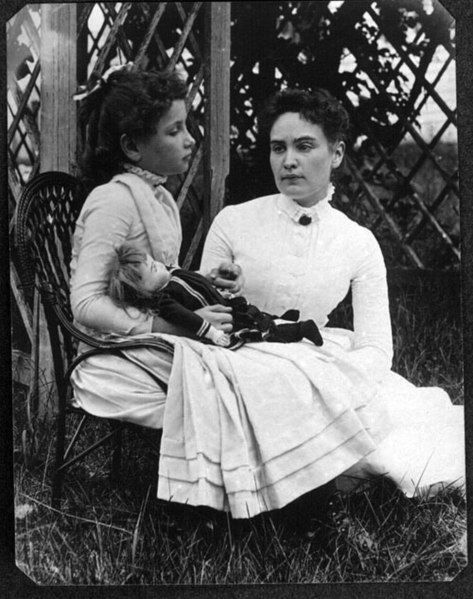
Helen Keller, precisely because she was deaf and blind, had an enormous influence on others once she discovered her gifts through the patience of Anne Sullivan, her tutor.

Portrait by Josef Karl Stieler [Wikipedia]

And Beethoven had become totally deaf by the time he composed his revolutionary Ninth Symphony, the first symphony ever to include singers, with Schiller's Ode to Joy in the last movement. But he didn't hear that music with his ears, only with his mind and memory. Beethoven wasn't 'differently-abled'. He was a musical genius who acquired the disability of deafness as he grew older. This began when he was about 30. For the last ten of his 57 years he was almost totally deaf but continued to compose.

When I was a young priest I studied for a degree in musical education and spent some months as a practice-teacher in two public schools in New York State. The students I had in First Year High School were almost impossible to keep in check. But when I was able to get across to them, despite the noise level, that Beethoven had no hearing when he wrote The Ninth they quietened down and listened, quite awe-struck, to the music. The concluding words of Pope Francis, in a sense, had come true in that instance: Indeed, only those who recognise their own fragility and their own limits can build bonds of fraternity and unity, [in the Church] and in society.

There were no flashmobs in Beethoven's day but I'm sure he wouldn't be unhappy with the Ode to Joy section of his 'Ninth' being played in a public square in Catalonia, Spain, bringing joy to young and old, his music, written nearly 200 years ago when he was already deaf, bringing musicians, singers and listeners out of themselves as it did those noisy 14-year-olds I was trying to teach 42 years ago.


05 April 2014

'I am the resurrection and the life.' Sunday Reflections. 5th Sunday of Lent Year A


Readings (New American Bible: Philippines, USA)                                  

Readings (Jerusalem Bible: Australia, England & Wales, India [optional], Ireland, New Zealand, Pakistan, Scotland, South Africa)

Gospel John 11:1-45 [or John 11:3-7, 20-27, 33B-45] (New Revised Standard Version, Catholic Edition, Canada) [Shorter form of the Gospel: omit what is in square brackets]

[Now a certain man was ill, Lazarus of Bethany, the village of Mary and her sister Martha. Mary was the one who anointed the Lord with perfume and wiped his feet with her hair; her brother Lazarus was ill.] 

So the sisters sent a message to Jesus, “Lord, he whom you love is ill.” But when Jesus heard it, he said, “This illness does not lead to death; rather it is for God’s glory, so that the Son of God may be glorified through it.” Accordingly, though Jesus loved Martha and her sister and Lazarus, after having heard that Lazarus was ill, he stayed two days longer in the place where he was.

Then after this he said to the disciples, “Let us go to Judea again.” 

[The disciples said to him, “Rabbi, the Jews were just now trying to stone you, and are you going there again?” Jesus answered, “Are there not twelve hours of daylight? Those who walk during the day do not stumble, because they see the light of this world.  But those who walk at night stumble, because the light is not in them.”  After saying this, he told them, “Our friend Lazarus has fallen asleep, but I am going there to awaken him.”  The disciples said to him, “Lord, if he has fallen asleep, he will be all right.”  Jesus, however, had been speaking about his death, but they thought that he was referring merely to sleep.  Then Jesus told them plainly, “Lazarus is dead.  For your sake I am glad I was not there, so that you may believe. But let us go to him.”  Thomas, who was called the Twin, said to his fellow disciples, “Let us also go, that we may die with him. When Jesus arrived, he found that Lazaruz had already been in the tomb four days. Now Bethany was near Jerusalem, some two miles away,  and many of the Jews had come to Martha and Mary to console them about their brother.]

When Martha heard that Jesus was coming, she went and met him, while Mary stayed at home. Martha said to Jesus, “Lord, if you had been here, my brother would not have died.  But even now I know that God will give you whatever you ask of him.”  Jesus said to her, “Your brother will rise again.”  Martha said to him, “I know that he will rise again in the resurrection on the last day.”  Jesus said to her, “I am the resurrection and the life. Those who believe in me, even though they die, will live,  and everyone who lives and believes in me will never die. Do you believe this?”  She said to him, “Yes, Lord, I believe that you are the Messiah, the Son of God, the one coming into the world.”

[ When she had said this, she went back and called her sister Mary, and told her privately, “The Teacher is here and is calling for you.”  And when she heard it, she got up quickly and went to him.  Now Jesus had not yet come to the village, but was still at the place where Martha had met him. The Jews who were with her in the house, consoling her, saw Mary get up quickly and go out. They followed her because they thought that she was going to the tomb to weep there. When Mary came where Jesus was and saw him, she knelt at his feet and said to him, “Lord, if you had been here, my brother would not have died.”  When Jesus saw her weeping, and the Jews who came with her also weeping,]

He (Jesus) was greatly disturbed in spirit and deeply moved. He said, “Where have you laid him?” They said to him, “Lord, come and see.”  Jesus began to weep. So the Jews said, “See how he loved him!”  But some of them said, “Could not he who opened the eyes of the blind man have kept this man from dying?”

Then Jesus, again greatly disturbed, came to the tomb. It was a cave, and a stone was lying against it.  Jesus said, “Take away the stone.” Martha, the sister of the dead man, said to him, “Lord, already there is a stench because he has been dead four days.”  Jesus said to her, “Did I not tell you that if you believed, you would see the glory of God?”  So they took away the stone. And Jesus looked upward and said, “Father, I thank you for having heard me.  I knew that you always hear me, but I have said this for the sake of the crowd standing here, so that they may believe that you sent me.” When he had said this, he cried with a loud voice, “Lazarus, come out!”  The dead man came out, his hands and feet bound with strips of cloth, and his face wrapped in a cloth. Jesus said to them, “Unbind him, and let him go.”

Many of the Jews therefore, who had come with Mary and had seen what Jesus did, believed in him.


From The Gospel of John

I think it was back in the 1980s when I was at home in Ireland on a visit that I heard a young diocesan priest being interviewed on national radio about his work as a prison chaplain. He spoke about an occasion when he spent an hour in a cell with one prisoner who was there for stealing on a large scale. The priest got no response whatever - until he was about to leave. He then looked at the young man, put his arms around him and said, 'I love you', adding the man's name.

The prisoner broke down and began to open up to the priest. Over a period of time they became friends. After he was released the young man set up a successful security agency, no doubt drawing on his 'professional skills'.

In Worldwide Marriage Encounter we say 'Love is a decision'. At times it may be accompanied by warm feelings, at other times the very opposite. It is easy for a young man and a young woman who find each other attractive to feel 'love'. This may lead to 'until death do us part', a very solemn decision to love one another.


Last Wednesday in his general audience Pope Francis reminded married couples of this, gently, humorously and clearly. The secret is that love is stronger than an argument. And therefore I always advise married couples, 'Don't end your day without making peace.

Here the Pope was saying 'Love is a decision'. He added humorously: It's not necessary to call the United Nations and have them come to your house to broker the peace. A little gesture will do, a caress, a 'Goodnight, see you tomorrow'. And tomorrow you start over. This is life, carry on! Go forward with the courage to want to live together. This is great, it's beautiful. What Pope Francis is saying here is that love is a decision, a major decision made on one's wedding day that demands many daily 'minor' decisions. The same applies to anyone called to a commitment.

The young priest visiting the prisoner in Ireland wasn't experiencing any feelings of love for the prisoner and the latter probably felt deep anger towards him, maybe even hatred. But the priest made a decision to love that man, no matter how difficult it was, no matter what he was feeling at the time.

Van Gogh, May 1890, Saint-Rémy [Web Gallery of Art]

In the gospel we find Jesus making a number of decisions, all expressions of love:
  • He decided not to go immediately to visit the gravely ill Lazarus when he got news of this: Though Jesus loved Martha and her sister and Lazarus, after having heard that Lazarus was ill, he stayed two days longer in the place where he was.
  • He then decided to go back to Judea despite the fears of his disciples that harm would come to him.
  • He accepted the reproaches of both Martha and Mary: Lord, if you had been here, my brother would not have died. He made no attempt to 'explain' why he hadn't come.
  • He told the people: Take away the stone.
The purpose of Jesus in all these decisions was to lead the disciples and Martha and Mary into a deeper faith:
  • To the disciples and later to Martha: Lazarus is dead.  For your sake I am glad I was not there, so that you may believe.
  • To the Father: Father, I thank you for having heard me.  I knew that you always hear me, but I have said this for the sake of the crowd standing here, so that they may believe that you sent me. 
It is clear from the gospels that Jesus had a special, though not exclusive, affection for Martha, Mary and Lazarus. Maybe he felt free to drop into their home at any time and not be 'on duty'. (As an aside, in more than 40 years in the Philippines I have rarely seen a bishop invited to any kind of occasion except to 'do something', to be 'on duty'.) The friendship Jesus had with the three gave them the freedom to be open with him and to be true to themselves.  Luke 10:38-42 shows us Martha scolding Mary in front of Jesus in a way that happens with someone considered part of the family. The Lord, if you had been here . . . of both Martha and Mary can be read as a reproach mingled with hope to someone deeply trusted. 

Jesus invites each of us into that kind of warm, trusting relationship that is expressed in the story about St Teresa of Avila: Once, when she was travelling to one of her convents, St Teresa of Ávila was knocked off her donkey and fell into the mud, injuring her leg. 'Lord', she said, 'you couldn’t have picked a worse time for this to happen. Why would you let this happen?' And the response in prayer that she heard was, 'That is how I treat my friends'. Teresa answered, 'And that is why you have so few of them!'

But above all in the raising of Lazarus, which points towards the death and Resurrection of Jesus himself, we see the resurrection and the life who was greatly disturbed in spirit and deeply moved confronting death and conquering it. The death he was conquering wasn't only physical death but the sickness and death brought about by sin. Jesus calls us to faith and hope in him and to make decisions to love based on that faith and hope.

It was such faith that gave that young priest in the prison cell the courage to express his love, rooted in the love of Jesus for both, for the prisoner in deed and then in word. And it was that expression of love, in deed and in word, rooted in the love of the resurrection and the life for both, that enabled the man to walk out of the prison cell he had created for himself in his own heart.

The decision of the priest to stay with the prisoner despite the lack of response and the eventual decision of the prisoner to believe in God's love for him were both examples of love being a decision, decisions based on trust in God's love for them, the kind of trust that Martha and Mary had in Jesus.


Antiphona ad Introitum Cf Ps 42 (43) 1-2

Iudica me, Deus
et discerne causam meam de gente non sancta,
ab homine iniquo et doloso eripe me,
qui tu es Deus meus et fortitudo mea.

Entrance Antiphon  Cf Ps 42 (43) 1-2

Give me justice, O God,
and plead my cause against a nation that is faithless.
From the deceitful and cunning rescue me,
for you, O God, are my strength.

01 April 2014

'If you forgive the sins of any, they are forgiven them; if you retain the sins of any, they are retained' (John 20:23).


28 March 2014

POPE FRANCIS
GENERAL AUDIENCE
Saint Peter's Square
Wednesday, 19 February 2014
[Emphasis added]

Dear Brothers and Sisters, Good morning!

Through the Sacraments of Christian Initiation — Baptism, Confirmation and the Eucharist — man receives new life in Christ. Now, we all know that we carry this life “in earthen vessels” (2 Cor 4:7), we are still subject to temptation, suffering, and death and, because of sin, we may even lose this new life. That is why the Lord Jesus willed that the Church continue his saving work even to her own members, especially through the Sacrament of Reconciliation and the Anointing of the Sick, which can be united under the heading of “Sacraments of Healing”. The Sacrament of Reconciliation is a Sacrament of healing. When I go to confession, it is in order to be healed, to heal my soul, to heal my heart and to be healed of some wrongdoing. The biblical icon which best expresses them in their deep bond is the episode of the forgiving and healing of the paralytic, where the Lord Jesus is revealed at the same time as the physician of souls and of bodies (cf. Mk 2:1-12; Mt 9:1-8; Lk 5:17-26).

1. The Sacrament of Penance and Reconciliation flows directly from the Paschal Mystery. In fact, on the evening of Easter the Lord appeared to the disciples, who were locked in the Upper Room, and after addressing them with the greeting, “Peace be with you!”, he breathed on them and said: “Receive the Holy Spirit. If you forgive the sins of any, they are forgiven” (Jn 20:21-23). This passage reveals to us the most profound dynamic contained in this Sacrament.

First, the fact that the forgiveness of our sins is not something we can give ourselves. I cannot say: I forgive my sins. Forgiveness is asked for, is asked of another, and in Confession we ask for forgiveness from Jesus. Forgiveness is not the fruit of our own efforts but rather a gift, it is a gift of the Holy Spirit who fills us with the the wellspring of mercy and of grace that flows unceasingly from the open heart of the Crucified and Risen Christ. Secondly, it reminds us that we can truly be at peace only if we allow ourselves to be reconciled, in the Lord Jesus, with the Father and with the brethren. And we have all felt this in our hearts, when we have gone to confession with a soul weighed down and with a little sadness; and when we receive Jesus’ forgiveness we feel at peace, with that peace of soul which is so beautiful, and which only Jesus can give, only Him.

2. Over time, the celebration of this Sacrament has passed from a public form — because at first it was made publicly — to a personal one, to the confidential form of Confession. This however does not entail losing the ecclesial matrix that constitutes its vital context. In fact, the Christian community is the place where the Spirit is made present, who renews hearts in the love of God and makes all of the brethren one thing in Christ Jesus. That is why it is not enough to ask the Lord for forgiveness in one’s own mind and heart, but why instead it is necessary humbly and trustingly to confess one’s sins to a minister of the Church. In the celebration of this Sacrament, the priest represents not only God but also the whole community, who sees itself in the weakness of each of its members, who listens and is moved by his repentance, and who is reconciled with him, which cheers him up and accompanies him on the path of conversion and human and Christian growth. One might say: I confess only to God. Yes, you can say to God “forgive me” and say your sins, but our sins are also committed against the brethren, and against the Church. That is why it is necessary to ask pardon of the Church, and of the brethren in the person of the priest. 


“But Father, I am ashamed ...”. Shame is also good, it is healthy to feel a little shame, because being ashamed is salutary. In my country when a person feels no shame, we say that he is “shameless”; a “sin verguenza”. But shame too does good, because it makes us more humble, and the priest receives this confession with love and tenderness and forgives us on God’s behalf. Also from a human point of view, in order to unburden oneself, it is good to talk with a brother and tell the priest these things which are weighing so much on my heart. And one feels that one is unburdening oneself before God, with the Church, with his brother. Do not be afraid of Confession! When one is in line to go to Confession, one feels all these things, even shame, but then when one finishes Confession one leaves free, grand, beautiful, forgiven, candid, happy. This is the beauty of Confession! 

I would like to ask you — but don’t say it aloud, everyone respond in his heart: when was the last time you made your confession? Everyone think about it ... Two days, two weeks, two years, twenty years, forty years? Everyone count, everyone say ‘when was the last time I went to confession?’. And if much time has passed, do not lose another day. Go, the priest will be good. Jesus is there, and Jesus is more benevolent than priests, Jesus receives you, he receives you with so much love. Be courageous and go to Confession!

3. Dear friends, celebrating the Sacrament of Reconciliation means being enfolded in a warm embrace: it is the embrace of the Father’s infinite mercy. Let us recall that beautiful, beautiful parable of the son who left his home with the money of his inheritance. He wasted all the money and then, when he had nothing left, he decided to return home, not as a son but as a servant. His heart was filled with so much guilt and shame. The surprise came when he began to speak, to ask for forgiveness, his father did not let him speak, he embraced him, he kissed him, and he began to make merry. But I am telling you: each time we go to confession, God embraces us. God rejoices! Let us go forward on this road. May God bless you!