Archbasilica of St John Lateran [Wikipedia]
The full name of the church is: Archbasilica of the Most Holy Saviour and Saints John the Baptist and the Evangelist at the Lateran. It is the Cathedral of the Diocese of Rome.
The Feast of the Dedication of the Lateran Basicila takes precedence over the 32nd Sunday in Ordinary Time.
Readings (Jerusalem Bible: Australia,
England & Wales, India [optional], Ireland, New Zealand, Pakistan,
Scotland, South Africa)
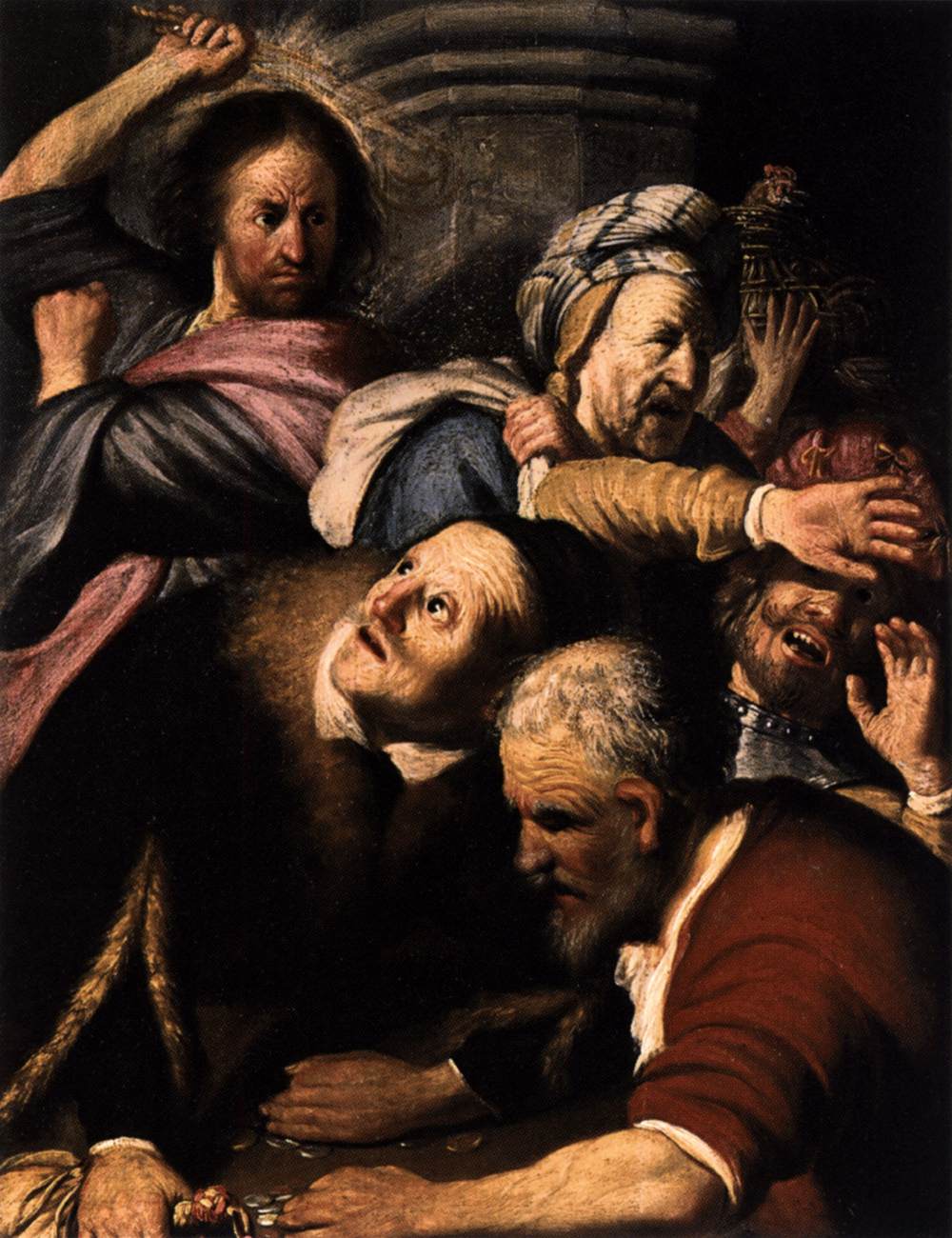
Christ driving the money-changers from the Temple, Rembrandt, c.1626
Pushkin Museum, Moscow [Web Gallery of Art]


 St Saviour's Church, Dominic St, Dublin [Wikipedia]

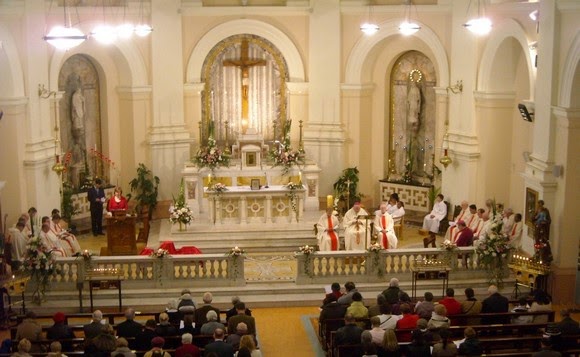
 Holy Family Church, Aughrim St, Dublin [Facebook]

We are not isolated and we are not Christians on an individual basis, each one on his or her own, no, our Christian identity is to belong! We are Christians because we belong to the Church.
Pope Francis spoke these words at his General Audience on Wednesday 25 June this year. He went on to say:
The Christian belongs to a people called the Church and this Church is what makes him or her Christian, on the day of Baptism, and then in the course of catechesis, and so on. But no one, no one becomes Christian on his or her own. If we believe, if we know how to pray, if we acknowledge the Lord and can listen to his Word, if we feel him close to us and recognize him in our brothers and sisters, it is because others, before us, lived the faith and then transmitted it to us. We have received the faith from our fathers, from our ancestors, and they have instructed us in it . . . So, this is the Church: one great family, where we are welcomed and learn to live as believers and disciples of the Lord Jesus.
A few weeks earlier in his homily at Mass in St Martha's on 15 May the Bishop of Rome spoke in similar words:
But you cannot understand a Christian alone, just like you cannot understand Jesus Christ alone. Jesus Christ did not fall from the sky like a superhero who comes to save us. No. Jesus Christ has a history. And we can say, and it is true, that God has a history because He wanted to walk with us. And you cannot understand Jesus Christ without His history. So a Christian without history, without a Christian nation, a Christian without the Church is incomprehensible. It is a thing of the laboratory, an artificial thing, a thing that cannot give life.
This Sunday we celebrate the dedication of the Cathedral of Rome. In a real sense it is the Mother Church for Catholics.
In his homily in St Martha's Pope Francis said:
Looking back the Christian is a person who remembers: Let us seek the grace of memory, always. Looking forward, the Christian is a man, a woman of hope.
The feast of the dedication of any church is a feast of the Lord and takes precedence over a Sunday in Ordinary Time. And because St John the Baptist is one of the patrons of the Lateran Basilica the Mass has baptismal overtones, especially the First Reading.
I felt myself drawn by this feast to be a person who remembers, to accept the grace of memory from God and look back at some of the churches in my native Dublin in which I became a Christian and grew in the faith. Before the Holy Week liturgies were changed from the morning to the afternoon or evening by Pope Pius XII in 1955 my mother used to take my brother and me to visit seven churches on the afternoon of Holy Thursday to spend some time in adoration of the Blessed Sacrament in each. This practice seems to have died out in Dublin but it is very much alive here in the larger cities in the Philippines where it is known by the Spanish term visita iglesia. And I have just discovered that this practice originated in Rome, with the Archbasilica of St John Lateran top of the list.
Here I 'visit' a number of churches in Dublin that played a significant part in my becoming a member of the Church and in my growth in the faith. I invite each reader to make a similar pilgrimage of thanksgiving to God for the gift of our faith, for the gift of our Church and for those who have passed on the faith to us and nurtured us in it. The Church is a community of persons, God the Father's sons and daughters by virtue of our baptism, just as a family is a community of persons. And just as a family normally lives in a home - we describe persons living in extreme poverty as 'homeless' - so does the Christian family normally gather in its parish church.
Pope Francis describes the parish in Evangelii Gaudium No 28, in these words: The parish is the presence of the Church in a given territory, an environment for hearing God’s word, for growth in the Christian life, for dialogue, proclamation, charitable outreach, worship and celebration.
Here I 'visit' a number of churches in Dublin that played a significant part in my becoming a member of the Church and in my growth in the faith. I invite each reader to make a similar pilgrimage of thanksgiving to God for the gift of our faith, for the gift of our Church and for those who have passed on the faith to us and nurtured us in it. The Church is a community of persons, God the Father's sons and daughters by virtue of our baptism, just as a family is a community of persons. And just as a family normally lives in a home - we describe persons living in extreme poverty as 'homeless' - so does the Christian family normally gather in its parish church.
Pope Francis describes the parish in Evangelii Gaudium No 28, in these words: The parish is the presence of the Church in a given territory, an environment for hearing God’s word, for growth in the Christian life, for dialogue, proclamation, charitable outreach, worship and celebration.
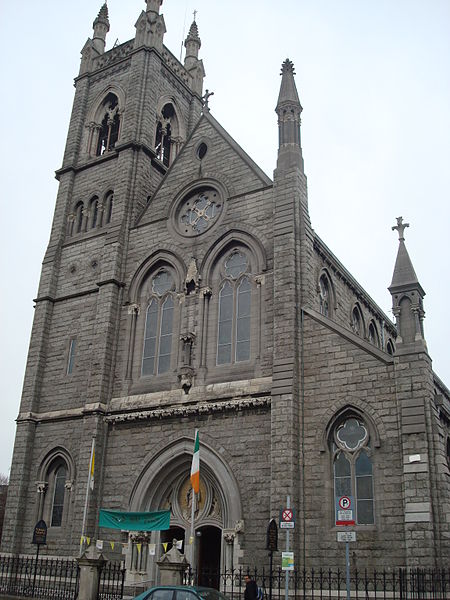
St Joseph's Church, Berkeley Road, Dublin [Wikipedia]
I was born in small nursing home nearly opposite the church above on 20 April 193, Tuesday of Holy Week, the last time that Easter fell on the latest date possible, 25 April. A few days later, probably on Holy Saturday, I was baptised in that church, which wasn't our parish church as we lived on the other side of the city.
About five years ago I celebrated Mass for the first time in St Joseph's. The parish is now run by the Discalced Carmelites. The congregation on the Sunday I celebrated Mass was very different from what it would have been at the time of my birth. There were many Filipinos in the congregation, most of them nurses in the nearby Mater Hospital. And the servers were two girls aged about 12. One was white, from one of the oldest parts of the city, and the other was black, of Nigerian parentage. I was amused by the fact that the white girl would not acknowledge that she was from the inner city of Dublin while her companion was very proud to be a Dubliner! I met their mothers after Mass and they laughed when I told them this.
When I entered the Columban seminary in 1961 I could not have imagined such a congregation in any parish in Dublin, much less an altar-server whose parents were immigrants from Nigeria.
Our Lady Help of Christians Church, Drimnagh, Dublin
On a Christmas weekday a few months before I turned three I was thrown out of the church above, along with my pregnant mother, for shouting 'Ba' at the Infant in the crib.It was a traumatic experience for my mother. But whenever she would recall the event she would always add that the priest who ordered us out could not have done more for her sister, my Auntie Madge, who died four years later, in another parish.
In 1991, while at home in Dublin, I was asked by the Columbans to preach at all the Masses in that church on a Sunday in Lent when students from their final year in secondary school were observing a 24-hour fast to raise funds for Trócaire, the development agency of the Catholic Church in Ireland. I've never had a more attention-grabbing opening to a homily than I did that day: I was thrown out of this church. But by the time I had preached for the fourth time I felt a vicarious healing on behalf of my mother, who died in 1970. That was a real grace.

In the old days churches belonging to religious orders in Dublin usually had High Mass on such days as Easter Monday and Whit (Pentecost) Monday and my father would bring me to one or other of them on those occasions. I distinctly recall that when I was maybe seven or eight being particularly attracted by the habit of the Dominican friars. I didn't recognise then the beginnings of being called by God to be a priest but I see it now as such, even though I subsequently never considered becoming a Dominican.

St Dominic at Prayer, El Greco, 1600-02
Private Collection [Web Gallery of Art]
I must confess that I wasn't an entirely enthusiastic pilgrim when my father took me to High Mass or when my mother brought my brother and me to seven churches on Holy Thursday. I can see a reflection of my father in these words of Pope Francis in Evangelii Gaudium, No 167: Proclaiming Christ means showing that to believe in and to follow him is not only something right and true, but also something beautiful, capable of filling life with new splendour and profound joy, even in the midst of difficulties.Every expression of true beauty can thus be acknowledged as a path leading to an encounter with the Lord Jesus. My father seldom spoke about his faith but I could see even then, and more clearly later, how his faith permeated his whole life and how he felt uplifted by the beauty of the High Mass.
St Agatha's Church, North William St, Dublin [parish website]
It was in St Agatha's Church that I was confirmed by Archbishop John Charles McQuaid of Dublin in March 1954, along with my classmates from O'Connell Schools, which was located in the parish. St Agatha's didn't play any other part in my young life but its most illustrious parishioner, the Venerable Matt Talbot, has always been part of my life. Sometimes when walking 'into town' with my mother - her way of describing going into the city centre - we would go through Granby Lane, behind the Dominican church, where Matt died suddenly on his way to Mass there on Trinity Sunday 1925, and say a prayer at the simple shrine that marked the spot. Matt, a simple working man, overcame, with God's grace, his addiction to alcohol and lived a life of extraordinary asceticism that was known during his lifetime only to his spiritual director. Without being aware of it, my mother was strengthening my faith.
It was above all in Aughrim Street Church - Dubliners rarely refer to a church by its patronal name but by the street its on - that my faith grew. That faith was strengthened by the 'communal cough' after the second elevation, that of the chalice with the Precious Blood, that to me was a far deeper expression of faith than the perfunctory 'Christ has died . . .' introduced in 1969. It was the release of the sense of awe that people had, knowing that the bread and wine had become the Body and Blood of Christ. The church thronged with people young and old, most getting ready to go to work or to school, at the early morning Mass on the weekdays of Lent was also part of my growth in our faith.
I never became and altar-boy in our parish church, though I had enlisted as a trainee shortly after my First Holy Communion in 1950 at St Mary of the Angels, Church Street, the church of the Capuchin Friars (in video above), where my father used to take me some times for High Mass and where my mother took me the Sunday when St Maria Goretti was canonised in 1950. Alessandro Serenelli, who murdered the saint, spent the latter years of his life after being released from prison in a Capuchin friary in Italy, hence the connection with the Capuchin church in Dublin. What I remember is how long it took to say the fifteen decades of the Rosary that day in the church when I was a very unwilling participant!
It was in Aughrim Street church that I celebrated my First Mass on 21 December 1967, the old feast of St Thomas the Apostle, the day after my ordination in St Mary's Pro-Cathedral, Dublin.
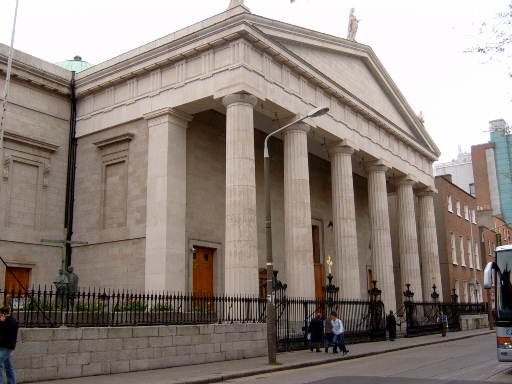
St Mary's Pro-cathedral, Dublin [Wikipedia]


Our class was to have been ordained in the seminary chapel in St Columban's College, Dalgan Park, Navan, about 35 kms north-west of Dublin, but had to be transferred at the last minute - we were informed about three days before 20 December - due to an outbreak of foot-and-mouth disease in Britain. Four opted to be ordained in Derry Cathedral, one in his native Glasgow on the 21st, with the remaining 14 to be ordained in the Pro-Cathedral in Dublin.
During our ordination ceremony
With Bishop Patrick Cleary who ordained us.
Bishop Cleary was one of the first Columbans and the first - and only, I think - Bishop of Nancheng, China, from which he was expelled in 1962.
When I was around 8 and 9 I was a member of the Palestrina Choir in the Pro-Cathedral and occasionally dropped in to pray there on my way home from school. But I have celebrated Mass there only twice - at my ordination and in November 2011 when I concelebrated in the annual Mass on the occasion of the death anniversary of Frank Duff, founder of the Legion of Mary, who died on 7 November 1980.
I realise that in these Sunday Reflections I have 'visited' seven churches in my native city and diocese. There are more, all of them places of God's very special presence, above all in the celebration of Mass and in the Blessed Sacrament, the latter inviting us into a deep intimacy with Jesus our Risen Lord.
Today's feast calls us to have a profound sense of thanksgiving to God for the gift of faith, for his abiding presence among us, in our daily lives and in the special buildings in which we gather each Sunday and often on other days to celebrate the Holy Sacrifice of the Mass. And as we celebrate the Dedication of the Cathedral of Rome It is truly right and just that we pray for Pope Francis, who emphasises that he is Bishop of Rome, and for the People of God in that diocese

The papal cathedra in St John Lateran [Wikipedia]
The Latin word cathedra means a chair with armrests, used as a throne. As the throne of the bishop, form which he teaches, it is the root of the word 'cathedral'.
The Latin word cathedra means a chair with armrests, used as a throne. As the throne of the bishop, form which he teaches, it is the root of the word 'cathedral'.
Art historian Elizabeth Lev speaks about the Cathedral of Rome