Since we are travellers and pilgrims in the world, let us ever ponder on the end of the road, that is of our life, for the end of our roadway is our home (St Columban, 8th sermon).
Fr Thomas
Kilkenny was born in Lecarrow, Carrowbehy, Castlerea, County Roscommon, Ireland, on 23 July
1922. He was educated at Gorthaganny National School, County Roscommon, and Summerhill
College, Sligo. He came to St Columban's, Dalgan Park, in September 1940 and was ordained priest in December
1946.
Father Tom was assigned
to Japan in 1947 and apart from his vacations and a year or so working in Mindanao, Philippines, in the 1950s, he spent the next fifty-five
years working there in a variety of pastoral assignments. His first assignment
was to Oiso. This was followed by stints in Toshima, Tokyo, and a longer period
in Katase, Kanagawa.
Then he spent
time in two Chiba parishes, in Choshi and then in Tateyama. In Kumamoto he
taught in the Marist High School and then worked for eight years in Tamana.
After that there were assignments in Kamugawa, Chiba, and Hakone, Kanagawa.
His last five
years in Japan were spent in Tokyo, and after that, in 2003, he returned to
Ireland where he lived in Cloontrasna, Castlerea, County Roscommon, not far from
his birthplace. Father Tom valued his independence and reluctantly agreed to move to
the Dalgan Nursing Home in December 2015 when he could no longer care
adequately for his own needs.
Father Tom was a quiet,
private person, a conscientious pastor who spoke excellent Japanese, and
dedicated himself to the people in his many assignments. He chose to be
buried close to his family in Gorthaganny Cemetery, Castlerea, County Roscommon.
May he rest in
peace.
In the last couple of years of his life Father Tom would often tell Fr Bernard Mulkerins about a blacksmith's forge that he loved to visit in his childhood days. He also loved poetry. The video above begins with the opening lines of The Village Blacksmith by Longfellow. The forge is only about an hour's drive from where Father Tom grew up.
The Solemnity of the
Ascension is celebrated on Ascension Thursday in England and Wales, in Scotland
and in parts of the USA. In these regions the Ascenson
is a holy day of obligation. In other countries, including Australia, Ireland,
Philippines and parts of the USA, the solemnity is observed on the Sunday after
Ascension Thursday.
Readings(Jerusalem Bible: Australia,
England & Wales, India [optional], Ireland, New Zealand, Pakistan,
Scotland, South Africa)
GospelMark 16:15-20 (New Revised Standard
Version, Anglicised Catholic Edition)
Jesus said
to his disciples, ‘Go into all the world and proclaim the good news to the
whole creation. The one who believes and is baptized will be saved; but the
one who does not believe will be condemned. And these signs will
accompany those who believe: by using my name they will cast out demons; they
will speak in new tongues; they will pick up
snakes in their hands, and if they drink any deadly thing, it will not
hurt them; they will lay their hands on the sick, and they will recover.’
So then the Lord Jesus, after he had spoken to them, was
taken up into heaven and sat down at the right hand of God. And they went out and proclaimed the good news everywhere,
while the Lord worked with them and confirmed the message by the signs that
accompanied it.
Seventh Sunday of Easter, Year B
These readings are used in
countries/jurisdictions that observe the solemnity on Ascension Thursday.
Fr Giuseppe Raviolo SJ (1923 - 1998) was a Pope St John XXIII-like figure, physically and spiritually, from Italy who spent most of his priestly life in Mindanao, Philippines, where I came to know him. He was the first rector of St John Vianney Major Seminary in Cagayan de Oro City. But he also spent nine years in Vietnam and was rector of the major seminary in Saigon, now Ho Chi Minh City, during the Vietnam War. He once told me an extraordinary story from that period. The North Vietnamese Army was advancing on Saigon. The soldiers were divided into groups of three. The standing order was that if one tried to surrender the other two were to shoot him. One particular group found themselves surrounded by American soldiers and one of them surrendered. The other two did not shoot their companion and were captured along with him. Later they asked their companion why he had taken such a risk. He answered, I knew you were Christians and that you would not shoot me. The two were in fact Catholics and had discussed the matter and had decided that, as Christians, they could not shoot their companion if that particular situation arose. These were soldiers in the army of a Communist country, an army without any chaplains, and their companion, who was not a Christian, took it for granted that they would not take his life because he knew that they were Christians. In the First Reading today, the opening verses of the Acts of the Apostles, Jesus says to his disciples, You will receive power when the Holy Spirit has come upon you; and you will be my witnesses in Jerusalem, in all Judea and Samaria, and to the ends of the earth. Those two Catholic soldiers in the North Vietnamese army were powerful witnesses of Jesus to their companion. They chose to live their faith in Jesus. In the Republic of Ireland citizens will be voting on 25 May on whether to retain a provision in the Constitution that protects both the life of an unborn child and that of its mother or to replace it with a provision that will allow the parliament to legislate for abortion. The current government has stated that if the Constitution is changed they will introduce legislation that would allow abortion up to twelve weeks for no reason whatever. Please pray that we in Ireland will have the same respect for human life that the two soldiers in Vietnam had and that we will exercise our responsibility as citizens by being witnesses of Jesus not only in Ireland but to the ends of the earth.
Sts Nereus and Achilleus, whose feast is observed on 12 May, were Roman soldiers who were martyred for being Christians.
Entrance Antiphon Acts 1:11 Antiphona ad introitum
Men of Galilee, why gaze in wonder at the heavens?
Viri Galilaei, quid admiramini aspicientes in caelum? This Jesus whom you saw ascending into heaven Quemadmodum vidisti eum ascendentem in caelum, will return as you saw him go, alleluia. ita veniet, alleluia.
Palestrina's setting uses a slightly different Latin translation along with a verse that is not in the Entrance Antiphon in the current Roman Missal: Viri Galilaei, quid statis aspicientes in coelum?
Hic Jesus, qui assumptus est a vobis in coelum,
sic veniet, quemadmodum vidistis eum euntem in coelum. Alleluia.
Ascendit Deus in jubilatione, et Dominus in voce tubae. Alleluia.
Dominus in coelo paravit sedem suam. Alleluia.
On 25 May voters in the Republic of Ireland will be voting on a referendum on whether to retain Article 40.3.3º of Bunreacht na hÉireann, Constitution of Ireland. The text is known as The Eighth Amendment and was included in the Constitution after a referendum in 1983. The English version reads: The State acknowledges the right to life of the unborn and, with due regard to the equal right to life of the mother, guarantees in its laws to respect, and, as far as practicable, by its laws to defend and vindicate that right. It is proposed to replace this with the following: Provision may be made by law for the regulation of termination of pregnancy. A 'Yes' vote will be for change while a 'No' vote will be to keep the Constitution as it is. If the people vote to change the Constitution the present government says it will introduce legislation that will allow abortion, among other circumstances, up to 12 weeks of pregnancy without specific indication, with a time period after an initial assessment by a medical practitioner and the termination procedure. This is the context of the statement of Bishop Michael Smith of Meath, in which diocese the Columbans have been present since 1927 and where I now live.
In a few weeks time, the people of Ireland must make a decision that will have a profound impact on the kind of society we will be in the future. We will be asked to decide on whether to retain the 8th amendment in our Constitution by voting ‘No’ or to remove it by voting ‘Yes’. I wish to share with you my conviction about why it is essential to vote 'No' if we are to build a truly compassionate society that values all life. The choice before us has become even starker in the light of the recent judgment of the Supreme Court which stated that the only legal protection the unborn child has at present is the 8th amendment. If this is removed the unborn child up to birth becomes a non-person in Irish law. Do we want to say that the child in the womb has no rights whatsoever in our Constitution? This, I am sure, every mother would find impossible to believe from her experience of her child moving in the womb as he or she grows and develops. The Supreme Court judgment means that the child in the womb would have no constitutional right to treatment or support. Despite suggestions to the contrary, the Church asks that all necessary medical treatment be given to a mother in pregnancy even if this were to result in the unintended death of the child. Highly respected medical and legal experts have made it clear that under the present law the best standards of care are available to mothers in a crisis pregnancy. All involved in caring for the pregnant mother in Ireland have to take pride in the fact that Ireland is one of the safest countries in which to be pregnant. A compassionate society will do all in its power to support and love the mother and baby. The 8th amendment is a declaration of equality and respect for human life. It represents, at the very foundation and substructure of our laws, a conviction that all human life has to be cherished. Are we as a society to say to women experiencing a crisis in their pregnancy that the solution to their concern is to be found in abortion? Does this show compassion and care for women? The solution to a crisis pregnancy should be found in addressing the crisis, not in terminating the life of an innocent child. Abortion is a brutal act. There is no semblance of compassion involved in ending the life of the child in the womb. It is difficult to imagine how such an action could be compatible with the Catholic faith in any way. The recent Supreme Court judgment means that, were the 8th amendment to be removed from the Constitution, the current government will legislate for unlimited abortion on demand up to 12 weeks, for unlimited abortion up to 24 weeks on the grounds of mental health, and for unlimited abortion up to birth in cases of life-limiting conditions. This prospect can only be described as horrifying. The appalling statistics of abortion rates in other countries should fill us with the dread of similar rates becoming normalised here. Are we to ignore the images, which technology makes available to us, of a child at 12 weeks who has a beating heart, a brain, eyes and ears, limbs, who is yawning, sucking the thumb, and who is clearly saying to us, 'I want to live!'? To deprive the child of the right to life would be the gravest of injustices and by removing the 8th amendment we are doing just that. It remains my hope that we can hand on to future generations a vision for society that is truly inclusive, which enshrines in its laws the equal right of every person to life, and which is capable of offering compassion and care to those in crisis. Our Constitution acknowledges that the right to life precedes all our laws, and our common humanity tells us that this is how it should be. The power to decide who lives and who dies should not belong to the individual. This can never be the foundation for a society that seeks to put compassion and care at its heart. Saving the 8th means that we do not have to choose between two competing rights. To choose life is to choose both.
Readings(Jerusalem Bible: Australia,
England & Wales, India [optional], Ireland, New Zealand, Pakistan,
Scotland, South Africa)
GospelJohn 15:9-17 (New Revised Standard
Version, Anglicised Catholic Edition)
Jesus
said to his disciples:
‘As the
Father has loved me, so I have loved you; abide in my love. If you keep my commandments, you will abide in my love,
just as I have kept my Father’s commandments and abide in his love. I have said these things to you so that my joy may be in
you, and that your joy may be complete.
‘This
is my commandment, that you love one another as I have loved you. No one has greater love than this, to lay down one’s life
for one’s friends. You are my friends if you do what I command you. I do not call you servants any longer, because the
servant does not know what the master is doing; but I have called you
friends, because I have made known to you everything that I have heard from my
Father. You did not choose me but I chose you. And I appointed you
to go and bear fruit, fruit that will last, so that the Father will give you
whatever you ask him in my name. I am giving you these
commands so that you may love one another.’
If ye love me, keep my commandments, and I will pray the Father, and he shall give you another comforter, that he may 'bide with you forever, e'en the spirit of truth. (John 14:15-17)
This is a setting by Thomas Tallis (c.1505 - 1585) of today's Communion Antiphon, with the first part of John 14:17 added.
Communion Antiphon Antiphona ad communionem (Jn 14:15-16)
If you love me, keep my commandments, says the Lord,
Si diligitis me, mandata mea servate, dicit Dominus.
and I will ask the Father and he will send you another Paraclete,
Et ego rogabo Patrem, et alium Paraclitum dabit vobis,
In May 2015 I gave a retreat to the Missionary Sisters of the Catechism in Lipa City, south of Manila. The Sisters have a house dedicated to Our Lady of Guadalupe where they take care of elderly and sick women whom they refer to as the lolas, the 'grandmas'. In another part of the compound they had at the time a group of orphans, five young boys and six young girls. (If my memory is correct the Sisters were planning to build an orphanage). Four of the boys served Mass every morning, including 'Zacchaeus', as the Sisters called him, the youngest of the boys and small, proudly wearing his white cassock like the others. 'Zacchaeus' wasn't yet old enough to make his First Holy Communion or First Confession. His role as a server was to hold up the small white towel - and he really has to stretch to do so - when the priest washes his hands during the Offertory.
The youngest of the girls was Chiara, aged four or five at the time. The children were present at lunch on the last day of the retreat, which had a celebratory air to it. I noticed after I had said Grace Before Meals that Chiara was somewhat tearful. Then I discovered that on such occasions she led the community in a Hail Mary as part of Grace. so the Sisters encouraged her to do so today even though the visiting priest had pre-empted her. After a little hesitation and the drying of her tears she prayerfully led us all in the Hail Mary and then invoked the protectors of the Congregation - Mother of Good Counsel, St Joseph, St Veronica Giuliani, St Gemma Galgani and St Bernadette Soubirous.
During the retreat I told a number of stories of seemingly insignificant events where God had revealed himself to me through the actions of children and of older persons without their being aware of it. Then on the way back to Manila after the retreat Sister Evelyn Cortes SMC, whose family I have I have known since she was in high school in Tangub City, Misamis Occidental, and Sister Eppie Resano SMC told me a story about Chiara where she showed an understanding of what this Sunday's Second Reading is all about, without being aware of it.
Beloved, let us love one another, because love is from God; everyone who loves is born of God and knows God. Whoever does not love does not know God, for God is love. God’s love was revealed among us in this way: God sent his only Son into the world so that we might live through him. In this is love, not that we loved God but that he loved us and sent his Son to be the atoning sacrifice for our sins (1 John 4:7-10).
Some time before I gave the retreat a missionary priest visited the Sisters and celebrated Mass for them. Little Chiara saw him as being very severe in his demeanour. After Mass she tugged on his cassock and asked him, Father, are you angry with God? It seems that the following morning he wasn't quite as severe looking!
Some may be angry with God. I don't think that God is too perturbed about that when he knows that the source of our anger may be bewilderment over tragedies in our lives, for example, just as we allow those whom we love to vent their anger on us because basically they trust us and we have some idea of the source of their anger.
Perhaps a more common experience, especially among persons who are serious about following Jesus faithfully but who try to live as if God's love had to be earned - as if it could be earned - is the idea that God is angry with us.
St John tells us so beautifully what the situation really is: In this is love, not that we loved God but that he loved us and sent his Son to be the atoning sacrifice for our sins.
Most of the Gospel readings on the Sundays and weekdays of Easter are taken from John 13-17, the Last Supper Discourse in which Jesus speaks to each of us with intense love about the intimacy into which he calls each of us through our baptism. In today's Gospel Jesus says to each of us, speaking from his heart to ours - Cor ad cor loquiter, 'Heart speaks to heart', as Blessed John Henry Cardinal Newman emphasised on his coat-of-arms - As the Father has loved me, so I have loved you; abide in my love . . . this is my commandment, that you love one another as I have loved you . . . you are my friends . . . you did not choose me but I chose you . . .
The initiative comes from God. Love comes from God and our loving response to that love is itself a gift from God. We do not and cannot earn God's love. God who is love gives us himself as pure gift.
How can such a God be angry with us and how can we be angry - choosing to remain angry as distinct from a spontaneous feeling - with such a God? In this is love, not that we loved God but that he loved us and sent his Son to be the atoning sacrifice for our sins (1 John 4:10).
For the LORD takes delight in his people; he crowns the poor with salvation (Psalm 149:4, Grail translation).
You may read an article by Eileen Kane on this painting in the May 2018 issue of The Sacred Heart Messengerhere.
O Mary we
crown thee with blossoms today!
Queen of the Angels and Queen of the May.
Bring Flowers of the Rarest (Queen
of the May) Composed by Mary E. Walsh.
Bring flowers of the
rarest bring blossoms the fairest, from garden and woodland and hillside and dale; our full hearts are swelling, our glad voices telling the praise of the loveliest flower of the vale!
Refrain: O Mary we crown thee with blossoms today! Queen of the Angels and Queen of the May. O Mary we crown thee with blossoms today, Queen of the Angels and Queen of the May.
Their lady they name thee, Their mistress proclaim thee, Oh, grant that thy children on earth be as true as long as the bowers are radiant with flowers, as long as the azure shall keep its bright hue
Refrain
Sing gaily in chorus; the bright angels o'er us re-echo the strains we begin upon earth; their harps are repeating the notes of our greeting, for Mary herself is the cause of our mirth.
Patrick James McGlinchey was born in the village of Raphoe, County Donegal, Ireland, which gives its name to the Diocese of Raphoe, on 6 June 1928. He was always known as 'PJ'. In Korea he was known by the Korean name of Yim Pi-jae, a derived from the first letter of each of his English names: Yim for the 'M' in McGlinchey, pi for the 'P' in Patrick and jae for the 'J' in James. (This information is from a fine article published in Korea in 2014: Sixty years on Jejudo: Irish priest shares his memories). He died in a hospice he had built on the island of Jeju - 'Jejudo' is the Korean for 'Jeju Island' - where he had lived for most of his life and was buried there on.
Ar dheis Dé go raibh a anam uasal. May his noble soul be
at the right hand of God.
Fr PJ McGlinchey with President Mary McAleese of Ireland and her husband Dr Martin McAleese
Jeju, March 2005
Below is a post I published on 16 October 2014.
Irish Presidential Distinguished Service Award for Columban Fr PJ McGlinchey
It has just been announced that Columban Fr PJ McGlinchey has been named as one of the recipients of a Presidential Distinguished Service Award for 2014 . He will be presented with the award by Irish President Michael D Higgins at a ceremony later this year. Fr McGlinchey's baptismal names are Patrick James but he is known to everyone as 'PJ'.
Fr McGlinchey, a native of County Donegal, Ireland, has spent his missionary life on Jeju [formerly 'Cheju'] Island about 130 kms off the southern coast of South Korea. The citation for his award reads: Arriving in Jeju, Korea in 1954 Fr McGlinchey, a priest with the Missionary Society of St Columban, was faced with a society that was deeply traumatised and ravished by poverty. Lead by his faith and knowledge in agriculture he set about helping to pull thousands of Jeju citizens out of poverty. His model of development and profitable farming encouraged use of underused farm land and new farming methods. St Isidore farm was founded to include pigs, sheep, cows and now a stud.
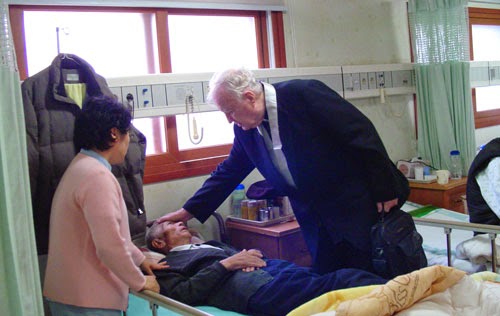
Fr McGlinchey with a sick person in Korea
A textile factory, employed up to 1,700 Jeju women in a time when jobs on the island were scarce. His forming of a credit union changed the economy of the island and helped the citizens emerge from poverty. Fr Mc Glinchey never forgot the island people setting up Isidore Nursing home, hospice, kindergarten and a youth centre which for over 18,000 young people from all over Korea. These welfare activities, some funded completely from donations and profits from the farm, take care of Jeju's most vulnerable. For 60 years, his extraordinary drive, dedication and vision has changed the lives of those on Jeju and Ireland is now associated with this great island. His tireless dedication gave them not just hope but a belief in what they could achieve themselves. You can read more about the work of Fr McGlinchey here.
In 1975 Fr McGlinchey was one of the Ramon Magsaysay awardees in Manila. His award was for Rural Development. The website of the Ramon Magsaysay Award Foundation has a biographical page on the priest here. The foundation was set up to honour President Ramon Magsaysay of the Philippines who died in a plane crash in the Philippines on St Patrick's Day, 17 March 1957. Isidore Farm founded by Fr McGlinchey is named after St Isidore the Farmer, widely venerated in the Philippines as San Isidro Labrador or simply, San Isidro.
Seán Joseph McGrath was born on 15 June
1930 at Killen, Coalisland, County Tyrone, Northern Ireland. Educated at
Aughamullan Public Elementary School and St Patrick's College, Armagh, he
entered St Columban's, Dalgan Park, County Meath, Ireland, in September 1948.
He was ordained priest on 21 December 1954.
Father Seán's first twenty years were spent in pastoral work in Mindanao, Philippines. He worked mainly in Ozamiz City and in Iligan City. In the latter he established the new parish of Corpsu Christi in Rosario Heights, Tubod, and built a huge, modern church there. In his years in Iligan he displayed his extraordinary creativity. He was always open to trying new ways of in volving his parishioners and had a particular gift for raising funds for the many projects of the parish.
After twenty years in the Philippines there followed ten years of promotion work in the District of Britain. Fr McGrath was in charge of the London house and in 1979 became Superior of the District. He was always a cheerful extrovert who made friends easily, remembered names and was a gifted fundraiser. All these qualities helped make him very effective in promoting mission.
When the Columbans opened a new English-speaking mission to Belize in 1986 Father Seán was one of the first to volunteer. His companions elected him as spokesperson of the mission unit. Conditions were difficult but he was happy to be back in a new environment, working out of St Ignatius Church in Belize City. He organised raffles in order to raise funds for the parish projects including the building of a new rectory. The mission to Belize ended in 1996 when the Columbans lacked manpower to continue there and Father Seán was assigned to the USA.
In the United States Fr McGrath's gifts were employed very successfully on behalf of projects in the Columban Region of the Philippines. He was delighted to be back working with Filipinos and he encouraged them to help with the education of our new Filipinos seminarians and with other projects. He worked happily in the USA until his health began to deteriorate and he returned to Ireland and to the nursing home at St Columban's, Dalgan Park, in 2014. Always full of energy, good humour and creativity, FatherSeán will be remembered among Columbans and his numerous friends in so many different countries. May he rest in peace.
St Columban's Cemetery, Dalgan Park
[Obituary by Fr Cyril Lovett]
Logo of the Tyrone Gaelic Athletic Association (GAA)
Fr McGrath was an outstanding Gaelic footballer in his youth and played midfield for the Tyrone minors when they won the All-Ireland Championship in 1947 and 1948. The following tribute appears on the Tyrone GAA Facebook:
‘Anocht is Uaigneach Tír Eoghain … Tonight Tyrone is Lonely’
The death of Fr Sean McGrath draws the curtain on the exceptional life journey of an exceptional Tyrone man. Fr Sean was in so many ways a person apart, an All-Ireland Minor double-winner for us in 1947 and 1948, (that group of young men whose significance within the Tyrone GAA story can never be underestimated), and then with the Columban Fathers a man who improved the lot of humankind not just in Ireland but in Belize, Britain, The Philippines and the USA. Most of us aspire to great things in life: Fr Sean lived them and delivered them.
The deepest sympathy of Gaelic Tyrone goes to his wide family connection – personal, Columban and Clonoe O’Rahillys.
‘Luímse le Dia agus luífidh Dia liom: Éireoidh mé le Dia agus éireoidh Dia liom. I lie with God and God will lie with me: I will rise with God and God will rise with me.’
Logo of Clonoe O'Rahillys GAA Club
Clonoe O'Rahillys was the local Gaelic football club of which Father Seán was a member. The club carries this tribute from a relative on its Facebook:
Father Seán loved
Irish music and during his long, lingering illness another Columban, Fr Bernard
Mulkerins, often sang for him in his room in the Columban nursing home. This was Father Seán's favourite song.