11 December 2019

'The deaf hear.' Sunday Reflections, 3rd Sunday of Advent, Year A

St John the Baptist in the Prison
Juan Fernández de Navarrete [Web Gallery of Art]


Readings (New American Bible: Philippines, USA)

Readings (Jerusalem Bible: Australia, England & Wales, India [optional], Ireland, New Zealand, Pakistan, Scotland, South Africa)

Gospel Matthew 11:2-11 (New Revised Standard Version, Anglicised Catholic Edition, Canada)  

When John heard in prison what the Messiah was doing, he sent word by his disciples and said to him, ‘Are you the one who is to come, or are we to wait for another?’ Jesus answered them, ‘Go and tell John what you hear and see: the blind receive their sight, the lame walk, the lepers are cleansed, the deaf hear, the dead are raised, and the poor have good news brought to them. And blessed is anyone who takes no offence at me.’

As they went away, Jesus began to speak to the crowds about John: ‘What did you go out into the wilderness to look at? A reed shaken by the wind? What then did you go out to see? Someone dressed in soft robes? Look, those who wear soft robes are in royal palaces. What then did you go out to see? A prophet? Yes, I tell you, and more than a prophet. This is the one about whom it is written,
“See, I am sending my messenger ahead of you,
    who will prepare your way before you.”
Truly I tell you, among those born of women no one has arisen greater than John the Baptist; yet the least in the kingdom of heaven is greater than he.


Fr Joseph Coyle 
(28 February 1937 - 18 December 1991)


Father Joseph Coyle was a Columban priest from Derry city, Northern Ireland. He died in the Philippines on 18 December 1991, aged 54, and is buried in a Catholic cemetery in Bacolod City. Father Joe and I weren't related - my Coyle ancestors moved centuries ago from the north-west of Ireland, where the surname originated, to Rush, a fishing village north of Dublin city - but we felt a sense of kinship. He was ordained on 21 December 1961 during my first year in the Columban seminary in Ireland.

Father Joe spent most of his life as a priest in the island of Negros. He gradually became aware of persons with disabilities and of how their needs weren't being met. He was able to obtain artificial limbs for some. But he noticed that there was one group in every community that was almost totally isolated, because they didn't share a common language with those around them, not even with their own families. This group was people who were profoundly deaf.

More and more Father Joe became involved with deaf people, celebrating Mass in Sign Language in a number of places. In the late 1980s he established Welcome Home in Bacolod City as a residence for out-of-town deaf students so that they could attend special schools in the city. Special Education has spread now to many towns and that particular need is no longer urgent. But Welcome Home Foundation, Inc., continues with a small number of residents, a school for young children, deaf and hearing, catechetical programmes in public schools with both deaf and hearing catechists, and other activities.

Father Joe's death was devastating initially to the young deaf people with whom he had worked. But his vision was continued and developed by others, most noticeably by Mrs Salvacion V. Tinsay who died in 2008. Her daughter Mrs Agnes T. Jalandoni, President and CEO, along with her board and staff have enabled the work begun by Father Joe to grow and adapt to current needs.


Fr Mike Depcik OSFS is an Oblate of St Francis de Sales, one of very few profoundly deaf priests in the world. He has his own vlog, Fr. MD's KitchenTable, where, among other things, he posts videos of homilies for Sunday Masses in American Sign Language, such as that above for this Sunday's Mass.

John the Baptist sends his followers to ask Jesus,  Are you the one who is to come, or are we to wait for another? Jesus replies, Go and tell John what you hear and see: the blind receive their sight, the lame walk, the lepers are cleansed, the deaf hear, the dead are raised, and the poor have good news brought to them. 

For Catholics who are profoundly deaf, priests such as Fr Mike Depcik, deaf from birth, and Fr Joe Coyle, who became aware of the isolation of the profoundly deaf, especially within their own families, are included in the response of Jesus to his cousin St John the Baptist: the deaf hear. The deaf aren't isolated to the same degree as before, though I have known of priests and people who consider a signing interpreter at Mass as a 'distraction'. 

And the ministry of priests such as Fr Depcik and Fr Coyle isn't limited to the deaf. Indeed, part of their ministry, and of those who work with them, whether deaf or hearing, is to bring about the change of heart that is central to Advent, not only a turning away from sin but a recognition of the needs of others that we weren't aware of before. It was through having friends deaf in varying degrees from birth and through knowing Father Joe that I became aware of the isolation of the deaf within the Church and in society at large. The same can be said to some extent of persons with other disabilities. But profound deafness is the only physical disability that of its nature can totally isolate a person from the community.

There will always be some, for whatever reason, on the margins. Pope Francis has on a number of occasions very strikingly shown his respect and love - the respect and love of Jesus himself - for such persons. The gradual inclusion of those who are profoundly deaf in all activities of the Church and of wider society, shown, for example, in the use of signing interpreters at public functions and on television, is one of the signs that Jesus spoke about to assure St John the Baptist that he truly was the one who is to come.


by Columban Fr Thomas Rouse

It was to the credit of the Columbans that I was accepted as a candidate for priesthood. That was back in 1969 when I was completing Form Seven in high school at St John’s College, Hastings, New Zealand.
You are here
I was accepted despite the fact that I was not only deaf but I also suffered a serious speech impediment which was a consequence of my hearing disability. My deafness was more peculiar rather than pronounced. I cannot hear high-pitched sounds. As a result, I cannot hear many of the consonants in my own ‘native’ English language.

Read the rest of Fr Tom Rouses' article and the responses to it of five profoundly deaf Filipinos, Normam, Willy, Eli, Noel and Marinela here.


Luis Antonio G. Cardinal Tagle, Archbishop of Manila, with Deaf students and staff of Welcome Home Foundation, Carmelite Monastery, Bacolod City, 26 January 2015.


Antiphona ad Communionem   Communion Antiphon Cf. Isaiah 35:4

Dicite: Pusillanimes, confortamini et nolite timere:
Say to the faintof heart: Be strong and do not fear.
ecce Deus noster veniet et salvabit nos.
Behold, our God will come, and he will save us.


05 December 2019

'So was the Word made incarnation / In Mary’s womb, a son.' Solemnity of the Immaculate Conception

The Virgin of the Immaculate Conception
El Greco [Web Gallery of Art]

The Solemnity of the Immaculate Conception, observed on 8 December, is a holyday of obligation in many countries, eg, Ireland, the Philippines. This year it falls on the Second Sunday of Advent, which takes precedence over it. So the Solemnity is transferred to Monday 9 December. However, the obligation to attend Mass does not carry over.

Readings (New American Bible: Philippines, USA)

Readings (Jerusalem Bible: Australia, England & Wales, India [optional], Ireland, New Zealand, Pakistan, Scotland, South Africa)

Gospel Luke 1:26-38 (New Revised Standard Version, Anglicised Catholic Edition, Canada)  

In the sixth month the angel Gabriel was sent by God to a town in Galilee called Nazareth, to a virgin engaged to a man whose name was Joseph, of the house of David. The virgin’s name was Mary. And he came to her and said, ‘Greetings, favoured one! The Lord is with you.’ But she was much perplexed by his words and pondered what sort of greeting this might be. The angel said to her, ‘Do not be afraid, Mary, for you have found favour with God. And now, you will conceive in your womb and bear a son, and you will name him Jesus. He will be great, and will be called the Son of the Most High, and the Lord God will give to him the throne of his ancestor David. He will reign over the house of Jacob for ever, and of his kingdom there will be no end.’ 

Mary said to the angel, ‘How can this be, since I am a virgin?’ The angel said to her, ‘The Holy Spirit will come upon you, and the power of the Most High will overshadow you; therefore the child to be born will be holy; he will be called Son of God. And now, your relative Elizabeth in her old age has also conceived a son; and this is the sixth month for her who was said to be barren. For nothing will be impossible with God.’ Then Mary said, ‘Here am I, the servant of the Lord; let it be with me according to your word.’ Then the angel departed from her.

The Annunciation
El Greco [Web Gallery of Art]

This is but one of many paintings of the Annunciation by El Greco.

The Incarnation

by St John of the Cross
Translation by Roy Campbell

Then He summoned an archangel,
Saint Gabriel: and when he came,
Sent him forth to find a maiden,
Mary was her name.

Only through her consenting love
Could the mystery be preferred
That the Trinity in human
Flesh might clothe the Word.

Though the three Persons worked the wonder
It only happened in the One.
So was the Word made incarnation
In Mary’s womb, a son.

So He who only had a Father
Now had a Mother undefiled,
Though not as ordinary maids
Had she conceived the Child.

By Mary, and with her own flesh
He was clothed in His own frame:
Both Son of God and Son of Man
Together had one name.

This poem is in The Divine Office (Breviary) approved by the hierarchies of Australia, England and Wales, Ireland. I found it online here.


Ave Maria
Setting by Franz Biebl, Sung by Voces8


Angelus Domini nuntiavit Mariae et concepit de Spiritu sancto.
(The angel of God declared unto Mary and she conceived of the Holy Spirit.)

Ave Maria, gratia plena, Dominus tecum. Benedicta tu in mulieribus, Et benedictus fructus ventris tui, Jesus.
(Hail Mary, Full of grace, the Lord is with you. Blessed are you among women, and blessed is the fruit of your womb, Jesus.)

Sancta Maria, Mater Dei, ora pro nobis peccatoribus, Sancta Maria, ora pro nobis, nunc et in hora mortis nostrae. Amen.
(Holy Mary, Mother of God, pray for us sinners, Holy Mary,
pray for us now and in the hour of our death. Amen.)


'I baptize you with water for repentance.' Sunday Reflections, 2nd Sunday of Advent, Year A

Linaioli Tabernacle: St John the Baptist
Blessed Fra Angelico [Web Gallery of Art]


The Second Sunday of Advent takes precedence over the Solemnity of the Immaculate Conception, which is transferred this year to Monday 9 December.

Readings (New American Bible: Philippines, USA)

Readings (Jerusalem Bible: Australia, England & Wales, India [optional], Ireland, New Zealand, Pakistan, Scotland, South Africa)

Gospel Matthew 3:1-12 (New Revised Standard Version, Anglicised Catholic Edition, Canada)  

In those days John the Baptist appeared in the wilderness of Judea, proclaiming, ‘Repent, for the kingdom of heaven has come near.’  This is the one of whom the prophet Isaiah spoke when he said,
‘The voice of one crying out in the wilderness:
“Prepare the way of the Lord,
    make his paths straight.”’


Now John wore clothing of camel’s hair with a leather belt around his waist, and his food was locusts and wild honey. Then the people of Jerusalem and all Judea were going out to him, and all the region along the Jordan, and they were baptized by him in the river Jordan, confessing their sins.
But when he saw many Pharisees and Sadducees coming for baptism, he said to them, ‘You brood of vipers! Who warned you to flee from the wrath to come? Bear fruit worthy of repentance. Do not presume to say to yourselves, “We have Abraham as our ancestor”; for I tell you, God is able from these stones to raise up children to Abraham. Even now the axe is lying at the root of the trees; every tree therefore that does not bear good fruit is cut down and thrown into the fire.
‘I baptize you with water for repentance, but one who is more powerful than I is coming after me; I am not worthy to carry his sandals. He will baptize you with the Holy Spirit and fire. His winnowing-fork is in his is in his hand, and he will clear his threshing-floor and will gather his wheat into the granary; but the chaff he will burn with unquenchable fire.’


Matthew 3:10-12 in Filipino Sign Language

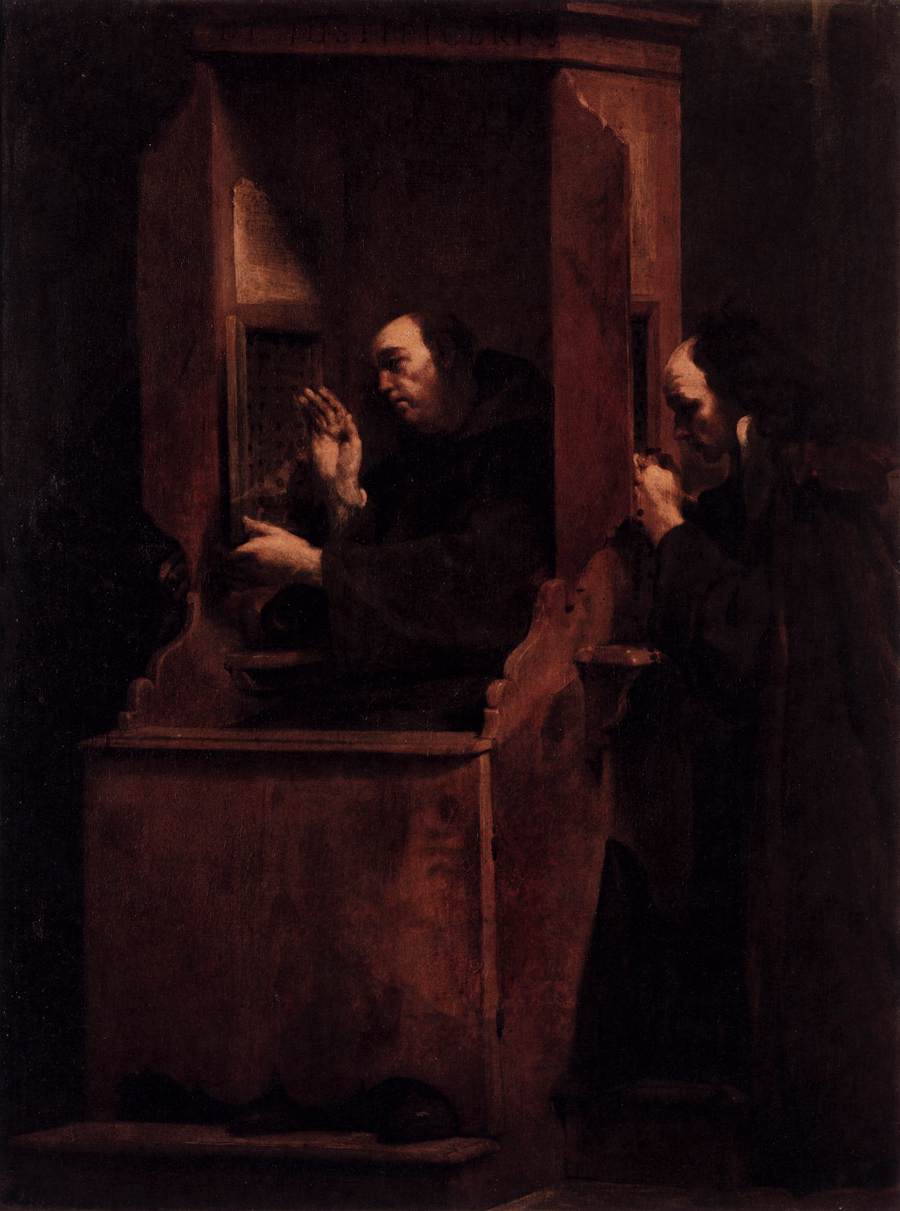
Confession
Giuseppe Maria Crespi [Web Gallery of Art]

Repent, for the kingdom of heaven has come near is the stark message of St John the Baptist. He says of his ministry, I baptize you with water for repentance. The response to the Responsorial Psalm is Justice shall flourish in his time, and fullness of peace for ever.

Repentance, justice and peace go together - with God's mercy. Pope Francis has spoken many times about that. In that context he has also reminded us, especially priests, of the importance of the sacrament of confession/penance/reconciliation.

Jesus speaks to us through his Church this Sunday reminding us of the importance of repenting in order to welcome him into our lives. In Advent we prepare to celebrate his birth and also for his Second coming, whenever that will be. And we also prepare for his daily coming into our lives.

We frequently fail Jesus by our sins. But he doesn't leave us in despair. He doesn't turn his back on us.

In his Wednesday General Audience on 20 November 2013 Pope Francis spoke about the remission of sins. As he often does, he used three points. The first was that the principal agent in the forgiveness of sins is the Holy Spirit. I'll print the rest of his talk and highlight parts of it. I'll also add some (comments).


And we come to the second element: Jesus gave the Apostles the power to forgive sins. It is a little difficult to understand how a man can forgive sins, but Jesus gives this power. The Church is the depository of the power of the keys, of opening or closing to forgiveness. God forgives every man in his sovereign mercy, but he himself willed that those who belong to Christ and to the Church receive forgiveness by means of the ministers of the community. (This means that the sacrament of confession is an explicit expression of God's will and that God forgives us through the ministry of the priest.) Through the apostolic ministry the mercy of God reaches me, my faults are forgiven and joy is bestowed on me. (God's mercy and the joy that comes from this, two realities that Pope Francis has spoken about again and again.) In this way Jesus calls us to live out reconciliation in the ecclesial, the community, dimension as well. And this is very beautiful. The Church, which is holy and at the same time in need of penitence, accompanies us on the journey of conversion throughout our life. The Church is not mistress of the power of the keys, but a servant of the ministry of mercy and rejoices every time she can offer this divine gift.

Perhaps many do not understand the ecclesial dimension of forgiveness, because individualism, subjectivism, always dominates, and even we Christians are affected by this. Certainly, God forgives every penitent sinner, personally, but the Christian is tied to Christ, and Christ is united to the Church. For us Christians there is a further gift, there is also a further duty: to pass humbly through the ecclesial community. (Through baptism we are related to Jesus Christ and to one another through the Church. It can never be a matter simply of 'Jesus and I', though he calls each of us into an intimate relationship with him, but never apart from his and our relationship with others.) We have to appreciate it; it is a gift, a cure, a protection as well as the assurance that God has forgiven me. I go to my brother priest and I say: 'Father, I did this...'. And he responds: 'But I forgive you; God forgives you'. At that moment, I am sure that God has forgiven me! 

And this is beautiful, this is having the surety that God forgives us always, he never tires of forgiving us. And we must never tire of going to ask for forgiveness. You may feel ashamed to tell your sins, but as our mothers and our grandmothers used to say, it is better to be red once than yellow a thousand times. We blush once but then our sins are forgiven and we go forward.

Pope Francis goes to confession

The service that the priest assumes a ministry, on behalf of God, to forgive sins is very delicate and requires that his heart be at peace, that the priest have peace in his heart; that he not mistreat the faithful, but that he be gentle, benevolent and merciful; that he know how to plant hope in hearts and, above all, that he be aware that the brother or sister who approaches the Sacrament of Reconciliation seeking forgiveness does so just as many people approached Jesus to be healed. The priest who is not of this disposition of mind had better not administer this sacrament until he has addressed it. The penitent faithful have the right, all faithful have the right, to find in priests servants of the forgiveness of God. (While Pope Francis doesn't call priests a 'brood of vipers', as St John the Baptist calls some of the Sadducees and Pharisees in today's gospel, he implies that those who are not 'gentle, benevolent and merciful' in the confessional are such.)

Dear brothers, as members of the Church are we conscious of the beauty of this gift that God himself offers us? Do we feel the joy of this cure, of this motherly attention that the Church has for us? Do we know how to appreciate it with simplicity and diligence? Let us not forget that God never tires of forgiving us; through the ministry of priests he holds us close in a new embrace and regenerates us and allows us to rise again and resume the journey. For this is our life: to rise again continuously and to resume our journey.

+++


[This is the form of absolution given by the priest. The highlighted words are essential for the validity of the sacrament.

God, the Father of mercies,
through the death and the resurrection of his Son
has reconciled the world to himself
and sent the Holy Spirit among us
for the forgiveness of sins;
through the ministry of the Church
may God give you pardon and peace,
and I absolve you from your sins in the name of the Father, and of the Son and of the Holy Spirit
.]

Adoramus Te, Christe
Setting by Claudio Monteverdi, Sung by Voces8


Adoramus te, Christe, et benedicimus tibi, Quia per sanguinem tuum pretiosum redemisti mundum, miserere nobis.

We adore you, O Christ, and we bless you, because through your precious blood you have redeemed the world. Have mercy on us.


28 November 2019

'What, at this moment of my life, does my heart long for?' Sunday Reflections, 1st Sunday of Advent, Year A

Madonna del Terremoto (Our Lady of the Earthquake)
Francesco di Giorgio Martini [Web Gallery of Art]


Readings (New American Bible: Philippines, USA)

Readings(Jerusalem Bible: Australia, England & Wales, India [optional], Ireland, New Zealand, Pakistan, Scotland, South Africa)

Gospel Matthew 24:37-44 (New Revised Standard Version, Anglicised Catholic Edition, Canada)  

Jesus said to his disciples:

‘For as the days of Noah were, so will be the coming of the Son of Man. For as in those days before the flood they were eating and drinking, marrying and giving in marriage, until the day Noah entered the ark, and they knew nothing until the flood came and swept them all away, so too will be the coming of the Son of Man. Then two will be in the field; one will be taken and one will be left. Two women will be grinding meal together; one will be taken and one will be left. 

‘Keep awake therefore, for you do not know on what day your Lord is coming. But understand this: if the owner of the house had known in what part of the night the thief was coming, he would have stayed awake and would not have let his house be broken into. Therefore you also must be ready, for the Son of Man is coming at an unexpected hour.’


Matthew 24:37-44 in Filipino Sign Language


Last Tuesday, 26 November, a 6.4 magnitude earthquake hit Albania, not far from the capital, Tirana. More than 40 people died. Among them were members of the family of Fehmi Vata, 73. He was spared because he had taken a job as an overnight security guard. 

He rushed several kilometres home to find that his wife, two grandchildren and a daughter-in-law were trapped under the rubble of their first-floor flat in a collapsed five-storey apartment building in the town of Thumane . . . Fehmi’s 10-year-old grandson was among those pulled from the rubble alive, but his wife was not lucky. She died while cradling her [other] grandson in her arms in an unsuccessful effort to protect him. His daughter-in-law survived but was badly injured and evacuated to hospital. 'My wife always said she would die for her grandchildren, it looks like she did that,' Vata said.

The Gospel of St John (15:13) tells us: No one has greater love than this, to lay down one’s life for one’s friends. Surely those words apply to the wife of Fehmi Vata.

Today's Gospel tells us: Then two will be in the field; one will be taken and one will be left. Two women will be grinding meal together; one will be taken and one will be left. ‘Keep awake therefore, for you do not know on what day your Lord is coming.'

One way we can always be prepared for whatever comes is by going to confession regularly, the sacrament given us as a gift by Jesus Christ himself so that we can approach God as sinners, trusting in his mercy, and obtain his forgiveness.


Pope Benedict XVI  [Wikipedia]

As we enter Advent we enter a time of waiting and preparation. Pope Benedict spoke about this eloquently in his Angelus talk on Sunday 28 November 2010, the First Sunday of Advent. I have highlighted parts of his talk.

Dear Brothers and Sisters,

Today, the first Sunday of Advent, the Church begins a new Liturgical Year, a new journey of faith that on the one hand commemorates the event of Jesus Christ and, on the other, opens to its ultimate fulfilment. It is precisely in this double perspective that she lives the Season of Advent, looking both to the first coming of the Son of God, when he was born of the Virgin Mary, and to his glorious return, when he will come 'to judge the living and the dead', as we say in the Creed. I would now like to focus briefly on this evocative theme of ‘waiting’, for it touches upon a profoundly human aspect in which the faith becomes, so to speak, completely one with our flesh and our heart.

Expectation or waiting is a dimension that flows through our whole personal, family and social existence. Expectation is present in thousands of situations, from the smallest and most banal to the most important that involve us completely and in our depths. Among these, let us think of waiting for a child, on the part of a husband and wife; of waiting for a relative or friend who is coming from far away to visit us; let us think, for a young person, of waiting to know his results in a crucially important examination or of the outcome of a job interview; in emotional relationships, of waiting to meet the beloved, of waiting for the answer to a letter, or for the acceptance of forgiveness . . . One could say that man is alive as long as he waits, as long as hope is alive in his heart. And from his expectations man recognizes himself: our moral and spiritual 'stature' can be measured by what we wait for, by what we hope for.

Every one of us, therefore, especially in this Season which prepares us for Christmas, can ask himself: What am I waiting for? What, at this moment of my life, does my heart long for? And this same question can be posed at the level of the family, of the community, of the nation. What are we waiting for together? What unites our aspirations, what brings them together? In the time before Jesus’ birth the expectation of the Messiah was very strong in Israel – that is, the expectation of an Anointed one, a descendent of King David, who would at last set the people free from every form of moral and political slavery and find the Kingdom of God. 

But no one would ever have imagined that the Messiah could be born of a humble girl like Mary, the betrothed of a righteous man, Joseph. Nor would she have ever thought of it, and yet in her heart the expectation of the Saviour was so great, her faith and hope were so ardent, that he was able to find in her a worthy mother. Moreover, God himself had prepared her before time. There is a mysterious correspondence between the waiting of God and that of Mary, the creature ‘full of grace’, totally transparent to the loving plan of the Most High. Let us learn from her, the Woman of Advent, how to live our daily actions with a new spirit, with the feeling of profound expectation that only the coming of God can fulfil.

Virgin Mary Annunciate
Blessed Fra Angelico [Web Gallery of Art]

The Incarnation reveals to us, with intense light and in a surprising way, that every human life has a very lofty and incomparable dignity (Benedict XVI).

These words were spoken by Pope Benedict in his homily at a celebration of First Vespers for the Unborn in St Peter's on 27 November 2010 to mark the beginning of Advent. In the homily Pope Benedict reminds us: God loves us deeply, totally and without making distinctions. He calls us to friendship with him, he makes us part of a reality beyond every imagination and every thought and word: his divine life itself.

He notes: The human person is a good in himself and his integral development must always be sought. Love for all, moreover, if it is sincere, tends spontaneously to become preferential attention to the weakest and poorest. This explains the Church’s concern for the unborn, the frailest, those most threatened by the selfishness of adults and the clouding of consciences.

Pope Benedict draws to our attention that the unborn baby is not an accumulation of biological material but rather of a new living being, dynamic and marvellously ordered, a new individual of the human species. This is what Jesus was in Mary’s womb; this is what we all were in our mother’s womb. We may say with Tertullian, an ancient Christian writer: 'the one who will be a man is one already' (Apologeticum IX, 8), there is no reason not to consider him a person from conception.

The full text of the Pope's homily is here.


Antiphona ad Introitum
Entrance Antiphon   Cf. Psalm 24[25]:1-3

Ad te levávi ánimam meam, Deus meus,
To you, I lift up my soul, O my God.
in te confído, non erubéscam.
In you, I have trusted; let me not be put to shame.
Neque irrídeant me inimíci mei,
Nor let my enemies exult over me;
étenim univérsi qui te exspéctant non confundéntur.
and let none who hope in you be put to shame.

The singers are the monks of St Benedict Monastery, Rio de Janeiro, Brazil.