09 June 2022

'In the human family, gathered by Christ, "the image and likeness" of the Most Holy Trinity has been restored.' Sunday Reflections, Trinity Sunday, Year C


The Two Trinities 

Readings (Jerusalem Bible: Australia, England & Wales, India [optional], Ireland, New Zealand, Pakistan, Scotland, South Africa)

Readings (New American Bible: Philippines, USA) 

Gospel John 16:12-15 (English Standard Version Anglicised: India)  

Jesus said to his disciples:

“I still have many things to say to you, but you cannot bear them now. When the Spirit of truth comes, he will guide you into all the truth, for he will not speak on his own authority, but whatever he hears he will speak, and he will declare to you the things that are to come. He will glorify me, for he will take what is mine and declare it to you. All that the Father has is mine; therefore I said that he will take what is mine and declare it to you.”


Léachtaí i nGaeilge


Holy Family and Trinity
Jacob de Wit [Web Gallery of Art]

During my kindergarten, primary and secondary school years, 1947 to 1961, my brother and I had breakfast and dinner - a midday meal for almost everybody in Ireland in those days - with our mother. In the evening we had 'tea', as that lighter meal is known in some English-speaking countries. The four of us were together for tea, my father having his dinner and tea combined. I often heard my mother 'complain' about having to prepare two dinners on weekdays. It would never have occurred to her or to any other working-class housewife in urban Ireland in those days to have dinner for the whole family in the evening. Now that is the norm.

However, we did have dinner together on Saturdays and Sundays. My father, like other construction workers, had a half-day on Saturday. Saturday was the only day when we had soup, usually barley soup, served in cups, not in bowls. Sunday dinner was special and the only day when we had dessert.

People's Gardens, Phoenix Park, Dublin

Sunday dinner was special, as it was for all families, and meant extra work for my mother who would spend the whole morning after Mass and breakfast preparing it. My father would take the two of us to meet our paternal grandfather and then for a walk in the nearby Phoenix Park. 

I don't ever recall my parents telling us that we were a family. We just knew. But it was only as an adult and after ordination that I realised that it was at our evening meals on weekdays and at our midday meals on Saturdays and Sundays that I experienced, without being aware of it, what family is. And our Sunday walks with my father were what is now called 'bonding'. Another part of that was Dad taking us to soccer games from time to time in nearby Dalymount Park. 

When in 1968 I went as a young priest to the USA to study I discovered that families there had to really work at being families, as the family couldn't be taken for granted, as it still could be in Ireland at that time.

Pope Francis is probably familiar with Murillo's painting above, The Two Trinities. In his Apostolic Exhortation Amoris Laetitia, On Love in the Family he states in No 29 [emphases added]: With a gaze of faith and love, grace and fidelity, we have contemplated the relationship between human families and the divine Trinity. The word of God tells us that the family is entrusted to a man, a woman and their children, so that they may become a communion of persons in the image of the union of the Father, the Son and the Holy Spirit. Begetting and raising children, for its part, mirrors God’s creative work. The family is called to join in daily prayer, to read the word of God and to share in Eucharistic communion, and thus to grow in love and become ever more fully a temple in which the Spirit dwells.

Pope Francis highlights this link again in No 71: Scripture and Tradition give us access to a knowledge of the Trinity, which is revealed with the features of a family. The family is the image of God, who is a communion of persons. At Christ’s baptism, the Father’s voice was heard, calling Jesus his beloved Son, and in this love we can recognize the Holy Spirit. Jesus, who reconciled all things in himself and redeemed us from sin, not only returned marriage and the family to their original form, but also raised marriage to the sacramental sign of his love for the Church. In the human family, gathered by Christ, ‘the image and likeness’ of the Most Holy Trinity has been restored, the mystery from which all true love flows. Through the Church, marriage and the family receive the grace of the Holy Spirit from Christ, in order to bear witness to the Gospel of God’s love.

Holy Family with the Infant St John 

Almost every Catholic in Ireland went to Sunday Mass in those days and our Protestant neighbours went to church. When I was a child it was usually my father who took me to Mass on Sunday morning. And on special days such as Easter Monday, Whit (Pentecost) Monday, which were public but not Church holidays, he would take me to High Mass in one of the churches in Dublin belonging to religious orders such as the Capuchins and the Dominicans. 

Before Pope Pius XII changed the Holy Week liturgies in 1955 the ceremonies on Holy Thursday, Good Friday and Holy Saturday were held in the morning. Not too many would attend these. But on the afternoon of Holy Thursday my mother would take my brother and me to visit seven churches for adoration of the Blessed Sacrament at the Altar of Repose. That practice disappeared after 1954 in Dublin but is alive and well in the Philippines in the larger cities where it is called Visita Iglesia. This was an experience, without being aware of it, of being drawn into the wider family that is the Church.


I must confess that as a child I didn't appreciate too much my father bringing me to High Masses or my mother bringing me to visit seven churches on Holy Thursday. But I could see clearly how Dad loved the solemnity of the High Mass and how central the Mass was to his life. He went to Mass every day of his life right up to the day he died. I am grateful now for the way my parents brought me into the life of the Blessed Trinity in this way. But I am also grateful for the way they drew me into the life of the Trinity, without being aware of it, through our daily family life, especially our evening meals together.


Judaism, Christianity and Islam are often referred to as the three monotheistic faiths. Those who belong to these three faiths believe in only One God.
I have often heard Catholics say in a well-meaning way, 'We all believe in the same God.' But that is not so. Only Christians believe in a God who is a communion of persons. And only Christians believe that Jesus Christ is the Second Person of the Holy Trinity, God who became Man, who died for us on the Cross and rose again form the dead on Easter Sunday.

Pope Francis has very forcefully reminded us that while the Most Holy Trinity is a mystery that we can never fathom, the Triune God is intimately part of our lives, especially through the sacrament of matrimony and the family: The word of God tells us that the family is entrusted to a man, a woman and their children, so that they may become a communion of persons in the image of the union of the Father, the Son and the Holy Spirit.

Prayer before the meal 
Adriaen Jansz van Ostade [Web Gallery of Art]

Glory be to the Father . . .
Sung in Latin by the monks of San Pedro Monastery
I cannot find any information on the location of this monastery in Spain.

Traditional Latin Mass

Trinity Sunday

The Complete Mass in Latin and English is here. (Adjust the date at the top of that page to 06-12-2022 if necessary).

Epistle: Romans 11:33-36. Gospel: Matthew 28:18-20.


Communion Antiphon (TLM) 

Tobias [Tobit] 12:6

Music by James MacMillan; sung by Sydney Chamber Choir

Benedicimus Deum caeli, et coram omnibus viventibus confitebimur ei: quia fecit nobiscum misericordiam suam.

We bless the God of heaven, and before all living we will praise Him because He has shown His mercy to us.


03 June 2022

'Because the Holy Ghost over the bent World . . .' Sunday Reflections, Pentecost Sunday, Year C


Pentecost

Pentecost Sunday, at the Vigil Mass 

(Saturday evening), Years ABC

NB: The Vigil Mass has its own prayers and readings. Those for the Mass During the Day on Sunday should not be used – though some priests seem to be unaware of this. It is incorrect to refer to this Vigil Mass as an ‘anticipated Mass’. It is a celebration proper to the evening before Pentecost Sunday and may be celebrated in an extended form. It also fulfils the Sunday obligation.

Readings, (Jerusalem Bible: Australia, England & Wales, India [optional], Ireland, New Zealand, Pakistan, Scotland, South Africa)

Readings, (New American Bible: Philippines, USA)

Gospel, John 7:37-39 (English Standard Version, Anglicised) 

On the last day of the feast, the great day, Jesus stood up and cried out, “If anyone thirsts, let him come to me and drink. Whoever believes in me, as the Scripture has said, ‘Out of his heart will flow rivers of living water.’” Now this he said about the Spirit, whom those who believed in him were to receive, for as yet the Spirit had not been given, because Jesus was not yet glorified.


Mass During the Day, Year C

Readings, (Jerusalem Bible: Australia, England & Wales, India [optional], Ireland, New Zealand, Pakistan, Scotland, South Africa)

Readings, (New American Bible: Philippines, USA

Gospel, John 14:15-16, 23-26 (English Standard Version Anglicised: India)  

Jesus said to his disciples:

‘If you love me, you will keep my commandments. And I will ask the Father, and he will give you another Helper, to be with you for ever,

‘If anyone loves me, he will keep my word, and my Father will love him, and we will come to him and make our home with him. Whoever does not love me does not keep my words. And the word that you hear is not mine but the Father's who sent me.

‘These things I have spoken to you while I am still with you. But the Helper, the Holy Spirit, whom the Father will send in my name, he will teach you all things and bring to your remembrance all that I have said to you.’

Or

Gospel, John 20:19-23 (English Standard Version Anglicised: India)  

On the evening of that day, the first day of the week, the doors being locked where the disciples were for fear of the Jews, Jesus came and stood among them and said to them, “Peace be with you.” When he had said this, he showed them his hands and his side. Then the disciples were glad when they saw the Lord. Jesus said to them again, “Peace be with you. As the Father has sent me, even so I am sending you.” And when he had said this, he breathed on them and said to them, “Receive the Holy Spirit. If you forgive the sins of any, they are forgiven them; if you withhold forgiveness from any, it is withheld.”


Léachtaí i nGaeilge


Pentecost
Master of the Dominican Effigies [Web Gallery of Art]

Here is what Pope Benedict XVI said in his Regina Caeli talk on Pentecost Sunday, 27 May 2007, to the people in St Peter's Square. The emphases are mine.

Dear Brothers and Sisters,

Today, we celebrate the great feast of Pentecost, in which the liturgy has us relive the birth of the Church, according to what St Luke narrates in the book of the Acts of the Apostles (2: 1-13).

Fifty days after Easter, the Holy Spirit descended on the community of disciples - 'with one accord devoted themselves to prayer'- gathered with 'Mary, the mother of Jesus' and with the Twelve Apostles (cf. Acts 1: 14; 2: 1). We can therefore say that the Church had its solemn beginning with the descent of the Holy Spirit.

In this extraordinary event we find the essential and qualifying characteristics of the Church: the Church is one, like the community at Pentecost, who were united in prayer and 'concordant': 'were of one heart and soul' (Acts 4: 32).

The Church is holy, not by her own merits, but because, animated by the Holy Spirit, she keeps her gaze on Christ, to become conformed to him and to his love.

The Church is catholic, because the Gospel is destined for all peoples, and for this, already at the beginning, the Holy Spirit made her speak all languages.

The Church is apostolic, because, built upon the foundation of the Apostles, she faithfully keeps their teaching through the uninterrupted chain of episcopal succession.

What is more, the Church by her nature is missionary, and from the day of Pentecost the Holy Spirit does not cease to move her along the ways of the world to the ends of the earth and to the end of time.

This reality, which we can verify in every epoch, is already anticipated in the Book of Acts, where the Gospel passage from the Hebrews to the pagans, from Jerusalem to Rome, is described. Rome represents the pagan world, and hence, all people who are outside of the ancient People of God. Actually, Acts concludes with the arrival of the Gospel to Rome.

It can be said, then, that Rome is the concrete name of catholicity and missionary spirit, it expresses fidelity to the origins, to the Church of all times, to a Church that speaks all languages and extends herself to all cultures.

Dear brothers and sisters, the first Pentecost took place when Mary Most Holy was present amid the disciples in the Upper Room in Jerusalem and prayed. Today, too, let us entrust ourselves to her maternal intercession, so that the Holy Spirit may descend in abundance upon the Church in our day, fill the hearts of all the faithful and enkindle in them the fire of his love.

+++

Pope Benedict notes: the first Pentecost took place when Mary Most Holy was present amid the disciples in the Upper Room in Jerusalem and prayed. In the three paintings I chose Mary is in the centre. We must never forget that from all eternity God the Father had chosen Mary to be the one to bring the Divine Word, the Second Person of the Holy Trinity, into the world as Jesus Christ, God who became Man. John 1: 14 tells us: the Word became flesh and dwelt among us. In Luke 1:34-35 Mary asks How will this be, since I am a virgin? and the angel replies, The Holy Spirit will come upon you, and the power of the Most High will overshadow you; therefore the child to be born will be called holy—the Son of God. Luke 2:51 states: And he went down with them and came to Nazareth and was submissive to them, 'them' being Mary and her husband St Joseph.

The Nicene Creed and the Apostles' Creed are shared by all Christians. In the former we pray and by the Holy Spirit was incarnate of the Virgin Mary, and became man; in the latter we proclaim I believe . . . in Jesus Christ, his only Son, our Lord, who was conceived by the Holy Spirit, born of the Virgin Mary . . .

God's Grandeur
by Gerard Manley Hopkins SJ, read by Samuel West 

Because the Holy Ghost over the bent

World broods with warm breast and with ah! bright wings.


(Thanks to Rachel Hoover at Crisis Magazine for putting this poem into my mind in the context of Pentecost.)

Ordinary Time resumes on 6 June: Monday in the Tenth Week of Ordinary Time. That day is the Memorial of Mary Mother of the Church, established by Pope Francis in 2018. The special readings are here and here.


Traditional Latin Mass

Pentecost or Whitsunday

The Complete Mass in Latin and English is here. (Adjust the date at the top of that page to 06-05-2022 if necessary).

Lesson: Acts 2:1-11. Gospel: John 14:23-31.

The Octave of Pentecost runs from the Vigil of Pentecost till the Saturday after Pentecost.

Mysteries of Faith
From top: Ascension, Pentecost, Transfiguration
Guido Reni [Web Gallery of Art]


30 May 2022

The Visitation; The Queenship of Mary


The Visitation of the Blessed Virgin Mary

The Visitation

El Greco [Web Gallery of Art]


The Magnificat (Luke 1:46-55)

Today, 31 May, is the Feast of the Visitation of the Blessed Virgin Mary in the liturgical calendar introduced in the Roman Catholic Church in 1969. In the older calendar, observed by those who celebrate the Traditional Latin Mass, it is the Feast of Our Lady Virgin and Queen.

Feast of Our Lady, Virgin and Queen

The Coronation of the Virgin
Blessed Fra Angelico [Web Gallery of Art]

Words by Fr John Lingard, Music by Henry Frederick Hemi
Sung by Regina Nathan


28 May 2022

'Stephen, full of the Holy Spirit, gazed into heaven and saw the glory of God.' Sunday Reflections, 7th Sunday of Easter, Year C


The Last Supper (detail)
Andrea del Sarto [Web Gallery of Art]

This Mass is celebrated in places where the Ascension is observed on Ascension Thursday: England & Wales, Scotland and in these ecclesiastical provinces in the USA: Boston, Hartford, New York, Newark, Omaha, Philadelphia.

You will find Sunday Reflections for The Ascension here.


Readings, (Jerusalem Bible: Australia, England & Wales, India [optional], Ireland, New Zealand, Pakistan, Scotland, South Africa)

Readings, (New American Bible: Philippines, USA)

Gospel, John 17:20-26 (English Standard Version Anglicised: India)  

Jesus lifted up his eyes to heaven and said:

 “I do not ask for these only, but also for those who will believe in me through their word, that they may all be one, just as you, Father, are in me, and I in you, that they also may be in us, so that the world may believe that you have sent me. The glory that you have given me I have given to them, that they may be one even as we are one, I in them and you in me, that they may become perfectly one, so that the world may know that you sent me and loved them even as you loved me. Father, I desire that they also, whom you have given me, may be with me where I am, to see my glory that you have given me because you loved me before the foundation of the world. O righteous Father, even though the world does not know you, I know you, and these know that you have sent me. I made known to them your name, and I will continue to make it known, that the love with which you have loved me may be in them, and I in them.”


The Martyrdom of St Stephen

But Stephen, full of the Holy Spirit, gazed into heaven and saw the glory of God, and Jesus standing at the right hand of God (Acts 7:55; First Reading).

Father, I desire that they also, whom you have given me, may be with me where I am, to see my glory that you have given me because you loved me before the foundation of the world (John 17:24; Gospel).

Since we are travellers and pilgrims in the world, let us ever ponder on the end of the road, that is of our life, for the end of our roadway is our home (St Columban, 8th sermon).

Come down, O love divine

Translated from the Italian of Bianco da Siena by Richard Frederick Littledale; music by Ralph Vaughan Williams

A hymn to the Holy Spirit sung between the Ascension and Pentecost.


Traditional Latin Mass

Sunday After the Ascension

The Complete Mass in Latin and English is here. (Adjust the date at the top of that page to 05-29-2022 if necessary).

Epistle: 1 Peter 4:7-11 . Gospel: John 15:26 - 16:1-4.

The Last Supper
Don Silvestro dei Gherarducci [Web Gallery of Art]


25 May 2022

'They looked up to heaven because they looked to Jesus Christ, the Crucified and Risen One.' Sunday Reflections, The Ascension, Year C


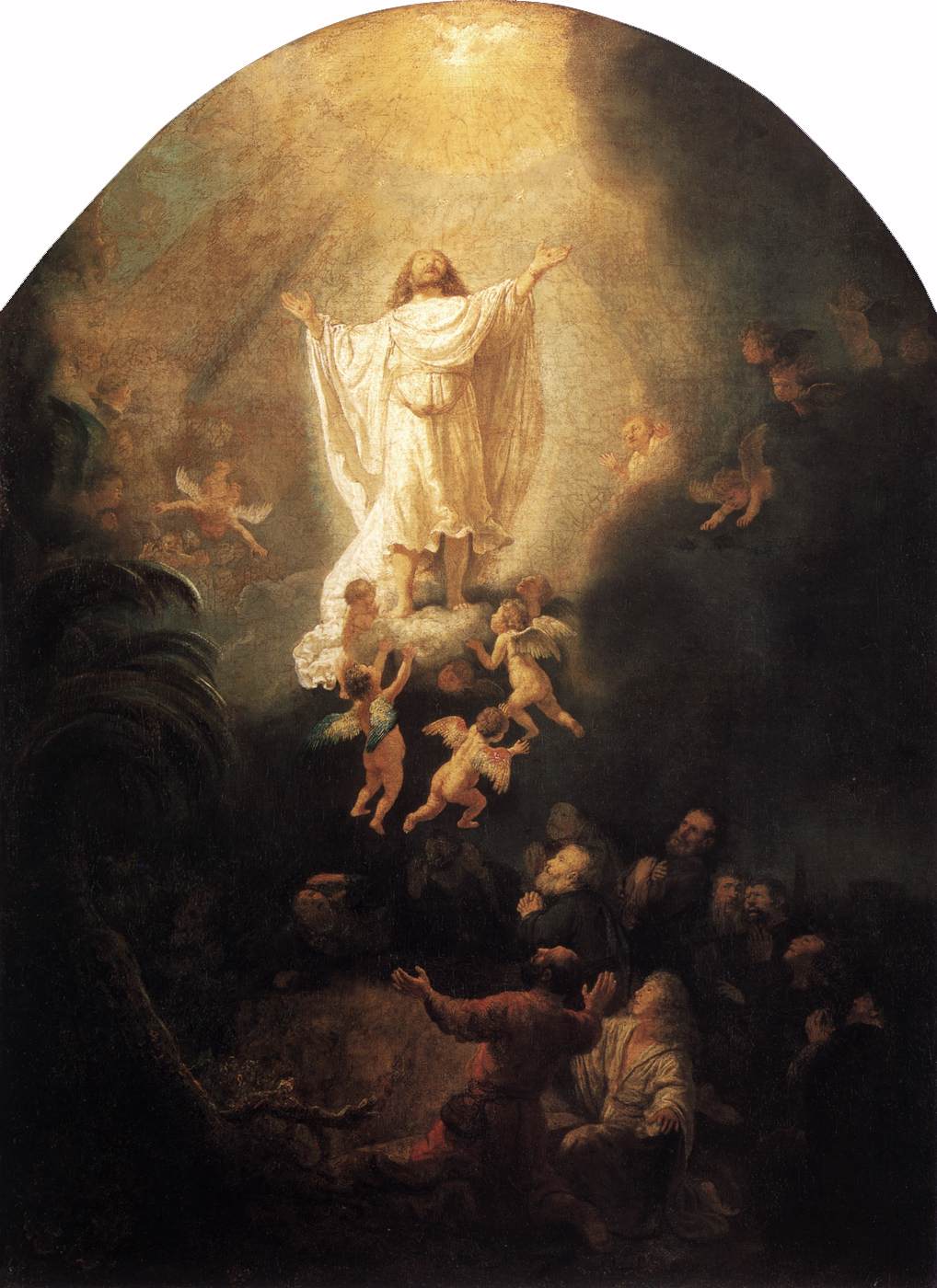
The Ascension of Christ
Rembrandt [Web Gallery of Art]

Ascension, Year C

The Ascension is celebrated on Ascension Thursday, 26 May, in England & Wales, Scotland. In the USA it is celebrated on Ascension Thursday in the Ecclesiastical Provinces of Boston, Hartford, New York, Newark, Omaha, Philadelphia, elsewhere on Sunday 29 May. In all of these areas Ascension Thursday is a Holyday of Obligation.

The Ascension is observed on Sunday, 29 May, in Aotearoa-New Zealand, Australia, Canada, Ireland, Philippines.


Readings, (Jerusalem Bible: Australia, England & Wales, India [optional], Ireland, New Zealand, Pakistan, Scotland, South Africa)

Readings, (New American Bible: Philippines, USA)

Gospel, Luke 24:46-53 (English Standard Version Anglicised: India)  

Jesus said to his disciples:

 “Thus it is written, that the Christ should suffer and on the third day rise from the dead, and that repentance and forgiveness of sins should be proclaimed in his name to all nations, beginning from Jerusalem. You are witnesses of these things. And behold, I am sending the promise of my Father upon you. But stay in the city until you are clothed with power from on high.”

Then he led them out as far as Bethany, and lifting up his hands he blessed them. While he blessed them, he parted from them and was carried up into heaven. And they worshipped him and returned to Jerusalem with great joy, and were continually in the temple blessing God.

Léachtaí i nGaeilge


St John Paul II Memorial, Błonia Park, Krakow

Here is part of the homily Pope Benedict XVI gave in Błonia Park, Kraków, Poland, on Sunday 28 May 2006, the Solemnity of the Ascension. The emphases are added. 

'Men of Galilee, why do you stand looking up to heaven?' (Acts 1:11).

Brothers and Sisters, today in Błonie Park in Kraków we hear once again this question from the Acts of the Apostles. This time it is directed to all of us: 'Why do you stand looking up to heaven?' The answer to this question involves the fundamental truth about the life and destiny of every man and woman.

The question has to do with our attitude to two basic realities which shape every human life: earth and heaven. First, the earth: 'Why do you stand?' - Why are you here on earth? Our answer is that we are here on earth because our Maker has put us here as the crowning work of his creation. Almighty God, in his ineffable plan of love, created the universe, bringing it forth from nothing. Then, at the completion of this work, he bestowed life on men and women, creating them in his own image and likeness (cf. Gen 1:26-27). He gave them the dignity of being children of God and the gift of immortality. We know that man went astray, misused the gift of freedom and said 'No' to God, thus condemning himself to a life marked by evil, sin, suffering and death. But we also know that God was not resigned to this situation, but entered directly into humanity’s history, which then became a history of salvation. 'We stand' on the earth, we are rooted in the earth and we grow from it. Here we do good in the many areas of everyday life, in the material and spiritual realms, in our relationships with other people, in our efforts to build up the human community and in culture. Here too we experience the weariness of those who make their way towards a goal by long and winding paths, amid hesitations, tensions, uncertainties, in the conviction that the journey will one day come to an end. That is when the question arises: Is this all there is? Is this earth on which 'we stand' our final destiny?

And so we need to turn to the second part of the biblical question: 'Why do you stand looking up to heaven?' We have read that, just as the Apostles were asking the Risen Lord about the restoration of Israel’s earthly kingdom, 'He was lifted up and a cloud took him out of their sight.”'And 'they looked up to heaven as he went' (cf. Acts 1:9-10). They looked up to heaven because they looked to Jesus Christ, the Crucified and Risen One, raised up on high. We do not know whether at that precise moment they realized that a magnificent, infinite horizon was opening up before their eyes: the ultimate goal of our earthly pilgrimage. Perhaps they only realized this at Pentecost, in the light of the Holy Spirit. But for us, at a distance of two thousand years, the meaning of that event is quite clear. Here on earth, we are called to look up to heaven, to turn our minds and hearts to the inexpressible mystery of God. We are called to look towards this divine reality, to which we have been directed from our creation. For there we find life’s ultimate meaning.

+++

Christ the Saviour

Thus it is written, that the Christ should suffer and on the third day rise from the dead, and that repentance and forgiveness of sins should be proclaimed in his name to all nations, beginning from Jerusalem. You are witnesses of these things. 

These are from the closing words of St Luke's Gospel, read today. The First Reading is the opening words of the Acts of the Apostles, written by St Luke and the continuation of his gospel. It also describes the Ascension and gives us these words of Jesus: You will be my witnesses in Jerusalem and in all Judea and Samaria, and to the end of the earth. 

Jesus sends us to the ends of the earth to proclaim his name, to proclaim forgiveness of sins for those who repent when they hear the Good News of the death and resurrection of Jesus. Our mission is not to be 'nice' to everyone, not to be 'good' but to be witnesses to Jesus the Risen Lord by the lives we lead.

I am preparing this early, on 20 May, the feast of St Bernardine of Siena (1380 - 1444) a Franciscan friar who promoted devotion to the name of Jesus. There is an extract from one of his homilies in the Office of Readings in the Breviary on his feast day. The saint said, Hence this name must not be hidden. But when it is preached if must not be proclaimed by an impure heart or an unclean mouth, but it must be kept safe and handed on in a chosen vessel.

Further on St Bernardine speaks about St Paul in these words: For he carried the name of Jesus around by his words, his letters, his miracles and his example. He praised Jesus' name without ceasing, and gave glory to it with thanksgiving.

May those words be said of each of us.

Antiphona ad introitum  Entrance Antiphon Acts 1:11

Viri Galilaei, quid admiramini aspicientes in caelum? [alleluia].

Men of Galilee, why gaze in wonder at the heavens? [Alleluia].

Quemadmodum vidistis eum ascendentem in caelum, ita veniet, alleluia [alleluia, alleluia].

This Jesus whom you saw ascending inot heaven will return as you saw him go, alleluia [alleluia, alleluia].


Traditional Latin Mass

The Ascension of the Lord

The Complete Mass in Latin and English is here. (Adjust the date at the top of that page to 05-26-2022 if necessary).

Lesson: Acts 1:1-11. Gospel: Mark 16: 14-20.


Ascension of Christ
Lattanzio Gambara [Web Gallery of Art]