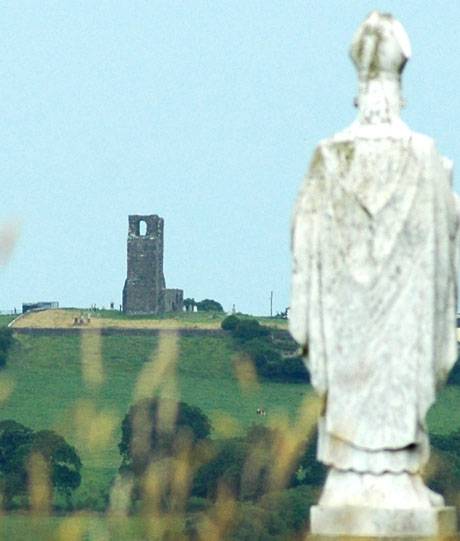
19 March 2010

A fellow-missionary's homily on St Patrick's Day


My fellow-Columban Fr Cyril Lovett, who edits the Far East, the magazine of the Columbans in Ireland and Britain, gave this homily at Mass in St Columban's, Dalgan Park, Navan, County Meath, Ireland, on St Patrick's Day. I've highlighted some parts and added a [comment] or two.

FROM ONE MISSIONARY TO ANOTHER


A reading of St Patrick’s Confession from the viewpoint of a fellow-missionary.

I have always had great affection and admiration for Patrick, and in my years on mission in the Philippines and Brazil I always read his Confession with sympathy and empathy around this time every year.

There are three particular aspects of Patrick that I want to look at:

• Patrick’s attitude towards the Irish.

• The fact that he always remained a foreigner.

• The crushing blow of having his life’s work denigrated by those who should have supported him.

Patrick’s initial contact with the Irish was enough to make him anti-Irish for ever. His father was a Roman citizen, living in the south of Britain, probably working as a civil servant in what would be known today as Boulogne-sur-mer, on the coast of northern France. As Patrick grew up in this isolated outpost, the Roman Empire was beginning to crumble. By 410 Alaric and his Goths had swept into Rome and sacked the city for three days.

At the age of 16 disaster struck nearer to home. His father’s house was raided by Irish pirates and Patrick along with many other youngsters was carried off to Ireland. There he was sold as a slave and spent the next six years herding sheep in all weathers on the slopes of Slemish in the north-east.

So, his first experience of the Irish was anything but a favourable one: the son of an upper class Roman citizen was poorly fed and housed; had to get used to manual labour; and had very little experience of any kindness from his captors. His writings are notable for acknowledging kindness from any source, but of these early years he had no kindness to report. [Fr Michael Sinnott, the 79-year-old Columban kidnapped last October  and held for 32 days in the southern Philippines, speaks of the kindness of his captors every time he is interviewed about his ordeal].

His normal schooling was also interrupted. He tried to make up for it later but he had to cope for the rest of his life with being a lonely man, with a permanent feeling of being isolated and unwanted. In our first ventures into another culture, we generally go full of hope and as we learn to cope with a strange new world we are enriched by the good things in it, and we learn to live with the down-side. [Father Sinnott has spoken of never understanding all the nuances of the culture in which he lives.]

When we return after holidays, it is the richness of the good things in the people and the culture that sustain us. For that reason I find it hard to imagine the heroism of Patrick who would later chose to go again to a people who had only given him unhappy memories and minister among them for more than thirty years.

Patrick remained a foreigner in Ireland for the rest of his life; this had to be so.

He writes “This is where I am now in all my insignificance among strangers”. This is a state that all of us missionaries can identify with. For all of us, working in one or more different cultures has been an enormous enrichment. The downside is that we can never fully belong: as soon as we open out mouths we are recognised as foreigners, even if our appearance has not proclaimed that loudly beforehand. And then having adapted as best we can to the new culture, we often find that we can no longer be fully at home in our own culture. There is then an aspect of being a nomad in living out our missionary vocation. [This aspect of missionary life is being written about more lately. The situation of the missionary is not quite the same as that of a migrant, whoe life may well be more lonely. But it is a phenomenon of migration that people from the same area in the home country often migrate to the same country and even the same area, eg, there are many Australians whose ancestors came from County Clare in Ireland. But people from neighboruing County Galway tended to migrate to the USA. Daly City in California is full of Filipinos. Most of the Filipinos in Hawaii, or people there of Philippine origin, trace their roots to the Ilocos region of northern Luzon. So migrants often find a large community of their own, unlike missionaries.] Patrick’s initial six years in Ireland meant that he acquired a good grasp of the language, but he would write later of his critics, “I was afraid of drawing general gossip on myself because I had not studied like the other who got a thorough grounding in law and theology. They never had to change their medium of speech since childhood…while I had to express myself in a foreign language.” [I once met a Filipino businesswoman at a gathering of Irish people in Cebu, Philippines, one St Patrick's Day. She travelled extensively and spoke English fluently. But she told me how trying it was at times when she had nobody to speak to in her own language, Cebuano visayan.]

He never went home to Britain and he felt that deeply. [Until less than a hundred years ago many missionaries never expected to go home again. Manyh of them didn't because they died very young.] He wrote, “It is not practical for me to consider leaving them and going to Britain. How dearly would I love to go, like a man going to his homeland and relatives, and not only there but also to Gaul in order to visit the brothers and to meet the members of the Christian community. God knows how I yearned for it but I am tied by the Spirit”.

And then there was that awful experience that happened to him late in life. When he had decided to respond to the Spirit calling him to evangelise the Irish, it seems he went for his early formation to Germanus of Auxerre. Germanus took him under his wing, understood his difficulties as a late vocation, but recognised his sanctity and his missionary potential, and had him ordained a deacon and later a bishop. When Germanus went to visit Britain, Patrick went along with him to try and get the financial backing of the British bishops for his mission to Ireland. But, Ireland was considered unimportant and savage; after all Patrick’s predecessor Palladius had disappeared there without a trace, and Patrick did not have great credentials. He may have wasted up to eight to ten years before he finally got the backing he sought.

Then, years later, as Patrick was trying to face the various challenges of his mission in Ireland, there was a disaster.

Here is how he describes it...

"I was put to the test by some of my senior fellow-bishops (in England) who came to cast up my sins at me in order to discredit my hard work as a bishop of this mission… After thirty years they discovered against me a confession which I had made before I became a deacon. In the anxiety of my troubled mind I confided to my dearest friend what I had done in my boyhood in one day… because I had not yet overcome my sinful ways…

My only sorrow that we should have deserved to hear such a report is for my dearest friend. To him I had confided my very soul… Now I was not in Britain at the debate… how could he have let me down publicly before all, good and bad, in a matter in which he had previously favoured me?” [It is not an enemy who taunts me-- then I could bear it; it is not an adversary who deals insolently with me-- then I could hide from him. But it is you, my equal, my companion, my familiar friend. We used to hold sweet converse together; within God's house we walked in fellowship Ps 55 (54) 12-14].

And he goes on to say, “On that day indeed the impulse was overpowering to fall away not only here and now but forever. But the Lord graciously spared his exile and wanderer and helped me greatly when I was walked on in this way. The disgrace and blame I felt, however, were considerable.”

So, this is the Patrick that I can relate to: a man heroic in his human qualities; a man who faced the kind of difficulties that missionaries of every age continue to face; a man of deep faith; a man who was inclined to postpone some hard decisions; a man who carried scars from the past, who was very conscious of his own shortcomings; and a man who suffered greatly at the hands of the very ones who should have supported him.

We ask his intercession for our country as it passes through the present crisis.

Homily at Mass in Dalgan Park by Fr Cyril Lovett SSC - 17 March 2010

17 March 2010

A St Patrick's Day greeting from the Philippines


The Hill of Tara is where the High Kings of Ireland lived. You can see it directly from the front door of St Columban's, Dalgan Park, Navan, where Irish Columban priests were formed from 1941 onwards. My maternal grandmother grew up in this area.

St Patrick, whose place of birth we do not know, wasn't Irish but probably grew up in Wales. He was kidnapped at the age of 16 and taken to Ireland to take care of animals. He escaped six years later and returned as a missionary bishop. He died in Ireland in 461. He is patron saint of Ireland and of Nigeria.


The UST Singers, from the University of Sto Tomas, Manila, sing an Old Irish Blessing. The university is the oldest existing in Asia.


Dóchas Linn Naomh Pádraig (a traditional hymn in honour of St Patrick, with my English translation).


Dóchas linn Naomh Pádraig, Aspal mór na hÉireann,

Bring hope to us, St Patrick, great Apostle of Ireland,

Ainm oirearc gléigeal, solas mór an tsaoil é.

Illustrious, glorious name, he is the great light of the world.

D'fhill le soiscéal grá dúinn d'ainneoin blianta i ngéibheann.

He came back to us with the gospel of love, despite years of captivity.

Grá mór Mhac na páirte, d'fhuascail cách ón daorbhruid.

Great love of the Son, freed all from oppression.


'Sé a chloigh na draoithe,

He who defeated the druids

Croíthe dúra gan aon mhaith.

Hard of heart and no good.

D'ísligh dream an díomais

Brought down the arrogant

Trí neart Dé ár dtréan-fhlaith.

Through the strength of God our powerful lord


Sléibhte, gleannta, máighe,'s bailte mór’ na hÉireann:

Hill, valleys, plains, large towns of Ireland

Ghlan sé iad go deo dúinn, míle glóir dár naomh dhil.

He cleaned them for ever, a thousand praises to our dear saint

Iarr’maid ort, a Phádraig, guí orainn na Gaela,

We ask you, Patrick, pray for us Irish,

Dia linn lá 'gus oíche 's Pádraig Aspal Éireann.

God and St Patrick Apostle of Ireland be with us day and night.

13 March 2010

'On God's Mission': Irish TV series on Catholic missionaries

Thanks to Shane blogger of St Adamnan's Diary, who commented on my previous post, for alerting me to RTÉ's two-part TV series, 'On Mission'. RTÉ is Ireland's national radio and TV service. The first programme, 50 minutes long, was broadcast on 2 March and is available online till 23 March here, while the second, shown a week later, is online until 30 March here. Shane gave a link to the blog of Fr Ray Blake of St Mary Magdalen Parish, Brighton, England.

The first programme of 'On Mission' covers the growth of the missionary movement of the Irish Catholic Church from the early part of the last century until the 1960s while the second part shows how it has declined and changed, being replaced to a large degree by the growth of NGOs which send many young Irish people overseas.

Fr (later Bishop) Edward Galvin in China

The Missionary Society of St Columban, of which I am a member, featured in both parts. 90-year-old Father Michael Healy ordained in 1943 eight months after I was born was interviewed. During the War years, when missionaries were unable to travel to Columban missions, he worked in Britain. Then he was sent to China and after being expelled from there with other missionaries he was assigned to Burma. When I was sent to Britain in 2000 where I spent two years visiting parishes on behalf of the Columbans he was still doing mission appeals, a joyful, happy priest with a huge network of friends.

I was very interested to see footage of Bishop Edward Galvin, co-founder, with Fr John Blowick, of the Columbans. When the Irish bishops gave their consent to the Maynooth Mission to China on 10 October 1916 Father Galvin was only 33 and Father Blowick 29. The Maynooth Mission formally became the Society of St Columban on 29 June 1918, the feast of St Peter and St Paul.

The narrator, Barry McGovern, who has a wonderful speaking voice, said that trouble seemed to follow the Columbans everywhere. That is true. We were caught in a China that was caught up in turmoil from bandits, then the Sino-Japanese War followed by World War II and the Communist takeover in 1949. Our missionaries in the Philippines, Burma and Korea were also directly affected by World War II and a number of our priests died in the Korea War that followed a few years later.

Bishop Joseph Shanahan CSSp of Southern Nigeria

This first programme showed the idealism and foresight of such great missionaries as Bishop Edward Glavin, Bishop Joseph Shanahan CSSp of Southern Nigeria, and Mother Mary Martin, who founded the Medical Missionaries of Mary and had to fight her way through opposition in the Vatican that finally recognised the need for religious Sisters who were qualified in the medical professions.

One of those who commented during the first programme was Festus Ikeotuonye, a Nigerian sociologist who has lived in Dublin for ten years. He seemed to say that the Irish and other missionaries had been colonizers and implied, as I understood, that they had probably done more harm than good. Yet the programme showed that Irish missionaries, coming from a background of being colonised themselves, understood the people of Africa, in particular, in a way that missionaries from colonising powers such as Belgium and France didn't. I wonder if he would have been working as a sociologist in Dublin if people with the vision of Bishop Shanahan had not started an educational system that was taken up in many African countries. The programme stated that Bishop Shanahan had been deeply influenced by his father's passionate belief that education was the key to freedom.


Mother Mary Martin MMM

The missionaries in the first half of the last century were driven by a passion to bring the Gospel of Jesus Christ to persons who didn't know him. They saw 'success', if that word may be used, as the number of those who were baptised. yet Bishop Galvin once said 'We are not here to convert China but to do God's will'. He had no interest whatever in the trappings of being a bishop but was very particular about his episcopal motto, Fiat voluntas tua, 'Thy will be done', as William Barrett points out in his biography of this great bishop, The Red-Lacquered Gate.

The second programme quoted my Columban colleague, Fr Shay Cullen, saying Saving souls doesn't come into the equation, doesn't come into our thinking - we've gone beyond all that. That's a very old theology, that's quite irrelevant nowadays. We're about transforming society and trying to create some kingdom of justice and peace here on this earth. Father Shay was one year behind me in the seminary. He has dedicated his life to saving children and women caught in sex slavery and has helped to bring about a change in the laws of a number of countries, including the Philippines, where he is located. I have no doubt that what he is doing is a proclamation of the Gospel.
Fr Shay Cullen

However, I think that one of the roots of injustice is that so many baptised persons, especially persons with power, are 'practical atheists', as distinct from persons who don't believe in God but who live by a moral code. I don't think that these 'practical atheists' really believe that they have to answer to God for the injustices they bring about, for the human degradation that they cause. I think that the Church has to speak to people about our eternal destiny. Father Shay refers to the Sermon on the Mount. Jesus makes quite a few references to Hell, especially in the parable of the last judgement, Mt 25:31-46, which shows a direct link between what we do here and now and what will happen to us after death. I think we need to look again at 'saving souls'.

Fr Shay Cullent with children

When I was in the seminary in the 1960s there was a common saying, 'You can't preach the gospel to an empty stomach'. (I don't remember any of our teachers saying this). On the face of it this seems to be true. But it's not. Jesus fed the hungry, cured the sick, forgave sinners. All of this was a proclamation of the Gospel. Irish missionaries have been doing all of those things, often in desperate situations, staying with the people, as the missionaried did with the Ibos of Biafra, Nigeria. They weren't supporting a political point of view but simply staying with the people in their plight. The result was that they were expelled when the Biafran War ended.
Sr Cyril Mooney IBVM, Kolkata, India

Loreto Sister Cyril Mooney IBVM in Kolkata came across as a loving grandmother, driven by her Christian faith, enabling children living on the streets to get an education and to have a future. She recognises the goodness of people of other faiths and that virtue is not confined to Catholics or Christians. She also faces the reality that the vast majority of Indians are not Christians and doesn't believe that they thereby go to Hell. Sister Cyril came to an awareness of her vocation to be a missionary Sister at the age of 13 at a specific moment and in a specific place. She can recall the words of a visiting missionary Sister that touched her heart. My own awareness of being called to be a missionary priest began at around the same age, as you can see in my previous post, though not at a precise moment. She is still living her vocation joyfully 63 years later, as the programme clearly showed. Her love for the children she serves was palpable. I was delighted also to see her stroking her cat!

Students at Loreto Sealdah, Kolkata, established by Sr Cyril Mooney IBVM

John O'Shea of GOAL recognised the heroism of the Irish missionaries of the last century in that they gave their whole lives whereas young Irish people today will give a year or two of their lives but rarely their whole lives in service overseas. It was faith that drove the missionaries but it is not always faith that motivates those who go on overseas service now, though it may be a factor. Generosity too is clearly there.

Every morning, on arrival at school, Sr. Cyril is greeted by her 'rainbows'.
Sister Cyril greeting students in the morning

As I write this I recall that a few months ago two Irish people were kidnapped, one in Sudan, one here in the Philippines. Sharon Commins of Dublin and Hilda Kawuki of Uganda, both GOAL volunteers, were kidnapped in Darfur, on 3 July and released on 18 October, a week after Fr Michael Sinnott, a 79-year-old Columban priest, was abducted in the southern Philippines. He was released 32 days later. Father Sinnott was a Catholic missionary in the old sense, Sharon and Hilda aid workers in a desperate situation. Yet their Catholic faith sustained them during their ordeal and was quite probably part of their motivation in going to Sudan in the first place. Though neither Fr Michael Sinnott nor Sharon Commins were mentioned in the series, they represent, I think, the best of the old and the best of the new.

Tom McGurk wrote about 'On God's Mission' in the 7 March edition of Sunday Business Post, an Irish newspaper, The forgotten Irishmen and women with a mission.

It was the Catholic faith that men and women from every part of Ireland to give their lives in the service of others in countries so different from their own. I don't think they were 'colonisers' but persons who wanted others to know Jesus Christ. They used every means possible to do this, setting up schools where people had no opportunity of formal education before, opening clinics and hospitals where no formal medical care had been available, feeding the hungry in the midst of war and famine, all in the name of Jesus Christ.

Just as I was starting to write this a technician from Philippine Long Distance Telephone Company (PLDT) came to check our broadband service which, at times, is 'iffy'. We had a good chat. He came here 26 years ago from Leyte, another island, on a brief visit to do a job. A German Benedictine Sister asked him if he wanted to continue his education. The result was that he stayed here, met his wife, is actively involved in his parish and one of his two children is graduating this month as salutatorian (the student with the second highest grades) from a school run by the same Benedictine Sisters, now nearly all Filipinos. There are many others like him who are grateful to God for the opportunities dedicated missionaries created for them and for enabling so many to come to know Jesus Christ.

You can read an article on the life of Bishop Edward Galvin in the current issue of Misyon, which I edit for the Columbans in the Philippines, Edward J. Galvin: Trailblazer for God.

There's information on Loreto Sealdah, Kolkata, here.

07 March 2010

'A Pineapple, a Junk and a Spitfire' - my vocation story


A Pineapple, A Junk And A Spitfire

by Fr Seán Coyle

The first book I ever read, when I was 7, was Treasure Island. A map guided Jim Hawkins and his friends to the hidden treasure. God drew a map with clues that guided me to discover the treasure of my vocation during my teenage years.

The first clue was Sister Gemma of the Irish Sisters of Charity in my second year in kindergarten in Stanhope Street, Dublin. She spoke about the need to support missionaries and asked us to speak to our parents. My classmates brought in the equivalent of a peso but mine gave me the equivalent of five, a lot of money for them as my father worked as a carpenter on a construction site. Sister Gemma gave me a little calendar with a picture of St Thérèse of Lisieux, Patroness of Missionaries. I didn’t know at the time that the saint would influence me greatly years after my ordination, even though I still don’t like the name she gave herself, “the Little Flower.”

The following year Father Woods came to our school. He was a parishioner but worked somewhere in Africa, which was unimaginably far away for us, a place where the people hadn’t heard the Good News. At least that is what the Sisters told us. I don’t remember a thing Father Woods said but I can still see him sitting in front of us, a fascinated audience, showing us artifacts from the country where he worked.

When I was a child pineapples were very expensive in Ireland and I dreamed of living in a country where they grew. Only after two years in the Philippines did I discover that they didn’t grow on trees! But my childhood dream was all part of the Lord’s gracious invitation.

My first contact with the Columbans in kindergarten was their magazine, The Far East. It had a picture of a traditional Chinese boat, a junk, on the cover. That was to take me to my “Treasure Island.”Z

I was confirmed in Grade Four while at O'Connell Schools, Dublin. My teacher, John Galligan, was very proud of his family and always talking about his wife. He once brought her to meet us, the only teacher who ever did that. He also had a great love for the Mass and taught us how to use the bilingual Latin-English missal in those pre-Vatican Two days when everything in church was in Latin. John Galligan, as I realized only years later, had a deep influence on me, as did another John, my father, who went to Mass every day of his life up to the day he died. My Dad didn’t talk about his faith. He just lived it and was the same person with everyone he met, deeply respectful to all.

In high school I tried to go to Mass every day. Often enough, especially on cold, winter mornings, I just turned over and got some extra sleep instead. By this time too I had already begun to see that girls my own age were very attractive. And I wanted to be a pilot, as did all my barkada. We were all strongly under the influence of Biggles, a fictional fighter pilot in the Royal Air Force. We devoured the novels Captain W.E.Johns wrote about him. He flew a Spitfire, a fighter plane that with the Hurricane won the Battle of Britain in 1940. To this day, though I am a pacifist, more or less, I find few things more beautiful than the graceful Spitfire in flight, the closest thing to a bird that man has ever made.

Of that barkada (a Filipino term for a group of young friends) of would-be pilots, two became doctors, one a diplomat and I a priest. During that first year in high school I began to feel the stirrings of an interest in being a priest. And it was always an interest in being a missionary priest. Other countries have always fascinated me and God built on that natural interest which he had put there in the first place.
With my Dad, John, my Mam, Mary and my brother Paddy, ordination day 20 December 1967 in St Mary's Pro-Cathedral, Dublin. Above: first blessing to a relative.

The following summer, 1957, I got my first job, at a small gasoline station. There weren’t too many customers and I had lots of time to read. I used to bring copies of The Far East and other material about missionaries to work and it became very clear to me that I really wanted to be a missionary priest. I still had four years to do in high school but my desire never wavered, despite the fact that I continued to notice that girls my own age were not only nice to look at but even nicer to be with. The idea of not being with them was the most difficult part of joining the Columbans in 1961. I had decided on the Columbans two years before that. I had shopped around all the missionary groups. Reading the students’ column in The Far East I wanted to be with these young men who were so human, not too much unlike myself. A Christian Brother who taught us, who didn’t know what I was thinking, said to us in class one day, “Only the best join the Columbans.” That encouraged me.

Another factor that drew me to the Columbans was that they had been founded in my native Ireland but were international in membership, with men from Ireland, Britain, Australia, New Zealand and the USA all working together in each country where there were Columbans. That international aspect has expanded and now we have members from Chile, China, Fiji, Korea, Peru, Philippines, Tonga and Vietnam.

The Columbans are secular priests, not religious. I never felt any desire to take a vow of poverty, though I had no expectation that I would become a millionaire either. Nor have I!

Behind all of this was a desire to bring the Good News to people who hadn’t heard it or whose church still needed support from overseas. I had a simple view of things but it was real and I’m convinced that the Lord was speaking to me through it.

The seminary years only strengthened my desire to be a missionary priest. Time and time again my experience as a priest has confirmed that, especially on occasions such as students’ retreats when young people, who so often judge themselves harshly, get an inkling of God’s unconditional and tender love for them. In recent years I find myself repeating more and more to people one of my favorite lines in the Bible, and it occurs many times, 'God takes delight in his people.'

Maybe God has called me to be a Columban just to learn that for myself and to tell others about it.

I wrote this article for Misyon, which I edit for the Columbans in the Philippines. You can find it in its original setting here and the video version in its original setting here.

06 March 2010

5 March update on Chile earthquake from Columban superior there


5 March 2010


Dear Friends,

It is five days since the earthquake and tsunami that has claimed the lives of more than 800 people with hundreds still not accounted for and more than 2,000 homeless. Some 700 churches and chapels have been destroyed in the five dioceses that make up the most affected regions. While we as Columbans do not have any parish commitments in the most affected areas, we do however have many contacts and frequent pastoral involvement. I personally have been going to Concepcion once a month for meetings. Some of our lay missionaries, Pilar Vasquez, our priests, Fr Alvaro Martinez, our seminarians, Rafael Ramirez, members of JUCOMI (Chilean Columban Youth) Alejandro, all have family in the most affected regions. All of us have been affected by this natural disaster and each one has his or her story to tell. For many days to come, people will ask, 'where were you for the earthquake?' It is still the basic topic of conversation as if nothing else matters. One young university student said this evening, 'once I discovered that my family was safe and our house was still standing, I just knelt down and thanked God and then headed off to help those who were still on their knees under the weight of the cross that they were made bear'.

With several days without communication between the most affected regions, particularly the region of Maule (where the best of Chilean wine comes from), the battery radio and the flash lamp have proven to be indispensible companions. I had only to remember my father (in Ireland), as these were two of his most treasured items. Among the items that people are asking for in the affected regions are small batteries to keep their transistors going. Local radio has proved a Godsend where technology is used at its best to locate survivors, communicate information and build a sense of community.

We have now realized that a tsunami occurred within five minutes of the earthquake and affected the coastal towns from Rancagua to Concepcion, some 429 kms of coastline.

I could only think of a comment made by John Moriarty, when he said that the sea is beautiful and majestic, a wonder of creation, an invitation to tread its waves, but yet it is a beast and it can as easily bring destruction as beauty and calm.

The tsunami has been very embarrassing for both the Chilean government and navy each of which on several occasions assured the country that we were well equipped to respond to such a natural disaster and it would not take us by surprise as in other parts of the world. When it arrived it took everyone by surprise and resulted in severe loss of life and massive devastation.

Chile has always been in denial that such a natural disaster was immanent.

It is only this evening that some of the affected regions have got their electricity back and they can see images on their television of the vastness of the tragedy throughout the country. Today many people are managing to make contact with their friends and relatives in various parts of the country and the world as mobile phones are charged and telephones systems are being restored.

We here in Valparaiso and Santiago have had our water supplies and electricity restored since last Monday. However in some parts the water supply is restricted to certain hours of the day. I have learned to live without a shower and spare the water in the bucket.

Santiago has got back to normal as regards transport and communication but transport in and out of Santiago is still difficult. Bridges on the main road from north to south known as 'Ruta 5 Sur ' collapsed during the earthquake, but the road is now open to emergency and relief traffic as the military have installed mechanical bridges.

This earthquake has brought out the best in Chileans and the worst. While most rallied to be of help and tried to keep calm, think on their feet and gather their immediate emotional reaction to do what was right and correct, others were empowered by evil for evil. They looted supermarkets and small businesses, left small shop owners with nothing to fall back on. These people laughed at the police and the press as they shouldered their merchandize away or transported it in pick-up trucks. Today some of the same people were selling their supplies on the black market, with no shame or self-respect.

This is very much in contrast to Matías Villegas and Miguel Neira from Rancagua who with a group of their university friends got together to cook and serve up to 1,200 hotdogs to people in the small villages along the affected coastline. Also there is Luis Gatica, a paramedic who lost his parents and his son in the tsunami in the village of Putú. He is presently giving himself completely to looking after the medical needs of the survivors of the village.

While Chile does have the resources to respond to this natural disaster, there is so much inequality, centralization and no autonomous regional government. This has been brought to bear in the initial slow response by the government to the regions most affected by the earthquake and tsunami. With the military back on the streets of Talca, Constitucion and Concepcion, a curfew has been put in place. And in the wake of all of this we foresee the likelihood of a right wing government taking power on 11 March. The scene is set for a very complicated, difficult and complex political and social reality in the immediate future.

This year Chile celebrates 150 years of its independence. The stage was set for a multitude of celebrations, two of which were cancelled over the past few days. The reality of the earthquake and tsunami has changed the sense of our celebration from rejoicing in a triumphal past to a building of bridges, healing of divisions and the creation of a new sense of hope.

Every Chilean has been invited to respond to this natural disaster. Friday and Saturday have been set aside for a national campaign for Chile to help Chile. While we have received direct help from Australia, the United Sates, Spain, Cuba, Argentina, Bolivia and Peru, the whole country has been called on to come to the aid of the victim of this terrible natural disaster. While all Columban parishes are committed to this campaign and church collections are being channelled through CARITAS CHILE, we as a region have decided to also focus our attention on some small towns and villages that are in great need and out of the limelight of the media. We have decided to support in the immediate and the long term the villages that are part of the parishes of Pencahue, near Talca and Hualañe, Licantén and Vichuquén on the costal region of Curicó. In Pencahue, a parish of 25 chapels, more than 1.200 houses have been totally destroyed and there is fear of the rains coming soon as we are into autumn. Fr Alvaro Martínez has already gone down to Pencahue, while I am going down tomorrow, Friday to Hualañe and Licantén. Both of us have collected food supplies and the local community here in Valparaiso have been campaigning for the past three days in solidarity with these places.

Many family members, friends and benefactors are asking how to help. I would like to invite all who would like to respond in any way to the work of relief and reconstruction, to support our Columban initiative by your prayers and generosity. The villages that we are supporting are poor and when the country moves on to other things, they will be very often forgotten about.

During these days of Lent, the reality of fast and abstinence has taken on a real meaning for many people here in Chile. While the Christian communities are aware of this Holy season, most people are not. They are however caught up in a moment in their lives when all of us ask, 'where is our God?' There is a yearning to try and understand it all and see the Hand of God ever present and ever near in our lives and planet earth.

Many thanks to each and everyone for all your support, interest, prayers and communication.

Fr Derry Healy

Father Healy, from County Cork, Ireland, is Regional Director of the Columbans in Chile.

04 March 2010

Liturgical postscript to St Casimir: 'Dives and Lazarus' worship and liturgy


Dives and Lazarus, Bonifacio Veronese, 1540s

Today's gospel, that of Dives and Lazarus, was appropriate for the commemoration of St Casimir, a prince noted for his strong sense of justice and love for the poor.

I was struck by the contrast in the English translations of the Collect or Opening Prayer for Thursday of the Second Week of Lent, that of ICEL and that in the breviary produced under the direction of the bishops of Australia, England & Wales, Ireland and Scotland, that I use.

ICEL

God of love,
bring us back to you.
Send your Spirit to make us strong in faith
and active in good works.

Grant this, etc

My Breviary

Lord God,
you love innocence of heart,
and when it is lost you alone can restore it.
Turn then our hearts to you,
and kindle in them the fire of your Spirit,
so that we may be steadfast in faith
and unwearied in good works.

We make this, etc.

I can't find the original Latin but the ICEL translation looks like a 'Lazarus' one in that it seems to be very undernourished English-wise.

St Casimir Church, Cleveland, Ohio, USA


Chapel in Hinsley Hall, Leeds, England, owned by the Catholic Diocese of Leeds

I can't help but notice a 'Dives and Lazarus' contrast here also. Which of these two places of worship is more likely to nourish the worshipper? 

A prince known for his sense of justice and for his purity


St Casimir (1461-1484) was a prince who is now the principal patron saint of Lithuania and also a patron of Poland. The reading from the Office of Readings for his feast, which in Lent is observed as a commemoration, in other words it is optional, taken from a life of the saint, 'written by a close contemporary', highlights some of this young man's deeply Christian qualities.

  • He dedicated himself completely and entirely to Christ's poor, to the pilgrims, the sick, the prisoners,and to all in distress.
  • To widows, orphans and the oppressed, he was not only a protector and defender, but a father, son and brother.
  • Nor is it possible to tell or even imagine the extent to which he promoted justice and exercised temperance, or the prudence with which he was endowed, or the strength and constancy of is character, and that in an age of permissiveness, when men were very much inclined to fall into evil ways . . .
  • Day by day her urged his father to rule the kingdom and the subject peoples with justice . . .
  • He took up the causes of the poor and wretched, and followed them up as if they were his own. Because of this the people called him the defender of the poor . . .
  • It was always his preference to mix with the poor and the weak . . .
  • He never sought the power which belongs to men of the highest rank . . .
  • We have the word of important and trustworthy men, who were close to him and in whom he confided, that he lived as a virgin all his life, and died a virgin.
We have elections here in the Philippines in May for everything from the presidency down to local councillors. It is difficult to find evidence of the virtues of St Casimir among the candidates for the major offices. A convicted but unrepentant plunderer, who has never served a day in prison for his crimes, who uses a false name and was pardoned by President Gloria Arroyo, who succeeded him when he was deposed, is running for president again. Three of the Marcos family, who destroyed the Philippines during the Marcos dictatorship, are running for office and the 84-year-old president of the Senate, the architect of Marcos's Martial Law and who tried to bring the scouting movement directly under the control of the military in 1985, is running again for the senate.

One of the things that happened during Martial Law was the forced sterilisation of many women after they gave birth in government hospitals. The Population Commission at the time was pushing a very aggressive population control programme at the time. It was widely believed that each government hospital had a quota of sterilisations that they were expected to meet. Husbands weren't consulted and wives often made decisions that they later regretted because they were under pressure from those who should have been taking care of them.

On the other hand, government doctors and nurses are poorly paid. Today, many fully qualified nurses who cannot afford to go overseas where they will get jobs with decent pay, often have to offer their services as 'volunteers' in government hospitals.

There is no question that many Filipinos have a strong Catholic faith. Many died during the Martial Law years in witness to that. But there is a woeful absence of a sense of  the justice the Gospel demands, especially when it concerns the poor and the good of the wider community, as shown in the Human Face column of Ma. Ceres P Doyo (photo) in today's Philippine Daily Inquirer, Confessions of a highwayman. You can also find the article on Ceres' own blog, Human Face by Ceres. Ceres is one of the best journalists in the Philippines.