12 October 2010

A Columban visits 'Camp Hope' in Chile

We hope and pray that the trapped miners in Chile will all be taken safely to the surface during the next few days. Here is an article by Columban Father Alvaro Martinez who visited Camp Hope recently. The article is by courtesy of the Columbans in Australia and New Zealand.

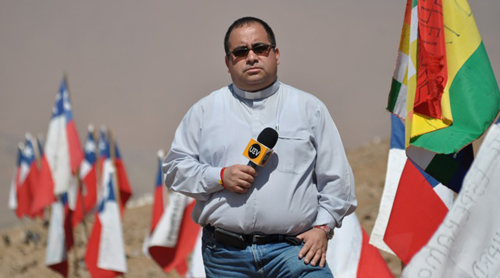
Fr Alvaro Martinez

During the rescue effort to free 33 miners in the San José mine near Copiapó in Northern Chile, Columban Fr Alvaro Martinez went to ‘Camp Hope’ with a television crew to do a report for the program, ‘The Paths of the Church’. He said, “We planned to speak with the families of the miners about how their religious faith helped them deal with waiting and hoping for the rescue of the miners.


On the streets of the mining camp, ‘Hope’, one can feel the anxiety of just waiting for the rescue. Each person, relatives and miners, feel the hammering of the machines that break the rock in search of the trapped men. This banging provokes both anxiety and hope. It also creates tension between people, as do a variety of circumstances of this temporary living arrangement. There are 33 families who have come to live in the camp. They live in tents without the conveniences of a town, but they do have running water and toilets. Recently a small school was installed so the miners’ children can continue with their classes. The camp is located 45 kilometres north of Copiapó.” Copiapó is 800 kms North of Santiago, Chile.

In the midst of this tension I felt the harassment from international mass media organisations making offers for an exclusive interview when the miners come out of the earth. Big money provokes people to make a deal with major television chains. I suggested to one family member whom I was interviewing that they be careful about allowing their men being subjected to more stress as they came out of the mine. The response was clear and firm: “We have to get organised to ensure the future”. Tough, but realistic. They are determined to do something about the bad work conditions of miners.

Along with that seething determination to work for greater justice in the workplace, the miners and their families have demonstrated an unbreakable trust in God and the Virgin Mary, giving witness of a living faith to the whole country. They made the idea of trusting in God real as the families and their men organised both above and below ground with daily routines of work and prayer. In the interviews with the families and friends who await the rescue I could feel how their faith was key to sustaining them in the midst of the tensions and anxiety of the ongoing rescue work.


Miguel Valenzuela was one of those who spoke to me. He said, “I’m not one for going to church but the day they told me the children (that is how their family members refer to the trapped miners) were alive I exploded with joy; I gave thanks to God and the Virgin Mary for returning our ‘children’ to us. The miracle that they are alive is half of it; the other half (which has yet to happen) is getting each one of them out alive”.

I asked Alonso Contreras, cousin of Carlos, one of the trapped miners - What happened in the mine? How have those men united and kept themselves going through their faith in God? He told me that there was one miner who is a man of faith and piety, who had been a messenger of hope for all the trapped men. He awakened the desire to look at God in the darkness 700 metres down and find the light of the Risen One. One of the trapped miners did not believe in God, but in one of the first telephone conversations he told his cousin, “I have found God and believe God exists.

These stories move me to share the importance of being a missionary in today’s world. A man of faith proclaimed a message of hope in the face of despair; he was able to see light in the midst of the darkness 700 metres below the earth’s surface. This man’s example urges us to witness our own faith, to offer hope in the face of despair.

Fr Alvaro Martinez SSC has worked in Santiago, Chile for many years.

08 October 2010

'Your faith has saved you': 28th Sunday of Ordinary Time Year C, 10 October 2010

Christ healing a leper, sketch by Rembrandt, drawn c. 1657-1660.

Readings


New American Bible (Philippines, USA)

Jerusalem Bible (Australia, England & Wales, Ireland, Scotland)

Gospel (Luke 17:11-19, NAB)

As Jesus continued his journey to Jerusalem, he traveled through Samaria and Galilee. As he was entering a village, ten lepers met him. They stood at a distance from him and raised their voices, saying, "Jesus, Master! Have pity on us!"

And when he saw them, he said, "Go show yourselves to the priests."

As they were going they were cleansed.

And one of them, realizing he had been healed, returned, glorifying God in a loud voice; and he fell at the feet of Jesus and thanked him. He was a Samaritan.

Jesus said in reply,
"Ten were cleansed, were they not? Where are the other nine? Has none but this foreigner returned to give thanks to God?"

Then he said to him, "Stand up and go; your faith has saved you."


When I was in kindergarten in Dublin one of the first holy persons I learned about was Father Damien of Molokai, now St Damien. Sister Stanislaus, the Irish Sister of Charity who was the principal of the boy's kindergarten and who prepared us for our First Holy Communion in 1950, was forever telling us about this great priest.


A few months after my First Holy Communion Mother Teresa's Missionaries of Charity were formally established. She had spent a few months in Dublin, 1928-29, as a postulant with the Loreto Sisters and it was they who sent her to India where she was a member of that congregation till she got permission to found the Missionaries of Charity.

Both St Damien and Blessed Mother Teresa exemplified very powerfully the mission of Jesus to those who are on the margins of or outside society. Both gave themselves at great cost. For St Damien it was isolation and then finding that he had acquired leprosy. For Blessed Mother Teresa, as we know now, there was deep spiritual anguish. Part of the cost to Jesus himself in today's gospel was the lack of gratitude of nine of the ten whom he had healed and enabled to be fully part of society again.

The Church continues to bring the healing power of Jesus to people who have nothing or who are ostracised.

The gospel too evokes the words of St Paul: 'Rejoice always, pray constantly, give thanks in all circumstances; for this is the will of God in Christ Jesus for you' (1Thess 5:17) and 'always and for everything giving thanks in the name of our Lord Jesus Christ to God the Father' (Eph 5:20). I remember an incident outside a retreat house in Cebu in the morning of Holy Thursday 1990. A woman and her daughter, aged about 13, asked me for money. I made an excuse that I was only visiting. Later I saw them sitting on the steps of the retreat house, the daughter, clearly tired, with her head on her mother's shoulder. When I was leaving I gave them enough to buy a meal. The girl looked at me with the most beautiful smile I have ever seen and said in Visayan 'Salamat sa Ginoo!' 'Thanks to the Lord!' she wasn't thanking me but inviting me to thank the Lord with her and her mother. This young girl had the same deep sense of gratitude as the Samaritan leper had.


Fr Thomas Rosica CSB writes: 'Thankfulness is much more than saying "Thank you" because we have to. It is a way to experience the world, to perceive and to be surprised. Thankfulness is having open eyes and a short distance between the eyes and the heart. What are the signs of grateful people? Tears are always wiped away from the eyes of those who are thankful. The courage to thank, to see the gifts and experiences of this world all together as a gift, changes not only the person who gains this insight. It also changes the environment, the world, and those who surround that person. Grateful hearts are the hallmark of authentic Christians. Those who possess the virtue of gratitude are truly rich. They not only know how richly they have been blessed, but they continuously remember that all good things come from God.'


You can read the full text of his reflections on the readings for this Sunday here.

30 September 2010

'Increase our faith' - Some thoughts for Sunday


I will be travelling in the south of Ireland over the next few days visiting friends and may not have time to use the internet. I'll be returning to the Philippines two weeks from today.

Here are some thought for Sunday, which is the 27th Sunday of Ordinary Time Year C.

Gospel (Luke 17:5-10, RSV, Catholic Edition)


The apostles said to the Lord, "Increase our faith!"


And the Lord said, "If you had faith as a grain of mustard seed, you could say to this sycamine tree, `Be rooted up, and be planted in the sea,' and it would obey you.

"Will any one of you, who has a servant plowing or keeping sheep, say to him when he has come in from the field, `Come at once and sit down at table'?

Will he not rather say to him, `Prepare supper for me, and gird yourself and serve me, till I eat and drink; and afterward you shall eat and drink'?

Does he thank the servant because he did what was commanded?

So you also, when you have done all that is commanded you, say, `We are unworthy servants; we have only done what was our duty.'"

Altarpiece, El Greco, 1597-99

Antoni Plàcid Guillem Gaudí i Cornet's yet unfinished basilica of the Holy Family, Temple Expiatori de la Sagrada Família, under construction since 1882 and not yet finished, will be consecrated and proclaiimed a basilica by Pope Benedict on 7 November. It is an expression of the faith of the great architect Antoni Gaudi (1852-1926) who designed a beautiful work that he would never see finished. It may be completed by 2026, the centennial of Gaudí's death. This in itself is an expression of the faith that Jesus speaks about in the parable, a faith that trusts in God to bring about growth, the kind of faith that God often demands of missionaries such as the Columbans who may never see the fruit of what the plant in God's name.
Gaudí

El Greco's altarpiece is also an expression of faith, drawing us to heaven at the place where the Holy Sacrifice of the Mass is offered. Maybe we have lost a sense of the awesomeness of the celebration of Mass. El Greco, 'The Greek', is how Doménikos Theotokópoulos (1541-1614), born in Crete, signed his paintings. He moved to Toledo, Spain, in 1577 and stayed there till his death.


Both Gaudí and El Greco found a lack of acceptance, and even disdain, during their lifetimes but both, through the beauty of their creations, can speak to our hearts and help bring about the growth in faith that God wills all of us to have.


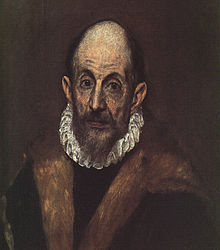
Portrait of An Old Man (presumed self-portrait of El Greco), circa 1595–1600, oil on canvas, 52.7 × 46.7 cm, Metropolitan Museum of Art, New York City, United States

The cause for the beatification of Gaudí began some years ago. You can read an article by Austen Ivereigh about this here. The opening paragraph gives us some idea of the kind of person he was:

When in 1926 God's architect was run over by a No. 30 tram on his way to evening prayer, he was mistaken for a beggar and taken to Barcelona's pauper hospital. His friends found him there the next day. But Antoni Gaudí refused to leave. "Here is where I belong", he told them. He had always wanted to leave this world poor and did, two days later, aged 74, honoured by a city which universally acknowledged him to be both an artistic genius and a saint.

Japanese sculptor Etsuro Sotoo found his Catholic faith through working on La Sagrada Familia, as you can read here. The article ends with these words:

According to the Japanese artist, the imposing character of the church is not meant to be the display of the proud power of an artist, but a work dedicated and maintained by God, of whom Gaudí regarded himself a collaborator, to the point that he did not want to put his personal name to the project.


Sotoo, who requested baptism in 1989, said that since his conversion, his way of working has not changed, but it "is easier and more secure" and fills him with "pleasure and freedom."


"Gaudí's architecture indicates, it does not oblige, it is something human," Sotoo said. "This is also Jesus' way. He does not oblige us to do anything, but guides us. And this way we can be much happier and secure."


Etsuro Sotoo ended his address at the Rimini meeting stating that "the artist, as Gaudí said, collaborates with his work in God's creation; in this way, freedom and happiness are possible. This is the only way man must follow."

Pope Benedict has shown in many ways the importance of beauty in bringing us closer to God:

The encounter with the beautiful can become the wound of the arrow that strikes the heart and in this way opens our eyes, so that later, from this experience, we take the criteria for judgment and can correctly evaluate the arguments. For me an unforgettable experience was the Bach concert that Leonard Bernstein conducted in Munich after the sudden death of Karl Richter. I was sitting next to the Lutheran Bishop Hanselmann. When the last note of one of the great Thomas-Kantor-Cantatas triumphantly faded away, we looked at each other spontaneously and right then we said: "Anyone who has heard this, knows that the faith is true."


The music had such an extraordinary force of reality that we realized, no longer by deduction, but by the impact on our hearts, that it could not have originated from nothingness, but could only have come to be through the power of the Truth that became real in the composer's inspiration. Isn't the same thing evident when we allow ourselves to be moved by the icon of the Trinity of Rublëv? In the art of the icons, as in the great Western paintings of the Romanesque and Gothic period, the experience described by Cabasilas, starting with interiority, is visibly portrayed and can be shared. (Message of the then Cardinal Joseph Ratzinger in 2002).

25 September 2010

Mikko back home. Thanks for your prayers

Mikko, Miggy, Gee-Gee and Mica Dimayuga who live near Atlanta, Georgia, USA

Recently I asked you to pray for three-year-old Mikko who, not for the first time, was admitted to the ICU. I received this email from Gee-Gee Torres Dimayuga, the mother of Mikko and former assistant editor of Misyon, the magazine I edit for the Columbans in the Philippines, the other day:


Mikko is finally home. We got out of the hospital 9 minutes before midnight last Saturday. We're so happy to be homw already. Those two weeks of being in hospital were too much to take. Miggy stayed with Mikko for 10 days and I watched Mikko for 4 days.

Mikko is recovering well here at home. We still have to watch his oxygen and sodiu levels. Oh, Miggy and I are still so tired. Not being able to drive makes it more harder for us. (As they were both applying for their visas to be renewed they were unable to renew their driver's licences which had expired.) We have to ask friends if they are free or we take the taxi . . . Thank you for all the prayers.

Please continue your prayers for this lovely family whose faith in a loving God and our prayers for them are the sources of their strength.


Beatification of 18-year-old Chiara 'Luce' Badano today in Rome

Chiara 'Luce' Badano who will be beatified today


Chiara 'Luce' Badano, who died in 1990 just short of her 19th birthday, will be beatified today at the Shrine of Our Lady of Divine Love in Rome. You can read Richelle Verdeprado's article, The Saint Who Failed Math, in the current issue of Misyon, the online magazine I edit for the Columbans in the Philippines, here. You will find links to other sites and articles there. The new beata or 'Blessed' was a member of the Focolare Movement. You can find a website dedicated to her here.


Chiara 'Luce' during her final illness


24 September 2010

Pakistan Flood Disaster


The floods in Pakistan  seem to have slipped out of the news but millions are still suffering there. The video is a collection of photos sourced from Caritas Australia and UNICEF and put together by the Columbans in Australia and New Zealand.

Technical difficulty: I'm not sure how to get the video to fit properly. But if you have RealPlayer you can download the video and watch it there.

21 September 2010

Amnesia anyone? Former detainee reflects on Martial Law in the Philipines

Ferdinand Edralin Marcos

Cebu-based Juan L. Mercado is one of the most incisive commentators on events in the Philippines. He was one of many journalists arrested in the early days of Martial Law, proclaimed on 21 September 1972, an event that hardly seems to touch us anymore, when some of the architects of that awful episode in Philippine history are still being elected to high positions. Juan L. Mercado writes a syndicated column and writes from the perspective of a lived Catholic faith. I took this from The Visayan Daily Star, published in Bacolod City where  live


I have highlighted parts of this column but I would really want to highlight all of it. I came to the Philippines in October 1971 and remember vividly the killings and the constant lies of the years of Martial Law, the corruption of the Congress, the Courts, the military and the police and of the Constitution itself. I remember too the persecution of members of the Church who spoke out against the grave injustices perpetrated by the cohorts of Ferdinand Edralin Marcos.

 
From the website of the Negros Nine Foundation. This links you also to an article on the Kristianong Katilingban, Christian Communities, in the Diocese of Bacolod during the Martial Law years.
 

Amnesia anyone?

by Juan L. Mercado (photo)

(Next week, we mark the 38th anniversary of the imposition of martial law. This column offers a look back – and asks questions about the implications of how we remember. – JLM)

"Could all the journalists please follow me," Col. Generoso Alejo told detainees crammed into Camp Crame’s gymnasium. "You have a visitor." It was almost midnight, at the tail end of martial law’s first week. Outside, an eerie silence blanketed streets, emptied by the dusk-to-dawn curfew."

In the lower bunk, Evening News Luis Beltran groaned and rose. From the upper bunk, I shimmied groggily down. We followed Daily Mirror’s Armando Doronila, Philippine News Service’s Manuel Almario and Taliba’s, Benny Esquivel.

Ben David, Celso Carunungan and Luis Mauricio (now all deceased) preceded us into the barred reception room.

Arresting teams earlier nailed 22 of us with photocopies of Proclamation 1081 warrants. They bore the photocopied signature of martial law enforcer Juan Ponce Enrile

Our "midnight visitor" turned out to be our jailor: then PC Commander General Fidel V. Ramos. "Nothing personal, gentlemen," he said after the amenities. "I was just ordered to neutralize you. Please cooperate. And we’ll try to make things easy for you."

That was 38 years back. Have we cooperated – by forgetting? Eight out of 10 students today barely recall Benigno Aquino’s kangaroo trial before Military Commission No. 2, or why he was gunned down at the Manila airport tarmac.


Under the "New Society," the Philippines became a gulag of safe houses" where citizens were tortured, maimed and salvaged, "Amnesty International noted. The Metropolitan Intelligence Security group ruled as Marcos’ tortured chamber. The notorious Col. Rolando Abadilla and Lt. Panfilo Lacson (PMA) 71 were MISG "stars."


Today, do we care?


Forget martial law and let’s move on, Joseph Estrada whimpered. Protests erupted when he agreed to bury the dictator’s mummy in Libingan ng mga Bayani.

"We have very little collective memory of past," Ateneo University president (Fr) Bienvenido Nebres (SJ)told the Legacies of the Marcos Dictatorship conference. "We tend to live in a perpetual present. Thus, we can not see well into the future."

Detention did offer a window on how people react under pressure. Some crumble. Others withdraw into cocoons. For a few, prison burnishes the steel in them.

In our prison, women political detainees would sometimes be allowed an hour to chat with us. Among these were Haydee Yorac, Manila Times’ Roz Galang, painter Veronica Yuyitung (wife of Chinese Commercial News editor, Rizal, who was shanghaied by Marcos agents to a Taipei military jail). We’d swap stories –and smuggled foreign news clips.

Yorac’s backbone recalled Juvenal’s axiom: "The sole and only nobility is integrity." That feistiness showed in her subsequent jobs, from peace negotiator to Commission on Election chair.

Is amnesia simplex today’s response to Sen. Jose Diokno’s eloquent letter, written from his Fort Bonifacio prison cell in December 1972:

"I’ve been deprived of freedom, stripped of my dignity. A non person, I’m reduced to having to ask permission for such a simple pleasure, as to step outside my prison to feel the wind on my face and the warmth of the sun on my back."

But ‘we can, even now, scrutinize our past; try to pinpoint what went wrong; determine what led to his madness," he added." And how, when it ends, we can make sure it need never happen again."

Thus, Cebu media has marked, over the last 16 years without fail, Press Freedom Week. It is seven days of professional discussions, exhibits (A press musuem is being launched) to songs. But Imelda and soul mates, however, insist on rewriting history.

Martial law was ‘one of the best things that happened in Philippine history," Madame Marcos asserted in an earlier interview. "It was a peaceful provision to ensure peace for our country. Tayo ang nagligtas ng demokrasya." ["We saved democracy".]

Now, this woman, whose name became a byword for profligacy, is a congresswoman. And she heads the Lower House committee on Millennium Development Goals – objectives to tamp down penury and it’s high death toll.


Her son Ferdinand Marcos Jr. spent his time, as a congressman, grabbing back from erstwhile cronies loot Marcos Sr. stashed. He is a senator.


Textbooks in public schools scrub the national memory blank.


Read by over 8 million students, these books paper over militarization of society denigrate dissidents, ignore human rights abuses, and massive kleptocracy, Joel Sarmenta and MelvinYabot of the University of Asia and the Pacific note. They recycle the claim that jack-booted rule was the only way to save democracy."


"It should not surprise us the young people today are apathetic about the struggle for democracy," historian Ambeth Ocampo noted. "Martial law textbooks continue to miseducate."

Thus, "the trauma of Marcos terror became embedded in the Philippine institutional fabric," Prof. Alfred Mc Coy writes in "Closer Than Brothers." ‘The Philippines seems caught in a long nightmare between remembering and forgetting."

In his novel "1984", George Orwell depicted a country where truth, freedom and justice were shoved down a "memory hole." Amnesia institutionalizes injustice. History‘s falsification invites repeated abuse – and prevents healing. "Why should I apologize for godly acts?" a puzzled Imelda asks.

How we remember assets as a shared past. But "all of us…must open our hearths to human memory," Noble Laureate Elie Weisel insisted at Auschwitz memorial rites, "I do not want my past to become the future of our children."*