17 July 2011

Archbishop of Dublin on Cloyne Report


Here are the homily notes of Archbishop Diarmuid Martin of Dublin (above), posted on the website of the Archdiocese of Dublin. I have highlighted some parts of the text and added [comments].

SIXTEENTH SUNDAY 2011


Homily Notes of
Most Rev. Diarmuid Martin
Archbishop of Dublin and Primate of Ireland

Pro-Cathedral, Dublin, 17th July 2011

Only a few months ago, here in Dublin’s Pro-Cathedral, we celebrated a liturgy of lament and repentance reflecting on the shattering facts regarding the wide-ranging abuse of children by priests and religious in this diocese and about the manner in which the Church in this diocese responded to that abuse. [This liturgy wasn't a Mass].

It was for me a moment of hope. The liturgy had been prepared by survivors of abuse and survivors took part in the carrying out of the liturgy. Courageously, men and women who had been abused spoke out about their hurt and their hopes. It was a moment which I know brought healing to many and gave them renewed strength in themselves and some sense of renewed hope in the Church which had not believed them or had even betrayed them. At that liturgy I saw many faces that I knew in tears; I watched others whose names I will never know sit alone in silence and sadness.

My first thoughts on reading the Cloyne report went back to that liturgy and to those who organized it and took part in it. I asked myself: what are they thinking today? Are they asking themselves if that entire liturgy was just an empty show? Were they being used just to boost the image of the Church? Were their renewed hopes just another illusion about a Church which seems unable to reform itself? Was their hurt just being further compounded?

As I reflected, the first emotion that came to me was one of anger:

anger at what had happened in the diocese of Cloyne and at response – or non-response - that was made to children whose lives had been ruptured by abuse;

anger at the fact that children had been put at risk well after agreed guidelines were in place which were approved by all the Irish bishops;

anger at how thousands of men and women in this diocese of Dublin must feel, who have invested time and training to ensure that the Church they love and hope can be different would truly be a safe place for children;

anger at the fact that there were in Cloyne - and perhaps elsewhere - individuals who placed their own views above the safeguarding of children, and seemingly without any second thought placed themselves outside and above the regime of safeguarding to which their diocese and the Irish bishops had committed themselves.

Paradoxically, appealing somehow to their own interpretation of Canon Law they had put themselves even above and beyond the norms which the current Pope himself has promulgated for the entire Church.

Some years ago I was criticized in some Church circles for speaking of strong forces still present in the Church which “would prefer that the truth did not emerge”. “There are signs”, I said, “of subconscious denial on the part of many about the extent of the abuse which occurred within the Church of Jesus Christ in Ireland and how it was covered up. There are other signs of rejection of a sense of responsibility for what had happened. There are worrying signs that despite solid regulations and norms these are not being followed with the rigour required”.

Much has, thank God, been undertaken within the Catholic Church to address the facts of the past and to improve safeguarding procedures. The Catholic Church in Ireland is a much safer place today than it was even in the recent past. [Until I began to read in the 1980s about abuse by priests I had always presumed that the Church, especially in its bishops, priests and religious, was a safe place].

Much is being said, on the other hand, that despite words the Church has not learned the lessons. Both statements are true. At our liturgy of lament and reconciliation I stressed that that event was only a first step. “It would be easy for all of us”, I said, ”to go away this afternoon somehow feeling good but feeling also ‘that is that now’, ‘it’s over’, ‘now we can get back to normal’”. I repeat once again what I said on that occasion “The Church can never rest until the day in which the last victim has found his or her peace and he or she can rejoice in being fully the person that God in his plan wants them to be”.

That is a challenge not just for bishops and Church leaders. It is a challenge for all. Obviously in this diocese it is a challenge to me personally. I know my own inadequacies and I do not wish to present myself as being better or more expert than anyone else. Like all of us, I need to have the courage to address my responsibilities with the utmost honesty day by day.

All of us need to have in place systems of verification and review which help us to identify mistakes made or areas where more can be done or things can be done better. We need to continue to build a cooperative climate where all the institutions of the Church work in a constructive way together and with the institutions of the State, which bears the primary responsibility for child safeguarding in the country.

I thank the priests and lay persons in this diocese who have committed themselves to implementing our child safeguarding policies and I appeal to them not to be become frustrated or indifferent. The Church needs you. The children who frequent our Churches need you. Parents need to be reassured by your presence. Public recognition is due to the mobilisation within the Church of so many volunteers who are in the front line in our parishes and organizations in child safeguarding.

Those priests who have ministered untarnished and generously over years – indeed for an entire lifetime - should not be made scapegoats and objects of hate. Priests deserve recognition for the good they do and they need the support of their people. I appeal to those priests who have become demoralised and half-hearted not to give in to cynicism but to heed the Lord’s call to renewal and conversion.

However, those in Church and State who have acted wrongly or inadequately should assume accountability.

What is at stake here is not just the past, but the future of our children and our young people and the need to foster a healthy environment across the board in which our upcoming generations are cherished and can grow to maturity. This is a huge challenge and cannot be addressed in a patchwork manner. The early results of the most recent census indicate that there will be a significant growth in the numbers and the proportion of children and young people in our population in the coming years. This will inevitably require significant investment.

While recognising the challenges of our current economic crisis, our long-term economic planning cannot overlook the need to provide not just protection but also vision, hope and opportunity for this future generation. The Proclamation of 1916 contained a vision of solidarity and inclusivity which dreamt not just of the freedom for Ireland’s people, but also of their welfare; it hoped for “equal rights and equal opportunities for all its citizens”; it dreamt of a society “where all the children of the nation would be cherished”. These are perennial goals for our nation which must at all times be a clear focal point for future economic and social planning.

The same proclamation and vision of those who founded our republic recognised that religious and civil liberty of all was to be fostered. A republic is not indifferent to the faith of its citizens. A republic respects the specific rights of believers. It recognises the role of believers in contributing to the common good as they journey with others in search of that hope to which we are all called as human beings and believers.

Great damage has been done to the credibility of the Church in Ireland. Credibility will only be regained by the Church being more truly what the Church is. Renewal will not be the work of sleek public relations moves. Irish religious culture has radically changed and has changed irreversibly. There will be no true renewal in the Church until that fact is recognised.

The Church cannot continue to be present in society as it was in the past. That is not to say that the Church will be renewed by that changed culture or should simply adapt itself to the vision of that new culture. The Gospel reading reminds us that the Church lives its life in the midst of different cultures and indeed with the presence of sin in its own midst.

As believers we know that in the long-term Christ who sows the good seed in our midst will work tirelessly to see that those forces “that provoke offence and who do evil” will not prevail but will face judgement on their lives. It would however be false to interpret the Gospel reading as if we should simply sit back and allow good and evil to grow together in the hope that in the end the good will win out. It is reminding us that fidelity to the message of Jesus is the way in which we will ensure the victory of the good.

The Gospel reading cries out: “Listen”, anyone who has ears”. Rarely more often than in our day are we as believers called to listen, to take note, to be alert and on our guard, so that the virtuous life will shine through us in our world. To do that we must renew ourselves and, as the second reading reminds us, allow the spirit of God to put into our lives a goodness and a love that cannot be summed up in our words. It is only then if we love good that we will drive evil away from us. ENDS.

16 July 2011

Threat to seal of confession by Irish government

Thanks to Fr Ray Blake's Blog for photo

The Irish media reports that Taoiseach (Prime Minister) Enda Kenny and Minister for Children and Youth Affairs Frances Fitzgerald intend to introduce legislation that would require priests to break the seal of confession in order to report anyone who confesses the sin of abusing a minor or vulnerable adult.

Social workers have already expressed their concern over mandatory reporting of suspected abuse,as The Irish Times reports today.

I am inclined to think that the proposal about the seal of confession is a non-starter and that the comments of Mr Kenny and of Ms Fitzgerald are an expression of disgust, a disgust which many of us Irish feel. When the matter is debated in a calmer atmosphere I think that what is being proposed will be seen as a form of abuse parallel to the abuse it is trying to stamp out.

Today’s Irish Examiner carries this front-page story: ‘THE HSE [Health Service Executive] has ordered an investigation into how social services failed to intervene in what a judge described as the "torture" of eight children by their mother over seven years’. Read more here.

In other words, Irish government workers, and the wider community, failed to do anything about a horrific situation that was known to the authorities and to at least some in the wider community. There was a similar case last year where even the town couldn’t be named for legal reasons when the trial of a mother was held. She too was found guilty.


I have written on this blog before about a Columban priest from New Zealand, Fr Francis Vernon Douglas (above), was tortured and killed by the Japanese in the Philippines in 1943 quite probably because he refused to break the seal of confession.

Recently I came across this moving account of hearing confessions by Fr John Blowick, co-founder of the Columbans, to which I belong, while the first batch of Columbans were on their way to China in 1920. I found this in The Chinese Batch by Fr Bernard T. Smyth, a now deceased Columban. I have highlighted some parts.

Frs Edward Galvin, John Blowick and Owen MacPolin, all mentioned below, shortly after their arrival in China.

The next afternoon found the Carmania only ten miles off the coast of Ireland; then out to open sea.

The crossing was quiet. Saturday, 3 April, was Holy Saturday, so Father Galvin [the other co-founder of the Columbans] went to the captain to make arrangements for Catholic sailors to go to Confession and Holy Communion for Easter. About Confession there was no great trouble, provided the men were not on duty. But Mass and Holy Communion on Sunday – that was quite another matter and quite opposed to the traditions of the service. First, the men were ‘unspeakably dirty’ and secondly it was a thing unheard of to allow them into places reserved for the use of passengers, specially first and second class passengers! But Edward Galvin was not a man to be easily baulked by the traditions, however venerable, of the service; and finally it was arranged that the men could come to Mass provided they were first well scrubbed. Fathers Blowick and MacPolin proceeded ‘below’, to hear the confessions of the crew. An extract from John Blowick’s diary describes Holy Saturday on the Carmania.

Father MacPolin and I went into the depths to hear their confessions this afternoon. We were descending till we thought we should never see the surface again and then we were shown into two little rooms, wet and dirty. The passage leading to the door of the room which I occupied was ankle deep in water and it was edifying to see the poor fellows standing in that mess waiting for their turn; they were being rounded up by one of the officers who was a Catholic, and so well did he do his work that when we went up to dinner at six o’clock there was not one single Catholic member of the ship’s crew who had not been to confession.

Hard work you may say, repulsive even sitting down there near the engines, in water and dirt and just trying to keep from getting sick. Yes, all that but the consolation of being able to bring the mercy of God into the lives of these poor fellows was a full reward was it not? And, as we passed through their quarters afterwards, the smile of recognition and respect and gratitude is something that you would do a good deal to merit.

After dinner Father Tierney heard confessions in the second [class] cabin, Father O’Doherty in the first and the others in the third where the Catholics were most numerous. In this latter place were our three young priests who then for the first time sat in the sacred judgment seat dispensing the mercy of God to His children. Father Galvin acted as a marshal, escorting them in to the room in which the priests were and showing them out. As each one left the room after confession, they knelt outside in the passage, saying their prayers and their penances and the publicity of the place and the presence of crowds of non-Catholics looking on with a sort of superstitious curiosity did not seem to have any effect on the fervor of their prayers. Every Catholic on board went to confession tonight.


15 July 2011

'Let them both grow till the harvest. . .' Sunday Reflections. 16th Sunday in Ordinary Time Year A, 17 July 2011

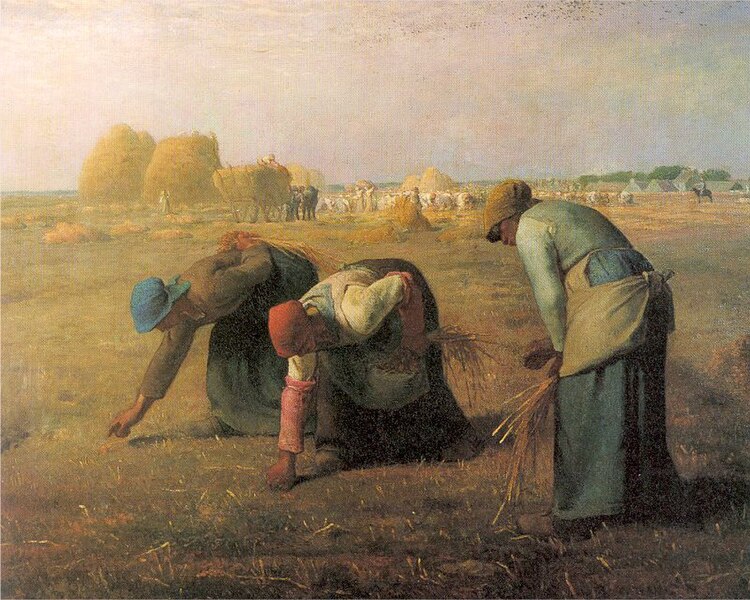
The Gleaners, Jean-François Millet, painted 1857
Readings (New American Bible, used in the Philippines and USA)

Gospel, Matthew 13:24-43 (Jerusalem Bible, used in Australia, England and Wales, Ireland, Scotland)

Jesus put a parable before the crowds, 'The kingdom of heaven may be compared to a man who sowed good seed in his field. While everybody was asleep his enemy came, sowed darnel all among the wheat, and made off. When the new wheat sprouted and ripened, the darnel appeared as well. The owner's servants went to him and said, "Sir, was it not good seed that you sowed in your field? If so, where does the darnel come from?" "Some enemy has done this" he answered. And the servants said, "Do you want us to go and weed it out?" But he said, "No, because when you weed out the darnel you might pull up the wheat with it. Let them both grow till the harvest; and at harvest time I shall say to the reapers: First collect the darnel and tie it in bundles to be burnt, then gather the wheat into my barn."'

He put another parable before them, 'The kingdom of heaven is like a mustard seed which a man took and sowed in his field. It is the smallest of all the seeds, but when it has grown it is the biggest shrub of all and becomes a tree so that the birds of the air come and shelter in its branches.'

He told them another parable, 'The kingdom of heaven is like the yeast a woman took and mixed in with three measures of flour till it was leavened all through'.

In all this Jesus spoke to the crowds in parables; indeed, he would never speak to them except in parables. This was to fulfil the prophecy:

I will speak to you in parables and expound things hidden since the foundation of the world.

Then, leaving the crowds, he went to the house; and his disciples came to him and said, 'Explain the parable about the darnel in the field to us'. He said in reply, 'The sower of the good seed is the Son of Man. The field is the world; the good seed is the subjects of the kingdom; the darnel, the subjects of the evil one; the enemy who sowed them, the devil; the harvest is the end of the world; the reapers are the angels. Well then, just as the darnel is gathered up and burnt in the fire, so it will be at the end of time. The Son of Man will send his angels and they will gather out of his kingdom all things that provoke offences and all who do evil, and throw them into the blazing furnace, where there will be weeping and grinding of teeth. Then the virtuous will shine like the sun in the kingdom of their Father. Listen, anyone who has ears.

Soiscéal, Matha 13:24-43 (Gaeilge, Irish)

San am sin chuir Íosa parabal eile os a gcomhair: “Is iad dála ríocht na bhflaitheas,” ar seisean, “mar a bhí ag an duine a chuir síol maith ina ghort. Ach fad a bhí an saol ina chodladh, bhí namhaid dó a tháinig ag scaipeadh cogail anuas ar an arbhar, agus d’imigh. Tháinig an t-arbhar aníos ina gheamhar, agus ansin ina dhias agus an uair sin chonacthas an cogal freisin. Tháinig a chuid sclábhaí go dtí an fear tí agus dúirt siad leis: ‘A mháistir, an síol a chuir tú i do ghort, nach síol maith a bhí ann? Agus cad a thug an cogal ann más ea?’ Dúirt sé leo: ‘Namhaid éigin a rinne an méid sin.’ ‘Agus ar mhaith leat,’ deir na sclábhaí leis, ‘go rachaimis á bhailiú chun a chéile?’ ‘Ná déanaigí,’ ar seisean, ‘ar eagla, nuair a bheadh sibh ag bailiú an chogail, go sracfadh sibh an t-arbhar aníos san am céanna. Fágtar le hais a chéile ag fás iad araon go dtí an fómhar, agus nuair a bheidh an fómhar á dhéanamh déarfaidh mé leis na buanaithe: Bailígí an cogal chun a chéile ar dtús, agus déanaigí punanna de chun a dhóite. Ach cruinnígí an t-arbhar isteach i mo scioból.’”

Chuir sé parabal eile os a gcomhair: “Is cosúil ríocht na bhflaitheas,” ar seisean, “le gráinne de shíol mustaird a thóg duine agus a chuir sé ina ghort. Is é an gráinnín síl is lú ar bith é, ach nuair a bhíonn sé fásta, bíonn sé ar an gceann is mó de na glasraí agus déantar crann de, a bhféadann éanlaith an aeir dul ar foscadh ina chraobhacha.”

D’inis sé parabal eile dóibh: “Is cosúil ríocht na bhflaitheas le gabháil a thóg bean agus a d’fholaigh sí i dtrí pheic plúir nó go raibh sé gabháilte ar fad.”

Labhair Íosa na nithe sin uile i bparabail leis na sluaite: ní dhéanadh sé caint ar bith leo gan pharabal, agus sin mar a comhlíonadh a ndúradh tríd an bhfáidh:
“Labhróidh mé i bparabail, nochtfaidh mé nithe ba rún ó thúsú an domhain.”

D’fhág sé na sluaite an uair sin agus chuaigh sé isteach sa teach. Tháinig a dheisceabail chuige agus dúirt siad: “Mínigh dúinn an parabal úd an chogail sa ghort.” D’fhreagair sé iad á rá: “An té a chuireann an síol maith, sin é Mac an Duine. Is é an domhan an gort. An síol maith muintir na ríochta. Dream an oilc an cogal, agus is é an diabhal an namhaid a scaipeann é. Is é deireadh an tsaoil an fómhar agus is iad na haingil na buanaithe. Amhail mar a bhailítear an cogal chun é dhó sa tine, sin mar a bheidh i ndeireadh an tsaoil. Cuirfidh Mac an Duine a aingil amach agus baileoidh siad gach ábhar scannail as a ríocht agus na daoine a thaobhaíonn an t-olc, agus teilgfidh siad san fhoirnéis tine iad. Is ann a bheidh gol agus díoscán fiacla. Beidh na fíréin an uair sin ag lonradh ar nós na gréine i ríocht a nAthar. An té a bhfuil cluasa air, éisteadh sé!”

Kyrie eleison from the Missa de Angelis
  
Jesus tells three parables, all to do with hidden growth. The first is the only one that speaks of the growth of something undesirable, side by side with what the farmer has planted.

The other day I came across a quotation from on an excellent blog, Remembering Fr William Doyle SJ. It reads: Avoid haste and want of control of bodily movements. The interior man, no matter how burdened with work or pressed for time, is never in a hurry. He is swift and expeditious in all he does, but never rushes; and by a jealous watchfulness over odd moments, “gathering up the fragments” of a full day “that none of them may be lost,” he finds time for all things. He knows that the Almighty is never in a hurry; that the great works of God in nature as in the soul are done silently and calmly, and that there is much wisdom in the old monastic saying, “The man who rushes will never run to perfection.”

Father Willie Doyle SJ (1873-1917) - he was born two months and a day after St Thérèse of Lisieux -
died during the Great War (1914-1918) in the trenches in Flanders, Belgium, where he was a chaplain in the British Army. He was living there in a real hell, a hell he was very much aware of. But he was constantly grateful for God's goodness shown especially in his mercy towards the many soldiers wounded and dying in the war. He heard the confessions of countless soldiers and anointed them on the battlefield. He was well aware of their sinfulness but also of their bravery, existing side by side in each just as the wheat and the darnel existed side by side. Father Willie himself went to confession only 15 minutes before he was blown to pieces by a German shell.

I first learned about Father Willie from Sister Stanislaus, the Irish Sister of Charity who was principal of the boys' kindergarten I attended in Dublin from 1947 to 1951. She often spoke to us about this brave priest, his sense of humour, his asceticism, his bravery. In my first year in St Columban's seminary more than a decade later I learned more about his from our director, Fr Ronan McGrath, the eldest of three brothers who became Columbans, all products of a Jesuit school where Father Willie had taught for a while, Belvedere College in the heart of Dublin.

I came across his name from time to time over the years, sometimes mocking references to his ascetic practices. Recently I came across Remembering Fr William Doyle SJ, which features something from Father Willie's writings most days, a labour of love by the blogger. As a result, I have begun to pray to him each day especially for Irish people close to me who seem to have lost the faith.

As I write, the Catholics of Ireland are reeling once again as a government report on the abuse of children by priests has been published, This one, the Cloyne Report, deals with allegations of abuse reported between 1996 and 2009 in the Diocese of Cloyne. The homepage of the website of the diocese has links to the report and to various statements made by officials in the diocese.

Even Catholics who have been faithful, prayerful and loyal are having their faith tested. The old cliché of a few rotten apples at the bottom of the barrel rings hollow for many now. The parable of the weeds growing alongside the wheat is much more accurate it seems.

Enormous harm has been done to the many individuals violated as minors by priests. The bishops as a body have lost nearly all of their authority. The Church in Ireland now is hardly capable of carrying out its mission of preaching the Gospel. 

Yet we need to take Jesus at his word. God is more aware than we are of the good and evil that co-exist in every person, in every society. We as individuals can get discouraged at our own sinfulness. Jesus is telling us that God wants only the best. God wants to harvest every piece of wheat, not to destroy what is good by destroying too soon what is bad.

Ireland is a country that has sent many missionaries to every continent, a country where the Catholic faith was strong as recently as only a few decades ago. Now it is a country in deep crisis, in terms of the faith and in its economic life, a country where a priest needs a police clearance to visit a Catholic school. May I, as an Irish missionary, ask your prayers for the people of my country, especially those who have been victims of priests, and the bishops and priests themselves. Perhaps you can pray:

Prayer for Priests by Father Doyle 
O my God, pour out in abundance Thy spirit of sacrifice upon Thy priests. It is both their glory and their duty to become victims, to be burnt up for souls, to live without ordinary joys, to be often the objects of distrust, injustice, and persecution.
The words they say every day at the altar, "This is my Body, this is my Blood," grant them to apply to themselves: "I am no longer myself, I am Jesus, Jesus crucified. I am, like the bread and wine, a substance no longer itself, but by consecration another."
O my God, I burn with desire for the sanctification of Thy priests. I wish all the priestly hands which touch Thee were hands whose touch is gentle and pleasing to Thee, that all the mouths uttering such sublime words at the altar should never descend to speaking trivialities.
Let priests in all their person stay at the level of their lofty functions, let every man find them simple and great, like the Holy Eucharist, accessible to all yet above the rest of men. O my God, grant them to carry with them from the Mass of today, a thirst for the Mass of tomorrow, and grant them, ladened themselves with gifts, to share these abundantly with their fellow men. Amen.