06 October 2011

The hand - or paw? - of God

Lala and Hachi

I don't know if St Bruno, the founder of the Carthusians and whose feast it is today, had a dog. I know I associate his name with canines and I had an extraordinary experience with a dog named Bruno in the mid-1980s.

Bruno belonged to the retreat house of the University of San Carlos in Talamban, Cebu City. He was, as I recall, part-Labrador, or at least the size of one and liked to be around people. I was giving a directed retreat at the time and sometimes would meet with a retreatant outside, as the weather was quite hot. On occasion Bruno would come and put his front paws on my knees and, after I patted him and spoke a few friendly words, would wander off.

One night I couldn't sleep because of a very strong and unusual feeling of loneliness. Around midnight I went outside and sat on the low wall outside looking down on the lights of Cebu City. The retreat house is built on a hillside. I was telling God how sorry for myself I was feeling and suddenly felt something on my left shoulder. It was Bruno's right front paw, as if to tell me 'Hindi ka mag-iisa', You're not alone'. ('Hinda ka mag-iisa' is a Tagalog slogan that became very popular after the murder of Benigno Aquino Jr on the tarmac of Manila Airport in 1983).

I hadn't heard Bruno running across the grass and I truly believe that he had sensed my feeling of loneliness, which disappeared immediately after he joined me. I gave him a big hug, said 'thank you' to the Lord, went back to bed and slept peacefully.


I'm not sure if the chant in the first part of the video is sung by Carthusian nuns and that in the second part by Carthusian monks. 

You can find the official website of the Carthusian Order here.

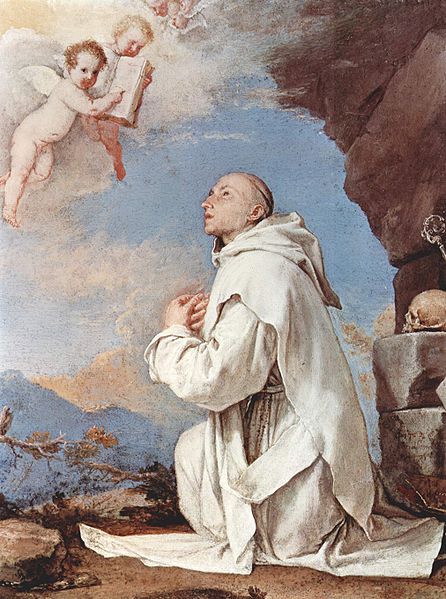
St Bruno of Cologne (c.1030-1101) painted by José de Ribera (painted 1643)

04 October 2011

St Francis, Patron of Ecology


by Fr Seán McDonagh


This article by my Columban confrere and friend, Fr Seán McDonagh, is taken from Columbans Ireland. The photos of Maria Cristina Falls, Iligan City, Philippines, were taken by Kurt Pala, a Columban seminarian from Iligan City, who is on his first mission assignment in Fiji

Tuesday October 4th 2011 is the feast day of Saint Francis of Assisi. On November 29th 1979, Pope John Paul II declared St Francis to be the Patron of Ecology. Three years later, on World Environment Day 1982, the Pope said that St Francis' love and care for creation was a challenge for contemporary Catholics. He called on Catholics "not to behave like dissident predators where nature is concerned, but to assume responsibility for it, taking all care so that everything stays healthy and integrated, so as to offer a welcoming and friendly environment even to those who succeed us.


Eight years later, on the occasion of the World Day of Peace, January 1st 2009, the Pope wrote that the poor man of Assisi "offers Christians an example of genuine and deep respect for the integrity of creation..." The Pope went on to make the point that St Francis "gives us striking witness that when we are at peace with God we are better able to devote ourselves to building up that peace with all creation which is inseparable from peace among all peoples." Pope John Paul II concluded that section of the document with these words, "It is my hope that the inspiration of Saint Francis will help us to keep ever alive a sense of 'fraternity' with all those good and beautiful things which Almighty God has created."


Francis pushes the boundaries for us today to reconsider and broaden our understanding of the gospel question: Who is my neighbour? Because for him the concept of "neighbour" included, not only the human race, but the whole of creation. This fellowship approach to creatures contrasts with the stewardship which has been more dominant in the Christian tradition. The stewardship reaches its most beneficial and comprehensive expression in the Benedictine and Cistercians monasteries. In his monumental study Farming in Ireland, History, Heritage and Environment, Dr John Feehan writes that the greatest and most permanent influence on 12th century farming in Ireland was the arrival and rapid spread of the most progressive and organised farmers of medieval times, the Cistercians. Their respectful way of caring for creation is captured by the American writer and farmer Wendel Berry in the final paragraph of his book, The Gift of Good Land. "To live we must daily break the body and shed the blood of creation. When we do it knowingly, lovingly, skilfully and reverently it is a sacrament. When we do it ignorantly, greedily, clumsily and destructively it is a desecration. In such a desecration we condemn ourselves to spiritual and moral loneliness and others to want."


In recent years, some people have challenged the stewardship metaphor because it is excessively human-centred. They see in Francis someone who claimed kinship bonds with all creation. For Francis, the world was not made up of objects made to satisfy either human need or greed. Francis saw the world in terms of relationships of cooperation rather than competition. Francis' example inspires us to approach nature with deep respect, admiration, sympathy and communion. His attitude of being-with all created things inspires us in our commitment to care for the Earth, to sustain and preserve what God has given us.

This is particularly important at a time when ecological damage, on many fronts, is happening right around the world. Some authors argue that the changes to the biosphere today are of such an order of magnitude that these changes are best described by using the language of geology, rather than the language of history. They have coined the word Anthropocene to graphically illustrate these massive changes. On October 4th this year, we should call to mind that Francis' example encourages us as individual Catholics and as the wider Church community to take a stand in the face of the unjust and unequal distribution of the earth's resources and the destruction of the living world. Much of what is happening today on land and in the oceans is nothing short of plunder. This plunder of the lands of indigenous people in the Philippines, Latin America and Papua New Guinea by mining corporations is trespassing not only on human rights but on the rights of other creatures to exist and fulfill their purpose in God's plan.


01 October 2011

'The stone rejected by the builders . . .' Sunday Reflections, 27th Sunday Year A

Jordan, in wheelchair, and Lala

Readings (New American Bible: Philippines and USA)

Gospel Matthew 21:33-43 (Jerusalem Bible: Australia, England & Wales, India [optional], Ireland, New Zealand, Pakistan, Scotland, South Africa)

Jesus said to the chief priests and the elders of the people: 'Listen to another parable. There was a man, a landowner, who planted a vineyard; he fenced it round, dug a winepress in it and built a tower; then he leased it to tenants and went abroad. When vintage time drew near he sent his servants to the tenants to collect his produce. But the tenants seized his servants, thrashed one, killed another and stoned a third. Next he sent some more servants, this time a larger number, and they dealt with them in the same way. Finally he sent his son to them. "They will respect my son" he said. But when the tenants saw the son, they said to each other, "This is the heir. Come on, let us kill him and take over his inheritance." So they seized him and threw him out of the vineyard and killed him. Now when the owner of the vineyard comes, what will he do to those tenants?' They answered, 'He will bring those wretches to a wretched end and lease the vineyard to other tenants who will deliver the produce to him when the season arrives'. Jesus said to them, 'Have you never read in the scriptures: 

It was the stone rejected by the builders
that became the keystone.
This was the Lord's doing
and it is wonderful to see?

I tell you, then, that the kingdom of God will be taken from you and given to a people who will produce its fruit.'

Soiscéal Matha 21:33-43 (Gaeilge, Irish)

San am sin dúirt Íosa le huachtaráin na sagart agus le seanóirí an phobail: “Éistigí le parabal eile: Bhí an fear tí seo ann a rinne fíonghort a phlandáil, fál a chur ina thimpeall, cantaoir a thochailt ann, agus túr a thógáil; chuir ar cíos ansin chun curadóirí é agus chuaigh ar an gcoigríoch. Nuair a bhí séasúr na dtorthaí ann, chuir sé a chuid seirbhíseach uaidh go dtí na curadóirí chun toradh an fhíonghoirt a fháil. Ach rug na curadóirí ar na seirbhísigh, thug siad bualadh do dhuine acu, mharaigh duine eile, chloch duine eile. Ansin chuir sé seirbhísigh eile uaidh ba líonmhaire ná iad siúd, ach ba é an cor céanna a thug siad dóibh sin. Sa deireadh, chuir sé chucu a mhac, mar dúirt sé leis féin: ‘Tabharfaidh siad ómós do mo mhac.’ Ach nuair a chonaic na curadóirí an mac, dúirt siad le chéile: ‘Is é seo an t-oidhre; seo, maraímis é, agus bíodh a oidhreacht againn féin,’ agus rug siad air, thiomáin siad amach as an bhfíonghort é agus mharaigh é. Dá bhrí sin, nuair a thiocfaidh máistir an fhíonghoirt, cad a dhéanfaidh sé leis na curadóirí úd?” Dúirt siad leis: “Tabharfaidh sé drochíde do na daoine mallaithe sin agus cuirfidh an fíonghort ar cíos chun curadóirí eile a thabharfaidh na torthaí dó ina séasúr féin.” Dúirt Íosa leo: “Nár léigh sibh riamh sna scrioptúir:

‘ An chloch dár dhiúltaigh na saoir,
rinneadh di ceann an chúinne;
obair an Tiarna é seo
agus is iontach inár súile é’?

“Sin an fáth a ndeirim libh go mbainfear ríocht Dé díbhse agus go dtabharfar do phobal í a thabharfaidh uathu a toradh.

+++

A little googling will show that in the USA in 90 percent of cases where prenatal testing shows that a child has Trisomy 21 (Down Syndrome) the mother chooses to have an abortion. Lala, who celebrated her 'official birthday' on 27 September, the feast of St Vincent de Paul, when she turned 32, lives in the L'Arche Community in Cainta, Rizal, part of the Metro Manila sprawl. You can read her story here.

Lala was left in a garbage pail after birth. She is a ray of sunshine to those blessed enough to know her. I am one of those such blessed. Much more so is Jordan, who also lives in the L'Arche community. He was born with multiple disabilities and has been in L'Arche since he was a small child.

According to the received 'wisdom' of many Lala and Jordan should never have been born.

Jesus tells us in the parable how the the tenants in the vineyard killed not only the servants of the owner, who provided them with a livelihood, but his own son, clearly a reference to Jesus himself, the Son of God the Father, God become Man.

So many today, for different reasons, destroy the lives of humans at their beginning. About 50,000,000 unborn babies have been legally killed in the USA since the infamous Roe vs Wade decision of the Supreme Court in 1973. Countless others have been destroyed because of the one-child policy of the People's Republic of China. Parts of China and India have an abnormally low percentage of women because of abortion.

This is one example of the rejection of God's love.

Jesus quotes from Psalm 118. Surely when we look at Jordan and Lala we can say 'This is the Lord's doing and is wonderful to see'.

The Madonna of the Grapes, Pierre Mignard, 1640s