27 August 2013

Asking again, 'Was St Monica an Irish mother?'


St Monica, Luis Tristán de Escamilla 1616 [Web Gallery of Art]

I posted the following four years ago here on Bangor to Bobbio. The story of St Monica's constant prayers for the conversion of her son Augustine to 'the Catholic Christian faith' - the expression St Augustine quotes her as saying - is an inspiring one and so I'm posting it again here on the feast of the saint:

The second reading in the Office of Readings for the feast of St Monica (332-387) always brings a smile to my face and leads me to ask, ‘Was St Monica an “Irish mother”?’ St Augustine’s brother had said to their mother when she was dying that it might be better if she died in her homeland in north Africa, rather than in Italy. The extract from St Augustine’s Confessions goes on: But as she heard this she looked at me and said: ‘See the way he talks’. And then she said to us both: ‘Lay this body where it may be. Let no care of it disturb you: this only I ask of you that you should remember me at the altar of the Lord wherever you may be’.

The latter part of the last quotation appears on innumerable memorial cards and I don’t know of a better request for prayers for the dead. But it’s the ‘See the way he talks’ that makes me smile. Many’s the time I heard my own mother – and other Irish mothers – say, nearly always in a family-type context, ‘Did you ever hear such nonsense?’ It’s the kind of thing that only people intimately related can say to one another, conveying gentle criticism/a reprimand and affection at the same time.

A variation of St Monica’s request is on the memorial card of my own mother, Mary who, like the saint, died at the age of 55: ‘All I ask of you is that you will remember me at Mass and Holy Communion’.


Death of St Monica, Benozzo Gozzoli 1464-65 [Web Gallery of Art]

Tradition Day by Day - no longer available online - carries this reading from the Confessions of St Augustine for today:

Remember, Monica, my motherMay Monica, my mother, rest in peace with her husband, before whom and after whom she was given in marriage to no man. She dutifully served him, bringing forth fruit to you with much patience, that she might also win him to you. Inspire, O Lord my God, inspire your servants my brethren, your children my master, whom I serve with my voice, my heart, and my writings, that as many of them as read these words may remember at your altar your handmaid, Monica, together with Patricius, formerly her husband, by whose flesh you brought me into this life, how I know not. May they with a pious affection remember them who were my parents in this transitory light, my brethren under you, our Father in our Catholic mother, and my fellow citizens in the eternal Jerusalem, for which your pilgrim people here below continually sigh from their setting out until their return, so that my mother's last request of me may be more abundantly granted by her through the prayers of many, occasioned by my confessions, rather than through my own prayers.

I was quite astonished some years ago reading an article in a scholarly Catholic magazine published in the USA lamenting that so many Catholic parents weren’t choosing truly Christian names for their children anymore. One example given was ‘Austin’. Clearly, the author was unaware that this is a common variation of ‘Augustine’, used especially in Ireland and in Britain. Indeed, the Augustinian Friars are often referred to in England as ‘The Austin Friars’.

When I was in primary school one of our juvenile jokes was: ‘Who is the patron saint of car manufacturers? St Monica, because she had a Baby Austin’. The ‘Baby Austin’ (see photo) was a small family car produced very successfully in England between 1922 and 1939. At least we knew who St Monica and St Augustine were. I’m not sure about young people in Ireland today.
I had posted something similar in 2008:
Was St Monica an 'Irish mother'?
I had a pleasant lunch today at Colegio de San Augustin-Bacolod as the Augustinian Friars celebrated the feast of the great St Augustine (354-430). Present too were the Augustinian Sisters of Our Lady of Consolation who run La Consolacion College, beside San Sebastian Cathedral here in Bacolod. This congregation was founded in the Philippines and has more than 230 sisters. Some of the friars of the Augustinian Recollects, known in the Philippines as the Recoletos, were also present. They own the University of Negros Occidental-Recoletos (UNO-R) here in Bacolod.

Both the Augustinian and Recollect friars played a large part in the evangelization of the Philippines in Spanish times.

The second reading in the Office of Readings for the feast of St Monica (332-387) yesterday always brings a smile to my face and leads me to ask, ‘Was St Monica an “Irish mother”?’ St Augustine’s brother had said to their mother when she was dying that it might be better if she died in her homeland in north Africa, rather than in Italy. The extract from St Augustine’s Confessions goes on: But as she heard this she looked at me and said: ‘See the way he talks’. And then she said to us both: ‘Lay this body where it may be. Let no care of it disturb you: this only I ask of you that you should remember me at the altar of the Lord wherever you may be’.

The latter part of the last quotation appears on innumerable memorial cards and I don’t know of a better request for prayers for the dead. But it’s the ‘See the way he talks’ that makes me smile. May’s the time I heard my own mother – and other Irish mothers – say, nearly always in a family-type context, ‘Did you ever hear such nonsense?’ It’s the kind of thing that only people intimately related can say to one another, conveying gentle criticism/a reprimand and affection at the same time.

Both St Monica and St Augustine were from the north-east of present-day Algeria. Hippo, where Augustine was bishop, is also located in Algeria. Today there is hardly a trace of Christianity in most of north Africa. Is Europe heading the same way? Our faith is a gift. We can lose it as individuals and as communities, as I often remind people.

23 August 2013

'Men will come from east and west . . .' Sunday Reflections, 21st Sunday in Ordinary Time Year C

Open Air Rock Cross also called Nasrani Sthambams in front of the 2nd Century built Marth Mariam Catholic Church at Kuravilangadu, Kerala, India. This church belongs to the Syro-Malabar Catholic Church, in full communion with Rome.

Readings (New American Bible: Philippines, USA)                                  

Readings (Jerusalem Bible: Australia, England & Wales, India [optional], Ireland, New Zealand, Pakistan, Scotland, South Africa)

Gospel Luke 13:22-30 (Revised Standard Version – Catholic Edition)

Jesus went on his way through towns and villages, teaching, and journeying toward Jerusalem. And some one said to him, "Lord, will those who are saved be few?" And he said to them, "Strive to enter by the narrow door; for many, I tell you, will seek to enter and will not be able. When once the householder has risen up and shut the door, you will begin to stand outside and to knock at the door, saying, 'Lord, open to us.' He will answer you, 'I do not know where you come from.' Then you will begin to say, 'We ate and drank in your presence, and you taught in our streets.' But he will say, 'I tell you, I do not know where you come from; depart from me, all you workers of iniquity!' There you will weep and gnash your teeth, when you see Abraham and Isaac and Jacob and all the prophets in the kingdom of God and you yourselves thrust out. And men will come from east and west, and from north and south, and sit at table in the kingdom of God. And behold, some are last who will be first, and some are first who will be last."


(Our Lady of Naval de Manila)

Earlier this month a friend of mine from the Philippines, Marifel, who was a parishioner of mine in Tangub City, Mindanao, when she was a child and now works as a receptionist for a community of Dominican Sisters near Dublin, invited me for a meal in a hotel. When the waitress came along I asked her if she was from Poland or Lithuania or 'one of those countries. 'One of those countries', she replied with a smile, 'Latvia.' She took our orders but the food was brought by an Indian waiter. Later on an Irish waiter looked after us.


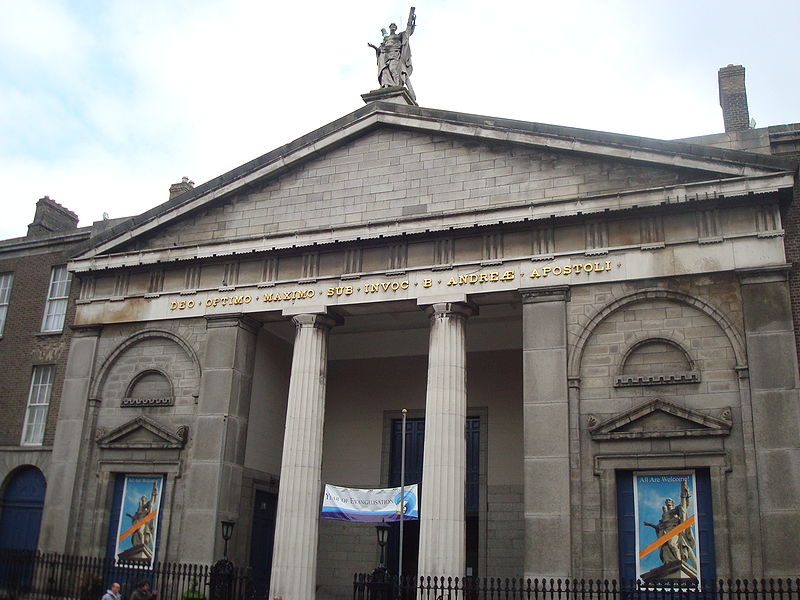
A week later I found myself in St Andrew's Church, Westland Row (above), beside one of Dublin's main railway stations. While I was praying there a grandfather and his grandson aged about three came in. The grandfather was wearing bright summer clothes - unlike grandparents when I was young who seemed to be always dressed in dark clothes - and genuflected before kneeling in the pew. After a while the little boy asked him some questions. His grandfather pointed at the altar and also at some of the Stations of the Cross as he explained things to the youngster. They then left.

On one Sunday a month in St Brigid's Church, Blanchardstown, in the Archdiocese of Dublin and the parish I come home to when I visit Ireland, has Mass for the Syro-Malabar Catholic community in Dublin. Many of these are nurses from Kerala, India, working in Irish hospitals. St Brigid's Parish also has a Filipino choir that sings at one of the Masses on the last Sunday of the month, except during the summer.

And men will come from east and west, and from north and south, and sit at table in the kingdom of God, Jesus tells us in the Gospel this Sunday. Thirty years ago churches in Ireland were still full at Sunday Masses, with young and old, and almost everyone Irish. Today there are fewer priests,  fewer Sunday Masses and fewer people attending them, most of them old. A large proportion of Sunday congregations are from places such as India, Nigeria, Poland, the Philippines. Mass servers - and there aren't too many of these anymore - are likely to be either immigrants or the Irish-born children of immigrants.

The above are snapshots of contemporary Ireland, as different from the Ireland of my childhood as are the mobile phones that everyone has from the box cameras that a few had and the telephones  that even fewer had in my time. 

But we had something precious that has been largely lost - our Catholic faith. There are various reasons for the rejection of the Church by many and the outright rejection of the Christian faith by some. But this can remind us that our faith is pure gift from God, a gift that can be shared and that was generously shared, even to the point of giving up life itself, by the countless missionaries who went overseas, or it can be lost, not only by individuals bu by whole communities.

The gift of faith can be lost by taking it for granted, by apathy, by not taking it seriously, by not passing it on. Jesus in the Gospel is telling his fellow Jews - and we must never forget that he is and will be for all eternity a Jew, just like Mary - that many of them are in danger of losing the precious gift of the faith, the faith they inherited from Abraham, our father in faith (Eucharistic Prayer I - Roman Canon) Isaac and Jacob, and that others will accept that same gift with gratitude.

Luis Antonio Cardinal Tagle, Archbishop of Manila [Wikipedia]

In 2003, at a gathering of priests in Antipolo City, near Manila, sponsored by Worldwide Marriage Encounter, then Bishop Luis Antonio G. Tagle, now Cardinal-Archbishop of Manila, spoke about a then recent survey on the values of young Filipinos. What he projected could happen within twenty years in terms of the loss of the Catholic faith in the Philippines was what had been happening in Ireland over the previous twenty years.

I was heartened by the sight of the grandfather passing on our Catholic Christian faith to his young grandson by his example and his readiness to answer the boy's questions. I am heartened by the living faith of so many immigrants to Ireland.

My hope is that the Catholic faith will continues to be passed on in Ireland and elsewhere by grandfathers - and grandmothers and parents - like the one I saw in St Andrew's Church. My hope is that the Catholic faith will be renewed in Ireland and elsewhere by the example and fervour of immigrants from Asia, Africa and Eastern Europe, by men from east and west, and from north and south and that together we will all sit at table in the kingdom of God, not only in heaven but here and now as brothers and sisters working together to build a world where the values  of the Gospel prevail, a world where everyone will have heard the Gospel of Jesus proclaimed to them, especially by the lives we lead. 

My hope is that the nurses from Kerala, who trace their Catholic faith back to St Thomas the Apostle, the waiters, caregivers and nurses from the Philippines, whose faith embodies a tender love of Mary the Mother of God as our Mother, will help the Irish to re-discover the greatness of the gift that their ancestors received more than 1,500 years ago from a great missionary who first arrived in Ireland at the age of 16 as a kidnapped slave, St Patrick.

My fear is that there will not be enough grandfathers - and grandmothers and parents - who will know and value the gift of faith enough to pass it on and that the youngsters, children of immigrants to Ireland and elsewhere in the Western world, will succumb to the values of their contemporaries and reject the most precious gift that God has given us - our Catholic Christian faith, an invitation to share in the love of God for all eternity.


Though the video was made for the Feast of the Baptism of the Lord it invites us to reflect on our faith, received through baptism, as pure gift from God, something we should do constantly.

Collect

O God, who cause the minds of the faithful 
to unite in a single purpose, 
grant your people to love what you command 
and to desire what you promise, 
that, amid the uncertainties of this world, 
our hearts may be fixed on that place where true gladness is found.
Through our Lord Jesus Christ, your Son, 
who lives and reigns with you 
in the unity of the Holy Spirit, 
one God, for ever and ever.

Photos from Wikipedia.

16 August 2013

'For henceforth in one house there will be five divided . . ..' Sunday Reflections, 20th Sunday in Ordinary Time Year C


The Marriage at Cana, Marten de Vos, painted 1596-97 [Web Gallery of Art]


Readings (New American Bible: Philippines, USA)                                  

Readings (Jerusalem Bible: Australia, England & Wales, India [optional], Ireland, New Zealand, Pakistan, Scotland, South Africa)

Gospel Luke 12:49-53 (Revised Standard Version – Catholic Edition)

Jesus said to his disciples:

"I came to cast fire upon the earth; and would that it were already kindled! I have a baptism to be baptized with; and how I am constrained until it is accomplished! Do you think that I have come to give peace on earth? No, I tell you, but rather division; for henceforth in one house there will be five divided, three against two and two against three; they will be divided, father against son and son against father, mother against daughter and daughter against her mother, mother-in-law against her daughter-in-law and daughter-in-law against her mother-in-law."


Nearly 40 years ago when I had some programmes on DXDD, a radio station in Ozamiz City, Mindanao, started by a Columban priest, Fr Charles Nolan, and now owned by the Archdiocese of Ozamiz, two friends of mine brought in a boy of about three whom they had found wandering at night. I appealed on the air for his family to come and bring him home. There was no response. My programme was the last for the night and I was wondering what we'd do with the boy. The janitor and his wife, whom I'll call Carlos and Teresa, happened to be there and said, 'We'll take him home. What's one more mouth to feed?' They had a small house and a large family.

The boy's mother, who worked in a night club, was found a day or two later and Carlos and Teresa reunited them.

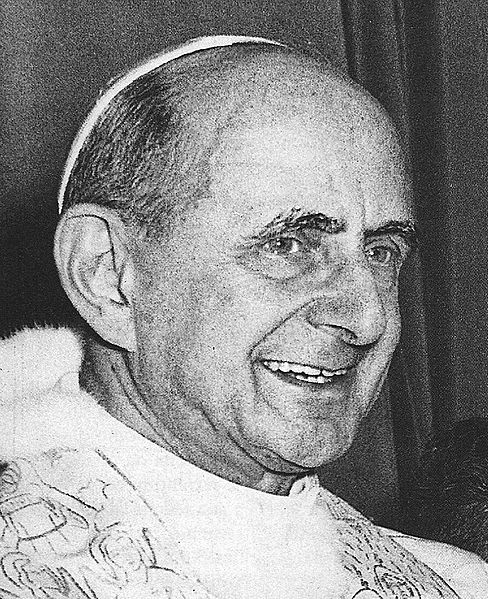
On 25 July 1968 Pope Paul VI issued his encyclical letter Humanae Vitae, which begins with these words:   

The transmission of human life is a most serious role in which married people collaborate freely and responsibly with God the Creator. It has always been a source of great joy to them, even though it sometimes entails many difficulties and hardships.

The fulfillment of this duty has always posed problems to the conscience of married people, but the recent course of human society and the concomitant changes have provoked new questions. The Church cannot ignore these questions, for they concern matters intimately connected with the life and happiness of human beings.

The encyclical, which upholds the Church's traditional teaching on family planning, immediately caused dissension within the Church, much of it quite bitter. It still provokes strong feelings and has been dismissed by many, maybe even by a majority of Catholics, especially in the West.

While no one threw Pope Paul into a well, as happened to the Prophet Jeremiah (First Reading), many did so metaphorically. Jeremiah had preached a message the authorities and the people didn't want to hear. The message wasn't his own but from God. He had told the people that those who stayed in Jerusalem would be slaughtered by the Babylonians, while those who fled, while losing their possessions, wouldn't lose their lives. All of this came about because leaders and people had ignored God's Covenant with them. 

The role of the prophet can be summed up in the title of a book by Fr Bruce Vawter CM that we used in Scripture studies in he seminary: The Conscience of Israel. 

Forty years after Humanae Vitae Pope Benedict spoke of the division that it had caused: The Document very soon became a sign of contradiction. Drafted to treat a difficult situation, it constitutes a significant show of courage in reasserting the continuity of the Church's doctrine and tradition. This text, all too often misunderstood and misinterpreted, also sparked much discussion because it was published at the beginning of profound contestations that marked the lives of entire generations. Forty years after its publication this teaching not only expresses its unchanged truth but also reveals the farsightedness with which the problem is treated. 

The Church has always seen marriage as the proper and only context for the most intimate relations between a man and a woman. And every human society has seen marriage in the context of the continuation of the human race, more specifically of the particular clan/tribe/nation and most specifically of the two families united through a wedding. And it's hardly an accident that in St John's Gospel the first sign or miracle of Jesus was the changing of the water into wine in Cana so that the marriage festivities could continue.

Pope Paul was reiterating in Humanae Vitae what the Church had always taught and what the Second Vatican Council teaches in Gaudium et Spes, Nos 47-52. No 51 includes this passage that speaks of the relationship between husband and wife in a way that calls them to the highest idealism: For God, the Lord of life, has conferred on men the surpassing ministry of safeguarding life in a manner which is worthy of man. Therefore from the moment of its conception life must be guarded with the greatest care while abortion and infanticide are unspeakable crimes. The sexual characteristics of man and the human faculty of reproduction wonderfully exceed the dispositions of lower forms of life. Hence the acts themselves which are proper to conjugal love and which are exercised in accord with genuine human dignity must be honored with great reverence. 

Down the years since Vatican II individuals who have rejected the Church's teaching have sometimes been described as 'prophets'. Many, no doubt, honestly thought that they were right and the Church's leaders wrong.

But we see the results of the most intimate act between a man and a woman being removed from its proper context or when a responsible openness to new life is lacking. There is now an imbalance in many countries in the developed world where the proportion of younger people is getting smaller and smaller, where the one-child family is becoming more and more common, sometimes by coercion, as in China, sometimes by the choice that couples make. Many more than before now have no brothers or sisters, no uncles or aunts.

We see in many countries the increase in abortion, despite the availability of contraceptives. 

Gaudium et Spes says, Hence the acts themselves which are proper to conjugal love and which are exercised in accord with genuine human dignity must be honored with great reverence. We see the very opposite in today's world where the acts that the Council speaks of are seen as a form of 'recreation', not even within the context of some kind of commitment, and where the openness to cooperating with God in the creation of new life is thwarted.

We see the utterly bizarre notion of 'marriage' between two persons of the same sex being passed into law in many jurisdictions as a 'right' and the perhaps even more bizarre reality that so many think this is right and proper.

Pope Paul was reviled and dismissed by many for Humanae Vitae. The experience of married couples who have generously planned their families in a way that respects nature has not, by and large, been taken seriously.

The DXDD janitor, Carlos, and his wife Teresa had an openness to accepting new life, even if temporarily, that reflected a generosity of heart. They had no idea how long they might have to look after their new charge.

Vatican II and Pope Paul were both addressing that generosity that we are capable of, even when great sacrifice may be demanded. Pope Paul must have been aware of the great division that his encyclical would cause. Pope Benedict speaks of its publication as a significant show of courage in reasserting the continuity of the Church's doctrine and tradition.

Forty years after Humanae Vitae perhaps we should recognise as true prophets the Venerable Paul VI who taught clearly and lovingly and the many married couples who, down the years, have faithfully lived the teaching of the Church that Jesus founded on the rock of Peter.


Ego sum panis vivus, Giovanni Pierluigi da Palestrina (c.1535 - 1594)
Cappella Victoria, Jakarta, Indonesia.
 A choir that mostly specializes in 16th-century sacred polyphony, especially the works of Palestrina and Victoria. A choir in line with the spirit of diaspora; has developed to include 33 singers from 14 parishes throughout the Jakarta Archdiocese (from its blog).

Communion Antiphon (John 6:51-52)

I am the living bread that came down from heaven, says the Lord. 
Whoever eats of this bread will live for ever.

Antiphona ad Communionem (Johannes 6:51-52)

Ego sum panis vivus, qui de caelo descendi, dicit Dominus: 
si quis manducaverit ex hoc pane, vivet in aeternum.

07 August 2013

'You also must be ready.' Sunday Reflections, 19th Sunday in Ordinary Time Year C


Readings (New American Bible: Philippines, USA)                                  

Readings(Jerusalem Bible: Australia, England & Wales, India [optional], Ireland, New Zealand, Pakistan, Scotland, South Africa)

Gospel Luke 12:32-48 [shorter: 35-40] (Revised Standard Version – Catholic Edition)

[For shorter version omit italics]

Jesus said to his disciples:

"Fear not, little flock, for it is your Father's good pleasure to give you the kingdom. Sell your possessions, and give alms; provide yourselves with purses that do not grow old, with a treasure in the heavens that does not fail, where no thief approaches and no moth destroys. For where your treasure is, there will your heart be also.

"Let your loins be girded and your lamps burning, and be like men who are waiting for their master to come home from the marriage feast, so that they may open to him at once when he comes and knocks.  Blessed are those servants whom the master finds awake when he comes; truly, I say to you, he will gird himself and have them sit at table, and he will come and serve them.  If he comes in the second watch, or in the third, and finds them so, blessed are those servants! But know this, that if the householder had known at what hour the thief was coming, he would have been awake and would not have left his house to be broken into. You also must be ready; for the Son of man is coming at an unexpected hour."

Peter said, "Lord, are you telling this parable for us or for all?" And the Lord said, "Who then is the faithful and wise steward, whom his master will set over his household, to give them their portion of food at the proper time? Blessed is that servant whom his master when he comes will find so doing. Truly, I say to you, he will set him over all his possessions. But if that servant says to himself, 'My master is delayed in coming,' and begins to beat the menservants and the maidservants, and to eat and drink and get drunk, the master of that servant will come on a day when he does not expect him and at an hour he does not know, and will punish him, and put him with the unfaithful. And that servant who knew his master's will, but did not make ready or act according to his will, shall receive a severe beating. But he who did not know, and did what deserved a beating, shall receive a light beating. Every one to whom much is given, of him will much be required; and of him to whom men commit much they will demand the more. 
A stamp with Liam Whelan's photo, issued by An Post, the Irish Postal Service, for the 50th anniversary of the Munich Disaster. The clock is in Old Trafford, the Manchester United stadium, showing the time and date of the crash.

I've posted a number of times before about the death of Irish footballer Liam Whelan in a plane crash in Munich in 1958. His life and death for me show the meaning of the words of Jesus in the gospel today: You also must be ready; for the Son of man is coming at an unexpected hour. I'll use here, with some changes, what I've posted before.

I remember the moment I heard of the crash that killed so many young sportsmen in their prime. It was late afternoon and already dark and a man whom I knew as a street-singer, someone I had perceived, wrongly perhaps, to be a beggar, was running around, almost frantically, telling everyone the tragic news. It was my first experience of what some call 'a public private moment'.

'If this is the end, then I'm ready for it'. (Posted 6 February 2008).

These were the last words of Liam Whelan who died more than 55 years ago and who is buried near my parents. Only about six years ago  I learned that when they were both around 14 Liam rescued a close friend of mine who had got into difficulties in a swimming pool. [I have baptised two of my friend's grandchildren in recent years].

The average age of Manchester United's players was only 22. One who was only 21, Duncan Edwards, from the English Midlands, was considered by many to have the potential to become perhaps the greatest footballer ever. He died 15 days after the crash.

These young men who filled stadiums were being paid only £15 a week, a little more than a tradesman could earn at the time, though very few played beyond the age of 35. Endorsements could bring in a little more income for a few talented players r. Their counterparts today are often spoiled millionaires. 

Those who knew him described Liam Whelan as 'a devout Catholic'. I know that he sent his mother some money for her to go to Lourdes. 11 February 1958 was the centennial of the first apparition of our Blessed Mother to St Bernadette. Mrs Whelan, a widow since 1943 when Liam was 8, used the money instead towards a beautiful statue of Our Lady of Lourdes over the grave of her son (photo below). I pass it each time I visit my parents’ grave.

Clearly young Liam Whelan had his life focused on what was most important. He was ready to meet death. I have often spoken about him at Mass and on retreats. Today's gospel invites us to focus on the essentials, God’s love for us sinners, the hope that the life and death of Jesus offer us, the necessity of acknowledging our sinfulness to enable God’s love to break through and the importance of being always prepared for death. 

But the deaths of so many talented young men still leaves a deep sadness among those who saw them play and followed their fortunes. I feel that sadness when I recall the Munich crash. The February 2008 issue of The Word, a magazine that sadly no longer exists and that was published by the Divine Word Missionaries in Ireland and Britain, had an article, A Sporting Tragedy, in which John Scally spoke for me : ‘Their funerals were like no other. Most funerals are a burial of someone or something already gone. These young deaths pointed in exactly the opposite direction and were therefore the more poignant. Normally we bury the past but in burying Liam Whelan and his colleagues, in some deep and gnawing way we buried the future’.

I remember reading about Liam Whelan's last words in a newspaper a few days after the tragedy. I've heard Harry Gregg, the Manchester United goalkeeper who survived the crash, speaking about them. They still move me and challenge me to be ready whenever death may come. Jesus isn't trying to frighten us in today's gospel but to keep us focused on important realities such as The Four Last Things: Death, Judgment, Heaven and Hell.

Jesus tells us that when we are honestly trying to follow him in doing the Father's will we are blessed: Blessed are those servants whom the master finds awake when he comes.

You also must be ready; for the Son of man is coming at an unexpected hour.

Grave of Liam Whelan (1935-1958), Glasnevin, Dublin, Ireland


Responsorial Psalm (New American Bible Lectionary)

06 August 2013

World Youth Day celebration in Aleppo, Syria, despite the civil war

ASIA/SYRIA - A small 'WYD' in the city of Aleppo


The Vatican-based Fides News Agency carried this story on 2 August:

Aleppo (Agenzia Fides) - On the day that Pope Francis celebrated the concluding Mass of World Youth Day in Rio de Janeiro, even Christian children in the martyred city of Aleppo came together to experience a day of prayer and communion of spirit with three million of their peers gathered on Copacabana beach and to help them keep together the hope, even in the suffering and struggle that marks their daily condition. 


On Sunday, July 28, about 850 young Christians belonging to all the Christian communities of the Syrian cities gathered at the Youth Center George and Matilda Salem, animated by the Salesian Fathers in the district of al-Sabeel, where they shared a day of reflection, prayer, discussion and entertainment. Four Catholic bishops took part in the day, celebrating Mass and dividing the tasks in the various moments of reflection and prayer. Everything ended with the consecration of the young people of Syria to the Immaculate Heart of Mary. 

King Faisal St, Aleppo, with church on right and mosque in the distance

The Armenian Catholic Bishop Boutros Marayati describes his emotion and shared experience with the young people of Aleppo to Fides Agency: 'I was amazed to see so many young people without fear, in a city scarred by war. They all bore witness to a certain inner peace that is a gift of the Lord. The perception of the tenderness of Jesus for each of them has strengthened, and many are beginning to think about consecrating themselves to the Lord in prayer and in service of others. We made the most of the words that Francis Pope had said in the early days of World Youth Day, with his call not to allow anyone to steal hope. Those words lit up our whole day'. 

This is the main square of the city

The description of the Armenian Catholic Bishop dwells at length on the miracle of inner peace which he perceived in the young Christians of Aleppo: 'They tried to contact the young people in Rio through Skype', said  Mgr Marayati to Fides, 'but the internet lines were not working. The atmosphere was relaxed, boys and girls did not seem taken from the anguish of feeling under siege or having to fear the future as Christians. Despite the high number of participants in the meeting, there was no protective measure. And thank God, everything went well'. (GV) (Agenzia Fides 02/08/2013).


Catholics in Aleppo

You can find some information about the Catholics in Syria on www.catholic-hierarchy.org. There are six Catholic jurisdictions in Aleppo, each with its own bishop, those of Armenian Catholics, Latin/Roman Catholics, Maronite Catholics, Chaldean Catholics, Melkite Greek Catholics and Syrian (or Syriac) Catholics. All of these are in full communion with Rome and are equally Catholic. Except for the Latin/Roman Catholics and Maronite Catholics, all have Orthodox counterparts.


Christians in Syria, who trace their origins back to the time of the Apostles, are in a minority and many have emigrated because of ongoing unrest in the Middle East, as they have from Iraq and Palestine, for example.


My thoughts at this moment also go to the Christian communities who live in Syria and throughout the Middle East. The Church supports the members of these communities who today find themselves in special difficulty. These have the great task of continuing to offer a Christian presence in the place where they were born. And it is our task to ensure that this witness remain there. The participation of the entire Christian community to this important work of assistance and aid is imperative at this time.


All photos from Wikipedia.

01 August 2013

'Christ is all, and in all.' Sunday Reflections, 18th Sunday in Ordinary Time Year C

Apse mosaic (detail), Italian mosaic artist, 1145-60 [Web Gallery of Art]

Readings (New American Bible: Philippines, USA)                                  

Readings (Jerusalem Bible: Australia, England & Wales, India [optional], Ireland, New Zealand, Pakistan, Scotland, South Africa)

Gospel Luke 12:13-21 (Revised Standard Version – Catholic Edition)

One of the multitude said to Jesus, "Teacher, bid my brother divide the inheritance with me." But he said to him, "Man, who made me a judge or divider over you?" And he said to them, "Take heed, and beware of all covetousness; for a man's life does not consist in the abundance of his possessions."

And he told them a parable, saying, "The land of a rich man brought forth plentifully; and he thought to himself, 'What shall I do, for I have nowhere to store my crops?' And he said, 'I will do this: I will pull down my barns, and build larger ones; and there I will store all my grain and my goods. And I will say to my soul, Soul, you have ample goods laid up for many years; take your ease, eat, drink, be merry.' But God said to him, 'Fool! This night your soul is required of you; and the things you have prepared, whose will they be?' So is he who lays up treasure for himself, and is not rich toward God." 


Here there cannot be Greek and Jew, circumcised and uncircumcised, barbarian, Scythian, slave, free man, but Christ is all, and in all (Colossians 3:11, Second Reading). 


. 

One of the most characteristic features of international World Youth Days is groups of young pilgrims proudly carrying their national flags, not with a sense of trying to express superiority but rather with a sense of being part of a wider and deeper reality. That reality is the Church, a Church given the mission by Jesus to Go and make disciples of all nations (Matthew 28:19), the theme of WYD Rio2013 that ended last Sunday.

St Cyril of Jerusalem in his instructions to catechumens describes the Church this way:

The Church, Catholic or universal, gets her name from the fact that she is scattered through the whole world from the one end of the earth to the other, and also because she teaches universally and without omission all the doctrines which are to be made known to mankind, whether concerned with visible or invisible things, with heavenly or earthly things. Then again because she teaches one way of worship to all men, nobles or commoners, learned or simple; finally because she universally cures and heals every sort of sin which is committed by soul and body. Moreover there is in her every kind of virtue in words and deeds and spiritual gifts of every sort (Office of Readings, Wednesday, 17th Week of Ordinary Time).

The young people in the video who welcomed Pope Francis to Copacabana beach on the evening of 25 July showed The Church, Catholic or universal, by carrying their countries' flags. On the following Sunday morning in the same place they showed that same universality in a different way by lowering their flags before Mass began as they engaged in one way of worship, as the Church had taught them.

On the evening of the 25th Pope Francis said:

I greet you with affection. All of you assembled here from the five continents and, through you, all young people of the world, in particular those who wanted to come to Rio de Janeiro but weren’t able to come. To those who are following us by means of radio, television and internet, to everyone I say: Welcome to this feast of faith! In several parts of the world, at this very moment, many young people have come together to share this event with us: let us all experience the joy of being united with each other in friendship and faith. And be sure of this: my heart embraces all of you with universal affection. Because what is most important today is your gathering here and the gathering together of all the young people who are following us through various forms of media. From the summit of the mountain of Corcovado, Christ the Redeemer welcomes you and embraces you in this beautiful city of Rio!

Christ the Redeemer was embracing them as one. This embrace of Christ was symbolised beautifully a few days later when a little boy wearing a Brazilian football shirt made his way to the popemobile and whispered his secret to the Argentinian Bishop of Rome, I have a very important message for you . . . I want to become a priest.

These photos were taken in Rio. I came across them on Facebook and they're from the FB of Zenit, one of the leading Catholic news agencies. Here is the story that goes with the photos.

I spent much of the summer of 2000 in the Faroe Islands in the north Atlantic. The first settlers came there from central Norway around AD 1000 but the islands, while semi-autonomous, are under the sovereignty of Denmark. Out of the 50,000 or so population there were only about 100 or so Catholics, the only church being in the capital, Tórshavn. But I celebrated Mass one Saturday in Klaksvík, the second largest town in the Faroes. We had to take a ferry on the last leg of our journey, though a tunnel has since been opened. 


We celebrated Mass in the home of a Filipina. There were about 15 of us but we had no common language. Sr Marisa FMM was from Malta, there was a Canadian woman, some university students from Poland working in a fish factory for the summer and one or two other nationalities. (Sr Marisa is still in the Faroes). The Mass was mostly in English, which not all understood, and we had a reading in Tagalog. However, all participated fully. (If I were in that situation today I would use some Latin). We experienced the truth of the words of St Cyril of Jerusalem in the quotation above: the Church teaches one way of worship to all men, nobles or commoners, learned or simple.

After Mass we had lunch, which consisted mostly of Filipino dishes, a new treat for some present.

Despite our lack of a common language we were totally united in our celebration as Catholic Christians of the Holy Sacrifice of the Mass. This is where we find our deepest identity, where we 'lower our flags' as we engage in one way of worship as sons and daughters of our heavenly Father, as brothers and sisters of Jesus, God who became Man, as brothers and sisters of one another, where Christ is all, and in all.