10 November 2016

'By your endurance you will gain your souls.' Sunday Reflections, 33rd Sunday in Ordinary Time, Year C

Nave of the Archbasilica of St John Lateran [Wikipedia]
The Cathedral of Rome, the 'Mother of all Churches'

Readings (New American Bible: Philippines, USA)

Readings (Jerusalem Bible: Australia, England & Wales, India [optional], Ireland, New Zealand, Pakistan, Scotland, South Africa)


When some were speaking about the temple, how it was adorned with beautiful stones and gifts dedicated to God, Jesus said,  ‘As for these things that you see, the days will come when not one stone will be left upon another; all will be thrown down.’
They asked him, ‘Teacher, when will this be, and what will be the sign that this is about to take place?’ And he said, ‘Beware that you are not led astray; for many will come in my name and say, “I am he!” and, “The time is near!” Do not go after them.
‘When you hear of wars and insurrections, do not be terrified; for these things must take place first, but the end will not follow immediately.’ Then he said to them, ‘Nation will rise against nation, and kingdom against kingdom; there will be great earthquakes, and in various places famines and plagues; and there will be dreadful portents and great signs from heaven.
‘But before all this occurs, they will arrest you and persecute you; they will hand you over to synagogues and prisons, and you will be brought before kings and governors because of my name. This will give you an opportunity to testify. So make up your minds not to prepare your defence in advance; for I will give you words and a wisdom that none of your opponents will be able to withstand or contradict. You will be betrayed even by parents and brothers, by relatives and friends; and they will put some of you to death. You will be hated by all because of my name. But not a hair of your head will perish. By your endurance you will gain your souls.


Earthquake destroys Basilica of St Benedict on 30 October 2016
Norcia (or Nursia) is the place where St Benedict was born c.480

This Sunday falls between two celebrations of church buildings in Rome, the Feast of the Dedication of the Lateran Basilica on 9 November and the Optional Memorial of the Dedication of the Basilicas of Saints Peter and Paul on 18 November. When the former falls on a Sunday its celebration takes precedence over the Sunday. The official name of the Lateran Basicilica is the Archbasilica of the Most Holy Saviour and of Saints John the Baptist and the Evangelist and is the Cathedral of the Diocese of Rome.

In the gospel Jesus speaks of the future destruction of the Temple where he had worshipped all his life, where he had been presented to the Father as an infant by Mary and Joseph, from which he threw the moneylenders because they were turning it into a market.

On 30 October the Basilica of St Benedict in his birthplace Norcia in Italy was destroyed in seconds by a powerful earthquake as if fulfilling the words of Jesus today, all will be thrown down.

Destroyed Basilica of St Benedict [Source:The Monks of Norcia]

In today's gospel Jesus warns us of wars and insurrections . . . great earthquakes . . . famine and plagues . . . You will be hated by all because of my name.

We are seeing all of these things in our time. They can lead us to lose hope - if we forget the closing words of Jesus in today's gospel: But not a hair of your head will perish. By your endurance you will gain your souls.

On 4 October this year Hurricane Matthew caused great destruction in southwestern Haiti, the poorest country in the Western Hemisphere. But the Sunday Examiner, the weekly newspaper of the Catholic Diocese of Hong Kong carried the following report in its issue for 30 October.

Port-au-Prince. Survivors of Hurricane Matthew put on their Sunday finest as they picked their way through rubble and downed power lines to gather in ruined churches on October 9, just three days after the devastating storm ravaged their homes. 

Photographs posted on news websites show pews in the open air, with the rubble from the hurricane piled to one side, as a neatly clad congregation in suits and ties, smart slacks and dresses made a colourful scene in what had once been churches with roofs.

Mass celebrated in Qaraqosh, Iraq, after its recent liberation

Archbishop Youhanna Boutros Moshe is the Syrian Catholic Archbishop of Mosul

In 2104 Christians were driven out of Mosul and nearby cities in Iraq by ISIS, also known as Daesh. For the first time in nearly 2,000 years Mass could not be celebrated in the area. But on Sunday 30 October Mass was celebrated again in the Church of the Immaculate Conception, Qaraqosh, near Mosul.

A church building is where Christians gather to celebrate the Eucharist, the Holy Mass, where they meet and receive the Risen Lord. Down the centuries Christian communities have built churches that are beautiful in order to draw people into the beauty and life of the Blessed Trinity. And even if the building is destroyed by an earthquake as in Norcia, by a hurricane as in southwestern Haiti, or by persecution  as in Qaraqosh, Iraq, the Lord is still present to and among the Christian community, especially when believers come together on Sunday, as Jesus Christ has asked us to do, to celebrate his life, death and Resurrection, and our hope in eternal life, in the Holy Sacrifice of the Mass.

By your endurance you will gain your souls.


Grave of Bishop Edward Galvin

St Columban's, Dalgan Park, Ireland

'But the spiritual edifice is, I think, intact.'

Since posting this week's Sunday Reflections I received the November 2016 issue of Far East, the magazine of the Columbans in Ireland and Britain, which has the following story that is connected so much with this Sunday's gospel.

After being expelled from China, September 1952

In the January/February 2006 issue of Far East, Fr Dan Fitzgerald recalled the following of Bishop Edward Galvin (Co-founder of the Columbans with Fr John Blowick):

Bishop Galvin was my bishop in China for six years. Three of us Columban priests arrived in Hanyang in central Chine in July 1946. We were the first Irish priests to arrive there after the war had ended in 1945.

The man we met on that July day looked older and more worn than his 64 years would suggest. He didn't look like a bishop either. He was in an old crumpled cotton Chinese shirt and pants, with perspiration running down his face and chest. Only for the plain episcopal ring he had on his finger, he might have been the gate-man. There was something about him that suggested one who had lived through a lot, had suffered and had survived.

His exile for Christ ended in September 1952. As he arrived in Hong Kong he said, They have taken our churches, schools, hospital and mission compounds, but the spiritual edifice is, I think, intact. I blessed the compound and the cathedral, the whole diocese, its Sisters, priests and people. I put then under the protection of Our Lord and His Blessed Mother, and of St Columban, the patron of the diocese and the cathedral. It was all I could do, but it was enough.

(1916 - 2016)


Antiphona ad Communionem   
Communion Antiphon  Mark 11:23-24

Amen dico vobis, quidquid orantes petitis, 
Amen, I say to you: whatever you ask in prayer,
credite quia accipientis, et fiet vobis, [dicit Dominus]. 
believe that you will receive, and it shall be given to you, [says the Lord]. 


07 November 2016

Prayer Intentions of Pope Francis for November 2016

Vietnamese refugee in Malaysia, 1980 [Wikipedia]

Universal Intention 
Countries Receiving Refugees: That the countries which take in a great number of displaced persons and refugees may find support for their efforts which show solidarity.


Reflection from the Apostleship of Prayer.

Evangelization Intention
 Collaboration of Priests and Laity: That within parishes, priests and lay people may collaborate in service to the community without giving in to the temptation of discouragement.


Reflection from the Apostleship of Prayer.


04 November 2016

'And the fact that the dead are raised Moses himself showed, in the story about the bush . . .' Sunday Reflections, 32nd Sunday in Ordinary Time, Year C

Moses before the Burning Bush, Domenico Fetti, 1613-14
Kunsthistorisches Museum, Vienna [Web Gallery of Art]


Readings (New American Bible: Philippines, USA)

Readings (Jerusalem Bible: Australia, England & Wales, India [optional], Ireland, New Zealand, Pakistan, Scotland, South Africa)


Some Sadducees, those who say there is no resurrection, came to Jesus(.) [and asked him a question, ‘Teacher, Moses wrote for us that if a man’s brother dies, leaving a wife but no children, the man  shall marry the widow and raise up children for his brother.  Now there were seven brothers; the first married, and died childless;  then the second and the third married her, and so in the same way all seven died childless.  Finally the woman also died. In the resurrection, therefore, whose wife will the woman be? For the seven had married her.’]
Jesus said to them, ‘Those who belong to this age marry and are given in marriage; but those who are considered worthy of a place in that age and in the resurrection from the dead neither marry nor are given in marriage. Indeed they cannot die any more, because they are like angels and are children of God, being children of the resurrection. And the fact that the dead are raised Moses himself showed, in the story about the bush, where he speaks of the Lord as the God of Abraham, the God of Isaac, and the God of Jacob. Now he is God not of the dead, but of the living; for to him all of them are alive.’
Fr William Spicer (1949 - 2009)

Seven years ago a Columban colleague of mine, Fr Willie Spicer, died suddenly in Ireland at the age of 59. And in a very real sense he preached at his own funeral. The homilist, Columban Fr Michael Scully, a very close friend of Father Willie because of their many years in Japan, told a remarkable story of how central the Resurrection was in the late priest's preaching at funerals and of how a man was led to the faith by this. Here is part of the homily of Father Scully. I have highlighted some passages.

Over that period of eight or nine years Willie and I enjoyed a game of golf together on a regular basis even though we lived quite far apart. Willie was pastor at the Church in Chigasaki City in the Diocese of Yokohama; I was assigned to a church in the Archdiocese of Tokyo about 80 miles away from where Willie lived. Sometimes before our game of golf I would stay overnight at Willie’s house.
On one of those occasions I noticed a painting which I had not seen before on the wall of his living-room. So, I asked him where he got the painting. ‘There is a story behind that’ was his answer. I would like to tell that story as Willie told it to me. These are his words: ‘About a year ago I did a funeral Mass here in Chigasaki Church. And, as usual, during the homily I emphasized that death was not the end of everything; and then went on to talk of Christian hope in the resurrection of the dead’. At this point, Willie paused and turned towards me: ‘I think it is meaningless’ he said, ‘to preach a homily at a wake or funeral Mass if we don’t make some mention of the resurrection of Christ and our own hope in the resurrection. Isn’t that what our Christian faith is all about? It’s because of that faith that we are on mission!’

Those words of Willie were for my benefit, but, needless to say, I was in complete agreement with what he said. However, Willie’s story did not end there. ‘You know’, he said ‘after that funeral Mass an elderly man approached me and said to me “Today was the first time I ever heard a talk like the talk you gave at the Mass. Until now, I had never heard of the resurrection of the dead – and somehow, it makes a lot of sense to me. Thank you for giving me the opportunity to hear that homily. If I had a chance I’d like to study the Catholic faith. Do you know if there’s a Catholic Church close to where I live?” And Willie continued, ‘That was about a year ago – something that I did not know at that time was that that man was an artist who lived about a hundred miles away. That painting came from him to me as an expression of thanks – thanks for my homily at the funeral Mass, but also as an expression of profound gratitude for the fact that he was studying the Catholic faith, and in hoping to be baptized in the not too distant future in a church close to where he lives’.

I have told this story because I believe that if Willie Spicer had a chance to speak to us today, he would say to us: ‘It’s all right to feel sad and to grieve on this occasion. I would feel the same way if I were in your place. But, don’t be carried away by sadness and grief. Today’s sadness and grief cannot compare with the joy and the happiness and the glory that will be ours if we but believe that the God who loves us, loves us so much that He gave His only Son for us’
.

The Resurrection, Passignano, 1600-25
Pinacoteca, Vatican [Web Gallery of Art]

Today's First Reading and the Gospel - they are always related by a common theme - look at the Resurrection. In the story of the martyrdom of the seven brothers in the Second Book of Maccabees the fourth brother When he was near death, he said, ‘One cannot but choose to die at the hands of mortals and to cherish the hope God gives of being raised again by him. But for you there will be no resurrection to life! (2 Maccabees 7:14). 

The Gospel also has a story of seven brothers, in a situation put to Jesus by some Sadducees, a group that didn't believe in the resurrection, that strains credulity. This gives Jesus the opportunity to teach about the resurrection: And the fact that the dead are raised Moses himself showed, in the story about the bush, where he speaks of the Lord as the God of Abraham, the God of Isaac, and the God of Jacob. Now he is God not of the dead, but of the living; for to him all of them are alive.

St Columban's Cemetery, Dalgan Park, Ireland

I don't go along with the idea that seems to have crept in in recent years of a funeral Mass being 'a celebration of the life' of the deceased. There certainly is a place for celebrating a person's life during the wake or, in the Philippines, during the novena held  in the home of the one who has died or when the family and other mourners gather to eat after the burial. Rather I see the funeral Mass as an occasion above all to pray that the one who has died will share fully in the life that God desires for everyone,

Preface I for the Dead puts it this way:


In him [Christ] the hope of blessed resurrection has dawned, 
that those saddened by the certainty of dying 
might be consoled by the promise of immortality to come. 
Indeed for your faithful, Lord, 
life is changed not ended, 
and, when this earthly dwelling turns to dust, 
an eternal dwelling is made ready for them in heaven.

Father Willie Spicer emphasised that belief in the Resurrection and the hope it gives when preaching at funerals. In Japan probably at every funeral Mass he celebrated there were people present who weren't Christians. To them he was proclaiming the central truth of our Christian faith. In the case of the artist he spoke about  that proclamation of our faith and of the hope of the resurrection spoke to his heart and led him to Jesus the Risen Lord.

In November we remember and pray for the dead in a special way. The readings in this Sunday's Mass can lead us to reflect on the reality that one day each of us will be remembered and prayed for by others. May the Collect for the first of the three Masses on The Commemoration of All the Faithful Departed, 2 November, help us in this:

Listen kindly to our prayers, O Lord, 
and, as our faith in your Son, 
raised from the dead, is deepened, 
so may our hope of resurrection for your departed servants 
also find new strength.
Through our Lord Jesus Christ, your Son, 
who lives and reigns with you in the unity of the Holy Spirit, 
one God, for ever and ever.


Antiphona ad Communionem        
Communion Antiphon Cf. Ps 22 [23]:1-2
Dóminus regit me, et nihil mihi déerit;
The Lord is my shepherd, there is nothing I shall want
in loco páscuae ibi me collocávit,
Fresh and Green are the pastures where he gives me repose,
super aquam refectiónis educávit me.
near restful waters he leads me.


27 October 2016

‘Zacchaeus, hurry and come down; for I must stay at your house today.’ Sunday Reflections, 31st Sunday in Ordinary Time, Year C

Zacchaeus's sycamore tree, Jericho [Wikipedia]


Readings (New American Bible: Philippines, USA)

Readings (Jerusalem Bible: Australia, England & Wales, India [optional], Ireland, New Zealand, Pakistan, Scotland, South Africa)


Jesus entered Jericho and was passing through it. A man was there named Zacchaeus; he was a chief tax-collector and was rich. He was trying to see who Jesus was, but on account of the crowd he could not, because he was short in stature. So he ran ahead and climbed a sycomore tree to see him, because he was going to pass that way. When Jesus came to the place, he looked up and said to him, ‘Zacchaeus, hurry and come down; for I must stay at your house today.’ So he hurried down and was happy to welcome him. All who saw it began to grumble and said, ‘He has gone to be the guest of one who is a sinner.’ Zacchaeus stood there and said to the Lord, ‘Look, half of my possessions, Lord, I will give to the poor; and if I have defrauded anyone of anything, I will pay back four times as much.’ Then Jesus said to him, ‘Today salvation has come to this house, because he too is a son of Abraham. For the Son of Man came to seek out and to save the lost.’

The Brothers in Black who produced Exclusive Interview with Zacchaeus, the video above, are seminarians from the USA studying in Rome.

'Zacchaeus' recounting his meeting with Jesus in the 'Exclusive Interview' above recalls, And he looked me right in the eyes. He goes on to repeat that.

In 2009, in a preface to a book on St Augustine, the then Jorge Mario Cardinal Bergoglio, Archbishop of Buenos Aires, now Pope Francis, wroteThe most striking image for me of how one becomes a Christian, as it emerges in this book, is the way in which Augustine recounts and comments on Jesus’ encounter with Zacchaeus. Zacchaeus is small, and wants to see the Lord pass, and so he climbs a sycamore. Augustine says: 'Et vidit Dominus ipsum Zacchaeum. Visus est, et vidit.' [And the Lord looked at Zacchaeus himself. He was seen, and saw.]

The then Cardinal Bergoglio comments [emphasis added here and below]: Some believe that faith and salvation come with our effort to look for, to seek the Lord. Whereas it’s the opposite: you are saved when the Lord looks for you, when He looks at you and you let yourself be looked at and sought for. The Lord will look for you first. And when you find Him, you understand that He was waiting there looking at you, He was expecting you from beforehand. 

That is salvation: He loves you beforehand. And you let yourself be loved. Salvation is precisely this meeting where He works first. If this meeting does not take place, we are not saved. We can talk about salvation. Invent reassuring theological systems that turn God into a notary and His gratuitous love into a due deed to which He is supposed to be forced by His nature. But we never enter into the People of God. Whereas, when you look at the Lord and you realize with gratitude that you are looking at Him because He is looking at you, all intellectual prejudices go away, that elitism of the spirit that is characteristic of intellectuals without talent and is ethicism without goodness.

God's mercy has been one of the main themes of Pope Francis since he became Bishop of Rome. And when you find Him, you understand that He was waiting there looking at you, He was expecting you from beforehand. These words of his while still in Buenos Aires recall the story of the Prodigal Son. But while he was still far off, his father saw him and was filled with compassion; he ran and put his arms around him and kissed him (Luke 15:20).


Zacchaeus receives Jesus
Church of the Good Shepherd, Jericho [Wikipedia]

I've often used today's gospel in retreats with young people in the context of preparing them for the sacrament of confession. Zacchaeus publicly acknowledges that he has cheated but is ready to give back fourfold what he has cheated people of. He has a joyful face-to-face meeting with Jesus that includes a celebratory meeting.

In his homily on 25 October 2013 in St Martha's, Vatican City, Pope Francis spoke once again about confession. He reminded those present that the sacrament is not like going to a psychiatrist or to a torture chamber. He also reminds us how far too easy it is to say I confess to GodThat's like confessing by email, he comments. I say things and there's no face-to-face contact. He then goes on to speak of how concrete children are when they confess their sins.

The meeting of Jesus and Zacchaeus was a deeply personal experience for both. In all his meetings with individuals Jesus gave of himself. We see that starkly in the story of the healing of the woman who had been bleeding for 12 years and who was cured when she touched his garment: Immediately aware that power had gone forth from him, Jesus turned about in the crowd and said, ‘Who touched my clothes?’ (Mark 5:30).


Homily of Pope Francis, 25 October 2013

Pope Francis then went on to speak of the grace of being ashamedBut if there is one thing that is beautiful, it is when we confess our sins in the presence of God just as they are. We always feel the grace of being ashamedTo feel ashamed before God is a graceIt is a grace to say: 'I am ashamed'. Let us think about St Peter after Jesus' miracle on the lake: 'Depart from me Lord, for I am a sinner'. He was ashamed of his sin in the presence of Jesus Christ.

Going to confession, the Pope said, is 'going to an encounter with the Lord who forgives us, who loves us. And our shame is what we offer him: 'Lord, I am a sinner, but I am not so bad, I am capable of feeling ashamed'.

The Holy Father concluded: 'let us ask for the grace to live in the truth without hiding anything from the Lord and without hiding anything from ourselves'.

I remember an Irish Christian Brother who taught me in my last two years of secondary school, Brother Mícheál S. Ó Flaitile. We all revered him as a saintly man. The worst 'punishment' you could get from him was a stare when you did something wrong. It made you feel the kind of shame that Pope Francis speaks about. It didn't humiliate you. It was a face-to-face encounter that made you want to be better, to be true to the reality that you were made in God's image.

Jesus is saying to each of us today by name: hurry and come down; for I must stay at your house today. May each of us hurry and come down, and be happy to welcome him. 


Antiphona ad introitum
Entrance Antiphon Cf Psalm 37[38]:22-23


Ne derelinquas me, Domine Deus meus, ne discedas a me;
Forsake me not, O Lord, my God; be not far from me!
intende in adiutorium meum, Domine, virtus salutis meae.
Make hast and come to my help, O Lord, my strong salvation!


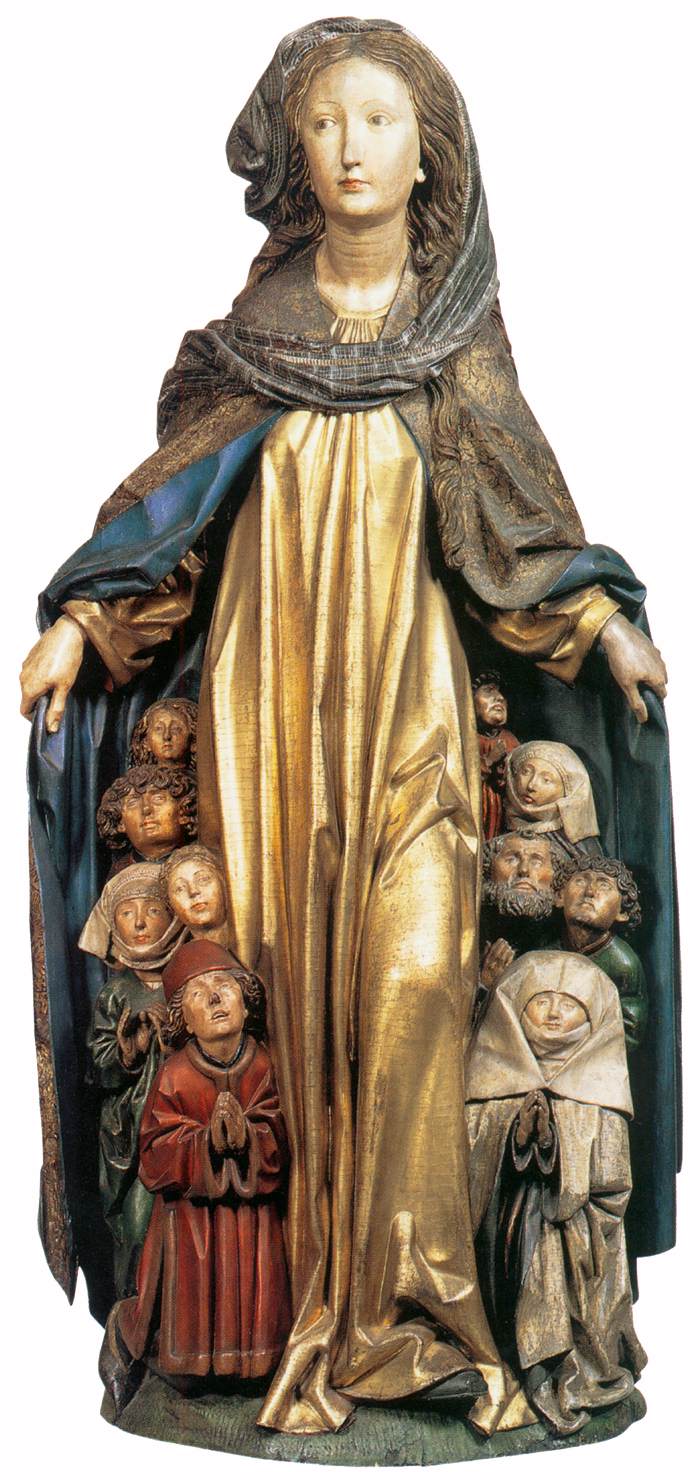
Ravensburg Madonna of Mercy, Michael Erhart, 1480s
Staatliche Museen, Berlin [Web Gallery of Art]

First Reading    Wisdom 11:22 - 12:2

The whole world before you is like a speck that tips the scales, and like a drop of morning dew that falls on the ground.


But you are merciful to all, for you can do all things, and you overlook people’s sins, so that they may repent.

For you love all things that exist, and detest none of the things that you have made, for you would not have made anything if you had hated it.

How would anything have endured if you had not willed it? Or how would anything not called forth by you have been preserved?

You spare all things, for they are yours, O Lord, you who love the living. For your immortal spirit is in all things.

Therefore you correct little by little those who trespass, and you remind and warn them of the things through which they sin, so that they may be freed from wickedness and put their trust in you, O Lord.