09 March 2011

'Smudged Foreheads' - a reflection for Ash Wednesday

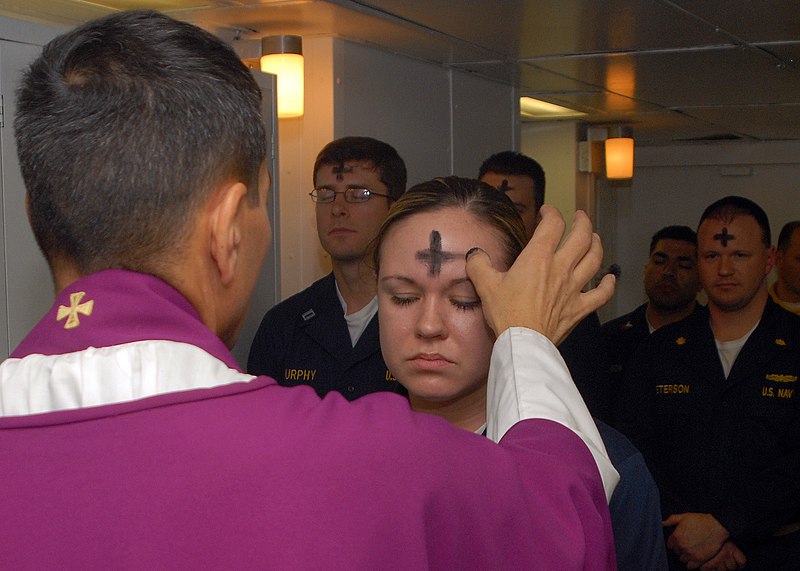
US Navy 080206-N-7869M-057 Electronics Technician 3rd Class Leila Tardieu receives ashes during an Ash Wednesday celebration.

This fine reflection for Ash Wednesday by Cebu-based columnist Juan L. Mercado appeared in yesterday's Visayan Daily Star and in other newspapers. I have highlighted some parts and [added comments].

“Get real” is the jolt that Ash Wednesday delivers. Dust returns to dust is one of the day’s overarching themes. “Death plucks my ears and says Live – I am coming,” Justice Oliver Wendell Holmes wrote on his 90th birthday.

Ashes will be traced tomorrow, in the form of a cross, on the forehead of President Benigno Aquino, on those who’ll never be president, thieves in costly barongs to beggars we half see. In a society where over 4.3 million scrounge below poverty thresholds, they blend into the woodwork. [All of us are equal as sinners in need of God's forgiving love].

“Your friend died last night,” a panhandler lisped to the wife as we walked by. Periodically, the wife would hand him some rice, coins or gaudy T-shirts we cringed to wear. Chronic hunger shriveled him into a scrawny man with a gap-toothed smile. “We never learned his name,” the wife murmured.

Tomorrow’s ashes come from burnt Palm Sunday 2010 fronds. With oil of the catechumen, ashes are stirred into a paste. [I don't think this is accurate. The oil of catechumens isn't used]. As priest or lay minister traces the cross on foreheads, he then reaches across the centuries, to echo a shattering sentence first heard in an Eden marred by disobedience: “Remember man, that you are dust. And unto dust you shall return.” [Mr Mercado has no difficulty with 'exclusive' or 'non-inclusive' English!]

Wednesday’s rites remind us of two friends: a young lieutenant and an equally young political activist. They never met. But their paths crossed briefly at the boarding gate for “Mount Pinatubo”, President Ramon Magsaysay’s plane.

President Ramon Magsaysay of the Philippines (31 August 1907 - 17 March 1957)

This was midnight of March 17, fifty four years back. Jesus Rama, younger brother of Journalist Napoleon Rama, came to Cebu’s Lahug airport, to see the President off. Standing in that same crowd was Lt. Julian Ares, then aide-de-camp to Gen. Cornelio Bondad. Both were to fly with the president to Manila.

As Magsaysay strode towards the ramp, he spotted Rama. “Jess,” he said clasping arms around Rama. “Come with me to Manila.” Rama, who had a phobia for flying, pulled back. Friends tut-tutted Rama, advising him: “Just accommodate the president, Jess.” Reluctantly, Rama climbed aboard.

“At Mt. Pinatubo’s door, presidential aide-de-camp Lt. Leopoldo Regis supervised loading,” Ares recalls from his Chicago retirement home. “President Magsaysay was already aboard.”

But at a Club Filipino rally, the President asked Senator Tomas Cabili and Cebu Congressman Pedro Lopez: “Join me.” The plane’s engines idled until Cabili and Lopez hurried aboard.

“Sorry, sir, we must leave you behind,” Lt. Regis apologetically said to the general. “Bondad’s satchel and mine were tossed off the plane.” The door slammed shut. And the reconfigured C47 took off – only to slam into Mt. Mannungal 20 minutes later.

Toiling half way up Mount Mannugal the next day, Ares’ search party met villagers hefting a hammock. In it was the only survivor: Nestor Mata of the Philippines Herald. Ares' team was also the first to reach the still-smoldering wreckage and human ashes just as the sun set.

“Presume not to promise yourself the next morning,” Thomas a’ Kempis counseled. . “And in the morning, consider that you may not live till nightfall…Many die when they least think of it....A man is here today. And tomorrow, he is gone. And when he is taken out of sight, he is also quickly out of mind."…

Ash Wednesday’s counsel is imparted without discrimination: generals who creamed off armed forces funds, pliable justices and ombudsmen, jueteng overlords, even former presidents, who ward off trial while bunkered behind squads of midnight appointees. ['Jueteng' is an illegal form of gambling that makes its organizers rich].

This sacramental signals start of the penitential season of Lent. Fasting for renewal is shared by major faiths. Muslims observe Ramadan. Hindus and Buddhists set aside days for fasting. Jews fast on Yom Kippur. Like Catholics, Anglicans designate Lent as a penitential season.

By the 8th century, “Day of Ashes” rites had become common in the church. But the use of ashes goes way back. “I heard of Thee by hearing of the ear. But now, mine eye seeth Thee,” says an anguished Job to the Voice from the whirlwind. “Wherefore, I …repent in dust and ashes.”

Imelda Marcos receives, in all sincerity, ashes on Wednesday. On Thursday, she scoffs at the US Federal Court’s decision that found the Marcos regime “liable for torture, summary executions and disappearances”. It awarded 7,526 victims token $1,000 checks from the ill-gotten loot.

The class suit “turned into a business,” Imelda sneered. “You spit on the blood of thousands who died for freedom,” snapped Inquirer’s Ma. Ceres Doyo, a martial law victim. “You have no shame.” The English translation loses the Tagalog pungency. Sayang...

Those smeared foreheads mean three things, writes Jesuit Father Danny Huang in an earlier paper: “Writing In The Dust”. We confess. [Lent is a time to take personal responsibility for our sins and to go to confession]. We promise. We hope.

We live in dark times: from Maguindanao murders, abortions to massive theft. “The ashes acknowledge that, in the end, it's not the fault of MILF, Abu Sayyaf or Al Qaeda. It is our fault. Cruelty to utter self-preoccupation, in our hearts, produced bitter fruits. We must face the truth of ourselves and refuse to “practice our Filipino expertise in palusot.” [Social psychologist Dr Patricia Licuanan describes 'palusot' thus: 'We (Filipinos) are impatient and unable to delay gratification or reward, resulting in the use of short cuts, skirting the rules (the palusot syndrome) and in foolhardiness.]

With fasting, almsgiving and prayer, we pledge to move beyond suffocating self-absorption to compassion. We must not remain paralyzed by self-pitying powerlessness. Ganito na talaga ako. Di ko na kayang magbago, it says. Instead, “we move on, one small, faltering, but real step at a time.”

Third, we hope. “We know that the world is not changed by the brute force of arms, but by the power of those whose spirits are made new.” That’s what those smudged foreheads mean.*


08 March 2011

St John of God of Granada

8 March, Feast of St John of God

When I was in my first year in the seminary in Ireland, back in 1961-62, our director, Fr Ronan McGrath, one of three brothers who became Columbans, spoke to us one day of his awe for religious brothers such as the Hospitaller Brothers of St John of God and the Alexian Brothers who take care of the sick. Today is the feast of St John of God, born in Portugal in 1495 and who, after a colourful life, experienced a conversion in Granada, Spain, at the age of 40 after hearing a sermon by St John of Avila. This conversion led people to believe that he was mad and he was put in an asylum until St John of Avila obtained his release. He was to devote the rest of his life to the care of people who were poor and with mental illnesses.

One of the websites of the Order of the Hospitaller Brothers of St John of God gives an outline of the order's origins:

In 1537, John Ciudad (later known as St. John of God), was a little-known bookseller in the city of Granada, Spain. He was struggling to put his life back together again after spending a period as a patient in the psychiatric wing of the Royal Hospital, where he was placed after experiencing a religious conversion so dramatic that many people though he was insane.

He was homeless and disillusioned, yet he felt a strong attraction to improve the situation of the many men, women and children, who like himself, were homeless and marginalized from the mainstream of society. John was fortunate that he had friends who respected him. One of these friends allowed John to shelter from the bitter cold of winter nights in the porchway of his house.

Sensitive to the suffering and pain of the many homeless people and travellers who sought shelter in doorways of where they could find it, John began to bring those who were sick and weak and those unable to cope, to share his accommodations in the porch of the house of his friend, Venegas. This was the stark and simple, yet profoundly beautiful beginning of the work that today still bears his name.

The man, John, huddling with his cold, hungry and weary companions in one corner of the porchway of Venegas’ house had no idea of the movement he was founding. St. John of God Services has continued to strive to carry this love, care and compassion to people down the centuries.

The modest porch of the home of the Venegas family was the first place where John gave shelter to the poor and rejected.

Hospitality is the name given to the great gift of care and welcome which John gave to the poor, the homeless, the sick and the dying and many others in the city of Granada over 460 years ago. After his death in 1550, a group of his closest companions continued the work he had begun. (The Order came into being some years after the saint's death).

The website of the Order's Province of Australia, New Zealand and Papua New Guinea has a good account of the life of St John of God here.

That account describes the Granada of his day in these terms: 'a tense, turbulent, dangerous city. A constant stream of travellers passed through it en route to the colonies of the new Americas via the ports of Seville and Cadiz. The streets teemed with mercenaries, adventurers, beggars, prostitutes and petty thieves. It was only a few years since Granada had been taken by the Spanish from the Moors ...'
+++

I know the connection is tenuous but I can't resist including a video of Peruvian tenor Juan Diego Flórez singing 'Granada' by Mexican composer Agustín Lara. Flórez has a glorious voice and he's backed here by a full orchestra. And it's Shrove Tuesday, so we can celebrate. We can also thank God that this year's very late Easter enables St John of God to have his feast day to himself instead of being hidden away in Lent.


05 March 2011

Funeral of Shahbaz Bhatti


http://www.asianews.it/, a service of the Milan-based PIME, a society of apostolic life like the Columbans and who work in the Philippines, carries a report by Jibran Khan, dated 4 March, on the funeral (photo above) of the assassinated Shahbaz Bhatti: Bhatti funeral: Christians angry when worshippers and relatives denied access to church.


Islamabad (AsiaNews) – “You have killed my brother, now you are stopping me from seeing his body [. . .]. You cannot protect the minorities,” said an angry and pained Anila Bhatti, when security forces prevented her from entering the church for her brother Shahbaz’s funeral. The service began at 11.40 am in Our Lady of Fatima Church in Islamabad. Right after Prime Minister Yousaf Raza Gilani entered the building, security forces closed the doors and did not let anyone in or out. A security perimeter was thrown up around the church, blocking access to the building. Christians who wanted to say goodbye one last time to the Catholic minister reacted by protesting. In the meantime, thousands of people travelled to Khushpur, the village in Punjab where Bhatti was buried this afternoon next to his father’s grave before a crowd of some 10,000 people.


This morning, Mgr Rufin Anthony, bishop of Islamabad-Rawalpindi, and Mgr Edgar Peña Parra, apostolic nuncio to Pakistan, celebrated the funeral of the slain Catholic minister. During his homily, the bishop of the Pakistani capital, described Bhatti, who was killed by a group of gunmen on Wednesday, as a “son”, someone he saw “growing up”. The prelate remembered how “, since his childhood he use to stand for the children who couldn`t speak for themselves or were bullied. [. . .] He regularly visited me for Bible studies. At a very young age, he dedicated his life to Jesus Christ.”

Full report here. There are links also to related stories there.


'Everyone who listens to these words of mine . . .' 9th Sunday in Ordinary Time Year A, 6 March 2011


Readings (New American Bible, used in the Philippines and USA)


Gospel Mt 7:21-27

Jesus said to his disciples:
“Not everyone who says to me, ‘Lord, Lord,’
will enter the kingdom of heaven,
but only the one who does the will of my Father in heaven.
Many will say to me on that day,
‘Lord, Lord, did we not prophesy in your name?
Did we not drive out demons in your name?
Did we not do mighty deeds in your name?’
Then I will declare to them solemnly,
‘I never knew you. Depart from me, you evildoers.’

“Everyone who listens to these words of mine and acts on them
will be like a wise man who built his house on rock.
The rain fell, the floods came,
and the winds blew and buffeted the house.
But it did not collapse; it had been set solidly on rock.
And everyone who listens to these words of mine
but does not act on them
will be like a fool who built his house on sand.
The rain fell, the floods came,
and the winds blew and buffeted the house.
And it collapsed and was completely ruined.”

+++

Best Practices for Biblical Construction Projects


Biblical Reflection for 9th Sunday in Ordinary Time A

By Father Thomas Rosica, CSB

TORONTO, MARCH 1, 2011 (Zenit.org).- Today's first reading from the book of Deuteronomy (11:18, 26-28) sets the stage for our Scripture texts today, and offers us a wide-angle view of the biblical journey of the past weeks and a lens into Matthew's Gospel. They are very fitting readings as we interrupt ordinary time and prepare to enter into the season of Lent on Wednesday, March 9.

Today we hear Moses addressing the people: "I set before you here, this day, a blessing and a curse: a blessing for obeying the commandments of the LORD, your God, which I enjoin on you today; a curse if you do not obey the commandments of the LORD, your God, but turn aside from the way I ordain for you today, to follow other gods, whom you have not known."

God uses his word and his commandments to transmit his very life to us and to lead us into the truth. We often use the very words of the Lord and his commandments to transmit death and hide the truth!

Moses and Jesus

Over the past weeks, we have seen that the Sermon on the Mount is clearly Matthew's greatest composition. More than any other teacher of morality, the Jesus of Matthew's Gospel instructs with divine power and authority, and makes possible a completely new existence. Matthew offers us many parallels between Moses and Jesus. Moses, the architect of ancient Israel, encountered God on Mount Sinai; the New Testament revealer speaks to his disciples on a mountain in Galilee (Matthew 5:3-12). For Christians, next to the Ten Commandments, the Eight Beatitudes (5:3-1) are held up as the Magna Carta of Christian living, expressing clearly the core of our life.

We have learned that in the beatitudes proclaimed and lived in Matthew's community, there are some people who are not suffering from poverty and hunger. Matthew assures us that Jesus is also concerned about their lot, as long as their attitudes are attuned to the kingdom. We have also observed that the Matthean Jesus does not abolish the Law, but rather asks for a deeper observance that gets to the reason why its demands were formulated: "to be perfect as your heavenly Father is perfect" (5:48). The righteousness of Jesus and his disciples must go beyond that of the scribes and Pharisees. Jesus speaks with such confidence and credibility and implies that he is more authoritative than Moses and seems to legislate with all the assurance of the God of Mount Sinai.

Whereas Mark emphasizes the necessity of accepting Jesus as the crucified Christ and following him on the stark path of self-denial, Matthew emphasizes manifesting one's single-hearted devotion to the Lord by obeying his ethical instructions. The righteousness that surpasses that of the scribes and the Pharisees (5:20) consists not in possessing the teachings of Jesus, but rather in acting upon them.

Full text here.

03 March 2011

'I only want a place at the feet of Jesus . . .' Catholic politician murdered in Pakistan


Shahbaz Bhatti, the first Federal Minister for Minorities in Pakistan, a position he held since 2 November 2008, was shot dead yesterday shortly after he left his mother's home in Islamabad. He came from a Catholic family deeply committed to justice. Of his work he said: 'I only want a place at the feet of Jesus. I want my life, my character, my actions to speak for me and say that I am a follower of Jesus Christ'.

The murdered minister a month ago in Dubai

Here is a report from Columban Father Robert McCulloch who has been in Pakistan since 1978 after spending eight years in Mindanao.

MURDER IN THE NAME OF RELIGION

Murder in the name of religion took a further ugly step in Pakistan today 2 March 2011 when Shahbaz Bhatti, Federal Minister for Minorities, was killed by 4 gunmen in Islamabad.

Shahbaz Bhatti, a member of the Pakistan People's Party of the slain Benazir Bhutto, had been minister for 3 years. He was 43 years old and unmarried. He had gone in mid-morning to visit his mother in Sector 8 of the residential area of Islamabad and was gunned down as he left his mother's home. Leaflets thrown at the place of the murder claim that it was carried out by Al Qaeda but real responsibility lies in the extensive Islamic extremist networks of urban violence which have been funded by Wahabi sources from Saudi Arabia.

Shahbaz Bhatti had insistently called for the amendment of the blasphemy laws which have been abused and mis-used in Pakistan since their introduction by the military dictator, Zia ul Haq. A solid legal opinion in Pakistan has declared that these laws are against the constititutional law of Pakistan and have no justification in the Islamic religious law.

The murdered federal minister had defended Aasia Bibi, the Christian woman who had been condemned to death on a charge of blasphemy because she refused to abandon her Christian faith and become a Muslim. Bhatti visited the Vatican in December 2010 and presented his appeal for justice to Pope Benedict XVI who then called for religious freedom and justice for persecuted Christians in Pakistan during his adddress in the first week of January 2011 to diplomats accredited to the Holy See.

The religiously-motivated murder of Shahbaz Bhatti follows on the murder of Salmaan Taseer, governor of the Punjab, on 4 January 2011, who had also called for a close re-examination of the discriminatory blasphemy laws.

Murder on religious grounds is propagated in Pakistan by Islamic extremists as an act pleasing to God which guarantees the immediate salvation of the murderer and his family. The perversion of the Pakistani education system and the distortion of religious values about which Pope Benedict alerted the world in his Regensberg address has arrived at its logical conclusion with these murders in Pakistan. How many more such muders will take place until honest Muslims in Pakistan and elsewhere and the world community at large take a stand against this evil and barbarous perversion of religion.

Fr Robert McCulloch SSC has worked in Pakistan since 1978. He sits on the administrative board for St Elizabeth’s Hospital with James Francis, the Administrator of St Elizabeth’s hospital and nephew of the murdered minister, Shahbaz Bhatti. He also sent this report:

CATHOLIC SCHOOLS IN PAKISTAN CLOSE FOR THREE DAYS PROTEST

All Catholic schools in Pakistan will close from Wednesday to Friday this week [March 3-5] in a nationwide protest against the religiously-motivated murder of Shahbaz Bhatti, Federal Minister for Minorities, in Islamabad on Tuesday.

Shahbaz Bhatti's murder was carried out by a group of four gunmen while he was visitng his mother. Leaflets scattered by the gunmen at the scene of the shooting claim that the gunmen were linked to Al Qaeda and the Taliban of Pakistan but any of the foreign-funded Islamic extremist groups in Pakistan could be responsible for the murder.

According to the leaflets left at the murder scene and shown on Pakistan television on Tuesday afternoon, the killing was carried out as part of a jihad [religious war] to eliminate a committee of people which had been formed to amend the laws of Pakistan about blasphemy. The leaflets said that Shahbaz Bhatti was killed because he was a Christian kaffir [unbeliever] and blasphemer who had become chairman of this committee. The leaflets threaten that the "by the grace of Allah, all the members of this committee will be killed one by one and sent to hell".

The Catholic Church has a wide network of schools throughout Pakistan including leading schools and colleges in the major cities and a system of primary and secondary schools in other towns and rural areas. Benazir Bhutto, murdered leader of the Pakistan People's Party, General Perwez Musharaf, recently ousted president of Pakistan, and Nawaz Sharif, leader of the powerful Pakistan Muslim League which is the governing party in the Punjab, all attended Catholic schools in Pakistan.

Bhatti's funeral will take place at his ancestral village of Khushpur in central Punjab near Faisalabad on Friday this week. Khushpur ["town of joy"] is a predominantly Catholic village of more than 1000 families. Amongst those attending will be two of the murdered minister's brothers, Dr Paul Bhatti, a pediatric surgeon who lives in Italy, and Peter Bhatti who lives in Canada and supports many Catholic charitable activities in Pakistan.

Shahbaz Batti meeting Pope Benedict last September

VATICAN CITY, 2 MAR 2011 (VIS) - Given below is the text of a declaration made this morning by Holy See Press Office Director Fr. Federico Lombardi S.J. concerning the assassination of Shabbaz Bhatti, the Pakistani minister for minorities.

"The assassination of Shahbaz Bhatti, Pakistani minister for minorities, is another terrible episode of violence. It shows how right the Pope is in his persistent remarks concerning violence against Christians and against religious freedom in general.

"Bhatti was the first Catholic to hold such an office. We recall how he was received by the Holy Father in September last year, and how he bore witness to his own commitment to peaceful coexistence among the religious communities of his country.

"Our prayers for the victim, our condemnation for this unspeakable act of violence, our closeness to Pakistani Christians who suffer hatred, are accompanied by an appeal that everyone many become aware of the urgent importance of defending both religious freedom and Christians who are subject to violence and persecution".

28 February 2011

A Holy Year for Nuns?


St Brigid of Kildare (c.451-521) is one of the three secondary patrons of Ireland, St Patrick being the principal one. The two other secondary patrons are St Columcille or Columba (521-597), as he is better known in Scotland where he is especially venerated, and St Columban or Columbanus (c.540-615), the patron of the Missionary Society of St Columban to which I belong.

St Brigid invited St Conleth to be the priest for her monastery in Kildare and he became the first bishop of Kildare around 490. He was killed by wolves in 519 as he was setting off on a pilgrimage to Rome. He and St Brigid are patron saints of the Diocese of Kildare to which the Diocese of Leighlin (pronounced 'LOCKlin') was united in 1678.

St Conleth's Catholic Heritage Association is located in the Diocese of Kildare and Leighlin. It aims at safeguarding the rich liturgical heritage of the Catholic Church and promoting its use in the sacramental life of the Church in the Diocese of Kildare and Leighlin. In effect, this means that we seek the full implementation of Summorum Pontificum throughout the Diocese of Kildare and Leighlin, wherever there is a genuine pastoral need.

In its blog entry on the Feast of St Brigid, 1 February, the first day of spring by ancient Irish reckoning, it made this suggestion:

Following the Holy Year for Priests, it is surely time to pray for consecrated women. Therefore, dear reader, we urge you to ask Ecclesiastical Authorities to dedicate a special year to give thanks to God for Nuns and to pray for Nuns and for more Nuns. What better way to do honour to St Brigid?

Please proclaim a Holy Year for Nuns!

Ora pro populo, interveni pro clero, intercede pro devoto femineo sexu!

25 February 2011

So do not worry and say, ‘What are we to eat?’. 8th Sunday in Ordinary Time Year A, 27 February 2011


Today's gospel calls us to trust in God's loving providence. Please pray for the people of Christchurch, New Zealand, which was hit by an earthquake last Tuesday around midday. The city was still recovering from an earthquake last September. 'Sufficient for a day it its own evil', the gospel tell us. May the people of Christchurch find God's love for them through their  care for one another, through the practical help given from many parts of the world, and through their grief and courage.


Prayer for Mass In Time of Earthquake


God our Father,
you set the earth on its foundation.
Keep us safe from the danger of earthquakes
and let us always feel the presence of your love.
May we be secure in your protection and serve you with grateful hearts.

We ask this through our Lord Jesus Christ, your Son,
who lives and reigns with you and the Holy Spirit,
one God, for ever and ever.

+++
Many Columbans are from New Zealand and the people of that country have supported us generously from the very beginning. They have given one Columban martyr to the Philippines, Fr Francis Vernon Douglas (above), who was tortured by Japanese military police in Paete, Rizal, probably because he refused to break the seal of confession. His body was never found but he is presumed to have died on 27 July 1943.
+++

Readings (New American Bible, used in the Philippines and the USA)


Gospel (Mt 6:24-34, NAB)

Jesus said to his disciples:
“No one can serve two masters.
He will either hate one and love the other,
or be devoted to one and despise the other.
You cannot serve God and mammon.

“Therefore I tell you, do not worry about your life,
what you will eat or drink,
or about your body, what you will wear.
Is not life more than food and the body more than clothing?
Look at the birds in the sky;
they do not sow or reap, they gather nothing into barns,
yet your heavenly Father feeds them.
Are not you more important than they?
Can any of you by worrying add a single moment to your life-span?
Why are you anxious about clothes?
Learn from the way the wild flowers grow.
They do not work or spin.
But I tell you that not even Solomon in all his splendor was clothed like one of them.
If God so clothes the grass of the field,
which grows today and is thrown into the oven tomorrow,
will he not much more provide for you, O you of little faith?
So do not worry and say, ‘What are we to eat?’
or ‘What are we to drink?’
or ‘What are we to wear?’
All these things the pagans seek.
Your heavenly Father knows that you need them all.
But seek first the kingdom of God and his righteousness,
and all these things will be given you besides.
Do not worry about tomorrow; tomorrow will take care of itself.
Sufficient for a day is its own evil.”

+++

On Holy Thursday 1990 I went to Holy Family Retreat House, Cebu City. It’s owned by the Redemptorists. As I was going in, a woman and her daughter, aged about 13, approached me and asked for help. I made an excuse, that I was only visiting, and went in.

After a while, through the glass door, I saw the two sitting on the step outside, the girl with her head on her mother’s shoulder, the two of them clearly tired and hungry. I felt some remorse and on my way out gave them enough to buy breakfast. The girl looked at me with the most beautiful smile I have ever seen and said, in Cebuano, ‘Salamat sa Ginoo!’, ‘Thanks to the Lord!’ She wasn’t thanking me but inviting me to join her and her mother to thank the Lord for his goodness.

So do not worry and say, ‘What are we to eat?’

+++

JUST WHEN YOU THINK LIFE IS FOR THE BIRDS, TAKE HEART

Biblical Reflection for the 8th Sunday in Ordinary Time A

By Father Thomas Rosica, CSB

TORONTO, FEB. 22, 2011 (Zenit.org).- In today's reading from Matthew's Gospel (6:25-34), Jesus does not deny the reality of human needs (v. 32), but forbids making them the object of anxious care and, in effect, becoming their slave.

Those who truly know God as the heavenly Father revealed by Jesus cannot be concerned about human needs in the same way. While disciples have to take reasonable care of themselves and of those for whom they are responsible, such concerns take second place to dedication to the rule of God and the "righteousness" (v. 33) for which it calls.

Verse 25 of today's Gospel indicates two major areas of concern for the human being: sustenance (food and drink) necessary for life, and clothing. Each of the areas is addressed -- food (vv. 26-27), clothing (vv. 28-30) -- in an argument that rests upon a New Testament logic. If God takes such care of the birds in the air, and ensures their feeding, and sees to it that the lilies of the field are magnificently adorned, how much more then will our heavenly Father take pains to see that the disciples shall not go wanting, since they are more precious in the divine sight than the birds of air and the flowers of the field?

In using this analogy, Jesus is by no means making a moral statement, but rather an imaginative appeal.

Full text here. 

Notice the ongoing repair work after September's earthquake.