Showing posts with label New Zealand. Show all posts

25 July 2018

75th Anniversary of Death of Columban Martyr, Fr Francis Vernon Douglas

Fr Francis Vernon Douglas
(1910–1943)
Fr Francis Vernon Douglas, known as 'Vernon' to his family, was taken away by Japanese soldiers on 27 July 1943 and never  seen again. It is presumed that he died on that date. This brief article is by my Columban confrere Fr John Keenan who has spent most of his life since 1966 in the Philippines, with a stint in Britain, and has done more than any other Columban to tell the story of Fr Douglas. He first wrote about Fr Douglas in 2001 in Here was a brave and strong man, an article that describes the suffering of the New Zealander and that has appeared in a number of publications since then.

Fr Francis Vernon Douglas Remembered
by Fr John Keenan
L to R: Vernon Douglas (nephew), Verne Turner (niece), Brendan Douglas (son of  Vernon) and Cliff Turner (husband of Verne)
Douglas Family at St Mary Magdalene Church, Pililla, Rizal, September 28, 2016

It is now 75 years since the martyrdom of Fr Vernon Douglas on 27 July 1943. For a long time he was almost totally forgotten. But over the past few years, providentially, we have become very aware of his suffering and death.

On 14 October 38 years after his death, Pope Francis will canonise Archbishop Oscar Romero who was shot dead as he celebrated mass in San Salvador, El Salvador, on 24 March 1980. He only suffered for a few seconds. But Fr Francis Vernon Douglas suffered excruciating torture for three days and three nights at St James the Apostle Church in Paete, laguna, Philippines, now in the Diocese of San Pablo.

Verne Turner at the pillar in Paete church where her uncle was scourged
Verne was born in April 1945 on the day the Douglas family received news of the death of Fr Vernon, hence her name.

From his abduction from his parish of St Mary Magdalene in Pililla, Rizal, now in the Diocese of Antipolo (during World War II both parishes were part of the Archdiocese of Manila) his tortuous journey to Paete and his three days and three nights of suffering, it is hard to imagine what he endured. His memory must be kept alive by reading more about him and by praying for him and to him. In his home Archdiocese of Wellington, New Zealand, the Friends of Fr Francis Douglas are praying for his beatification and hopefully canonization someday.

Similar prayers can be said in Pililla and in Paete. Already some petitions are being granted through his intercession. Pray for more.

No miracles are needed for martyrs. But at the same time miracles help as in the case of Blessed Oscar Romero, some of whose former critics have been healed through his intercession.

So let us continue to pray that someday in the not-too-distant future, Fr Francis Vernon Douglas will be numbered among the saints along with St Oscar Romero and so many other martyrs in modern times. That would be the crowning jewel of the Columban Centenary. (The Missionary Society of St Columban was officially established on 29 June 1918 in the Diocese of Galway, Ireland). 

I have a dream that someday he will be the first Columban saint, the first New Zealand saint and the first saint connected with Pililla and Paete. Amen.

Fr John Keenan (2nd from right) and concelebrants at Paete Mass

Here is the homily that Fr John Keenan gave on 28 September 2016 in the Church of St James the Apostle, Paete, during a one-day Columban pilgrimage to Pililla and Paete. 

This coming Friday, 27 July, there will be another Columban pilgrimage to Pililla and Paete, and also including Binangonan, Rizal,  where Fr Douglas served for a while. Parishioners in those places will be very much involved.

Some Articles About Fr Douglas

Columban Pilgrimage 2016. This page gives links to article about the Columban pilgrimage to Pililla and Paete and also to other articles about this great missionary priest.

I do not know of any other martyr whose sufferings so resembled those of Jesus himself during his scourging. Fr John Keenan said in his homily: The prisoners did not fail to notice that torture on them ceased after Fr Vernon’s arrival. All the anger seemed to be concentrated on him. They thought of him as their saviour, like Jesus.


Patricia Brooks has written a biography of Fr Douglas, With No Regrets.


28 October 2015

Columban Fr Patrick Crowley RIP

Fr Patrick J. Crowley 
(1926-2015)

Fr Patrick (Pat) J. Crowley died suddenly on 25 October, 2015, in St Columban's Nursing Home, Dalgan Park, Navan, Ireland. Born in Caheragh Parish (Diocese of Cork and Ross), County Cork, on 18 March 1926, he was educated in Dromore National School,  Bantry, and St Colman’s College, Fermoy, County Cork. He joined the Columbans  in Dalgan Park in 1945, was ordained priest on 21 December 1951, and was assigned to Japan.

River Blackwater, Fermoy [Wikipedia]

He soon became Bursar for the Region of Japan and after a term of seven years, he took on the same task in Whitby, England. There followed appointments  as Bursar  in Australia (Essendon and Perth) in 1963, and later in Wellington, New Zealand, before he was reassigned to Britain where he became District Superior in 1972. As he put it himself: 'it was a case of out of the frying pan into another frying pan'.  Finishing that term in 1979  he became Manager of the Mission Office in Ireland, where he computerised the office systems, before being appointed as Director of the Irish Region in 1983 for a term of four years.

Wellington, New Zealand [Wikipedia]

He was appointed General Secretary to the Central Administration of the Society in 1987, and continued working with the General Council for over twenty years, accepting the jobs of Society Archivist and History Coordinator as well.  It was only occasionally that his dedicated and painstaking work could be seen and admired.  In his annual publication of the Society Personnel Directory he tried to keep up with all the personnel changes  across the world.  But it was his bi-annual updating of Those who Journeyed with Us, where he managed to assemble profiles and photos of the more than seven hundred deceased Columbans, that really reflected his many years of determined effort.

St Columban's Cemetery, Dalgan Park

This is Fr Pat Crowley's final resting place as it is of so many others whom he lovingly honoured in Those Who Journeyed With Us, the book of obituaries of deceased Columbans, many editions of which he compiled and edited.

After the General Council left Dublin for Hong Kong in 1988, Father Pat remained on to manage the house in Donaghmede, Dublin,  until ill health obliged him to enter the Nursing Home in Dalgan in June 2012. Father Pat left us with memories of  a caring missionary, a quiet-spoken, discrete man with a deadpan sense of humour who served others without thought of reward or recognition. 

May he rest in peace. 

Bantry Bay sung by John McCormack

'Some are gone upon their last logged homing,
Some are left, but they are old and gray,
And we're waiting for the tide in the gloaming,
To sail upon the Great Highway,
To the land of rest unending,
All peacefully from Bantry Bay.'

This song about the people and the place where Father Pat grew up was written by James Molloy. The photo used in the video is by Pam Brophy and taken from Wikipedia. Thanks to Frs Noel Daly and Cyril Lovett for the text of the obituary.


23 April 2015

Centennial ANZAC Day


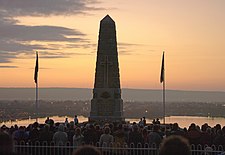
Anzac Day Dawn Service, King's Park, Western Australia, 25 April 2009

I have posted this a number of times, with slight variations. I made my first visit to Australia 25 years ago at this time when the 75th anniversary of the arrival of the Australia New Zealand Army Corps, 'ANZACs', arrived in Gallipoli, Turkey. That was an occasion for the people of Australia and the people of New Zealand to look back on this event in a new way. Gallipoli was a formative moment for the modern Australian and New Zealand nations.

This year the Centennial of the event is being marked on Saturday 25 April.

My great-uncle Lawrence Dowd, an older half-brother of my maternal grandmother, fought in Gallipoli as a member of the Royal Dublin Fusiliers. However, he survived that campaign and was to die on 6 August 1917 'In Flanders Fields'. I was the first relative to visit his grave, 84 years later.

The Columbans arrived in Australia in 1919 and in New Zealand two years later. Our arrival in those two countries was only a few years after the landing in Gallipoli, Turkey, on 25 April 1915, during the Great War, World War I. The battle in Gallipoli had a huge impact on the people of Australia and New Zealand of European origin, mainly British and Irish at the time. Many of my Columban confreres are from these two countries and because of that, their history is part of mine.

I paid my first visit to Australia just after Easter 1990. I was there for the 75th anniversary of the landing of the first members of the Australia and New Zealand Army Corps, the 'Anzacs', in Gallipoli. That particular anniversary generated new interest in this event. The Australian government flew a group of Gallipoli veterans, some of them aged more than 100, to Gallipoli to mark the event. Since then many young Australians have been going there for the anniversary ceremonies.

The landing at Anzac Cove, painting by George Lambert

On one TV discussion while I was there a participant pointed out that the iconic symbol of the Great War and Gallipoli for Australians wasn't one of soldiers killing or being killed, but of one saving lives: Private John Simpson, a stretcher-bearer, born in England, who was with the first group that landed, and his donkey, which he 'recruited' in Gallipoli and which acquired the name 'Duffy'. He had worked with donkeys as a youth during summers in England.

Private Simpson, centre, with his donkey and a wounded soldier (a Turk?)

John Simpson died on 15 May from machine gun fire, less than a month after he had arrived. He was 22. He quickly became a legend In Australia and his exploits were somewhat exaggerated, rather like some of the legends about the Church's martyrs. But there's no doubt about his bravery and that he saved many men.

Australian director Peter Weir's 1981 Gallipoli is one of the most memorable and moving films I have ever seen. It is built around the friendship of two young runners, Archy Hamilton, played by Mark Lee, and Frank Dunne, played by Mel Gibson. They meet as rivals in a 100-yard sprint but quickly become close friends or 'mates' and acquire more mates when they enlist in the army. Part of the movie's power is the detail paid to characters with small parts, every one a real human being, some attractive, some not.

Another is the wonderful use of music, especially of the Adagio in G minor by Venetian composer Tomaso Giovanni Albinoni (1671-1751). It is used with poignant effect at the end of the movie, with Frank  running back from the general to tell the major in charge of the group to which he and Archy belong that he was 're-considering the whole situation', ie, that he didn't want to have the soldiers go 'over the top' just yet. However, before he can reach the major a colonel has ordered that the soldiers go into attack immediately. The ending is unbearably sad,  the realisation of Frank that he is too late and his friend Archy going to his death.

The scenes in the trench before the soldiers go 'over the top' show their fear and their bravery. It shows them writing final letters, sharing a last cigarette and one praying the rosary. Archy recalls the words of his coach, his uncle. Here is that desperately poignant final scene.


Here is a beautiful video of Albinoni's Adagio played by the Franz Lizst Chamber Orchestra and recorded in Pannonhalma Archabbey, Hungary:


Eric Bogle, a Scottish singer-songwriter, wrote And the Band Played Waltzing Matilda in 1971, two years after he emigrated to Australia. The interpretation of the late Irish singer Liam Clancy is the best I have heard. Few could interpret a ballad as he did. War is not glorious for those who are maimed for life.


This year ANZAC Day falls during the Easter Season, but this song is more of a Good Friday one, recalling the words of Isaiah read on that day: He was despised and rejected by men; a man of sorrows, and acquainted with grief;  and as one from whom men hide their faces he was despised, and we esteemed him not.

Opening Prayer, Mass on ANZAC Day


Lord our God, boundless provider,

source of peace that the world cannot give,

kindly hear our constant prayer

for those who bore witness to your own fidelity

by giving their lives for those they loved.
Resurrect them in our true homeland
and perfect that peace for which they longed and died.

Through our Lord Jesus Christ, your Son,
who lives and reigns with you in the unity of the Holy Spirit,
one God, for ever and ever.


From The Fallen by Laurence Binyon

They shall grow not old, as we that are left grow old;
Age shall not weary them, nor the years condemn.
At the going down of the sun and in the morning
We will remember them.

In the video below The Ode is recited in Maori and in English.


You can listen to a musical setting of these words by Fr Christopher Willcock SJ from his Mass for the Fallen, commissioned by Allan and Maria Myers.

Audio here.


26 September 2014

Columban Fr John Griffin RIP

Fr John Griffin (1927 - 2014)

Columban Fr John Griffin died in Wellington, New Zealand, 25 September 2014.  Here is an article about him written by his fellow Columban and New Zealander, Fr Michael Gormly, from the website of the Columbans in Australia and New Zealand and published in 2010. Fr Gormley has added some details in the obituary he sent out.


Father John Griffin was a missionary priest blessed with an engaging personality and relentless charm. His friendly, positive and expansive spirit influenced people in many mission situations. Throughout his career blessings emerged from family, friends, names, faces, travel, cultures, languages and music. 


His travelling violin played a part too. He was a fiddler on the roof, making music, telling stories, bringing inspiration and hope to others. Faith came wrapped in warm-hearted affability.


Father Gormley describes Father John as 'a fiddler on the roof'. The late priest liked to play music from Fiddler on the Roof.
Father John, born in Timaru, New Zealand,  in 1927 commenced his missionary journey as a youthful volunteer in 1944. His theological studies were completed at Corpus Christi, Melbourne, with ordination sixty years ago, in 1950, at Dunedin.


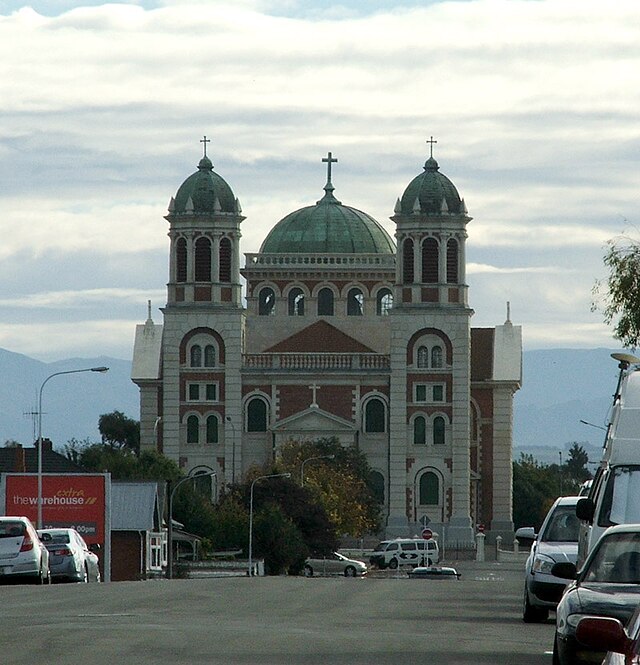
Sacred Heart Basilica, Timaru, New Zealand [Wikipedia]

His first mission assignment was to the Philippines, to the province of Zambales, north-west of Manila. He first grappled with the intricacies of Ilokano, a language brought by migrants from provinces in Northern Luzon. He was to work in Ilokano parishes in the Diocese of Iba for twenty years.


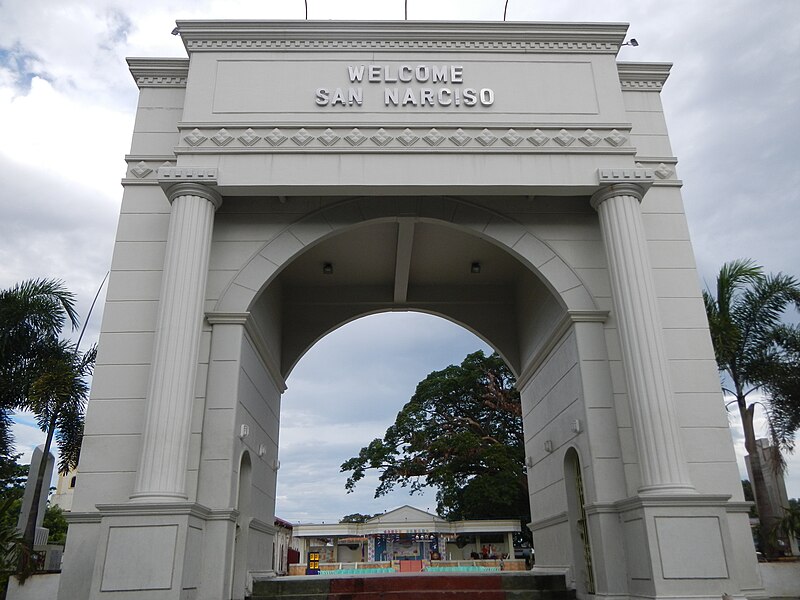
San Narciso, Zambales, Diocese of Iba, where Fr Griffin was parish priest [Wikipedia]

A medical emergency in 1970 sent Father John home to New Zealand for the amputation of his right leg due to cancer. The medical specialist spoke of a choice, 'Your leg or your life". With an artificial limb, plus a car adapted to his needs, he joined the mission education team based in Lower Hutt.


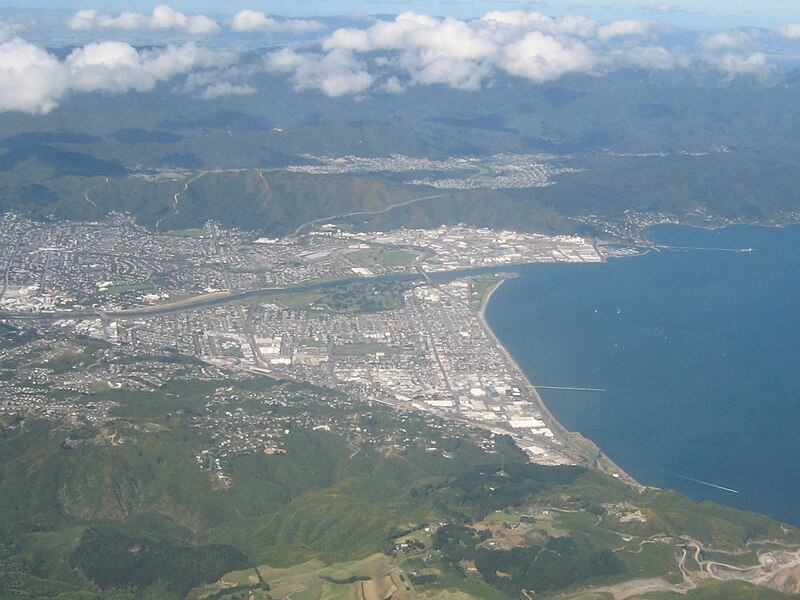
Lower Hutt from the air, looking eastwards [Wikipedia]

In 1974 he was nominated by the Bishops' Conference to head the National Missions Office. For ten years he brought his talent, charms and enthusiasm to promoting the mission cause in all corners of the country. In addition he established close personal contacts with Kiwi missionaries across the world.


Santiago, Chile [Wikipedia]

Next, Father John volunteered to serve in Latin America, learn Spanish and settle in Chile. For ten years he assisted the Columban team in the capital, Santiago. On his return to New Zealand in 1995, he moved around the Diocese of Auckland with a message of mission awareness. He made a deliberate effort to keep mission alive in the local church. In retirement at the Columban Mission Centre he was by no means house-bound. Family, friends and colleagues enjoyed his company, visits, phone calls and emails.


Ageing and a loss of mobility led to dedicated healthcare and professional nursing at the Aroha Centre for the Elderly. He spoke of his final blessings In terms of ‘aroha’ – warm care and attention based on love and respect.
Father John Griffin died peacefully in Wellington, New Zealand, on 25 September 2014, remembered as a gifted missionary priest with a remarkable interest and concern for people. One tribute says it well: 'He arrived among us bringing short moments of joy and encouragement; he departed leaving long memories of friendship and celebration.'


Santiago Cathedral at night [Wikipedia]

In reviewing his life, Father John recalls wisdom learned as a youth. 'You will receive much more than you will give; you will learn much more than you will teach'. He has no doubt that learning that truth and humbly accepting it has been the greatest experience of his life.


Praise to the Holiest, by Blessed John Cardinal Newman
Sacred Heart Basilica, Timaru, New Zealand

+++


Father John, a tall, handsome, distinguished-looking and very kind man, wrote an amusing account of the unexpected obstacles he met while travelling from Australia to New Zealand for his ordination in 1950 in Ordination Misadventures.

San Alberto Hurtado SJ, Chile's second saint

Father John also wrote an article on San Alberto Hurtado SJ which we have used a number of times in MISYONonline.com, A priest, I bless you - Alberto.

In that article Father John writes about the Hogar de Cristo (Home of Christ) founded by the saint. May he join San Alberto in the Hogar that Christ has prepared for us all.


22 November 2012

'Every one who is of the truth hears my voice.' Sunday Reflections. Christ the King, Year B


From The Gospel of John (2003) Directed by Philip Saville. Jesus played by Henry Ian Cusick; narrator, Christopher Plummer. 


Readings (New American Bible: Philippines, USA)

Readings (Jerusalem Bible: Australia, England & Wales, India [optional], Ireland, New Zealand, Pakistan, Scotland, South Africa)

Gospel John 18:33b-37 (Revised Standard Version – Catholic Edition)

Pilate said to Jesus, "Are you the King of the Jews?" Jesus answered, "Do you say this of your own accord, or did others say it to you about me?" Pilate answered, "Am I a Jew? Your own nation and the chief priests have handed you over to me; what have you done?" Jesus answered, "My kingship is not of this world; if my kingship were of this world, my servants would fight, that I might not be handed over to the Jews; but my kingship is not from the world." Pilate said to him, "So you are a king?" Jesus answered, "You say that I am a king. For this I was born, and for this I have come into the world, to bear witness to the truth. Every one who is of the truth hears my voice."

Christ Before Pilate, Nicolas Maes, 1649-50 (Web Gallery of Art)


Entrance Antiphon  Revelations 5:12; 1:6

Dignus est Agnus qui occísus est, accípere virtútem, et divinitátem et sapiéntiam, et fortitúdinen, et honórem. Ipsi glória et impériun in sæcula sæculórum. 

[V. (Ps. 71: 1) Deus, judícium tuum Regi da: et justítiam tuam Fílio Regis. v. Gloria Patri, et Filio, et Spiritui Sancto. Sicut erat in principio et nunc et semper et in saecula saeculorum. Amen.]

How worthy is the Lamb who was slain, 
to receive power and divinity, 
and wisdom and strength and honour. 
To him belong glory and power for ever and ever.

+++


Fr Gabriel Harty OP (above) is an Irish Dominican friar is now 91. He blogs under the title Irish Rosary Priest. In the November issue of Pioneer, the excellent monthly of the Pioneer Total Abstinence Association, he writes about losing his job.

As National Director of the Rosary apostolate for almost sixty years, I realise that I had made a name for myself in certain quarters and that I had, as it were, built up a little kingdom of my own. then one day I heard the news, that I was no longer to be in control. A big white van came down from the North to clear everything out of what was once my office, my home, my sanctuary to establish the Rosary Centre elsewhere. I c onfess that I felt angry. Like so many at this time of recession who find themselves redundant, or like those who have to move aside to let the young take over, I went through a process of grieving. I confess that I failed to recognise the times, or come to terms with my own declining years.

In the midst of a time of darkness, it was the Lord's own prayer that helped me. Unable to run around the country anymore preaching to the crowds, I took time to walk up and down the Gethsemane back-garden of a dear friend who understood my predicament. As I would begin the Our Father, it would slowly dawn on me, that it was not my name that mattered or my kingdom that had to be preserved . . .

Father Gabriel was sharing in some of the humiliation of Jesus as he stood before Pilate, a humiliation captured so movingly by Nicolas Maes in the painting above. The only person in the foreground looking at Jesus is one showing mock veneration and concern.

In many Western countries in the last twenty years or so the Church has been going through a process of humiliation, much of it brought on by priests and religious who misused their positions of authority and power to abuse young people. And it would seem that many of their superiors refused to use their positions of authority and power to stop the abusers and protect those being abused. Not all of this failure was due to malice. Some followed the best advice they could find at the time, advice that would be found wanting now, and acted as responsibly as they could.

But the Church has lost its moral authority to a large degree, its ability to announce the Gospel, its ability to teach, to guide, to lead, to encourage, to heal. 

I grew up in the Republic of Ireland at a time when around 95 percent were Catholics and where the authority of bishops and other authority figures in the Church held sway. This was not by any means as negative as some say. But it did mean that many authority figures, if they ever considered it, could say with Father Gabriel that I had, as it were, built up a little kingdom of my own. 

This can happen when one is truly working for the Lord just as much as when one sets out to be in control no matter who suffers. It can happen to parents who thwart their adult children's desires, hopes and plans for their future. I remember a parish here in the Philippines where the people in one section of the city wanted to have a priest of their own. They had a chapel and were willing to support a priest. The committee elected by the people went to see the bishop. When the son of the committee's chairman expressed a desire to enter the diocesan seminary his father forbade him.

In the 1990s a parish priest visiting from Ireland told some of us of an incident that hurt him deeply. It was during a time when cases of priests abusing children were in the news with sickening frequency. One morning when he was walking along a street in his parish he saw a parishioner who had been at Mass that morning coming towards him and then, very deliberately, crossing the road to avoid him.

That has not been my experience in Ireland or in the Philippines but I'm well aware of the sense of humiliation that so many good Catholic feel at times, of the sense of disappointment at having been let down by those they trusted, of the sense at times that it doesn't really matter whether we're Catholics or Christians 'as long as we're nice to one another'.

A few months ago I re-read  The Laughter and the Weeping by the late Fr Luke O'Reilly, a Columban who, like many others, was expelled from China in the early 1950s after having spent some time in jail. I can't recall whether it was about himself or another Columban but when the priest in question was being walked through the town before being expelled and the people lined up to mock and humiliate him - they didn't have much choice - there were one or two who quietly showed their support and gratitude.

Catholics and other Christians in some countries live with humiliation and danger daily. They are sometimes a very small and despised minority. They can identify with the Jesus in the painting of Maes. But for those of us who have grown up in communities where the Church was powerful and for the most part used its power and influence for the good of the people, and who now see that same Church as having little or now outward power of influence, we have to choose to stand with the humiliated Jesus and walk with him to Calvary.

We have to choose to live by the values of the Gospel, by the teachings of the Church. We have to do that in societies where marriage as taught by the Bible, the Word of God, as taught explicitly by Jesus, is no longer considered a norm or even desirable. We have to do that in societies where the unborn child is not considered to be worthy of full protection. We have to do that in a world where God's own creation is exploited and destroyed to the detriment of all, often causing great poverty and suffering.

The image of Christ the King of Maes is a true image and the measure of God's love for us, the measure of the love of Jesus, God who became Man, for us.

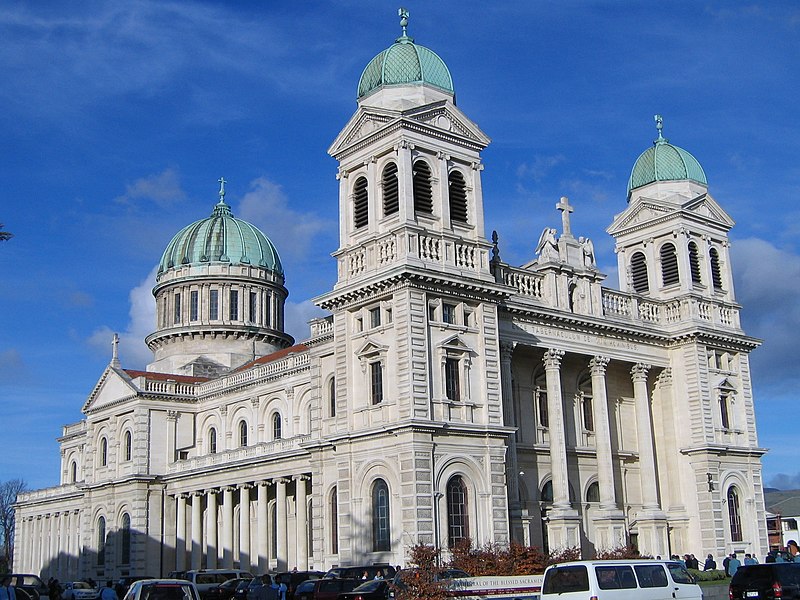
Hail Redeemer King Divine - Catholic Cathedral Christchurch, New Zealand, November 1999


Sometimes a very building may share in the humiliation of Jesus. The above recording was made in the Cathedral of the Blessed Sacrament, Christchurch, New Zealand. It, along with the Anglican Cathedral, was largely destroyed by the earthquake that hit that city on 4 September 2010.


Blessed Sacrament Cathedral, Christchurch, New Zealand, 2005


Blessed Sacrament Cathedral, 2011, a year after the earthquake

Hail Redeemer, King Divine! (music by Grattan Flood, 1859 – 1928, words by Fr Patrick Brennan CSsR, 1877 – 1952)
Hail Redeemer, King divine!
Priest and Lamb, the throne is thine;
King, whose reign shall never cease,
Prince of everlasting peace.
Refrain
Angels, saints and nations sing :
“Praise be Jesus Christ our King;
Lord of life, earth, sky and sea,
King of love on Calvary!”
Verse 2
King, whose name creation thrills,
rule our hearts, our minds, our wills;
till in peace, each nation rings
with thy praises, King of kings.
Refrain
Verse 3
King most holy, King of truth,
guard the lowly, guide the youth;
Christ the King of glory bright,
be to us eternal light.
Refrain
Verse 4
Shepherd-king, o’er mountains steep
homeward bring the wandering sheep;
shelter in one royal fold
states and kingdoms, new and old.
Refrain
[Extra verses
Crimson streams, O King of grace,
drenched thy thorn-crowned head and face;
floods of love’s redeeming tide
tore thy hands, thy feet, and side.
Eucharistic King, what love
draws thee daily from above,
clad in signs of bread and wine :
feed us, lead us, keep us thine!
Sing with joy in ev’ry home :
“Christ our King, thy kingdom come!
To the King of ages, then,
honour, glory, love : Amen!”]

The words of this stirring hymn remind us who Christ the King really is: King of love on Calvary.

Here is another setting of the hymn by Charles Rigby (1901 – 1952)