31 January 2012

'I have always laboured lovingly for them. . .' St John Bosco


I have always admired St John Bosco (16 August 1815 - 31 January 1888). I gave more than a passing thought to the idea of being a Salesian, though that notion never really took hold. But a Salesian priest in England whom I never met did play a part in my desire to be a priest. He established a group called The Guild of St Dominic Savio and members received a newsletter each month. At one stage I wrote the priest to tell him that I hoped to be a missionary priest. I was about 16 at the time. He wrote me a personal letter in which he said that there were many good priests but that the Church needed holy priests. That has stayed with me for more than 50 years now.

I have been blessed all my life as a priest - more than 44 years now - through involvement with young people, as a teacher, a retreat-giver, a confessor, an editor replying to letters, as a friend. At times young people have exasperated me but they have always given me hope and have called forth the best in me. They have been forgiving and understanding.

The second reading in the Office of Readings today, the Feast of St John Bosco, is from a letter of St John Bosco to his confreres in the Salesian Congregation which he founded to respond to the needs of boys who had little hope or direction in their lives. It is a letter that shows an understanding of human nature and of God's call to be loving.

I have highlighted some parts and added [comments].
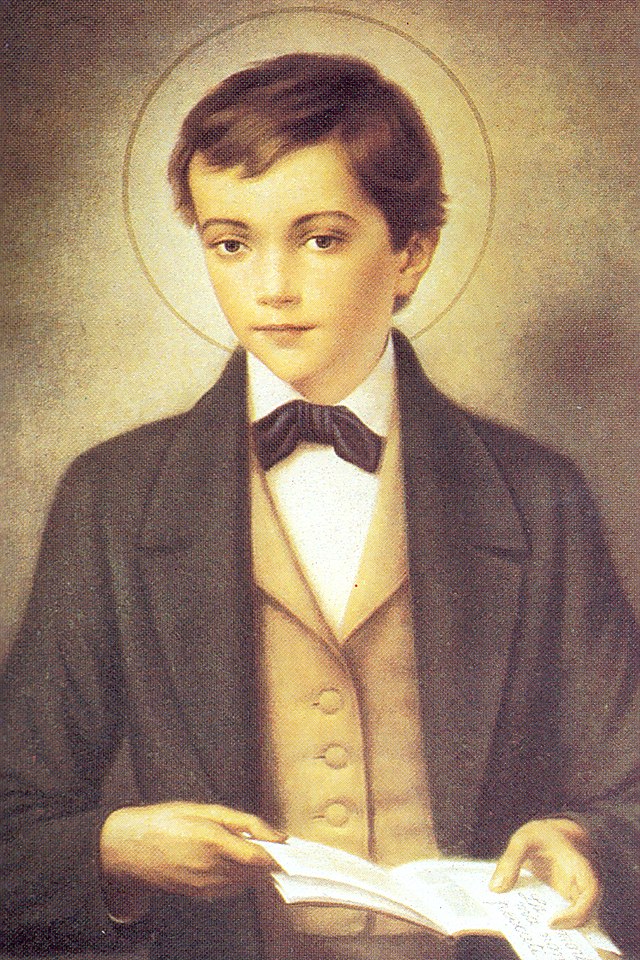
St Dominic Savio, 2 April 1842 - 9 March 1857, a student of St John Bosco

I have always laboured out of love

First of all, if we wish to appear concerned about the true happiness of our foster children and if we would move them to fulfil their duties, you must never forget that you are taking the place of the parents of these beloved young people. I have always laboured lovingly for them, and carried out my priestly duties with zeal. And the whole Salesian society has done this with me.

My sons, in my long experience very often I had to be convinced of this great truth. It is easier to become angry than to restrain oneself, and to threaten a boy than to persuade him. Yes, indeed, it is more fitting to be persistent in punishing our own impatience and pride than to correct the boys. We must be firm but kind, and be patient with them. [So often I've seen young persons respond positively and with gratitude to kind firmness, what may be called at times 'tough love'.]

I give you as a model the charity of Paul which he showed to his new converts. They often reduced him to tears and entreaties when he found them lacking docility and even opposing his loving efforts. [No young person has ever reduced me to tears by his or her behaviour but I have been close to tears on occasion when a young person has thanked me for being firm and showing care.]

See that no one finds you motivated by impetuosity or wilfulness. It is difficult to keep calm when administering punishment, but this must be done if we are to keep ourselves from showing off our authority or spilling out our anger. [This echoes last Sunday's gospel, Mark 1:21-28, where the people recognised the inner authority of Jesus.]

Let us regard those boys over whom we have some authority as our own sons. Let us place ourselves in their service. Let us be ashamed to assume an attitude of superiority. [The Handbook of the Legion of Mary, written by its founder, the Venerable Frank Duff, urges a similar approach to persons.] Let us not rule over them except for the purpose of serving them better. [Elected officials and anyone in a position of authority might take this to heart.]

This was the method that Jesus used with the apostles. He put up with their ignorance and roughness and even their infidelity. He treated sinners with a kindness and affection that caused some to be shocked, others to be scandalised, and still others to hope for God’s mercy. [Read an extraordinary instance of this in yesterday's post in Remembering Fr William Doyle SJ.] And so he bade us to be gentle and humble of heart.

They are our sons, and so in correcting their mistakes we must lay aside all anger and restrain it so firmly that it is extinguished entirely.

There must be no hostility in our minds, no contempt in our eyes, no insult on our lips. We must use mercy for the present and have hope for the future, as is fitting for true fathers who are eager for real correction and improvement.

In serious matters it is better to beg God humbly than to send forth a flood of words that will only offend the listeners and have no effect on those who are guilty.
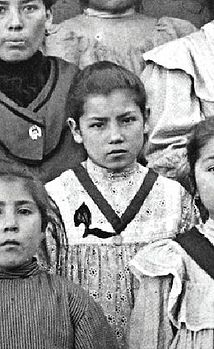
Blessed Laura Vicuña (5 April 1891, Chile – 22 January 1904, Argentina, educated by the Salesian Sisters, Patron of victims of abuse


29 January 2012

Pleasing your wife, pleasing your husband

Officiating at a wedding in the Philippines


I want you to be free from anxieties. The unmarried man is anxious about the affairs of the Lord, how to please the Lord; but the married man is anxious about worldly affairs, how to please his wife, and his interests are divided. And the unmarried woman or girl is anxious about the affairs of the Lord, how to be holy in body and spirit; but the married woman is anxious about worldly affairs, how to please her husband.

This is a sort of appendix to Sunday Reflections for today. The above verses, 1 Corinthians 7: 32-34, are from today's Second Reading. My friends in Worldwide Marriage Encounter are probably sick and tired of my emphasising that the basic vocation in marriage is to be a spouse, not a parent. The latter is a consequence of the former. In this brief passage St Paul doesn't mention parenthood at all but the priority of pleasing one's spouse. I truly believe that  a spouse who gives first priority to that will be a good parent.

I was invited to a wedding recently and the officiating priest asked me to preach. I told the couple that their wedding day didn't mean the end of dating but rather the beginning. I went on to speak of the spousal relationship as being the fundamental one.

The wedding was at 4pm. Before 9pm, the last item during the reception was a short video of the ceremony. I was delightedly surprised when it opened with my words about dating and made the spousal relationship the basic theme, rather than only showing various shots of the wedding.

I have seen marriages break up where both spouses were doing everything they could 'for the sake of the kids'. I think that break-ups are much less likely when a husband's priority is, in St Paul's words, how to please his wife, and a wife's priority how to please her husband.

I have seen in so many families how children truly feel loved when their parents' priorities are such. One adult daughter told me how her father, when he was dying, said goodbye to all his children and then asked them to leave so that he could spent his last moments with his wife.

27 January 2012

'He taught them with authority.' Sunday Reflections, 4th Sunday in Ordinary Time Year B

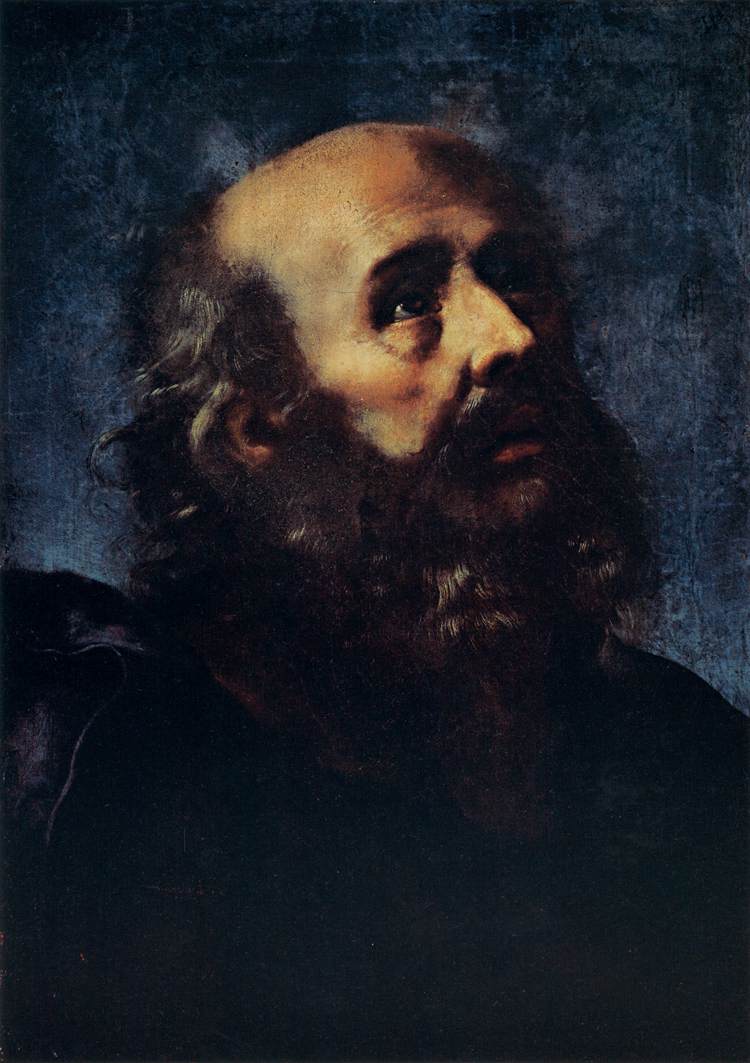
Moses, Carlo Dolci, painted 1640-45

Readings (New American Bible: Philippines, USA)


Gospel Mark 1:21-28 (Jerusalem Bible: Australia, England & Wales, India [optional], Ireland, New Zealand, Pakistan, Scotland, South Africa)

Jesus and his followers went as far as Capernaum, and as soon as the sabbath came Jesus went to the synagogue and began to teach. And his teaching made a deep impression on them because, unlike the scribes, he taught them with authority.

In their synagogue just then there was a man possessed by an unclean spirit, and it shouted, ‘What do you want with us, Jesus of Nazareth? Have you come to destroy us? I know who you are: the Holy One of God.’ But Jesus said sharply, ‘Be quiet! Come out of him!’ And the unclean spirit threw the man into convulsions and with a loud cry went out of him. The people were so astonished that they started asking each other what it all meant. ‘Here is a teaching that is new’ they said ‘and with authority behind it: he gives orders even to unclean spirits and they obey him.’ And his reputation rapidly spread everywhere, through all the surrounding Galilean countryside.

An Soiscéal Marcas 1:21-28 (Gaeilge, Irish)

When I was 16 I joined Fórsa Cosanta Áitiúil (Local Defence Force), part of the Irish Army Reserve (cap badge above). Membership was voluntary. We trained on Sundays and there was a two-week summer camp. However, I didn’t stay in it long enough to experience that.

I remember two individuals very clearly, not by name but by rank. One was a corporal and the other a sergeant. The corporal took delight in shouting and swearing at everyone. He was in his early 20s and we mostly between 16 and 18. We did what he told us to do. But none of us had any respect for him. 

The sergeant, also in his early 20s, while strict, never shouted at us and the strongest word he ever used was ‘damn’. While in its fullest meaning this really is a curse, usage over the centuries has made it a very mild expression, with hardly any connection to its dictionary definition. We did what the sergeant told us to do, and with genuine respect for him. He respected us and because of that his authority came primarily from his person, not from his rank.

I am always struck by the way St Mark highlights the authority Jesus had. It wasn’t from any position he held but from the Truth that he is. He tells us in St John’s Gospel that he is ‘the way, the truth and the life’. The people recognised this: his teaching made a deep impression on them because, unlike the scribes, he taught them with authority; ‘Here is a teaching that is new’ they said ‘and with authority behind it: he gives orders even to unclean spirits and they obey him.’

I remember our rector in the seminary, Fr Joseph Flynn, once saying to us, ‘Let us at least be hypocrites’. What he meant was that if we fall short of what we believe and profess, and know that we are falling short and ask God’s forgiveness, we will still have something of the authority of Jesus himself. The tax collector who prayed in the Temple, ‘Lord, have mercy on me a sinner’, still carries authority whereas the hypocritical Pharisee doesn’t.

Yesterday I had an email from a recovering alcoholic who told me he ‘went into a blank space’ when he learned of the death of a priest who had also been a recovering alcoholic. This priest had been very close to him during the first years of his recovery. I know that the priest had occasional lapses but sought the help of others in AA when he did. That’s what gave him the authority he had with fellow 'strugglers'. 


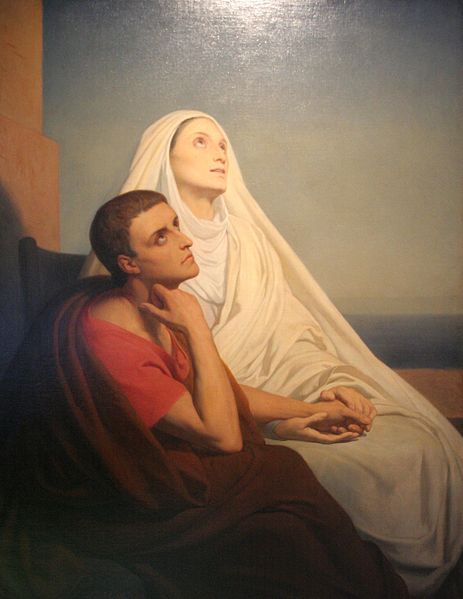
Some saints, such as St Thérèse of Lisieux (above, aged 15), carry the authority of the purity of their lives. Some, like St Augustine of Hippo, carry the authority of a person who has, with God’s grace, overcome a life of sin. Moses, who speaks to us in the first reading today, carries the authority of a great leader who acknowledged his own impatience and who accepted the consequence of this, that he would lead his people to the Promised Land, see it, but never enter it himself.

  St Augustine and St Monica, by Ary Scheffer (painted 1846)


San am sin chuaigh Íosa isteach i gCafarnáum. Agus lá na sabóide féin, ar dhul isteach satsionagóg dó, thosaigh sé ag teagasc.Agus bhí ionadh orthu faoina theagasc; á dteagasc a bhí sé mar dhuine a mbeadh údarás aige, níorbh ionann agus na scríobhaithe.

Bhí, san am sin, duine sa tsionagóg a raibh smacht ag spiorad míghlan air, agus scread sé amach: “Há, cad ab áil leat dínn, a Íosa Nazairéanaigh? Chun ár millte a tháinig tú. Is eol dom cé hé thú: Naomh Dé.” Labhair Íosa leis go bagrach: “Bí i do thost, agus gabh amach as.” Bhain an spiorad míghlan rachtaí as an duine, ghlaoigh amach go hard agus d’imigh as. Agus bhí alltacht chomh mór sin ar chách go raibh siad ag fiafraí dá chéile: “Cad é an rud é seo?” deiridís: “teagasc nua á dhéanamh le húdarás; na spioraid mhíghlana féin, fógraíonn sé orthu agus déanann siad rud air.” Agus níorbh fhada gur leath a chlú go fada gearr ar fud cheantar uile na Gailíle.

+++

26 January 2012

A 'spirited' young Massgoer!


I came across this on Facebook. We'll have to wait in the Philippines, in Hong Kong and, I think, New Zealand, until next Advent for this.

24 January 2012

Please pray for Julie

Mrs Julie Lamb with grandchildren Erin and Patrick O'Brien

Yesterday I received an email from a good friend in London, Ontario, Laura O'Brien. Laura asked me to pray for her mother, Mrs Julie Lamb. Julie has lung cancer and has been 'given weeks to a couple months to live'.

I've known Laura since 1981 when I was studying in Toronto. She and her husband Danny - Laura had the good sense to marry an Irishman! - were members of a prayer group that used to meet in St Basil's in the heart of  this remarkably cosmopolitan city. (The 1980 census showed that 44 per cent of the population of Metro Toronto had been born outside of Canada).

I met Julie for the first time in 2010 during a visit to Canada. She is a delightfully alive person.

Laura wrote, 'She is getting great care, and all the family have pulled together to ensure she has all her needs met'.

Please remember Julie and her family in your prayers

20 January 2012

'At once they left their nets and followed him', Sunday Reflections, 3rd Sunday in Ordinary Time Year B

Calling of Peter and Andrew, Duccio di Buoninsegna, painted 1308-11
Readings (New American Bible: Philippines, USA)
Gospel Mark 1:14-20 (Jerusalem Bible: Australia, England & Wales, India [optional], Ireland, New Zealand, Pakistan, Scotland, South Africa)


After John had been arrested, Jesus went into Galilee. There he proclaimed the Good News from God. ‘The time has come’ he said ‘and the kingdom of God is close at hand. Repent, and believe the Good News.’
As he was walking along by the Sea of Galilee he saw Simon and his brother Andrew casting a net in the lake – for they were fishermen. And Jesus said to them, ‘Follow me and I will make you into fishers of men.’ And at once they left their nets and followed him.


Going on a little further, he saw James son of Zebedee and his brother John; they too were in their boat, mending their nets. He called them at once and, leaving their father Zebedee in the boat with the men he employed, they went after him.


An Soiscéal Marcas 1:14-20 (Gaeilge, Irish)


Tar éis Eoin a bheith tugtha ar láimh, tháinig Íosa go dtí an Ghailíl ag fógairt soiscéal Dé agus ag rá: “Tá an tréimhse caite agus tá ríocht Dé in achmaireacht. Déanaigí aithrí agus creidigí sa soiscéal.”


Bhí sé ag imeacht leis cois farraige na Gailíle nuair a chonaic sé Síomón agus Aindrias deartháir Shíomóin agus iad ag caitheamh eangaí san fharraige, mar iascairí a bhí iontu. Dúirt Íosa leo: “Tagaigí i mo dhiaidh, agus déanfaidh mé díbh iascairí ar dhaoine.” D’fhág aid na líonta láithreach agus lean aid é. Bhuail sé ar aghaidh beagán eile agus chonaic sé Séamas mac Zeibidé agus Eoin a dheartháir, iad ina mbád féin ag ceartú na líonta, agus ghlaoigh sé iad láithreach. D’fhág aid a n-athair Zeibidé sa bhád, é féin agus an lucht pá, agus ghabh aid leis.


The young Fr Edward Galvin in China

One hundred years ago a 29-year-old Irishman who had been working in Brooklyn, New York City, wrote a letter to his mother in his native County Cork. Nothing unusual in that. There were countless young Irishmen and women in the USA who had gone there because there was no work for them at home. That was the case with this young man. He had been ordained in 1909 for his own Diocese of Cork but his bishop had so many priests that he loaned the young man, Fr Edward Galvin, to the Diocese of Brooklyn.

While there he felt a desire to be a missionary. This led him to head off to China in February 1912 from Toronto, Canada, with a Canadian priest, Fr John Fraser, instead of going home to Ireland.

Here is his letter, written in Toronto:

Photocopy of letter (Thanks, Father Rex)
Dear Mother,

I am sorry, dear Mother, to have to write this letter, but God’s will be done. Everything is in His hands. Mother, don’t grieve, don’t cry. It is God’s will. God has called and I had to obey.

I am not going back to Ireland. I am going as a missionary to China. May God’s will be done. God knows my heart is broken, not for myself but for you whom I love above all the world.

Mother, you know how this has always been on my mind. But I thought it was a foolish thought – a boyish thought; that it would pass away as I grew older. But it never passed, never, never, never.

Why should God ask me to do this thing that is breaking my heart to do? I don’t know. God knows best. May His will be done. “If any man will come after me let him take up his cross and follow me.” Oh yes, but oh my God I never thought that it was so hard to follow. I have tried to follow when you called. I ask you in return to console my poor mother, to comfort her, to help her to make the Sacrifice I am making and spare her until we meet again.’
 

Frs Edward Galvin, John Blowick (seated) and Owen McPolin shortly after the arrival of the first group of Columbans in China. They left Ireland in 1920. Fr Blowick, the first Superior General, returned to Ireland to direct the Society and to teach in the Columban seminary.

Fr Fraser was to found the Scarboro Foreign Mission Society, with its headquarters in Scarborough, Ontario, now part of Metro Toronto, and the young Fr Galvin was to co-found with Fr John Blowick, another Irish diocesan priest and more than five years younger, what was first known as the Maynooth Mission to China in 1916 and formally became the Society of St Columban in 1918. Both societies had China as their original mission and both are societies of secular priests, not religious.

Father Galvin thought his idea of becoming a missionary was ‘a foolish thought – a boyish thought’. The actual moment when God called him as starkly as Jesus called Peter and Andrew, James and John, in today’s gospel happened on his weekly day off when he had planned to go to the office of the Propagation of the Faith in New York City to explore the idea of becoming a missionary. Two unexpected sick calls came that morning, which he responded to, leaving it too late for him to do what he had planned. Then Fr John Fraser arrived unannounced at the rectory and it was this meeting the led Edward Galvin to China shortly afterwards.

The cover of The Far East, the Columban magazine in Ireland, was the same for many years and the Chinese junk symbolised the Columbans for the Irish people and touched the imagination of many a future Columban missionary, including my own while I was still in kindergarten.

I don’t know what went on in the hearts of Peter and Andrew when, as St Mark tells us, ‘at once they left their nets and followed’ Jesus, or in the hearts of James and John who 'leaving their father Zebedee . . . went after him’. That decision was to lead ultimately to the martyrdom of three of them and to John standing at the Cross of Jesus and taking on the care of Mary, the Mother of Jesus.

Father Galvin recalled years later what it had cost him to set off for China, starting from New York City: ‘I still remember the pain of parting on that grey, dreary morning. When the train got underway for Toronto, I crumpled up in the coach and cried as if my heart would break.’

He was to become Bishop of Hanyang in China where he was to experience natural calamiteis such as great floods, the Sino-Japanese War, World War II and the Communist takeover, leading his expulsion in 1952. Born on the feast of St Columban, 23 November 1882, he died on 23 February 1956, the feast of the great martyr-bishop St Polycarp of Smyrna who knew St John the Evangelist who, with his brother James, had left his father to follow Jesus.

The cover on The Far East after the death of Bishop Galvin.

You can read more in an article by English Columban Fr Pat Sayles, Edward J. Galvin: a Trailblazer for God. 

17 January 2012

'Some loved him as a son . . .' St Anthony the Abbot

St Anthony Distributing his Wealth to the Poor, Master of the Ozzervanza, c.1440

St Anthony the Abbot, also known as St Anthony of Egypt and St Anthony the Hermit has had an enormous influence on the life of the Church, touching the lives of nearly all of us. When he went off into the desert as a young man he had no idea that this would lead to the spread of monsticism, which in turn led to other forms of religious life of which there are many variations. He died in 356 at the great age of 105. There were monasteries before St Anthony, so he didn't start this but his life helped to spread it.

There is a lovely reading in the Office of Readings today from the Life of St Anthony by St Athanasius. It ends with these words: And so all the people of the village, and the good men with whom he was associated was what kind of man he was, and they called him 'The friend of God'. Some loved him as a son, and others as though he were a brother. 

It's conventional enough to describe a saintly man as a brother or as a father, though St Athanasius didn't use the latter. However, I'm always touched by the words Some loved him as a son. There must have been something very special about St Anthony that led St Athansius to describe him in that way.

St Athanasius also lets us know that the young Anthony was late arriving at Mass when he heard the words of the gospel that changed his life: It happened that the gospel was then being read, and he heard what the Lord had said to the rich man 'If you would be perfect, go, sell what you possess and give to the poor, and you will have treasure in heaven; and come, follow me'.

This passage is from Matthew 19:16-26, which is recommended for the Mass of the saint. Here it is in the Revised Standard Version - Catholic Edition.

And behold, one came up to Jesus, saying, "Teacher, what good deed must I do, to have eternal life?" And he said to him, "Why do you ask me about what is good? One there is who is good. If you would enter life, keep the commandments." He said to him, "Which?" And Jesus said, "You shall not kill, You shall not commit adultery, You shall not steal, You shall not bear false witness, Honor your father and mother, and, You shall love your neighbor as yourself." The young man said to him, "All these I have observed; what do I still lack?" Jesus said to him, "If you would be perfect, go, sell what you possess and give to the poor, and you will have treasure in heaven; and come, follow me." When the young man heard this he went away sorrowful; for he had great possessions. And Jesus said to his disciples, "Truly, I say to you, it will be hard for a rich man to enter the kingdom of heaven. Again I tell you, it is easier for a camel to go through the eye of a needle than for a rich man to enter the kingdom of God." When the disciples heard this they were greatly astonished, saying, "Who then can be saved?" But Jesus looked at them and said to them, "With men this is impossible, but with God all things are possible."

+++

O God, who brought the Abbot Saint Anthony
to serve you by a wondrous way of life in the desert,
grant, through his intercession,
that, denying ourselves,
we may always love you above all things.
Through our Lord Jesus Christ, your Son,
who lives and reigns with you in the unity of the Holy Spirit,
one God, for ever and ever.