15 March 2012

'The gift of God' - the faith that St Patrick brought to the Irish


Saturday, 17 March, is St Patrick's Day and Ireland's National Day.

One of Miss Cunningham's pupils in Rutland St School in the heart of Dublin half a century ago tells how St Patrick came to Ireland twice, the second time to stay there. You will notice that in this Brown Bag Production, done a few years ago, the pope who gave St Patrick permission to go to Ireland as a bishop bears a remarkable resemblance to a much more recent pope!

Mary, the young girl telling the story, has Patrick being kidnapped in France. I'm more inclined to think he was from Wales, much nearer to Ireland. But we don't know. Scholars can't identify 'Bannavem Taburniae', Patrick's native place as mentioned in the opening paragraph of his Confession. Young Mary sees Patrick's reluctant willingness to return to Ireland as a missionary. There is no doubt about the truth of this because the saint writes about his struggle in his Confession, the authenticity of which no scholar doubts. It and the Letter to Coroticus are the only writings of the saint that we have.

 Slemish, County Antrim in the north-east of Ireland where St Patrick is said to have worked as a shepherd while a slave. It is generally believed that St Patrick came to Ireland as a bishop in 432 and that he died on 17 March 461.

Each time I read his Confession I'm struck by the saint's knowledge of Scripture. Texts from the Bible are interwoven with his own words. He had a strong sense of the faith being a gift from God as this extract shows. Words from Scripture are in italics. The English translation is by Bishop Joseph Duffy, the Latin is Patrick's own and the Irish version is by Bishop Liam Mac Philibín (William Philbin).

 My decision to write must be made, then, in the light of our faith in the Trinity. The gift of God and his eternal consolation must be made known regardless of danger, I must fearlessly and frankly spread the name of God everywhere in order to leave a legacy after my death to my brothers, and children, the many thousands of them, whom I have baptized in the Lord. And at the very end of the Confession: Do not attribute to me in my ignorance the little I achieved or pointed out which pleased God. Let your concusion and the general opinion rather be the real truth, that my success was the gift of God. This is my confession before I die.

In mensura itaque fidei Trinitatis oportet distinguere, sine reprehensione periculi, notum facere donum Dei, et consulationem aeternam, sine timore fiducialiter Dei nomen ubique expandere, ut etiam post obitum meum exagallias relinquere fratribus et filiis meis, quos in Domino ego babtizaui, tot milia homnium.  And at the very end of the Confessio: ut nemo umquam dicat, quod mea ignorantia si aliquid pusillum egi uel demonstrauerim secundum Dei placitum; sed arbitramini et uerissime credatur quod donum Dei fuisset. Et haec est Confessio mea antequam morior.

Mar sin, de réir creidimh sa Tríonóid is ceart dom comhairle a dhéanamh, bronntanas Dé agus an sólás síoraí a chur in iúl gan aird ar chontúirt, ainm Dé a leathadh i ngach áit gan fuacht gan faitíos ionas go bhfágainn tar éis mo bháis oidhreacht ag my bhráithre agus ag mo chlann, a liachtaí sin mile duine a bhaist mé sa tiarna. Agus ag deireadh na Faoistine: . . . nach ndéarfaidh aon duine choíche go mba é m’aineolas ab údar le cibé beagán a rinne mé nó a léirigh mé de réir thoil Dé. Ach ceapaigí agus creidtear – is é lomchlár na fírinne  é -  go mba é tabhartas Dé é. Agus siúd í m’Fhaoistin roimh bhás dom.

Please pray that the present generation of Irish people, many of whom, perhaps even a majority, have rejected the gift of God, our Christian Catholic faith that St Patrick cherished so deeply, may, with God's grace, re-discover it. 

Lord, through the work of Saint Patrick in Ireland 
we have come to acknowledge the mystery of the one true God 
and give thanks for our salvation in Christ; 
grant by his prayers that we who celebrate this festival 
may keep alive the fire of faith he kindled.
Through our Lord Jesus Christ, your Son, 
who lives and reigns with you in the unity of the Holy Spirit, 
one God, for ever and ever.


I

Dóchas linn Naomh Pádraig, Aspal mór na hÉireann,

Bring hope to us, St Patrick, great Apostle of Ireland,

Ainm oirearc gléigeal, solas mór an tsaoil é.

Illustrious, glorious name, he is the great light of the world.

D'fhill le soiscéal grá dúinn d'ainneoin blianta i ngéibheann.

He came back to us with the gospel of love, despite years of captivity.

Grá mór Mhac na páirte, d'fhuascail cách ón daorbhruid.

Great love of the Son, freed all from oppression.

II

Sléibhte, gleannta, máighe,'s bailte mór’ na hÉireann:

Hill, valleys, plains, large towns of Ireland

Ghlan sé iad go deo dúinn, míle glóir dár naomh dhil.

He cleaned them for ever, a thousand praises to our dear saint.

Iarr’maid ort, a Phádraig, guí orainn na Gaela,

We ask you, Patrick, pray for us Irish,

Dia linn lá 'gus oíche 's Pádraig Aspal Éireann.

God and St Patrick Apostle of Ireland be with us day and night.

First stanza repeated.

Lá Fhéile Pádraig faoi mhaise daoibh!
A Happy St Patrick’s Day!

10 March 2012

'Zeal for your house will devour me'. Sunday Reflections for 3rd Sunday of Lent, Year B


Readings (New American Bible: Philippines, USA)


An Soiscéal Eoin 2:13-25 (Gaeilge, Irish)

Nuair a bhí Cáisc na nGiúdach in achmaireacht agus chuaigh Íosa suas go Iarúsailéim dá bhrí sin. Fuair sé sa sanctóir lucht ba agus caoirigh agus colmáin a dhíol, agus lucht airgead a mhalartú ina suí ann. Agus rinne sé sciúirse de théada agus thiomáin sé iad go léir amach as an sanctóir, na caoirigh agus na ba chomh maith; scaip sé airgead an lucht mhalartaithe agus leag sé na boird, agus dúirt sé le lucht na gcolmán a dhíol: “Beirigí na nithe sin as seo agus ná déanaigí teach margaidh de theach m’Athar.” Chuimhnigh a dheisceabail go bhfuil sé scríofa: “Déanfaidh díograis do thí mé a ithe.” D’fhreagair na Giúdaigh ansin: “Cén comhartha,” ar siad leis, “atá á thaispeáint agat dúinn mar bhonn lena bhfuil á dhéanamh agat?” D’fhreagair Íosa: “Leagaigí an teampall seo,” ar sé leo, “agus i dtrí lá tógfaidh mé suas arís é.” Dúirt na Giúdaigh á fhreagairt: “Sé bliana agus daichead atá an Teampall seo á thógáil, agus an dtógfaidh tusa é i dtrí lá?” Ach ar theampall a choirp féin a bhí seisean ag labhairt. Nuair a d’aiséirigh sé ó mhairbh, dá bhrí sin, chuimhnigh a dheisceabail go ndúirt sé an chaint seo agus chreid siad sa scrioptúr agus sa chaint a dúirt Íosa. Fad bhí sé in Iarúsailéim le linn féile na Cásca chreid a lán ina ainm nuair a chonaic siad na comharthaí a bhí á ndéanamh aige. Ach Íosa féin, níor thug sé é féin ar iontaoibh dóibh mar gurb aithnid dó iad go léir. Agus nach raibh aon ghá aige go dtabharfadh aon duine fianaise dó i dtaobh an duine. Óir bhí fhios aige féin cad a bhí sa duine.
+++

The Scripture text the disciples recalled, Zeal for your house will devour me (Ps 69:9 reminds me of part of a letter of St Francis Xavier to St Ignatius and included in the Office of Readings for the feast of the great missionary: I have very often had the notion to go round the universities of Europe, and especially Paris, and to shout aloud everywhere like a madman, and to bludgeon those people who have more learning than love, with these words, ‘Alas, what an immense number of souls are excluded from heaven through your fault and thrust down to hell!’
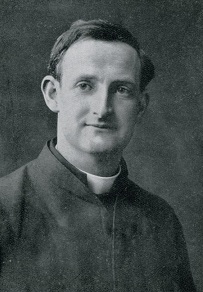
A heroic Irish Jesuit who found his mission on the Western Front during the Great War (1914-1918), Fr William Doyle SJ, was also 'devoured by zeal for his house', as this extract from his biography by Alfred O’Rahilly shows. I’ve taken it from the post for 5 March 2012 on Remembering Fr William Doyle SJ.
Fr William Doyle SJ (3 March 1873 – 16 August 1917)

It was not long before he had an experience of real danger. On Sunday, 5th March, he said Mass for the 8th Fusiliers. After he had finished (about 9 o’clock) he mounted his bicycle in order to go to the 8th Inniskillings, of whom he also had charge, and say Mass at eleven for them. They were stationed four miles away near the ruined village of Mazingarbe. Fr. Doyle may be left to describe his adventure in his own words.

“On the way I noticed that heavy firing was going on ahead, but it was only when I reached a bend in the road that I realized the enemy were actually shelling the very spot I had to pass. Some soldiers stopped me, saying it was dangerous to go on. At the moment I was wondering what had become of the side of a vacant house which had suddenly vanished in a cloud of smoke, and I was painfully aware of the proximity of high explosive shells.

“Here was a fix! I knew my regiment was waiting in the village for Mass, and also that half of them were going to the trenches that afternoon for the first time; if I did not turn up they would lose Confession and Holy Communion, but the only way to reach them was by the shell-swept road. What really decided me was the thought that I was carrying the Blessed Sacrament, and I felt that, having our Lord Himself with me, no harm could possibly come to me. I mounted the bicycle and faced the music. I don’t want you to think me very brave and courageous, for I confess I felt horribly afraid; it was my baptism of fire, and one needs to grow accustomed to the sound of bursting shells. Just then I was wishing my regiment in Jericho and every German gun at the bottom of the Red Sea or any other hot place.

“Call it a miracle if you will, but the moment I turned the corner the guns ceased firing, and not a shell fell till I was safely in the village Church. My confidence in God’s protection was not misplaced. Naturally I did not know this was going to happen, and it was anything but pleasant riding down the last stretch of road, listening for the scream of the coming shell. Have you ever had a nightmare in which you were pursued by ten mad bulls, while the faster you tried to run, the more your feet stuck in the mud? These were just my feelings as I pedalled down that blessed road which seemed to grow longer and longer the further I went.

“At last I turned the corner, reached the Church, and had just begun Mass when down came the hail of shells once more. One or two must have burst very close, judging by the way the walls shook, but I felt quite happy and quite ready to be blown from the altar, for I saw a fine plump Frenchwoman just behind me; she might have been killed, but I was quite safe!

“I mention this little adventure as I think it will console you, as it has consoled me, showing that all the good prayers are not in vain, and that this is a happy omen of God’s loving protection from all dangers. I have just heard that one, at least, of the men to whom I gave Holy Communion that morning was killed the same night in the trenches.”

Father Willie Doyle’s zeal was to lead to his own death on 16 August 1917 during the Third Battle of Ypres (Ieper), blown to pieces by a German shell about 15 minutes after he had made his last confession and nearly two years after he had gone to the Western Front as a chaplain in the British army. He was one of around 500,000 from both sides killed or wounded in the battle that lasted from July to November 1917.


PRAYER FOR PRIESTS BY FR DOYLE
O my God, pour out in abundance Thy spirit of sacrifice upon Thy priests. It is both their glory and their duty to become victims, to be burnt up for souls, to live without ordinary joys, to be often the objects of distrust, injustice, and persecution.
The words they say every day at the altar, "This is my Body, this is my Blood," grant them to apply to themselves: "I am no longer myself, I am Jesus, Jesus crucified. I am, like the bread and wine, a substance no longer itself, but by consecration another."
O my God, I burn with desire for the sanctification of Thy priests. I wish all the priestly hands which touch Thee were hands whose touch is gentle and pleasing to Thee, that all the mouths uttering such sublime words at the altar should never descend to speaking trivialities.
Let priests in all their person stay at the level of their lofty functions, let every man find them simple and great, like the Holy Eucharist, accessible to all yet above the rest of men. O my God, grant them to carry with them from the Mass of today, a thirst for the Mass of tomorrow, and grant them, ladened themselves with gifts, to share these abundantly with their fellow men. Amen.


Gospel John 2:13-25 (Jerusalem Bible: Australia, England & Wales, India [optional], Ireland, New Zealand, Pakistan, Scotland, South Africa)
Just before the Jewish Passover Jesus went up to Jerusalem, and in the Temple he found people selling cattle and sheep and pigeons, and the money changers sitting at their counters there. Making a whip out of some cord, he drove them all out of the Temple, cattle and sheep as well, scattered the money changers' coins, knocked their tables over and said to the pigeon-sellers, 'Take all this out of here and stop turning my Father's house into a market.' Then his disciples remembered the words of scripture: Zeal for your house will devour me. The Jews intervened and said, 'What sign can you show us to justify what you have done?' Jesus answered, 'Destroy this sanctuary, and in three days I will raise it up.' The Jews replied, 'It has taken forty-six years to build this sanctuary: are you going to raise it up in three days?' But he was speaking of the sanctuary that was his body, and when Jesus rose from the dead, his disciples remembered that he had said this, and they believed the scripture and the words he had said. During his stay in Jerusalem for the Passover many believed in his name when they saw the signs that he gave, but Jesus knew them all and did not trust himself to them; he never needed evidence about any man; he could tell what a man had in him.

09 March 2012

Pope Benedict's Prayer Intentions for March 2012

General Intention - Contribution of Women

That the whole world may recognize the contribution of women to the development of society.

Weaving a Dream

By Mercy B. Gawason


The author is a young Subanen who works with Subanen Crafts. She and her companions at Subanen Crafts recently visited Negros Occidental and dropped by the Misyon editorial office in Bacolod City. The word 'Subanen' means 'people of the river'. The Subanens live in the mountains of western Mindanao. This article is in the March-April 2012 issue of Misyon, the online magazine I edit for the Columbans in the Philippines.

There’s no easy way for the poor to reach their dreams. They have to work and sacrifice for it. There are lots of thorns and obstacles that you can encounter but if you really want to achieve your dreams in life, then you'll find your own strategy. No matter how difficult it is you must go on. As they say, poverty is not a hindrance to success. Never forget where you have come from and always remember decisions you've made because you’ve put God first in all things and believe that with God nothing is impossible.

This is what I’ve experienced as the daughter of poor parents. I supported myself. I studied as a working student and this was very hard. Things had to be kept in balance, time had to be managed properly and personal matters set aside. There were many times when I was hurt, discriminated against because of my culture and for who I am. There were times when I wanted to give up but I had to pursue my dream so that someday I could make others wake up and realize that judging others is very wrong. That's why I stood up. Life had to go on so I used my heartaches as my challenge and inspiration, not just for myself but for my family and culture too.


And I was so lucky because there was a door that opened to me, Subanen Crafts with Fr Vincent Busch, a Columban priest in Ozamiz City. I was so happy when I became one of the Subanen Crafts weavers because since I was a kid I dreamed of earning a degree and having a better future so that I could help my family and fellow Subanens.
The project was able to send me to high school and college where I completed a two-year course, Associate in Office Administration (AOA), at La Salle University, Ozamiz City. Right after my graduation in March 2010 Subanen Crafts offered me an opportunity to work as the admin clerk.


I’ve had so many lessons and experience in life: traveling to other places, meeting new friends, facing other people and getting to know myself better. This has helped me a lot to develop what I learned in school. Though I’ve already graduated with an AOA, I still want to do further study so that I can gain more knowledge and be more capable of doing the tasks I’m given and be able to help my fellow Subanens.
And I encourage all who are poor and my fellow Subanens to study. It really is true that ‘education is the only weapon’. It is the only key to success and to defend ourselves. It is also the only property and wealth that nobody can take and steal from us. Trust God completely and do not put yourself down . . . TO GOD BE THE GLORY.

You may email the author at mercy_gawason@yahoo.com
+++
Mission Intention - Persecuted Christians

That the Holy Spirit may grant perseverance to those who suffer discrimination, persecution, or death for the name of Christ, particularly in Asia.
'I only want a place at the feet of Jesus'

Clement Shahbaz Bhatti (9 September 1968 - 2 March 2011)

The first anniversary of the assassination of Clement Shahbaz Bhatti in Pakistan, the only Christian member of the cabinet, was observed on 2 March. He was a devout Catholic deeply committed to justice for those on the margins, especially the Christian minority, who said not long before he died, I only want a place at the feet of Jesus. I want my life, my character, my actions to speak for me and say that I am a follower of Jesus Christ.

Shahbaz Bhatti, the first Federal Minister for Minorities in Pakistan, a position he held since 2 November 2008, was shot dead yesterday shortly after he left his mother's home in Islamabad. He came from a Catholic family deeply committed to justice. Of his work he said: 'I only want a place at the feet of Jesus. I want my life, my character, my actions to speak for me and say that I am a follower of Jesus Christ'.

Mr Bhatti spoke a month ago in an interview in Dubai about the danger to his life and his willingness to die for his principles. Here is the last part of the interview along with a video of his meeting with Pope Benedict some months bfore his death.


Shahbaz Bhatti interviewed a month before his death in 2011.


Shahbaz Bhatti meeting Pope Benedict XVI in Sept 2010

Here is a report from Columban Father Robert McCulloch, an Australian, who has been in Pakistan since 1978 after spending eight years in Mindanao, southern Philippines.

Murder in the name of religion

Murder in the name of religion took a further ugly step in Pakistan today 2 March 2011 when Shahbaz Bhatti, Federal Minister for Minorities, was killed by 4 gunmen in Islamabad.

Shahbaz Bhatti, a member of the Pakistan People's Party of the slain Benazir Bhutto, had been minister for 3 years. He was 43 years old and unmarried. He had gone in mid-morning to visit his mother in Sector 8 of the residential area of Islamabad and was gunned down as he left his mother's home. Leaflets thrown at the place of the murder claim that it was carried out by Al Qaeda but real responsibility lies in the extensive Islamic extremist networks of urban violence which have been funded by Wahabi sources from Saudi Arabia.

Shahbaz Bhatti had insistently called for the amendment of the blasphemy laws which have been abused and mis-used in Pakistan since their introduction by the military dictator, Zia ul Haq. A solid legal opinion in Pakistan has declared that these laws are against the constititutional law of Pakistan and have no justification in the Islamic religious law.

The murdered federal minister had defended Aasia Bibi, the Christian woman who had been condemned to death on a charge of blasphemy because she refused to abandon her Christian faith and become a Muslim. Bhatti visited the Vatican in December 2010 and presented his appeal for justice to Pope Benedict XVI who then called for religious freedom and justice for persecuted Christians in Pakistan during his adddress in the first week of January 2011 to diplomats accredited to the Holy See.

The religiously-motivated murder of Shahbaz Bhatti follows on the murder of Salmaan Taseer, governor of the Punjab, on 4 January 2011, who had also called for a close re-examination of the discriminatory blasphemy laws.

Murder on religious grounds is propagated in Pakistan by Islamic extremists as an act pleasing to God which guarantees the immediate salvation of the murderer and his family. The perversion of the Pakistani education system and the distortion of religious values about which Pope Benedict alerted the world in his Regensberg address has arrived at its logical conclusion with these murders in Pakistan. How many more such muders will take place until honest Muslims in Pakistan and elsewhere and the world community at large take a stand against this evil and barbarous perversion of religion.

Fr Robert McCulloch SSC has worked in Pakistan since 1978. He sits on the administrative board for St Elizabeth’s Hospital with James Francis, the Administrator of St Elizabeth’s hospital and nephew of the murdered minister, Shahbaz Bhatti. He is now based in Rome as Procurator General of the Columbans.

Columbans were first assigned to Pakistan in 1978 and have been there since.

07 March 2012

'Write it down; it's a good one!'


I think that there must be a special place in heaven for those who have the gift of making people laugh and leaving them with happy memories. In 1990 I was buying a stamp in the post office in Turramurra, near Sydney, where the Columbans had a seminary before. When I opened my mouth the woman serving me broke into a big smile and told me of her visit to Ireland and of attending a show starring Hal Roach, a comedian who died in Ireland on 28 February at the age of 84. As it happened, on my flight from Manila to Sydney I got chatting with one of the cabin crew, an Irishman named Frank Kennedy. He told me that he wrote scripts for Hal.

Hal starred in a cabaret in Jury's Hotel, Dublin, for 26 summer seasons. I attended one of his shows there many years ago with two American Franciscan Sisters who worked in a hospital in New York City. They enjoyed themselves immensely. Hal targetted in particular American tourists, laying on the 'Blarney' thickly. I remember one of his jokes from that evening: 'We had the President of Egypt here last week. After the show this guy came up and said to me, " If you're a comedian . . ."'

As it happened, Hal died only six days after another Irish comedian, Frank Carson, who was 85. Blessed John Paul II had made Frank a Knight of St Gregory in 1987 for his work for charity. One of his gags was, 'I don't think my wife likes me. when I had a heart attack she wrote for an ambulance'. In reality, Frank Carson had a heart attack in 1976 and he was buried from the church in Belfast where he had married Ruth, his wife of 60 years, who survives him.

In the 1960s Hal Roach appeared in a number of fundraising shows for the Columbans in the New England area of the USA. His humour was always directed at family audiences and a friend who knew him told me that his humour offstage was the same.

In the video above, in which Hal tells stories about children, he is presuming that his audience were familiar with the Bible and with Catholicism. I'm not sure that younger Irish comedians would or could make that presumption or that they and audiences would be so familiar with what Hal Roach took for granted.

I know from a number of sources that Hal was a very charitable person.

Hal Roach bore more than a passing resemblance to the late Kim Jong-Il of North Korea but 
I've no doubt as to which of them left the greater legacy. 
 
I wonder if Hal regaled St Peter at the Pearly Gates with some of his stories and used his 
catch-phrase, 'Write it down; it's a good one!'
 
Kim Jong-Il


03 March 2012

What does 'rising from the dead' mean? Sunday Reflections, 2nd Sunday of Lent Year B

Transfiguration of Christ, Paolo Veronese, painted 1555-56
Readings (New American Bible: Philippines, USA)

Gospel Mark 9:2-10 (Jerusalem Bible: Australia, England & Wales, India [optional], Ireland, New Zealand, Pakistan, Scotland, South Africa)

Jesus took with him Peter and James and John and led them up a high mountain where they could be alone by themselves. There in their presence he was transfigured: his clothes became dazzlingly white, whiter than any earthly bleacher could make them. Elijah appeared to them with Moses; and they were talking with Jesus. Then Peter spoke to Jesus. 'Rabbi', he said it is wonderful for us to be here; so let us make three tents, one for you, one for Moses and one for Elijah.' He did not know what to say; they were so frightened. And a cloud came, covering them in shadow; and there came a voice from the cloud, 'This is my Son, the Beloved. Listen to him.' Then suddenly, when they looked round, they saw no one with them any more but only Jesus.
As they came down the mountain he warned them to tell no one what they had seen, until after the Son of Man had risen from the dead. They observed the warning faithfully, though among themselves they discussed what 'rising from the dead' could mean.
An Soiscéal Marcas 9:2-10 (Gaeilge, Irish)

San am sin rug Íosa leis Peadar, Séamas agus Eoin, agus sheol sé suas iad sliabh ard ar leithligh. Agus tháinig claochlú air os comhair a súl, agus d’éirigh a chuid éadaigh dealrach, iad gléigeal thar cuimse, nach bhfuil úcaire ar domhan a dhéanfadh chomh geal iad. Agus chonacthas dóibh Maois mar aon le hÉilias agus iad ag comhrá leis. Agus labhair Peadar le hÍosa: “A Mháistir, “ ar sé, “is maith mar a tharla anseo sinn: déanaimis trí bothanna, ceann duit féin, ceann do Mhaois agus ceann d’Éilias” – mar ní raibh a fhios aige cad ba mhaith dó a rá óir tháinig uamhan orthu. Agus tháinig scamall ina scáil anuas orthu, agus an glór as an scamall: “Is é seo mo Mhac muirneach dár thug mé gnaoi: éistigí leis!” Agus go tobann, ar dhearcadh dóibh ina dtimpeall, ní fhaca siad duine ar bith níos mó ach Íosa in éineacht leo ina aonar.

Ar a slí anuas dóibh ón sliabh, chuir sé mar acht orthu gan a raibh feicthe acu a insint do dhuine ar bith nó go mbeadh Mac an Duine éirithe ó mhairbh. Agus choinnigh siad an scéal chucu féin ach go mbídís ag fiafraí dá chéile cad ba chiall leis an éirí úd ó mhairbh.

+++

Clement Shahbaz Bhatti (9 September 1968 - 2 March 2011)
Federal Minister for Minority Affairs, Pakistan (2 November 2008 - 2 March 2011)

In today's first reading God asks Abraham to sacrifice his only son 'on a height that I will point out to you'. We can only imagine the heartbreak of Abraham being asked by God to give offer his only son by Sarah his wife, born when both of them were very old. But God wasn't looking for the life of Isaac but for Abraham to submit himself to God's will, no matter the consequences. Abraham's sacrifice of his own will made him 'our Father in faith', as the Roman Canon says, the Father of countless Jews and Christians.

From the time of St Stephen, the first Christian martyr, down to our own day, God has been calling certain individuals to give up everything that is precious to them, including life itself, for the sake of others.

The struggle of Abraham is a sign of the struggle that Jesus would have to go through. Last Sunday we got a glimpse of his struggle in the desert where he was tempted by Satan, basically to abandon the mission the Father had given him. During Holy Week we will see is awful struggle in the Garden of Gethsemane and his cry from the Cross, My God, my God, why have you forsaken me?

Each of us in some way has to share in that struggle, to let go of our own will in something big or small for the sake of others and to do what God want us to do.

Shahbaz Bhatti was living in a situation where he new that God might ask him to give up his own life. Less than two months before his own death, Governor Salmaan Taseer of Punjab, a Muslim, was murdered by one of his own security guards because of his opposition to Pakistan's Blasphemy Law.

Mr Bhatti was deeply committed to working for groups discriminated against, including the Christian minority in Pakistan. He gave as the reason for his commitment, I just want a place at the feet of Jesus. I want my life, my character, my actions to speak for me and say that I am following Jesus Christ.

About a month before his death he gave an interview on TV, the concluding part of which is in this video. Below the video is a transcript of what Mr Bhatti said.


Minister Bhatti, you forgot one question in the interview. Your life is threatened by who and what sort of threats are you receiving?

The forces of violence, militant banned organizations, the Taliban, and Al Qaeda, they want to impose their radical philosophy on Pakistan. And whoever stands against their radical philosophy that threatens them, when I’m leading this campaign against the Sharia Law, for the abolishment (abolition) of (the) Blasphemy Law, and speaking for the oppressed, marginalized and persecuted Christian and other minorities, these Taliban threaten me.

But I want to share that I believe in Jesus Christ who has given his own life for us. I know what is the meaning of (the) Cross and I am following of the Cross and I am ready to die for a cause. I’m living for my community and suffering people and will die to defend their rights. So these threats and these warnings cannot change my opinion and principles. I will prefer to die for my principle and for the justice of my community rather to compromise on these threats.

Sts Peter, James and John, as they came down the mountain after having seen the Transfigured Jesus, wondered what 'rising from the dead' meant. A few weeks after the assassination of Clement Shahbaz Bhatti the bishops of Pakistan petitioned the Holy See to declare him a martyr. Bishop Andrew Francis of Multan, who drafted the petition, said, We Christians in Pakistan want to transform the death of Shahbaz Bhatti into a prophecy of the Resurrection. It was only after the Crucifixion that the Resurrection could occur and it was only after Easter Sunday that the Apostles found the answer to their question.

May each of us pray for the grace to make these words of Shahbaz Bhatti our own: I just want a place at the feet of Jesus. I want my life, my character, my actions to speak for me and say that I am following Jesus Christ.

+++
Ooberfuse is an electro pop band based in London, England. Their female singer, Cherrie Anderson, is from the Philippine. They will sing at a peace rally in honour of Shabaz Bhatti in Trafalgar Square, London, on 10 March. They wrote His Blood Cries Out in his memory.


His Blood Cries Out
 
Verse 1.
These are the hands
They praise the life of you
These are the veins
Your life and love flow through
These are the words we try to write for you
We sing this song

Refrain/Chorus
His Blood Cries Out
His Blood Cries Out

Verse 2.
Peace is the star
That guides our hearts to you
Hear all the angels
How they sing for you
These are the words we try to write for you
Help us to erase
This war, this rage
We need to turn the page and
Find true peace within love's heart
In the silence hear the shout
His blood cries out
Refrain/Chorus
 
His blood cries out
His blood cries out

Verse 3.
These are the prayers
Helpless and the weak
His was the voice
For those that couldn't speak
For this we cry
Freedom, Love and Peace
What have you done
This war, this rage,
We need to turn the page and
Find true peace within love's heart
In the silence hear the shout
His blood cries out

Refrain/Chorus.
His blood cries out
His blood cries out.........

02 March 2012

'I only want a place at the feet of Jesus'. 1st anniversary of assassination of Shahbaz Bhatti

Clement Shahbaz Bhatti (9 September 1968 - 2 March 2011)

Today is the first anniversary of the assassination of Clement Shahbaz Bhatti in Pakistan, the only Christian member of the cabinet. He was a devout Catholic deeply committed to justice for those on the margins, especially the Christian minority,  who said not long before he died, I only want a place at the feet of Jesus. I want my life, my character, my actions to speak for me and say that I am a follower of Jesus Christ.

I will have more about Shahbaz Bhatti on Sunday Reflections for the Second Sunday of Lent. But you may read about him here.

Columbans wre first assigned to Pakistan in 1978 and have been there since.


27 February 2012

Volunteers needed for L'Arche Community, Cainta, Rizal

Lala taking care of Jordan
 
I received an email the other day from Maria Linda 'Letlet' Paulino of the L'Arche Community, also known as 'Punla', the Tagalog for 'seed', in Cainta, Rizal. Cainta is part of the Metro Manila sprawl and and Punla is the only L'Arche community in the Philippines. I have visited Punla a number of times over the years and some of our Columban seminarians have worked there during their formation. I have also written a number of times about my friend Lala  who was left in a garbage pail shortly after her birth in Cebu more than 30 years ago.

Here is part of Letlet's email.

You've seen the community, Fr Sean, and maybe you noticed that we live here together with our friends and we try to guide and support them to learn to be confident in whatever/however they can do to be self independent in making their choices/decisions and in attending to their basic daily needs with less supervision, except Jordan (in photo above) and Raymond whom we need to follow in their daily rhythm and structure which they've been familiar with and following everyday to feel the belongingness, security and at home.
 
We are giving the volunteer house assistants an allowance of P1,500.00 for the first three months plus board and lodging and as part of community  program we let the assistants join the formation program and accompaniment for self awareness and personality growth. The first three months is a probationary period. There's an evaluation in the first month and then on the third months. If evaluation is okay, allowance will be increased to P2,500.00 starting on the fourth  month to the 12th month.  Each week there's a one day off and then after a month an additional 2 days off. The daily task is doing the household chores together with the other house assistants and the core members. (The core members are those with learning disabilities - the VIPs in L'arche). The first house is composed of four core members and the ideal number of house assistants is supposed to be five (three males and two females); the second house is for three core members and three house assistants.
 
Lala with Hachi

Letlet also wrote:

Our community is always  in need of volunteers who can join us living in the community together with our friends with intellectual disabilities. I've been racking my brains about whom and where to contact to ask for help in looking for a potential person for us who is looking for meaning in life. The L'Arche community might possibly be able to help him or her in his/her search. 

You may contact Letlet at larchepunla@yahoo.com.ph  

This video from Erie, Pennsylvania, shows us something of the life of a L'Arche community. Being an assistant isn't easy but it is deeply enriching and a profound way of living the Gospel. For some assistants it has been a way of discovering the Gospel.