06 April 2012

'"Behold, your son" . . . "Behold, your mother!"' Good Friday


From The Gospel of John (2003) http://decentfilms.com/reviews/gospelofjohn Jesus Predicts His Death (12:20-36) Directed by Philip Saville. Jesus played by Henry Ian Cusick; narrator, Christopher Plummer.
The Disrobing of Christ (El Espolio), El Greco, painted 1577-79

John 19: 23-27 (RSV-CE)
When the soldiers had crucified Jesus they took his garments and made four parts, one for each soldier; also his tunic. But the tunic was without seam, woven from top to bottom;  so they said to one another, "Let us not tear it, but cast lots for it to see whose it shall be." This was to fulfill the scripture, "They parted my garments among them, and for my clothing they cast lots." So the soldiers did this. But standing by the cross of Jesus were his mother, and his mother's sister, Mary the wife of Clopas, and Mary Magdalene. When Jesus saw his mother, and the disciple whom he loved standing near, he said to his mother, "Woman, behold, your son!" Then he said to the disciple, "Behold, your mother!" And from that hour the disciple took her to his own home.
The Crucifixion, El Greco, painted 1596-1600

The Killing (Edwin Muir, 1887-1959)

That was the day they killed the Son of God
On a squat hill-top by Jerusalem.
Zion was bare, her children from their maze
Sucked by the demon curiosity
Clean through the gates. The very halt and blind
Had somehow got themselves up to the hill.

After the ceremonial preparation,
The scourging, nailing, nailing against the wood,
Erection of the main-trees with their burden,
While from the hill rose an orchestral wailing,
They were there at last, high up in the soft spring day.
We watched the writhings, heard the moanings, saw
The three heads turning on their separate axles
Like broken wheels left spinning. Round his head
Was loosely bound a crown of plaited thorn
That hurt at random, stinging temple and brow
As the pain swung into its envious circle.
In front the wreath was gathered in a knot
That as he gazed looked like the last stump left
Of a death-wounded deer’s great antlers. Some
Who came to stare grew silent as they looked,
Indignant or sorry. But the hardened old
And the hard-hearted young, although at odds
From the first morning, cursed him with one curse,
Having prayed for a Rabbi or an armed Messiah
And found the Son of God. What use to them
Was a God or a Son of God? Of what avail
For purposes such as theirs? Beside the cross-foot
Alone, four women stood and did not move
All day. The sun revolved, the shadow wheeled,
The evening fell. His head lay on his breast,
But in his breast they watched his heart move on
By itself alone, accomplishing its journey.
Their taunts grew louder, sharpened by the knowledge
That he was walking in the park of death,
Far from their rage. Yet all grew stale at last,
Spite, curiosity, envy, hate itself.
They waited only for death and death was slow
And came so quietly they scarce could mark it.
They were angry then with death and death’s deceit.

I was a stranger, could not read these people
Or this outlandish deity. Did a God
Indeed in dying cross my life that day
By chance, he on his road and I on mine?

05 April 2012

' . . . you also ought to wash one another's feet.' Holy Thursday


From The Gospel of John (2003) http://decentfilms.com/reviews/gospelofjohn Directed by Philip Saville. Jesus played by Henry Ian Cusick; narrator, Christopher Plummer.
John 13: 1-15 (Revised Standard Version - Catholic Edition)

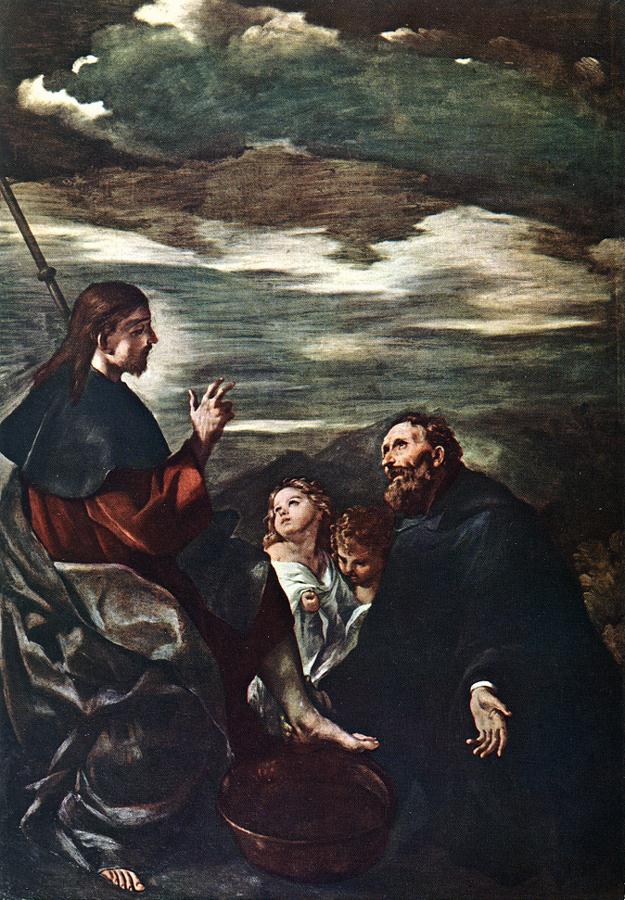
Now before the feast of the Passover, when Jesus knew that his hour had come to depart out of this world to the Father, having loved his own who were in the world, he loved them to the end. And during supper, when the devil had already put it into the heart of Judas Iscariot, Simon's son, to betray him, Jesus, knowing that the Father had given all things into his hands, and that he had come from God and was going to God, rose from supper, laid aside his garments, and girded himself with a towel. Then he poured water into a basin, and began to wash the disciples' feet, and to wipe them with the towel with which he was girded.
He came to Simon Peter; and Peter said to him, "Lord, do you wash my feet?"
Jesus answered him, "What I am doing you do not know now, but afterward you will understand."
Peter said to him, "You shall never wash my feet."
Jesus answered him, "If I do not wash you, you have no part in me."
Simon Peter said to him, "Lord, not my feet only but also my hands and my head!"
Jesus said to him, "He who has bathed does not need to wash, except for his feet, * but he is clean all over; and you are clean, but not every one of you."
For he knew who was to betray him; that was why he said, "You are not all clean." When he had washed their feet, and taken his garments, and resumed his place, he said to them, "Do you know what I have done to you? You call me Teacher and Lord; and you are right, for so I am. If I then, your Lord and Teacher, have washed your feet, you also ought to wash one another's feet. For I have given you an example, that you also should do as I have done to you”.


Pange lingua, written by St Thomas Aquinas (1225 – 1274) and sung during the solemn procession of the Blessed Sacrament to the Altar of Repose at the end of the Evening Mass of the Lord’s Supper. The last two stanzas are known to us as Tantum ergo, sung at Benediction.
English translation by Fr Edward Caswall

Sing, my tongue, the Savior's glory,
of His flesh the mystery sing;
of the Blood, all price exceeding,
shed by our immortal King,
destined, for the world's redemption,
from a noble womb to spring.


Of a pure and spotless Virgin
born for us on earth below,
He, as Man, with man conversing,
stayed, the seeds of truth to sow;
then He closed in solemn order
wondrously His life of woe.


On the night of that Last Supper,
seated with His chosen band,
He the Pascal victim eating,

first fulfills the Law's command;
then as Food to His Apostles
gives Himself with His own hand.


Word-made-Flesh, the bread of nature
by His word to Flesh He turns;
wine into His Blood He changes;
what though sense no change discerns?
Only be the heart in earnest,
faith her lesson quickly learns.


Down in adoration falling,
This great Sacrament we hail,
Over ancient forms of worship
Newer rites of grace prevail;
Faith will tell us Christ is present,
When our human senses fail.

To the everlasting Father,
And the Son who made us free
And the Spirit, God proceeding
From them Each eternally,
Be salvation, honor, blessing,
Might and endless majesty.
Amen.

04 April 2012

A tribute to a deceased priest-uncle


Tomorrow I will concelebrate the Chrism Mass in San Sebastian Cathedral, Bacolod City, with Bishop Vicente M. Navarra, whose Golden Jubilee of ordination to the priesthood falls on Holy Saturday. We will celebrate that on Easter Monday in the Cathedral.

During the Chrism Mass the priests renew their commitment in the presence of the bishop and of the people.

My brother alerted me to a beautiful tribute by rugby correspondent Matt Williams in yesterday's Irish Times to a recently deceased priest-uncle, Fr Brian Ryan of the Archdiocese of Sydney, Let's hear it for the Uncle Brians of this world. Fr Ryan, the son of Irish immigrants, was 85. His death led his nephew to reflect on his uncle's vocation to the priesthood. I've highlighted parts of the article.

FRENCH NOTES: Being part of a sport where the successful are lauded as heroes by media, we can lose sight of the fact that the real ones live anonymously amongst us, writes MATT WILLIAMS

IN THE midst of the glamour, drama and glory that is the Six Nations Championship, 10,000 kilometres away in Sydney, an old man died in his sleep and the world did not notice. He had never walked with presidents, captains of industry or prime ministers. He did not have the ear of the great. He held no media presence. He did not stride the world stage in any shape or form. He had never sought fame or fortune. Most of his days were spent with the humblest of society.

His life had none of what society would describe as success. Materially, he was poor. He owned no property and had little use of money. He was reliant on charity for more than 50 years. In that time nothing he did was measurable in terms of business productivity.

His actions never produced outcomes that accounts could label as profitable.

He died in great care, in a nursing home run by the Little Sisters of the Poor.

Yet for six decades he was an agent of good in the lives of a countless number of people.

He had recently been given the use of a new TV in his nursing home and would have been looking forward to watching the Ireland versus Scotland game when he woke the next morning. A few hours before the Ireland match started, his life force left him. Brian Ryan died in the same way he lived. Humbly, gently and as far away as possible from the centre of attention.

The media laud the famous sporting personalities as heroes. The rich and the physically beautiful are placed on pedestals as examples of what to strive for. All too often the real heroes live anonymously amongst us. The ones whose lives have been lived for the good of others, they are the real heroes. Brian lived such a life.

He was a Catholic priest but I am not writing about religion. He was my uncle, my mother’s brother, but I am not writing about family.

Today I am writing as if in a fog of ignorance. I am trying to comprehend what would bring a man to give away the material world and give his life to an ideal of service of others in need. I knew my uncle well, but until now I never contemplated his life choice.

Since his death I have been contemplating the enormity of his sacrifice. To give your life so totally to the service of the weak and the poor is a commitment of indescribable proportions. His life was lived to the beat of a drum that is so radically different from what today’s society considers admirable that I had never fully comprehended the enormity of his commitment.

To ask a young talented person to dedicate their life to other people with no hope of material reward is almost unthinkable in today’s world. To be honest if it was your own child you would strongly discourage it. It seems a burden of unimaginable proportions. To give your working life on this planet to the poor, the sick, the broken and the lonely is to be considered strange or fanatical.

The Kardashians, Dragons’ Den and The X- Factor, these are what we hold up as templates for success. Material consumption, selfishness and physical beauty.

Brian chose to spend his working life ministering in the inner city working class suburb of Enmore. It has a large Portuguese migrant population. The tribulations of the migrants were well known to him, with a mother from Wicklow and his father’s family from Limerick. Typical of the Irish migrant, they valued education highly and Brian completed a science degree from Sydney University, before securing an interesting and well paid job with a large manufacturing company, only to inform his disbelieving parents that he was walking away from the material world.

This pathway led to a life spent helping the people of Enmore cope with an uncaring world; consoling a grieving family that faced an unstable future after the loss of its bread-winning father; helping parents cope with a drug addicted child; helping to heal the shattered heart from a broken relationship.

Some days were as vital as providing food for the hungry and safe lodging for the homeless. For years in hospitals it was holding the hand of those dying alone and helping them to leave this world with as little fear as possible.

For more than 50 years these were his everyday tasks. These are the tasks I hide from. The tasks I hope other people do. I don’t want to do them, they are too painful. It is too hard for me and let’s be honest, I am way too selfish.

I will give to charities. I attend some events to help the charity raise a few quid. This is like a balm on my conscience. In the last few weeks I have realised Brian’s commitment to his fellow man was simply staggering in its magnitude and mine is almost non existent.

He was not a religious fanatic. He never forced his beliefs on people. He was no “Holy Joe”. He was an ordinary man living an extraordinary life.

He loved his sport. He attended most games I coached for the Waratahs in Australia.

For years he was the unofficial chaplain of the Newtown Jets rugby league team. As he joked he did, “births, deaths and marriages”.

Newtown was the adjoining suburb to Enmore and “The Blue Bags” as Newtown were known, were the focus of the entire community for almost 90 years. Newtown had the same colour and jerseys as the Leinster team – the blue jersey and socks with white shorts.

They were demoted from top-flight rugby league in the mid 1980s as the number of Sydney inner city teams was reduced and teams from Queensland and Canberra were added to create today’s National Rugby League.

The pain and mourning in the community was massive. He told me once that the hurt done to the local people was immeasurable. A poor community does not have a lot to keep its pride. Having your local team competing with the best was a huge source of joy that was stripped from the people. I know he did a lot of forgiving in his life but I am not sure he fully forgave those who ended “The Blue Bags”. After a life of giving he had to live with the scorn and indignity that society unjustly collectively heaped on all priests after the emergence of the horrific stories of abuse and the shameful cover-ups.

He detested the abuses and the actions of those that covered them.

He saw justice and care for the victims and he bore the collective shame.

That took a lot of courage.

I saw him a few weeks before he died. After 85 years his legs were no longer mobile but his mind was as sharp as ever. He was happy and content. There was never a word of complaint, other than what the rugby referees are doing to the scrum.

Hemmingway said: “We are all broken by life, but some of us are stronger in the places where we were broken”.

Brian tried to heal the broken. Many of those he helped were stronger because of him.

Our world could do with lot more like Brian, but I fear his like are a dying breed. I am neither brave enough nor selfless enough to fill his shoes.

The planet is a much lesser place for his leaving, but humanity is far richer because of his commitment to it.

+++

The Catholic Weekly, the newspaper of the Archdiocese of Sydney, has an obituary of Father Ryan here.

Matt Williams's tribute to his priest-uncle gives me a boost as I prepare to renew my commitment tomorrow.

Prayer for Priests by Fr William Doyle SJ 

 Fr William Doyle SJ (born 3 March 1873, killed during the Third Battle of Ypres 16 August 1917)

O my God, pour out in abundance Thy spirit of sacrifice upon Thy priests. It is both their glory and their duty to become victims, to be burnt up for souls, to live without ordinary joys, to be often the objects of distrust, injustice, and persecution

The words they say every day at the altar, "This is my Body, this is my Blood," grant them to apply to themselves: "I am no longer myself, I am Jesus, Jesus crucified. I am, like the bread and wine, a substance no longer itself, but by consecration another.

O my God, I burn with desire for the sanctification of Thy priests. I wish all the priestly hands which touch Thee were hands whose touch is gentle and pleasing to Thee, that all the mouths uttering such sublime words at the altar should never descend to speaking trivialities.

Let priests in all their person stay at the level of their lofty functions, let every man find them simple and great, like the Holy Eucharist, accessible to all yet above the rest of men. O my God, grant them to carry with them from the Mass of today, a thirst for the Mass of tomorrow, and grant them, ladened themselves with gifts, to share these abundantly with their fellow men. Amen.

03 April 2012

Columban priest given Pakistan's highest civilian award for foreign nationals

Fr Robert McCulloch with his Sitara-e-Quaid-e-Azam award

Pakistan's highest civilian award for foreign nationals, the Sitara-e-Quaid-Azam was presented to Fr Robert McCulloch by the Governor of Sindh, Dr Ishrat ul Ebad Khan, on 23 March, Pakistan Day, at Government House in Karachi.

Governor Ishrat ul Ebal Khan of Sindh conferring the award on Fr McCulloch

The award was given by President Asif Ali Zardari of Pakistan to Fr McCulloch in recognition of his 34 years of service and contribution to Pakistan in education, health, and inter-faith relations. An Australia, the awardee worked in Mindanao, Philippines, from 1971 until 1978 when he was part of the pioneering group of Columbans to go to Pakistan. He recently moved to Rome as Procurator General of the Columbans.

Fr McCulloch, left, with Bishop Max Rodrigues of Hyderabad and James Francis, Administrator of St Elizabeth Hospital


A reception was held on 26 March at St Elizabeth Hospital where Fr McCulloch is Chairman of the Administrative Council. Among those present was MNA (Member of the National Assembly) Tayyab Hussain who praised the work of St Elizabeth Hospital under the leadership of Fr McCulloch. He said that the hospital was an outstanding beacon of compassion in Hyderabad especially through its medical outreach programmes, palliative care for the terminally ill, and flood relief activities. He held up St Elizabeth Hospital as an example to other institutions in Hyderabad and Pakistan of how people of different faiths, cultures and languages can work together for the betterment and progress of Pakistan and its people. 
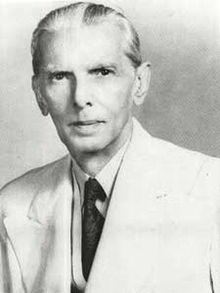
Muhammad Ali Jinnah, 'Quaid-e-Azam' (1876-1948)
 
Fr McCulloch said that he was personally honoured in being awarded the Sitara-e-Quaid-Azam by the President and receiving it from the Governor of Sindh, Dr Ishrat ul Ibad. He said that the award also showed that the government of Pakistan recognized the presence and work of the Catholic Church throughout Pakistan and in interior Sindh. Fr McCulloch said he was proud to receive an award which carried the name of the Quaid-e-Azam who founded Pakistan to be a nation based upon principles of unity, equality, and religious harmony. (Sitara-e-Quaid-e-Azam means 'Star of the Great Leader'. This is in honour of Muhammad Ali Jinnah, the founder of Pakistan).


At Governor's House Karachi after investitute: Syed Tayyab Hussain [MNA for Hyderabad], Fr Tomás  King [Columban Coordinator in Pakistan], Fr Robert McCulloch, Deacon Gulshan Barkat, James Francis [administrator St Elizabeth Hospital], Dr Tariq Arshad [Deputy Medical Superintendent SEH]


Floods have played a major part in the history of the Columbans, those in China in the 1930s that affected millions, those in Mindanao last December and, currently, in Fiji. Last October St Elizabeth Hospital was flooded.

02 April 2012

Madonna House: The People of the Towel & Water


Video made at Madonna House, Combermere, Ontario, Canada

I have visited the Madonna House community in Whitehorse, Yukon Territory, Canada, a number of times, in 1985 and in 2005. One of many blessings was meeting and working with a priest of Madonna House, the late Monsignor Art Bukowski, from Michigan, USA, in Kentucky during the summers of 1969 and 1970, when I was a young priest studying in the USA. He was much older than me and when I first met him he had just finished 29 years as president of Aquinas College, Grand Rapids. He later, I think, spent some time in Latin America. He died in 1989. I remember him for his quiet, missionary zeal as a priest and his driest of the dry humour. I also remember the Madonna House cross that he wore.

 Monsignor Arthur F. Bukowski

The video, which begins with part of the gospel for Holy Thursday, highlights the consecration of Catherine de Hueck (de HUEeck) Doherty and her husband to Jesus through Mary. This consecration comes from the teachings of St Louis-Marie de Montfort. The film mentions that that saint had a similarly deep influence on the spirituality of Blessed Teresa of Calcutta and Blessed John Paul II. It was also the bedrock of the spirituality of the Servant of God Frank Duff, founder of the Legion of Mary.

Something else emphasised in the video is 'Nazareth spirituality', which deeply influenced Blessed Charles de Foucauld, though in a somewhat different way. It is also implicitly part of the spirituality of Jean Vanier, founder of L'Arche and co-founder of its 'cousin' Faith and Light. Both of these, like Madonna House, are very Marian. Indeed, Faith and Light grew out of an international pilgrimage to Lourdes for persons with learning disabilities and their families in 1971.

The very title of this video also reminds me of something that Jean Vanier places great importance on, the washing of the feet. In a retreat I made under him in Manila in 1995 we spent a whole afternoon reflecting on this, ending in small circles where we washed the feet of one of the persons beside us. The one who washed mine was Lala, about whom I've written a number of times before.

 Lala taking care of Jordan in the 'Nazareth' that is the L'Arche community, Cainta, Rizal, near Manila

Though based in England at the time, I was chaplain to the small Philippine group at the Faith and Light international pilgrimage to Lourdes during Holy Week 2001. After the Evening Mass of the Lord's Supper we had our own washing of the feet ritual in the garden of the hotel where the Filipinos were staying.

'Nazareth spirituality' shows the extraordinary presence of God in the ordinary. Most of us spend our whole lives in 'Nazareth' and yet very few of us are aware of this.

A quiet joy comes through this film, the kind of joy that Pope Benedict spoke about in his message for this year's World Youth Day, observed yesterday, Palm Sunday.

31 March 2012

World Youth Day 2012


Tomorrow, Palm Sunday, is the 27th World Youth Day. WYD is celebrated as an international event every tow or three years. In August last year it was in Madrid, Spain. In July 2013 it will be held in Rio de Janeiro, Brazil. In other years it is celebrated at diocesan level, especially in Rome. Here is Pope Benedict's message for this year's WYD. I have highlighted some parts.

“Rejoice in the Lord always” (Phil 4:4)

Dear young friends,

I am happy to address you once more on the occasion of the 27th World Youth Day. The memory of our meeting in Madrid last August remains close to my heart. It was a time of extraordinary grace when God showered his blessings on the young people gathered from all over the world. I give thanks to God for all the fruits which that event bore, fruits which will surely multiply for young people and their communities in the future. Now we are looking forward to our next meeting in Rio de Janeiro in 2013, whose theme will be: “Go and make disciples of all nations!” (cf. Mt 28:19).

Columban seminarian Louie Ybañez and friends in Holy Rosary Parish, Cagayan de Oro, run by the Columbans, preparing palms with friends (from parish's Facebook).
  
This year’s World Youth Day theme comes from Saint Paul’s exhortation in his Letter to the Philippians: “Rejoice in the Lord always” (4:4). Joy is at the heart of Christian experience. At each World Youth Day we experience immense joy, the joy of communion, the joy of being Christian, the joy of faith. This is one of the marks of these gatherings. We can see the great attraction that joy exercises. In a world of sorrow and anxiety, joy is an important witness to the beauty and reliability of the Christian faith.

The Church’s vocation is to bring joy to the world, a joy that is authentic and enduring, the joy proclaimed by the angels to the shepherds on the night Jesus was born (cf. Lk 2:10). Not only did God speak, not only did he accomplish great signs throughout the history of humankind, but he drew so near to us that he became one of us and lived our life completely. In these difficult times, so many young people all around you need to hear that the Christian message is a message of joy and hope! I would like to reflect with you on this joy and on how to find it, so that you can experience it more deeply and bring it to everyone you meet.

Joy-filled young Indian-Fijians with Columban seminarian Kurt Zion Pala from Iligan City, Philippines (Kurt's Facebook)

1. Our hearts are made for joy

A yearning for joy lurks within the heart of every man and woman. Far more than immediate and fleeting feelings of satisfaction, our hearts seek a perfect, full and lasting joy capable of giving “flavour” to our existence. This is particularly true for you, because youth is a time of continuous discovery of life, of the world, of others and of ourselves. It is a time of openness to the future and of great longing for happiness, friendship, sharing and truth, a time when we are moved by high ideals and make great plans.

Each day is filled with countless simple joys which are the Lord’s gift: the joy of living, the joy of seeing nature’s beauty, the joy of a job well done, the joy of helping others, the joy of sincere and pure love. If we look carefully, we can see many other reasons to rejoice. There are the happy times in family life, shared friendship, the discovery of our talents, our successes, the compliments we receive from others, the ability to express ourselves and to know that we are understood, and the feeling of being of help to others. There is also the excitement of learning new things, seeing new and broader horizons open up through our travels and encounters, and realizing the possibilities we have for charting our future. We might also mention the experience of reading a great work of literature, of admiring a masterpiece of art, of listening to or playing music, or of watching a film. All these things can bring us real joy.

Kurt with two young Indian-Fijian friends (Kurt's Facebook)

Yet each day we also face any number of difficulties. Deep down we also worry about the future; we begin to wonder if the full and lasting joy for which we long might be an illusion and an escape from reality. Many young people ask themselves: is perfect joy really possible? The quest for joy can follow various paths, and some of these turn out to be mistaken, if not dangerous. How can we distinguish things that give real and lasting joy from immediate and illusory pleasures? How can we find true joy in life, a joy that endures and does not forsake us at moments of difficulty?

2. God is the source of true joy

Whatever brings us true joy, whether the small joys of each day or the greatest joys in life, has its source in God, even if this does not seem immediately obvious. This is because God is a communion of eternal love, he is infinite joy that does not remain closed in on itself, but expands to embrace all whom God loves and who love him. God created us in his image out of love, in order to shower his love upon us and to fill us with his presence and grace. God wants us to share in his own divine and eternal joy, and he helps us to see that the deepest meaning and value of our lives lie in being accepted, welcomed and loved by him. Whereas we sometimes find it hard to accept others, God offers us an unconditional acceptance which enables us to say: “I am loved; I have a place in the world and in history; I am personally loved by God. If God accepts me and loves me and I am sure of this, then I know clearly and with certainty that it is a good thing that I am alive”.

First Holy Communion, Fiji (Kurt's Facebook)

God’s infinite love for each of us is fully seen in Jesus Christ. The joy we are searching for is to be found in him. We see in the Gospel how the events at the beginning of Jesus’ life are marked by joy. When the Archangel Gabriel tells the Virgin Mary that she is to be the mother of the Saviour, his first word is “Rejoice!” (Lk 1:28). When Jesus is born, the angel of the Lord says to the shepherds: “Behold, I proclaim to you good news of great joy that will be for all the people. For today in the city of David a Saviour has been born for you, who is Messiah and Lord” (Lk 2:10-11). When the Magi came in search of the child, “they were overjoyed at seeing the star” (Mt 2:10). The cause of all this joy is the closeness of God who became one of us. This is what Saint Paul means when he writes to the Philippians: “Rejoice in the Lord always. I shall say it again: rejoice! Your kindness should be known to all. The Lord is near” (Phil 4:4-5). Our first reason for joy is the closeness of the Lord, who welcomes me and loves me.

An encounter with Jesus always gives rise to immense inner joy. We can see this in many of the Gospel stories. We recall when Jesus visited Zacchaeus, a dishonest tax collector and public sinner, he said to him: “Today I must stay at your house”. Then, Saint Luke tells us, Zacchaeus “received him with joy” (Lk 19:5-6). This is the joy of meeting the Lord. It is the joy of feeling God’s love, a love that can transform our whole life and bring salvation. Zacchaeus decides to change his life and to give half of his possessions to the poor.

At the hour of Jesus’ passion, this love can be seen in all its power. At the end of his earthly life, while at supper with his friends, Jesus said: “As the Father loves me, so I also love you. Remain in my love... I have told you this so that my joy may be in you and your joy may be complete” (Jn 15:9,11). Jesus wants to lead his disciples and each one of us into the fullness of joy that he shares with the Father, so that the Father’s love for him might abide in us (cf. Jn 17:26). Christian joy consists in being open to God’s love and belonging to him.

The Gospels recount that Mary Magdalene and other women went to visit the tomb where Jesus had been laid after his death. An angel told them the astonishing news of Jesus’ resurrection. Then, the Evangelist tells us, they ran from the sepulchre, “fearful yet overjoyed” to share the good news with the disciples. Jesus met them on the way and said: “Peace!” (Mt 28:8-9). They were being offered the joy of salvation. Christ is the One who lives and who overcame evil, sin and death. He is present among us as the Risen One and he will remain with us until the end of the world (cf. Mt 28:20). Evil does not have the last word in our lives; rather, faith in Christ the Saviour tells us that God’s love is victorious.

This deep joy is the fruit of the Holy Spirit who makes us God’s sons and daughters, capable of experiencing and savouring his goodness, and calling him “Abba”, Father (cf. Rm 8:15). Joy is the sign of God’s presence and action within us.

Columban Lay Missionaries (Facebook of Columban Lay Missionary Nette Toledo, far right)

3. Preserving Christian joy in our hearts

At this point we wonder: “How do we receive and maintain this gift of deep, spiritual joy?”

One of the Psalms tells us: “Find your delight in the Lord who will give you your heart's desire” (Ps 37:4). Jesus told us that “the kingdom of heaven is like a treasure buried in a field, which a person finds and hides again, and out of joy goes and sells all that he has and buys that field” (Mt 13:44). The discovery and preservation of spiritual joy is the fruit of an encounter with the Lord. Jesus asks us to follow him and to stake our whole life on him. Dear young people, do not be afraid to risk your lives by making space for Jesus Christ and his Gospel. This is the way to find inner peace and true happiness. It is the way to live fully as children of God, created in his image and likeness.

 Filipinos bringing joy to the Church in Ireland (Facebook of Columban Lay Missionary Angie Escarsa, top left)

Seek joy in the Lord: for joy is the fruit of faith. It is being aware of his presence and friendship every day: “the Lord is near!” (Phil 4:5). It is putting our trust in God, and growing in his knowledge and love. Shortly we shall begin the “Year of Faith”, and this will help and encourage us. Dear friends, learn to see how God is working in your lives and discover him hidden within the events of daily life. Believe that he is always faithful to the covenant which he made with you on the day of your Baptism. Know that God will never abandon you. Turn your eyes to him often. He gave his life for you on the cross because he loves you. Contemplation of this great love brings a hope and joy to our hearts that nothing can destroy. Christians can never be sad, for they have met Christ, who gave his life for them.

To seek the Lord and find him in our lives also means accepting his word, which is joy for our hearts. The Prophet Jeremiah wrote: “When I found your words, I devoured them; they became my joy and the happiness of my heart” (Jer 15:16). Learn to read and meditate on the sacred Scriptures. There you will find an answer to your deepest questions about truth. God’s word reveals the wonders that he has accomplished throughout human history, it fills us with joy, and it leads us to praise and adoration: “Come, let us sing joyfully to the Lord; let us kneel before the Lord who made us” (Ps 95:1,6).

 Columban Lay Missionaries Reina Mosqueda, Sherryl Lou Capili and Joan Yap on their way from Manila to Taiwan (Sherryl's Facebook)

The liturgy is a special place where the Church expresses the joy which she receives from the Lord and transmits it to the world. Each Sunday at Mass the Christian community celebrates the central mystery of salvation, which is the death and resurrection of Christ. This is a very important moment for all the Lord’s disciples because his sacrifice of love is made present. Sunday is the day when we meet the risen Christ, listen to his word, and are nourished by his body and blood. As we hear in one of the Psalms: “This is the day the Lord has made; let us rejoice in it and be glad” (Ps 118:24). At the Easter Vigil, the Church sings the Exultet, a hymn of joy for the victory of Jesus Christ over sin and death: “Sing, choirs of angels! ... Rejoice, O earth, in shining splendour ... Let this place resound with joy, echoing the mighty song of all God’s people!” Christian joy is born of this awareness of being loved by God who became man, gave his life for us and overcame evil and death. It means living a life of love for him. As Saint Thérèse of the Child Jesus, a young Carmelite, wrote: “Jesus, my joy is loving you” (P 45, 21 January 1897).

4. The joy of love

Dear friends, joy is intimately linked to love. They are inseparable gifts of the Holy Spirit (cf. Gal 5:23). Love gives rise to joy, and joy is a form of love. Blessed Teresa of Calcutta drew on Jesus’ words: “It is more blessed to give than to receive” (Acts 20:35) when she said: “Joy is a net of love by which you can catch souls; God loves a cheerful giver. Whoever gives with joy gives more”. As the Servant of God Paul VI wrote: “In God himself, all is joy because all is giving” (Apostolic Exhortation Gaudete in Domino, 9 May 1975).

In every area of your life, you should know that to love means to be steadfast, reliable and faithful to commitments. This applies most of all to friendship. Our friends expect us to be sincere, loyal and faithful because true love perseveres even in times of difficulty. The same thing can be said about your work and studies and the services you carry out. Fidelity and perseverance in doing good brings joy, even if not always immediately.

If we are to experience the joy of love, we must also be generous. We cannot be content to give the minimum. We need to be fully committed in life and to pay particular attention to those in need. The world needs men and women who are competent and generous, willing to be at the service of the common good. Make every effort to study conscientiously, to develop your talents and to put them at the service of others even now. Find ways to help make society more just and humane wherever you happen to be. May your entire life be guided by a spirit of service and not by the pursuit of power, material success and money.

Kurt Pala with seminarians from other groups, Manila (Kurt's Facebook)

Speaking of generosity, I would like to mention one particular joy. It is the joy we feel when we respond to the vocation to give our whole life to the Lord. Dear young people, do not be afraid if Christ is calling you to the religious, monastic or missionary life or to the priesthood. Be assured that he fills with joy all those who respond to his invitation to leave everything to be with him and to devote themselves with undivided heart to the service of others. In the same way, God gives great joy to men and women who give themselves totally to one another in marriage in order to build a family and to be signs of Christ’s love for the Church.

Let me remind you of a third element that will lead you to the joy of love. It is allowing fraternal love to grow in your lives and in those of your communities. There is a close bond between communion and joy. It is not by chance that Saint Paul’s exhortation: “Rejoice in the Lord always” (Phil 4:4) is written in the plural, addressing the community as a whole, rather than its individual members. Only when we are together in the communion of fellowship do we experience this joy. In the Acts of the Apostles, the first Christian community is described in these words: “Breaking bread in their homes, they ate their meals with exultation and sincerity of heart” (Acts 2:46). I ask you to make every effort to help our Christian communities to be special places of sharing, attention and concern for one another.

During a celebration among Catholic in the Kachin State, northern Myanmar (Facebook of Arlenne Villahermosa, Columban Lay Missionary from Cebu, Philippines, right)
5. The joy of conversion

Dear friends, experiencing real joy also means recognizing the temptations that lead us away from it. Our present-day culture often pressures us to seek immediate goals, achievements and pleasures. It fosters fickleness more than perseverance, hard work and fidelity to commitments. The messages it sends push a consumerist mentality and promise false happiness. Experience teaches us that possessions do not ensure happiness. How many people are surrounded by material possessions yet their lives are filled with despair, sadness and emptiness! To have lasting joy we need to live in love and truth. We need to live in God.

God wants us to be happy. That is why he gave us specific directions for the journey of life: the commandments. If we observe them, we will find the path to life and happiness. At first glance, they might seem to be a list of prohibitions and an obstacle to our freedom. But if we study them more closely, we see in the light of Christ’s message that the commandments are a set of essential and valuable rules leading to a happy life in accordance with God’s plan. How often, on the other hand, do we see that choosing to build our lives apart from God and his will brings disappointment, sadness and a sense of failure. The experience of sin, which is the refusal to follow God and an affront to his friendship, brings gloom into our hearts.

At times the path of the Christian life is not easy, and being faithful to the Lord’s love presents obstacles; occasionally we fall. Yet God in his mercy never abandons us; he always offers us the possibility of returning to him, being reconciled with him and experiencing the joy of his love which forgives and welcomes us back.

Dear young people, have frequent recourse to the sacrament of Penance and Reconciliation! It is the sacrament of joy rediscovered. Ask the Holy Spirit for the light needed to acknowledge your sinfulness and to ask for God’s forgiveness. Celebrate this sacrament regularly, with serenity and trust. The Lord will always open his arms to you. He will purify you and bring you into his joy: for there is joy in heaven even for one sinner who repents (cf. Lk 15:7).

6. Joy at times of trial

In the end, though, we might still wonder in our hearts whether it is really possible to live joyfully amid all life’s trials, especially those which are most tragic and mysterious. We wonder whether following the Lord and putting our trust in him will always bring happiness.


We can find an answer in some of the experiences of young people like yourselves who have found in Christ the light that can give strength and hope even in difficult situations. Blessed Pier Giorgio Frassati (1901-1925) experienced many trials during his short life, including a romantic experience that left him deeply hurt. In the midst of this situation he wrote to his sister: “You ask me if I am happy. How could I not be? As long as faith gives me strength, I am happy. A Catholic could not be other than happy... The goal for which we were created involves a path which has its thorns, but it is not a sad path. It is joy, even when it involves pain” (Letter to his sister Luciana, Turin, 14 February 1925). When Blessed John Paul II presented Blessed Pier Giorgio as a model for young people, he described him as “a young person with infectious joy, the joy that overcame many difficulties in his life” (Address to Young People, Turin, 13 April 1980).

Blessed Chiara Luce Badano, 'The Saint Who Failed Math'

Closer to us in time is Chiara Badano (1971-1990), who was recently beatified. She experienced how pain could be transfigured by love and mysteriously steeped in joy. At the age of eighteen, while suffering greatly from cancer, Chiara prayed to the Holy Spirit and interceded for the young people of the movement to which she belonged. As well as praying for her own cure, she asked God to enlighten all those young people by his Spirit and to give them wisdom and light. “It was really a moment of God’s presence. I was suffering physically, but my soul was singing” (Letter to Chiara Lubich, Sassello, 20 December 1989). The key to her peace and joy was her complete trust in the Lord and the acceptance of her illness as a mysterious expression of his will for her sake and that of everyone. She often said: “Jesus, if you desire it, then I desire it too”.

These are just two testimonies taken from any number of others which show that authentic Christians are never despairing or sad, not even when faced with difficult trials. They show that Christian joy is not a flight from reality, but a supernatural power that helps us to deal with the challenges of daily life. We know that the crucified and risen Christ is here with us and that he is a faithful friend always. When we share in his sufferings, we also share in his glory. With him and in him, suffering is transformed into love. And there we find joy (cf. Col 1:24).

7. Witnesses of joy

Dear friends, to conclude I would encourage you to be missionaries of joy. We cannot be happy if others are not. Joy has to be shared. Go and tell other young people about your joy at finding the precious treasure which is Jesus himself. We cannot keep the joy of faith to ourselves. If we are to keep it, we must give it away. Saint John said: “What we have seen and heard we proclaim now to you, so that you too may have fellowship with us; we are writing this so that our joy may be complete” (1 Jn 1:3-4).

Christianity is sometimes depicted as a way of life that stifles our freedom and goes against our desires for happiness and joy. But this is far from the truth. Christians are men and women who are truly happy because they know that they are not alone. They know that God is always holding them in his hands. It is up to you, young followers of Christ, to show the world that faith brings happiness and a joy which is true, full and enduring. If the way Christians live at times appears dull and boring, you should be the first to show the joyful and happy side of faith. The Gospel is the “good news” that God loves us and that each of us is important to him. Show the world that this is true!

Be enthusiastic witnesses of the new evangelization! Go to those who are suffering and those who are searching, and give them the joy that Jesus wants to bestow. Bring it to your families, your schools and universities, and your workplaces and your friends, wherever you live. You will see how it is contagious. You will receive a hundredfold: the joy of salvation for yourselves, and the joy of seeing God’s mercy at work in the hearts of others. And when you go to meet the Lord on that last day, you will hear him say: “Well done, my good and faithful servant... Come, share your master’s joy” (Mt 25:21).

Columban Lay Missionary Irma Cantago, from Ozamiz City, Philippines, with young friends in Lima, Peru (Irma's Facebook)

May the Blessed Virgin Mary accompany you on this journey. She welcomed the Lord within herself and proclaimed this in a song of praise and joy, the Magnificat: “My soul proclaims the greatness of the Lord; my spirit rejoices in God my Saviour” (Lk 1:46-47). Mary responded fully to God’s love by devoting her life to him in humble and complete service. She is invoked as “Cause of our Joy” because she gave us Jesus. May she lead you to that joy which no one will ever be able to take away from you!

From the Vatican, 15 March 2012

BENEDICTUS PP. XVI

30 March 2012

'Your king is coming . . .' Sunday Reflections, Palm Sunday Year B


From The Gospel of John (2003). Directed by Philip Saville. Jesus played by Henry Ian Cusick; narrator, Christopher Plummer.

Readings (New American Bible: Philippines, USA)

At the Procession of Palms either of these gospels may be used: Mark 11:1-10 or John 12:12-16.

Gospel for Procession of Palms Mark 11:1-10 (Jerusalem Bible: Australia, England & Wales, India [optional], Ireland, New Zealand, Pakistan, Scotland, South Africa)

When they were approaching Jerusalem, in sight of Bethphage and Bethany, close by the Mount of Olives, Jesus sent two of his disciples and said to them, 'Go off to the village facing you, and as soon as you enter it you will find a tethered colt that no one has yet ridden. Untie it and bring it here. If anyone says to you, "What are you doing?" say, "The Master needs it and will send it back here directly." They went off and found a colt tethered near a door in the open street. As they untied it, some men standing there said, 'What are you doing, untying that colt?' They gave the answer Jesus, had told them, and, the men let them go. Then they took the colt to Jesus and threw their cloaks on its back, and he sat on it. Many people spread their cloaks on the road, others greenery which they had cut in the fields. And those who went in front and those who followed were all shouting, “Hosanna! Blessings on him who comes in the name of the Lord! Blessings on the coming kingdom of our father David! Hosanna in the highest heavens!'

or
John 12:12-16 
The next day the crowds who had come up for the festival heard that Jesus was on his way to Jerusalem. They took branches of palm and went out to receive him, shouting: 'Hosanna! Blessings on the King of Israel, who comes in the name of the Lord. Jesus found a young donkey and mounted it -- as scripture says: Do not be afraid, daughter of Zion; see, your king is coming, mounted on the colt of a donkey. At the time his disciples did not understand this, but later, after Jesus had been glorified, they remembered that this had been written about him and that this was in fact how they had received him.

An Soiscéal Marcas 11:1-10 (Gaeilge, Irish)

Nuair a bhí siad ag teacht i ngar do Iarúsailéim, agus iad chomh fada le Béatfaigé agus Béatáine i dtreo Chnoc na nOlóg, chuir sé beirt dá dheisceabail uaidh, agus  dúirt sé leo: “Téigí isteach sa bhaile atá os bhur gcomhair agus láithreach ag dul isteach ann daoibh, gheobhaidh sibh searrach ceangailte nach raibh duine ar bith riamh ar a mhuin. Scaoiligí é agus tugaigí libh é. Agus má deir aon duine libh: ‘Cad atá sibh a dhéanamh?’ abraigí: ‘Tá gá ag an Tiarna leis. Ach cuirfidh sé ar ais anseo gan mhoill é.’” D’imigh siad leo agus fuair an searrach ceangailte ag doras, lasmuigh ar an tsráid agus scaoil siad é. Agus dúirt cuid dá raibh ina seasamh ansiúd leo: “Cad ab áil libh ag scaoileadh an tsearraigh?” D’fhreagair siad faoi mar a dúirt Íosa leo, agus scaoil siad leo. Agus thug siad leo an searrach go dtí Íosa agus chuir siad a mbrait anuas air agus chuaigh sé ina shuí air. Leath a lán daoine a mbrait ar an mbóthar, a thuilleadh craobhacha a bhain siad sna goirt; agus na daoine a bhí roimhe amach, agus iad siúd a bhí á leanuint, bhí na gártha acu á gcur suas:
“Hósana!
Is beannaithe an té atá ag teacht in ainm an Tiarna!
Is beannaithe ag teacht í, Ríocht ár nAthar, Dáiví!
Hósana sna harda!”

ó
Eoin 12:12-16 

Lá arna mhárach, an slua mór a tháinig don fhéile, nuair a chuala siad go raibh Íosa ag teacht go Iarúsailéim, thóg siad craobhacha pailme agus amach leo ina choinne, agus na gártha á gcur suas acu: “Hósana! Is beannaithe an té atá ag teacht in ainm an Tiarna, sea, rí Iosrael.” Agus fuair Íosa asal óg agus shuigh air mar atá scríofa: 15“Na bíodh eagla ort, a iníon Shíón; féach, tá do rí ag teacht agus é ina shuí ar shearrach asail.” Nior thuig a dheisceabail na nithe ar dtús ach nuair a glóiríodh Íosa, ansin is ea a chuimhnigh siad air go raibh na nithe seo scríofa agus go ndearna siad na nithe sin leis.

+++

There’s an expression in Irish, An té atá thuas óltar deoch air; an té atá thíos buailtear cos air (‘The one who succeeds is toasted; the one who fails is kicked’). On Palm Sunday Jesus was joyfully welcomed with people shouting ‘Hosanna!’ Five days later the mob, that surely included at least some who had cried out ‘Hosanna!’ was shouting ‘Crucify him!’

The last century has seen ‘The Thousand Year Reich’ end in ruins after only twelve years, the overthrowing of many dictators, powerful politicians ending up in jail or on the gallows, statues that some of them had built in their own honour toppled from their pedestals.

Charles Dickens, born 200 years ago, in A Christmas Carol describes the reaction of a young woman when her husband comes home with news of the debt they owed.

He sat down to the dinner that had been hoarding for him by the fire; and when she asked him faintly what news (which was not until after a long silence), he appeared embarrassed how to answer.
“Is it good,” she said, “or bad?” – to help him.
“Bad”, he answered.
“We are quite ruined?”
“No. There is hope yet, Caroline.”
“If  he relents,” she said, amazed, “there is! Nothing is past hope, if such a miracle has happened.”
“He is past relenting,” said her husband. “He is dead.”
She was a mild and patient creature if her face spoke truth; but she was thankful in her soul to hear it, and she said so, with clasped hands. She prayed forgiveness the next moment, and was sorry; but the first was the emotion of her heart’.

This took place after Scrooge, in the presence of the Ghost of Christmas Yet to Come had asked the Ghost, who had been showing him scenes around the death of someone unloved whom Scrooge had not yet recognized as himself, If there is any one person in the town, who feels emotion caused by this man’s death, show that person to me, Spirit, I beseech you!

The instinctive emotion was relief, as it always is, at least for a while, when a tyrant is overthrown. I remember my own feelings of relief and joy when dictator Ferdinand Marcos of the Philippine was overthrown in February 1986.

The story of the conversion of Scrooge is set at Christmastime but what underlies it is what we commemorate and celebrate during the coming week, the suffering, death and resurrection of Jesus, God who became Man. Jesus cold see clearly through the adulation offered him on Palm Sunday. We’ve no reason to believe that the welcome the people gave him was insincere or that Jesus didn’t accept it. But, for some at least, the welcome they gave Jesus was surely shallow. The parable of the seeds was reflected in the responses showed during the coming week by those who welcomed him.

Overthrown or deceased tyrants are not usually remembered for being loving. Some children are unfortunate enough to have a parent who is tyrannical. Some have been affected for life by a teacher who has terrorized his students. Dickens’s novels provide us with many such characters, reflective of people in real life. They are full of children who have been abused in different ways. In recent years we have become all too familiar with a reality that many of us could never have imagined – the abuse of children by priests and religious. There is a growing awareness of the much wider reality of abuse of children in families.

But the death of Jesus led initially to great sorrow and remorse, a loss of hope, until the reality of his Resurrection became apparent to his closest followers. Then they began to see him and understand his mission in a new way. Then they began to see how he had always been on the side of the outsider – the blind, the lame, the deaf, the leper, the child. Even the animal he chose to ride on into Jerusalem is described by GK Chesterton in the poem below as The devil’s walking parody / On all four-footed things. But the humble donkey also had his hour.

When Óscar Arnulfo Romero y Galdámez was appointed Archbishop of San Salvador, El Salvador, on 23 February 1977 the governing authorities welcomed this. They gave him a sort of Palm Sunday welcome as someone they perceived to be pious and compliant. He was indeed a deeply pious person, in the full sense of one devoted to the will of God the Father, and this was the foundation on which the dramatic last years of his life were based. On 24 March 1980 agents of the state shot Archbishop Romero dead while he was celebrating Mass in a hospital chapel (photo below). His 'Holy Week' had lasted just over three years.

In his final homily, a few minutes before he was murdered, Archbishop Romero said, May this Body immolated and this blood sacrificed for Mankind nourish us also, that we may give our body and blood over to suffering and pain, like Christ – not for Self, but to give harvests of peace and justice to our people.

A few days earlier Archbishop Romero had said to a journalist, I need to say that as a Christian I do not believe in death without resurrection. If they kill me, I will rise again in the people of El Salvador . . . If they manage to carry out their threats, as of now, I offer my blood for the redemption and resurrection of El Salvador. If God accepts the sacrifice of my life, then may my blood be the seed of liberty and the sign that hope will soon become a reality. May my death, if it is accepted by God, be for the liberation of my people, as a witness of hope in what is to come. You can tell them that if they succeed in killing me, I pardon and bless those who do it. A bishop may die, but the Church of God, which is in the people, will never die.

In 1994 Blessed John Paul II wrote in Tertio Adveniente: At the end of the second millennium, the Church has once again become a Church of martyrs . . . It is a testimony that must not be forgotten. Among the Catholic martyrs of the new millennium are my close friend and Columban colleague Fr Rufus Halley, shot dead on 28 August 2001 having spent 20 years trying to be a bridge between Christians and Muslims in Mindanao, Fr Ragheed Aziz Ganni, shot dead in Iraq after celebrating Mass on Pentecost Sunday 2007 and Pakistani politician Clement Shahbaz Bhatti, murdered just after visiting his mother on 2 March last year.

Palm Sunday, Holy Week and Easter bring hope into our lives. We can see our often shallow enthusiasm for Jesus echoed in the crowds greeting him on Palm Sunday. We can see our frequent betrayals of him in small matters and big as we listen to the Passion, this year that of St Mark, on Palm Sunday and again to St John’s version on Good Friday. But the reality that Jesus, God who became Man, the Son of God the Father, took on all of this so that we might have life to the full. Óscar Romero, Rufus Halley, Ragheed Ganni and Shahbaz Bhatti all walked with Jesus on Palm Sunday, walked with him to Calvary on Good Friday and now share in the joy of his Resurrection, bringing hope to the rest of us, a hope rooted in their faith in Jesus the Risen Lord.


THE DONKEY
G.K. Chesterton (1874-1936)

When fishes flew and forests walked
And figs grew upon thorn,
Some moment when the moon was blood
Then surely I was born;

With monstrous head and sickening cry
And ears like errant wings,
The devil's walking parody
On all four-footed things.

The tattered outlaw of the earth,
Of ancient crooked will;
Starve, scourge, deride me: I am dumb,
I keep my secret still.

Fools! For I also had my hour;
One far fierce hour and sweet:
There was a shout about my ears,
And palms before my feet.