14 June 2012

'The seed shall sprout and grow, he knows not how.' Sunday Reflections, 11th Sunday in Ordinary Time Year B

Though We Are Many - Official Hymn of the 32nd International Eucharistic Congress

Readings (New American Bible: Philippines, USA) 

Readings (Jerusalem Bible: Australia, England & Wales, India [optional], Ireland, New Zealand, Pakistan, Scotland, South Africa) 


Gospel Mark 4:26-14 (Revised Standard Version – Catholic Edition)

Jesus said, "The kingdom of God is as if a man should scatter seed upon the ground, and should sleep and rise night and day, and the seed should sprout and grow, he knows not how. The earth produces of itself, first the blade, then the ear, then the full grain in the ear. But when the grain is ripe, at once he puts in the sickle, because the harvest has come." 

And he said, "With what can we compare the kingdom of God, or what parable shall we use for it? It is like a grain of mustard seed, which, when sown upon the ground, is the smallest of all the seeds on earth; yet when it is sown it grows up and becomes the greatest of all shrubs, and puts forth large branches, so that the birds of the air can make nests in its shade." With many such parables he spoke the word to them, as they were able to hear it; he did not speak to them without a parable, but privately to his own disciples he explained everything.


During the week I saw a comment pointing out that 80 years ago a million people gathered for the closing Mass of the 31st International Eucharistic Congress in 1932 in the Phoenix Park, Dublin, one quarter of the population of the whole of Ireland at the time and about one third of the Catholic population. Last Sunday, at the opening Mass of the 50th International Eucharistic Congress being held in Dublin and ending this Sunday about 12,500 attended the opening Mass. It is hoped that 80,000 will be at the closing Mass in Croke Park, Ireland's largest stadium. The writer pointed out that more than a million who describe themselves as Catholics live in the Dublin area and yet so few were present at the opening Mass.

The writer's implicit interpretation was that there has been a collapse of the Catholic faith in Ireland since 1932. There has been.

Yet the parable reminds us that the faith has had many small beginnings. Perhaps the greatest is the Twelve Apostles. The Congress Prayer in the video above prays that 'we may recognise you in the Scriptures and in the breaking of bread'. It goes on further to ask us 'to walk humbly on the earth, in justice and love, as witnesses of the resurrection'. This is exactly what the two disciples on the road to Emmaus did. The listened to the Scriptures explained by the Word himself, recognised him as the Risen Lord in the breaking of bread and set out on their first missionary journey that night to be witnesses of the resurrection back in Jerusalem.

As a Columban I'm very conscious of our history. Fr Edward Galvin from Ireland went off to China with Canadian Fr John Fraser. Fr Fraser went on to found the Scarboro Missionary Society in Canada and Fr Galvin, with Fr John Blowick, was to set up the Missionary Society of St Columban within a few years, both societies working to bring the Gospel to the people of China.

The Columbans, along with all other Christian missionaries, were eventually driven out of China after 1949 but have a presence there again, in a different way. And a year ago, as I wrote for last Sunday, the first two Chinese students came to Manila to prepare to be Columban missionary priests. Another small beginning in the service of the mission that Jesus gave to the Church.

70 years ago my parents were married. Another small beginning in faith, a faith nourished, at least in part, by the Eucharistic Congress ten years earlier in their native Dublin. Without that beginning I would not be here. 

Today, Friday, I visited a friend in Cebu City whom I hadn't seen in more than twelve years. When we last met she was single. Today I met her husband and seven children, the youngest born last month. She and her husband have both lost their mothers in the last couple of months. Her husband will be going into hospital on Saturday for a procedure on one of his kidneys.The house they were living in before was burned down and they are now in a very small temporary house from which they will have to move soon. Yet I saw a house filled with love, the older children when they came home from school giving the mano po, the hand to the forehead, a sign of respect in the Philippines and in East Timor, to their parents and to me - and then going to kiss their two youngest brothers. And we shared bread together, pandesal, small pieces of bread that are very popular for breakfast and for snacks.

The kingdom of God is as if a man should scatter seed upon the ground, and should sleep and rise night and day, and the seed should sprout and grow, he knows not how.

We just don't know where the seed will be scattered and where it will bear fruit. I once met a young woman from Japan in Manila. She was moving towards the Catholic faith and the seed was being nourished in the predominantly Catholic Philippines. But the seed of her faith came to fruition in Thailand where she was baptised during an Easter Vigil. Thailand, like Japan, is a country where only about one person in two hundred is a Catholic. 


And there is a Thai version of the Official Hymn of the 32nd International Eucharistic Congress.

May we be aware of the many 'mustard seeds' that the Lord has scattered in our lives, that he nourishes through the Eucharist and that he brings to fruition in the most unexpected ways.

12 June 2012

The 1932 International Eucharistic Congress in Dublin and my Dad's faith


The 50th International Eucharistic Congress began in Dublin last Sunday, in a very different Ireland from the one where the 31st such congress was held 80 years ago. There is a positive report about the opening of the current congress by Mary O'Regan in the Catholic Herald.

Some time ago a friend at home asked me to make a short video about the then forthcoming Congress. What you see above is what came out, a little different to what I had been asked to do. I later did the latter and posted it last week.

What came out in this video was mostly about the faith of my Dad and the impact the 1932 Congress had on it. I never asked him about the Congress, though he often spoke about it, and I never asked him about his faith. But his faith still continues to form me nearly 25 years after his death.

May the current Congress not only strengthen  and help renew the faith of Irish Catholics of today but may it influence the missionary faith of generations to come as the Congress 80 years ago continues to do with me through the faith of my Dad who died in 1987.

10 June 2012

'Soul of My Saviour': Theme Hymn of 1932 Eucharistic Congress in Dublin


 From the 'Faith of Our Fathers' Concert, Dublin, 1997

I read somewhere the other day that Soul of My Saviour was the Theme Hymn for the 31st International Eucharistic Congress in Dublin 1932. The original Latin, Anima Christi, was possibly written by Pope John XXII (reigned 1316-1334). The music was written by WJ Mahler, according to one source I found.

This is one of the first hymns I remember hearing and singing, in Holy Family Church, Aughrim Street, Dublin. Part of the tune's appeal for me is that it is manly.

I got into trouble once in the seminary for playing Soul of My Saviour on the organ.  Every year our Sunday Mass was broadcast nationally for four successive Sundays. (Our national broadcasting service still has Mass on the air every Sunday morning). One year our month coincided with Lent when music was kept to a minimum. However, I decided to play the hymn at the end of one Mass so that there wouldn't be silence on the air, normally a 'no-no'. However, the Senior Dean, the late Fr Hugh Markey, a canon lawyer, gave me a verbal equivalent of the 'good clip in the year' that my late father used to threaten us with at home but never carried out. However, I wasn't expelled or excommunicated.

I mentioned in Sunday Reflections that one of the speakers at the International Eucharistic Congress opening in Dublin today is Archbishop Luis Antonio Tagle of Manila. Here is another setting in English of the Anima Christi sung by the Madrigal Singers of the University of the Philippines. 

The University has a special place in Columban history as it was there that Fr Edward J. McCarthy, one of the very first Columbans, started Student Catholic Action. The authorities wouldn't allow him to work as a chaplain so he enrolled as a student and organised his fellow students.Among other things, SCA helped prepare students for the 33rd International Eucharistic Congress held in Manila in 1936, the same year the movement began. The Archbishop of Manila at that time was Irishman Michael O'Doherty.


I know one bishop here in the Philippines who has the strange idea that people always stand when they're singing. He insists on the congregation standing even during the responsorial psalm when it's sung, as it should be, ideally. However, the Madrigal Singers, whom I saw perform in Sacred Heart Seminary here in Bacolod City, nearly always sit while they are singing.

Please continue your prayers for a renewal of faith among Irish Catholics.

08 June 2012

'This is my body . . .' Sunday Reflections, Corpus Christi


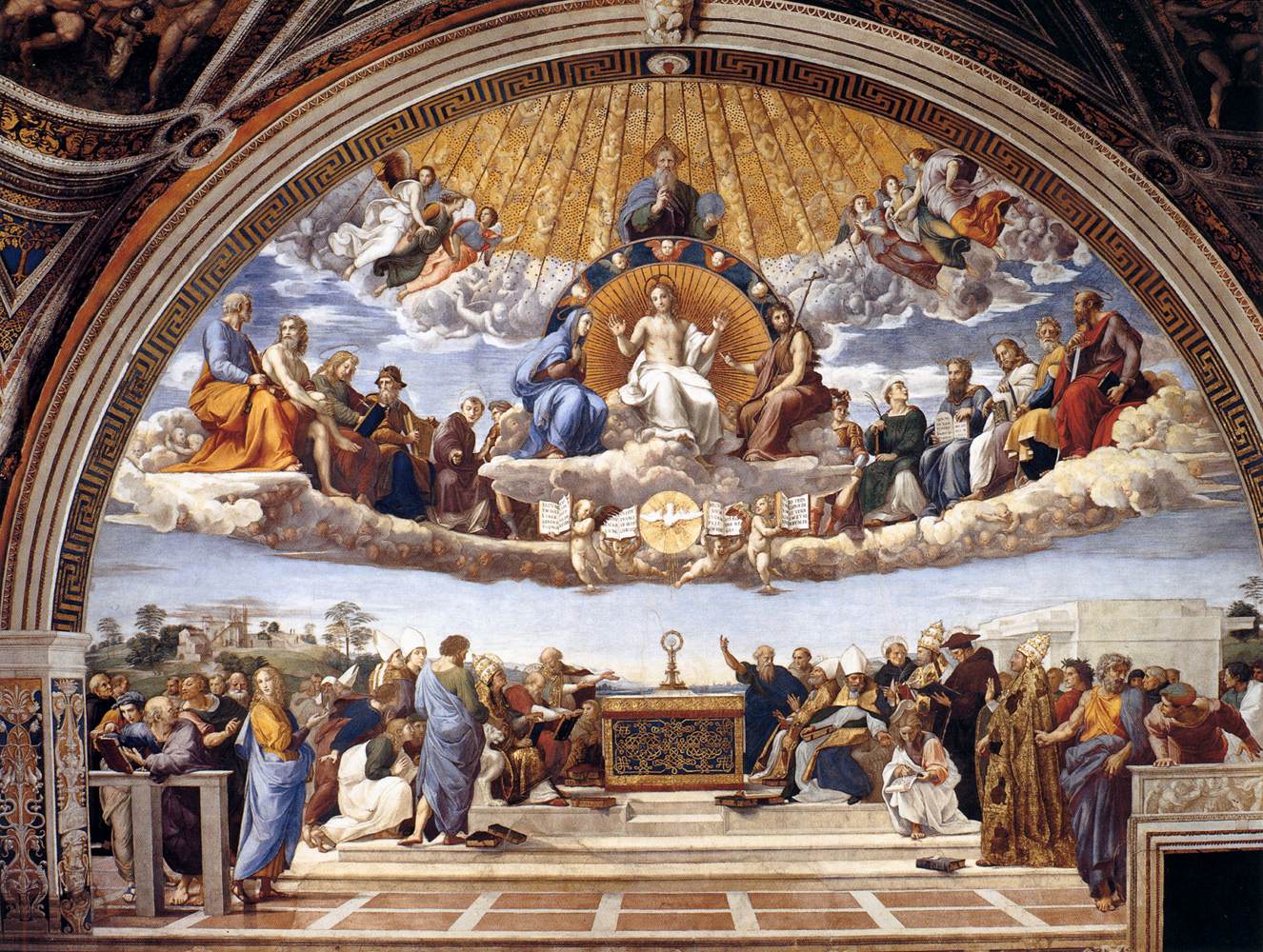
La Disputà (Disputation of the Holy Sacrament), Raffaello Sanzio, painted 1510-11

You will find a description of this magnificent fresco here and a video on its restoration here.

The Solemnity of the Body and Blood of Christ


Readings (New American Bible: Philippines, USA) 

Readings (Jerusalem Bible: Australia, England & Wales, India [optional], Ireland, New Zealand, Pakistan, Scotland, South Africa) 

Gospel Mark 14:12-16, 22-26 (Revised Standard Version – Catholic Edition)

On the first day of Unleavened Bread, when they sacrificed the passover lamb, his disciples said to him, "Where will you have us go and prepare for you to eat the passover?" And he sent two of his disciples, and said to them, "Go into the city, and a man carrying a jar of water will meet you; follow him, and wherever he enters, say to the householder, 'The Teacher says, Where is my guest room, where I am to eat the passover with my disciples?' And he will show you a large upper room furnished and ready; there prepare for us." And the disciples set out and went to the city, and found it as he had told them; and they prepared the passover. And as they were eating, he took bread, and blessed, and broke it, and gave it to them, and said, "Take; this is my body." And he took a cup, and when he had given thanks he gave it to them, and they all drank of it.  And he said to them, "This is my blood of the covenant, which is poured out for many. Truly, I say to you, I shall not drink again of the fruit of the vine until that day when I drink it new in the kingdom of God." And when they had sung a hymn, they went out to the Mount of Olives.


Pope Benedict leads Corpus Christi procession in Rome

‘As a primary school student, each Saturday I would play with my friends in our village but also made time for one hour’s adoration before the Blessed Sacrament in the local church. It was the custom in our village to have exposition of the Blessed Sacrament on Saturday afternoon and the Catholics would spend some time in prayer in the church.  I feel that my personal relationship with God has its origin in those hours before the Blessed Sacrament.’  [Emphasis added].

John Wang Zongshe is one of two young Chinese men who came to Manila a year ago to prepare to be Columban priests, the first candidates from that country. The original mission of the Columbans was China. John tells his vocation story, Life-giving Connections, in the current issue of Misyononline, the online magazine I edit for the Columbans here in the Philippines.

John is from a village that is one-third Catholic. but his companion Joseph Li Jiangang is from a village where all 800 inhabitants are Catholic.  Joseph, like John became involved actively in the life of the Church when he was young, as he writes in his vocation story, A Church with Room for All: The Franciscan Missionaries of Mary worked in our village and ran a medical clinic. In junior high school, one Sister got us together for religious education during our summer holidays, and at the age of eleven I began to know more about God.  I was born after the Cultural Revolution (1966-1976) when so much religious practice had ceased. I used to sit at the back of the church when I went alone, but when I joined the youth group we would sit at the front. As a youth I went of my own free will to church.

At that time, I was timid and afraid to read in public. I became an altar server and at twelve I was leading the congregation in half an hour of prayers before Mass. I liked that and on returning from school I’d drop my bag and head for the church. [Emphasis added].

Joseph, John and Emmannuel Trocino, a Columban seminarian from Negros Occidental, on a recent visit to Australian Columban Fr Brian Gore at San Columbano Mission Center, Himamaylan City, Negros Occidental, under the watchful eye of St Columban.

The first Columbans went to China in 1920 to bring the Gospel to the millions there who had never heard of Jesus Christ. Fr Paddy O'Connor, one of the first students to join the Columbans and who was ordained in 1923, wrote a poem called The Splendid Cause, which became the Columban anthem for many years, in which he used the line To bring to the nations the sweet, white Host. For Father O'Connor the Eucharist was at the heart of mission. 


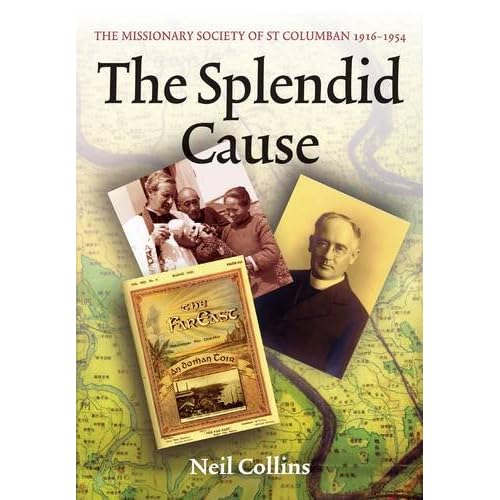
The Splendid Cause is also the title of a history of the Columbans from 1916 to 1954 by Columban Fr Neil Collins, who will be one of the speakers at the 50th International Eucharistic Congress being held in Dublin from 10 to 17 June. St Columbanus (Columban), the patron saint of the Society of St Columban,  is one of the patron saints of the Congress.

Recent polls and studies in Ireland indicate a great loss of faith, even though 84 percent in last year's census in the Republic of Ireland identified themselves as Catholics. (About 75 percent in the whole of Ireland would call themselves Catholics). Only about one third attend Mass every Sunday and a large percentage, especially of those who don't go to Mass regularly, don't believe that the bread and wine brought up at the offertory of the Mass become the Body and Blood of Christ at the Consecration. If they receive Holy Communion they believe they are receiving only a symbol.

It was a great love for the Mass and a desire to bring the Catholic Christian faith to the people of China that led two young Irish diocesan priests nearly 100 years ago, Fr Edward J. Galvin, later first Bishop of Hanyang, China, and Fr John Blowick to start what initially was 'The Maynooth Mission to China' and later became the Society of St Columban.

No Irish Columban has been ordained in the Third Millenium of Christianity nor are there any candidates at present. But the first two  seminarians from China, a country where the Church is still being harassed, a country from which Bishop Galvin and all other Columbans were expelled 60 years ago, some after having spent time in prison, have now joined us.

We just don't know God's plans. But absolutely central to the spirituality of Bishop Galvin was doing God's will. He cared little for the trappings of the office of bishop but insisted on his episcopal motto being Fiat voluntas tua, 'Your will be done'. He would surely be delighted that the call of John and John was awakened in communities focuses on the Eucharist.

The Columbans came to Manila in 1929 at the request of Archbishop Michael O'Doherty, an Irishman. One of the speakers at the Eucharistic Congress is his current successor, Manila-born Archbishop Luis Antonio Tagle. He also spoke at the 49th International Eucharistic Congress in Quebec City, Canada, in 2008.

Please pray that as the Church celebrates the Feast of Corpus Christ, the Body of Christ, which it has done already on Thursday in countries where it is still a holyday of obligation, and as the Archdiocese of Dublin hosts the Eucharistic Congress that there will be a renewal and deepening of faith in Ireland, a faith centred on the Eucharist, and that the Catholics of China, the Philippines and other countries where Irish missionaries have preached and lived the Gospel, may help re-evangelise the country that produced such missionary giants as St Columban 1,500 years ago and Edward Galvin and John Blowick a 100 years ago.


Lauda Sion Salvatorem
Sequence for Mass on the Solemnity of Corpus Christi

English Version

Sion, lift up thy voice and sing:
Praise thy Savior and thy King,
Praise with hymns thy shepherd true.
All thou canst, do thou endeavour:
Yet thy praise can equal never
Such as merits thy great King.
See today before us laid
The living and life-giving Bread,
Theme for praise and joy profound.
The same which at the sacred board
Was, by our incarnate Lord,
Giv'n to His Apostles round.
Let the praise be loud and high:
Sweet and tranquil be the joy
Felt today in every breast.
On this festival divine
Which records the origin
Of the glorious Eucharist.
On this table of the King,
Our new Paschal offering
Brings to end the olden rite.
Here, for empty shadows fled,
Is reality instead,
Here, instead of darkness, light.
His own act, at supper seated
Christ ordain'd to be repeated
In His memory divine;
Wherefore now, with adoration,
We, the host of our salvation,
Consecrate from bread and wine.
Hear, what holy Church maintaineth,
That the bread its substance changeth
Into Flesh, the wine to Blood.
Doth it pass thy comprehending?
Faith, the law of sight transcending
Leaps to things not understood.
Here beneath these signs are hidden
Priceless things, to sense forbidden,
Signs, not things, are all we see.
Flesh from bread, and Blood from wine,
Yet is Christ in either sign,
All entire, confessed to be.
They, who of Him here partake,
Sever not, nor rend, nor break:
But, entire, their Lord receive.
Whether one or thousands eat:
All receive the self-same meat:
Nor the less for others leave.
Both the wicked and the good
Eat of this celestial Food:
But with ends how opposite!
Here 't is life: and there 't is death:
The same, yet issuing to each
In a difference infinite.
Nor a single doubt retain,
When they break the Host in twain,
But that in each part remains
What was in the whole before.
Since the simple sign alone
Suffers change in state or form:
The signified remaining one
And the same for evermore.
Lo! bread of the Angels broken,
For us pilgrims food, and token
Of the promise by Christ spoken,
Children’s meat, to dogs denied.
Shewn in Isaac's dedication,
In the manna's preparation:
In the Paschal immolation,
In old types pre-signified.
Jesu, shepherd of the sheep:
Thou thy flock in safety keep,
Living bread, thy life supply:
Strengthen us, or else we die,
Fill us with celestial grace.
Thou, who feedest us below:
Source of all we have or know:
Grant that with Thy Saints above,
Sitting at the feast of love,
We may see Thee face to face.
Amen. Alleluia.

06 June 2012

My hopes for the International Eucharistic Congress in Dublin


I recorded this video some weeks ago at the request of a friend in Ireland. I mention my concern about the diminishing numbers attending Sunday Mass and of the loss of faith in the Real Presence. The report in yesterday's edition of  The Irish Times, Many Catholics 'do not believe' church teachings, confirms what I express in the video. I posted about the report, with links to related articles, yesterday.

Please pray that the 50th International Eucharistic Congress, to be held in Dublin 10-17 June, will bring a renewal of faith in Ireland.

05 June 2012

Have most Irish Catholics lost the faith?


 First Holy Communion at Holy Family Home for Girls, Bacolod City, Philippines


A few months ago, at a large funeral in a mid-western Irish town for a devout, much-loved 88-year-old family man, his 13 handsome, 20- and 30-something grandchildren brought joy and life to the occasion. The one thing they failed to bring was a knowledge of basic Mass etiquette. Throughout the consecration, oblivious to the bowed and kneeling congregation behind them, all 13 remained seated, exchanging the odd friendly word. Then they all trooped solemnly up for Communion.

It generated some quiet exchanges afterwards. The local priest said cheerfully that all were welcome in his church, regardless of their knowledge or devotion – “sure, isn’t that what we’re here for?” A visiting priest remarked mildly that “nearly all Irish Catholics were infantilised – their spiritual development was arrested back around First Communion time”.

A 50-something layman shrugged and said : “They’re gone in any meaningful sense. They’ll turn up in church because they know their grandad would have wanted it and they like the sense of community it gives them – but do they really believe in any of it anymore . . . ?”

The above is the opening of an article by Kathy Sheridan in today's issue of The Irish Times, Never less cause for celebration with just a third of Catholics attending weekly Mass.The article is related to a recent poll in the Irish Republic commissioned by the paper and in the wider context of the 50th International Eucharistic Congress to be held in Dublin from 10 to 17 June.

 First Communicants at Holy Family Home for Girls. Some had just been baptised and confirmed. Most of these girls come from backgrounds of poverty and many have experienced far worse than that.

Carl O'Brien's report on the poll says, When it comes to the church’s teachings, many Catholics do not subscribe to key tenets such as transubstantiation. Almost two-thirds (62 per cent) believe the blessing of bread and wine during Mass only represents the body and blood of Christ.

May is the traditional month in Ireland for First Holy Communion. In my kindergarten school, Stanhope St, Dublin, there used to be First Holy Communions also in December. I made mine on 20 May 1950, which was a Holy Year. Kathy Sheridan of The Irish Times had an article in the 12 May issue of the paper this year, The first holy conundrum.  She began this way:

To some families it’s a holy sacrament, to others it’s an excuse for a party, and to many it’s an exercise in hypocrisy and mass delusion. So why is First Holy Communion a tradition we can’t let go of?

So you thought the meringue dresses, stretch limos and cash-stuffed envelopes were the worst of it? Think about the people behind the scenes. This weekend, the Catholic priests of Ireland will don their festive vestments, set their jaws to smile mode and pray they get through the season without having to arm-wrestle someone in the aisle.

First Communions can be trying affairs.

And this bit is similar to the opening of her article today, quoted above:

Ann Buggie, principal of the 408-pupil Scoil Mhuire in Portlaoise town, attributes the increased noise and random movement partly to multicultural factors but also to a general social shift towards inappropriate behaviour. “It’s a reflection of what’s happening in the home,” she says.

“It’s to do with the number of people in the church who are not familiar with those surroundings any more and who are determined not to be respectful in those surroundings,” says Msgr Byrne. “I think there is a need in them to display their dissatisfaction with the church by not respecting the building.”

So why are they there? “They’re there for the child, and they’re not really interested. But it’s just not a lack of interest in the ceremony. They’re very uncomfortable at being there.”

One of the girls being baptised at Holy Family Home

A few years ago I celebrated Sunday Mass in a parish in Dublin. I think it was the feast of Corpus Christi, which will be celebrated on Thursday in countries where it is a holyday of obligation and on Sunday elsewhere. I gave very simple and direct teaching in my homily, stressing that the bread and wine brought up at the offertory become the Body and Blood, Soul and Divinity of Jesus Christ the Risen Lord at the Consecration. This is something I often do. A middle-aged man came to me afterwards and thanked me because, he said, such teaching was seldom heard anymore.

The Pope's two prayer intentions for June are very relevant to the situation in Ireland.


General intention: Christ, Present in the Eucharist. That believers may recognize in the Eucharist the living presence of the Risen One who accompanies them in daily life. 


Missionary intention: European Christians. That Christians in Europe may rediscover their true identity and participate with greater enthusiasm in the proclamation of the Gospel.

04 June 2012

'Don't come home before midnight!' - a dying girl's gift to her parents

Blessed Chiara Luce Badano (1971-1990)

The patron of the Congress Youth Space  at the 50th International Eucharistic Congress to be held in Dublin from 10 to 17 June is Blessed Chiara Luce Badano (1971-1990). In the September-October 2010 issue of Misyon we published an article about her, TheSaint Who Failed Math.  

Ruggero and Maria Teresa Badano with their infant daughter

In the June 2012 issue of Intercom, the monthly published by the Irish Catholic Bishops’ Conference, Fr Patrick Leahy tells a lovely story about this only child who was born to her parents Ruggero and Maria Teresa on 29 October 1971, eleven years after they married and who died 22 days short of her 19th birthday. On St Valentine’s Day 1990, when she was already very sick, Blessed Chiara Luce booked a meal for her parents at a local restaurant. Before they went there she said to them, ‘This evening look at one another in the eyes, and don’t come home before midnight!’ She then turned to her mother and said, ‘And remember, Mum, before me, there was Dad’.


I wish that every married couple had the clarity that this young person had, that the foundational relationship in the family is that between husband and wife, not between parent and child. The latter is a consequence of the first.