Showing posts with label First Holy Communion. Show all posts

29 May 2013

'Delay communions until adulthood, says priest' - Irish Examiner today


May is the month in Ireland when children make their First Holy Communion. Over the years it has become less and less a significant moment of faith in the lives of young Irish Catholics and more and more an extravagant family celebration where the Christian faith is no more than a background and very often lacking in the parents of the First Communicant.

Today's Irish Examiner carries a story under the headline Delay communions until adulthood, says priest. Fiachra Ó Cionnaith's report begins:

The claim has been made by a leading Catholic priest, who said the age-specific system has lost almost all connection to what is meant to be intended. 

Speaking on RTÉ Liveline programme [a very popular phone-in radio show on the main national station] yesterday, Fr Paddy Byrne said the modern-day version of the religious rites of passage has become a 'hostile' event involving families who do not want to be there. 

He said cultural changes in recent years mean many ceremonies now involve parents who have moved away from the Church, but feel peer pressure to allow their children to join the ceremonies. 

In other cases, he said, otherwise religious families see the events more as family parties and opportunities for their children to be given money and presents. 


The article quotes Fr Byrne: 85% of children taking first communion are not seen again by the Church. This figure may not be quite accurate as probably most of them will appear in church at least once after their First Holy Communion - for their Confirmation about five years later. Then for many, maybe most, it's 'Goodbye'.


TV3, a commercial station in Ireland, broadcast Modern Ireland - My First Holy Communion  (video above) in 2009. It looks at three families, two Irish and a Nigerian family now living in Dublin. Ironically, the immigrant family is the most comfortable financially. For all three families the First Holy Communion of one of their children is a very important family event. One father hopes that it will bring his separated parents together for the occasion. Sadly, it doesn't.

But it is only the Nigerian family that clearly sees the day above all as a celebration of their Catholic faith and an occasion they hope will be one of a deepening in his faith of the young boy making his First Holy Communion.

The excerpts from the Mass in County Louth shown in the video made me shudder.

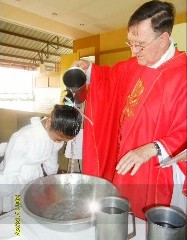
First Communicants at Holy Family Home for Girls. I had just baptised and confirmed some of them. Most of these girls come from backgrounds of poverty and many have experienced far worse than that.

Though I'm not sure that I'd go along with the idea of leaving the sacraments of initiation until adulthood I think that Fr Byrne is highlighting the crisis of a widespread loss of the Catholic Christian faith in Ireland, something I've posted about before, also in the context of First Holy Communion.

Father Byrne observes that First Holy Communion and Confirmation are losing their meaning for Irish Catholics and notes, There’s a majority [of parents] who are quite unruly when it comes to the basic etiquette of how to behave. I’ve often been asked 'do you have wi-fi here, can people go on Facebook?'

How can someone who doesn't now the alphabet teach another how to read? How can parents or grandparents who have in effect lost the faith or for whom Mass is not important pass on the faith to their children and grandchildren? Pope Francis carries in his breviary a note from his paternal grandmother, born Rosa Margherita Vasallo and who emigrated from Italy to Argentina with his parents: May my grandchildren, to whom I have given my whole heart, have a long and happy life but if pain, sickness or loss of a loved one should fill them with sadness, may they remember that one breath taken at the Tabernacle, where the greatest and august martyr is present and one glance at Mary at the foot of the cross, will act like a balm that is able to heal the deepest and most painful wounds.

Where are the Rosa Margheritas in contemporary Ireland?


Céad míle fáilte romhat, a Íosa, a Íosa
A hundred thousand welcomes to you, o Jesus, o Jesus
A traditional Irish Communion / Christmas hymn

SA GHAEILGE / IN IRISH

Céad míle fáilte romhat, a Íosa, a Íosa,
Céad míle fáilte romhat, a Íosa,
Céad míle fáilte romhat, a Shlánaitheoir
Céad míle míle fáilte romhat, a Íosa, a Íosa...

Glóir agus moladh duit, a Íosa, a Íosa,
Glóir agus moladh duit, a Íosa,
Glóir agus moladh duit, a Shlánaitheoir,
Glóir, moladh agus buíochas duit, a Íosa, a Íosa...

Céad míle fáilte romhat, a Shlánaitheoir,
Céad míle míle fáilte romhat, a Íosa, a Íosa...

IN ENGLISH / SA BHÉARLA

A hundred thousand welcomes to you, o Jesus, o Jesus,
A hundred thousand welcomes to you, o Jesus,
A hundred thousand welcomes to you, o Saviour,
A hundred thousand welcomes to you, o Jesus, o Jesus...

Glory and praise to you, o Jesus, o Jesus,
Glory and praise to you, o Jesus,
Glory and praise to you, o Saviour,
Glory, praise and thanks to you, o Jesus, o Jesus...

A hundred thousand welcomes to you, o Saviour,
A hundred thousand welcomes to you, o Jesus, o Jesus...

05 June 2012

Have most Irish Catholics lost the faith?


 First Holy Communion at Holy Family Home for Girls, Bacolod City, Philippines


A few months ago, at a large funeral in a mid-western Irish town for a devout, much-loved 88-year-old family man, his 13 handsome, 20- and 30-something grandchildren brought joy and life to the occasion. The one thing they failed to bring was a knowledge of basic Mass etiquette. Throughout the consecration, oblivious to the bowed and kneeling congregation behind them, all 13 remained seated, exchanging the odd friendly word. Then they all trooped solemnly up for Communion.

It generated some quiet exchanges afterwards. The local priest said cheerfully that all were welcome in his church, regardless of their knowledge or devotion – “sure, isn’t that what we’re here for?” A visiting priest remarked mildly that “nearly all Irish Catholics were infantilised – their spiritual development was arrested back around First Communion time”.

A 50-something layman shrugged and said : “They’re gone in any meaningful sense. They’ll turn up in church because they know their grandad would have wanted it and they like the sense of community it gives them – but do they really believe in any of it anymore . . . ?”

The above is the opening of an article by Kathy Sheridan in today's issue of The Irish Times, Never less cause for celebration with just a third of Catholics attending weekly Mass.The article is related to a recent poll in the Irish Republic commissioned by the paper and in the wider context of the 50th International Eucharistic Congress to be held in Dublin from 10 to 17 June.

 First Communicants at Holy Family Home for Girls. Some had just been baptised and confirmed. Most of these girls come from backgrounds of poverty and many have experienced far worse than that.

Carl O'Brien's report on the poll says, When it comes to the church’s teachings, many Catholics do not subscribe to key tenets such as transubstantiation. Almost two-thirds (62 per cent) believe the blessing of bread and wine during Mass only represents the body and blood of Christ.

May is the traditional month in Ireland for First Holy Communion. In my kindergarten school, Stanhope St, Dublin, there used to be First Holy Communions also in December. I made mine on 20 May 1950, which was a Holy Year. Kathy Sheridan of The Irish Times had an article in the 12 May issue of the paper this year, The first holy conundrum.  She began this way:

To some families it’s a holy sacrament, to others it’s an excuse for a party, and to many it’s an exercise in hypocrisy and mass delusion. So why is First Holy Communion a tradition we can’t let go of?

So you thought the meringue dresses, stretch limos and cash-stuffed envelopes were the worst of it? Think about the people behind the scenes. This weekend, the Catholic priests of Ireland will don their festive vestments, set their jaws to smile mode and pray they get through the season without having to arm-wrestle someone in the aisle.

First Communions can be trying affairs.

And this bit is similar to the opening of her article today, quoted above:

Ann Buggie, principal of the 408-pupil Scoil Mhuire in Portlaoise town, attributes the increased noise and random movement partly to multicultural factors but also to a general social shift towards inappropriate behaviour. “It’s a reflection of what’s happening in the home,” she says.

“It’s to do with the number of people in the church who are not familiar with those surroundings any more and who are determined not to be respectful in those surroundings,” says Msgr Byrne. “I think there is a need in them to display their dissatisfaction with the church by not respecting the building.”

So why are they there? “They’re there for the child, and they’re not really interested. But it’s just not a lack of interest in the ceremony. They’re very uncomfortable at being there.”

One of the girls being baptised at Holy Family Home

A few years ago I celebrated Sunday Mass in a parish in Dublin. I think it was the feast of Corpus Christi, which will be celebrated on Thursday in countries where it is a holyday of obligation and on Sunday elsewhere. I gave very simple and direct teaching in my homily, stressing that the bread and wine brought up at the offertory become the Body and Blood, Soul and Divinity of Jesus Christ the Risen Lord at the Consecration. This is something I often do. A middle-aged man came to me afterwards and thanked me because, he said, such teaching was seldom heard anymore.

The Pope's two prayer intentions for June are very relevant to the situation in Ireland.


General intention: Christ, Present in the Eucharist. That believers may recognize in the Eucharist the living presence of the Risen One who accompanies them in daily life. 


Missionary intention: European Christians. That Christians in Europe may rediscover their true identity and participate with greater enthusiasm in the proclamation of the Gospel.

07 January 2012

'You are my Son, the Beloved; my favour rests on you.' The Baptism of the Lord

The Seven Sacraments: Baptism, Nicolas Poussin, painted 1641-42  [Web Gallery of Art]

The Feast of the Baptism of the Lord is observed in Ireland on Sunday 8 January and in other countries that use English widely on Monday 9 January. The Feast brings an end to the liturgical Season of Christmas.
Readings (New American Bible: Philippines, USA)
Gospel Mark 1:7-11 (Jerusalem Bible: Australia, England & Wales, India [optional], Ireland, New Zealand, Pakistan, Scotland, South Africa) 

 In the course of his preaching John the Baptist said, 'Someone is following me, someone who is more powerful than I am, and I am not fit to kneel down and undo the strap of his sandals. I have baptised you with water, but he will baptise you with the Holy Spirit.'

It was at this time that Jesus came from Nazareth in Galilee and was baptised in the Jordan by John. No sooner had he come up out of the water than he saw the heavens torn apart and the Spirit, like a dove, descending on him. And a voice came from heaven, 'You are my Son, the Beloved; my favour rests on you.'

An Soiscéal Marcas 1:7-11 (Gaeilge, Irish)

Agus bhíodh Eoin ag seanmóir á rá: “Tá ag teacht i mo dhiaidh an té atá níos treise ná mé, agus ní fiú mé cromadh síos chun iall a chuarán a scaoileadh. Bhaist mise le huisce sibh, ach baistfidh seisean sibh leis an Spiorad Naomh.” Lá de na laethanta sin tháinig Íosa ó Nazarat sa Ghailíl agus fuair baisteadh sa Iordáin ó Eoin. Agus an túisce a tháinig sé aníos as an uisce, chonaic sé na flaithis ag oscailt ó chéile agus an Spiorad mar a bheadh colm ag teacht anuas air. Agus tháinig glór ó na flaithis: “Is tú mo Mhac muirneach; is duit a thug mé gnaoi.”

+++

 14 young women and girls lining up for baptism and confirmation, 28 December 2011

The Irish Examiner carried a story by Gordon Deegan on 29 December, President washed dishes on visits to nuns. Every year during her 14 years in the mainly ceremonial post of president, a job she carried out with distinction and relinquished in November, President Mary McAleese of Ireland went to the Poor Clares monastery in Ennis, County Clare, to make a retreat.

Sister Gabriel, the abbess said, President McAleese has been great. She has been such an inspiration to us. She comes in, no mobile phone, no nothing, she relinquishes everything . . . President McAleese would be washing your dishes and you’re embarrassed, thinking ‘The President of Ireland is washing my dishes!’

In a way this was the only place she was Mary McAleese. She wasn’t the president, she could just be Mary and feed her own inner life to recharge herself for her duties. She is just so ordinary, so real - that is why the world took to her.

This story reminded me of one aspect of the Baptism of Jesus. He lined up anonymously with sinners in order to be baptized by John the Baptist, his cousin. The others in the line would not have known who he was. They would have presumed that he was a sinner like them. They had no idea he was God who had become Man, the Messiah they had all been waiting for.

I’m not suggesting that the Poor Clares in Ennis are noted for their sinfulness, though they are sinners like the rest of us. But the Irish President joined them every year, unknown to anyone apart from the nuns and her own family, to join them in prayer seven times a day, to join them in the silence broken only by for story-telling during recreation in the evening.

Very few of the paintings of the baptism of Jesus I looked at show him as one of a crowd of penitents. Poussin’s painting does to some extent. Can there be anything more extraordinary than God who is Love and who became Man allowing himself to be considered a sinner as he lined up for baptism, a foreshadowing of his death on Calvary, condemned as a criminal?


'I baptise you in the name of the Father . . .'

On 28 December, the Feast of the Holy Innocents, I had the joy of baptising and confirming 14 young women and girls at Holy Family Home in Bacolod City. Nine others joined them in making their First Holy Communion. Although none of us heard any voice from heaven, the reality is that God the Father said to each of those being baptised what he said to Jesus at his baptism, You are my daughter, my beloved; my favour rests on you.

First Holy Communion

The webpage of the Poor Clares in Ennis is here. The excellent website of the Poor Clares in Galway, just over an hour by road from Ennis, is here. It’s well worth exploring, especially to learn the stories of some of the nuns there.

15 June 2009

Jacinta's First Holy Communion

Jacinta Parkes, the youngest of the ten children of Andrew and Jackie Parkes - she of Catholicmomof10militant - made her First Holy Communion yesterday at the Oratory, Edgbaston, Birmingham, yesterday, Corpus Christi Sunday. You can read more and find plenty of photos on Jackie's blog here.

The First Communion class with Fr Guy Nicholls of the Oratory

Fr Guy Nicholls with Jacinta