20 March 2013

A phone call at 3:32am - from Pope Francis


The Vatican Information Service carried this story yesterday, 19 March:

Vatican City, 19 March 2013 (VIS) – The thousands of people who spent a sleepless night in the main square of Buenos Aires, Plaza de Mayo, to watch the Mass inaugurating former Archbishop Jorge Mario Bergoglio's Petrine ministry had a pleasant surprise. At 7:32am Rome time—that is, 3:32am in Argentina—the speakers placed outside the cathedral in the square began to carry the voice of Pope Francis. He was calling, from the Vatican, to greet them.
Plaza de Mayo, Buenos aires

As reported by the Argentine newspaper, Clarin, the Pope had called the cell phone of one of his aides, Fr. Alejandro Russo, rector of the cathedral. From the archdiocesan television centre they were then able to connect the call to Plaza de Mayo, so that the pontiff might say hello to his parishioners. Shortly afterwards, the rector announced that he had a special surprise and those gathered began to hear Francis' voice. “Dear sons and daughters, I know you have gathered in the square. I know that you are saying prayers, I need them very much. It is beautiful to pray because we look to heaven and know that we have a good Father who is God.”

Another view of the Plaza de Mayo

A huge wave of applause greeted the Pope's words and he continued: “I want to ask a favour of you. I want to ask for us to walk together, to care for one another, for you to care for each other. Do not cause harm. Protect life. Protect the family; protect nature; protect the young; protect the elderly. Let there not be hatred or fighting. Put aside envy.” And, in the city's slang, he added: “No le saquen el cuero a nadie" [literally, “don't flay or skin anyone alive”, that is, don't gossip, don't criticize one another]. Talk with one another so that this desire to protect each other might grow in your hearts. And draw near to God. God is good. He always forgives and understands. Do not be afraid of him. Draw near to him and may the Virgin bless you. May she, as a mother, protect you. Please do not forget this bishop who is far away but who loves you very much. Pray for me!”

View of Plaza de Mayo from Casa Rosada

“Through the intercession of Mary, ever Virgin, and each of your guardian angels, the glorious patriarch St. Joseph, St. Therese of the Child Jesus, and each of your protector saints, may God All-mighty, Father, Son, and Holy Spirit, bless you,” Francis concluded, imparting the papal blessing to all present before closing the connection.


The note that accompanies this video reads:

The ceremony for Pope Francis' Inaugural Mass started off at the Tomb of St. Peter. Joined by the other patriarchs and major archbishops of the Eastern Catholic Churches, the Pope descended to the sepulcher for St. Peter, prayed for several minutes, and offered incense to the Apostle.

Though the vast majority of Catholics may be described as 'Roman Catholics' because they belong to the Roman or Latin rite, using the Roman Missal for the celebration of Mass, Catholics of the Eastern Catholic Churches are not 'Roman' Catholics but Catholics, members of the Catholic Church, in the fullest sense.


18 March 2013

St Joseph, an Italian-Argentinian Pope and an Italian Jesuit-composer in Argentina

The Holy Family, Andrea del Sarto, c.1528 (Web Gallery of Art)

Ant. ad introitum  Cf Lc 12:42

Ecce fidélis servus et prudens, 
quem constítuit Dóminus super famíliam suam.

Entrance Antiphon  Cf Luke 12:42

Behold, a faithful and prudent steward, 
whom the Lord set over his household.


Fidelis servus et prudens,
quem constituit Dominus super familiam suam.

A faithful and prudent steward, 
whom the Lord set over his household.

This is an anonymous setting of today's Introit or Entrance Antiphon from the 18th century. It might have been written by Domenico Zípoli (17 October 1688 – 2 January 1726), an Italian Jesuit who died in Córdoba, in what is now Argentina. Or it might have been written by Martin Schmid, also known as Esmid (September 26, 1694 – March 10 1772), a Swiss Jesuit who died in what is now Bolivia.

The antiphon is sung here by El Coro de Niños cantores de Córdoba del Instituto Domingo Zípoli, Argentina, with the Ensemble Elyma, conducted by Argentinian conductor Gabriel Garrido who was born in Buenos Aires in 1950.


The website of the Cathedral gives this encouraging information:

CONFESIONES - CONFESSIONS
Lunes a Viernes - Monday to Friday: 9.45 a 13.15 - 14.30 a 17.30.

Clearly the Cathedral in the Archdiocese of Buenos Aires, of which Pope Francis was Archbishop for the last 15 years, gives priority to the Sacrament of Confession.

I started out this post with the intention of having something about St Joseph. The Introit of the Mass for the Solemnity led me to the musical setting with close links to the native country of our new Holy Father and two fellow Jesuits, and with links to the country of his parents, Italy. 


Pope Francis (when still Cardinal Bergoglio, 2008)

This is what the Vatican website gives as the activity of Pope Francis on the Solemnity of St Joseph:

19 Tuesday 
Solemnity of St. Joseph, Spouse of the Blessed Virgin Mary
Saint Peter's Square, at 9:30
PAPAL MASS
Imposition of the Pallium, conferral of the Fisherman's Ring and Holy Mass 
for the beginning of the Petrine Ministry of the Bishop of Rome Francis.


The Church honours St Joseph on this feast as the Spouse of the Blessed Virgin Mary. But he is also Patron of the Universal Church and the Collect of the Mass reflects both of these. May he protect Pope Francis in a very special way, as he protected Jesus.

Collect

Grant, we pray, almighty God, 
that by Saint Joseph's intercession 
your Church may constantly watch over 
the unfolding of the mysteries of human salvation, 
whose beginnings you entrusted to his faithful care.
Through our Lord Jesus Christ, your Son, 
who lives and reigns with you in the unity of the Holy Spirit, 
one God, for ever and ever.

16 March 2013

'Go, and do not sin again'. Sunday Reflections, 5th Sunday of Lent Year C


From Jesus of Nazareth (1977) directed by Franco Zeffirelli

Readings (New American Bible: Philippines, USA)

Readings (Jerusalem Bible: Australia, England & Wales, India [optional], Ireland, New Zealand, Pakistan, Scotland, South Africa)

Gospel John 8:1-11 (Revised Standard Version – Catholic Edition)

Jesus went to the Mount of Olives. Early in the morning he came again to the temple; all the people came to him, and he sat down and taught them. The scribes and the Pharisees brought a woman who had been caught in adultery, and placing her in the midst they said to him, "Teacher, this woman has been caught in the act of adultery. Now in the law Moses commanded us to stone such. What do you say about her?" This they said to test him, that they might have some charge to bring against him. Jesus bent down and wrote with his finger on the ground. And as they continued to ask him, he stood up and said to them, "Let him who is without sin among you be the first to throw a stone at her." And once more he bent down and wrote with his finger on the ground. But when they heard it, they went away, one by one, beginning with the eldest, and Jesus was left alone with the woman standing before him. Jesus looked up and said to her, "Woman, where are they? Has no one condemned you?" She said, "No one, Lord." And Jesus said, "Neither do I condemn you; go, and do not sin again."

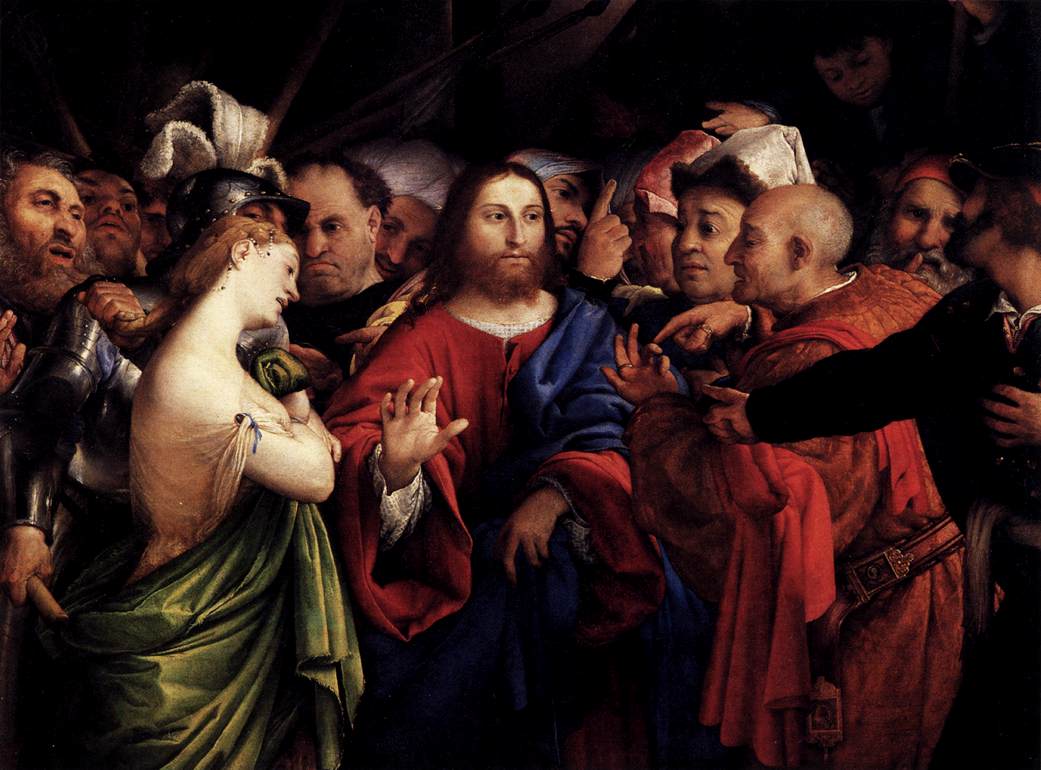
Christ and the Woman Taken in Adultery, Lorenzo Lotto, 1527-29 
[Web Gallery of Art]


More than 30 years ago I did a number of brief supplies in parishes in one of the western states in the USA. In one parish, where I stayed only from Saturday till Monday morning, the gospel one showing the mercy of Jesus. I forget which one, but know it wasn't today's. In my homily I emphasised God's love for us as sinners and how he wants to welcome us back when we turn away from him, partly or fully, by sinning.

The following morning I found an anonymous note that had been shoved under the front door of the priest's house. The style was that of a teenage girl. But the message was one for which I thanked God.

The writer said that for years she had hated God, thinking that God hated her. But whatever was in the gospel of that Sunday and whatever I said in my homily had touched her deeply, making her aware of God's unconditional love for her precisely as a sinner, a love that led her to let go of the hatred she had been carrying.

Today's gospel shows so clearly the profound, merciful love that Jesus has for the sinner. We tend to focus on his mercy for the woman taken in adultery. She is indeed the main focal point. But we also see the merciful love of Jesus for those who had accused her. Jesus often spoke harshly to and about hypocrites. But on this occasion he brings the men who had wanted to execute the woman to reflect on their own sinfulness. Let him who is without sin among you be the first to throw a stone at her.

And the men did respond. But when they heard it, they went away, one by one, beginning with the eldest.

Today's gospel reflects that of last Sunday, the parable of the Prodigal Son. The older son couldn't see beyond the great sins of his younger brother and failed even to see his father's love shown each day. But the father gently points out, Son, you are always with me, and all that is mine is yours.

The men in the gospel could see only the sin of the woman. And she had committed a grave sin. Adultery is never a 'peccadillo', a 'little sin'. It is among other things a sin of injustice and causes grief to the other spouse and to their children, as I know only too well from listening to young people on retreats over the years.

We live in a time when it is considered a 'grave sin' to be 'judgmental'. The 'grave sin' is not against God but against current 'thinking' and 'feeling'. Yet certain persons are called by their very professions to be 'judgmental': judges, referees and umpires, for example.

And Jesus in this instance is judgmental in that sense. He first asks the woman, Has no one condemned you? He then goes on to say, Neither do I condemn you; go, and do not sin again.

Jesus judges the woman - but doesn't condemn her. He acknowledges her sin - but sends her away forgiven.

Jesus has given us through the Church a powerful way of experiencing what the woman in today's gospel did. It is the Sacrament of Reconciliation/Confession/Penance. We're not usually dragged to the confessional by people condemning us. But we acknowledge our sins while acknowledging God's mercy. 

Among other things, 'The whole power of the sacrament of Penance consists in restoring us to God's grace and joining us with him in an intimate friendship.' Reconciliation with God is thus the purpose and effect of this sacrament. For those who receive the sacrament of Penance with contrite heart and religious disposition, reconciliation 'is usually followed by peace and serenity of conscience with strong spiritual consolation.' Indeed the sacrament of Reconciliation with God brings about a true 'spiritual resurrection,' restoration of the dignity and blessings of the life of the children of God, of which the most precious is friendship with God. (Catechism of the Catholic Church, No 1468).  


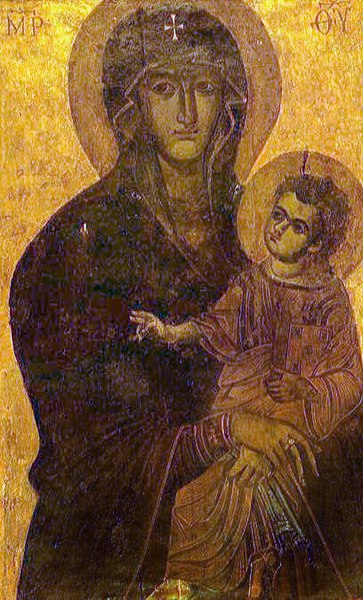
Salus Populi Romani (Protectress of the Roman People)

The day after he was elected Pope Francis visited the Basilica of St Mary Major in Rome to pray for the people of his new diocese - the Pope is above all the Bishop of Rome - where he knelt before the icon of the Madonna and Child, said to date back to the early days of Christianity. Since the 19th century Mary in this image has been known as 'Salus Populi Romani' or 'Protectress of the Roman People'.

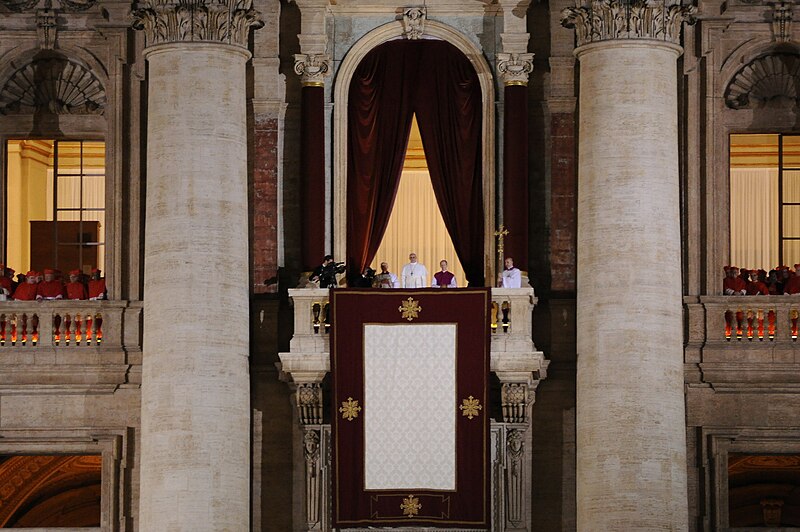
When Pope Francis came out on the balcony for the first time he said, And now, we take up this journey:  Bishop and People.  This journey of the Church of Rome which presides in charity over all the Churches.  A journey of fraternity, of love, of trust among us.  Let us always pray for one another. Let us pray for the whole world, that there may be a great spirit of fraternity.  It is my hope for you that this journey of the Church, which we start today, and in which my Cardinal Vicar, here present, will assist me, will be fruitful for the evangelization of this most beautiful city. 

Here, for the second time in his brief words, Pope Francis was emphasising that he is Bishop of Rome. He then went on to ask the people to pray for him before he gave his Urbi et Orbi - 'To the City and the World' - blessing.


Collect from the Mass for the Pope.

O God, who in your providential design 
willed that your Church be built 
upon blessed Peter, whom you set over the other Apostles, 
look with favour, we pray, on Francis our Pope 
and grant that he, whom you have made Peter's successor, 
may be for your people a visible source and foundation 
of unity in faith and of communion.
Through our Lord Jesus Christ, your Son, 
who lives and reigns with you in the unity of the Holy Spirit, 
one God, for ever and ever.

14 March 2013

'Let us make, in silence, this prayer: your prayer over me.' Pope Francis

 
13 March 2013

Annuntio vobis gaudium magnum;
habemus Papam:
Eminentissimum ac Reverendissimum Dominum,
Dominum Georgium Marium
Sanctae Romanae Ecclesiae Cardinalem Bergoglio
qui sibi nomen imposuit Franciscum
The photo above of the then Cardinal Bergoglio was taken in 2008.
Our new Holy Father is described on the Vatican website as 'Pope Francis', not 'Pope Francis the First', or simply as 'Franciscus', the Latin form of the name, as above, or its equivalent in other languages. Numbering only comes in when there is more than one pope with the same name.
The plaque above, in St Peter's, listing all the popes buried there, follows that convention. The first four, for example, are 'S Petrvs (St Peter), Linvs, Cletvs, Evaristvs' without any number after the name. (In Latin the letters 'u' and 'v' were often used interchangeably.) Sts Linus and Cletus are mentioned in the Roman Canon, also called the First Eucharistic Prayer.
+++

I was in Manila when Pope Francis was elected. At present the Philippines is seven hours ahead of Rome. When I went to bed I decided I'd get up whenever I woke to check if there was white smoke. The first time I woke I figured it was too early but at 2am Thursday, Philippine time, I woke again and went to the TV room, switched on BBC World, saw the white smoke and heard the bells joyfully ringing. So I waited till the name of the new pope was announced. 

When Pope Francis stood in front of the people he seemed to be stunned and I began to feel anxious for him. But once he took the microphone I was very assured by his simple words and by the way he spoke. It was extraordinary to hear the silence after he asked us to 
Here is Pope Francis speaking to the people of Rome, whose bishop he now is, and the people of the world. Below is the official English translation from the website of the Vatican.
It is very striking that before Pope Francis gives us his blessing for the first time he asks the people to pray to the Lord that he will bless me: the prayer of the people asking the blessing for their Bishop. Let us make, in silence, this prayer: your prayer over me.   

May we pray fervently for Pope Francis every day.
Apostolic Blessing 'Urbi et Orbi':
Brothers and sisters, good evening!
You know that it was the duty of the Conclave to give Rome a Bishop.  It seems that my brother Cardinals have gone to the ends of the earth to get one... but here we are... I thank you for your welcome.  The diocesan community of Rome now has its Bishop.  Thank you!      And first of all, I would like to offer a prayer for our Bishop Emeritus, Benedict XVI.  Let us pray together for him, that the Lord may bless him and that Our Lady may keep him. 
Our Father...
Hail Mary...
Glory Be...
And now, we take up this journey:  Bishop and People.  This journey of the Church of Rome which presides in charity over all the Churches.  A journey of fraternity, of love, of trust among us.  Let us always pray for one another.  Let us pray for the whole world, that there may be a great spirit of fraternity.  It is my hope for you that this journey of the Church, which we start today, and in which my Cardinal Vicar, here present, will assist me, will be fruitful for the evangelization of this most beautiful city. 
And now I would like to give the blessing, but first - first I ask a favour of you: before the Bishop blesses his people, I ask you to pray to the Lord that he will bless me: the prayer of the people asking the blessing for their Bishop.  Let us make, in silence, this prayer:  your prayer over me. 
[...]
Now I will give the Blessing to you and to the whole world, to all men and women of good will.
[Blessing]
Brothers and sisters, I leave you now.  Thank you for your welcome.  Pray for me and until we meet again.  We will see each other soon.  Tomorrow I wish to go and pray to Our Lady, that she may watch over all of Rome.  Good night and sleep well!

13 March 2013

Habemus Papam! POPE FRANCIS


Jorge Mario Bergoglio (born 17 December 1936)
Archbishop of Buenos Aires, Argentina
May God bless his ministry abundantly.

10 March 2013

'Long ago I used to be a young man and dear Margaret remembers that for me.' National Week of Prayer and Awareness of Dementia, 12-19 March


Long ago I used to be a young man
and dear Margaret remembers that for me.

The Dutchman is a song written by Michael Peter Smith in 1968. It's about an elderly couple living in Amsterdam, Margaret and the title character. The unnamed Dutchman has dementia and Margaret cares for him with a sadness over what has happened to him over the years. It's a story of unconditional love.


I became involved with The Pastoral Care Project in the Archdiocese of Birmingham, England, while based in the Columban house in Solihull from September 2000 to April 2002 when I moved to Glasgow, Scotland, though I stayed there for only a few months before returning to the Philippines. The mission statement of the Project is above. I first got involved when the founder of the Project, Mrs Frances Molloy, invited me to celebrate Mass in a home for old people.

The mission statement of the Project is above. The focus is on the spiritual needs of those who are frail, especially mentally. The Project also works with carers, not all of whom would understand the spiritual needs of those they are looking after. And the carers themselves need some care too as their work can be very demanding.

Michael Peter Smith's song, sung with such feeling by the late Liam Clancy and Tommy Makem, captures something of what is asked of those taking care of a person with dementia, who is very often a spouse or a parent, in the lines, Long ago I used to be a young man / and dear Margaret remembers that for me.

The Project is holding a National Week of Prayer and Awareness of Dementia. One of the activities suggested is Bake 'n' Share. Those taking part are asked to Create something whereby your visit with an elderly person focuses on their interests. The visit can become a hub of activity generating memories of the moment and a feeling of fulfilment.

It doesn't have to be baking but something the older person can be involved in and that will give a sense of purpose to that person, a sense of continuity with the past. The visitor remembers that for me.

I studied Shakespeare's As You Like It in school. (Stratford-on-Avon is in the Archdiocese of Birmingham and not far from the office of The Pastoral Care Project.) I always liked the famous speech of Jacques, The Seven Ages of Man or All the world's a stage. But a 15-year-old cannot understand the closing lines in the way Richard Pasco does here: 

Last scene of all, 
That ends this strange eventful history,  
Is second childishness and mere oblivion,  
Sans teeth, sans eyes, sans taste, sans everything.


All the world's a stage,
And all the men and women merely players;
They have their exits and their entrances,
And one man in his time plays many parts,
His acts being seven ages. At first, the infant,
Mewling and puking in the nurse's arms.
Then the whining schoolboy, with his satchel
And shining morning face, creeping like snail
Unwillingly to school. And then the lover,
Sighing like furnace, with a woeful ballad
Made to his mistress' eyebrow. Then a soldier,
Full of strange oaths and bearded like the pard,
Jealous in honor, sudden and quick in quarrel,
Seeking the bubble reputation
Even in the cannon's mouth. And then the justice,
In fair round belly with good capon lined,
With eyes severe and beard of formal cut,
Full of wise saws and modern instances;
And so he plays his part. The sixth age shifts
Into the lean and slippered pantaloon,
With spectacles on nose and pouch on side;
His youthful hose, well saved, a world too wide
For his shrunk shank, and his big manly voice,
Turning again toward childish treble, pipes
And whistles in his sound. Last scene of all,
That ends this strange eventful history,
Is second childishness and mere oblivion,
Sans teeth, sans eyes, sans taste, sans everything.

Portrait of an Old Woman, Peter Bruegel the Elder, c.1564 (Web Gallery of Art)

Prayer for Healthcare Professionals © 

O Lord we pray for all those whose work is dedicated 
to the assessment and care of those who experience 
confusion and profound memory loss. 
For all who work as Healthcare Professionals in 
everyday care and research into the causes of 
Dementia of many kinds. 
May they be strengthened in their work of service 
with individuals, families and friends. 
Through Jesus Christ our Lord. 
Amen. 

Written in 2009 for the Pastoral Care Project by Rev’d Canon Edward Pogmore, 
Chaplain Co-ordinator, The George Eliot Hospital NHS Trust and North Warwickshire Primary Care Trust.

The following is a press release by the Pastoral Care Project. Bishop David Christopher McGough is an auxiliary bishop of the Archdiocese of Birmingham.

National Week of Prayer and Awareness of Dementia takes place 12th – 19th March 2013 and it is the initiative of the Pastoral Care Project.

Introducing the forthcoming Week, Bishop McGough, lead Bishop for the Pastoral Care Project said, "I am pleased to commend the national week of prayer and awareness of dementia. Few of us can imagine the isolation, and consequent anxiety, that this affliction brings both to those who suffer and their families. Through prayer let us ground ourselves in our communion with the Lord, making ourselves one with the many who suffer and those who care for them."

Everyone can participate in this week by visiting  www. pastoralcareproject.org.uk using the resources to organise an event or to join in existing event locally.    

Frances Molloy, Project Manager would like to thank everyone who gave their support last year and is hopeful that this years’ event will be supported more widely.  “It is an important week for people with dementia and for our charity, so, whether you purchase Prayer Cards or  host an event you will be helping to raise awareness and you will be supporting the ongoing work of the Pastoral Care Project.  These are difficult times which have also impacted on the people with dementia and their carers; so making use of these resources may bring about new initiatives in parishes and help to reduce the isolation.  

Reducing isolation is ongoing and to get started we are launching Bake and Share. “wonderful scones mummy used to make”  Face book message.

When you think of home made scones, what memories arise? Bake and Share is a simple way to foster parish friendships and  visit the sick and housebound. What about their carers, and their needs?  Visiting with freshly baked scones; shared over a pot of tea is an enriching experience.

This new initiative has been adopted by  Communitas - an inter-faith project. Their Coffee Morning on 14th at English Martyrs’, Birmingham will combine Prayer, baking and selling scones to raise funds for the Pastoral Care Project.

Another  known event; Camplehaye Care Home in Devon will be having an ecumenical service on Friday 15th for the residents, relatives and staff to pray and share friendship followed by Devonshire Cream Tea.

Schools – a few to date in the UK holding special assemblies. Our Lady of the Angel’s Infant School and St Joseph’s Junior School will be contributing to the liturgy and music for the Mass celebrated by Bishop David McGough Our Lady of the Angels, Nuneaton for the deanery on Wednesday 13th March at 11.00am. Prayer intentions for the and the week  should be sent to the Pastoral Care Project.

At the Pastoral Care Project we are often asked how parishes can respond to  dementia.  One  example where a parish visiting team offers lunch after the regular first Friday Mass. This helps overcome isolation and also provides opportunities for parishioners to contribute; through baking, or serving.

For those whose interest is music and leading services there are also online resources. Music touches people at a very deep level and so sensitivity to the choice of music or hymns is important because of the memories evoked.

Hymns which they would have sung at Mass are helpful; times when they felt God was very close, confirmed by one carer so wisely said “People with dementia have an awareness of God – God is also aware of them.” 

Carers too need support. When a former elderly carer whose wife with dementia was hospitalised he would visit and help feed her and give her drinks and ensure she was well cared for, even though he was frail himself. He would sing songs, hymns and pray with her. After her death he found comfort  through praying and writing poetry; by donating the poems to the Pastoral Care Project he felt solidarity with people with dementia and those in similar caring situations.


The following poem was composed by him as he reflected on the painting of the Washing of the Feet by Sieger Koder during one of the Pastoral Care Projects’ Quiet Day for Carers.

The Water of your Blessing©

Do not kneel, My Lord.
It is for me to kneel
At your feet.
With your loving hands you
Touch my feet…
Loving, gentle hands
Which made those who ail and hurt
Whole and well.
You washed your feet with
Water cool and soothing…
The water of your
Blessings.
You dried my feet with
Linen pure; and gentleness.
But infinitely you washed
My heart…
A heart ‘oft grieved and saddened.
You drew me close and called me Son,
And filled me with your grace,
Your great Amen

The Week of Prayer and Awareness of Dementia 12-19th March involves us all – for everyone knows someone who is affected by dementia. Think about dementia?  You can’t help but get involved in some small way to make a difference to someone? Baking a few scones, sharing with a neighbour or sell to friends and raise a few desperately needed pounds for the Pastoral Care Project . You will be helping others through us to create opportunities to make the lives of people with dementia more fulfilling

Parishes are contacting regularly to update the events calendar, for example, All Hallows in Miskin, Cardiff diocese are having a mass on 19th March the feast of St Joseph a lovely closing to the week of prayer. 
 
We will help where we can, or let us know what your parish or school might be organising? For further information or donations please contact Frances Molloy, Project Manager at the Pastoral Care Project, St Gerard’s, Coventry Road, Coleshill, B46 3ED, telephone 01675 434035, www.pastoralcareproject.org.uk email info@pastoralcareproject.org.uk


08 March 2013

'And he arose and came to his father.' Sunday Reflections, 4th Sunday of Lent Year C


Readings (New American Bible: Philippines, USA)

Readings (Jerusalem Bible: Australia, England & Wales, India [optional], Ireland, New Zealand, Pakistan, Scotland, South Africa) 

Gospel Luke 15:1-3, 11-32 (Revised Standard Version – Catholic Edition)

Now the tax collectors and sinners were all drawing near to hear Jesus. And the Pharisees and the scribes murmured, saying, "This man receives sinners and eats with them." So he told them this parable:

"There was a man who had two sons; and the younger of them said to his father, 'Father, give me the share of property that falls to me.' And he divided his living between them. Not many days later, the younger son gathered all he had and took his journey into a far country, and there he squandered his property in loose living. 

Departure of the Prodigal Son, Stained Glass Window, Bourges Cathedral, c.1210 (Web Gallery of Art)

"And when he had spent everything, a great famine arose in that country, and he began to be in want. So he went and joined himself to one of the citizens of that country, who sent him into his fields to feed swine. And he would gladly have fed on the pods that the swine ate; and no one gave him anything.


"But when he came to himself he said, 'How many of my father's hired servants have bread enough and to spare, but I perish here with hunger! I will arise and go to my father, and I will say to him, "Father, I have sinned against heaven and before you; I am no longer worthy to be called your son; treat me as one of your hired servants."'

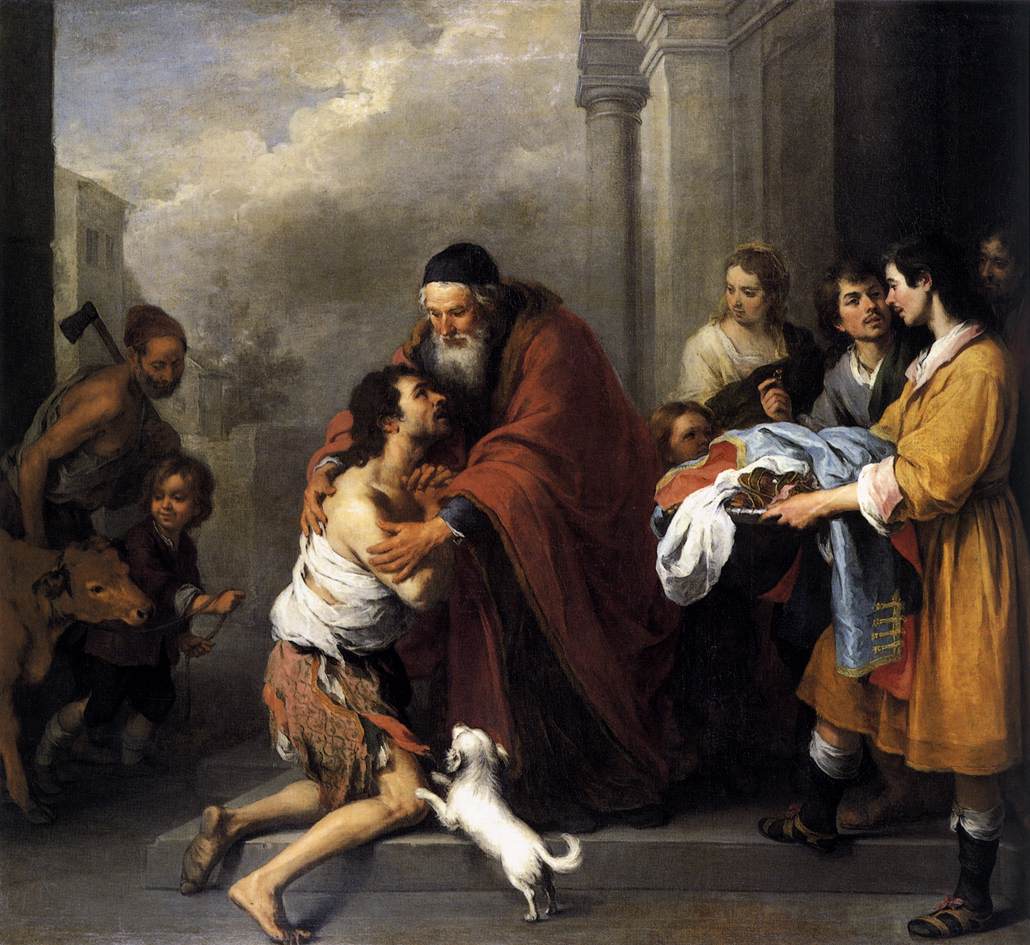
"And he arose and came to his father. But while he was yet at a distance, his father saw him and had compassion, and ran and embraced him and kissed him. And the son said to him, 'Father, I have sinned against heaven and before you; I am no longer worthy to be called your son.'

"But the father said to his servants, 'Bring quickly the best robe, and put it on him; and put a ring on his hand, and shoes on his feet; and bring the fatted calf and kill it, and let us eat and make merry; for this my son was dead, and is alive again; he was lost, and is found.' And they began to make merry.


"Now his elder son was in the field; and as he came and drew near to the house, he heard music and dancing. And he called one of the servants and asked what this meant. And he said to him, 'Your brother has come, and your father has killed the fatted calf, because he has received him safe and sound.'

"But he was angry and refused to go in. His father came out and entreated him, but he answered his father, 'Lo, these many years I have served you, and I never disobeyed your command; yet you never gave me a kid, that I might make merry with my friends. But when this son of yours came, who has devoured your living with harlots, you killed for him the fatted calf!' And he said to him, 'Son, you are always with me, and all that is mine is yours. It was fitting to make merry and be glad, for this your brother was dead, and is alive; he was lost, and is found.'"

+++

A friend who is a priest told me a story about three priests whom he knew in his own country. I'll call them Father Andy, Father Bert and Father Chris. Father Chris, younger than the other two who were quite well on in years, no longer used the title 'Father' as he had left the priesthood.

Father Andy was in hospital and knew he was nearing death. Father Bert went to visit him. The dying man asked his friend for his blessing. But he got a response that he had never expected. 'When you forgive Chris, then I will bless you'. Father Bert knew that his dying friend had been deeply hurt when Father Chris had left the priesthood. He also knew that he still carried resentment in his heart towards the younger man.

The tears welled up in Father Andy's eyes and he asked his friend to invite Chris to visit him. He let go of his hurt and resentment, was fully reconciled with Chris - and received from Father Bert the blessing he had asked for, a blessing far greater than he ever could have imagined.

Part of the genius of this parable of Jesus is that it doesn't have an ending, but an invitation. We don't know whether or not the older, dutiful son joined the celebration. He can  only see at this moment the wasted life of his younger brother and the immense suffering this had brought to their father, suffering that Rembrandt captures so movingly. 

The Return of the Prodigal Son, Rembrandt , c.1669 (detail) (Web Gallery of Art)

The father doesn't argue with his older son. He is well aware of that son's sense of responsibility. The father also hears his angry and dismissive 'this son of yours'. He gently points out, Son, you are always with me, and all that is mine is yours. It was fitting to make merry and be glad, for this your brother was dead, and is alive; he was lost, and is found.

The invitation in the parable is not only to the older son. It is to me. Is the Father inviting me to let go of sins that have separated me from him, a separation that he doesn't want, by asking his pardon, especially in the sacrament of confession? Or is the Father inviting me to let go of my self-righteousness, my lack of humility, my lack of gratitude for daily blessings, even though I am conscientious in doing what is right?

The Father has reserved a place for each of us at the celebration.


Introit. Cf Isaiah 66:10-11.

Laetáre, Ierúsalem, et convéntum fácite, omnes qui dilígitis eam; 
gaudéte cum laetítia, qui in tristítia fuístis, 
ut exsultétis, et satiémini ab ubéribus consolatiónis vestrae.

The Fourth Sunday of Lent is known as 'Laetare Sunday' from the first word of the Introit (Entrance Antiphon) in Latin, a word that means 'Rejoice', since we are now in the middle of Lent and Easter is approaching.

Entrance Antiphon. Cf Isaiah 66:10-11.

Rejoice, Jerusalem, and all who love her.
Be joyful, all who were in mourning;
exult and be satisfied at her consoling breast.