06 February 2015

Jesus 'got up and went out to a deserted place, and there he prayed.' Sunday Reflections, 5th Sunday in Ordinary Time, Year B

Apostle St Peter, El Greco, 1610-14
Museo de El Greco, Toledo, Spain [Web Gallery of Art]


Readings (New American Bible: Philippines, USA)

Readings (Jerusalem Bible: Australia, England & Wales, India [optional], Ireland, New Zealand, Pakistan, Scotland, South Africa) 


As soon as they left the synagogue, they entered the house of Simon and Andrew, with James and John. Now Simon’s mother-in-law was in bed with a fever, and they told Jesus about her at once. He came and took her by the hand and lifted her up. Then the fever left her, and she began to serve them.
That evening, at sunset, they brought to him all who were sick or possessed with demons. And the whole city was gathered around the door.  And he cured many who were sick with various diseases, and cast out many demons; and he would not permit the demons to speak, because they knew him.

In the morning, while it was still very dark, he got up and went out to a deserted place, and there he prayed. And Simon and his companions hunted for him.  When they found him, they said to him, “Everyone is searching for you.” He answered, “Let us go on to the neighboring towns, so that I may proclaim the message there also; for that is what I came out to do.” And he went throughout Galilee, proclaiming the message in their synagogues and casting out demons.


In the morning, while it was still very dark, he got up and went out to a deserted place, and there he prayed. I have always been drawn by this text and similar ones elsewhere in the Gospels. People often ask me how to pray. Last Tuesday Pope Francis spoke about prayer at Mass in Santa Marta. Here is how Vatican Radio's website reports on what he said. I have highlighted parts of the report and added some [comments].

(Vatican Radio) Daily contemplation of the Gospel helps us to have true hope, said Pope Francis Tuesday morning during Mass celebrated in the Casa Santa Marta chapel. In his homily, the Pope again urged people to take 10 minutes out of their day to pick up the Gospel and talk to the Lord, rather than waste it on TV soap operas or listening to other peoples’ gossip.

Focusing on the passage from the Letter to the Hebrews on hope, Pope Francis said that “keeping our gaze fixed on Jesus” is the core of hope.  He stressed that if we do not listen to the Lord, we may be “optimistic or positive” people but without the hope that we learn “from contemplating Christ”.  [Optimism and Christian hope are not the same thing. Some are optimistic by nature, some not. Either may have Christian hope or not. His faith and hope in God, not his sunny and optimistic nature, enabled my close friend and Columban confrere, Fr Rufus Halley, shot dead in Mindanao on 28 August 2001, to live for twenty years in a situation that was always tense and often dangerous. His close friend Gaudencio Cardinal Rosales, Archbishop Emeritus of Manila, wrote of him: I knew of the intensity with which Father Rufus lived his own Christian faith, how he began each day with an hour of adoration before the Blessed Sacrament, the centrality of the Mass in his life.]


Fr Rufus Halley (1944 - 2001)

This led the Holy Father to speak of "contemplative prayer”.  The Pope said that "it is good to pray the Rosary every day", to talk "with the Lord, when we have a problem, or the Virgin Mary or the Saints ..". But, "contemplative prayer" is important and this can only be done "with the Gospel in hand".

He said: "'How do I contemplate with today’s Gospel? I see that Jesus was in the middle of the people, he was surrounded by a large crowd. Five times this passage uses the word 'crowd'. Did Jesus ever rest? This would lead me to think: 'Always with the crowd ...'. Most of Jesus’ life was on the streets, with the crowd. Did he ever rest? Yes, once, says the Gospel, he was sleeping on the boat but the storm came and the disciples woke him. Jesus was constantly in the midst of the people. And this is how we look at Jesus, contemplate Jesus, imagine Jesus. And so I tell Jesus what comes to my mind to tell him".

Continuing his reflection on today's Gospel, Pope Francis spoke of how Jesus realizes that a sick woman in the crowd touched him. Jesus, the Pope said, "not only understands the crowd, he feels the crowd", "he feels the heartbeat of each of us, everyone. He cares for each and every one of us, always!". [Most of the healing stories in the Gospel are about individuals Jesus met on the way, not persons who had an appointment with him. He saw the individual in the crowd.]

Christ Raises the Daughter of Jairus, Friedrich Overbeck, 1815
Staatliche Museen, Berlin [Web Gallery of Art]

The case of the chief of the synagogue who goes "to speak to him of his daughter who was seriously ill” is similar: [Jesus] leaves everything to takes care of the matter. The Pope went on to depict the scene: Jesus arrives in the home, the women are crying because the little girl is dead, but the Lord tells them to be calm and they scorn him. Here, the Pope said, we see "the patience of Jesus."

And then after the resurrection of the child, instead of saying "Praise be God!", Jesus  tells them: "Please give her something to eat". Pope Francis noted "Jesus always thinks of the little things." [For years 'Please give her something to eat' has been one of my favourite lines in the Gospels since it shows so clearly the thoughtfulness and humanity of Jesus, God and Man. I see him with a smile on his face, with a twinkle in his eye as he looks at the girl, maybe even winking at her.]

The Pope then pointed out "What I have just done with this Gospel is a prayer of contemplation: take up the Gospel, read and imagine the scene, imagine what happens and talk to Jesus, from the heart".

"And with this we allow hope to grow, because we have our gaze fixed, we keep our eyes fixed on Jesus. We should all carry out this contemplative prayer. 'But I have so much to do!' At home, 15 minutes, pick up the Gospel, a small passage, imagine what happened and talk with Jesus about it. [God invited Father Rufus to spend an hour in adoration each morning. He doesn't invite most Christians to do that. But is there anyone really so busy that they cannot create a 15-minute space with the Lord each day? We can do this even on the bus, on the jeepney, on the commuter-train, on the plane.] So your gaze will be fixed on Jesus and not so much on a TV soap opera, for example. Your ears will be focused on the words of Jesus and not so much on your neighborhood gossip ... ".

"This is how contemplative prayer helps us in hope. Living the substance of the Gospel. Always pray”.

Pope Francis invited people to "pray your prayers, pray the rosary, talk with the Lord, but also carry out this contemplative prayer keeping your gaze fixed on Jesus". Hope comes from this prayer, he said, adding "our Christian life unfolds in that context, between memory and hope":

"Memory of our past journey, memory of so many graces received from the Lord. And hope, looking at the Lord, who is the only one who can give me hope. And in order to gaze at the Lord, to know the Lord, we pick up the Gospel and carry out this contemplative prayer. Today, for example, try for 10 minutes - 15, no more – to read the Gospel, picture it and say something to Jesus. And nothing more. And so your knowledge of Jesus will be bigger and your hope will grow. Do not forget, keeping our eyes fixed on Jesus. And in order to do this contemplative prayer".



05 February 2015

Pope Francis: 'Every family needs a father . . . because they are . . . irreplaceable . . . '


Vatican City, February 04, 2015 (Zenit.org) 

This is from the website of the Rome-based Catholic news agency Zenit. I have highlighted some parts and added [comments].

Here is the translation of the Holy Father's address during his weekly General Audience at the Paul VI Audience Hall.

Dear Brothers and Sisters,

Today I would like to develop the second part of the reflection on the figure of the father in the family. Last time I spoke of the danger of “absent” fathers. Today, instead, I want to look at the positive aspect. Saint Joseph was also tempted to leave Mary, when he discovered that she was pregnant, but the Angel of the Lord intervened and revealed God’s plan and his mission of foster father. And Joseph, a just man, “took his wife” (Mt. 1:24) and became the father of the Family of Nazareth.

The Dream of St Joseph, Georges de la Tour, c.1640
Musée des Beaux-Arts, Nantes, France [Web Gallery of Art]

Every family needs a father. Today we reflect on the value of his role, and I would like to begin from some expressions that are found in the Book of Proverbs, words that a father addresses to his son: “My son, if your heart is wise, my heart too will be glad. My soul will rejoice when your lips speak what is right” (Proverbs 23:15-16).

One cannot express better the pride and emotion of a father who realizes that he has transmitted to his son what truly counts in life, namely, a wise heart. This father does not say: “I am proud of you because you are, in fact, just like me, because you repeat the things that I say and do.” No, he says something far more important to him, which we can interpret thus: “I will be happy every time that I see you act with wisdom, and I will be moved every time I hear you speak what is right. This is what I wanted to leave you, so that it would become something of yours: the attitude to feel and act, to speak and judge with wisdom and righteousness. And so that you would be able to be like this, I taught you things you did not know, I corrected errors that you did not see. I made you feel a profound and, at the same time, discreet affection, which perhaps you did not recognize fully when you were young and uncertain. I gave you a witness of rigor and firmness, which perhaps you did not understand, when you would only have wished for complicity and protection. I had to put myself first to the test of wisdom of heart, and to watch over excesses of sentiment and resentment, to bear the weight of the inevitable misunderstandings and find the right words to make myself understood. Now, when I see that you seek to be like this with your children, and with everyone, I am moved. I am happy to be your father.” And that is what a wise father says, a mature father.

Christ in the Carpenter's Shop, Georges de la Tour, 1645
Musée du Louvre, Paris [Web Gallery of Art]

A father is well aware how much it costs to transmit this heritage: how much closeness, how much gentleness and how much firmness. [Closeness, gentleness and firmness go together. I know the truth of this from how I experienced my own father. ] However, what consolation and what reward is received when children honor to this heritage! It is a joy that compensates for every effort, that surpasses every misunderstanding and heals every wound.

Hence, the first necessity is in fact this: that the father be present in the family. That he be close to his wife, to share everything – joys and sorrows, efforts and hopes. [The first part of the 'first necessity' is 'to be close to his wife, to share everything . . . The spousal relationship comes first and is the foundation of the parental one.] And that he be close to the children in their growth: when they play and when they are busy, when they are carefree and when they are anguished, when they express themselves and when they are silent, when they risk and when they are afraid, when they take a wrong step and when they find the way again. A father that is present, always! But to be present is not the same as controlling. Because fathers who are too controlling override the children, they do not let them grow.

[I saw a lovely example of what the Holy Father means there while waiting at Incheon Airport last November for my flight to Manila. A young father, a Filipino, was allowing his daughter, clearly his first child, to run around - but keeping an eye on her. She was at the stage where she had just learned to walk within the previous two or three weeks and was now able to run. He created space for her by staying at a distance but moving around and she didn't interfere with anyone. I could see the little girl's delight in discovering what it is to run. And I could see the father's delight in his daughter's delight. 'The Lord takes delight in his people (Psalm 149: 4, Grail translation). His wife, who was sitting nearby, had nothing to worry about. The painting below shows Joseph and Mary, while carrying on with their work, letting Jesus be while keeping an eye on him.]

Christian Wilhelm Ernst Dietrich
Private Collection [Web Gallery of Art]

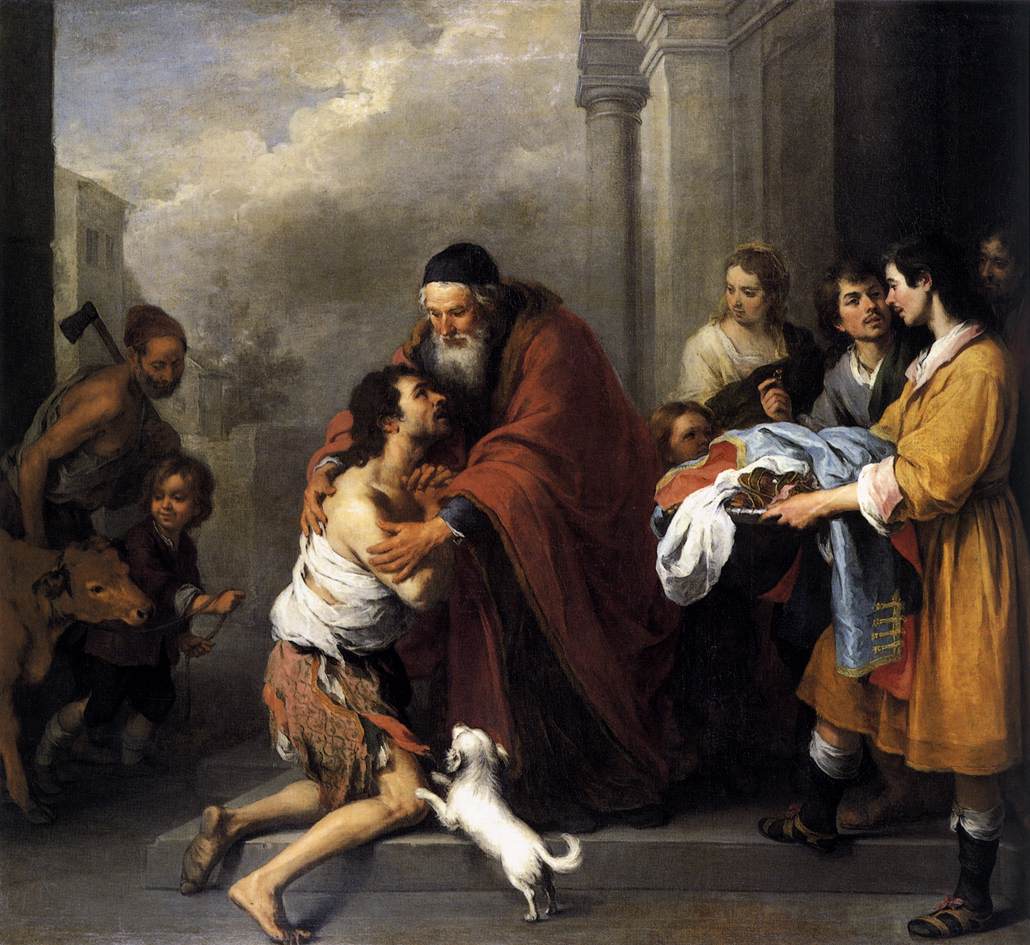
The Gospel speaks to us of the exemplarity of the Father who is in Heaven – the only one, says Jesus, who can be truly called “Good Father” (Cf. Mark 10:18). Everyone knows that extraordinary parable called the “Prodigal Son,” or better of the “Merciful Father,” which is found in Luke’s Gospel (Cf. 15:11-32). How much dignity and how much tenderness in the father’s waiting, who is at the door of his home waiting for his son to return! Fathers should be patient, many times there is nothing else that can be done other than to wait. Pray and wait with patience, gentleness, magnanimity and mercy.

National Gallery of Art, Washington DC [Web Gallery of Art]

A good father is able to wait and to forgive from the depth of his heart. Of course, he is also able to correct with firmness: he is not a weak, compliant and sentimental father. The father who is able to correct without discouraging is the same one who is able to protect tirelessly. One time, I heard a father, in a meeting with married couples, say: "I, sometimes, must hit my child a little, but never in the face, to not degrade him. How beautiful! He knows the sense of dignity! He must punish but does it justly and moves forward.

Therefore, if there is someone who can explain in depth the prayer of the “Our Father,” taught by Jesus, it is in fact one who lives paternity personally. Without the grace that comes from the Father who is in Heaven, fathers lose courage and abandon the field. [I believe that this grace comes largely through the Sacrament of Matrimony.]
However, children are in need of finding a father who waits for them when they return from their failures. They will do everything not to admit it, not to make it seen, but they need him and in not finding him opens in them wounds that are difficult to heal.

The Church, our Mother, is committed to supporting with all her strength the good and generous presence of fathers in families, because they are, for the new generations, irreplaceable custodians and mediators of faith in goodness, in justice and in the protection of God, as Saint Joseph. [Fathers are 'irreplaceable'. None of the bizarre nonsense that has become 'politically correct' in the Western world that it doesn't matter whether your parents are man and woman, two men or two women. What the Pope said here echoes what he said last year in his general audience on the Solemnity of St Joseph, Spouse of the Blessed Virgin Mary.]


Joseph's Song 
Written by Michael Card, sung by Gabe Hughes


24 January 2015

'Repent . . . believe . . . follow me.' Sunday Reflections, 3rd Sunday in Ordinary Time, Year B


Jacob Willemsz de Wet the Elder
Private collection [Web Gallery of Art]


Readings (New American Bible: Philippines, USA)

Readings (Jerusalem Bible: Australia, England & Wales, India [optional], Ireland, New Zealand, Pakistan, Scotland, South Africa) 


Now after John was arrested, Jesus came to Galilee, proclaiming the good news of God, and saying, “The time is fulfilled, and the kingdom of God has come near; repent, and believe in the good news.”

As Jesus passed along the Sea of Galilee, he saw Simon and his brother Andrew casting a net into the sea—for they were fishermen. And Jesus said to them, “Follow me and I will make you fish for people.” And immediately they left their nets and followed him. As he went a little farther, he saw James son of Zebedee and his brother John, who were in their boat mending the nets. Immediately he called them; and they left their father Zebedee in the boat with the hired men, and followed him.


Speaking in Rome to members of ecclesial movements on the evening of Saturday 17 May 2013, the Vigil of Pentecost, Pope Francis told this story:

One day in particular, though, was very important to me: 21 September 1953. I was almost 17. It was 'Students’ Day', for us the first day of spring — for you the first day of autumn. Before going to the celebration I passed through the parish I normally attended, I found a priest that I did not know and I felt the need to go to confession. For me this was an experience of encounter: I found that someone was waiting for me. Yet I do not know what happened, I can’t remember, I do not know why that particular priest was there whom I did not know, or why I felt this desire to confess, but the truth is that someone was waiting for me. He had been waiting for me for some time. After making my confession I felt something had changed. I was not the same. I had heard something like a voice, or a call. I was convinced that I should become a priest.

In an interview with Sergio Rubin, an Argentinian journalist, in 2010 the then Cardinal Jorge Mario Bergoglio SJ of Buenos Aires said:

In that confession, something very rare happened to me. I don’t know what it was, but it changed my life. I would say that I was caught with my guard down. … It was a surprise, the astonishment of an encounter. I realized that God was waiting for me. From that moment, for me, God has been the one who precedes [to guide me]. … We want to meet him, but he meets us first.

What is striking is that the young Jorge Mario Bergoglio experienced God's call to the priesthood unexpectedly and within the context of confession.

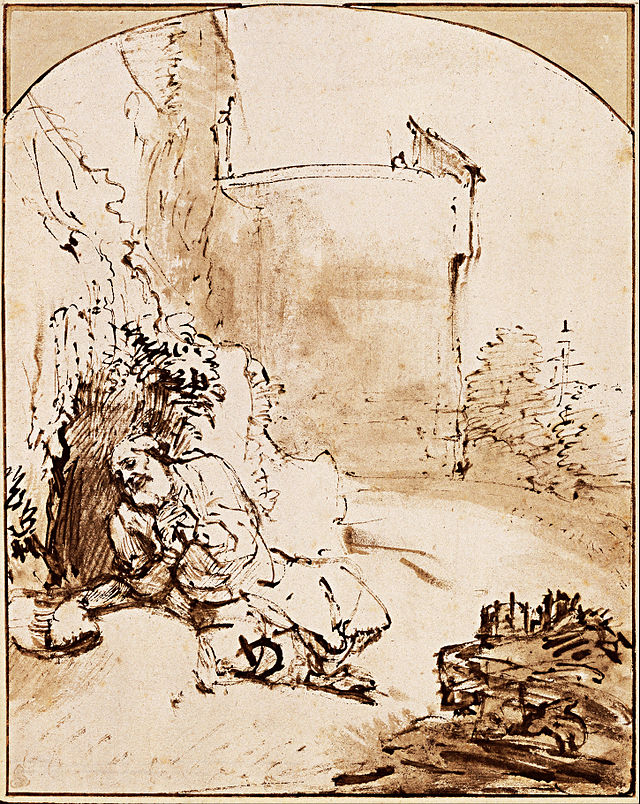
Drawing by Rembrandt, c.1655 [Wikipedia]

The First Reading, from the Book of Jonah, shows the people of Nineveh, from the King down, believing the reluctant prophet and then fasting and repenting.

In the Gospel Jesus preaches, Repent, and believe in the good news. It is in the context of that proclamation to the people in Galilee that Jesus invites Simon and Andrew, James and John, to follow him. Each of the four could make the words of Pope Francis their own: For me this was an experience of encounter: I found that someone was waiting for me. Yet I do not know what happened . . . I was not the same. I had heard something like a voice, or a call. That call was to lead the four of them to leave everything to follow him, a decision that was to bring three of them to martyrdom. The young Jorge Mario Bergoglio could not have had the slightest idea that listening to God's call would lead him to Rome.

Twelve or thirteen years ago I did a mission appeal in a parish in England where the then recently appointed parish priest had inherited a filthy rectory/presbytery/convento from his predecessor. He had managed by then to clean up only his own bedroom. He could not invite me to stay at his place because the guest room was filthy and so had me put up by a neighbouring parish priest.

The people of Nineveh cleaned up the the 'room' of their inner heart by turning away from sin and allowed the word of God to enter. The Gospel suggests that the two sets of fishermen-brothers had done the same and were able to hear and respond to the call of Jesus there and then.


There is nothing to suggest in the Pope's story about his encounter with the Lord at the age of 17 that he was a great sinner. But it was while confessing his sins and receiving absolution, that great act of the mercy and compassion of God, the theme of his recent visit to us in the Philippines, that he heard God's call to the priesthood very clearly.


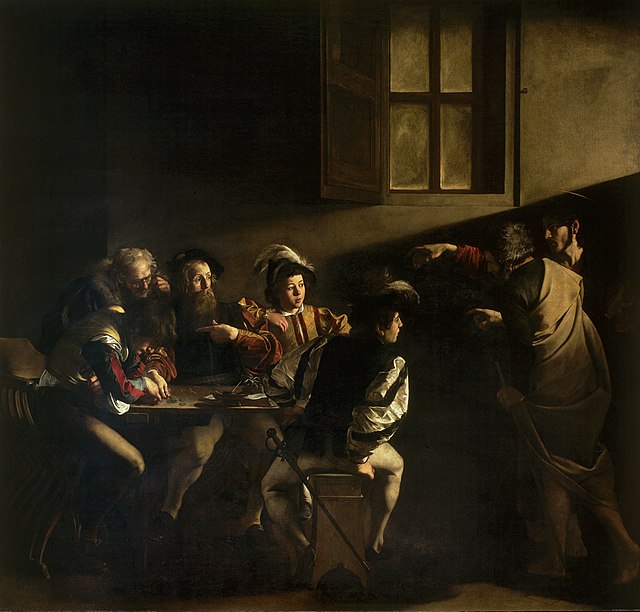
Caravaggio, 1599-1600 [Wikipedia]

Pope Francis spoke to the young people assembled at the University of Santo Tomas, Manila, about the painting above. It was on the feast of St Matthew that he had that encounter with the Lord in confession. In his impromptu speech he said:

Think of Saint Matthew. He was a good businessman. He also betrayed his country because he collected taxes from the Jews and paid them to the Romans. He was loaded with money and he collected taxes. Then Jesus comes along, looks at him and says: 'Come, follow me'. Matthew couldn’t believe it. If you have some time later, go look at the picture that Caravaggio painted about this scene. Jesus called him, like this (stretching out his hand). Those who were with Jesus were saying: '[He is calling] this man, a traitor, a scoundrel?' And Matthew hangs on to his money and doesn’t want to leave. But the surprise of being loved wins him over and he follows Jesus. That morning, when Matthew was going off to work and said goodbye to his wife, he never thought that he was going to return in a hurry, without money to tell his wife to prepare a banquet. The banquet for the one who loved him first, who surprised him with something important, more important than all the money he had.

Perhaps very few experience God's call to their vocation in life, whether it is to marriage, to the consecrated life as a religious or as a lay person, to the priesthood, to remaining single, in as clear a way as Jorge Mario Bergoglio did. But in order to hear God's call, in order to respond to God's will, in order to live out God's call till the end of our life it is necessary to have a pure and uncluttered heart.

This is expressed in the Lord's Prayer: Thy will be done, on earth as it is in heaven . . . forgive us our trespasses . . .


The Our Father sung in Tagalog during the meeting of Pope Francis with young people at the University of Santo Tomas, Manila, on 18 January. [There was no Mass celebrated on this occasion.]

Repent . . . believe . . . follow me.

18 January 2015

My mother's 100th birth anniversary

Mary Coyle (née Collins)
18 January 1915 – 29 April 1970

I was told by a childhood and lifelong friend of my mother, Maureen, that this studio photo was taken when my mother was 19. They both had their photos taken the same day.


On 18 January 1915 an event happened in Dublin that was to have some consequences for me. Annie Dowd presented William Patrick Collins with the third of their ten children, seven girls and three boys. T
hey named her Mary. She in turn, on 20 April 1943, presented her husband, John Coyle, with the first of their two children, both boys. The photo above was taken in a studio shortly after their honeymoon. They were married on 6 July 1942.


The video above shows scenes of the Dublin into which she was born, all in the city centre. Apart from the volume and nature of traffic not too much has changed there in the last hundred years.

From what she and others told me I know that my mother was a very lively person when young. She told me more than once, with a smile, that when she was 12 she won a Charleston contest but was afraid her father would find out. I don't know if he ever did.


As a young adult my mother appeared in a number of amateur stage productions and on at least one occasion she appeared in one of Dublin's leading theatres, The Olympia, singing Vienna, City of My Dreams. I think she would have liked this version in the original German and performed in Vienna itself.


I can say that I grew up with music, thanks to both my parents. Neither played an instrument but they had me take piano lessons from the time I was five or six. And we listened to the same popular music on the radio as there was only one station in the Republic of Ireland in those days, though we could pick up some BBC stations as well.

My mother's 'party piece' was Because and her favourite recording of it was that by Deanna Durbin, who sang it in a 1939 movie called Three Smart Girls Grow Up, a sequel to the 1936 film Three Smart Girls. She often referred to these, with a smile on her face.


There used to a video of the song on YouTube taken from the movie but it's not there anymore.

Mam hated school and left the day she turned 14, as the law allowed. However, I think she regretted that. She and my father, who left school at 15 to become an apprentice carpenter, made sure that my brother and I got a good education. The husband of a cousin once said to me, 'One of the most important decisions in your life was your parents' decision to send you to O'Connell's School.' He was right and I think my mother was the driving force in that. I think that they both hoped I would be able to get a permanent job in the civil service but they never told me what to do. When they asked me one night, not long before I did my Leaving Certificate, the state examination at the end of secondary schooling, what I wanted to do and I told them that I wanted to be a missionary priest, they gave me their full blessing.
Ordination Day with my parents and brother Paddy

When I was four or five my mother, who had been a very fit person until then, not at all bothered by pushing a pram for miles, developed bronchitis, which was to plague her for the rest of her life. She told me after my ordination on 20 December 1967 that she had prayed that she would live long enough to see that day. I was sent in 1968 to study music at Manhattanville College, Purchase, New York. I got an unexpected opportunity to spend six weeks at home over Christmas 1969 and New Year 1970. That turned out to be the last time we were to meet. She died in her sleep on 29 April 1970.

My mother, though she was quick-tempered, wasn't one who showed other emotions openly. However, someone, possibly my father, told me that after my parents saw me off on my way back to New York that last time that she cried, the only time she had ever done so when I was going away.

A photo I took of my parents in the summer of 1968

After my mother's sudden death I gradually came to see so many unexpected blessing before she died, including the long visit home at Christmas. I've seen such blessings since in my own life and in those of others. I call this the 'thoughtfulness' of God.


The last song I heard my mother sing at a party, maybe during that long Christmas break, wasn't her usual 'party piece' but a song that has been adopted by the Irish as one of their own, even though it was written in 1875 by a German-American, Thomas P. Westendorf. 'Kathleen' is an Irish form of 'Catherine'. Here is Deanna Durbin, who had a beautifully pure voice, singing it, appropriately, in a movie called For the Love of Mary, made in 1948. It was her last film, though she lived to be 91 and died two years ago in Paris.


More than once my father told me how good my mother was at budgetting. Whatever it was, food or clothing, she always bought good quality, though not the most expensive. From both my parents I learned the values of honesty, responsibility and hard work. I learned not to spend money I don't have. I also learned to be trustworthy - because of their trust in me.

Mam, may your mezzo-soprano voice add to the heavenly choir!


17 January 2015

Sunday Reflections, 2nd Sunday in Ordinary Time, Year B; Feast of the Santo Niño (Philippines)

From The Gospel of John, directed by Philip Saville

Readings (New American Bible: Philippines, USA)

Readings (Jerusalem Bible: Australia, England & Wales, India [optional], Ireland, New Zealand, Pakistan, Scotland, South Africa) 


The next day John again was standing with two of his disciples,  and as he watched Jesus walk by, he exclaimed, “Look, here is the Lamb of God!” The two disciples heard him say this, and they followed Jesus.  When Jesus turned and saw them following, he said to them, “What are you looking for?” They said to him, “Rabbi” (which translated means Teacher), “where are you staying?” He said to them, “Come and see.” They came and saw where he was staying, and they remained with him that day. It was about four o’clock in the afternoon.  One of the two who heard John speak and followed him was Andrew, Simon Peter’s brother. He first found his brother Simon and said to him, “We have found the Messiah” (which is translated Anointed). He brought Simon to Jesus, who looked at him and said, “You are Simon son of John. You are to be called Cephas” (which is translated Peter).

Links to the readings and some reflections for the Feast of the Santo Niño  are further down.

Second Sunday in Ordinary Time, Year B


God calls each of us to our particular vocation in life in a unique way. Pope Francis has told us, for example, that it was on the occasion of going to confession when he was 17 that he saw clearly that God was calling him to be a priest. A couple at whose wedding I officiated some years ago were members of the same Catholic organisation in the university they attended. They became an 'item', as they say here in the Philippines, when they were the only members of the group to turn up at the appointed time for an outing. While waiting for the others to arrive they discovered that they were more than just casual friends. Now they are happily married.

I'm always amused by the Second Reading from the Office of Readings for the feast of St Anthony the Abbot, today, Saturday, as I write this. St Athanasius tells us: He went into the church. It happened that the gospel was then being read, and he heard what the Lord had said to the rich man 'If you would be perfect, go, sell what you possess and give to the poor, and you will have treasure in heaven; and come, follow me.'

The young man Anthony, whose parents had died about six months previously, took these words to heart and went to live in the desert. He became, without planning it, the 'Father of Monasticism' in the Church. And perhaps if he had not been late for Mass that day the Gospel might not have struck him as it did. He was to be 'later' than most in another sense in that he was 105 when he died, a remarkable age to live to now but even more remarkable in the fourth century! Unlike the married couple above whose punctuality led them to discover God's call for them, it was through being late for Mass that Anthony discovered what God had in mind for him.

Jean Vanier, the founder of L'Arche, in 1964 invited two men with learning disabilities, Raphael Simi and Philippe Seux, who had been living in institutions, to live with him in a small cottage that he bought and renovated in France. Having done so he realized that he had made a commitment to these two men and that his commitment involved remaining single. He had no intention of founding a movement but, in God's plan, that's what came about.

Fr Hans Urs von Balthasar, a great theologian from Switzerland, much admired by St John Paul II, in reflecting on today's Gospel from the First Chapter of St John, links it to an incident in the last chapter, John 21: 15 ff [starting at 0:55 in the video below].


Fr von Balthasar writes: In the last chapter of the book Peter will be the foundation stone to such a degree that he will also have to undergird ecclesial love: 'Simon, do you love me more than these?'

John 21:15-17 was the gospel read at the Pope's Mass in Manila Cathedral yesterday, Friday, with priests, religious, consecrated persons and seminarians. This passage shows what is at the heart of every call from God, whether to marriage, to the priesthood, to the consecrated life, to the single life. The call is above all to an intimate relationship with Jesus. Pope Francis highlighted this in his homily yesterday: For us priests and consecrated persons, conversion to the newness of the Gospel entails a daily encounter with the Lord in prayer. The saints teach us that this is the source of all apostolic zeal! For religious, living the newness of the Gospel also means finding ever anew in community life and community apostolates the incentive for an ever closer union with the Lord in perfect charity. For all of us, it means living lives that reflect the poverty of Christ, whose entire life was focused on doing the will of the Father and serving others.

Pope Francis also said, The poor. The poor are at the center of the Gospel, are at heart of the Gospel, if we take away the poor from the Gospel we can’t understand the whole message of Jesus Christ.

Living the Gospel within the context of a deep personal relationship with Jesus the Risen Lord involves seeing reality through the eyes of those with little. Pope Francis showed this in a beautiful way by an unplanned - at least it wasn't on the official schedule - to a group of very poor children at TNK in Manila, near the Cathedral. ('Tulay ng Kabataan' means 'A Bridge to Children').


That video can act as a bridge to the celebration in the Philippines this Sunday and the gospel that will be read.


In the Philippines the Feast of the Santo Niño (Holy Child) is celebrated this Sunday. This year it coincides with the visit of Pope Francis. He will celebrate the Mass of the feast in Manila.

The original image, at the Minor Basilica of the Santo Niño de Cebú. [Wikipedia]

You will find the readings for the feast, with the exception of the Gospel, and some reflections here.

Gospel: Mark 10:13-16

And people were bringing children to Jesus that he might touch them, but the disciples rebuked them. When Jesus saw this he became indignant and said to them, “Let the children come to me; do not prevent them, for the kingdom of God belongs to such as these. Amen, I say to you, whoever does not accept the kingdom of God like a child will not enter it.” Then he embraced them and blessed them, placing his hands on them.