Showing posts with label Eucharist. Show all posts

14 October 2023

‘O wondrous gift indeed! / the poor and lowly may / upon their Lord and Master feed.’ Sunday Reflections, 29th Sunday in Ordinary Time, Year A


Pope Benedict elevating the Body of Christ
[Wikipedia; photo]

Readings (Jerusalem Bible: Australia, England & Wales, Ireland, New Zealand, Pakistan, Scotland)

Readings (New American Bible: Philippines, USA)

Gospel Matthew 22:1-14 For the shorter form (22:1-10), omit the text in Brackets.] (English Standard Version Anglicised, India)

And again Jesus spoke to them in parables, saying, “The kingdom of heaven may be compared to a king who gave a wedding feast for his son, and sent his servants to call those who were invited to the wedding feast, but they would not come. Again he sent other servants, saying, ‘Tell those who are invited, See, I have prepared my dinner, my oxen and my fat calves have been slaughtered, and everything is ready. Come to the wedding feast.’ But they paid no attention and went off, one to his farm, another to his business, while the rest seized his servants, treated them shamefully, and killed them. The king was angry, and he sent his troops and destroyed those murderers and burned their city. Then he said to his servants, ‘The wedding feast is ready, but those invited were not worthy. Go therefore to the main roads and invite to the wedding feast as many as you find.’ And those servants went out into the roads and gathered all whom they found, both bad and good. So the wedding hall was filled with guests.

[“But when the king came in to look at the guests, he saw there a man who had no wedding garment. And he said to him, ‘Friend, how did you get in here without a wedding garment?’ And he was speechless. Then the king said to the attendants, ‘Bind him hand and foot and cast him into the outer darkness. In that place there will be weeping and gnashing of teeth.’ For many are called, but few are chosen.”]


Léachtaí i nGaeilge


Words by St Thomas Aquinas, music by César Franck
Sung by Patricia Janečková (18 June 1998 - 1 October 2023) with The Janáček Chamber Orchestra

Latin of St Thomas Aquinas

Panis angelicus
fit panis hominum;
Dat panis cœlicus
figuris terminum:
O res mirabilis!
Manducat Dominum
pauper, servus et humilis.

English translation by John David Chambers

Thus Angels' Bread is made
the Bread of man today:
the Living Bread from heaven
with figures dost away:
O wondrous gift indeed!
the poor and lowly may
upon their Lord and Master feed.


The First Reading, the Responsorial Psalm and the Gospel can be understood in a  Eucharistic sense. The Prophet Isaiah's words can be seen as a description of the heavenly banquet to which we are all invited.

The words of St Thomas Aquinas set to music by César Franck remind us that in the Holy Sacrifice of the Mass the bread and wine become the Body and Blood of Christ to nourish us on our journey through life, whether that journey be long or short. In Psalm 22 [23] we pray, you have prepared a banquet for me. In the Mass we are invited to participate in that banquet  where Manducat Dominum pauper et humilis - The poor and lowly may upon their Lord and Master feed.

The words of the hymn, figuris terminum, translated above as with figures dost away,  mean that what we receive in Holy Communion is not a symbol but the Lord Jesus Christ himself. And to receive such a precious Gift we need to prepare, with God's grace, to be as worthy as possible.

In the last part of the Gospel, the section that may be omitted, Jesus speaks very harshly about those who choose to turn up at the banquet unprepared by choice. St Paul deals with this in the context of celebrating the Eucharist in 1 Corinthians 11:27-30: Whoever, therefore, eats the bread or drinks the cup of the Lord in an unworthy manner will be guilty concerning the body and blood of the Lord. Let a person examine himself, then, and so eat of the bread and drink of the cup. For anyone who eats and drinks without discerning the body eats and drinks judgement on himself. That is why many of you are weak and ill, and some have died.

Jesus gave a precious gift to the Church to help us to be prepared to receive him in the Eucharist when we have turned our backs on him through mortal sin, which breaks our relationship with God and can have eternal consequences: the sacrament of confession. Nobody is turned away from this, unless priests don't make themselves available.

God extends his invitation to all of us. Like some in the gospel we may ignore it because we are 'busy' with other things; we may reject it violently as some did; we may accept it while showing contempt towards the One who extended the invitation. Or we may accept it by preparing with God's grace to be worthy of the occasion.

+++

The news this last week has unexpectedly been dominated by the conflict between Israel and Gaza. More than a thousand deaths have been recorded on each side, the majority civilians, many of them children and young adults. Two earthquakes in Afghanistan this month have resulted in many deaths. 

I first posted the video above of Patricia Janečková, the German-born Slovak soprano, singing Panis angelicus on 16 June last year. I added this note: Patricia Janečková was born on 18 June 1998 and was 19 when the video above was made. Last February she was diagnosed with breast cancer. Please pray for her full recovery. Sadly, Patricia died on 1 October. Last June she married actor Vlastimil Burda.

It is always difficult to come to terms with the death of someone who is young, whether the cause of death is war, an accident or illness. Jesus wept at the death of the young Lazarus. Part of the pain of loss iw what might have been in the future.

Yet our Christian faith gives us the hope of sharing in the Resurrection of our Lord Jesus Christ. Today's readings point towards the heavenly banquet and the Eucharistic Banquet where we receive the Body, Blood, Soul and Divinity of Jesus as our nourishment on our journey through this life.

We pray for the dead, those we have known personally, those we have known through their public lives, and those who have no one to pray for them by name. May the video below of Patricia Janečková singing Andrew Lloyd Webber's Pie Jesu be a prayer for her soul, for the souls of those who have died in the Gaza-Israel war and in other conflicts, for those who have died in recent natural calamities, for those who have nobody to pray for them by name and for those like Patricia who have died young.

At the same time may we thank God for the gift that each of those has been to those who knew and loved them and for the gift of Patricia who continues through her recorded voice to be an expression of God's beauty.

May we all sit down together at the heavenly banquet.


Pie Jesu
Composed by Andrew Lloyd Webber
Sung by Patricia Janečková with the Kühn Children’s Choir and the Czech Army Central Band.
Subtitles in Latin and English


Traditional Latin Mass

Twentieth Sunday After Pentecost

The Complete Mass in Latin and English is here. (Adjust the date at the top of that page to 10-15-2023 if necessary).

Epistle: Ephesians 5:15-21Gospel: John 4:46-53.


Christ Healing the Sick
István Dorffmeister [Web Gallery of Art]

Jesus said to him, “Go; your son will live.” The man believed the word that Jesus spoke to him and went his way (John 4:50; Gospel). 


10 August 2012

'I am the bread of life.' Sunday Reflections, 19th Sunday in Ordinary Time Year B

,
The Charity of St Lawrence, Bernardo Strozzi, painted 1639-40

Readings (New American Bible: Philippines, USA)

Readings(Jerusalem Bible: Australia, England & Wales, India [optional], Ireland, New Zealand, Pakistan, Scotland, South Africa) 

Gospel John 6:41-51 (Revised Standard Version – Catholic Edition)

The Jews then murmured at Jesus, because he said, "I am the bread which came down from heaven." They said, "Is not this Jesus, the son of Joseph, whose father and mother we know? How does he now say, 'I have come down from heaven'?" Jesus answered them, "Do not murmur among yourselves. No one can come to me unless the Father who sent me draws him; and I will raise him up at the last day. It is written in the prophets, 'And they shall all be taught by God.' Every one who has heard and learned from the Father comes to me. Not that any one has seen the Father except him who is from God; he has seen the Father. Truly, truly, I say to you, he who believes has eternal life. I am the bread of life. Your fathers ate the manna in the wilderness, and they died. This is the bread which comes down from heaven, that a man may eat of it and not die. I am the living bread which came down from heaven; if any one eats of this bread, he will live for ever; and the bread which I shall give for the life of the world is my flesh."


St Lawrence of Rome was martyred on the orders of the Emperor Valerian on 10 August 258, four days after St Sixtus II, Pope, and four deacons. According to tradition Lawrence, who was from Spain and was a deacon, was roasted on a gridiron. Some scholars say that he was probably beheaded, not roasted. But there's no doubt about his martyrdom and the great impression he made on the people of Rome, especially on the poor. When he was asked to bring the Church's treasures he said he would have them in a matter of days. he distributed the Church's goods to the poor, as in Strozzi's painting above, and then brought the people before the authorities saying, 'These are the Church's treasures'.


While being roasted he told his executioners, according to the story that has come down, that they could now turn him over as he was done on one side. Whether this actually happened or not, the story shows us that the people of Rome remembered Lawrence as a man full of loving joy, as the video above shows. I'm almost certain that I've read or heard somewhere, though I can't find anything online to back this up, that those present at the saint's martyrdom smelled the aroma of bread baking as he was being grilled. For those of us who eat bread there is hardly a more pleasant sensation.

I'm writing this on the feast of St Lawrence - technically it's a memorial in the Church's liturgical calendar but has some of the trappings of a feast - and I see this saint as an embodiment of what Jesus is teaching us in the gospel for this Sunday. St Lawrence believed absolutely in the promise of eternal life given by Jesus. His faith was nourished by the Bread of Life that he received when taking part in the Holy Sacrifice of the Mass. This gave him the strength to give himself as 'bread of life' to the poor of Rome, in his great love for the poor and in his willingness to lay down his life.

Pope Benedict XV, Giacomo della Chiesa (1854-1922)

St Lawrence's life was one that integrated the Mass with service to the people, especially the poor. A few years ago I was accosted after Mass outside a cathedral in England where I was doing a mission appeal on behalf of the Columbans by a young man who kept insisting that the Church sell all its buildings and so on in order to help the poor. I'm afraid that after about ten minutes of this my patience gave way somewhat. But St Lawrence did precisely that, though the Church was still a persecuted one and , at the time as far as I know, didn't have too much in the way of buildings. And in more modern times Pope Benedict XV (1914-1922) did exactly the same with money at his disposal, both his own and that beloning to the Church in Rome. When he died there was only US$19,000 left in the Vatican treasury.


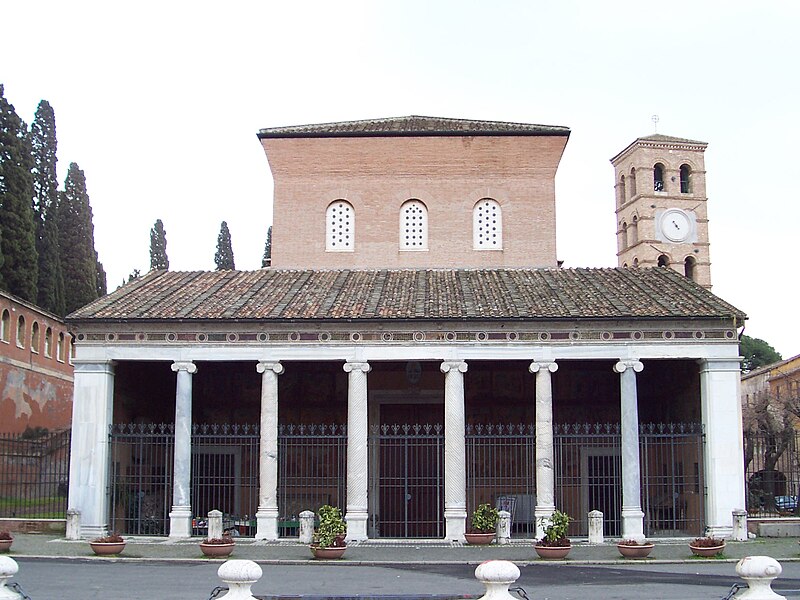
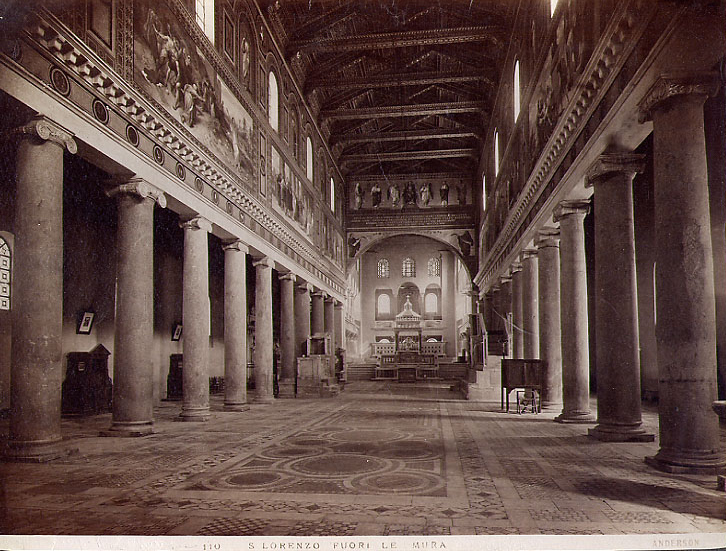
When the Holy Sacrifice of the Mass if offered in the basilica of St Lawrence, as in every other church, the bread and wine brought to the altar at the offertory become the Body and Blood of Christ. They're not 'symbols' of this. They are the Body and Blood of the Risen Lord Jesus. As the Catechism of the Catholic Church, No 33, puts it, At the heart of the Eucharistic celebration are the bread and wine that, by the words of Christ and the invocation of the Holy Spirit, become Christ's Body and Blood. 

Many walked away from Jesus because they couldn't accept his words, I am the living bread which came down from heaven; if any one eats of this bread, he will live for ever; and the bread which I shall give for the life of the world is my flesh.

Fr William Morton, a Columban priest who grew up in a strongly Catholic family in Philadelphia, tells how he lost the faith and re-discovered it while discovering his call to the priesthood. I've highlighted some parts. [By this time he had become part of a 'Born Again' group, which brought him back to Jesus Christ].

Q. What then brought you back to the Catholic Church?

A. Though I agreed with and experienced personally this relationship with Jesus, certain behaviours like smoking, drinking and swearing were stressed as litmus tests of Christian life. There was a lot of quoting of Scripture and arguments about who was saved and who was not. I began to think of the Catholics I knew who didn't quote much Scripture, who smoked or drank, but who were also generous, compassionate and non-judgmental people.

I asked myself: ‘If Jesus came back whose butt would he be kicking?' I concluded that it would more likely be my own, because of my self-righteousness, rather than the man on the street with his bottle.

I was madly in love with one of the girls who sang in our Christian rock group. She had been raised Protestant and one day she asked if we could go to a Catholic Mass. We went to a Saturday evening Mass at St Mary's and it was a lively celebration with guitars and songs and a young, Irish priest who preached with fervour and humour. Though still very much a member of the Church of the Open Bible I had a fleeting ‘I could do that’ thought about the priest.

My girlfriend enjoyed the visit and so we began to go each Saturday evening and then to the Open Bible on Sunday morning.

My mother had also written me a very challenging letter, quoting John 6, and asking me how those who claim to interpret the Bible literally understand the Eucharist. I didn't get any convincing answers and began to hunger to receive again in the Catholic way.

Though I had always disliked confession as a youth I began to long too to hear those words of pardon and absolution and finally made up my mind to seek out a priest. Around this time my girlfriend suggested that we break off for a while to get things into perspective. This upset me at first but thoughts of priesthood and mission continued to float around in my head.

Fr Bill Morton, once an air traffic controller, is now working in the Columban mission in El Paso, Texas / Ciudad Juarez, Mexico, the latter one of the most violent cities in the world because of drug wars. Fr Kevin Mullins, a Columban from Brisbane, Australia, is in charge of the Columban parish in Ciudad Juarez.


St Lawrence of Rome enabled the poor there to get bread to keep body and soul together. With the Christians there he took part every Sunday in the Holy Sacrifice of the Mass, despite the danger. It was from the Bread of Life that he and they got the strength and courage to lay down their own lives.

It was the curiosity of his 'Born Again' girlfriend about the Mass and the clear challenge of his mother about today's gospel that brought the young Bill Morton back to the Church and eventually to the priesthood.

It is the Bread of Life who gives himself to the people of the Columban parish in Ciudad Juarez as they celebrate the Eucharist every Sunday that gives them the courage to live with hope in the midst of awful violence. When Father Kevin went there first only a few came. Now the church is full.

St Lawrence and the poor of Rome in 258, Fr Kevin Mullins and the poor of Ciudad Juarez in 2012, each a place of danger and violence, each a place where people take Jesus at his word: I am the living bread which came down from heaven; if any one eats of this bread, he will live for ever; and the bread which I shall give for the life of the world is my flesh.

26 June 2012

Manila-based Columban Fr Brendan Lovett writes on the Eucharist in The Irish Times

Meaning behind the offer to eat and drink Christ's body and blood

by FR BRENDAN LOVETT
This article appears in The Irish Times, 26 June 2012. Father Lovett teaches at the Institute of Formation and Religious Studies (IFRS), Quezon City, Philippines.
The Last Supper, El Greco (painted c,1568)
RITE & REASON: ‘THIS IS a hard saying . . .” This response elicited in the context of John 6:51-9, marked the parting of the ways for many. But some disciples, already affected by the contagion of Jesus, decided to continue following him: they trusted him enough to be willing to wait for some future moment in which to understand the strange offer of his flesh to eat.
What is it, then, that makes this a hard saying? It has to do with the extent to which it evades being read either metaphorically or symbolically. Many scholars have drawn attention to the sheer physicality of the language here; Raymond Brown in The Gospel According to St John pointing out that “the Fourth Gospel makes no concession to Jewish sensibilities and insists stubbornly on the reality of the flesh and the blood” (page 283).
As far back as we can go, the Christian movement is understood to be a missionary movement. It assumes that it has something to say – better, something to be lived out – that is humanly attractive across all cultural boundaries.
The ancient Christian tradition of the Last Supper saw the action of Jesus in continuity with the specifically divine activity of shaping a people by covenant.
From the earliest strata of the Hebrew Bible, God is understood as forming “a people”. God responds to the cry of cruelly exploited people by shaping them into “a people”. Christian tradition introduced the term “covenant” into the narrative to acknowledge this uniquely divine activity as emanating from Jesus.
It is in and through experiencing his reconstruction of our humanity that we come to know who Jesus is. The experience of being enabled to realise our humanity in previously unimaginable ways is integral to faith’s recognition of Jesus.
Underlying Paul’s discussion of the Body in 1 Cor and elaborated in the closing chapters of Romans is his conviction that the relation of Christians to each other is one of “building up”: we are involved in Christ in constructing each other’s humanity. It helps to connect this with John 13.
Here we are told that to grow into Jesus’s “Lordship” is to become able to wash one another’s feet, that is, to welcome them as guests at the same table.
The New Testament, in speaking of the new creation, the new covenant in his blood, does not encourage us to think of this as being in simple continuity with the world as we have made it. On the contrary, the world as we have made it reacts with murderous violence to Jesus’s invitation to welcome the future God is bringing to God’s world and to the people God loves (Luke 4:28-9).
It would appear then that to grasp the event of Jesus as an act of God, the community must first understand its distinctiveness and separateness. Not, of course, separateness from the human race: that would miss the point.
Separateness, rather, from all communities and kinships whose limits fall short of the human race. This new way of realising our humanity is based on no pre-existing social structures but on sheer humanity, common creatureliness, our common capacity to grow into the likeness of Christ.
Even though we habitually think of the Eucharist in relation to the Last Supper, there is, in fact, a wider Eucharistic theme that is coextensive with the whole Gospel account of the flesh and blood way of being human enacted by Jesus in our world.
This theme of the Eucharistic Way of Jesus refers to his practice of welcoming all that God has let be as gift, and giving thanks for it. He gives thanks for the others; they are gift to him.
Challenged to a deeper humanity, to a level of relating that is inclusive of every scrap of the human, we easily become resentful, angry, dangerous. But since the challenge arises only through the experience of an immense love, we may yet be enabled to respond with Jesus’s own words: “my flesh for the life of the world”.

14 June 2012

'The seed shall sprout and grow, he knows not how.' Sunday Reflections, 11th Sunday in Ordinary Time Year B

Though We Are Many - Official Hymn of the 32nd International Eucharistic Congress

Readings (New American Bible: Philippines, USA) 

Readings (Jerusalem Bible: Australia, England & Wales, India [optional], Ireland, New Zealand, Pakistan, Scotland, South Africa) 


Gospel Mark 4:26-14 (Revised Standard Version – Catholic Edition)

Jesus said, "The kingdom of God is as if a man should scatter seed upon the ground, and should sleep and rise night and day, and the seed should sprout and grow, he knows not how. The earth produces of itself, first the blade, then the ear, then the full grain in the ear. But when the grain is ripe, at once he puts in the sickle, because the harvest has come." 

And he said, "With what can we compare the kingdom of God, or what parable shall we use for it? It is like a grain of mustard seed, which, when sown upon the ground, is the smallest of all the seeds on earth; yet when it is sown it grows up and becomes the greatest of all shrubs, and puts forth large branches, so that the birds of the air can make nests in its shade." With many such parables he spoke the word to them, as they were able to hear it; he did not speak to them without a parable, but privately to his own disciples he explained everything.


During the week I saw a comment pointing out that 80 years ago a million people gathered for the closing Mass of the 31st International Eucharistic Congress in 1932 in the Phoenix Park, Dublin, one quarter of the population of the whole of Ireland at the time and about one third of the Catholic population. Last Sunday, at the opening Mass of the 50th International Eucharistic Congress being held in Dublin and ending this Sunday about 12,500 attended the opening Mass. It is hoped that 80,000 will be at the closing Mass in Croke Park, Ireland's largest stadium. The writer pointed out that more than a million who describe themselves as Catholics live in the Dublin area and yet so few were present at the opening Mass.

The writer's implicit interpretation was that there has been a collapse of the Catholic faith in Ireland since 1932. There has been.

Yet the parable reminds us that the faith has had many small beginnings. Perhaps the greatest is the Twelve Apostles. The Congress Prayer in the video above prays that 'we may recognise you in the Scriptures and in the breaking of bread'. It goes on further to ask us 'to walk humbly on the earth, in justice and love, as witnesses of the resurrection'. This is exactly what the two disciples on the road to Emmaus did. The listened to the Scriptures explained by the Word himself, recognised him as the Risen Lord in the breaking of bread and set out on their first missionary journey that night to be witnesses of the resurrection back in Jerusalem.

As a Columban I'm very conscious of our history. Fr Edward Galvin from Ireland went off to China with Canadian Fr John Fraser. Fr Fraser went on to found the Scarboro Missionary Society in Canada and Fr Galvin, with Fr John Blowick, was to set up the Missionary Society of St Columban within a few years, both societies working to bring the Gospel to the people of China.

The Columbans, along with all other Christian missionaries, were eventually driven out of China after 1949 but have a presence there again, in a different way. And a year ago, as I wrote for last Sunday, the first two Chinese students came to Manila to prepare to be Columban missionary priests. Another small beginning in the service of the mission that Jesus gave to the Church.

70 years ago my parents were married. Another small beginning in faith, a faith nourished, at least in part, by the Eucharistic Congress ten years earlier in their native Dublin. Without that beginning I would not be here. 

Today, Friday, I visited a friend in Cebu City whom I hadn't seen in more than twelve years. When we last met she was single. Today I met her husband and seven children, the youngest born last month. She and her husband have both lost their mothers in the last couple of months. Her husband will be going into hospital on Saturday for a procedure on one of his kidneys.The house they were living in before was burned down and they are now in a very small temporary house from which they will have to move soon. Yet I saw a house filled with love, the older children when they came home from school giving the mano po, the hand to the forehead, a sign of respect in the Philippines and in East Timor, to their parents and to me - and then going to kiss their two youngest brothers. And we shared bread together, pandesal, small pieces of bread that are very popular for breakfast and for snacks.

The kingdom of God is as if a man should scatter seed upon the ground, and should sleep and rise night and day, and the seed should sprout and grow, he knows not how.

We just don't know where the seed will be scattered and where it will bear fruit. I once met a young woman from Japan in Manila. She was moving towards the Catholic faith and the seed was being nourished in the predominantly Catholic Philippines. But the seed of her faith came to fruition in Thailand where she was baptised during an Easter Vigil. Thailand, like Japan, is a country where only about one person in two hundred is a Catholic. 


And there is a Thai version of the Official Hymn of the 32nd International Eucharistic Congress.

May we be aware of the many 'mustard seeds' that the Lord has scattered in our lives, that he nourishes through the Eucharist and that he brings to fruition in the most unexpected ways.