Showing posts with label Fr Ragheed Ganni. Show all posts

12 September 2025

'We will not stop celebrating Mass.' Sunday Reflections, Feast of the Exaltation of the Holy Cross


Christ in Agony on the Cross

When the Feast of the Exaltation of the Holy Cross falls on a Sunday, as a feast of the Lord it replaces the celebration of the Sunday in Ordinary Time. So the Mass of the 24th Sunday in Ordinary Time is not celebrated this year.

Readings (Jerusalem Bible: Australia, Ireland, New Zealand)

Readings (English Standard Version, Catholic Edition: England & Wales, India, Scotland) 

Readings (New American Bible: Philippines, USA)

Gospel John 3:13-17 (English Standard Version, Anglicised)

At that time: Jesus said to Nicodemus, ‘No one has ascended into heaven except he who descended from heaven, the Son of Man. And as Moses lifted up the serpent in the wilderness, so must the Son of Man be lifted up, that whoever believes in him may have eternal life. For God so loved the world, that he gave his only begotten Son, that whoever believes in him should not perish but have eternal life. For God did not send his Son into the world to condemn the world, but in order that the world might be saved through him.’

Léachtaí i nGaeilge

.


Fr Ragheed Aziz Ganni
(20 January 1972 - 3 June 2007)

For me the face of the persecuted Christians in today's world is that of Fr Ragheed Ganni. An article by Ed West published in the Catholic Herald, now published monthly in England, on 20 December 2013 and that has a very personal dimension, gives as good an account of Father Ragheed as any I've read. (The link to the article that I used before no longer functions.)

Ed West writes: Fr Ragheed was one of 1,000 Iraqi Christians murdered during the pogrom that began after the Coalition invasion of 2003. The persecution culminated in October 31 2010, with the massacre of 52 worshippers at a Catholic church in Baghdad. In the words of one Chaldean bishop, this is a 'Calvary' that has largely been ignored in the western media, outside of the Christian press . . .

 It has been a shocking and horrific ordeal for one of the world’s oldest Christian communities, which has been all but driven out of its homeland. A pre-war population of a million is now somewhere in the region of 150,000, many of them elderly, and more than 60 churches have been bombed.  That figure has got smaller in recent months and the ancient city of Mosul, in many ways the heart of the Christian faith in Iraq and Syria, has been emptied of its Christians by ISIS.

The article describes First Holy Communion day in Father Ragheed's parish in 2006: The atmosphere in Ragheed’s home town had become terrifying. On 4 August 2006, when 80 children of his parish of the Holy Spirit received their first Holy Communion, battles broke out in the street outside, and the children cowered from the sounds of guns and rockets.

The good shepherd helped them through. He told AsiaNews: 'Although people are used to it and remained reasonably calm, they started to wonder whether they were going to make it back to their homes or not. I was aware of the immense joy of the 80 children receiving their first Communion so I turned the subject into a joke and said to them: "Do not panic, these are fireworks. The city is celebrating with us." And at the same time I gave them instructions to leave the church quietly and quickly.'

The author further notes: Friends later recalled that he had become increasingly weary and broken by the demands of the priesthood amid such terror. After an attack on his parish, on Palm Sunday 2007, he wrote: 'We empathise with Christ, who entered Jerusalem in full knowledge that the consequence of His love for mankind was the cross. Thus while bullets smashed our church windows, we offered up our suffering as a sign of love for Christ.'

Shortly before his death Fr Ganni wrote in an email: 'Each day we wait for the decisive attack, but we will not stop celebrating Mass; we will do it underground, where we are safer. I am encouraged in this decision by the strength of my parishioners. This is war, real war, but we hope to carry our cross to the very end with the help of Divine Grace.'

This young Iraqi priest of the Chaldean Catholic Church, an engineer by profession, was murdered on Trinity Sunday, 3 June 2007, along with three subdeacons, Basman Yousef Daud, Gassan Isam Bidawed and Wahid Hanna Isho after he had celebrated Mass in Mosul, the city of his birth.

At a Eucharistic Congress in Bari, Italy, in 2005 Father Ragheed said, There are days when I feel frail and full of fear. But when, holding the Eucharist, I say ‘Behold the Lamb of God Behold, who takes away the sin of the world’, I feel His strength in me. When I hold the Host in my hands, it is really He who is holding me and all of us, challenging the terrorists and keeping us united in His boundless love. He also said, Without Sunday, without the Eucharist, the Christians in Iraq cannot survive.

To put some time perspective on the Christian faith in Iraq and Syria: in 2021 the Church in the Philippines will celebrate 500 years of the Catholic Christian faith in that country, a great occasion for thanking God for that precious gift. The Christian faith has been lived in Iraq and Syria for four times as long as that, since the time of the Apostles. Mass was celebrated for 2,000 years in Mosul until a couple of months ago when Christians were driven from their ancestral homeland by ISIS.

Father Raqheed's words, But when, holding the Eucharist, I say ‘Behold the Lamb of God Behold, who takes away the sin of the world’, I feel His strength in me, reflect the words of Jesus to Nicodemus in today's Gospel: And just as Moses lifted up the serpent in the wilderness, so must the Son of Man be lifted up, that whoever believes in him may have eternal life.

A Muslim friend of Fr Ragheed, Adnam Mokrani, professor of Islamic Studies at the Pontifical Gregorian University in Rome, said that on his ordination day, 13 October 2001, recalled that the new priest said, Today, I have died to self. St Paul in today's Second Reading tells us, Christ Jesus, who, though he was in the form of God did not regard equality with God has something to be exploited, but emptied himself, taking the form of a slave and that he became obedient to the point of death—even death on a cross.

As we celebrate the Exaltation of the Holy Cross and as we pray for persecuted Christians, particularly in Iraq and Syria, parts of Nigeria and the Democratic Republic of the Congo and other places, may we thank God for the gift of our Christian faith and ask him for the courage to live it as Father Ragheed and countless others have done, becoming obedient to the point of death.                                   


Christ on the Cross
Velázquez [Web Gallery of Art]


Traditional Latin Mass 

What earlier generations held as sacred, remains sacred and great for us too, and it cannot be all of a sudden entirely forbidden or even considered harmful (Benedict XVI). 

 The Exaltation of the Holy Cross

The Complete Mass in Latin and English is here. (Adjust the date at the top of that page to 09-14-2025 if necessary).

Readings. Epistle: Philippians 5:2-11. Gospel: John 12:31-36.

Crucifixion (1596-1600)

And I, if I be lifted up from the earth, will draw all things to Myself (Gospel). 


02 August 2024

'We cannot keep to ourselves the words of eternal life given to us in our encounter with Jesus Christ.' Sunday Reflections, 18th Sunday in Ordinary Time, Year B


Man with Two Loaves of Bread
Jean-François Raffaëlli  [Web Gallery of Art]

Readings (Jerusalem Bible: Australia, England & Wales, Ireland, New Zealand, Pakistan, Scotland)

Readings (New American Bible: Philippines, USA)

Gospel John 6:24-35 (English Standard Version, Anglicised: India)

When the crowd saw that Jesus was not there, nor his disciples, they themselves got into the boats and went to Capernaum, seeking Jesus.

When they found him on the other side of the sea, they said to him, “Rabbi, when did you come here?” Jesus answered them, “Truly, truly, I say to you, you are seeking me, not because you saw signs, but because you ate your fill of the loaves. Do not labour for the food that perishes, but for the food that endures to eternal life, which the Son of Man will give to you. For on him God the Father has set his seal.” Then they said to him, “What must we do, to be doing the works of God?” Jesus answered them, “This is the work of God, that you believe in him whom he has sent.” So they said to him, “Then what sign do you do, that we may see and believe you? What work do you perform? Our fathers ate the manna in the wilderness; as it is written, ‘He gave them bread from heaven to eat.’” Jesus then said to them, “Truly, truly, I say to you, it was not Moses who gave you the bread from heaven, but my Father gives you the true bread from heaven. For the bread of God is he who comes down from heaven and gives life to the world.” They said to him, “Sir, give us this bread always.”

Jesus said to them, “I am the bread of life; whoever comes to me shall not hunger, and whoever believes in me shall never thirst.


Léachtaí i nGaeilge


Servant of God Fr Ragheed Aziz Ganni
(20 January 1972 - 3 June 2007)

I have featured Fr Ragheed Ganni a number of times on Sunday Reflections. As a priest and as a Catholic Christian I am truly inspired by this man who was less than half the age I am now when he was assassinated.

He was a raconteur par excellence and a font of knowledge - we discussed everything and anything from the metaphysical to the trivial. A young and gauche student at the time, I learnt about Iraq and about theology; about the workings of the college in the summer and the best places to eat pizza. I was amazed at his command of English and Italian and his perennial good spirits and big smile - he was and will always be an inspiration.

That is how an Irish student at the Pontifical Irish College in Rome described Fr Ragheed Ganni, a Chaldean Catholic priest murdered along with three married subdeacons, Basman Yousef Daud,Wahid Hanna Isho, and Gassan Isam Bidawed, on 3 June 2007 just after the young priest had celebrated Mass in Holy Spirit parish, Mosul, Iraq. (The cause for the canonisation of these four men officially opened in 2018.) Fr Ganni, an engineer, studied theology in Rome before and after ordination, and stayed at the Irish College, where he was known as 'Paddy the Iraqi', 'Paddy' being a generic term for Irishmen, derived from the name of Ireland's - and Nigeria's - patron saint, St Patrick.


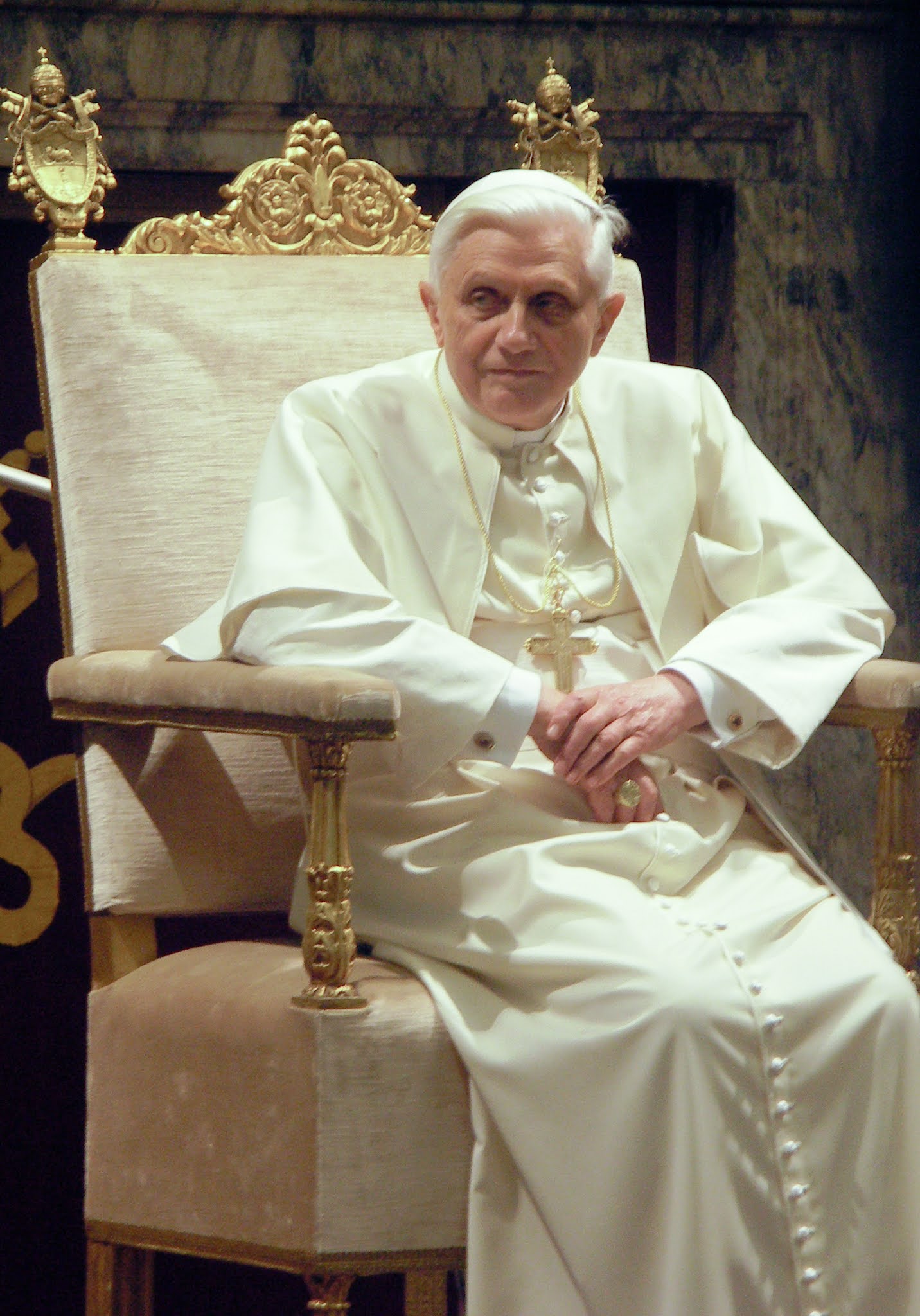
Pope Benedict XVI, 20 January 2006
[Wikipedia; photo by Sergey Khozhukhov]

Dear young people, do not be satisfied with anything less than Truth and Love, do not be content with anything less than Christ. Pope Benedict spoke these words at the prayer vigil on 20 August 2011 during the Madrid World Youth Day. He also said, we need to speak with courage and humility of the universal significance of Christ as the Saviour of humanity and the source of hope for our lives.

In these words he is echoing the answer of Jesus to the question put to him in today's gospel, What must we do, to be doing the works of God? His reply: This is the work of God, that you believe in him whom he has sent.

In Verbum Domini (2010) the Pope wrote, We cannot keep to ourselves the words of eternal life given to us in our encounter with Jesus Christ: they are meant for everyone, for every man and woman . . . It is our responsibility to pass on what, by God's grace, we ourselves have received. 

In his Angelus talk on 29 October 2006 Benedict said, The rediscovery of the value of one's own Baptism is at the root of every Christian's missionary commitment, because as we see in the Gospel, those who allow themselves to be fascinated by Christ cannot fail to witness to the joy of following in his footsteps. [Emphasis added].

In that same talk, in which he commented on the gospel of that Sunday which tells the story of the meeting between the blind Bartimaeus and Jesus, Mark 10:46-52, Pope Benedict said, The decisive moment was the direct, personal encounter between the Lord and that suffering man. They found each other face to face:  God with his desire to heal and the man with his desire to be healed; two freedoms, two converging desires. 

One theme that comes through repeatedly in the teaching of Pope Benedict is that our faith is in a person, Jesus, God who became man. Jesus tells us clearly that it is his Father's will that we believe in him.

Another theme of Benedict is the joy that Jesus promised those who follow him. This was the theme of the Pope's message for World Youth Day 2012 held on Palm Sunday in Rome. Benedict insists so often that our faith is faith in the person of Jesus, not in a set of doctrines, though they come to us from Jesus through his Church and are central to the deposit of faith.

Just over a year before his death Father Ragheed spoke at the Eucharistic Congress in Bari, Italy. He said, Mosul Christians are not theologians; some are even illiterate. And yet inside of us for many generations one truth has become embedded: without the Sunday Eucharist we cannot live.

In the context of the war in Iraq he spoke eloquently about the Sunday Eucharist: It is among such difficulties that we understand the real value of Sunday, the day when we meet the Risen Christ, the day of our unity and love, of our (mutual) support and help. There are days when I feel frail and full of fear. But when, holding the Eucharist, I say 'Behold the Lamb of God, who takes away the sin of the world', I feel His strength in me. When I hold the Host in my hands, it is really He who is holding me and all of us, challenging the terrorists and keeping us united in His boundless love.

In normal times, everything is taken for granted and we forget the greatest gift that is made to us. Ironically, it is thanks to terrorist violence that we have truly learnt that it is the Eucharist, the Christ who died and risen, that gives us life. And this allows us to resist and hope. 

This martyr of our times was clearly fascinated by Christ and understood that it is the Risen Lord himself whom we meet when we come together for Sunday Mass.

Jesus chides the people and questions their real reason for coming after him: Truly, truly, I say to you, you are seeking me, not because you saw signs, but because you ate your fill of the loaves. Yet he doesn't regret having fed them and he sees that for at least some of them their reason is somewhat deeper. He gives a straight answer to their question about the work of God: This is the work of God, that you believe in him whom he has sent. It is not being 'good', it is not being 'nice'. It is in accepting him for who he is, God who became man, who lived among us, died for us on the Cross, rose from the dead on Easter Sunday and is with us in an intimate and challenging way when we celebrate Mass, especially on Sunday.

All who met Father Ragheed described him as a joyful person. There is something very joyful, in the sense that Jesus meant, in a person who can not only tell you where the best pizza in Rome is, who is not content with anything less than Christ and who is prepared to go back to a very dangerous situation in order to be able to celebrate Mass with his people and to stay with them in the midst of war.

Read more about Fr Ragheed Ganni here and here.


Traditional Latin Mass 

Eleventh Sunday after Pentecost 

The Complete Mass in Latin and English is here. (Adjust the date at the top of that page to 08-04-2022 if necessary).

Epistle: 1 Corinthians 15:1-10.  Gospel: Mark 7:31-37.

Crucified Christ
Blessed Fra Angelico [Web Gallery of Art]

For I delivered to you as of first importance what I also received, that Christ died for our sins in accordance with the scriptures (1 Corinthians 1:3; Epistle).


29 July 2021

'We cannot keep to ourselves the words of eternal life.' Sunday Reflections, 18th Sunday in Ordinary Time, Year B


Man with Two Loaves of Bread
Jean-François Raffaëlli  [Web Gallery of Art]

Readings(Jerusalem Bible: Australia, England & Wales, Ireland, New Zealand, Pakistan, Scotland)

Readings (New American Bible: Philippines, USA)

Gospel John 6:24-35 (English Standard Version, Anglicised: India)

When the crowd saw that Jesus was not there, nor his disciples, they themselves got into the boats and went to Capernaum, seeking Jesus.

When they found him on the other side of the sea, they said to him, “Rabbi, when did you come here?” Jesus answered them, “Truly, truly, I say to you, you are seeking me, not because you saw signs, but because you ate your fill of the loaves. Do not labour for the food that perishes, but for the food that endures to eternal life, which the Son of Man will give to you. For on him God the Father has set his seal.” Then they said to him, “What must we do, to be doing the works of God?” Jesus answered them, “This is the work of God, that you believe in him whom he has sent.” So they said to him, “Then what sign do you do, that we may see and believe you? What work do you perform? Our fathers ate the manna in the wilderness; as it is written, ‘He gave them bread from heaven to eat.’” Jesus then said to them, “Truly, truly, I say to you, it was not Moses who gave you the bread from heaven, but my Father gives you the true bread from heaven. For the bread of God is he who comes down from heaven and gives life to the world.” They said to him, “Sir, give us this bread always.”

Jesus said to them, “I am the bread of life; whoever comes to me shall not hunger, and whoever believes in me shall never thirst.


Léachtaí i nGaeilge


Fr Ragheed Aziz Ganni
(20 January 1972 - 3 June 2007)

I have featured Fr Ragheed Ganni a number of times on Sunday Reflections. As a priest and as a Catholic Christian I am truly inspired by this man who was less than half the age I am now when he was assassinated.

He was a raconteur par excellence and a font of knowledge - we discussed everything and anything from the metaphysical to the trivial. A young and gauche student at the time, I learnt about Iraq and about theology; about the workings of the college in the summer and the best places to eat pizza. I was amazed at his command of English and Italian and his perennial good spirits and big smile - he was and will always be an inspiration.

That is how an Irish student at the Pontifical Irish College in Rome described Fr Ragheed Ganni, a Chaldean Catholic priest murdered along with three subdeacons, Basman Yousef Daud,Wahid Hanna Isho, and Gassan Isam Bidawed, on 3 June 2007 just after the young priest had celebrated Mass in Holy Spirit parish, Mosul, Iraq. (The cause for the canonisation of these four men has now officially opened). Fr Ganni, an engineer, studied theology in Rome before and after ordination, and stayed at the Irish College, where he was known as 'Paddy the Iraqi', 'Paddy' being a generic term for Irishmen, derived from the name of Ireland's - and Nigeria's - patron saint, St Patrick.


Pope Benedict XVI, 20 January 2006
[Wikipedia; photo by Sergey Khozhukhov]

Dear young people, do not be satisfied with anything less than Truth and Love, do not be content with anything less than Christ. Pope Benedict spoke these words at the prayer vigil on 20 August 2011 during the Madrid World Youth Day. He also said, we need to speak with courage and humility of the universal significance of Christ as the Saviour of humanity and the source of hope for our lives.

In these words he is echoing the answer of Jesus to the question put to him in today's gospel, What must we do, to be doing the works of God? His reply: This is the work of God, that you believe in him whom he has sent.

In Verbum Domini (2010) the Pope wrote, We cannot keep to ourselves the words of eternal life given to us in our encounter with Jesus Christ: they are meant for everyone, for every man and woman . . . It is our responsibility to pass on what, by God's grace, we ourselves have received. 

In his Angelus talk on 29 October 2006 Benedict said, The rediscovery of the value of one's own Baptism is at the root of every Christian's missionary commitment, because as we see in the Gospel, those who allow themselves to be fascinated by Christ cannot fail to witness to the joy of following in his footsteps. [Emphasis added].

In that same talk, in which he commented on the gospel of that Sunday which tells the story of the meeting between the blind Bartimaeus and Jesus, Mark 10:46-52, Pope Benedict said, The decisive moment was the direct, personal encounter between the Lord and that suffering man. They found each other face to face:  God with his desire to heal and the man with his desire to be healed; two freedoms, two converging desires. 

One theme that comes through repeatedly in the teaching of Pope Benedict is that our faith is in a person, Jesus, God who became man. Jesus tells us clearly that it is his Father's will that we believe in him.

Another theme of Benedict is the joy that Jesus promised those who follow him. This was the theme of the Pope's message for World Youth Day 2012 held on Palm Sunday in Rome. Benedict insists so often that our faith is faith in the person of Jesus, not in a set of doctrines, though they come to us from Jesus through his Church and are central to the deposit of faith.

Just over a year before his death Father Ragheed spoke at the Eucharistic Conference in Bari, Italy. He said, Mosul Christians are not theologians; some are even illiterate. And yet inside of us for many generations one truth has become embedded: without the Sunday Eucharist we cannot live.

In the context of the war in Iraq he spoke eloquently about the Sunday Eucharist: It is among such difficulties that we understand the real value of Sunday, the day when we meet the Risen Christ, the day of our unity and love, of our (mutual) support and help. There are days when I feel frail and full of fear. But when, holding the Eucharist, I say 'Behold the Lamb of God, who takes away the sin of the world', I feel His strength in me. When I hold the Host in my hands, it is really He who is holding me and all of us, challenging the terrorists and keeping us united in His boundless love.

In normal times, everything is taken for granted and we forget the greatest gift that is made to us. Ironically, it is thanks to terrorist violence that we have truly learnt that it is the Eucharist, the Christ who died and risen, that gives us life. And this allows us to resist and hope. 

This martyr of our times was clearly fascinated by Christ and understood that it is the Risen Lord himself whom we meet when we come together for Sunday Mass.

Jesus chides the people and questions their real reason for coming after him: Truly, truly, I say to you, you are seeking me, not because you saw signs, but because you ate your fill of the loaves. Yet he doesn't regret having fed them and he sees that for at least some of them their reason is somewhat deeper. He gives a straight answer to their question about the work of God: This is the work of God, that you believe in him whom he has sent. It is not being 'good', it is not being 'nice'. It is in accepting him for who he is, God who became man, who lived among us, died for us on the Cross, rose from the dead on Easter Sunday and is with us in an intimate and challenging way when we celebrate Mass, especially on Sunday.

All who met Father Ragheed described him as a joyful person. There is something very joyful, in the sense that Jesus meant, in a person who can not only tell you where the best pizza in Rome is, who is not content with anything less than Christ and who is prepared to go back to a very dangerous situation in order to be able to celebrate Mass with his people and to stay with them in the midst of war.


Read more about Fr Ragheed Ganni here and here.


Iesu, Panis Vitae - Jesus, the Bread of Life
Music by Fr Manoling V. Francisco SJ, words by Fr René
 Javellana SJ.
A production of Bukas Palad Music Ministry, Philippines.

The refrain of this Communion hymn is in Latin. Here it is with an English translation.

Iesu, panis vitae, donum patris.

Iesu, fons vitae, fons vitae acquae.

Cibus et potus noster, Cibus et potus noster

In itinere, in itinere ad domus Dei.


Jesus, bread of life, gift of the Father.

Jesus, source of life, source of the water of life.

Our food and drink, our food and drink

On the journey, on the journey to the house of God.


The verses are, successively, in Tagalog, English and Spanish.


Traditional Latin Mass (TLM) 

Tenth Sunday after Pentecost 

The Complete Mass in Latin and English is here. (Adjust the date at the top of that page to 8-1-2021 if necessary).

Epistle: 1 Corinthians 12:2-11.  Gospel: Luke 18:9-14.


Church Interior with the Parable of the Pharisee and the Publican [Luke 18:9-14]
Dirck van Delen [Web Gallery of Art]

Authentic Beauty

Authentic beauty, however, unlocks the yearning of the human heart, the profound desire to know, to love, to go towards the Other, to reach for the Beyond.

Someone to Watch Over Me
Music by George Gershwin, lyrics by Ira Gershwin
Singer: Lea Salonga; guitarist: Cesar Aguas
The Broadway Concert, Manila, 2002


20 June 2019

'When I hold the Host in my hands, it is really He who is holding me and all of us.' Sunday Reflections, Corpus Christi, Year C

Pope Benedict elevating the Body of Christ at Mass [Wikipedia]


But when, holding the Eucharist, I say 'Behold the Lamb of God, who takes away the sin of the world', I feel His strength in me. When I hold the Host in my hands, it is really He who is holding me and all of us, challenging the terrorists and keeping us united in His boundless love (Fr Ragheed Ganni, Iraqi martyr).

Readings (New American Bible: Philippines, USA)

Readings (Jerusalem Bible: Australia, England & Wales, India [optional], Ireland, New Zealand, Pakistan, Scotland, South Africa)

Gospel Luke 9:11b-17 (New Revised Standard Version, Anglicised Catholic Edition, Canada)  

Jesus spoke to the crowds about the kingdom of God, and healed those who needed to be cured.
The day was drawing to a close, and the twelve came to him and said, ‘Send the crowd away, so that they may go into the surrounding villages and countryside, to lodge and get provisions; for we are here in a deserted place.’ But he said to them, ‘You give them something to eat.’ They said, ‘We have no more than five loaves and two fish—unless we are to go and buy food for all these people.’ For there were about five thousand men. And he said to his disciples, ‘Make them sit down in groups of about fifty each.’ They did so and made them all sit down. And taking the five loaves and the two fish, he looked up to heaven, and blessed and broke them, and gave them to the disciples to set before the crowd. And all ate and were filled. What was left over was gathered up, twelve baskets of broken pieces.


Twelfth Sunday in Ordinary Time, Year C
In countries where Corpus Christi is observed as a holyday of obligation on the Thursday after Trinity Sunday.
Readings (Jerusalem Bible

Luke 9:11b-17 in Filipino Sign Language


In the video above Bishop Robert E. Barron, auxiliary bishop of Los Angeles, tells a story about the young Flannery O'Connor (1925-1964), at the time a promising writer, and Mary McCarthy (1912-1989) an established writer. Mary Flannery O'Connor was a devout Catholic from the southern US state of Georgia where, at the time, Catholics were fewer than two percent of the population. Mary McCarthy, who lost both parents when a child and who had an unhappy upbringing, described herself when the two met as an ex-Catholic. She and her husband had invited the young Georgian for dinner. The latter was very shy. But when Mary McCarthy described the Eucharist as 'a very powerful symbol' Flannery O'Connor, overcoming her shyness, retorted almost violently, 'Well, if it's a symbol I say "to hell with it"'.
Bishop Barron goes on to speak of the Eucharist as ipse Christus, Christ himself, quoting St Thomas Aquinas, with whose writings Flannery O'Connor was very familiar. The bishop then speaks of Christ 'really, truly and substantially present'. 'Body, Blood, Soul and Divinity' is the Church's traditional way of speaking of the Real Presence of Jesus in the Eucharist. This is vastly different from being a symbol, though symbols can be powerful.

Servant of God, Fr Ragheed Ganni (1972-2007)

Chaldean Catholic priest Fr Ragheed Ganni was shot dead with three subdeacons, Basman Yousef Daud, Wahid Hanna Isho, and Gassan Isam Bidawed, in Mosul, Iraq, after celebrating Mass in Mosul, Iraq, on Trinity Sunday 2007. The cause for their beatification has begun.  Father Ragheed gave a powerful testimony on the Eucharist at a Eucharistic Congress in Bari, Italy, at a vigil there on 28 May 2005. I have posted this testimony a number of times but think that it is especially appropriate for the feast of Corpus Christi, the feast of the Body of Christ.


Fr Ragheed Ganni's Testimony

Mosul Christians are not theologians; some are even illiterate. And yet inside of us for many generations one truth has become embedded: without the Sunday Eucharist we cannot live.

This is true today when evil has reached the point of destroying churches and killing Christians, something unheard of in Iraq till now. In June 2004, a group of young women were cleaning the church to get it ready for Sunday service. My sister Raghad, who is nineteen, was among them. As she was carrying a pail of water to wash the floor, two men drove up and threw a grenade that blew up just a few yards away from her. She was wounded but miraculously, survived. And on that Sunday, we still celebrated the Eucharist. My shaken parents were also there. For me and my community, my sister’s wounds were a source of strength so that we, too, may bear our cross.

Last August in St Paul’s Church, a car bomb exploded after the 6 pm Mass. The blast killed two Christians and wounded many others. But that, too, was another miracle – the car was full of bombs but only one exploded. Had they all gone off together, the dead would have been in the hundreds since 400 faithful had come on that day. People could not believe what had happened. The terrorists might think they can kill our bodies or our spirit by frightening us, but, on Sundays, churches are always full. They may try to take our life, but the Eucharist gives it back.

On 7 December, the eve of the Immaculate Conception, a group of terrorists tried to destroy the Chaldean Bishop’s Residence, which is near Our Lady of the Tigris Shrine, a place venerated by both Christians and Muslims. They placed explosives everywhere, and a few minutes later blew the place up. This and fundamentalist violence against young Christians has forced many families to flee. Yet the churches have remained open and people continue to go to Mass, even among the ruins.

It is among such difficulties that we understand the real value of Sunday, the day when we meet the Risen Christ, the day of our unity and love, of our (mutual) support and help. There are days when I feel frail and full of fear. But when, holding the Eucharist, I say 'Behold the Lamb of God, who takes away the sin of the world', I feel His strength in me. When I hold the Host in my hands, it is really He who is holding me and all of us, challenging the terrorists and keeping us united in His boundless love.

In normal times, everything is taken for granted and we forget the greatest gift that is made to us. Ironically, it is thanks to terrorist violence that we have truly learnt that it is the Eucharist, the Christ who died and is risen, that gives us life. And this allows us to resist and hope. 


Apse of Chapel, Irish College, Rome
Fr Ragheed Ganni is on the far right, holding the palms of martyrdom.

Fr Ragheed Ganni lived in the Pontifical Irish College in Rome while he studied theology, before and after his ordination. He would have been familiar with the 17 Irish martyrs, a representative group, beatified by St John Paul II on 27 September 1992. Among them were four known as the Wexford Martyrs, Matthew Lambert, a baker, and three sailors, Robert Tyler, Edward Cheevers and Patrick Cavanagh, who were hanged, drawn and quartered in Wexford on 5 July 1591. The opening words of Father Ganni's testimony, Mosul Christians are not theologians; some are even illiterate, echo those of Matthew Lambert. He could not read or write and said in court under questioning, I am not a learned man. I am unable to debate with you, but I can tell you this, I am a Catholic and I believe whatever our Holy Mother the Catholic Church believes. 

This testimony was given by a baker who died for his belief in the Bread of Life and, to use the words of Fr Ragheed Ganni, the Eucharist, the Christ who died and is risen, that gives us life. 


The Supper at Emmaus, Velázquez [Web Gallery of Art]

Then they told what had happened on the road, and how he had been made known to them in the breaking of the bread (Luke 24:35).


Ego sum panis vivus. Patres vestri manducaverunt manna in deserto, et mortui sunt. Hic est panis de coelo descendens: si quis ex ipso manducaverit, non morietur. [Ioannes 6: 48-50]

I am the bread of life. 
Your ancestors ate the manna in the wilderness, 
and they died. 
This is the bread that comes down from heaven, 
so that one may eat of it 
and not die. [John 6:48-50]