Showing posts with label Uganda. Show all posts

01 September 2015

'O Lord, how manifold are your works!' World Day of Prayer for the Care of Creation


O Lord, how manifold are your works! 
Psalm 104 [103]:24 [Tagaytay, Philippines]

In a letter dated 6 August 2015, the Feast of the Transfiguration, Pope Francis established the First of September each year as World Day of Prayer for the Care of Creation. He stated that the Catholic Church will be following what the Orthodox Church has been doing for some time.

The letter states: The ecological crisis thus summons us to a profound spiritual conversion: Christians are called to 'an ecological conversion whereby the effects of their encounter with Jesus Christ become evident in their relationship with the world around them'. For 'living our vocation to be protectors of God’s handiwork is essential to a life of virtue; it is not an optional or a secondary aspect of our Christian experience'. The quotations are from the Pope's recent encyclical Laudato Si', Nos 216 and 217 respectively.

You make springs gush forth in the valleys;
    they flow between the hills.
Psalm 104 [103]: 10. [Ballachulish, Scotland]

At the end of Laudato Si' , No 246, Pope Francis gives two prayers, with this introduction: At the conclusion of this lengthy reflection which has been both joyful and troubling, I propose that we offer two prayers. The first we can share with all who believe in a God who is the all-powerful Creator, while in the other we Christians ask for inspiration to take up the commitment to creation set before us by the Gospel of Jesus. Both echo the magnificent and tender Psalm 104 [103]. 

Laudato Si' and the Pope's letter establishing World Day of Prayer for the Care of Creation are both written in the context of our relationship with the Blessed Trinity and with Jesus Christ, God who became Man. Here is the second of those prayers.

A Christian prayer in union with creation

Father, we praise you with all your creatures.
They came forth from your all-powerful hand;
they are yours, filled with your presence and your tender love.
Praise be to you!
Son of God, Jesus,
through you all things were made.
You were formed in the womb of Mary our Mother,
you became part of this earth,
and you gazed upon this world with human eyes.
Today you are alive in every creature
in your risen glory.
Praise be to you!
Holy Spirit, by your light
you guide this world towards the Father’s love
and accompany creation as it groans in travail.
You also dwell in our hearts
and you inspire us to do what is good.
Praise be to you!
Triune Lord, wondrous community of infinite love,
teach us to contemplate you
in the beauty of the universe,
for all things speak of you.
Awaken our praise and thankfulness
for every being that you have made.
Give us the grace to feel profoundly joined
to everything that is.
God of love, show us our place in this world
as channels of your love
for all the creatures of this earth,
for not one of them is forgotten in your sight.
Enlighten those who possess power and money
that they may avoid the sin of indifference,
that they may love the common good, advance the weak,
and care for this world in which we live.
The poor and the earth are crying out.
O Lord, seize us with your power and light,
help us to protect all life,
to prepare for a better future,
for the coming of your Kingdom
of justice, peace, love and beauty.
Praise be to you!
Amen.


A wonderfully vibrant setting of Psalm 104 [103] produced by Psalm Project Africa, based in Uganda.

03 June 2013

The Martyrs of Uganda and the current scandal in the Church


Today, 3 June, is the Memorial of Saint Charles Lwanga and Companions, Martyrs.

On 18 October 1964 Pope Paul VI canonised 22 young males - one, Kizito, was only 14 - martyred by King Mwanga II of Buganda, now part of Uganda, between 1885 and 1887. These men and boys were all pages of the king. In his homily at the canonisation the Pope spoke of some of the great saints of north Africa and of the Anglicans who were also martyred: Who could have predicted to the famous African confessors and martyrs such as Cyprian, Felicity, Perpetua and—the greatest of all—Augustine, that we would one day add names so dear to us as Charles Lwanga and Matthias Mulumba Kalemba and their twenty companions? Nor must we forget those members of the Anglican Church who also died for the name of Christ.

In 2010 there were more than 33 million people in Uganda of whom 41.9 percent were Catholics and 35.9 percent Anglican.


The Word Among Us carried an article by Bob French, The Uganda Martyrs; Their Countercultural Witness Still Speaks Today, in its August 2008 issue. Here are some extracts, emphasis added.


Unlike some missionaries of the day, the White Fathers took their time preparing people for baptism. They wanted their new converts to understand what it means to enter into new life with Jesus and to follow him.
Many Bugandans were hungry for their teaching and responded eagerly to this approach. “They were offered the living word of God, not just the historical facts of salvation,” says Caroli Lwanga Mpoza, a historian from Uganda. “They grabbed onto it, and it changed them.”
The depth of their faith became obvious during a three-year period when Mutesa’s hostility forced the White Fathers out of the country. The priests returned from exile after Mutesa’s death in 1884 and were pleased to find that their converts had taken it upon themselves to bring their families and friends to the Lord. Many had renounced polygamy and slavery and were devoting their energies to serving and caring for the needy around them.
Hero of the Faith. One exceptionally active convert was Joseph Mukasa, who served as personal attendant for both Mutesa and the new king, his son Mwanga. He had brought Christ to many of the five hundred young men and boys who worked as court pages, and they relied on his leadership and his clear grasp of the faith . . . 
Joseph Mukasa reprimanded the king for killing Anglican Bishop James Hannington, an Englishman.
Mukasa could have played it safe and chosen not to cross the king again. Instead, he enraged Mwanga even more by repeatedly opposing his attempts to use the younger pages as his sex partners. Mukasa not only taught the boys to resist but made sure they stayed out of Mwanga’s reach.
The Kabaka finally decided to make Mukasa an example, ordering him to be burned alive as a conspirator. But here, too, Mukasa proved the stronger and braver. He assured his executioner that “a Christian who gives his life for God has no reason to fear death… . Tell Mwanga,” he also said, “that he has condemned me unjustly, but I forgive him with all my heart.” The executioner was so impressed with Mukasa that he beheaded him swiftly before tying him to the stake and burning his body.
A Terrible Vengeance. Now on a rampage, King Mwanga threatened to have all his Christian pages killed unless they renounced their faith. This failed to intimidate them, however, for Mukasa’s example had inspired them. Even the catechumens among them followed Mukasa’s bravery by asking to be baptized before they died.
Among them was Charles Lwanga, who took over both Mukasa’s position as head of the pages and his role of spiritual leader. Like Mukasa, Lwanga professed loyalty to the king but fell into disfavor for protecting the boys and holding onto his faith . . .
The article concludes with these paragraphs:
Against the Grain. The martyrs of Uganda were young, but they were not seduced by the values of the royal court. They took a stand for God’s law, even when it meant defying the king himself. Out of allegiance to a higher king and a nobler law, they rejected the earthly security that could have been theirs had they given in to the king’s lusts.
Their example is extremely important today, Caroli Mpoza points out. It shows how faith can become a “rudder” that sustains us in times of trial and temptation. It also shows how critical it is to instill godliness in our children. If they learn to honor God and put him first, he says, they too will stand firm against the seductive values of our culture.
Like the parable of the sower, the story of the Uganda Martyrs invites us to examine our commitment to the Lord. Here are young people whose whole life of faith was marked by simple, luminous, joyful trust in God—even in the face of a gruesome death. They were “rich soil” indeed—not just for Africa, but for the whole church.
In 2010 there were more than 33 million people in Uganda of whom 41.9 percent were Catholics and 35.9 percent Anglicans.
The Murphy Report (2009) by the Irish Department of Justice examining the sexual abuse of minors by priest in the Archdiocese of Dublin was based on complaints in respect of over 320 children against the 46 priests in the representative sample. Substantially more of the complaints relate to boys – the ratio is 2.3 boys to 1 girl. [Emphasis added here and below.]
The John Jay Report of sexual abuse of minors by priests in the USA listed the main characteristics of the sex abuse incidents reported. These included:
-- An overwhelming majority of the victims, 81 percent, were males. The most vulnerable were boys aged 11 to 14, representing more than 40 percent of the victims. This goes against the trend in the general U.S. society where the main problem is men abusing girls.
-- A majority of the victims were post-pubescent adolescents with a small percentage of the priests accused of abusing children who had not reached puberty.
-- Most of the accused committed a variety of sex acts involving serious sexual offenses.
-- The most frequent context for abuse was a social event and many priests socialized with the families of victims.
-- Abuses occurred in a variety of places with the most common being the residence of the priest.


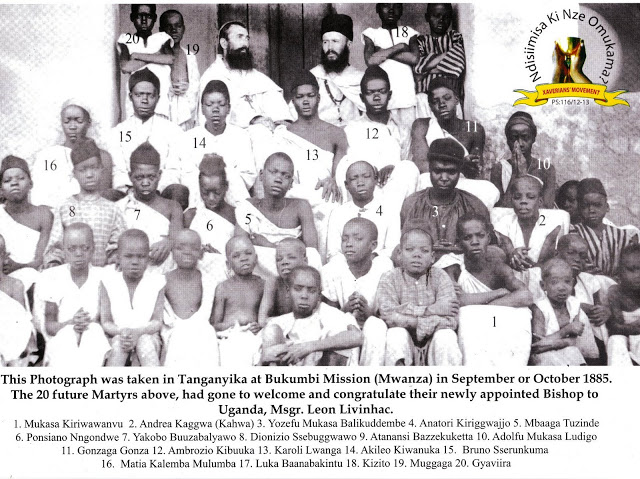
I thank Fr Ray Blake for this photo, which I found on his post today on the Ugandan Martyrs after I had published my post.
O God, who have made the blood of Martyrs 
the seed of Christians,
mercifully grant that the field which is your Church,
watered by the blood 
shed by Saints Charles Lwanga and his companions, 
may be fertile and always yield you an abundant harvest. 
Through our Lord Jesus Christ, your Son, 
who lives and reigns with you in the unity of the Holy Spirit, 
one God, for ever and ever.