Showing posts with label typhoon. Show all posts

15 November 2013

'There will be great earthquakes . . .' Sunday Reflections, 33rd Sunday in Ordinary Time Year C

Sto Niño Basilica, Cebu City, Philippines, 15 October 2013

Readings (New American Bible: Philippines, USA)                                  

Readings (Jerusalem Bible: Australia, England & Wales, India [optional], Ireland, New Zealand, Pakistan, Scotland, South Africa)


And as some spoke of the temple, how it was adorned with noble stones and offerings, Jesus said, "As for these things which you see, the days will come when there shall not be left here one stone upon another that will not be thrown down." And they asked him, "Teacher, when will this be, and what will be the sign when this is about to take place?" And he said, "Take heed that you are not led astray; for many will come in my name, saying, 'I am he!' and, 'The time is at hand!' Do not go after them. And when you hear of wars and tumults, do not be terrified; for this must first take place, but the end will not be at once." 

Then he said to them, "Nation will rise against nation, and kingdom against kingdom; there will be great earthquakes, and in various places famines and pestilences; and there will be terrors and great signs from heaven. But before all this they will lay their hands on you and persecute you, delivering you up to the synagogues and prisons, and you will be brought before kings and governors for my name's sake. This will be a time for you to bear testimony.  Settle it therefore in your minds, not to meditate beforehand how to answer; for I will give you a mouth and wisdom, which none of your adversaries will be able to withstand or contradict.  You will be delivered up even by parents and brothers and kinsmen and friends, and some of you they will put to death;  you will be hated by all for my name's sake. But not a hair of your head will perish. By your endurance you will gain your lives."

Tanauan, Leyte, after Super Typhoon Haiyan/Yolanda 8 November 2013


Sr Maricel Fuerza TC and Sr Reah Lei Talibas TC are friends of mine, members of the Capuchin Tertiary Sisters of the Holy Family. They both happen to be in the same small community at the novitiate of the Sisters in Talisay City, Negros Occidental, just north of Bacolod City.

Sr Maricel is from Catigbian, Bohol, very near the epicentre of the 7.2 magnitude earthquake that hit Bohol and other parts of the Visayas, noticeably Cebu, the morning of 15 October. Her family home was destroyed, though nobody was hurt.


Sister Maricel is on the left.

Sr Rhea Lei is from Tanauan, Leyte, a coastal town south of Tacloban City that has been featured so much in the news since Super typhoon Haiyan/Yolanda passed through the central Philippines on 8 November. Her family home too was destroyed though all are safe. Sister texted me the other day that her family were suffering from hunger because of the lack of food and water. She texted later 'I desire to go [home] but I feel helpless at this time'.


Sister Rhea Lei is on the far left.

A word I have often used about the people of the Philippines is 'resilience'. Many reporters, foreign and Filipino, have been seen that resilience this last week. I have seen it so many times. I remember travelling on a bus nearly 40 years ago in northern Mindanao sitting next to a young couple with two or three very young children and two or three bags. I didn't really find out their story but I knew they were moving to another place to make a new start. Jesus tells us at the end of today's gospel, By your endurance you will gain your lives.

People here, especially those who are poor or without influence, are long-suffering. Sometimes this can result in an unhelpful passivity. But the other side of that is an extraordinary resilience when disaster strikes. Very often this is an expression of deep faith. I saw on TV a shot of people kneeling and praying in front of a statue of Our Blessed Mother in one of the churches in Tacloban City. These were people left with nothing who had probably lost family members or others close to them.

The Church of Our Lady of Perpetual Help, the Redemptorist church in Tacloban, is sheltering 200 to 300 families,  the pews serving as beds. A BBC reporter there described Fr Edwin Bacaltos CSsR, the parish priest and whom I know, as a genuine good shepherd. And it was stated that, as usual, there would be four Masses on Sunday.

Though there has been some looting, what I saw on TV showed an 'orderliness' of some kind, even though some were taking goods that couldn't possibly be of any use. I have been struck by the orderliness of very long queues of people, young and old, waiting patiently  and with hope for food and water, even when hardly anything is available.


Christ on the Sea of Galilee, 1854, Eugène Delacroix [Wikipedia]

I know that the Church in some countries will have special collections for the victims of Haiyan/Yolanda. I know that people will be very generous, as so many have been already.

'I have returned', 1944, Gulf of Leyte [Wikipedia]

An iconic photo from World War II is that of General Douglas MacArthur landing at Tacloban to help, with the aid of both American and Filipino soldiers (the soldier with the helmet behind General MacArthur is Philippine General Carlos P. Romulo), to liberate the Philippines from the Japanese. 69 years later an American aircraft carrier has arrived in the same area to help, with many others, to liberate the people of Leyte from their present misery. The 'many others' include not only countless Filipinos but people on board ships sent by the United Kingdom and Japan. Nation will rise against nation, and kingdom against kingdom Jesus tells us, That was the reality in the Pacific War 70 years ago but now former enemies are working together to help the victims of what is said to be the strongest storm ever to hit land.

Surely this is a symbol of God's presence just as Jesus, God who became man, was present while asleep on the boat in the middle of a storm.

Filipinos have a great devotion to the Sto Niño, the Child Jesus. The video at the top shows the bell tower of the Sto Niño Basilica in Cebu being destroyed by the earthquake. The main church in Tacloban City is also named after the Sto Niño. I used the video below earlier in the week. The hymn to the Sto Niño of Tacloban was recorded in that church, which is seen in the video. The hymn, both the words and the way it is sung, captures for me something of the faith and hope of Filipino Catholics, in this instance those in the region that has been most severely stricken, a trust in God's love and mercy. The people fervently sing as they ask the Holy Child of Tacloban not to leave them.

He won't.


Shortly after I uploaded Sunday Reflections I received the following reflection from a friend in Manila, not as a response but by coincidence.

Calamities, natural and man-made have besieged our country in recent months and years, with increasing frequency, intensity and horror. As Christians, how do we witness about God, to a man cradling his lifeless daughter in his arms, or a child made orphan by surging sea and homeless by howling wind, or a community whose locus of worship for centuries has been reduced to a pile of rubble in seconds? Is God punishing us? As Catholics, fortified by the Year of Faith, we can never ever believe that. Instead, we witness to a God of love, as we help bury the dead, feed, clothe, shelter the living, comfort the grieving. We cling to our faith in a God who brings good out of evil, for our sake and for those who are on the verge of losing their faith. The good has started coming, in the deluge of donations, equipment, rescue and medical missions, from all over the world – even from those, with whom, we have had differences. Indeed, natural calamities make humankind realize how fleeting is life, how fragile is our shared planet. Reminded of how helpless we truly are, we raise our hearts in prayer, our arms in surrender, like children asking to be carried, confident, that our Father will scoop us up in His arms and carry us home.

Blessings

Vi

13 November 2013

'We may have ratified our own doom.' Aftermath of Super Typhoon Haiyan/Yolanda in Tacloban City, Philippines


The photos above were uploaded on October 30 on her Facebook account by my friend Rhea Gladys Mae Sarigumba, a social worker who lives in Tacloban City. She is with one of her two daughters in the top right while her mother Mrs Vicenta Matildo is in the photo below with her to granddaughters, the children of Rhea and her husband Rogel who is pictured in the top right with his two daughters, his mother-in-law Vicenta and sister-in-law Lalai with her daughter Barbie.

Rhea with her husband Rogel and their daughters whose nicknames are 'Xycy' and 'Xie Ann'.

I've had no news about Rhea since Super Typhoon Haiyan/Yolanda hit Tacloban City early on Friday morning, 8 November. One of the last entries by Rhea on the timeline of her Facebook is a link to an update on the approaching storm on the website of PAGASA, the national weather bureau in the Philippines issued at 6AM on 7 November, less than 24 hours before it hit the islands of Samar and Leyte in the Eastern Visayas. ('PAGASA' is an acronym but in the Visayan languages, spoken in the hardest-hit areas, it means 'hope'.)

Rhea's very last entry on Facebook, dated 7 November, was How can I sleep when 
all I hear is raindrops.. #kanta lang teh? (Just sing?)

Vicenta, Rhea's mother left Surigao del Norte in Mindanao, where she lives, for Tacloban City on Sunday but I haven't heard from her since. However,  a mutual friend and neighbour of Vicenta texted me this morning that Vicenta's mother and her sisters are all safe as they had evacuated before the storm hit.


This afternoon I received a text message from another Rhea, Sr Rhea Lei Tolibas TC, a young religious of the Capuchin Tertiary Sisters of the Holy Family who is based in the novitiate of the Sisters just north of Bacolod City. She's from Tanauan, Leyte, seen at the beginning of the video above, a coastal town about 45 minutes south of Tacloban City. Her family are safe and in an evacuation centre but lack food and water. Sr Rhea mentioned that people are desperate. 

BBC World reported this afternoon, Wednesday, that eight people had been killed while a crowd stormed a storehouse looking for food.


The website of the Mercy International Association carries this report of damage to the hospital and school of the Mercy Sisters in Tacloban:

As a human tragedy, the scale of the disaster is so enormous that it is almost beyond our comprehension. What makes this tragedy especially compelling for us is that our own Sisters are significantly effected. The new Mother of Mercy hospital at Tacloban is 50% damaged, the Holy Infant school and college 75% damaged, the Convent in Mindanao badly damaged and the food supplies have run out. It is,of course, impossible to make direct contact with our Sisters, but our understanding is that no Sister is hurt, thank God. However, news has filtered through that some of our Sisters' families are harmed or missing. In the midst of this disaster, these Sisters of Mercy continue to bring human and spiritual comfort and support to all in such drastic need around them.

Six Irish Mercy Sisters from St Maries of the Isle, Cork, went to Tacloban in 1954 at the invitation of Bishop Lino Gonzaga of Palo. That original group grew into a new congregation of Mercy Sisters that now has 47 members, all Filipinos, working in a number of areas. Education and medical care have always been central to Mercy Sisters. Mother of Mercy Hospital, Tacloban City, was one expression of that. 

The six Irish Sisters were asked to take over the running of an already established school that has grown into Holy Infant College (HIC). Ironically, the thene for the 87th anniversary of the establishment of the school was Responding to the Challenges of Climate Change.


Yeb Saño, Climate Change Commissioner of the Philippines and a delegate to the 2013 Climate Change Conference in Warsaw speaks very movingly about the impact of Haiyan/Yolanda on his own family. Whether or not the super typhoon was caused by climate change it reminds us of the urgency of respecting God's creation. And God saw everything that he had made, and behold, it was very good (Genesis 1:31, RSVCE). We may have ratified our own doom, Mr Saño points out. But there still is room for us to act.

From looking at news reports on television I see some hope that  within two or three days essential aid, food, drinking water, shelter, medicine,communication systems, proper sanitation, the recovery and burial of all the dead, may avert an even greater disaster than what is there now. Good weather that will last for at least a few days is expected by Friday.

Last night President Aquino said that the estimate of 10,000 dead was too high and that the government believed the death toll was around 2,500. The final figure may be somewhere in between those two estimates. But each death is a tragedy for family and relatives.

When my friend Rhea Sarigumba posted the PAGASA update on Facebook she wrote, May God guide us with His loving care and protection.

May God give strength to all in the affected areas, victims, those bringing aid, administrators and media people. 


Will Yeb Saño's warning, We may have ratified our own doom, come true or will there be a place for Xycy, Xie Ann, Mabel, the children born just after the storm, and their contemporaries around the world at the table of life when they grow up?

Just now, 7:50pm Philippine time, I received news that the family of Reah and Rogel are all safe. Thanks be to God.

10 November 2013

Devastation in Tacloban City, Philippines


It has become clear that Super Typhoon Haiyan ('Yolanda' in the Philippines) has caused enormous destruction and, very possibly, many deaths. Tacloban City, on the island of Leyte in the eastern Visayas, the group of large islands in the centre of the country, looks as if a bomb had been dropped on it. I have visited it a number of times.

Much of the damage was caused by a storm surge, which is similar to a tsunami. I heard an official of PAGASA, the national weather bureau, explain on television today that where the seas is shallow, as it is in Tacloban City,  such surges tend to be much higher than where the sea is deep and therefore much more destructive.

Part of downtown Tacloban City


There are now reports that more than 10,000 may have died as a result of the storm. Reuters quotes a senior police official on this.


At 1.47 in the video above you can see the damage done to Daniel Z. Romualdez Airport. Below is a photo of the main building.


Although the airport buildings, including the control tower, as far as I know, have been badly damaged the runway has now been cleared of debris and military aircraft carrying supplies and troops have been able to land. President Aquino also visited today.

Reports indicate that it may be months before normal electricity services can be resumed.

There has been some looting in Tacloban City but scenes on TV showed this to be an 'orderly' process, if one can describe it as such. And footage shows people queuing up in orderly fashion at the airport, hoping for relief goods and, in some cases, hoping to get out. However, police and soldiers have been brought in to bring about order. One can well imagine that if people don't get basics such as food, drinking water, shelter and medical care, that matters could get out of hand.

One striking characteristic of Filipinos is their resilience. I've seen this over and over again. People pick up the pieces and start again.

Pope Francis sent the following telegram through Secretary of State Archbishop Pietro Parolin to President Aquino:

Deeply saddened by the destruction and loss of life caused by the super typhoon, His Holiness Pope Francis expresses his heartfelt solidarity with all those affected by this storm and its aftermath. He is especially mindful of those who mourn the loss of their loved ones and of those who have lost their homes. In praying for all the people of the Philippines, the Holy Father likewise offers encouragement to the civil authorities and emergency personnel as they assist the victims of this storm. He invokes divine blessings of strength and consolation for the Nation.

Basilica of Sto Niño de Tacloban

The Patron of Tacloban City is the Sto Niño de Tacloban, the Holy Child of Tacloban. May God show his love in a special way to the many children who have been traumatised by their experience in those places in the Philippines that bore the brunt of the typhoon. And may Mary and her husband St Joseph obtain for parents and others in positions of authority the strength and generosity to do what needs to be done to bring about a life-giving normality.


May the faith of the people of Tacloban City and other affected areas, expressed in the hymn above to the Sto Niño de Tacloban asking his blessing and mercy, touch the Merciful Heart of our loving Saviour Jesus Christ.

Photos from Wikipedia.

12 January 2012

'Yes, GOD IS GOOD ALL THE TIME . . . ALL THE TIME GOD IS GOOD'


The title of this post is a text message I received from a friend whose daughter and grandchildren survived Typhoon Sendong that hit northern Mindanao a week before Christmas. I use it in Pulong ng Editor, 'Editor's Word', in the January-February issue of Misyon, which I edit for the Columbans here in the Philippines.

My friend is no stranger to suffering. When he was a small child his father was murdered. Yet he powerfully expresses his faith in a simple text message, an expression of the resilience of the faith of so many Filipinos.

11 January 2012

Update on aftermath of Sendong/Washi on Cagayan de Oro City and Iligan City

A Report by Fr Pat O'Donoghue

Fr Pat O'Donoghue is the Regional Director of the Columbans in the Philippines. He visited Cagayan de Oro City and Iligan Ciy last week. He wrote this report on 8 January, the Solemnity of the Epiphany here in the Philippines.


I arrived in Cagayan de Oro in the early afternoon of Monday, 2 January. The signs of the calamity were visible from the air as we approached the airport, but the full extent of the damage hits you when you stand on the river bank or visit those places where whole neighborhoods were simply washed away.

The damage to the water system was such that most of Cagayan still did not have running water when I arrived. On the way from the airport we saw groups of people surrounding trucks or fire hydrants where water was being dispensed while others were coming and going with all kinds of water containers – the innovative spirit of people once more shining through the difficulties. Drinking water was also being dispensed at points set up by the Red Cross and others who had large water purifying machines. The lack of water leads to many difficulties one of which is the difficulty people have in doing any kind of cleaning up. Water was restored to the western side of Cagayan by Thursday, January 5, a big help.

Holy Rosary Parish, which is served by the Columbans, was affected but, when compared to other parts of Cagayan and Iligan, only relatively so. Fr Paul Finlayson estimates about 100 families are affected with about 30 homes destroyed. Food and other immediate necessities have been provided for these families. At a meeting on Tuesday, January 3, attended by most Columbans in Mindanao, it was agreed that we will continue to cooperate with the Archdiocese of Cagayan de Oro which are doing a very good job of coordinating the relief operations, without prejudice to the specific needs of the parish.

What is the more pressing need now is that of rehabilitation, which must include relocation for most of those affected. There is little point in rebuilding homes in those areas that could be hit again in the immediate future. Getting this right and utilizing all the help that has been promised by the Government, foreign governments, aid agencies and private individuals is both a priority and a challenge. In the meanwhile, there is a need for some kind of intermediate accommodation so that people can get back to some normality. We will continue to provide any further 'immediate' aid where it is seen to be genuinely needed.


The effort now is to get people out of the evacuation centers which are mostly schools and churches and into temporary accommodation. Archbishop Antonio J. Ledesma SJ pastoral letter just before Christmas urged those who were not affected to 'adopt' a family and care for them not only during Christmas but also in the coming months until that family can go to a more permanent home. Of course, relatives are already doing this for their own families, but one of the fears that some people have is that if they leave the evacuation centers now they might lose their status as genuine claimants on the aid that is promised. There are a number of tent communities being set up also to give each family some way of being together.

There is a lot of pain not only for those directly affected but also for those who heard the cries of others for help and were unable to do anything. I’m not sure that time will heal all this, but certainly God can and the faith of many of these people is both challenging and humbling. One eight-year-old boy who lost his mother and two of his siblings had found a photo of her and would look at it and say, 'I will see you in Heaven, Mommy'.

There are the happy stories too: the child who was saved by riding on the back of a neighbor’s Labrador Retriever. The owners of the dog were not at home when the tragedy struck. Or my little friend Cedric, who is all of four years old, who clung to a floating refrigerator when he got separated from his parents. He was found by fishermen several miles away later that morning still astride the fridge.

There is much more that could be added to this, but I simply want to give you some snapshots of the situation as I experienced it. In truth it reduced me to silence, or more accurately perhaps, it called to silence. In so many ways it is overwhelming and yet people do what they can and many have sent help. At times I felt like an intruder, but as I listened to the stories and simply held a hand or embraced the person, I was glad I was there and privileged to be with such people.


I want to thank all those who have sent in money to our fund and to assure you that we will continue to monitor the situation in both Cagayan and Iligan so as to best use the money we have received. As I mentioned above, we see the greater need now to be that of rehabilitation and that is probably where we will use most of the money left in the fund and any that will get added to it. I hope that this is acceptable to all of you.

Finally, on this Feast of the Epiphany, may Jesus show His face to all those who are still suffering so terribly. May He also show His face to those who, by the help they send, the prayers they make or their work on the ground, have become that face of Christ for others.

24 December 2011

'In Times Like These', a song dedicated to the victims of Typhoon Sendong/Washi


Glenn, a young man who is studying law at Xavier University in Cagayan de Oro, the southern Philippines city hardest hit by Typhoon Sendong/Washi a week ago, wrote and recorded this song. His sister Maria Fe produced the video. Their parents, Joe and Annie, are teachers who grew up in Columban parishes in Mindanao.

Please continue to pray for the souls of those who have died, for those who are trying to pick up the pieces and for the many people who are working together for a better future for all.

23 December 2011

Typhoon Sendong/Washi: Pastoral Letter of Archbishop of Cagayan de Oro, Philippines

Photos from Iligan.org

 
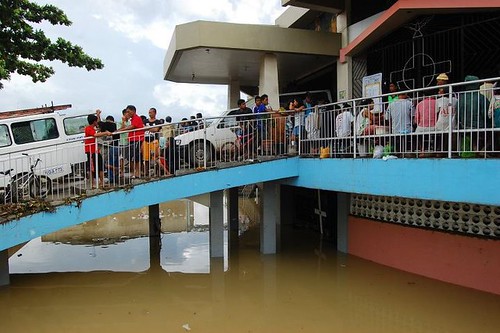
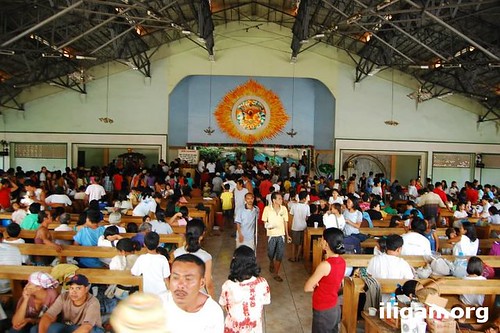
San Lorenzo Ruiz Church, Iligan City, a temporary evacuation center.

The Columbans are very familiar with both Iligan City and Cagayan de Oro City, the two places most badly hit by Typhoon Sendong/Washi last weekend. 'Washi' was the international code-name for the storm, 'Sendong' the Philippine name. Columban Fr Rolly Aniscal lost a cousin and her two children in Cagayan de Oro. The children's bodies haven't been recovered yet.

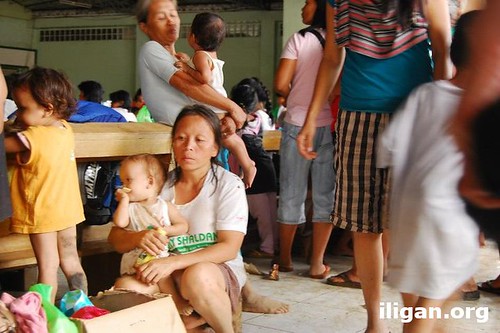
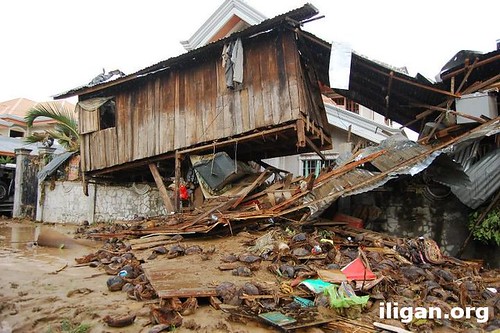
I'm posting photos taken in Iligan City, which is about 90kms from Cagayan de Oro City.

New Zealander Fr Paul Finlayson and his team in the Columban-run Holy Rosary Parish, Agusan, Cagayan de Oro, are taking care of 25 families whose homes were destroyed or badly damaged. Venus Guibone, who worked in Ireland as a Columban lay missionary whose house was very badly damaged is among those being accommodated at St John Vianney Theological Seminary.

San Lorenzo Ruiz Church

Pastoral Letter - A Time to Grieve, A Time to Build

A Pastoral Letter written by Archbishop Antonio J. Ledesma, S.J., Archbishop of Cagayan de Oro, addressed to the faithful people of the Archdiocese of Cagayan in this moment of pain and sorrow as the city was devastated by the typhoon Sendong.

Christmas is a time of rejoicing. But this year in Cagayan de Oro we mourn and express our condolence for all those who have perished in the wake of Typhoon Sendong on Dec. 16-17. In some places entire families have been washed away by the rampaging waters of Cagayan de Oro River. Others died in their sleep trapped inside their homes by the sudden rise of flood waters that reached unprecedented levels past midnight.

There are accounts of how a mother clutching the hands of two children was able to escape from the floods, only to lose another child whose pleas for help could be heard receding in the darkness of the night. Another family was able to hold on to an uprooted balete tree that floated out into Macajalar Bay and reached the shores of Camiguin Island. Floating bodies have been retrieved from the waters of nearby towns. The low-lying communities of Cala-Cala and Isla de Oro have been leveled by a tsunami-like river surge.


Practically everyone in the city has lost some relatives or personal friends in this calamity. Schools have lost some students and staff; officemates have not reported because of the condition of their homes; and a number of unidentified bodies still await a dignified burial in a common resting place.

In some of our churches, the Misa de Gallo could not be celebrated because the church became a refuge for families seeking higher ground. In one chapel, even pigs and other animals were brought in and tied at the foot of the altar. Lay ministers were scandalized until the parish priest reminded them that this must have been the same situation in the stable of that first Christmas night. We have also started to celebrate the Misa de Gallo in the evacuation centers. [Note: the Misa de Gallo is the novena of nine pre-dawn Masses in thanksgiving for the gift of our faith celebrated throughout the Philippines from 16 to 14 December. A resilient faith is one of the most remarkable gifts God has given the people of the Philippines.]

Even as we grieve with those directly affected by this tragedy, the challenge for us now is to help re-build the lives and broken homes of the survivors. The evacuation centers are slowly being organized in the distribution of relief goods – in particular, water, food, medicine, mats, blankets, etc.

We are heartened to see many volunteers and organizations coming forward to share their time, energy and resources. Our affected parishes and social action workers have collaborated with government agencies in running these centers in the City Central School, West City Central School, Macasandig, Bulua, Kauswagan, Iponan, etc. The 14 centers have been providing shelter and basic needs to more than 7,000 families and 43,000 individuals. Meanwhile, the listed number of dead and missing has reached nearly 700 persons.


The longer-term challenge is to help these families re-build their present homes or re-locate to safer grounds. We are heartened by the visit of President Aquino and other public officials. His declaration of a state of national calamity and observation that families should not be allowed to return to extremely dangerous areas are welcome statements. Last January 2009, the city had already experienced severe flooding. Some old-time residents recalled that this phenomenom happens every forty years. But barely three years after that, Typhoon Sendong came with greater vengeance.

We have to cast a broader look at the entire river basin area of Cagayan de Oro River. This extends to the northwestern part of Bukidnon and surrounding areas. Illegal logging and irresponsible mining activities have contributed to the degradation of the environment and the siltation of the river bed. The erection of man-made structures may have also impeded the natural flow of the waters. (The continued hydraulic flush mining along Iponan River has likewise caused widespread flooding of the Canitoan-Iponan areas of the city.) It is for these reasons that we have to strengthen the Cagayan de Oro River Basin Management Council, a multi-sectoral effort to protect and conserve our most precious natural resource after our human resources – the river system.

As we approach Christmas week and the coming of the new year, may I propose a Family-Adopt-a-Family program. Families unaffected by the flood can invite to their homes an evacuee family, especially those that have lost their homes or loved ones, for a few days or for a Christmas meal to share the spirit of the season. May the new-born child in the manger fill us with the spirit of solidarity in moments of adversity and hope in the sharing of love and life with one another. “Make us know the shortness of our life that we may gain wisdom of heart” (Ps. 90).

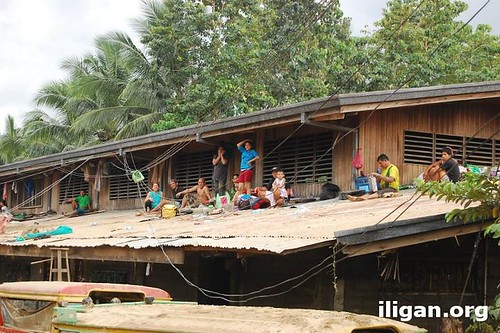
These people had been on the roof for two days.