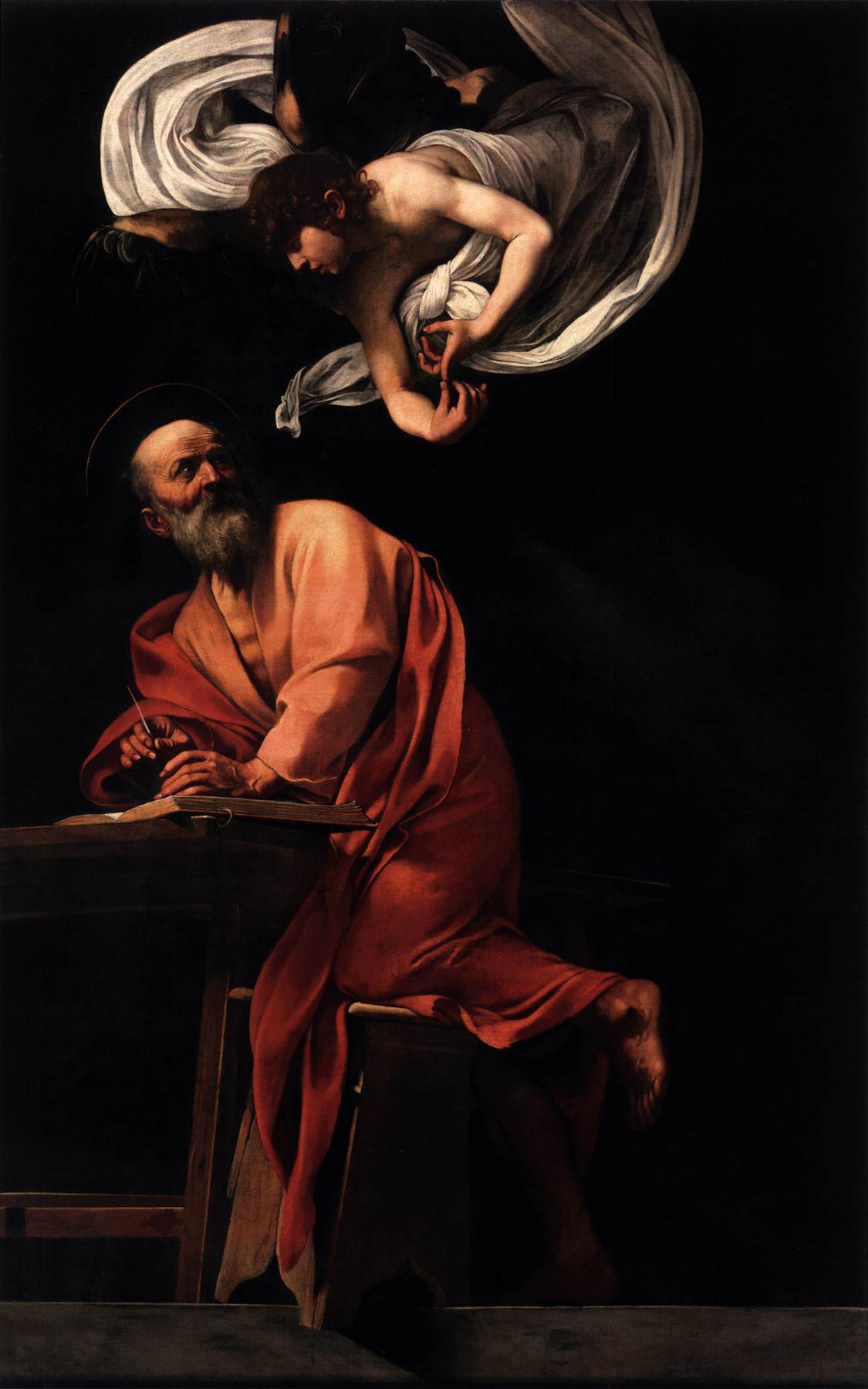
The Inspiration of St Matthew, Caravaggio, 1602
Contarelli Chapel, San Luigi dei Francesi, Rome [Web Gallery of Art]
Readings (Jerusalem Bible: Australia, England & Wales, India [optional],
Ireland, New Zealand, Pakistan, Scotland, South Africa)
Gospel Matthew 22:1-14 [or 22:1-10] (New Revised Standard Version, Catholic Edition: Canada)
Jesus said to the chief
priest and the elders of the people:
“The kingdom of heaven may be
compared to a king who gave a wedding banquet for his son. He sent his slaves to call
those who had been invited to the wedding banquet, but they would not come. Again he sent other slaves,
saying, ‘Tell those who have been invited: Look, I have prepared my dinner, my
oxen and my fat calves have been slaughtered, and everything is ready; come to
the wedding banquet.’ But they made light of it and went away, one to his farm, another
to his business, while the rest seized his slaves, mistreated them, and killed
them. The king was enraged. He sent his troops, destroyed those
murderers, and burned their city. Then he said to his slaves,
‘The wedding is ready, but those invited were not worthy. Go therefore into the main
streets, and invite everyone you find to the wedding banquet.’ Those slaves went out into
the streets and gathered all whom they found, both good and bad; so the wedding
hall was filled with guests.
[“But when the king came in to see the guests, he noticed a man
there who was not wearing a wedding robe, and he said to him, ‘Friend,
how did you get in here without a wedding robe?’ And he was speechless. Then the
king said to the attendants, ‘Bind him hand and foot, and throw him into the
outer darkness, where there will be weeping and gnashing of teeth.’ For many are called, but few
are chosen.”]
Antiphona ad introitum Entrance Antiphon Ps 129 [130]:3-4
Si iniquitates observaveris, Domine, Domine, quis sustinebit?
Quia apud te
propitiatio est, Deus Israel.
De profundis clamavi ad te Domine:
Domine exaudi vocem meam.
Gloria Patri, et Filio, et
Spiritui Sancto; sicut erat in principio, et nunc
et semper. Amen.
Si iniquitates observaveris, Domine, Domine, quis sustinebit?
Quia apud te propitiatio est, Deus Israel.
If you, O Lord, should mark
iniquities, Lord, who could stand?
But with you is found
forgiveness, O God of Israel.
Out of the depths I cry to you, O Lord. Lord, hear my voice!
Glory to the Father, and to the Son, and to the Holy Spirit;
as it was in the beginning, is now and will be for ever. Amen.
If you, O Lord, should mark iniquities, Lord, who could stand?
But with you is found forgiveness, O God of Israel.
[The longer form is used when Mass is celebrated in the Extraordinary Form, using the 1962 Missal.]

A friend of mine who has three young daughters and a fourth
child on the way and who now lives in California posted on her Facebook the other day that the authorities in some school are removing the swings from its
playground because they are 'dangerous' for children. I wonder if the committee
in the Vatican who drew up the Lectionary we have been using since 1969 thought
that some of the words of Jesus might be 'dangerous' for us since they have given
us the option today of leaving out the last four verses of the Gospel [in square
brackets above].
In Matthew 3:7 Jesus addresses some Pharisees and Sadducees with the words, You brood of vipers!, which he repeats in 12:34 and in 23:34 he's even more scathing: You snakes, you brood of vipers! How can you escape being sentenced to hell?
The words of Jesus aren't always 'nice'. And not all the words in the homily of Pope Francis last Sunday at the Holy Mass for the opening of the Extraordinary Synod on the Family were 'nice'. Addressing the assembled participants, mostly bishops, he said, And to satisfy this greed, evil pastors lay intolerable burdens on the shoulders of others . . . We are all sinners and can also be tempted to 'take over' the vineyard, because of that greed which is always present in us human beings. God’s dream always clashes with the hypocrisy of some of his servants. We can 'thwart' God’s dream if we fail to let ourselves be guided by the Holy Spirit.


The First Reading and the Gospel speak clearly of God's desire for all of us to be with him, sharing in the abundance of his riches, symbolized in both readings by a lavish banquet.

President Ramon Magsaysay (died 1957) of the Philippines wearing a barong Tagalog [Wikipedia]
Nearly 30 years ago I officiated at a wedding in Sacred Heart Church, Cebu City. The reception was held next door at a centre attached to the church, which belongs to the Jesuits. At the reception I noticed an elderly man wearing a barong Tagalog, which is formal dress for men in the Philippines, especially at weddings. But it turned out that nobody knew him. He wasn't a guest, but had invited himself along. As there were weddings almost every day at Sacred Heart Church I figured that maybe he invited himself along whenever the reception was held at the adjacent centre.
But nobody minded. Filipinos are hospitable and nobody is ever turned away. Many of us were amused and I had noticed the man at Mass. In other words, he wasn't a freeloader but participated in the wedding ceremony, something that many invited to weddings an baptisms don't do. They just turn up for the meal.
The harsh words of Jesus, which I suspect many priests won't read at Mass, jolt us out of our complacency. The man who turned up at the banquet without bothering to dress for the occasion clearly thought that cultural norms and good manners didn't apply to him. It's not a crime to turn up at a wedding or some similar event dressed casually but to do so shows a lack of respect for the celebrants and for oneself.
However, in the parable, Jesus isn't telling us to be 'nice' and well-mannered. He's telling us forcefully that in order to share in the 'dream' that he and our heavenly Father have for us we have to do the Father's will. Pope Francis referred to this in the closing words of his homily: My Synod brothers, to do a good job of nurturing and tending the vineyard, our hearts and our minds must be kept in Jesus Christ by 'the peace of God which passes all understanding' (Phil 4:7). In this way our thoughts and plans will correspond to God’s dream: to form a holy people who are his own and produce the fruits of the kingdom of God (cf. Mt 21:43).
We have to make choices. We often choose to sin. God is merciful, bending down to welcome us back, to acknowledge our sins and to ask for and receive his forgiveness. Jesus has given the Church the wonderful Sacrament of Reconciliation/Confession/Penance, precisely so that he can meet us in our sinfulness, forgive and heal us. And the Church teaches us clearly that when we have committed a grave sin we must avail of that sacrament. By the same token, he wants us priests to be available for penitents and to go to confession regularly ourselves.
When God gave us the gift of freedom he also placed some 'swings' in our 'playground', knowing that we would sometimes fall and 'graze our knees' or even hurt ourselves more seriously. He didn't protect us from all possible eventualities. Had he done so he would have made prisoners of us. He invites us to his heavenly banquet, paid for by the sacrifice of his Son on Calvary.
In the parable the king's servants went out into the streets and gathered all whom they found, both good and bad; so the wedding hall was filled with guests. Both good and bad had a sense of being blessed and honoured by the invitation, except for one - we don't know if he was one of the 'good' or one of the 'bad' - with an insolent sense of entitlement rather than a wondrous sense of being graced.

The Two Trinities, Murillo, 1675-82
National Gallery, London [Web Gallery of Art]
Jesus, Mary and Joseph,
in you we contemplate
the splendor of true love,
to you we turn with trust.
in you we contemplate
the splendor of true love,
to you we turn with trust.
Holy Family of Nazareth,
grant that our families too
may be places of communion and prayer,
authentic schools of the Gospel
and small domestic Churches.
grant that our families too
may be places of communion and prayer,
authentic schools of the Gospel
and small domestic Churches.
Holy Family of Nazareth,
may families never again
experience violence, rejection and division:
may all who have been hurt or scandalized
find ready comfort and healing.
may families never again
experience violence, rejection and division:
may all who have been hurt or scandalized
find ready comfort and healing.
Holy Family of Nazareth,
may the approaching Synod of Bishops
make us once more mindful
of the sacredness and inviolability of the family,
and its beauty in God's plan.
may the approaching Synod of Bishops
make us once more mindful
of the sacredness and inviolability of the family,
and its beauty in God's plan.
Jesus, Mary and Joseph,
graciously hear our prayer.
graciously hear our prayer.


