18 January 2013

'Do whatever he tells you.' Sunday Reflections. 2nd Sunday in Ordinary Time Year C

The Marriage at Cana, Jan Cornelisz Vermeyen, c.1530
Rijksmuesum, Amsterdam  [Web Gallery of Art]


Readings (New American Bible: Philippines, USA)

Readings (Jerusalem Bible: Australia, England & Wales, India [optional], Ireland, New Zealand, Pakistan, Scotland, South Africa) 

Gospel John 2:1-11 (Revised Standard Version – Catholic Edition)

On the third day there was a marriage at Cana in Galilee, and the mother of Jesus was there; Jesus also was invited to the marriage, with his disciples. When the wine failed, the mother of Jesus said to him, "They have no wine." And Jesus said to her, "O woman, what have you to do with me? My hour has not yet come." His mother said to the servants, "Do whatever he tells you." Now six stone jars were standing there, for the Jewish rites of purification, each holding twenty or thirty gallons. Jesus said to them, "Fill the jars with water." And they filled them up to the brim. He said to them, "Now draw some out, and take it to the steward of the feast." So they took it. When the steward of the feast tasted the water now become wine, and did not know where it came from (though the servants who had drawn the water knew), the steward of the feast called the bridegroom and said to him, "Every man serves the good wine first; and when men have drunk freely, then the poor wine; but you have kept the good wine until now." This, the first of his signs, Jesus did at Cana in Galilee, and manifested his glory; and his disciples believed in him. 

Feast of the Sto Niño

On the third Sunday of January the Church in the Philippines celebrates the Feast of the Sto Niño, the Holy Child. These Sunday Reflections focus on the Second Sunday in Ordinary Time Year C. But you may want to read an article by a good friend in Cebu, Judge Simeon Dumdum, Jr, which I featured on this blog in 2009, The Sleeping Sto Niño.

To complicate matters for me, here in the Diocese of Bacolod, as Sunday is 20 January, we celebrate the Solemnity of St Sebastian, patron of the Cathedral, of the Diocese and of the City, and will observe the Feast of the Sto Niño the following Sunday.

Second Sunday in Ordinary Time Year B


Last Sunday I featured the late King Baudouin of the Belgians. This week I feature him again, with Queen Fabiola. The story of how they met is quite remarkable and the late Cardinal Suenens tels the story in his biography of the King, Baudouin, King of the Belgians, The Hidden Life.

The video above has as background music and Irish song that I learned in Grade Three, The Dawning of the Day, in Irish Gaelic Fáinne Geal an Lae, the version I learned. An Irish song is not at all inappropriate as the matchmaker of the marriage of Baudouin and Fabiola was an Irish woman, Veronica O'Brien. 

Veronica was envoy of the Legion of Mary to France and some other European countries. Much 'cloak and dagger' work was involved in finding a wife and queen for the young king. Much more importantly, much prayer was involved too, prayer that was basically a searching for God's will. They became formally engaged in Lourdes, France, King Baudouin travelling incognito, as he always did when he went there.

The couple were married in Brussels on 15 December 1960. The video shows photos of both the civil and church ceremonies. In a number of European countries a separate civil ceremony is required by law and takes place before the church celebration. The King wrote in his spiritual diary for that day: Normally we are awake by day and dream at night, but this time it's as if I'm in a dream all day.

On 8 July 1978 Baudouin wrote in his diary: My God, I thank you for having led us by the hand to the feet of Mary, and every day since then, I thank you, Lord, that we have been able to love each other in your Love, and that that love has brown each day.

And Queen Fabiola wrote to Veronica: I knew Our Blessed Lady was a Queen and a Mother, and all sort of other things, but I never knew that she was a Matchmaker!

Quoting the Queen led Cardinal Suenens to quote a Spanish verse:

Cristo dijo a su Madre 
el dia de la Asunción 
no te vaya de este mundo 
sin pasar por Aragón.

Christ said to his Mother 
on the day of the Assumption: 
do not leave this world 
without passing through Aragón.

Before her marriage the Queen was Doña Fabiola de Mora y Aragón.
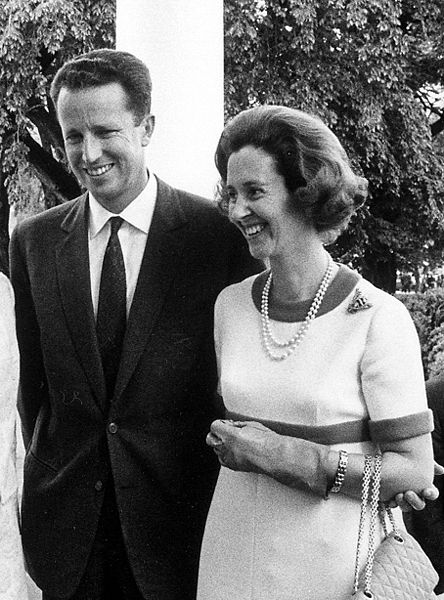

The Cardinal quotes freely from Baudouin's diary about Queen Fabiola.

Fill Fabiola with your holiness. May she live her life in your joy and your peace. Teach me to love her with your own tenderness . . .

Fabiola is so loving; she warms my heart. Her silent, yet active presence is a source of great joy to me. My God, how you have spoiled me!

Thank you, Jesus, for having nurtured in me an immense love for my wife. Thank you for having given me a spouse whose love for me is second only to her love for You. May we both grow in you, Lord.

When Veronica O'Brien met Fabiola in Spain she asked the young woman, who had no idea why where things were leading, why she had never married. She replied, What can I say? I have never fallen in love up to now. I have put my life into the hands of God. I abandon myself to Him, maybe he is preparing something for me.

Veronica recounted all of this in a letter to the King and concluded, It was utterly astounding, because I knew exactly what God was preparing for her.

Thirty years later the King wrote in his spiritual diary: Mary, show me what I should do so as not to miss an opportunity of loving, of denying myself for your sake, of living the present moment to the full, as if it were my last, and of loving my darling Fabiola infinitely more. yes, Mother, teach me to love her with tenderness, gentleness, thoughtfulness, respect, and teach me to have faith in here . . .

And Baudouin, addressing the Lord, wrote, Teach me too to respect her personality with its difference adn its inconsistencies. Jesus, I thank you for having given me this wonderful treasure.

Both King Baudouin and Queen Fabiola in these extracts reflect the spirituality of a book that Cardinal Suenens had given the King before he met his future queen and wife, Abandonment to Divine Providence by Jean-Pierre de Caussade SJ. One English translation of this masterpiece has the title The Sacrament of the Present Moment, which captures the essence of the book, that God's will is in the present moment.

Shortly before he left for Motril, Spain, in 1993, where he died suddenly, King Baudouin confided to Cardinal Suenens and Veronica, I love Fabiola more and more each day: what an inspiration she is to me!

This led the Cardinal to quote Jean Guitton, the first lay person to be invited to Vatican II as an observer, Love is always fruitful, were it only because it transforms those who love.

Children's Games, 1560, Peter Bruegel the Elder

One of the great sorrows in the life of Baudouin and Fabiola as a married couple was that they had no children. The Queen had five miscarriages. Reflecting on this, the King said to a group visiting the Palace, We have pondered on the meaning of this suffering and, bit by bit, we have come to see that it meant that our heart was freer to love all children, absolutely all children.

In a letter to a young mother the King wrote about a children's party that he and the Queen had hosted at the Palace: In one corner there was a group of handicapped children, several of them with Down's syndrome. I brought over a plateful of toffees to a little girl who had scarcely any manual control. with great difficulty, she succeed in taking a toffee but, to my astonishment, she gave it to another child. then for a long time, without ever keeping one for herself, she distributed these sweets (candies) to all the healthy children who could not believe their eyes. What a depth of love there is in those physically handicapped bodies . . .

One by one the children left. We really felt as if they had become in some sense our children. I think they felt it too. It was a very special afternoon; the presence of the Lord was really tangible. There was such peace and joy. that was pure gift!

I have read Baudouin, King of the Belgians, The Hidden Life, a number of times and each time I am moved by it. I see in it a reflection of what's in today's gospel: his gratitude to God, like the gratitude of all at the wedding feast, not mentioned explicitly but clearly there; his and Fabiola's submission to God's will through Mary: Do whatever he tells you; and the extraordinary generosity of Jesus, God and Man, turning water into  the equivalent of about 500 or 600 bottles of the best wine, a generosity that led Baudouin and Fabiola, who couldn't have children of their own, to see that our heart was freer to love all children, absolutely all children.

When we allow him, Jesus can turn the very ordinary in our lives into the extraordinary, just as a little girl with physical and mental disabilities revealed the presence of God to the King of the Belgians, just as Fabiola, his wife and queen, was a daily revelation of God's loving presence to him.

God has the same desire to reveal himself to each of us every day, specifically in the present moment. And He has given us his Mother, who is our Mother also, to guide us with her words of absolute faith, do whatever he tells you.


15 January 2013

Columban, the patron saint of a united Europe

Statue of St Columban, Luxeuil

The following article by Columban Fr Seán McDonagh appears in today's issue of The Irish Times in its Rite & Reason series.
Rite & Reason: The Irish presidency of the European Union provides an opportunity for us to reflect on the achievements of the Irish in Europe from the sixth to the eighth centuries. (The Republic of Ireland holds the Presidency of the European Union from 1 January till 30 June 2013).
St Columban is arguably the best-known Irish person to have visited the European continent then.
Born on the Carlow/ Wexford border about AD543, he studied under Sinell of Cleenish, whose monastery was on an island of the river Erne, in modern Co Fermanagh.
Later he joined the monastery at Bangor under the abbot Comgall and was ordained a priest. At age 51, with a number of companions, he set sail for Europe to become a pilgrim for Christ.

In Saint Columbanus: Pilgrim for Christ, Fr Aidan Larkin gives a biographical sketch of the saint: “The child would grow to manhood and become first a monk, then a priest, a distinguished scripture teacher, a master of Latin prose style and rhetoric, a competent versifier, an abbot, a founder of monasteries and monastic lawgiver, notably in Annegray, Luxeuil and Fontaines, in Burgundy, France, from where he would be expelled, and then in Bregenz, Austria, and finally in Bobbio, northern Italy, where he would die in 615.


A European saint 
“The monasteries that he founded would multiply themselves. Figures vary, but around 60 is a reasonable claim for the number of monastic communities living under the Columban Rule in the following generation, in France; and, out of roughly 100 French diocesan sees, at least 12 would be occupied by his disciples.”
In June 2008, in a reflection on the life of St Columban, Pope Benedict XVI said there was good reason to call Columban a European saint.
The pope drew attention to the fact that the expression “totius Europae – of all Europe” first appeared in a letter which Columban wrote to Pope Gregory the Great in AD600.
Pope Benedict also points out that Columban’s last monastery at Bobbio became a “cultural centre on a par with the famous (Benedictine) monastery of Monte Cassino”.

Columban never forgot his Irish identity. In fact, he is the first Irish person to articulate a sense of what it means to be Irish. In the letter he wrote to Pope Boniface in AD613, he wrote of “...we Irish”. The Irish were not held in high esteem in continental Europe during the Roman Empire and even after the collapse of that empire.
Columban and the monks who followed him to Europe in the sixth and seventh centuries changed that perception radically. The fact that, within a generation after his death Jonas, a monk at Bobbio, wrote the Life of Columbanus is a testimony to the importance of Columban’s legacy in Europe.

Shaping identity 
The UCC historian Damian Bracken has commented that, “this is another first: Columbanus is the first Irishman to be the subject of a biography”.
Columban and the other Irish monks who laboured in Europe between the sixth and eighth centuries helped to shape the European identity. According to Bracken, “shrines, towns and landmarks across Europe bear Columbanus’s name and testify to the widespread diffusion of devotion to the saint”.
In the middle of the ninth century a biographer of St Gall, a colleague of Columban, acknowledges the debt of his people to Ireland “whence the splendour of such light came to us”.

Robert Schuman, stamp issued in West Germany, 1968
In July 1950 a congress was organised in Luxeuil in eastern France to celebrate the 1,400th anniversary of the birth of St Columban. It was the brainchild of Robert Schuman, one of the founders of the European Union, who was at the time foreign minister of France and a tireless promoter of understanding and co-operation among European countries.
In his speech then he said that, “St Columban, this illustrious Irishman who left his own country for voluntary exile, willed and achieved a spiritual union between the principal European countries of his time. He is the patron saint of all those who now seek to build a united Europe.”

Taoiseach (title of Irish Prime Minster) of the day, John A Costello, told the gathering that: “All statesmen of today might well turn their thoughts to St Columban and his teaching. History records that it was by men like him that civilisation was saved in the 6th century.”


A Columban priest, Fr SEÁN McDONAGH is based at Dalgan Park, Navan, Co Meath. Blog:http://earthcaremission.wordpress.com/

11 January 2013

'Thou art my beloved Son.' Sunday Reflections, Baptism of the Lord, Year C

Baptism of Christ, El Greco, painted 1596-1600 (Web Gallery of Art)

Readings (New American Bible: Philippines, USA)

Readings (Jerusalem Bible: Australia, England & Wales, India [optional], Ireland, New Zealand, Pakistan, Scotland, South Africa) 

Gospel Luke 3:15-16, 21-22 (Revised Standard Version – Catholic Edition)

As the people were in expectation, and all men questioned in their hearts concerning John, whether perhaps he were the Christ, John answered them all, "I baptize you with water; but he who is mightier than I is coming, the thong of whose sandals I am not worthy to untie; he will baptize you with the Holy Spirit and with fire. 

Now when all the people were baptized, and when Jesus also had been baptized and was praying, the heaven was opened, and the Holy Spirit descended upon him in bodily form, as a dove, and a voice came from heaven, "Thou art my beloved Son; with thee I am well pleased." 


A friend of my brother some years ago was asked if he would mind playing a round of golf on a course near Belfast with a visitor from the European Continent. He agreed and the visitor was introduced as 'Monsieur So-and-so'. Naturally,  the two men got chatting and the Irishman asked his companion, 'What do you do for a living?' 'Monsieur So-and-so' smiled and said, 'I'm the King of the Belgians'. It was indeed the late King Baudouin.

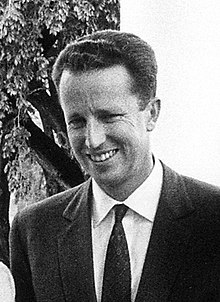
King Baudouin of the Belgians (1930 - 1993)

King Baudouin, a saintly man, often travelled incognito, as Leo Cardinal Suenens, the late Archbishop of Mechelen-Brussels, tells in his biography of the King, Baudouin, King of the Belgians, The Hidden Life. They sometimes went on pilgrimage to Lourdes together, the King driving. On one such occasion, the Cardinal recalled, they passed a wayside shrine of the Blessed Mother that had been vandalized. King Baudouin stopped the car and fixed the shrine.

While the video above, from Franco Zeffirelli's 1977 TV miniseries Jesus of Nazareth, doesn't follow St Luke's gospel word for word, it does highlight one remarkable aspect of the baptism of Jesus - he lined up with sinners who wouldn't have known who he was. He is God who became Man, utterly sinless, and yet he asks for baptism, which for John the Baptist was a sign of repentance.  Have this mind among yourselves, which was in Christ Jesus, who, though he was in the form of God, did not count equality with God a thing to be grasped, but emptied himself, taking the form of a servant, being born in the likeness of men. And being found in human form he humbled himself and became obedient unto death, even death on a cross (Philippians 2:5-8).

In the video St John the Baptist speaks the beautiful words of the Father to Jesus, Thou art my beloved Son; with thee I am well pleased. And when each of us was baptized the Father spoke the same words to each of us, his beloved sons and daughters. A few days ago at Mass we heard those powerful words of St John: In this the love of God was made manifest among us, that God sent his only Son into the world, so that we might live through him. In this is love, not that we loved God but that he loved us and sent his Son to be the expiation for our sins (1 John 4:9-10).

There at his baptism in the Jordan is God made manifest among us. What greater assurance can we have of God's love?

King Baudouin wrote a letter in 1984 in response to one he had received from 'someone who had written to him full or rebellion and indignation against everything that is even remotely related to religious or accepted ways of behaving', as Cardinal Suenens put it. Here are some extracts from the King's reply to this person.

When I was still a teenager, I discovered that God, in the person of Jesus, loved us and loved me with a love that is foolish, but very real. He suffered the most excruciating torture in order to save us, to save me, to save each one of us personally from the grip of evil, and to enable us to share, if we so will, in his divine life. That, if we accept him, his Father will become our Father, my Father. That Mary, his mother, will also become my mother, our mother.

From that day on my life changed. by that I mean my way of looking at things, because I'm afraid I'm still the same poor chap, with the same faults as before. but my weaknesses don't discourage me any longer: on the contrary, they provide me with a reason for trusting totally in the all-powerful strength of my Father who is also your Father.

This is a king writing to one of his people, an angry young person who trusted him enough to write him. King Baudouin is taking the words of St John to heart: In this is love, not that we loved God but that he loved us and sent his Son to be the expiation for our sins . . .

And in recognising that he himself is still the same poor chap he is acknowledging that Jesus is not ashamed of him, no more than he was ashamed of the sinners he lined up with to be baptized by John, even if he himself was utterly sinless.


The Royal Palace in Laeken, near Brussels

King Baudouin wasn't ashamed of his subjects or of those who came to his country from elsewhere. The London newspaper, The Independent, carried an astonishing story about his funeral (I've highlighted some parts):

A former prostitute paid an emotional homage to King Baudouin at the funeral Mass. One of a handful of people chosen to deliver orations, Luz Oral, a Filipino, praised the King for his fight against the international sex trade. She stood in silence as a writer, Chris de Stoop, read aloud the words she had written. Ms Oral had met the King when he paid a highly-publicised visit to a brothel in Antwerp, and De Stoop said both the King and Queen had wanted her to address the funeral. This was her homage:


Now my friend passed away, who else can help us? I come from Manila. My family is very poor. I was promised a nice job in Europe. But Belgian men put us in a sex club. Belgian men put us in prostitution. We cried and we refused. But nobody could help us. We were forced. We were treated like slaves. When I could run away, I was arrested by police. I had many problems. 

Last year the King came to see us in Antwerp. We were five girls there. We cried again but it was different tears. The King was holding my arm. He listened to me. Only the King listened to us. He was shocked. There are too many victims here. From Manila. From Bangkok. From Santo Domingo. From Budapest. From eastern Europe. All looking for a better life in the West. All pushed in prostitution. The King was fighting against this sex trade. He was standing up for us. He was a real king. I called him my friend.

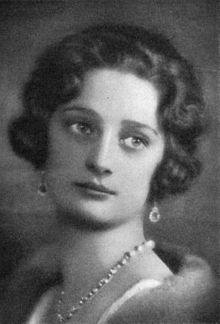
Princess Astrid of Sweden, Queen Consort of the Belgians (1905 - 1935)

King Baudouin, living his faith in Jesus Christ, brought hope into the lives of people on the margins, the hope that Jesus brought into the world by standing with us sinners in the River Jordan. The King himself had suffered much in his lifetime. His mother, Princess Astrid of Sweden, died in a car accident when he was only five. He, his sister and brother, with their father King Leopold III were under house arrest during World War II and spent part of it in Germany. In 1951 Leopold, a cause of bitter division in Belgium because of his surrender to Nazi Germany in 1940, abdicated and his elder son took over, not yet 21.


In 1960 the young king married Doña Fabiola de Mora y Aragón from Spain. To their great sorrow, they had no children. Queen Fabiola had five miscarriages.

In 1990 King Baudouin asked the government to declare him temporarily unable to reign so that he wouldn't have to sign a bill legalising abortion. The government agreed. The King's stand was one of principle, though he was unable to stop the law coming into force.

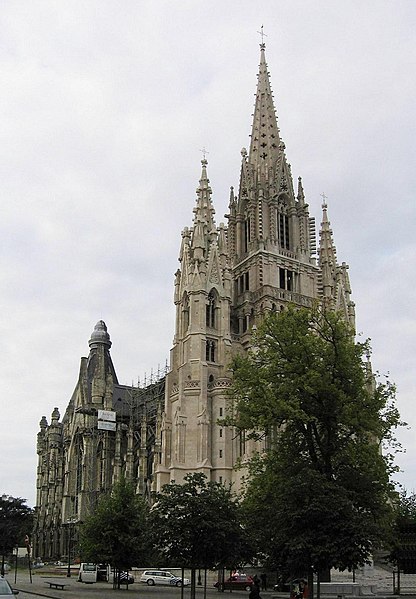
Church of Our Lady of Laeken where King Baudouin is buried 

King Baudouin went to Mass every day and to confession regularly. The baptism of St John the Baptist might spur each of us on to avail of the sacrament of reconciliation often and to us priests to make ourselves available for it. The King would write a 'thought for the day' in his pocket diary, a text from the Mass.

And in that diary, after his death, this prayer was found:

Lord, make us suffer with the suffering of others. 
Lord, let us never again keep our happiness to ourselves. 
Make us share the agony of all suffering humanity. 
And deliver us from ourselves, if that is in accordance with your will.

(1904-1996)

Cardinal Suenens writes that Baudouin once confided to a friend his purpose in being King:

To love his country, 
to pray for his country, 
and to suffer for his country.

05 January 2013

'When they saw the star, they rejoiced exceedingly with great joy.' Sunday Reflections for the Epiphany.


Adoration of the Magi, Francisco de Zurbarán, 1639-40 (Web Gallery of Art)


Readings (New American Bible: Philippines, USA)

Readings (Jerusalem Bible: Australia, England & Wales, India [optional], Ireland, New Zealand, Pakistan, Scotland, South Africa) 

Gospel Matthew 2:1-12 (Revised Standard Version – Catholic Edition)

Now when Jesus was born in Bethlehem of Judea in the days of Herod the king, behold, wise men from the East came to Jerusalem, saying, "Where is he who has been born king of the Jews? For we have seen his star in the East, and have come to worship him." When Herod the king heard this, he was troubled, and all Jerusalem with him; and assembling all the chief priests and scribes of the people, he inquired of them where the Christ was to be born. They told him, "In Bethlehem of Judea; for so it is written by the prophet: 'And you, O Bethlehem, in the land of Judah, are by no means least among the rulers of Judah; for from you shall come a ruler who will govern my people Israel.'" Then Herod summoned the wise men secretly and ascertained from them what time the star appeared; and he sent them to Bethlehem, saying, "Go and search diligently for the child, and when you have found him bring me word, that I too may come and worship him." When they had heard the king they went their way; and lo, the star which they had seen in the East went before them, till it came to rest over the place where the child was. When they saw the star, they rejoiced exceedingly with great joy; and going into the house they saw the child with Mary his mother, and they fell down and worshipped him. Then, opening their treasures, they offered him gifts, gold and frankincense and myrrh. And being warned in a dream not to return to Herod, they departed to their own country by another way.

Liturgical note: The 2002 edition of the Roman Missal re-introduced the Vigil of the Epiphany. The Vigil Mass, celebrated before or after Evening Prayer on the eve of the Epiphany, has its own prayers, Entrance and Communion antiphons, but uses the same readings as on the feast day itself. It is incorrect to refer to a Vigil Mass as an 'anticipated Mass'. The Vigil Mass fulfils the obligation to attend Mass on a holyday of obligation or on a Sunday.


The history of the Church in Korea is unique. The faith was brought there by a 'wise man from the East', the 'wise man' in question being a diplomat and 'the East' being Korea, to the east of China where the diplomat went on a mission to Beijing where he was baptised. He then brought the faith to his own country. The video above, which marks the feast of the Korean Martyrs celebrated on 20 September, gives a brief synopsis of the story. Blessed Pope John Paul II canonised 103 Korean martyrs in Seoul on 6 May 1984. It is estimated that about 8,000 Koreans died as martyrs for the faith.

The Koreans embraced the Catholic Christian faith at great cost. There were four major persecutions in the 19th century. Korea's first priest, St Andrew Kim Taegon, was martyred in 1846 aged 25. His father, Ignatius, was also a martyr.

The last persecution was in 1868. One little incident in that shows a remarkable contrast to the aftermath of the visit of the Magi to Bethlehem when King Herod had all the boys aged two and under killed. Fr Donal O'Keeffe, the Columban superior in Korea, wrote about this after the death of Stephen Cardinal Kim, former Archbishop of Seoul, on 16 February 2009 :

Kim Sou-Hwan (Stephen) was born in May 1922 in Taegu in the province of Kyongsangdo to a fervent Catholic family. His grandfather Kim Bo-hyun (John) was arrested and martyred in Seoul in 1868 during the last persecution of Christians in Korea. His grandmother was also to be executed with him but was released because she was pregnant. The child born was Kim Young-sok (Joseph) who was to become the father of Kim Sou-hwan.

The persecutors spared the Cardinal's grandmother because she was pregnant!

Stephen Cardinal Kim Sou-hwan (8 May 1922 - 16 February 2009) with friends


Mary, the Mother of God, is central to the whole Christmas story. The Magi saw the child with Mary his mother, and they fell down and worshipped him.

Korean soprano Sumi Jo sings a setting of the words Ave Maria, 'Hail Mary', attributed to Giulio Caccini who died in 1618. But it seems it was written anonymously by Russian composer Vladimir Vasilov in 1970. The two words Ave Maria, the music and the singing of Sumi Jo surely draw us to behold the beauty of your sublime glory, as the Collect of the Mass prays. 

Collect

O God, who on this day 
revealed your Only Begotten Son to the nations 
by the guidance of a star, 
grant in your mercy 
that we, who know you already by faith, 
may be brought to behold the beauty of your sublime glory.
Through our Lord Jesus Christ, your Son, 
who lives and reigns with you in the unity of the Holy Spirit, 
one God, for ever and ever.

03 January 2013

'He communicated best as priest.' Fr James B. Reuter SJ dies in Manila at 96


It's not every day that the death of a priest is marked by an editorial in a country's leading newspaper. But yesterday, 2 January, the Philippine Daily Inquirer carried one, Great soul, about an American Jesuit who had come here in 1938 as a scholastic and, with the exception of two or three years after World War II, spent the rest of his life here, Fr James B. Reuter SJ. He died peacefully on 31 December.

Father Jim was from Elizabeth, New Jersey, and was of German stock on his father's side and Irish on his mother's, a good combination of which he was proud. He was a pioneer in the use of the mass media in the Philippines in the service of the Gospel - radio, TV, the stage. I don't know if he ever got into IT but he had been quite sick for the last three or four years.

In either 1974 or 1974, when I was chaplain in the college department of Immaculate Conception College, Ozamiz City, then run by the Columban Sisters and now La Salle University, I invited him to give a workshop on radio drama to the members of the radio club I had started. I had a number of programmes on DXDD, the station of the Diocese of Ozamiz that had been started by a Columban priest, Fr Charles Nolan.

The first thing that surprised me when I met him at the airport was that he was wearing his cassock. That had been the universal dress of priests in the Philippines until the late 1960s. He was one of the few to continue the practice. The last time I met him, maybe four years ago at a Catholic Mass Media Awards ceremony, he was in a wheelchair. 


We spent the whole of each of the five days of the workshop in Ozamiz in the studios of DXDD and we learned by doing, under the direction of Father Jim. He had brought along five of his own 30-minute plays. As far as I recall, he directed three of the five plays and supervised two of us while we directed the last two. It was hard work but great fun. And we enjoyed listening to ourselves when the station broadcast our work.

During the Martial Law years Father Jim produced a four-page newsletter called The Communicator, which was widely distributed by the Catholic Church. It was published either weekly or monthly, I can't quite remember. He also encouraged rural communities to to write the news on blackboards. Almost everyone had access to radio but the media were controlled and news heavily censored or simply suppressed.


Eventually the authorities caught up with Father Reuter. Lai S. Reyes tells the story in the Philippine Star, the Manila daily for which Father Jim wrote a column, At 3AM, until 2009. Her article, In the Name of the Father - James Reuter SJ, was published on 28 July 2010.

The Communicator, The Hero
Unknown to the younger generation, Fr. Jim also played an important role in restoring our democracy. Through his Sunday radio program, The Commonweal Hour, and his magazine, The Communicator, Fr. Jim exposed the wrongdoings of the late dictator, President Ferdinand Marcos.
“There was one story I wrote, which blew his top. It was about the shoemaker in Manila who got killed because he didn’t give up the land (which he owned) that the government wanted,” Fr. Jim recalls.
The shoemaker’s story displeased the former president.
“As a dictator, Marcos thought he could do anything he pleased because he could easily get away with it. At that time, it was a crime to say or do anything hostile to the actions of Marcos,” Fr. Jim notes. The shoemaker was an ordinary man, but he eventually became a symbol of freedom.
The Xavier House in Sta. Ana, Manila, which served as Fr. Jim’s home and office, was raided by the military during Martial Law. They confiscated all the copies of The Communicator and eventually put the priest on house arrest.
Fr. Jim went on trial for eight days at Camp Crame, but the man behind his arrest got nervous and was afraid that the incident would be exposed to the international press. In no time, President Marcos gave Fr. Jim “amnesty.”
“They had 76 accusations against me. Amnesty means all the crimes you’ve been accused of have been forgotten by the defendant. But for Marcos, it meant otherwise. They told me that I was guilty, but they were not going to punish me yet. However, if I did something that would displease the dictator, they would put me in jail or deport me, or worst, shoot me,” recalls Fr. Jim.
That incident didn’t dampen Fr. Jim’s spirit. In fact, it further fueled his desire to fight back and put an end to the evil deeds of the oppressor. That day came when People Power broke out on EDSA in 1986.
“It was such a sweet victory not only for me but especially the Filipino people. My heart belongs to the Philippines. In fact, I’m more of a Filipino than an American. I even applied for a Filipino citizenship, but I was denied on grounds of being an ‘undesirable alien,’” he says with a laugh.
The long wait is over. In 2006, Fr. Jim was granted an honorary Filipino citizenship by the House of Representatives and the Senate. 

Father Reuter called his column, which he wrote for twenty years, At 3AM because that was the time he wrote it. He was unconventional in another way too. Most westerners in the Philippines take a siesta after lunch, which is usually at 12, but Father Jim used to come to the Columban house in Manila and swim in our pool at that time. He did this into his 80s.


Ma. Ceres P. Doyo of the Philippine Daily Inquirer recalls an interview in 1989 with Father Reuter in her weekly Human Face column today, Conversation with Fr. James Reuter SJ. She notes: 

Being the head of the Catholic Church’s National Office of Mass Media is only one of the many jobs of Father Reuter. But this office is the hub and heart of what the Jesuit padre is into. He writes, he directs plays, gives retreats and spiritual guidance. He is also an organizer, a mover. The youth is his forte.

The Philippine Daily Inquirer editorial yesterday ended with these words:

Reuter’s pivotal role in Philippine history was prepared for in part by the high price he had to pay: He was imprisoned by the Japanese during World War II, and he was silenced, arrested, tried then quietly released during the Marcos dictatorship.
To the thousands who came to work with Reuter, it was perhaps as a teaching priest, a shaper of conscience and character, that they knew him best. In a generous tribute occasioned by Reuter’s 90th birthday in 2006, Gaudencio Cardinal Rosales, the archbishop of Manila at that time, zeroed in on this particular gift.
“However, his finest hours as a communicator [are] when he is with people: with the many young people [who] went under his spiritual direction through retreats and recollections, the many nuns [whom] he directed and counseled, the many couples he guided, the many priests he walked with, the many poor he visited and assisted, the many bishops he served, the ordinary men and women who confessed to him, attended the Masses he presided, received his comfort and blessings. He communicated best as priest.”
On reflection, we can now see that the Reuter legacy was not so much the act of communicating (he excelled in many media), but the content of his communication (he had one constant message). Or to be more precise, and recalling the earliest Judeo-Christian traditions, his word was his work. It was all of a piece.
Two years ago, he paid his adopted countrymen the highest compliment: “When I first came here, I thought I was bringing God to the Philippines. But what I discovered was [the Filipinos] brought God to me.”
One little detail remains in my memory from the Ozamiz workshop. Irving Berlin's Blue Skies was to be sung by a young man to his girlfriend in one of the radio plays. However, none of the students knew the song, which I took to be a favourite of Father Jim, so we replaced it with a Filipino love song. When he went home to the USA a the end of the War he probably saw Bing Crosby sing Blue Skies in the 1946 movie of the same name.

For me as a priest it is a blessing to have known Father Jim, even briefly, and to know how faithfully and zealously he lived as a Jesuit priest among the Filipino people whom he loved. And what a lovely tribute by Gaudencio Cardinal Rosales, then Archbishop of Manila, on the occasion of Father Jim's 90th birthday: He communicated best as priest. May he rest in peace.