Showing posts with label St Columban. Show all posts

28 November 2025

Sunday Reflections, 1st Sunday of Advent, Year A, 30 November 2025


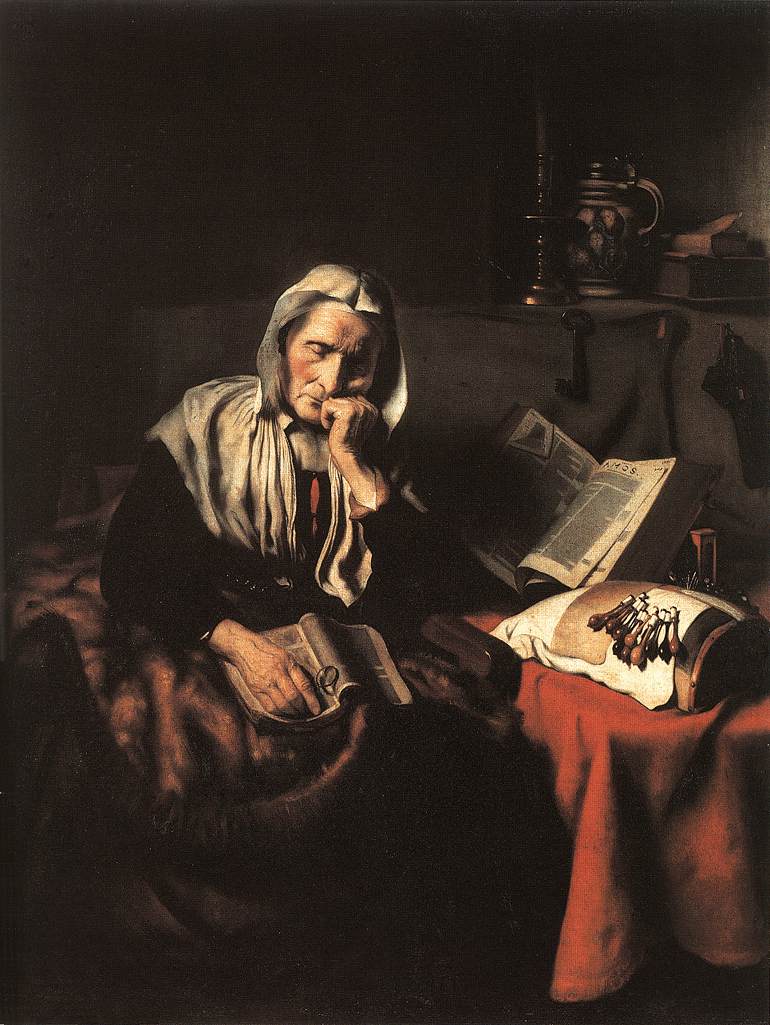
Old Woman Dozing
Nicolaes Maes [Web Gallery of Art]

Therefore, stay awake, for you do not know on what day your Lord is coming (Matthew 24:42; Gospel).

Readings (Jerusalem Bible: Australia, Ireland, New Zealand)

Readings (English Standard Version, Catholic Edition: (England & Wales, Scotland, India)

Readings (New American Bible: Philippines, USA)

Gospel Matthew 24: 37-44 (English Standard Version, Anglicised)

At that time: Jesus said to his disciples: ‘For as were the days of Noah, so will be the coming of the Son of Man. For as in those days before the flood they were eating and drinking, marrying and giving in marriage, until the day when Noah entered the ark, and they were unaware until the flood came and swept them all away, so will be the coming of the Son of Man. Then two men will be in the field; one will be taken and one left. Two women will be grinding at the mill; one will be taken and one left. Therefore, stay awake, for you do not know on what day your Lord is coming. But know this, that if the master of the house had known in what part of the night the thief was coming, he would have stayed awake and would not have let his house be broken into. Therefore you also must be ready, for the Son of Man is coming at an hour you do not expect.’

Léachtaí i nGaeilge


The Infant Jesus Distributing Bread to Pilgrims

Since we are travellers and pilgrims in the world, let us ever ponder on the end of the road, that is of our life, for the end of our roadway is our home (St Columban, 8th sermon).

The above text is at the top of the home page of this blog. St Columban's words, written more than 1,400 years ago, remind me of the destination God desires for me and for all of us: heaven.

The texts of today's Mass invite us to focus on that end and on Jesus Christ, God who became Man. Put on the Lord Jesus Christ St Paul tells us in the Second Reading (Let your armour be Jesus Christ, in the Jerusalem Bible translation). In the Collect (Opening Prayer) the priest addresses God the Father on our behalf with these words: Grant your faithful, we pray, almighty God, to resolve to run forth to meet your Christ with righteous deeds at his comingso that, gathered at his right hand, they may be worthy to possess the heavenly kingdom . . .

This prayer alludes to the The Final Judgment in Matthew 25, where those joyfully running forth to meet your Christ will be gathered at his right hand. And the words running forth remind me of the welcome his father gave to the Prodigal Son: But while he was still a long way off, his father saw him and felt compassion, and ran and embraced him and kissed him (Luke 15). Whether we are running forth to meet Christ or the Father is running to embrace and kiss us, there is that strong note of joy. I believe that this is what Jesus meant at the Last Supper when he said to the Apostles: These things I have spoken to you, that my joy may be in you, and that your joy may be full (John 15:11).

On the same occasion Jesus told the Apostles what heaven is: And this is eternal life, that they know you the only true God, and Jesus Christ whom you have sent (John 17:3).

These words of Jesus tell us absolutely clearly that our faith as Christians is one of relationship, coming to know our Father through Jesus Christ and to be with them for ever.

The Prayer over the Offerings focuses on the theme of eternal life: Accept, we pray, O Lord, these offerings we make, gathered from among your gifts to us, and may what you grant us to celebrate devoutly here below, gain for us the prize of eternal redemption . . . The prayer reminds us also that everything we have and the eternal life that the Father wants for us are pure gift from God.

The Prayer after Communion reinforces St Columban's words that the end of our roadway is our home. The priest prays on our behalf: May these mysteries, O Lord, in which we have participated, profit us, we pray, for even, as we walk amid passing things, you teach us to love the things of heaven and hold fast to what endures . . .

In Advent we prepare to celebrate at Christmas the First Coming of Jesus Christ - And the Word became flesh and dwelt among us (John 1:14) - and we prepare for his Second Coming in glory at the end of time when we hope to run forth to meet Christ at the Last Judgment. 

But during Advent we also prepare to meet Jesus in our daily lives, particularly through these mysteries in which we participate. These mysteries above all are the celebration of the Holy Sacrifice of the Mass. From the earliest days of the Church this has been celebrated by Christians gathering together on Sunday, the Lord's Day, the day on which Jesus rose from the dead, the Resurrection being at the heart of our faith. (It is incorrect to refer to Sunday as 'the Sabbath', the Jewish holy day observed every Saturday.) The Catechism of the Catholic Church reminds usOn Sundays and other holy days of obligation the faithful are bound to participate in the Mass. And as the response to the Responsorial Psalm reminds us, I rejoiced when I heard them say: 'Let us go to God's house.'

Listening to the Word of God at Mass and receiving the Risen Lord, in Holy Communion prepare us to recognise Him in the many ways He comes to us in our daily lives. In the painting above, The Infant Jesus Distributing Bread to Pilgrims, Murillo is foreshadowing the Eucharist in which the same Jesus, now the Risen Lord, gives himself 'Body and Blood, Soul and Divinity' to us to strengthen our faith by putting on the Lord Jesus, as St Paul tells us. 

This is how the Lord prepares us to be ready whenever and in whatever way He will come.


Locus Iste
Music by Anton Bruckner, sung by Voces8

Locus iste a Deo factus est, inaestimabile sacramentum irreprehensibilis est.

This place is made by God, inestimably sacred, irreprehensible.

Response to Responsorial Psalm (Ps 121 [122]:1)

I rejoiced when I heard them say: 'Let us go to God's house.'


Traditional Latin Mass

First Sunday of Advent

The Complete Mass in Latin and English is here. (Adjust the date at the top of that page to 11-30-2025 if necessary).

Epistle: Romans 13:11-14Gospel: Luke 21:25-33.

San Giorgio Maggiore at Dawn

The night is far gone, the day is at hand. Let us then cast off the works of darkness and put on the armor of light (Romans 13:12; Epistle).


29 June 2022

Bono, Pope Benedict XVI and Spe Salvi


Bono

[Wikipedia; photo]


Paul David Hewson, the U2 member better known as Bono, spoke recently with Lauren Laverne on Desert Island Discs, a long-running radio programme on the BBC, about his half-brother and his at times difficult relationship with his father, Bob Hewson. 

Sinéad Crowley, the Arts and Media correspondent of RTÉ, Ireland’s national broadcaster, in her report on this wrote: 

Bono (62) also spoke to Laverne about how his relationship with his father came under tremendous strain following the death of his mother, although he now admits he was partly to blame, adding that after Bob's death in 2001, he apologised to him during a visit to a chapel in France.

'There was nobody there, I lit a candle and I got on my knees, and I just said, “look, I’m sorry I wasn’t there for you, you went through a lot and please forgive me”, and I felt free,’ Bono said.


Pope Benedict XVI in 2006

What Bono did reminded me of a beautiful passage in Spe Salvi, the Latin title of Pope Benedict's encyclical issued in 2007, words taken from Romans 8:24, in hope we were saved. I have often used this passage, section 48 of the encyclical, at funerals. I have highlighted some parts.

The belief that love can reach into the afterlife, that reciprocal giving and receiving is possible, in which our affection for one another continues beyond the limits of death—this has been a fundamental conviction of Christianity throughout the ages and it remains a source of comfort today. Who would not feel the need to convey to their departed loved ones a sign of kindness, a gesture of gratitude or even a request for pardon?

. . . We should recall that no man is an island, entire of itself. Our lives are involved with one another . . . The lives of others continually spill over into mine: in what I think, say, do and achieve. And conversely, my life spills over into that of others: for better and for worse. So my prayer for another is not something extraneous to that person, something external, not even after death. In the interconnectedness of Being, my gratitude to the other—my prayer for him—can play a small part in his purification. And for that there is no need to convert earthly time into God's time: in the communion of souls simple terrestrial time is superseded. It is never too late to touch the heart of another, nor is it ever in vain. In this way we further clarify an important element of the Christian concept of hope. Our hope is always essentially also hope for others; only thus is it truly hope for me too.


No Man is an Island
by John Donne

Pope Benedict quotes from this poem in the passage from Spe Salvi above .


I Still Haven't Found What I'm Looking For
U2 with a gospel choir in Harlem. Lyrics here.

Since we are travellers and pilgrims in the world, let us ever ponder on the end of the road, that is of our life, for the end of our roadway is our home (St Columban, 8th sermon).

17 June 2021

'The love of Christ overwhelms us.' Sunday Reflections, 12th Sunday in Ordinary Time Year B


Christ in the Storm on the Sea of Galilee
Rembrandt [Web Gallery of Art]

Readings (Jerusalem Bible: Australia, England & Wales, India [optional], Ireland, New Zealand, Pakistan, Scotland)

Readings (New American Bible: Philippines, USA)

Gospel Mark 4:35-41 (English Standard Version, Anglicised)

On that day, when evening had come, he said to them, “Let us go across to the other side.”  And leaving the crowd, they took him with them in the boat, just as he was. And other boats were with him. And a great windstorm arose, and the waves were breaking into the boat, so that the boat was already filling. But he was in the stern, asleep on the cushion. And they woke him and said to him, “Teacher, do you not care that we are perishing?” And he awoke and rebuked the wind and said to the sea, “Peace! Be still!” And the wind ceased, and there was a great calm. He said to them, “Why are you so afraid? Have you still no faith?” And they were filled with great fear and said to one another, “Who then is this, that even the wind and the sea obey him?”


Léachtaí i nGaeilge


The very first pastoral visit outside of Rome of Pope Francis was to the small island of Lampedusa, the most southerly part of Italy. He went there on 8 July 2013 because of his concern about the plight of many migrants and refugees trying to get from North Africa to Europe through Lampedusa and the many who died in trying to do so. The vast majority of these were exploited 'boat people' who had spent all they had, handing over their money to unscrupulous persons who were becoming rich by living off the poor and not caring whether they lived or died.

In his homily that day Pope Francis asked, Has any one of us grieved for the death of these brothers and sisters? Has any one of us wept for these persons who were on the boat? For the young mothers carrying their babies? For these men who were looking for a means of supporting their families? 

The question the Pope asked in a way echoes that of the Apostles in the boat to Jesus: Teacher, do you not care that we are perishing? 

 Eithne, Mediterranean, 2015

In May 2015 LÉ Eithne, the flagship of the Irish Naval Service with a crew of 55, engaged in Operation Sophia in the Mediterranean along with ships of navies of other European Union countries, in an effort to rescue 'boat people' trying to cross from Libya to Europe. Between May and November that year this small vessel rescued 8,592 men women and children. By the time Operation Sophia ended in 2017 Irish naval vessels had rescued more than 10,000 refugees. At the moment the Irish Naval Service has a total personnel of fewer than 1,100, with only five of its nine ships in service due to a lack of recruits.

It is estimated that between 2014 and the present around 21,000 undocumented immigrants have died trying to reach Italy from North Africa, 2016 being the worst year

So this Sunday's gospel speaks to us of a situation that is all too common in the contemporary world.

The Apostles discovered that Jesus did care: he awoke and rebuked the wind and said to the sea, 'Peace! Be still!' And he shows that same care to the refugees in the Mediterranean and in other parts of the world through the authorities, agencies and individuals who are trying to alleviate their immediate dangerous situations while others try to deal with the roots and causes of those situations.

There is an expression in the English language, 'We're all in the same boat', meaning especially in a difficult or dangerous situation that all are equal and all are responsible in some way for changing that situation. In his encyclical, Laudato Si': On Care for Our Common Home, Pope Francis echoes this (No 13): The urgent challenge to protect our common home includes a concern to bring the whole human family together to seek a sustainable and integral development, for we know that things can change. The Creator does not abandon us; he never forsakes his loving plan or repents of having created us. Humanity still has the ability to work together in building our common home. 

We can and should pray for all those caught up in the human tragedy of refugees and asylum seekers desperately seeking a better life as they flee from areas of conflict and hopelessness, being exploited ruthlessly by others in their plight - surely an expression of the reality of evil, of sin and of the Devil that Pope Francis frequently speaks about - and often losing their lives in the process. And we can and should pray for those working with refugees, whether in emergency situations or at the level of administration where important decisions are made about the future of individuals and families.

And the Second Reading, though it's not thematically related to the First Reading and the Gospel which are related, gives us some points to consider. The Jerusalem Bible translation reads, The love of Christ overwhelms us. Other versions give, The love of Christ controls us / urges us on / compels us / impels us / presseth us / is a compelling motive . . . But the Jerusalem Bible evokes for me, in the context of the other two readings, a great wave of God's love as distinct from a wave of destruction.

The Great Wave off Kanagawa
Katsushika Hokusai [WikipediaSource of illustration]

The Second Reading also speaks of creation: From now on, therefore, we regard no one according to the flesh. Even though we once regarded Christ according to the flesh, we regard him thus no longer. Therefore, if anyone is in Christ, he is a new creation. The old has passed away; behold, the new has come. By virtue of our baptism each of us is a new creation. And by virtue of the mission that Jesus gave all of us who are baptised to Go into all the world and proclaim the gospel to the whole creation (Mark 16:15) we are called to let every human being know that God wants each of them to be in Christ so as to be a new creation

We are called not just to rescue people in danger of drowning but rather to invite people to join us on the Barque of Peter - the ship that is the Church - so that they may come to know the Lord Jesus who, through his Holy Spirit, wants to lead us to our eternal home. We must never lose sight of our central mission as Church.

To mix metaphors, I conclude with a quotation from the Eighth Sermon of St Columban that I use at the top of the homepage of this blog: Since we are travellers and pilgrims in the world, let us ever ponder on the end of the road, that is of our life, for the end of our roadway is our home.


Responsorial Psalm [NAB - Philippines, USA]

Fr John Moran
(22 June 1926 - 11 June 2021)

Please pray for Columban Father John Moran who died last week in Bristol, Rhode Island. We were together in the Columban college formation program in Cebu City in the early 1990s. He was a delightful person to live with, a true Christian gentleman and a great example to our seminarians.

Father John loved sailing and had a small boat in Bristol, where the Columban retirement home, formerly a seminary, is by the sea. The name of the boat is Santo Niño (Holy Child). May the Lord who rebuked the wind and said to the sea, “Peace! Be still!" welcome Father John into a safe harbour.

Sailing By
Composed by Ronald Binge
Played by The Perry-Gardner Orchestra


Extraordinary Form of the Mass

Traditional Latin Mass (TLM) 

Fourth Sunday after Pentecost 

The Complete Mass in Latin and English is here. (Adjust the date at the top of that page to 6-20-2021 if necessary).

Epistle: Romans 8:18-23.  Gospel: Luke 5:1-1i.


Authentic Beauty

Authentic beauty, however, unlocks the yearning of the human heart, the profound desire to know, to love, to go towards the Other, to reach for the Beyond.

Pope Benedict XVI meeting with artists in the Sistine Chapel, 21 November 2009.

The Padstow Lifeboat
Composed by Sir Malcolm Arnold
Played by the St Dennis Band

The village of St Dennis, where the band is from, is 25 minutes by car from Padstow and 45 minutes from Carbis Bay, where the recent G7 summit meeting was held. These places are all in Cornwall in south-west England. The Volunteers of the Royal National Lifeboat Institution (RNLI) have saved countless lives off the coasts of Britain and Ireland down the years.

17 November 2020

‘Come, you who are blessed by my Father.' Sunday Reflections, Solemnity of Christ the King, Year A

The Last Judgement, Michelangelo 

Readings (New American Bible: Philippines, USA)

Readings (Jerusalem Bible: Australia, England & Wales, Ireland, New Zealand, Pakistan, Scotland, South Africa)

Gospel Matthew 25:31-46 (English Standard Version Anglicised: India)

Jesus said to his disciples:

 “When the Son of Man comes in his glory, and all the angels with him, then he will sit on his glorious throne. Before him will be gathered all the nations, and he will separate people one from another as a shepherd separates the sheep from the goats. And he will place the sheep on his right, but the goats on the left. Then the King will say to those on his right, ‘Come, you who are blessed by my Father, inherit the kingdom prepared for you from the foundation of the world. For I was hungry and you gave me food, I was thirsty and you gave me drink, I was a stranger and you welcomed me, I was naked and you clothed me, I was sick and you visited me, I was in prison and you came to me.’ Then the righteous will answer him, saying, ‘Lord, when did we see you hungry and feed you, or thirsty and give you drink? And when did we see you a stranger and welcome you, or naked and clothe you? And when did we see you sick or in prison and visit you?’ And the King will answer them, ‘Truly, I say to you, as you did it to one of the least of these my brothers, you did it to me.’

“Then he will say to those on his left, ‘Depart from me, you cursed, into the eternal fire prepared for the devil and his angels. For I was hungry and you gave me no food, I was thirsty and you gave me no drink, I was a stranger and you did not welcome me, naked and you did not clothe me, sick and in prison and you did not visit me.’ Then they also will answer, saying, ‘Lord, when did we see you hungry or thirsty or a stranger or naked or sick or in prison, and did not minister to you?’ Then he will answer them, saying, ‘Truly, I say to you, as you did not do it to one of the least of these, you did not do it to me.’ And these will go away into eternal punishment, but the righteous into eternal life.”


Léachtaí i nGaeilge


St Elizabeth of Hungary 
Sándor Liezen-Mayer [Web Gallery of Art]

In November 1974 some members of the Praesidium of the Legion of Mary of which I was spiritual director came to me and told me of two starving children, a brother and sister, that they had come across on home visitation. The Legionaries were students in the college department of what was then Immaculate Conception College, Ozamiz City, where I was chaplain. At the time ICC was run by the Columban Sisters. It is now La Salle University, under the care of the De La Salle Brothers.

We arranged with the parents to take the two children to the local government hospital. When I saw Linda, as I will call her, I thought she was a malnourished eight-year-old. I was utterly shocked when I learned that she was twelve. Her brother, whom I'll call Nonoy, was five. His ribs were sticking out and his stomach severely bloated. The eldest in the family, a girl aged 13 or 14, showed no signs of malnutrition. This was the first time I had ever met anyone with signs of starvation. I never discovered why the children were in such a state.

After a few days Linda began to shyly smile and slowly got a little better, due to the nourishment and attention she was getting. But Nonoy showed no signs of improvement. He died two days before Christmas, without once smiling. We buried him on Christmas Eve.

Linda was able to go home and on at least one occasion we took her on an outing. She was still very small for her age but always cheerful whenever we met her. However, the severe malnutrition had taken its toll and she died in September 1976 while I was at home in Ireland.


St Martin and the Beggar
El Greco [Web Gallery of Art]


Today's Gospel makes me both fearful and hopeful.

Fearful, because Jesus speaks such harsh language: Depart from me, you cursed, into the eternal fire prepared for the devil and his angels. This is not 'the Church of nice'.

Hopeful, because Linda and Nonoy will be there at the Last Judgment to speak on my behalf.

St Martin de Porres OP 

This portrait was painted during his lifetime or very soon after his death, hence it is probably the most true to his appearance.

During November the Church honours three saints noted for their extraordinary love for the poor, St Martin de Porres (1579 - 1639) on the 3rd, St Martin of Tours (316 - 397) on the 11th and St Elizabeth of Hungary (1207 - 1231) on the 17th. These three gave of their very self. These exemplified in their lives what Jesus is teaching us in today's gospel.

El Greco is one of many artists who have depicted the scene of St Martin of Tours, then a young soldier and preparing for baptism, giving half of his cloak in the depths of winter to a beggar clad only in rags. The following night, the story continues, Martin in his sleep saw Jesus Christ, surrounded by angels, and dressed in the half of the cloak he had given away. A voice bade him look at it well and say whether he knew it. He then heard Jesus say to the angels, 'Martin, as yet only a catechumen, has covered me with his cloak.' Sulpicius Severus, the saint's friend and biographer, says that as a consequence of this vision Martin 'flew to be baptized'.

Sándor Liezen-Mayer in his painting of St Elizabeth of Hungary above, shows her protecting a young mother and baby with her cloak. The saint herself was a young mother. She married at 14, bore three children and was widowed at 20. The painting reminds me of a beautiful Irish blessing, Faoi bhrat Mhuire thú/sibh ('May thou/you be protected by the cloak of Mary'). The young saint, who was only 24 when she died, followed the example of St Francis, with the blessing of her husband, lived very simply and served the poor and the sick each day personally and ate with them at the same table.

Shrine of St Martin de Porres in Lima 

St Martin de Porres, born outside of marriage and of mixed blood, learned some of the medical arts by working with a barber/surgeon in his young days. He devoted his life as a Dominican lay brother to caring for the sick, whether they were rich or poor. It was mostly the latter who came to him and whom he went looking for. Like St Francis he had a special closeness to animals and people brought these to him to be healed. He is often depicted carrying a broom, with a dog, a cat and a mouse at his feet eating from the same plate. 

These three saints from different social backgrounds wrestled with situations we wrestle with today. They spent themselves in bringing about the Kingdom of God by serving the very poorest. St Martin of Tours, who like St Elizabeth was born in Hungary, asked himself as a soldier if it was proper to engage in battle, where he would kill others. Wikipedia tells usRegardless of whether or not he remained in the army, academic opinion holds that just before a battle with the Gauls at Borbetomagus (now Worms, Germany), Martin determined that his faith prohibited him from fighting, saying, 'I am a soldier of Christ. I cannot fight.' He was charged with cowardice and jailed, but in response to the charge, he volunteered to go unarmed to the front of the troops. His superiors planned to take him up on the offer, but before they could, the invaders sued for peace, the battle never occurred, and Martin was released from military service.

Conscientious objection doesn't only concern those called to join an army. A Swedish midwife,  Ellinor Grimmark, was fired in 2014 for refusing to do abortions. This is an area where, more and more, individuals will have to make choices that may involve losing their jobs, or even worse. (In 2017 a Swedish court ruled against Ellinor Grimmark).

The world is still overwhelmed with the needs of those trapped in poverty, victims of wars, of natural calamities. Pope Francis has spoken of the Church as being 'a field hospital'. He has asked priests and others to know 'the smell of the sheep'. St Elizabeth of Hungary and St Martin de Porres immersed themselves in that every day, seeing in each one they served Jesus Christ himself. And those they took care of, whether they were aware of it or not, were being served by Jesus himself through those saints and through the many others down the centuries who have been doing the same.

I am certain that Linda and Nonoy will hear Jesus say to them, Come, you who are blessed by my Father . . . I hope and pray that they and others like them who have crossed my path down the years will put in a good word for me so that I will hear Jesus say the same to me.


Christus Vincit! Christus Regnat! Christus Imperat!
Christ Conquers! Christ Rules! Christ Commands!

This very ancient Latin hymn, which is a litany, is also known as Laudes Regiae. In the video above it is sung in St Mary's Cathedral, Tokyo.

Extraordinary Form of the Mass

Traditional Latin Mass (TLM) 

This Sunday, 22 November, is the Twenty-fourth and Last Sunday after Pentecost in the calendar that uses the TLM.

The complete Mass in Latin and English is here. (Adjust the date at the top of that page to 11-22-2020, if necessary).

Epistle: Colossians 1:9-14. Gospel: Matthew 24:13-35.


St Columban's Day

23 November 

At the Crypt of St Columban, Bobbio, Italy, June 2015

Be helpful when you are at the bottom of the ladder and be the lowest when you are in authority . . . Be submissive to good, unbending to evil, gentle in generosity, untiring in love, just in all things. Be respectful to the worthy, respectful to the poor. Be mindful of favours, unmindful of wrongs. Be a lover of the ordinary man, and don't wish for riches, but cool down excitement and speak your mind.

From a letter of St Columban to a young disciple, c. AD. 610.

Happy St Columban's Day to my fellow Columbans and to our benefactors!

Authentic Beauty

Authentic beauty, however, unlocks the yearning of the human heart, the profound desire to know, to love, to go towards the Other, to reach for the Beyond.

Pope Benedict XVI meeting with artists in the Sistine Chapel, 21 November 2009.

The Promise of Living
Composed by Aaron Copland, arranged by John Williams 
Words by Horace Everett


Happy American Thanksgiving Day!
26 November