Showing posts with label Nicolaes Maes. Show all posts

28 November 2025

Sunday Reflections, 1st Sunday of Advent, Year A, 30 November 2025


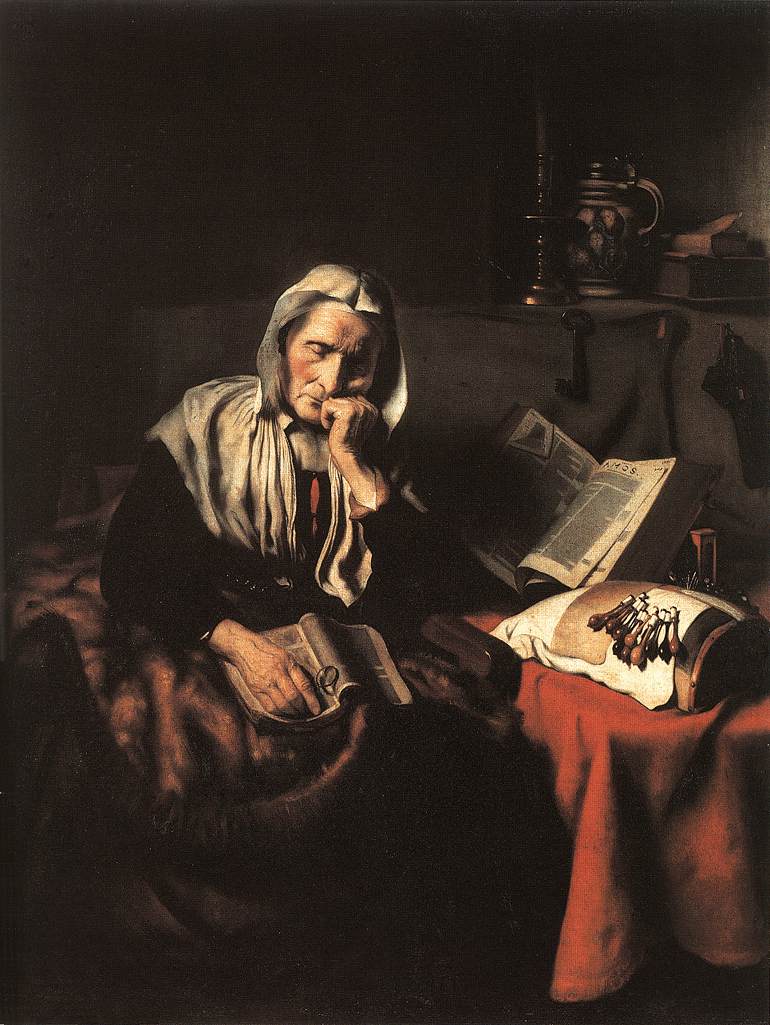
Old Woman Dozing
Nicolaes Maes [Web Gallery of Art]

Therefore, stay awake, for you do not know on what day your Lord is coming (Matthew 24:42; Gospel).

Readings (Jerusalem Bible: Australia, Ireland, New Zealand)

Readings (English Standard Version, Catholic Edition: (England & Wales, Scotland, India)

Readings (New American Bible: Philippines, USA)

Gospel Matthew 24: 37-44 (English Standard Version, Anglicised)

At that time: Jesus said to his disciples: ‘For as were the days of Noah, so will be the coming of the Son of Man. For as in those days before the flood they were eating and drinking, marrying and giving in marriage, until the day when Noah entered the ark, and they were unaware until the flood came and swept them all away, so will be the coming of the Son of Man. Then two men will be in the field; one will be taken and one left. Two women will be grinding at the mill; one will be taken and one left. Therefore, stay awake, for you do not know on what day your Lord is coming. But know this, that if the master of the house had known in what part of the night the thief was coming, he would have stayed awake and would not have let his house be broken into. Therefore you also must be ready, for the Son of Man is coming at an hour you do not expect.’

Léachtaí i nGaeilge


The Infant Jesus Distributing Bread to Pilgrims

Since we are travellers and pilgrims in the world, let us ever ponder on the end of the road, that is of our life, for the end of our roadway is our home (St Columban, 8th sermon).

The above text is at the top of the home page of this blog. St Columban's words, written more than 1,400 years ago, remind me of the destination God desires for me and for all of us: heaven.

The texts of today's Mass invite us to focus on that end and on Jesus Christ, God who became Man. Put on the Lord Jesus Christ St Paul tells us in the Second Reading (Let your armour be Jesus Christ, in the Jerusalem Bible translation). In the Collect (Opening Prayer) the priest addresses God the Father on our behalf with these words: Grant your faithful, we pray, almighty God, to resolve to run forth to meet your Christ with righteous deeds at his comingso that, gathered at his right hand, they may be worthy to possess the heavenly kingdom . . .

This prayer alludes to the The Final Judgment in Matthew 25, where those joyfully running forth to meet your Christ will be gathered at his right hand. And the words running forth remind me of the welcome his father gave to the Prodigal Son: But while he was still a long way off, his father saw him and felt compassion, and ran and embraced him and kissed him (Luke 15). Whether we are running forth to meet Christ or the Father is running to embrace and kiss us, there is that strong note of joy. I believe that this is what Jesus meant at the Last Supper when he said to the Apostles: These things I have spoken to you, that my joy may be in you, and that your joy may be full (John 15:11).

On the same occasion Jesus told the Apostles what heaven is: And this is eternal life, that they know you the only true God, and Jesus Christ whom you have sent (John 17:3).

These words of Jesus tell us absolutely clearly that our faith as Christians is one of relationship, coming to know our Father through Jesus Christ and to be with them for ever.

The Prayer over the Offerings focuses on the theme of eternal life: Accept, we pray, O Lord, these offerings we make, gathered from among your gifts to us, and may what you grant us to celebrate devoutly here below, gain for us the prize of eternal redemption . . . The prayer reminds us also that everything we have and the eternal life that the Father wants for us are pure gift from God.

The Prayer after Communion reinforces St Columban's words that the end of our roadway is our home. The priest prays on our behalf: May these mysteries, O Lord, in which we have participated, profit us, we pray, for even, as we walk amid passing things, you teach us to love the things of heaven and hold fast to what endures . . .

In Advent we prepare to celebrate at Christmas the First Coming of Jesus Christ - And the Word became flesh and dwelt among us (John 1:14) - and we prepare for his Second Coming in glory at the end of time when we hope to run forth to meet Christ at the Last Judgment. 

But during Advent we also prepare to meet Jesus in our daily lives, particularly through these mysteries in which we participate. These mysteries above all are the celebration of the Holy Sacrifice of the Mass. From the earliest days of the Church this has been celebrated by Christians gathering together on Sunday, the Lord's Day, the day on which Jesus rose from the dead, the Resurrection being at the heart of our faith. (It is incorrect to refer to Sunday as 'the Sabbath', the Jewish holy day observed every Saturday.) The Catechism of the Catholic Church reminds usOn Sundays and other holy days of obligation the faithful are bound to participate in the Mass. And as the response to the Responsorial Psalm reminds us, I rejoiced when I heard them say: 'Let us go to God's house.'

Listening to the Word of God at Mass and receiving the Risen Lord, in Holy Communion prepare us to recognise Him in the many ways He comes to us in our daily lives. In the painting above, The Infant Jesus Distributing Bread to Pilgrims, Murillo is foreshadowing the Eucharist in which the same Jesus, now the Risen Lord, gives himself 'Body and Blood, Soul and Divinity' to us to strengthen our faith by putting on the Lord Jesus, as St Paul tells us. 

This is how the Lord prepares us to be ready whenever and in whatever way He will come.


Locus Iste
Music by Anton Bruckner, sung by Voces8

Locus iste a Deo factus est, inaestimabile sacramentum irreprehensibilis est.

This place is made by God, inestimably sacred, irreprehensible.

Response to Responsorial Psalm (Ps 121 [122]:1)

I rejoiced when I heard them say: 'Let us go to God's house.'


Traditional Latin Mass

First Sunday of Advent

The Complete Mass in Latin and English is here. (Adjust the date at the top of that page to 11-30-2025 if necessary).

Epistle: Romans 13:11-14Gospel: Luke 21:25-33.

San Giorgio Maggiore at Dawn

The night is far gone, the day is at hand. Let us then cast off the works of darkness and put on the armor of light (Romans 13:12; Epistle).


03 May 2024

Little girl to priest: 'Father, are you angry with God?' Sunday Reflections, 6th Sundah of Easter, Year B


The Little Fruit Seller

Readings (Jerusalem Bible: Australia, England & Wales, Ireland, New Zealand, Pakistan, Scotland)

Readings (New American Bible: Philippines, USA)

Gospel  John 15:9-17  (English Standard Version, Anglicised)

Jesus said to his disciples:

“As the Father has loved me, so have I loved you. Abide in my love. If you keep my commandments, you will abide in my love, just as I have kept my Father's commandments and abide in his love. These things I have spoken to you, that my joy may be in you, and that your joy may be full.

“This is my commandment, that you love one another as I have loved you. Greater love has no one than this, that someone lay down his life for his friends. You are my friends if you do what I command you. No longer do I call you servants, for the servant does not know what his master is doing; but I have called you friends, for all that I have heard from my Father I have made known to you. You did not choose me, but I chose you and appointed you that you should go and bear fruit and that your fruit should abide, so that whatever you ask the Father in my name, he may give it to you. These things I command you, so that you will love one another."


Léachtaí i nGaeilge


The video above is from the Ecumenical Evening Prayer in Westminster Abbey, London, on 17 September 2010 during the visit of Pope Benedict XVI to Britain. He is with Anglican Archbishop Rowan Williams of Canterbury.

This is a setting by Thomas Tallis (c.1505 - 1585) of today's Communion Antiphon with the first part of John 14:17 added.

If ye love me, keep my commandments,
and I will pray the Father,
and he shall give you another comforter,
that he may 'bide with you forever,
e'en the spirit of truth. (John 14:15-17)

Communion Antiphon   Antiphona ad communionem (Jn 14:15-16) 

Si diligitis me, mandata mea servate, dicit Dominus. Et ego rogabo Patrem, et alium Paraclitum dabit vobis, ut maneat vobiscum in aeternum, alleluia.

If you love me, keep my commandments, says the Lord, and I will ask the Father and he will send you another Paraclete, to abide with you for ever, alleluia.

Christ Blessing the Children
Nicolaes Maes [Web Gallery of Art]

In May 2015 I gave a retreat to the Missionary Sisters of the Catechism in Lipa City, south of Manila. The Sisters have a house dedicated to Our Lady of Guadalupe where they take care of elderly and sick women whom they refer to as the lolas, the 'grandmas'. In another part of the compound they had at the time a group of orphans, five young boys and six young girls. (If my memory is correct the Sisters were planning to build an orphanage). Four of the boys served Mass every morning, including 'Zacchaeus', as the Sisters called him, the youngest of them and small, proudly wearing his white cassock like the others. 'Zacchaeus' wasn't yet old enough to make his First Holy Communion or First Confession. His role as a server was to hold up the small white towel - and he really had to stretch to do so - when the priest washed his hands during the Offertory.

The youngest of the girls was Chiara, aged four or five at the time. The children were present at lunch on the last day of the retreat, which had a celebratory air to it. I noticed after I had said Grace Before Meals that Chiara was somewhat tearful. Then I discovered that on such occasions she led the community in a Hail Mary as part of Grace. So the Sisters encouraged her to do so even though this visiting priest had pre-empted her. After a little hesitation and the drying of her tears she prayerfully led us all in the Hail Mary and then invoked the protectors of the Congregation - Our Lady of Good Counsel, St Joseph, St Veronica Giuliani, St Gemma Galgani and St Bernadette Soubirous.


The Prayer Before Meal
Jean-Baptiste-Siméon Chardin [Web Gallery of Art]

During the retreat I told a number of stories of seemingly insignificant events where God had revealed himself to me through the actions of children and of older persons without their being aware of it. Then on the way back to Manila after the retreat Sister Evelyn Cortes SMC, whose family I have known since she was in high school in Tangub City, Misamis Occidental, and Sister Eppie Resano SMC told me a story about Chiara where she showed an understanding of what this Sunday's Second Reading is all about, without being aware of it.

Beloved, let us love one another, for love is from God, and whoever loves has been born of God and knows God. Anyone who does not love does not know God, because God is love. In this the love of God was made manifest among us, that God sent his only Son into the world, so that we might live through him. In this is love, not that we have loved God but that he loved us and sent his Son to be the propitiation for our sins (1 John 4:7-10).

Some time before I gave the retreat a missionary priest visited the Sisters and celebrated Mass for them. Little Chiara saw him as being very severe in his demeanour. After Mass she tugged on his cassock and asked him, Father, are you angry with God? It seems that the following morning he wasn't quite as severe looking!

Some may be angry with God. I don't think that God is too perturbed about that when he knows that the source of our anger may be bewilderment over tragedies in our lives, for example, just as we allow those whom we love to vent their anger on us because basically they trust us and we have some idea of the source of their anger.

Perhaps a more common experience, especially among persons who are serious about following Jesus faithfully but who try to live as if God's love had to be earned, as if it could be earned, is the idea that God is angry with us or very distant from us.

St John tells us so beautifully what the situation really is: In this is love, not that we have loved God but that he loved us and sent his Son to be the propitiation for our sins.

Most of the Gospel readings on the Sundays and weekdays of Easter are taken from John 13-17, the Last Supper Discourse in which Jesus speaks to each of us with intense love about the intimacy into which he calls us personally through our baptism. In today's Gospel Jesus says to each of us, speaking from his heart to ours - Cor ad cor loquiter, 'Heart speaks to heart', as St John Henry Cardinal Newman emphasised on his coat-of-arms - As the Father has loved me, so have I loved you. Abide in my love . . . This is my commandment, that you love one another as I have loved you . . . You are my friends . . . You did not choose me, but I chose you . . . The initiative comes from God. Love comes from God and our loving response to that love is itself a gift from God. We do not and cannot earn God's love. God who is love gives us himself as pure gift.

How can such a God be angry with us and how can we be angry - choosing to remain angry as distinct from a spontaneous feeling - with such a God?

In this is love, not that we have loved God but that he loved us and sent his Son to be the propitiation for our sins (1 John 4:10). 
 

For the LORD takes delight in his people; 
he crowns the poor with salvation (Psalm 149:4, Grail translation).


Alleluia from Exsultate, jubilate
Composer: Mozart
Soprano: Khánh Ngc, pianist: Phuc Phan
St Joseph's Cathedral, Hanoi, Vietnam, 21 December 2021

Although this was recorded during Advent, Alleluia - Praise God is preeminently an Easter song. The Hebrew word Alleluia is the same in whatever languages Christians sing or pray. In the Northern Hemisphere Easter always falls in springtime which produces many yellow flowers, of which the blouse worn by singer Khánh Ngc reminded me. And an ancient Hebrew word, set to music by an 18th-century Austrian who died at the age of 35, is sung to praise God in the cathedral in Hanoi by a young Vietnamese in a country where the Church has undergone persecution and where the people suffered from war for many decades. We truly are called to be disciples of Jesus crucified and now risen from the dead, with the hope of eternal life that that brings. Alleluia!


Traditional Latin Mass

Fifth Sunday after Easter

The Complete Mass in Latin and English is here. (Adjust the date at the top of that page to 05-05-2024 if necessary).

Epistle: James 1:22-27. Gospel: John 16:23-30.


St Elizabeth of Hungary
Sándor Liezen-Mayer [Web Gallery ofArt]

Religion that is pure and undefiled before God and the Father is this: to visit orphans and widows in their affliction, and to keep oneself unstained from the world (James 1:27; Epistle).

25 November 2022

'Let us go to God's house.' Sunday Reflections, 1st Sunday of Advent, Year A


Old Woman Dozing
Nicolaes Maes [Web Gallery of Art]

Therefore, stay awake, for you do not know on what day your Lord is coming (Matthew 24:42; Gospel).

Readings (Jerusalem Bible: Australia, England & Wales, India [optional], Ireland, New Zealand, Pakistan, Scotland, South Africa)

Readings (New American Bible: Philippines, USA)

Gospel Matthew 24:37-44 (English Standard Version Anglicised: India)

Jesus said to his disciples:

For as were the days of Noah, so will be the coming of the Son of Man. For as in those days before the flood they were eating and drinking, marrying and giving in marriage, until the day when Noah entered the ark, and they were unaware until the flood came and swept them all away, so will be the coming of the Son of Man. Then two men will be in the field; one will be taken and one left. Two women will be grinding at the mill; one will be taken and one left. 

Therefore, stay awake, for you do not know on what day your Lord is coming. But know this, that if the master of the house had known in what part of the night the thief was coming, he would have stayed awake and would not have let his house be broken into. Therefore you also must be ready, for the Son of Man is coming at an hour you do not expect.

Léachtaí i nGaeilge 


The Infant Jesus Distributing Bread to Pilgrims

Since we are travellers and pilgrims in the world, let us ever ponder on the end of the road, that is of our life, for the end of our roadway is our home (St Columban, 8th sermon).

The above text is at the top of the home page of this blog. St Columban's words, written more than 1,400 years ago, remind me of the destination God desires for me and for all of us: heaven.

The texts of today's Mass invite us to focus on that end and on Jesus Christ, God who became Man. Put on the Lord Jesus Christ St Paul tells us in the Second Reading (Let your armour be Jesus Christ, in the Jerusalem Bible translation). In the Collect (Opening Prayer) the priest addresses God the Father on our behalf with these words: Grant your faithful, we pray, almighty God, to resolve to run forth to meet your Christ with righteous deeds at his coming, so that, gathered at his right hand, they may be worthy to possess the heavenly kingdom . . .

This prayer alludes to the The Final Judgment in Matthew 25, where those joyfully running forth to meet your Christ will be gathered at his right hand. And the words running forth remind me of the welcome his father gave to the Prodigal Son: But while he was still a long way off, his father saw him and felt compassion, and ran and embraced him and kissed him (Luke 15). Whether we are running forth to meet Christ or the Father is running to embrace and kiss us, there is that strong note of joy. I believe that this is what Jesus meant at the Last Supper when he said to the Apostles: These things I have spoken to you, that my joy may be in you, and that your joy may be full (John 15:11).

On the same occasion Jesus told the Apostles what heaven is: And this is eternal life, that they know you the only true God, and Jesus Christ whom you have sent (John 17:3).

These words of Jesus tell us absolutely clearly that our faith as Christians is one of relationship, coming to know our Father through Jesus Christ and to be with them for ever.

The Prayer over the Offerings focuses on the theme of eternal life: Accept, we pray, O Lord, these offerings we make, gathered from among your gifts to us, and may what you grant us to celebrate devoutly here below, gain for us the prize of eternal redemption . . . The prayer reminds us also that everything we have and the eternal life that the Father wants for us are pure gift from God.

The Prayer after Communion reinforces St Columban's words that the end of our roadway is our home. The priest prays on our behalf: May these mysteries, O Lord, in which we have participated, profit us, we pray, for even, as we walk amid passing things, you teach us to love the things of heaven and hold fast to what endures . . .

In Advent we prepare to celebrate at Christmas the First Coming of Jesus Christ - And the Word became flesh and dwelt among us (John 1:14) - and we prepare for his Second Coming in glory at the end of time when we hope to run forth to meet Christ at the Last Judgment. 

But during Advent we also prepare to meet Jesus in our daily lives, particularly through these mysteries in which we participate. These mysteries above all are the celebration of the Holy Sacrifice of the Mass. From the earliest days of the Church this has been celebrated by Christians gathering together on Sunday, the Lord's Day, the day on which Jesus rose from the dead, the Resurrection being at the heart of our faith. (It is incorrect to refer to Sunday as 'the Sabbath', the Jewish holy day observed every Saturday.) The Catechism of the Catholic Church reminds usOn Sundays and other holy days of obligation the faithful are bound to participate in the Mass. And as the response to the Responsorial Psalm reminds us, I rejoiced when I heard them say: 'Let us go to God's house.'

Listening to the Word of God at Mass and receiving the Risen Lord, in Holy Communion prepare us to recognise Him in the many ways He comes to us in our daily lives. In the painting above, The Infant Jesus Distributing Bread to Pilgrims, Murillo is foreshadowing the Eucharist in which the same Jesus, now the Risen Lord, gives himself 'Body and Blood, Soul and Divinity' to us to strengthen our faith by putting on the Lord Jesus, as St Paul tells us. 

This is how the Lord prepares us to be ready whenever and in whatever way He will come.


Locus Iste
Music by Anton Bruckner, sung by Voces8

Locus iste a Deo factus est, inaestimabile sacramentum irreprehensibilis est.

This place is made by God, inestimably sacred, irreprehensible.

Response to Responsorial Psalm (Ps 121 [122]:1)

I rejoiced when I heard them say: 'Let us go to God's house.'


Traditional Latin Mass

First Sunday of Advent

The Complete Mass in Latin and English is here. (Adjust the date at the top of that page to 11-27-2022 if necessary).

Epistle: Romans 13:11-14. Gospel: Luke 21:25-33.

San Giorgio Maggiore at Dawn

The night is far gone, the day is at hand. Let us then cast off the works of darkness and put on the armor of light (Romans 13:12; Epistle).


04 May 2021

'Father, are you angry with God?' Sunday Reflections, 6th Sunday of Easter, Year B


The Little Fruit Seller


Readings (Jerusalem Bible: Australia, England & Wales, Ireland, New Zealand, Pakistan, Scotland)

Readings (New American Bible: Philippines, USA)

Gospel  John 15:9-17  (English Standard Version, Anglicised)

Jesus said to his disciples:

As the Father has loved me, so have I loved you. Abide in my love. If you keep my commandments, you will abide in my love, just as I have kept my Father's commandments and abide in his love.  These things I have spoken to you, that my joy may be in you, and that your joy may be full.

“This is my commandment, that you love one another as I have loved you. Greater love has no one than this, that someone lay down his life for his friends. You are my friends if you do what I command you. No longer do I call you servants, for the servant does not know what his master is doing; but I have called you friends, for all that I have heard from my Father I have made known to you. You did not choose me, but I chose you and appointed you that you should go and bear fruit and that your fruit should abide, so that whatever you ask the Father in my name, he may give it to you. These things I command you, so that you will love one another.


Léachtaí i nGaeilge


If ye love me, keep my commandments,
and I will pray the Father,
and he shall give you another comforter,
that he may 'bide with you forever,
e'en the spirit of truth. (John 14:15-17)

This is a setting by Thomas Tallis (c.1505 - 1585) of today's Communion Antiphon, with the first part of John 14:17 added.

Communion Antiphon   Antiphona ad communionem (Jn 14:15-16) 

Si diligitis me, mandata mea servate, dicit Dominus. Et ego rogabo Patrem, et alium Paraclitum dabit vobis, ut maneat vobiscum in aeternum, alleluia.

If you love me, keep my commandments, says the Lord, and I will ask the Father and he will send you another Paraclete, to abide with you for ever, alleluia.

Christ Blessing the Children
Nicolaes Maes [Web Gallery of Art]

In May 2015 I gave a retreat to the Missionary Sisters of the Catechism in Lipa City, south of Manila. The Sisters have a house dedicated to Our Lady of Guadalupe where they take care of elderly and sick women whom they refer to as the lolas, the 'grandmas'. In another part of the compound they had at the time a group of orphans, five young boys and six young girls. (If my memory is correct the Sisters were planning to build an orphanage). Four of the boys served Mass every morning, including 'Zacchaeus', as the Sisters called him, the youngest of the boys and small, proudly wearing his white cassock like the others. 'Zacchaeus' wasn't yet old enough to make his First Holy Communion or First Confession. His role as a server was to hold up the small white towel - and he really had to stretch to do so - when the priest washed his hands during the Offertory.

The youngest of the girls was Chiara, aged four or five at the time. The children were present at lunch on the last day of the retreat, which had a celebratory air to it. I noticed after I had said Grace Before Meals that Chiara was somewhat tearful. Then I discovered that on such occasions she led the community in a Hail Mary as part of Grace. So the Sisters encouraged her to do so even though this visiting priest had pre-empted her. After a little hesitation and the drying of her tears she prayerfully led us all in the Hail Mary and then invoked the protectors of the Congregation - Mother of Good Counsel, St Joseph, St Veronica Giuliani, St Gemma Galgani and St Bernadette Soubirous.

The Prayer Before Meal
Jean-Baptiste-Siméon Chardin [Web Gallery of Art]

During the retreat I told a number of stories of seemingly insignificant events where God had revealed himself to me through the actions of children and of older persons without their being aware of it. Then on the way back to Manila after the retreat Sister Evelyn Cortes SMC, whose family I have I have known since she was in high school in Tangub City, Misamis Occidental, and Sister Eppie Resano SMC told me a story about Chiara where she showed an understanding of what this Sunday's Second Reading is all about, without being aware of it.

Beloved, let us love one another, for love is from God, and whoever loves has been born of God and knows God. Anyone who does not love does not know God, because God is love. In this the love of God was made manifest among us, that God sent his only Son into the world, so that we might live through him. In this is love, not that we have loved God but that he loved us and sent his Son to be the propitiation for our sins (1 John 4:7-10).

Some time before I gave the retreat a missionary priest visited the Sisters and celebrated Mass for them. Little Chiara saw him as being very severe in his demeanour. After Mass she tugged on his cassock and asked him, Father, are you angry with God? It seems that the following morning he wasn't quite as severe looking!

Some may be angry with God. I don't think that God is too perturbed about that when he knows that the source of our anger may be bewilderment over tragedies in our lives, for example, just as we allow those whom we love to vent their anger on us because basically they trust us and we have some idea of the source of their anger.

Perhaps a more common experience, especially among persons who are serious about following Jesus faithfully but who try to live as if God's love had to be earned, as if it could be earned, is the idea that God is angry with us.

St John tells us so beautifully what the situation really is: In this is love, not that we have loved God but that he loved us and sent his Son to be the propitiation for our sins.

Most of the Gospel readings on the Sundays and weekdays of Easter are taken from John 13-17, the Last Supper Discourse in which Jesus speaks to each of us with intense love about the intimacy into which he calls each of us through our baptism. In today's Gospel Jesus says to each of us, speaking from his heart to ours - Cor ad cor loquiter, 'Heart speaks to heart', as St John Henry Cardinal Newman emphasised on his coat-of-arms - As the Father has loved me, so have I loved you. Abide in my love . . . This is my commandment, that you love one another as I have loved you . . . You are my friends . . . You did not choose me, but I chose you . . . The initiative comes from God. Love comes from God and our loving response to that love is itself a gift from God. We do not and cannot earn God's love. God who is love gives us himself as pure gift.

How can such a God be angry with us and how can we be angry - choosing to remain angry as distinct from a spontaneous feeling - with such a God?

In this is love, not that we have loved God but that he loved us and sent his Son to be the propitiation for our sins (1 John 4:10). 
 

For the LORD takes delight in his people; 
he crowns the poor with salvation (Psalm 149:4, Grail translation).

May, the Month of Mary

Garland of Flowers with the Madonna and Child
Christiaen Luyckx [Web Gallery of Art]

O Mary we crown thee with blossoms today!

Queen of the Angels and Queen of the May.


Bring Flowers of the Rarest (Queen of the May)

Composed by Mary E. Walsh, sung by Frank Patterson


Bring flowers of the rarest
bring blossoms the fairest,
from garden and woodland and hillside and dale;
our full hearts are swelling,
our glad voices telling
the praise of the loveliest flower of the vale!

Refrain:
O Mary we crown thee with blossoms today!
Queen of the Angels and Queen of the May.
O Mary we crown thee with blossoms today,
Queen of the Angels and Queen of the May.

Their lady they name thee,
Their mistress proclaim thee,
Oh, grant that thy children on earth be as true
as long as the bowers
are radiant with flowers,
as long as the azure shall keep its bright hue

Refrain

Sing gaily in chorus;
the bright angels o'er us
re-echo the strains we begin upon earth;
their harps are repeating
the notes of our greeting,
for Mary herself is the cause of our mirth.

Refrain

Extraordinary Form of the Mass

Traditional Latin Mass (TLM) 

Fifth Sunday after Easter 

The Complete Mass in Latin and English is here. (Adjust the date at the top of that page to 5-9-2021 if necessary).

Epistle: James 1:22-27.  GospelJohn 16:23-30.


Authentic Beauty

Authentic beauty, however, unlocks the yearning of the human heart, the profound desire to know, to love, to go towards the Other, to reach for the Beyond.

Pope Benedict XVI meeting with artists in the Sistine Chapel, 21

Recuerdos de la Alhambra
(Memories of the Alhambra)
Composed by Francisco Tárrega, played by Alí Arango