18 September 2013

'He who is faithful in a very little is faithful also in much.' Sunday Reflections. 25th Sunday in Ordinary Time Year C

Girl with a Pearl Earring, c.1665, Johannes Vermeer [Web Gallery of Art]
Readings
(Jerusalem Bible: Australia, England & Wales, India
[optional], Ireland, New Zealand, Pakistan, Scotland, South Africa)
Gospel
Luke 16:1-13 [Short form 10-13] (Revised
Standard Version – Catholic Edition)
Jesus said
to the disciples, ["There was a rich
man who had a steward, and charges were brought to him that this man was
wasting his goods. And he called him and said to him, 'What is this that I hear
about you? Turn in the account of your stewardship, for you can no longer be
steward.' And the steward said to himself, 'What shall I do, since my master is
taking the stewardship away from me? I am not strong enough to dig, and I am
ashamed to beg. I have decided what to do, so that people may receive me into
their houses when I am put out of the stewardship.' So, summoning his master's
debtors one by one, he said to the first, 'How much do you owe my master?' He
said, 'A hundred measures of oil.' And he said to him, 'Take your bill, and sit
down quickly and write fifty.' Then he said to another, 'And how much do you
owe?' He said, 'A hundred measures of wheat.' He said to him, 'Take your bill,
and write eighty.' The master commended the dishonest steward for his
shrewdness; for the sons of this world are more shrewd in dealing with their
own generation than the sons of light. And I tell you, make friends for
yourselves by means of unrighteous mammon, so that when it fails they may
receive you into the eternal habitations.]
"He who
is faithful in a very little is faithful also in much; and he who is dishonest
in a very little is dishonest also in much. If then you have not been faithful
in the unrighteous mammon, who will entrust to you the true riches? And if you
have not been faithful in that which is another's, who will give you that which
is your own? No servant can serve two masters; for either he will hate the one
and love the other, or he will be devoted to the one and despise the other. You
cannot serve God and mammon."
Antiphona ad Communionem / Communion Antiphon (John 10:14)
Ego sum pastor
bonus, dicit Dóminus;
et cognósco
oves meas, et cognóscunt me meae.
I am the Good shepherd, says the Lord;
I know my sheep, and mine know me.

May 1888, Arles, Vincent van Gogh [Web Gallery of Art]
Shortly before I came back to the Philippines from Ireland I dropped by the house of Brian, a childhood friend in Dublin. Over coffee we chatted about many things, ranging from the current situation of the Church in Ireland to the days when we were growing up.
In the course of our conversation the small Jewish community in Dublin came up. It has never quite reached 4,000 in Ireland and the majority of the now fewer than 2,000 live in Dublin. I told Brian that my father, who spent all his working life as a carpenter on building/construction sites, most of those years as a highly respected general foreman, had built a house for a wealthy Jewish couple in the late 1950s.
Shortly after the house was finished a very expensive car stopped outside our house, in a street of terraced houses where nobody had a telephone and very few had cars. The few cars that were there were the kind that Pope Francis might have been interested in had he been around! The driver knocked on our door and turned out to be the owner of the new house my father had built. He came to invite our family to dinner the following week in his new home. My father had helped build many new homes over the 54 years of his working life but this was the only occasion when he had been thanked in such a way.
We enjoyed the gracious hospitality of the family and it was the only time I ever visited a Jewish home in Ireland.
Brian then told me a story about his father Jimmy, whom I had known well, a house painter and decorator. He had painted and decorated the houses of many Jewish families in Dublin over the years. This was mainly due to an incident the first time he was asked to work in a Jewish home. While scraping the old paint from the stairs he found a diamond ring stuck in a corner. He immediately brought it to the owner and said 'I found this on the stairs'. 'I know', said the owner, 'I put it there!'
The word spread through the Jewish community that Jimmy was trustworthy. Over the years he had many Jewish clients.
He who is faithful in a very little is faithful also in much.

Jewish Museum, Walworth Road, Dublin
When I told the story of Jimmy and the diamond ring to my sister-in-law Gladys she told me that her engagement ring had been stolen while she and my brother Paddy were having renovations done to their home a few years ago.
I remember too how upset my father was when he was renovating a Georgian house in Dublin. He discovered that the knocker on the front door had disappeared and it could only have been one of his workmates who took it. He was unable to trace the knocker or find out who the thief was.
He who is dishonest in a very little is dishonest also in much.

Georgian doorways, Dublin
The current major story in the Philippines is the 'pork barrel scam'. PHP10 billion - roughly US$200,000,000 or €200,000,000 - of taxes paid by the people have disappeared. Some senators and members of Congress are alleged to be beneficiaries of this along with others.
Today's gospel speaks to situations like this. Corruption on such a vast scale begins in the classroom when a child learns that though cheating isn't right the main thing is not to be caught. The man who stole my sister-in-law's engagement ring and my father's workmate who walked away with the valuable knocker from the front door of the Georgian house were earning salaries. What values were they passing on to their families?
One thing that both my parents instilled in me was that I must not keep anything that isn't mine. When I was a toddler I came home from a park up the road from where we lived with a leather football. This was in the mid-1940s, around the time World War II ended when such things would have been very scarce and expensive. They asked around the neighbourhood and it was only when nobody claimed the ball that our family kept it.
Honesty and trustworthiness at such basic levels are a foundation for justice. I've known of individuals 'working for justice' who weren't paying their own workers a proper wage. I've known many others such as my father, such as Jimmy, who didn't talk much about justice. They simply behaved in a just and honest manner and treated others with respect.
God invites every single one of us to share for ever in the riches of eternal life. Eternal life begins in the here and now. We make our choices in the here and now.
No servant can serve two masters; for either he will hate the one and love the other, or he will be devoted to the one and despise the other. You cannot serve God and mammon.
+++

I mentioned two diamond rings above. I couldn't find a painting with a diamond ring but Vermeer's Girl with a Pearl Earring is a work of such extraordinary beauty that I used it instead.
I'm posting this a little early because I will be giving a directed retreat for eight days, the evening of 19 till the evening of 27 September, to six Missionaries of Charity in Tagaytay City, south of Manila. I know from being there before that it is difficult to connect with the internet.
I would be grateful for your prayers for the Sisters and myself.
Photos from Wikipedia.
I'm posting this a little early because I will be giving a directed retreat for eight days, the evening of 19 till the evening of 27 September, to six Missionaries of Charity in Tagaytay City, south of Manila. I know from being there before that it is difficult to connect with the internet.
I would be grateful for your prayers for the Sisters and myself.
Photos from Wikipedia.
13 September 2013
'Rejoice with me, for I have found . . .' Sunday Reflections, 24th Sunday in Ordinary Time Year C

The Prodigal Son, 1651-55, Salvator Rosa [Web Gallery of Art]
Luke 15:11-32
Readings
(Jerusalem Bible: Australia, England & Wales, India
[optional], Ireland, New Zealand, Pakistan, Scotland, South Africa)
Gospel
Luke 15:1-32 [1-10, short form] (Revised
Standard Version – Catholic Edition)
Now the tax
collectors and sinners were all drawing near to hear Jesus. And the Pharisees
and the scribes murmured, saying, "This man receives sinners and eats with
them." So he told them this parable: "What man of you, having a
hundred sheep, if he has lost one of them, does not leave the ninety-nine in
the wilderness, and go after the one which is lost, until he finds it? And when
he has found it, he lays it on his shoulders, rejoicing. And when he comes
home, he calls together his friends and his neighbors, saying to them, 'Rejoice
with me, for I have found my sheep which was lost.' Just so, I tell you, there
will be more joy in heaven over one sinner who repents than over ninety-nine
righteous persons who need no repentance. "
[And he said, "There was a man
who had two sons; and the younger of them said to his father, 'Father, give me
the share of property that falls to me.' And he divided his living between
them. Not many days later, the younger son gathered all he had and took his
journey into a far country, and there he squandered his property in loose living.
And when he had spent everything, a
great famine arose in that country, and he began to be in want. So he went and
joined himself to one of the citizens of that country, who sent him into his
fields to feed swine. And he would gladly have fed on the pods that the swine
ate; and no one gave him anything. But when he came to himself he said, 'How
many of my father's hired servants have bread enough and to spare, but I perish
here with hunger! I will arise and go to my father, and I will say to him,
"Father, I have sinned against heaven and before you; I am no longer
worthy to be called your son; treat me as one of your hired servants."' And
he arose and came to his father.
But while he was yet at a distance,
his father saw him and had compassion, and ran and embraced him and kissed him.
And the son said to him, 'Father, I have sinned against heaven and before you;
I am no longer worthy to be called your son.' But the father said to his
servants, 'Bring quickly the best robe, and put it on him; and put a ring on
his hand, and shoes on his feet; and bring the fatted calf and kill it, and let
us eat and make merry; for this my son was dead, and is alive again; he was
lost, and is found.' And they began to make merry.
"Now his elder son was in the
field; and as he came and drew near to the house, he heard music and dancing. And
he called one of the servants and asked what this meant. And he said to him,
'Your brother has come, and your father has killed the fatted calf, because he
has received him safe and sound.' But he was angry and refused to go in. His
father came out and entreated him, but he answered his father, 'Lo, these many
years I have served you, and I never disobeyed your command; yet you never gave
me a kid, that I might make merry with my friends. But when this son of yours
came, who has devoured your living with harlots, you killed for him the fatted
calf!'
Responsorial Psalm (NAB Lectionary)
A few days after I went to Ireland on vacation in May a man came to me after Mass one morning. I'll call him Tom. He told me with great joy that he had drifted away from the Church for a number of years, though he wasn't quite sure why. This happened after his wife died. But a friend of his, another widower whom I'll call Jim, gently kept encouraging him to come back. Tom is a couple of years short of 70 while Jim is a couple of years above.
Tom decided on the morning of Ash Wednesday this year that he'd go to Mass. He wasn't quite sure at the time why. But he's been going every day since with Jim. They usually have coffee afterwards in the parish hall. I joined them from time to time and came to know both as friends, two men quietly living their faith.
In his first general audience as Bishop of Rome, on Wednesday 27 March, Pope Francis said, God does not wait for us to go to him but it is he who moves towards us, without calculation, without quantification. That is what God is like. He always takes the first step, he comes towards us.
But God usually approaches us through others. In the same talk, given during Holy Week, Pope Francis said, Following Jesus means learning to come out of ourselves — as I said last Sunday — in order to go to meet others, to go towards the outskirts of existence, to be the first to take a step towards our brothers and our sisters, especially those who are the most distant, those who are forgotten, those who are most in need of understanding, comfort and help. There is such a great need to bring the living presence of Jesus, merciful and full of love!
As he has done so often since, Pope Francis speaks of God's mercy and alludes to today's gospel (though some priests or deacons may not read the parable of the Prodigal Son): God always thinks with mercy: do not forget this. God always thinks mercifully. He is the merciful Father! God thinks like the father waiting for the son and goes to meet him, he spots him coming when he is still far off....
What does this mean? That he went every day to see if his son was coming home: this is our merciful Father. It indicates that he was waiting for him with longing on the terrace of his house.
In his first general audience as Bishop of Rome, on Wednesday 27 March, Pope Francis said, God does not wait for us to go to him but it is he who moves towards us, without calculation, without quantification. That is what God is like. He always takes the first step, he comes towards us.
But God usually approaches us through others. In the same talk, given during Holy Week, Pope Francis said, Following Jesus means learning to come out of ourselves — as I said last Sunday — in order to go to meet others, to go towards the outskirts of existence, to be the first to take a step towards our brothers and our sisters, especially those who are the most distant, those who are forgotten, those who are most in need of understanding, comfort and help. There is such a great need to bring the living presence of Jesus, merciful and full of love!
As he has done so often since, Pope Francis speaks of God's mercy and alludes to today's gospel (though some priests or deacons may not read the parable of the Prodigal Son): God always thinks with mercy: do not forget this. God always thinks mercifully. He is the merciful Father! God thinks like the father waiting for the son and goes to meet him, he spots him coming when he is still far off....
What does this mean? That he went every day to see if his son was coming home: this is our merciful Father. It indicates that he was waiting for him with longing on the terrace of his house.
Jim is a former professional footballer. A good player is constantly 'reading' the game and when he gets possession of the ball he knows who to pass it to or, if there is an opening, to take a shot at goal. Not every forward movement results in a goal because a good defender 'reads' the game too and knows when and how to shut down an attack. But the forwards keep looking for opportunities to score and the backs for ways to stop them from scoring.
In the two short parables Jesus speaks of individuals who know they have lost something valuable. In the case of the woman it was the equivalent of a day's wage. In each case the owner goes in search of what has been lost. Sometimes we may not know ourselves that we have lost something precious. That was the case with Tom. But Jim his friend could see what Tom had lost. And as a good footballer would do, he 'kept his eye on the ball', looking for a way to enable Tom not only to see that he had lost something precious but to find it.
That's what happened. And in the same talk on Wednesday of Holy Week Pope Francis urged us 'to come out' in order to meet others, to make ourselves close, to bring them the light and joy of our faith. To come out always! And to do so with God’s love and tenderness, with respect and with patience, knowing that God takes our hands, our feet, our heart, and guides them and makes all our actions fruitful. .
Pope Francis mentions a number of aspects of following Jesus: light, joy, respect, patience. He emphasises that the one seeking us out is our loving God who takes our hands, our feet, our heart, and guides them and makes all our actions fruitful.
Jesus waited for the opportunity to strike, taking first of all Jim's caring heart and then, in a way that a soccer player would appreciate, 'took his feet' to 'score the goal' that was the joyful return of Tom to the Church.

That's what happened. And in the same talk on Wednesday of Holy Week Pope Francis urged us 'to come out' in order to meet others, to make ourselves close, to bring them the light and joy of our faith. To come out always! And to do so with God’s love and tenderness, with respect and with patience, knowing that God takes our hands, our feet, our heart, and guides them and makes all our actions fruitful. .
Pope Francis mentions a number of aspects of following Jesus: light, joy, respect, patience. He emphasises that the one seeking us out is our loving God who takes our hands, our feet, our heart, and guides them and makes all our actions fruitful.
Jesus waited for the opportunity to strike, taking first of all Jim's caring heart and then, in a way that a soccer player would appreciate, 'took his feet' to 'score the goal' that was the joyful return of Tom to the Church.
This setting of Psalm 51 (Psalm 50 in the Vulgate and liturgical books) from which the verses of today's Responsorial Psalm are taken, is by Gregorio Allegri (1582-1653) who was a priest in Rome.
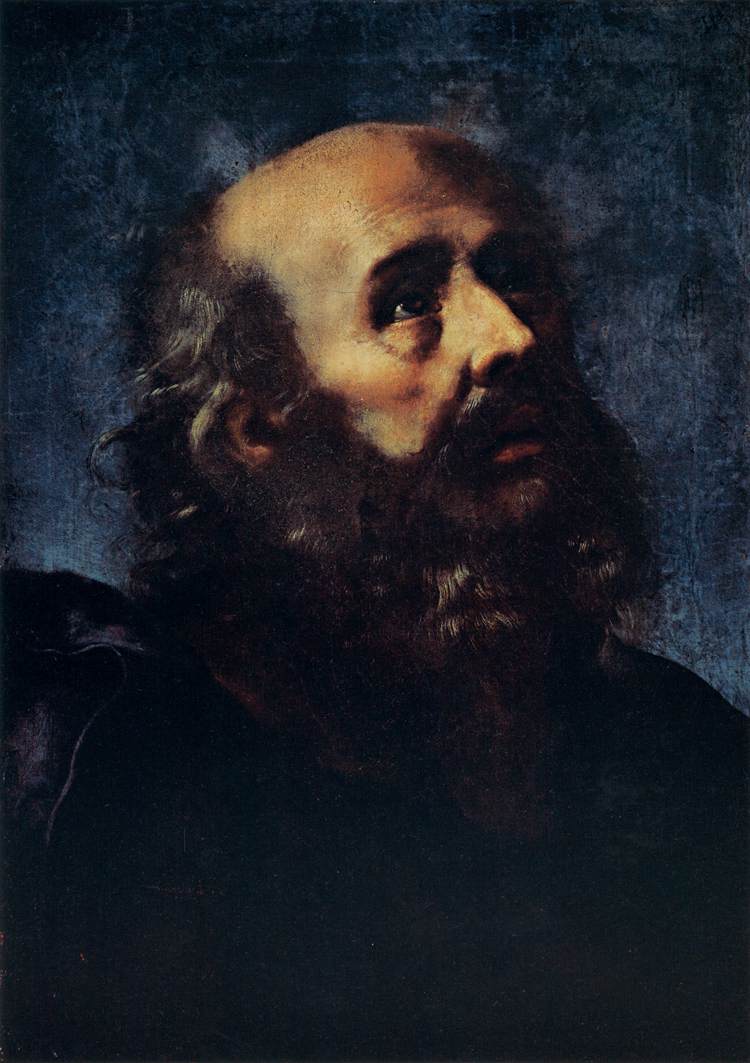
Moses, 1640-45, Carlo Dolci [Web Gallery of Art]
First Reading: Exodus 32:7-11, 13-14
11 September 2013
Standing with Fr Ray Blake

This is a follow up to my post on 9 September, Fr Ray Blake, English priest-blogger, misrepresented by local journalist and others. I came across the photo above on a number of other blogs since. I took it from The Epomynous Flower. I do not know who designed it.
There is much misrepresentation in the media of the Church and its mission and of some of its members who are faithfully carrying out that mission. This misrepresentation extends to matters on which the Church speaks. One example was the recent introduction of legislation allowing abortion in the Republic of Ireland for the first time.
Some misrepresentation is the result of ignorance and may contain no malice whatever. But when a person who is actively involved, along with his parishioners, in helping the destitute every day is described as 'complaining' about them when he is simply showing one unpleasant aspect of reality, one has to ask if only simple, genuine ignorance is involved.
Journalists often provide a great service to the community by calling others to task, including bishops and priests. Many journalists have lost their lives for speaking the truth. But sometimes it may be necessary to call a journalist to task.

St Francis de Sales, patron saint of journalists. [Wikipedia]
Maybe we can direct some prayers through the intercession of St Francis de Sales, patron saint of journalists, for those directly affected by this situation.
09 September 2013
Fr Ray Blake, English priest-blogger, misrepresented by local journalist and others
.JPG)
St Mary Magdalen's Church, Brighton, England

Fr Ray Blake is parish priest of St Mary Magdalen's, Brighton, in the Diocese of Arundel and Brighton on the south coast of England. He is also a blogger with a wide readership. I have been a regular reader of his blog for some years and am struck by two aspects of his writing in particular: his faithfulness to the Church's teaching and his commitment to those on the fringes of society such as immigrants in difficulties, drug addicts, alcoholics, beggars.
On 10 August this year he posted The Trouble with the Poor. It begins this way: The trouble with the poor is that they are messy.
There is a secluded area between the church and our hall, a passage, occasionally we find someone has got a few cardboard boxes together and has slept there and if it has been raining leaves a sodden blanket, cardboard there to be cleaned up, often it also smells of urine and there is often excrement there and sometimes a used needle or two.
There is a man who comes into the church, especially during the trad Mass and during the silence of the Canon will pray aloud, "Jesus, I want you to bless Fr Ray and ...., and God, can you persuade the good people here to give to the poor, I am poor", unchecked he will take his cap off and have a collection. It makes a mess of our prayers, it stops some coming to Mass here.
This post, along with many others he has written, has shown Father Ray to be a person who is very much involved with the poor.
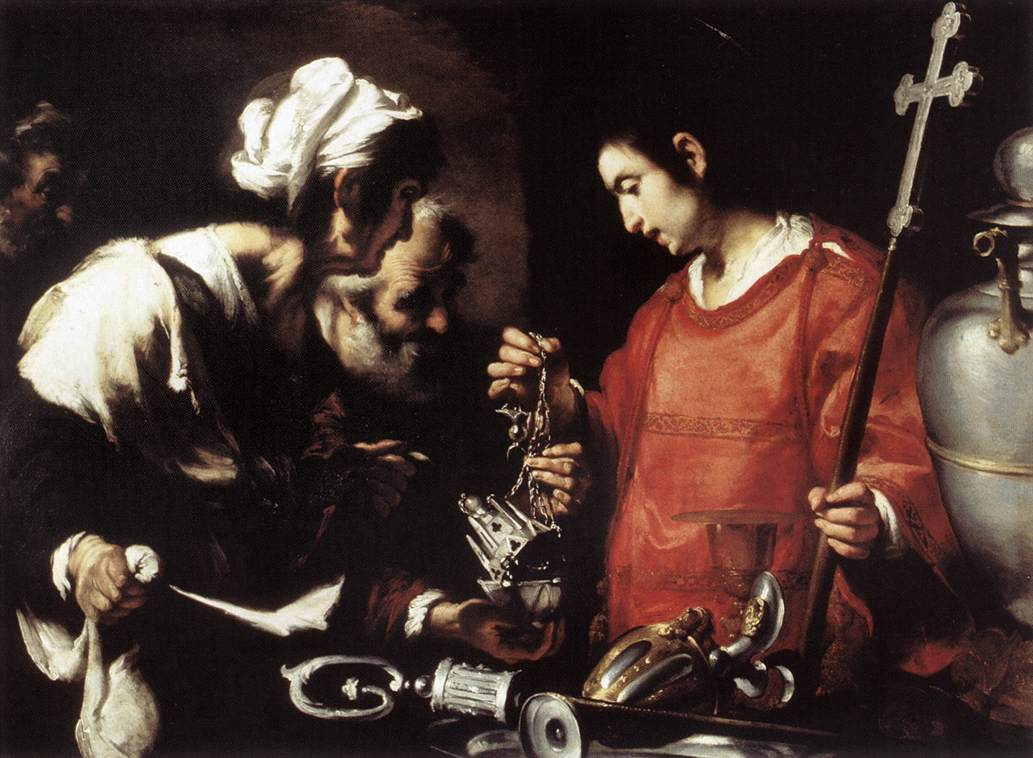
The Charity of St Lawrence, 1815-20, Bernardo Strozzi [Web Gallery of Art]
On 5 September, The Argus, a Brighton-based paper published an 'exclusive' article about Father Ray's blogpost under the by-line of Bill Gardner, 'Lying and messy' poor sent by God to test us, says Brighton priest. The article begins, A complaining priest claims “lying” poor people have been sent by God to “test my holiness”.
Nobody reading Father Ray's article with an open mind or reading his blog regularly could describe him as 'a complaining priest'. Here in the Philippines I have been trying to deal with people looking for money all the years I have been in the country since 1971. I have been stopped on the street in Ireland and in England, sometimes in places such as railway stations. Even as a seminarian, when we wore a black suit and black tie when outside the seminary, I was a target of beggars as were other seminarians and priests.
Some asking for help are in real need. Some are con-artists. I have never really learned how to meet with grace persons who approach me for help or how to distinguish those in real need from those on the make. I prefer to direct whatever money comes my way to help those in need when I know this really responds to their needs, eg, a home run by religious sisters for girls many of whom have been abused, while respecting their dignity - and mine.
I have never had the experience of having what I wrote totally distorted, the experience Father Ray has had.
Laurence England, a parishioner and parish secretary at St Mary Magdalen's and a blogger, sent this letter to The Argus. Inter alia Mr England writes: Fr Blake also helps other poor and homeless people who come to his door. They are not all honest and some do indeed lie in order to get money. I know this is true because I am the secretary at the Church and often respond to callers and give from the poor fund established by the Church for their relief. Despite this, if you read his post, it was about how Christians should respond to the poor, not an attack on the poor themselves.


St Martin and the Beggar, c.1604, El Greco [Web Gallery of Art]
Father Ray is wondering if he should continue blogging. Perhaps you might visit his blog and post a word of encouragement. Pope Benedict has spoken of our responsibility to use the internet to preach the Gospel to what he calls 'this digital continent'. Some will listen and accept, some will listen politely and walk away, some will malign those who preach the Gospel and some will deliberately refuse to see how persons such as Father Ray are powerfully living the Gospel.
06 September 2013
'Whoever does not bear his own cross and come after me, cannot be my disciple.' Sunday Reflections, 23rd Sunday in Ordinary Time Year C

For which of you, desiring to build a tower, does not first sit down and count the cost, whether he has enough to complete it? (Luke 14:28)
Readings(Jerusalem Bible: Australia, England & Wales, India
[optional], Ireland, New Zealand, Pakistan, Scotland, South Africa)
For which of you, desiring to build a
tower, does not first sit down and count the cost, whether he has enough to
complete it? Otherwise, when he has laid a foundation, and is not able to
finish, all who see it begin to mock him, saying, 'This man began to build, and
was not able to finish.' Or what king, going to encounter another king in war,
will not sit down first and take counsel whether he is able with ten thousand
to meet him who comes against him with twenty thousand? And if not, while the
other is yet a great way off, he sends an embassy and asks terms of peace. So
therefore, whoever of you does not renounce all that he has cannot be my
disciple."
Responsorial Psalm (NAB Lectionary)

There probably are very few Irish mothers who at some stage have not said
on many occasions to their children, 'I'll kill you if you do that again'.
But I would also say that there have been very few Irish children who have
ever taken that literally. When my mother threatened me with 'killing' I knew
it to be a warning not to misbehave. If I heard her say 'I'll keelhaul
you', I knew I was really out of line. I had no idea as a child what keelhauling was and I don't know if my mother knew what it
was either.
However, the message was loud and clear: 'Behave yourself!' My
father's threat was
a much milder 'I'll give you a good clip in the ear'. However, I
survived childhood without ever receiving a 'good clip in the ear' - it was
always 'a good clip' never just 'a clip'! - or being keelhauled,
never mind being killed.
The word 'hate' as
used by Jesus in today's gospel is in the same category as the threat of Irish
mothers to 'kill' their children. But like the message that Irish mothers convey to their children to
behave themselves, the meaning of Jesus is clear: 'You must be prepared to
give up everything if necessary to be my disciple. A disciple is one who
is prepared to learn a way of life from another.

A filling station in Brazil
Julie was a student of mine in college in Mindanao 40 years ago. She was the eldest in a family of six or seven children, as I recall. Her father Loloy was a casual labourer while her mother Minda worked for the family life apostolate in the parish. The parents earned just about to enough to feed their children and to send them to school. So when Julie graduated after a two-year course and got a job as a bookkeeper in a filling station the family were very happy to get the extra money.
However, Julie began to feel very uncomfortable with a request to keep two different books, with different records. She realized that her employer was cheating on taxes and expressed her concern to her parents. The three of them discussed the matter and saw clearly that what Julie was being asked to do was wrong, sinful, and so they advised her to resign, which she did. The loss of a job, the loss of a regular salary was a real sacrifice for the family. But they kept their integrity as disciples of Jesus.
Whoever does not bear his own cross and come after me, cannot be my disciple.
Antiphona ad communionem /Communion Antiphon Cf.Psalm 41 (42):2-3.
Quemadmodum desiderat cervus ad fontes aquarum,
ita desiderat anima mea ad te, Deus. Sitivit anima mea ad Deum, Deum vivum.
Like the deer that yearns for running streams,
so my soul is yearning for you, my God;
my soul is thirsting for God, the living God.
Palestrina's setting is for Psalm 41 (42):2-4. This starts with the word 'Sicut' instead of 'Quemadmodum', used in Missale Romanum (2002). The English
text is from the Revised Grail Psalter, the version used for the Psalms in the new English translation of The Roman Missal.
Sicut cervus desiderat ad fontes aquarum:
ita desiderat anima mea ad te, Deus. Sitivit anima mea ad Deum fortem vivum: quando veniam et apparebo ante faciem Dei? Fuerunt mihi lacrimae meae panes die ac nocte, dum dicitur mihi quotidie: Ubi est Deus tuus?
Like the deer that yearns for running streams,
so my soul is yearning for you, my God.
My soul is thirsting for God, the living God;
when can I enter and appear before the face of God?
My tears have become my bread, by day, by night,
|
30 August 2013
'You will be repaid at the resurrection of the just.' Sunday Reflections, 22nd Sunday in Ordinary Time Year C
Columban Fr Aedan McGrath speaking about his time in solitary confinement in China, 1950-53
Readings
(Jerusalem Bible: Australia, England & Wales, India
[optional], Ireland, New Zealand, Pakistan, Scotland, South Africa)
Gospel
Luke 14:1, 7-14 (Revised Standard
Version – Catholic Edition)
One sabbath
when Jesus went to dine at the house of a ruler who belonged to the Pharisees,
they were watching him.
Now he told
a parable to those who were invited, when he marked how they chose the places
of honor, saying to them, "When you are invited by any one to a marriage
feast, do not sit down in a place of honor, lest a more eminent man than you be
invited by him; and he who invited you both will come and say to you, 'Give
place to this man,' and then you will begin with shame to take the lowest place.
But when you are invited, go and sit in the lowest place, so that when your
host comes he may say to you, 'Friend, go up higher'; then you will be honored
in the presence of all who sit at table with you. For every one who exalts
himself will be humbled, and he who humbles himself will be exalted." He
said also to the man who had invited him, "When you give a dinner or a
banquet, do not invite your friends or your brothers or your kinsmen or rich
neighbors, lest they also invite you in return, and you be repaid. But when you
give a feast, invite the poor, the maimed, the lame, the blind, and you will be
blessed, because they cannot repay you. You will be repaid at the resurrection
of the just."

I remember the homecoming of Fr Aedan McGrath from China to Ireland in 1953 when I was ten. It was front-page news and there was a photograph on the now defunct Irish Press of the President and Prime Minister of Ireland greeting him along with thousands of others at Dublin Airport, much smaller than it is now.
Father Aedan had been imprisoned by the authorities of the People's Republic of China who had come into power in 1949 for his work with the Legion of Mary. He spent nearly three years in solitary confinement.
I had no idea in 1953 that one day I would be a Columban missionary priest like him and that he would become a good friend. I was also to discover that we both spent our early years in Holy Family Parish, Aughrim St, Dublin.

Father Aedan told me in the Philippines that when his plane landed in Dublin and he saw the thousands of people on the observation deck he said to himself, 'There must be someone important on board'. It never crossed his mind that he was the VIP. Friend, go up higher.
One of the parishioners in St Brigid's, Blanchardstown, in the Archdiocese of Dublin, to which I've been going home since 1981, is Lawrence Wren, now 89. From 1983 to 1987 he was Commissioner of An Garda Síochána, ie, Chief of Police in the Republic of Ireland. Before, during and after that period he was an active member of the Society of St Vincent de Paul in the parish. The society helps families and individuals in difficult financial circumstances. Once a month members stand outside the church after all Sunday Masses holding collection boxes. Until a few years ago Lawrence Wren was always among them, even when he was head of the Irish police. A stranger would have no idea who he was. When you give a feast, invite the poor, the maimed, the lame, the blind, and you will be blessed, because they cannot repay you.
The greater you are, the more you must humble yourself; so you will find favor in the sight of the Lord, the Book of Sirach tells us in the First Reading.

When I had reached this point in preparing these Sunday Reflections I learned of the death of Seamus Heaney, the poet from Derry, Northern Ireland, who received the Nobel Prize in Literature in 1995. Here he is reading his own poem, St Kevin and the Blackbird, which ties in with today's readings and with the story of Fr Aedan McGrath and the bird that used to visit him in prison in China. There was, for me, an extraordinary connection between Father Aedan's experience with the bird and his burial in St Columban's, Dalgan Park, Ireland, a few days after he died suddenly at the age of 94 at a family gathering in Dublin on Christmas Day 2000. You can view A Heavenly Farewell here or read it here.
In Seamus Heaney's poem the prayer of St Kevin, To labour and not to seek reward, reflects today's gospel: But when you give a feast, invite the poor, the maimed, the lame, the blind, and you will be blessed, because they cannot repay you. You will be repaid at the resurrection of the just.
In his introduction the poet speaks of Doing the right thing for the reward of doing the right thing. Father Aedan was prepared to go to prison for doing the right thing, even if it meant death, as it did for Fr Beda Chang SJ, a Chinese priest who was jailed with him. For Garda Commissioner Wren Doing the right thing for the reward of doing the right thing meant carrying out his professional duties to the best of his ability at a particularly difficult time in Ireland and serving the poor as a member of the St Vincent de Paul Society almost anonymously.
Thank God for the many Aedan McGraths, Beda Changs and Lawrence Wrens among us and for the Seamus Heaneys who can put words on the lives of so many who quietly serve even the least of God's creatures, who do the right thing for the reward of doing the right thing and who will be repaid at the resurrection of the just.


Seamus Heaney (13 April 1939 - 30 August 2013)
When I had reached this point in preparing these Sunday Reflections I learned of the death of Seamus Heaney, the poet from Derry, Northern Ireland, who received the Nobel Prize in Literature in 1995. Here he is reading his own poem, St Kevin and the Blackbird, which ties in with today's readings and with the story of Fr Aedan McGrath and the bird that used to visit him in prison in China. There was, for me, an extraordinary connection between Father Aedan's experience with the bird and his burial in St Columban's, Dalgan Park, Ireland, a few days after he died suddenly at the age of 94 at a family gathering in Dublin on Christmas Day 2000. You can view A Heavenly Farewell here or read it here.
In Seamus Heaney's poem the prayer of St Kevin, To labour and not to seek reward, reflects today's gospel: But when you give a feast, invite the poor, the maimed, the lame, the blind, and you will be blessed, because they cannot repay you. You will be repaid at the resurrection of the just.
In his introduction the poet speaks of Doing the right thing for the reward of doing the right thing. Father Aedan was prepared to go to prison for doing the right thing, even if it meant death, as it did for Fr Beda Chang SJ, a Chinese priest who was jailed with him. For Garda Commissioner Wren Doing the right thing for the reward of doing the right thing meant carrying out his professional duties to the best of his ability at a particularly difficult time in Ireland and serving the poor as a member of the St Vincent de Paul Society almost anonymously.
Thank God for the many Aedan McGraths, Beda Changs and Lawrence Wrens among us and for the Seamus Heaneys who can put words on the lives of so many who quietly serve even the least of God's creatures, who do the right thing for the reward of doing the right thing and who will be repaid at the resurrection of the just.
And then there was St Kevin and the blackbird.
The saint is kneeling, arms stretched out, inside
His cell, but the cell is narrow, so
The saint is kneeling, arms stretched out, inside
His cell, but the cell is narrow, so
One turned-up palm is out the window, stiff
As a crossbeam, when a blackbird lands
and Lays in it and settles down to nest.
As a crossbeam, when a blackbird lands
and Lays in it and settles down to nest.
Kevin feels the warm eggs, the small breast, the tucked
Neat head and claws and, finding himself linked
Into the network of eternal life,
Neat head and claws and, finding himself linked
Into the network of eternal life,
Is moved to pity: now he must hold his hand
Like a branch out in the sun and rain for weeks
Until the young are hatched and fledged and flown.
Like a branch out in the sun and rain for weeks
Until the young are hatched and fledged and flown.
*
And since the whole thing’s imagined anyhow,
Imagine being Kevin. Which is he?
Self-forgetful or in agony all the time
Imagine being Kevin. Which is he?
Self-forgetful or in agony all the time
From the neck on out down through his hurting forearms?
Are his fingers sleeping? Does he still feel his knees?
Or has the shut-eyed blank of underearth
Are his fingers sleeping? Does he still feel his knees?
Or has the shut-eyed blank of underearth
Crept up through him? Is there distance in his head?
Alone and mirrored clear in Love’s deep river,
‘To labour and not to seek reward,’ he prays,
Alone and mirrored clear in Love’s deep river,
‘To labour and not to seek reward,’ he prays,
A prayer his body makes entirely
For he has forgotten self, forgotten bird
And on the riverbank forgotten the river’s name.
For he has forgotten self, forgotten bird
And on the riverbank forgotten the river’s name.
Seamus Heaney
The Spirit Level (1996)
The Spirit Level (1996)

St Kevin's Bed, Glendalough, Ireland, the cave where the saint lived as a hermit.
Please pray for the repose of the soul of Seamus Heaney.
Photos from Wikipedia. Poem taken from The Poetry Place.
Subscribe to:
Posts (Atom)