13 February 2014

'You have heard that it was said . . . But I say to you . . .' Sunday Reflections, 6th Sunday in Ordinary Time Year A


Readings (New American Bible: Philippines, USA)                                  

Readings (Jerusalem Bible: Australia, England & Wales, India [optional], Ireland, New Zealand, Pakistan, Scotland, South Africa)

Gospel: Matthew 5:17-37 [ or 5:20-22a, 27-28, 33-34a, 37] (New Revised Standard Version, Catholic Edition, Canada) [May be omitted]

Jesus said to his disciples: [“Do not think that I have come to abolish the law or the prophets; I have come not to abolish but to fulfill. For truly I tell you, until heaven and earth pass away, not one letter, not one stroke of a letter, will pass from the law until all is accomplished.  Therefore, whoever breaks one of the least of these commandments, and teaches others to do the same, will be called least in the kingdom of heaven; but whoever does them and teaches them will be called great in the kingdom of heaven.] For I tell you, unless your righteousness exceeds that of the scribes and Pharisees, you will never enter the kingdom of heaven.

“You have heard that it was said to those of ancient times, ‘You shall not murder’; and ‘whoever murders shall be liable to judgment.’ But I say to you that if you are angry with a brother or sister, you will be liable to judgment; [and if you insult a brother or sister, you will be liable to the council; and if you say, ‘You fool,’ you will be liable to the hell of fire. So when you are offering your gift at the altar, if you remember that your brother or sister has something against you,  leave your gift there before the altar and go; first be reconciled to your brother or sister, and then come and offer your gift. Come to terms quickly with your accuser while you are on the way to court with him, or your accuser may hand you over to the judge, and the judge to the guard, and you will be thrown into prison. Truly I tell you, you will never get out until you have paid the last penny.]

“You have heard that it was said, ‘You shall not commit adultery.’ But I say to you that everyone who looks at a woman with lust has already committed adultery with her in his heart. [If your right eye causes you to sin, tear it out and throw it away; it is better for you to lose one of your members than for your whole body to be thrown into hell.  And if your right hand causes you to sin, cut it off and throw it away; it is better for you to lose one of your members than for your whole body to go into hell.

“It was also said, ‘Whoever divorces his wife, let him give her a certificate of divorce.’ But I say to you that anyone who divorces his wife, except on the ground of unchastity, causes her to commit adultery; and whoever marries a divorced woman commits adultery.]

“Again, you have heard that it was said to those of ancient times, ‘You shall not swear falsely, but carry out the vows you have made to the Lord.’ But I say to you, Do not swear at all, [either by heaven, for it is the throne of God, or by the earth, for it is his footstool, or by Jerusalem, for it is the city of the great King. And do not swear by your head, for you cannot make one hair white or black.] Let your word be ‘Yes, Yes’ or ‘No, No’; anything more than this comes from the evil one.

Responsorial Psalm (NAB Lectionary, Philippines, USA)


More than thirty years ago I spent part of a summer working in a parish near New York City. One day when I was on duty I answered the phone. The man calling gave me his name, which I wrote down. He told me he was living in an irregular situation, having been divorced from his wife. He was asking what the Church could do for him in that situation. I tried to tell him about programmes that the Church had in the diocese for Catholics who were divorced and re-married civilly or living with someone else. The latter situation wasn't nearly as common then as it is now.

But he was getting more and more angry, though I remained calm. He eventually hung up.

I was able to find his mailing address easily and wrote him a letter letting him know that I had understood his situation and the reason for his anger and frustration. Again, I informed him of the ways the Church was trying to be with those who found themselves in situations such as his.

The following day I had another phone call from the man. He thanked me profusely for my letter, for having listened to him and for having heard what he was trying to say. He also acknowledged that he was in a situation that he himself had created.

Today's Gospel shows us a Jesus who is somewhat different from the 'domesticated' meek and mild Jesus that we often imagine or create. He speaks of hard things: the consequences of breaking God's law, the necessity of forgiving and accepting forgiveness, the fruits of anger - not the feeling, which is something spontaneous, but the decision to remain angry/to hate - and the effects of adultery. Some of the most difficult parts of the gospel may be omitted and probably will be by many priests, for various reasons.

The media at the moment are giving lots of coverage to how the Church approaches those who are living with someone not their spouse. One might be led to think that the Church is being harsh for the sake of being harsh, imposing impossible difficulties on some of its members and failing to be 'merciful' and 'pastoral'.

On 11 February Fr Edward McNamara LC, who writes for the Catholic news agency Zenit, replies to a question about this very matter. He quotes from The Catechism of the Catholic Church, Nos 1650 and 1651. The latter says, Toward Christians who live in this situation, and who often keep the faith and desire to bring up their children in a Christian manner, priests and the whole community must manifest an attentive solicitude, so that they do not consider themselves separated from the Church, in whose life they can and must participate as baptized persons: 'They should be encouraged to listen to the Word of God, to attend the Sacrifice of the Mass, to persevere in prayer, to contribute to works of charity and to community efforts for justice, to bring up their children in the Christian faith, to cultivate the spirit and practice of penance and thus implore, day by day, God's grace.

I have close friends in such situations and in visiting parishes in Britain to do mission appeals for the Columbans I've met couples in irregular situations who are very much involved in their parishes, but who accept the teaching of Jesus, expressed through his Church, and live with that painful reality which they know they have created for themselves, for whatever reasons.

Rembrandt, 1644 [Web Gallery of Art]

In the story of the woman caught in adultery (John 8:1-11) we find this exchange at the end:

Jesus was left alone with the woman standing before him. Jesus straightened up and said to her, “Woman, where are they? Has no one condemned you?” She said, “No one, sir.” And Jesus said, “Neither do I condemn you. Go your way, and from now on do not sin again.”

Jesus shows the woman the greatest respect. Part of that respect is not denying that she had sinned. She knew that she had. God alone knew what had been going on in her heart. Jesus restored her dignity to her, gave her hope: Neither do I condemn you. Go your way, and from now on do not sin again.

Jesus has taught us very clearly what marriage is: Some Pharisees came to him, and to test him they asked, “Is it lawful for a man to divorce his wife for any cause?” He answered, “Have you not read that the one who made them at the beginning ‘made them male and female,’ and said, ‘For this reason a man shall leave his father and mother and be joined to his wife, and the two shall become one flesh’? So they are no longer two, but one flesh. Therefore what God has joined together, let no one separate” (Matthew 19:3-6)

This is a hard saying. Many utterly reject it, even the part about male and female. Others wrestle with the consequences of not accepting the teaching of Jesus when they find themselves in difficult situations.

Some think, wrongly, that the Church does not allow persons who are divorced to receive Holy Communion. That is not true. An ongoing seriously sinful situation is created when two persons, at least one of whom is married in the eyes of the Church, choose to live together whether after a civil wedding or otherwise. The same, of course, applies to any two persons not married to each other who live together in a sexually intimate relationship. That is a choice people make. But if a divorced person lives a chaste life he or she isn't living in a sinful situation.

The First Reading makes it very clear that God gives us the freedom to choose - and that there are consequences to the choices we make:


If you choose, you can keep the commandments,
    and to act faithfully is a matter of your own choice.
He has placed before you fire and water;
    stretch out your hand for whichever you choose.
 Before each person are life and death,
    and whichever one chooses will be given.
For great is the wisdom of the Lord;
    he is mighty in power and sees everything;
his eyes are on those who fear him,
    and he knows every human action.
 He has not commanded anyone to be wicked,  
    he has not given anyone permission to sin.

The response in the responsorial psalm, which is an echo of the first reading, is Blessed are they who follow the law of the Lord! (NAB). This is taken from Psalm 119 [118], as are the verses used in the responsorial psalm. this is the longest psalm, 176 verses in groups of eight in praise of God's law as something that makes us free.

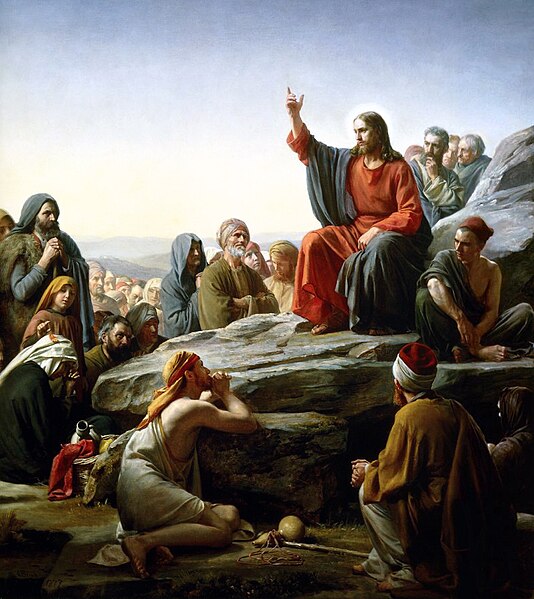
In the Sermon on the Mount Jesus challenges us in every aspect of our lives. He challenges us to think with a new mindset. St Paul expresses it well: Let the same mind be in you that was in Christ Jesus (Philippians 2:5).

That means taking to heart the words that Jesus repeated a number of times in the Sermon on the Mount: You have heard it said . . . But I say to you . . .


God So Loved the World (from Stainer’s ’The Crucifixion’)
Words: Text compiled by William John Sparrow-Simpson 
Music: God So Loved the World (from Stainer’s 'The Crucifixion’) John Stainer
God so loved the world that He gave His only begotten Son,
That whosoever believeth in Him should not perish,
But have everlasting life.
For God sent not His Son into the world to condemn the world,
But that the world through Him might be saved.

Communion Antiphon (John 3:16)

God so loved the world 
that he gave his Only Begotten Son, 
so that all who believe in him may not perish, 
but may have eternal life.

Pope Francis' Prayer Intentions for February 2014


Universal Intention - Elders

That the Church and society may respect the wisdom and experience of older people. 

Evangelization Intention - Collaboration in Evangelization

 That priests, religious, and lay people may work together with generosity.

Videos from the website of the Apostleship of Prayer, Milwaukee, WI, USA.

12 February 2014

Happy SAINT Valentine's Day!


There are various stories and legends about St Valentine. Some say he was a bishop, some that he was a priest. But at the heart of the stories is the reality that he was martyred for officiating at weddings.

His feast day is no longer on the universal calendar of the Catholic Church where the Ordinary Form of the Mass is celebrated, the form of the Mass introduced after the Second Vatican Council, in 1969, the only form of the Mass that most Catholics today have experienced. But his feast day is still on the calendar used by those who celebrate the Extraordinary Form of the Mass, using the Missal promulgated by Blessed John XXIII in 1962. 

In many parts of the world St Valentine's Day has become a largely secular affair and the word 'Saint' dropped. Here in the Philippines it is for more than a few an excuse for fornication and adultery, though not by any means for all. For some it is a day to celebrate innocent friendship.

For some years the Catholic Church in Australia has been Putting the Saint Back into St Valentine's Day. That is the Archdiocese of Sydney. The Archdiocese of Melbourne is Celebrating St Valentine. The Australian Catholic Family and Marriage Council has been preparing a kit for the last five years. That for 2014 is here. It includes a link to On the Feast of St Valentine, with Pope Francis! He will be meeting with engaged couples on 14 February.

Our Lady of Mount Carmel Church, Dublin 

Relics of St Valentine were given to the Carmelite Friars (OCarm) by Pope Gregory XVI in 1836 and they are in the casket beneath the altar in the photo above, which is a side-altar. You can find the history of the relics and of the saint on the website of the Friars.

On another page you will find the texts for Mass in honour of St Valentine.

Opening Prayer

Almighty ever-living God,
by whose gift blessed Valentine fought
for righteousness’ sake even until death,
grant, we pray, through his intercession,
that we may bear every adversity for the sake of your love
and hasten with all our strength towards you
who alone are life.
Through our Lord Jesus Christ, your Son,
who lives and reigns with you and the Holy Spirit,
One God, for ever and ever.
Amen.


Prayer to St Valentine

O glorious advocate and protector,
St Valentine,
look with pity upon our wants,
hear our requests,
attend to our prayers,
relieve by your intercession the miseries
under which we labour,
and obtain for us the divine blessing,
that we may be found worthy to join you
in praising the Almighty for all eternity:
through the merits of
Our Lord Jesus Christ.
Amen.

Happy SAINT Valentine's Day!

King Solomon and the Queen of Sheba

Nicolaus Knüpfer, 1640s [Web Gallery of Art]

The First Reading from today's Mass, 1 Kings 10:1-10 (NRSVCE)

When the queen of Sheba heard of the fame of Solomon  she came to test him with hard questions. She came to Jerusalem with a very great retinue, with camels bearing spices, and very much gold, and precious stones; and when she came to Solomon, she told him all that was on her mind. 

Solomon answered all her questions; there was nothing hidden from the king that he could not explain to her. When the queen of Sheba had observed all the wisdom of Solomon, the house that he had built, the food of his table, the seating of his officials, and the attendance of his servants, their clothing, his valets, and his burnt offerings that he offered at the house of the Lord, there was no more spirit in her.

So she said to the king, “The report was true that I heard in my own land of your accomplishments and of your wisdom, but I did not believe the reports until I came and my own eyes had seen it. Not even half had been told me; your wisdom and prosperity far surpass the report that I had heard. Happy are your wives! Happy are these your servants, who continually attend you and hear your wisdom! Blessed be the Lord your God, who has delighted in you and set you on the throne of Israel! Because the Lord loved Israel forever, he has made you king to execute justice and righteousness.” 

Then she gave the king one hundred twenty talents of gold, a great quantity of spices, and precious stones; never again did spices come in such quantity as that which the queen of Sheba gave to King Solomon.

The Arrival of the Queen of Sheba, George Frideric Handel
Played by The Sixteen conducted by Harry Christophers

Surely one of the most delightful pieces of music ever written!

05 February 2014

'You are the salt of the earth . . . the light of the world.' Sunday Reflections, 5th Sunday in Ordinary Time

Károly Ferenczy, 1896 [Web Gallery of Art]

Readings (New American Bible: Philippines, USA)                                  

Readings (Jerusalem Bible: Australia, England & Wales, India [optional], Ireland, New Zealand, Pakistan, Scotland, South Africa)

Gospel: Matthew 5:13-16 (New RevisedStandard Version, Catholic Edition, Canada) 

Jesus said to his disciples: “You are the salt of the earth; but if salt has lost its taste, how can its saltiness be restored? It is no longer good for anything, but is thrown out and trampled under foot.

“You are the light of the world. A city built on a hill cannot be hid. No one after lighting a lamp puts it under the bushel basket, but on the lampstand, and it gives light to all in the house. In the same way, let your light shine before others, so that they may see your good works and give glory to your Father in heaven.


One of the darkest periods in the history of the world was 1939 to 1945 when much of the world was at war. At the heart of the darkness was Nazi Germany, where freedom had been almost entirely suppressed. But not quite. Between June 1942 and February 1943 a small group of students at the University of Munich with their philosophy professor Kurt Huber formed The White Rose, a non-violent resistance group working against Hitler and the Nazi regime. 


(9 May 1921 - 22 February 1943)


Among the leaders were Sophie Scholl and her older brother Hans. They were executed together. Both were devout Lutherans. It is said that she was influenced by the writings of Blessed John Henry Cardinal Newman. Others in the group, such as Willi Graf, were devout Catholics. Not all were Christians but they shared a commitment to speaking the truth, even if it cost them their young lives. Most were in their early 20s.


One German Catholic who had a great impact on the group was Blessed Clemens August Graf von Galen, Bishop of Münster, Germany, who died just after being made a cardinal in 1946, a giant of a man physically, morally and spiritually. In a series of sermons in 1941 he denounced some of the policies of Hitler, including that of euthanasia. Hans and Sophie Scholl used one of these in a leaflet The White Rose printed and distributed secretly.


Memorial to The White Rose at the University of Munich


It was while distributing leaflets - the movement produced a total of six, their only means of communication - at the University of Munich, that Hans and Sophie were caught and then executed.

The members of The White Rose are remembered and honoured today and a number of films have been made about them. The video above contains footage from one of those.

You can see Franz Josef Müller, a member of The White Rose who survived, speak about the movement here. [The video can't be embedded.]

I remember the late Fr Vincent San Juan SJ, a Filipino who spent most of his life as a priest in the family life apostolate, telling me that during the days of Martial Law here in the Philippines when the government was conducting a vigorous campaign of promoting contraception - doctors in government hospitals often ligated women shortly after they had given birth, with no regard for their husbands or for their feelings - he sometimes gave seminars to government workers. They had little real freedom. But they were happy and encouraged to hear what they recognised as the truth from Father San Juan. To the participants in these seminars who were bombarded daily with government propaganda the Jesuit priest speaking the truth of the Gospel in a quiet and encouraging way was the salt of the earth . . . the light of the world.

Hans and Sophie Scholl and their companions knew that their lives were in danger. But their Christian faith led them to be the salt of the earth . . . the light of the world. Through them at least some experienced the truth of the words of Isaiah 9:2 quoted in Matthew 4:16, the people who sat in darkness have seen a great light, and for those who sat in the region and shadow of death light has dawned.

Salt is of use only when it is mixed with other things. The light of the sun doesn't exist for itself, for us to look at it. If we did we would be blinded. It is meant to light up everything around us, as we are meant by being salt and light to bring others to taste and see the joy of knowing Jesus the Risen Lord.

Not many are called, as some of the members of The White Rose were, to be the salt of the earth . . . the light of the world by laying down their lives. But those in The White Rose got their Christian faith, their moral values from others who for them were the salt of the earth . . . the light of the world. Some of them had belonged to various Nazi movements for young people but saw through the false values being promoted and left. In other words, they had been formed in solid values by others, older persons such as parents, some teachers perhaps. others trying to live honest and upright lives as followers of Jesus, 'missionary disciples', as Pope Francis calls us to be in Evangelii Gaudium No 120, without even being aware that they were such.


Last October in his homily in St Peter's Square on World Family Day Pope Francis explicitly called families to be the salt of the earth . . . the light of the world. And, characteristically, he called them to be such in a spirit of joy. He ended his homily with these words:

Dear families, you know very well that the true joy which we experience in the family is not superficial; it does not come from material objects, from the fact that everything seems to be going well . . . True joy comes from a profound harmony between persons, something which we all feel in our hearts and which makes us experience the beauty of togetherness, of mutual support along life’s journey. But the basis of this feeling of deep joy is the presence of God in the family and his love, which is welcoming, merciful, and respectful towards all. God alone knows how to create harmony from differences. But if God’s love is lacking, the family loses its harmony, self-centredness prevails and joy fades. But the family which experiences the joy of faith communicates it naturally. That family is the salt of the earth and the light of the world, it is the leaven of society.

Dear families, always live in faith and simplicity, like the Holy Family of Nazareth! The joy and peace of the Lord be always with you!

Photos from Wikipedia.

04 February 2014

'Give her something to eat'. Jesus, the Church, serving the sick


Friedrich Overbeck, 1825 [Web Gallery of Art]

Today's gospel, Mark 5:21-43, weaves two different healing stories into one, that of the woman who had been bleeding for twelve years and that of the daughter of Jairus, aged twelve, who had just died.

In the scene below, taken from Franco Zeffirelli's Jesus of Nazareth, the director focuses only on the story of the little girl. I don't know if the servant of Jairus, whom the latter addresses as 'Thomas' is meant in Zeffirelli's mind to be the future Apostle already showing the honest directness of the saint often referred to as 'Doubting Thomas', the saint who was to make the most explicit act of faith in the whole Bible, My Lord and my God.

In this scene Jesus immediately leaves what he was doing in order to respond to an emergency. Much of our life is like that.

Zeffirelli retains words of Jesus that we find in the version of St Mark of this incident and in that of St Luke (8:40-46) but not in that of St Matthew (9:18-26): Give her something to eat. There is something wonderfully human about these words. Zeffirelli has Jesus carry the little girl out to her parents and relatives. She would have been very weak after the illness that had led to her death. In my own imagination I can see Jesus standing back and smiling, gently reminding Jairus and his wife in their grateful joy that their daughter was hungry.


Healing the sick was central to the way Jesus proclaimed the Gospel, 'The Good News'. It has always been central to the way the Church proclaims that same Gospel. Many of us are familiar with the name 'Gemelli Policlinico' in Rome. This teaching hospital of 1,850 beds, attached to the medical school of the Catholic University of the Sacred Heart, is named after the founder of the University, Fr Agostino Gemelli OFM, priest, friar, physician, psychologist. Study, science and teaching are also at the heart of the proclamation of the Gospel by the Church.

On the Solemnity of the Epiphany last year Pope Benedict visited the children in the paediatric section of the Gemelli Clinic. The children and staff there, especially the little girl to whom he gave a teddy bear, don't seem to have noticed that he was 'dour', as I saw him described the other day, or that he was really a 'Rottweiler', as he has often been called.


Mark 5:21-43 (New Revised Standard Version, Anglicised Catholic Edition)

When Jesus had crossed again in the boat to the other side, a great crowd gathered round him; and he was by the lake. Then one of the leaders of the synagogue named Jairus came and, when he saw him, fell at his feet and begged him repeatedly, ‘My little daughter is at the point of death. Come and lay your hands on her, so that she may be made well, and live.’  So he went with him.

And a large crowd followed him and pressed in on him. Now there was a woman who had been suffering from haemorrhages for twelve years. She had endured much under many physicians, and had spent all that she had; and she was no better, but rather grew worse. She had heard about Jesus, and came up behind him in the crowd and touched his cloak, for she said, ‘If I but touch his clothes, I will be made well.’ Immediately her haemorrhage stopped; and she felt in her body that she was healed of her disease. Immediately aware that power had gone forth from him, Jesus turned about in the crowd and said, ‘Who touched my clothes?’ And his disciples said to him, ‘You see the crowd pressing in on you; how can you say, “Who touched me?”’ He looked all round to see who had done it. But the woman, knowing what had happened to her, came in fear and trembling, fell down before him, and told him the whole truth. He said to her, ‘Daughter, your faith has made you well; go in peace, and be healed of your disease.’

While he was still speaking, some people came from the leader’s house to say, ‘Your daughter is dead. Why trouble the teacher any further?’ But overhearing what they said, Jesus said to the leader of the synagogue, ‘Do not fear, only believe.’ He allowed no one to follow him except Peter, James, and John, the brother of James. When they came to the house of the leader of the synagogue, he saw a commotion, people weeping and wailing loudly. When he had entered, he said to them, ‘Why do you make a commotion and weep? The child is not dead but sleeping.’ And they laughed at him. Then he put them all outside, and took the child’s father and mother and those who were with him, and went in where the child was. He took her by the hand and said to her, ‘Talitha cum’, which means, ‘Little girl, get up!’ And immediately the girl got up and began to walk about (she was twelve years of age). At this they were overcome with amazement. He strictly ordered them that no one should know this, and told them to give her something to eat.

03 February 2014

St Blaise, Hansel and Gretel, and Englebert Humperdinck


When I was a child growing up in Dublin the blessing of throats on the feast of St Blaise took place only in the Franciscan and Capuchin churches, as I recall. Apart from my memory, the only evidence I have been able to find of this is from a bulletin of the Augustinian church in Limerick, Ireland, a year ago: For many centuries devotion to St. Blaise, a fourth century Armenian bishop, had almost completely disappeared. It was kept alive in some Franciscan churches. On the 4th February 2004 the Limerick Chronicle published a picture in its memory section, a clear photograph of a long queue in the local Franciscan church lining up for the blessing of the throats on the Feast of St Blaise. The Friars stood in the sanctuary for the entire day ministering the healing of this popular saint to those who streamed in and out of their church on Henry St

I have a vague recollection of red flannel, a sort of rough cloth, and of oil being associated with the blessing. The Wikipedia entry on the blessing of throats mentions oil.


Now the blessing of throats is widespread again with the priest holding two unlit candles to the throat of each person while praying this formula: Through the intercession of St Blaise, bishop and martyr, may God deliver you from every disease of the throat and from every other illness: in the name of the Father and of the Son and of the Holy Spirit. Amen.


St Blaise is one of the Fourteen Holy Helpers, saints invoked against various illnesses. That's where the connection with Englebert Humperdinck - the German composer, not the English singer whose real name is Arnold George Dorsey - comes in. In his opera Hansel and Gretel contains this song, The Evening Prayer, when Hansel and Gretel are lost in the forest:

When at night I go to sleep,
Fourteen angels watch do keep,
Two my head are guarding,
Two my feet are guiding;
Two upon my right hand,
Two upon my left hand.
Two who warmly cover
Two who o'er me hover,
Two to whom 'tis given
To guide my steps to heaven.

The 'fourteen angels' are the Fourteen Holy Helpers. Here it's sung by Libera, a boys' choir from England.


St Blaise was a bishop Sebaste in historical Armenia. The area of which he was bishop is now part of Turkey and under the jurisdiction of the Archeparchy of Istanbul (Armenian). The Armenian Catholic Church is, with fewer than 500,000 members, one of the smallest of about thirty churches that are fully part of the Catholic Church. The largest by far of these is the Roman or Latin Church but all are equally Catholic and in full communion with one another and with the Pope.