06 February 2013

Same-sex 'marriage' and 'The Emperor's New Clothes'


The British Parliament yesterday voted in favour of a bill that would legalise same-sex 'marriage' in England and Wales. A majority of the Conservative Party that governs in a coalition with the much smaller Liberal Democrats, voted against the bill which still has a few hurdles to jump over before it becomes law. 

Three days earlier the French Parliament voted in favour of a similar bill, though it too has some way to go.


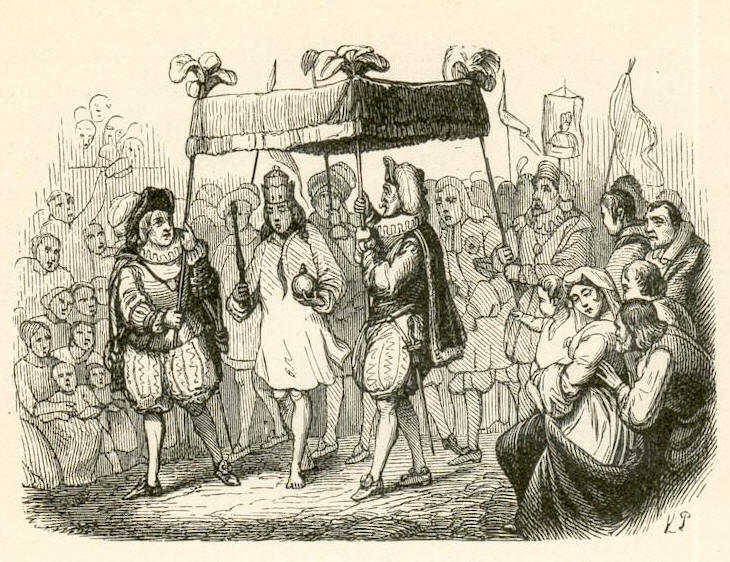
It might be good if those who voted in favour of the absurdity of same-sex 'marriage' would either read Hans Christian Andersen's The Emperor's New Clothes or listen to Frank Loesser's musical rewriting of the story [video above] for Danny Kaye to sing as he played Hans Christian Andersen in the 1952 movie of the same name.

Illustration by Vilhelm Pedersen, Andersen's first illustrator.

When will enough 'little boys' see and expose 'same-sex "marriage" as a "human right"' for the universal con-job that it has become?

04 February 2013

Violence against women in India and elsewhere


This video presents the newly-launched campaign by the Archdiocese of Bombay to raise awareness and initiate change in the attitude toward and the treatment of women in India, in the aftermath of a horrific gang-rape of a young woman in December last year.
This video and report were posted by UCANews on 28 January. A diya is an oil lamp, usually made from clay, widely used in India, especially during certain religious festivals.
Nature seems to provide 103 - 108 boys to 100 girls at birth. The video gives figures for three locations in India:
Delhi: 866 girls / 1,000 boys;
Haryana: 877 girls / 1,000 boys;
Chanidgarh: 818 girls / 1,000 boys. 
It is thought that sex-selection abortion and the killing of newborn girls are factors in skewing the natural proportion between males and females in India and in some other countries.
The '37,000,000 Diyas' campaign of the Archdiocese of Bombay - it retains the old name for 'Mumbai' - is for the excess of 37,000,000 males over females in India in 2011.
However, violence towards women and children is universal but seems to be made worse where there isn't a natural proportion between males and females.
A now deceased Columban priest once told me that years ago a young Protestant man here in the Philippines preparing to marry a Catholic girl told him that his Catholic male friends had advised him, 'Beat her up a few times and you'll have no problems'. I've no idea how prevalent this attitude is here or elsewhere. But it is very wrong.

02 February 2013

The Presentation in the Temple and the Menin Gate

From Franco Zeffirelli's mini-series Jesus of Nazareth (1977)

Luke 2: 22-40 (RSV Catholic Edition)

And when the time came for their purification according to the law of Moses, they brought him up to Jerusalem to present him to the Lord (as it is written in the law of the Lord, "Every male that opens the womb shall be called holy to the Lord") and to offer a sacrifice according to what is said in the law of the Lord, "a pair of turtledoves, or two young pigeons." 

Now there was a man in Jerusalem, whose name was Simeon, and this man was righteous and devout, looking for the consolation of Israel, and the Holy Spirit was upon him. And it had been revealed to him by the Holy Spirit that he should not see death before he had seen the Lord's Christ. And inspired by the Spirit he came into the temple; and when the parents brought in the child Jesus, to do for him according to the custom of the law, he took him up in his arms and blessed God and said, "Lord, now lettest thou thy servant depart in peace, according to thy word; for mine eyes have seen thy salvation which thou hast prepared in the presence of all peoples, a light for revelation to the Gentiles, and for glory to thy people Israel." And his father and his mother marveled at what was said about him; and Simeon blessed them and said to Mary his mother, "Behold, this child is set for the fall and rising of many in Israel, and for a sign that is spoken against (and a sword will pierce through your own soul also), that thoughts out of many hearts may be revealed." 

And there was a prophetess, Anna, the daughter of Phanuel, of the tribe of Asher; she was of a great age, having lived with her husband seven years from her virginity, and as a widow till she was eighty-four. She did not depart from the temple, worshiping with fasting and prayer night and day. And coming up at that very hour she gave thanks to God, and spoke of him to all who were looking for the redemption of Jerusalem. 

And when they had performed everything according to the law of the Lord, they returned into Galilee, to their own city, Nazareth. And the child grew and became strong, filled with wisdom; and the favor of God was upon him

The Prophetess Anna, Rembrandt, 1631

When I was reading the Gospel above at Mass this morning, the Feast of the Presentation of the Lord, I recalled an experience in September 2001. At the time I was based in England and was invited to officiate at a Belgian-Filipino wedding of two friends, Stefaan and Joy, near Ieper/Ypres in Belgium. I had heard that every evening in Ieper members of the local fire brigade sounded the Last Post at the Menin Gate to remember the tens of thousands of young men who died in that area in the Great War of 1914 - 1918. 

The day after I arrived in Belgium Stefaan helped me locate the grave of my great-uncle Corporal Lawrence Dowd who was killed on 6 August 1917, ten days before Fr William Doyle SJ, a saintly and heroic Irish chaplain in the British army was killed in the same area.

The evening before the wedding a Belgian friend of Joy and Stefaan took me to the Menin Gate for the ceremony. I had already realised how the memory of the tragic deaths of so many young men on both sides of the conflict nearly 90 years earlier was part of the people living in and near Ieper.

After the sounding of the Last Post a very old man laid a wreath. He might have been one of the few survivors of the Great War still living at the time. But what moved me deeply was that a woman standing near me was carrying an infant that looked no more than a week or so old. Jesus in today's Gospel who was forty days old. 

The child at the Menin Gate was already being brought into the communal memory of a conflict that had occurred long before the vast majority of those present at the ceremony were even born.

Simeon's Song of Praise, Aert de Gelder, around 1700 - 1710.

In the Gospel two elderly people of faith recognise Jesus as the Messiah. They are bridges between the Old and New Testaments. Simeon blesses God for the grace he has received and then blesses Mary and Joseph. Anna is the first person to preach the Gospel: she gave thanks to God, and spoke of him to all who were looking for the redemption of Jerusalem.

I thought of the old people who quietly and without being aware of it spoke of him to me when I was a child. Whenever I dropped into the church on my way home from school I would always see some of them, including my grandfather, praying quietly before the Blessed Sacrament. Some of the old men I used to see had survived the Great War and all of the people had come through hard times.

But they lived lives of faith and hope, like Simeon and Anna. Like the mother of the infant at the Menin Gate and the very old man who laid the wreath passing on the memory of the young lives lost in the Great War, they, like Simeon and Anna, were quietly passing on their faith in Jesus Christ to me and my contemporaries.

01 February 2013

'Is not this Joseph's son?' Sunday Reflections, 4th Sunday in Ordinary Time Year C


Readings (New American Bible: Philippines, USA)

Readings (Jerusalem Bible: Australia, England & Wales, India [optional], Ireland, New Zealand, Pakistan, Scotland, South Africa)

Gospel Luke 4:21 30 (Revised Standard Version – Catholic Edition)

Jesus began to say to them, "Today this scripture has been fulfilled in your hearing." And all spoke well of him, and wondered at the gracious words which proceeded out of his mouth; and they said, "Is not this Joseph's son?" 

And he said to them, "Doubtless you will quote to me this proverb, 'Physician, heal yourself; what we have heard you did at Capernaum, do here also in your own country.'" And he said, "Truly, I say to you, no prophet is acceptable in his own country. But in truth, I tell you, there were many widows in Israel in the days of Elijah, when the heaven was shut up three years and six months, when there came a great famine over all the land; and Elijah was sent to none of them but only to Zarephath, in the land of Sidon, to a woman who was a widow.  And there were many lepers in Israel in the time of the prophet Elisha; and none of them was cleansed, but only Naaman the Syrian." 

When they heard this, all in the synagogue were filled with wrath. And they rose up and put him out of the city, and led him to the brow of the hill on which their city was built, that they might throw him down headlong. But passing through the midst of them he went away. 


I left home for the first time when I was 11, though only for a month. It was during the summer of 1954 and I spent the four weeks in an Irish-speaking part of County Galway in the west of Ireland, just beyond An Spidéal (Spiddal) on the northern shore of Galway Bay.


I was one of around 100 children aged between 10 and 14, all sons and daughters of members of trade unions in Dublin which sponsored a summer-school / holiday each year so that the youngsters involved could become more fluent in the Irish language (Gaelic), which we all studied at school. We used to have outdoor classes in the mornings, unless it rained, and were free in the afternoon. We all stayed in groups of three or four boys or girls with local families. We were excused from class if we went to the bog with our hosts when they were cutting turf.

In the house where I stayed with two other boys a family from Dublin came down for their annual holiday. I had never met them before and they didn't know me. The husband/father, whom I later learned was named Paddy O'Neill, asked me the first time he met me if I was the son of John Coyle. At that time I knew nothing about where we come from, though I knew that children often looked like one or other of their parents but had no idea why. I felt a surge of pride as I said 'Yes' to Mr O'Neill. 

He had seen my father's face in mine. Then he told me that he had worked as a young carpenter with my father, who was older than he was, and that he had found my Dad very helpful to him. Over the years others were to tell me the same thing, how my father was such a great mentor to young men learning their trade. Dad was a carpenter too but became first a foreman of the carpenters and later a general foreman on the building/construction sites where he worked for 54 years.

My father in turn often spoke with great respect and affection of foremen he had worked under and who had helped him. I remember Ned Boyle, who lived near us. He had a big moustache, as I recall, and his wife had beautiful white hair and a lovely smile. The looked like every child's favourite grandparents. My mother often described them as a real 'Darby and Joan' couple. In the song The Folks Who Live on the Hill Oscar Hammerstein II's lyrics to Jerome Kern's music include these lines:

We'll sit and look at the same old view,
Just we two.
Darby and Joan who used to be Jack and Jill,
The folks who like to be called,
What they have always been called,
'The folks who live on the hill'.

I remember Dad talking about Mr Grace, another foreman under whom he worked. I never knew him, though I had some contact with some of his sons, all of whom were older than me. Two of them, Fr Ronald and Fr John, became Capuchin priests and were assigned to what is now Zambia. Another, Mick, died in an accident while building a church in Dublin. I got the impression from my father that Mr Grace was a man of great integrity and of nobility. I could see something of that in his sons.

I could see it in my father and how foremen such as Mr Boyle and Mr Grace had helped to form him as a person, without even being aware of it.


St Joseph the Carpenter, Georges de la Tour, 1640s.

As I grow older I see more clearly how my parents and others formed me. Very often when I'm writing I think of John Galligan, my teacher in Fourth Class (Grade Four) who gave us a great grounding in the grammar of both Irish and English, encouraged us to read the newspaper critically and gave us many opportunities to write. But above all, he shared his faith as he prepared us for confirmation and as he spoke so often about his wife Mary. I came to know them years later as a friend and saw in them a real 'Darby and Joan' couple.

Is not this Joseph's son? the people in the synagogue asked in wonder before they turned against Jesus and tried to kill him. There's a gap of 18 years between the time when Mary and Joseph, sick with worry, went back to Jerusalem to try to find the 12-year-old Jesus in the Temple, where in his humanity his sense of his vocation was beginning to awake. The First Reading, from Jeremiah, has the word of the Lord saying to the prophet, Before I formed you in the womb I knew you, and before you were born I consecrated you; I appointed you a prophet to the nations. Further on the Lord tells Jeremiah, They will fight against you; but they shall not prevail against you, for I am with you, says the LORD, to deliver you (Jer 1:5, 19).

God the Father had the mission of his Son Jesus, God who became Man, in mind from from all eternity. He knew that many would fight against Jesus, but they shall not prevail against you . . . And the Father called two human beings to prepare Jesus for his mission, Mary to be his very mother and Joseph, her husband, to be like a father to him.

Jesus in his humanity learned from St Joseph how to be a responsible man. The years when Jesus went down with them and came to Nazareth, and was obedient to them and increased in wisdom and in stature, and in favor with God and man (Luke 2:51, 52) were the years when Joseph and Mary were preparing Jesus for his mission, Mary keeping all these things in her heart but probably neither of them fully realising the importance of daily life in the house, in the carpenter's shop, in preparing Jesus for his mission.

Mr Boyle and Mr Grace were among those who formed my father as an upright man of deep faith. I doubt if any of them ever spoke to each other about their faith, just as my father rarely spoke about it to me. They simply lived it. I'm prouder now, more than 25 years after his death, to be known as 'John Coyle's son' because I can see how much he has influenced me as a priest.

Our influence on each other is for good and for bad. Those who hear it asked about them as a compliment Isn't this the son/daughter of . . .? are blessed. Those of whom it is said that they are saintly, not because they are 'pious' but because their is something Christ-like about their lives, are blessed and are a blessing to others.

When Jesus heard the people in the synagogue ask Is not this Joseph's son? I'm certain that in his humanity he felt deeply blessed because the love and care of Joseph had been central to the loving plan of God the Father for his Son, God who became Man.


Communion Antiphon Cf Psalm 30:17-18. [Latin]

Illúmina fáciem tuam super servum tuum, 
et salvum me fac in tua misericórdia. 
Dómine, non confúndar, quóniam invocávi te.

Let your face shine on your servant. 
Save me in your merciful love.
O Lord, let me never be put to shame, for I call on you.

In the video above the antiphon is sung in Latin in Gregorian chant. Below is a setting of the Latin text for five voices by Carlo Gesualdo da Venosa (1566 - 1613) sung by a choir in Brno in the Czech Republic.


+++

I mentioned above the song The Folks Who Live on the Hill. I came across this version by Liverpool-born singer Michael Holliday who took his own life at the age of 38 in 1963, a couple of years after he had a nervous breakdown. It seems he suffered badly from stage fright, as his hands during his introduction to the song seem to indicate. Remember him in your prayers.

Feast of St Brigid, the first day of spring in Ireland. And elsewhere? 'It might as well be spring!'

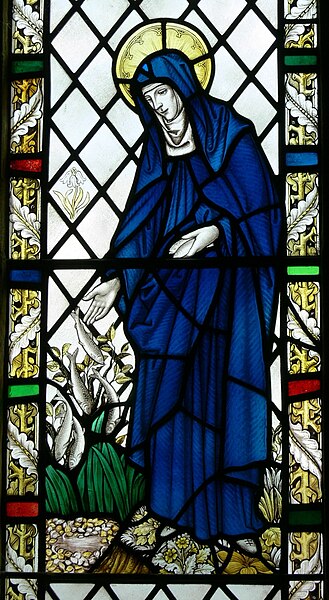
St Brigid  (c.451 - 525), St Non's Chapel, St David's, Wales

Today is observed in Ireland as Lá Fhéile Bhríde, the Feast of St Brigid of Kildare. She is one of the patrons of Ireland and is often referred to as 'Muire na nGael' or 'Mary of the Irish'.

You can find some prayers and resources for celebrating the Feast of St Brigid, including a video on how to make a St Brigid's Cross, on the website of the Diocese of Kildare and Leighlin in Ireland.

Cros BrídeSt Brigid's Cross

Collect

Merciful God,
origin and reward of all charity, 
you called Saint Brigid to teach the new commandment of love 
through her life of hospitality and her care of the needy; 
give to your people, by her intercession, 
a generous spirit, 
so that, with hearts made pure, 
we may show your love to all.
Through our Lord Jesus Christ, your Son, 
who lives and reigns with you in the unity of the Holy Spirit, 
one God, for ever and ever.

The first day of spring

According to the ancient Irish reckoning today, 1 February, is the first day of spring in the temperate regions of the Northern Hemisphere. In most places in those regions 21 March, the equinox, is considered the first day of that season of new growth and hope. Even after more than 41 years in the tropical Philippines the four seasons that I grew up with are still 'in my bones' and I always get a 'lift' when St Brigid's Day comes around. The very cold weather, at least in Ireland, is usually over and the days are growing longer.

The stained glass image of St Brigid above is in a chapel in the southwest of Wales, a country that you can see from parts of the east coast of Ireland on a clear day. In the video below is a singer from a tiny hamlet in the northwest of Wales, Bryn Terfel, with my wish for you whether or not you live in the temperate regions of the Northern Hemisphere or elsewhere, whether or not you consider 1 February or 21 March as the first day of spring. Well, It might as well be spring! 

I don't know of a better version of this classic, a combination of the clever lyrics of Oscar Hammerstein II and the tuneful music of Richard Rodgers.


31 January 2013

'Let us be ashamed to assume an attitude of superiority.' St John Bosco on discipline


Since my teenage years I've had a great admiration for St John Bosco and even gave a passing thought at that time to joining the Salesians, the congregation that he founded.

As a priest I became very familiar with the Second Reading in the Office of Readings on his feast day, 31 January. I have worked with young people in one way or another for most of the more than 45 years that I have been a priest. I see in this letter from St John Bosco his great respect for young people but also his understanding of those who take care of them, teachers, parents and guardians, and of his awareness, no doubt from his own experience, that the same young persons can at times test the patience of those in charge of them.

The word 'discipline' comes from 'discipleship'. It is learning from the example of the mentor how to follow the mentor's way of life. Jesus didn't beat up his disciples, though they often tested his patience and on occasion he scolded them.

Years ago a girl of 15 or so on a weekend retreat in her school, a girls' school run by Sisters, who had been behaving rather immaturely came to me in floods of tears and said, 'My parents give me everything I ask for. But they never ask me how I'm doing in school - and they never even scold me'.

Nobody likes to be scolded but most young people recognise it as an expression of concern, of care, of love - when it's not heavy-handed.

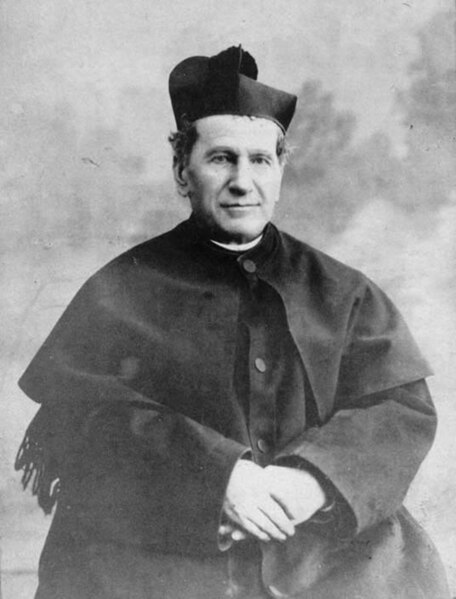
I've always liked that fact that in photos and portraits of St John Bosco his hair is slightly untidy!

St John Bosco (16 August 1851 - 31 January 1888)

From a letter by Saint John Bosco, priest
I have always laboured out of love
First of all, if we wish to appear concerned about the true happiness of our foster children and if we would move them to fulfil their duties, you must never forget that you are taking the place of the parents of these beloved young people. I have always laboured lovingly for them, and carried out my priestly duties with zeal. And the whole Salesian society has done this with me.

My sons, in my long experience very often I had to be convinced of this great truth. It is easier to become angry than to restrain oneself, and to threaten a boy than to persuade him. Yes, indeed, it is more fitting to be persistent in punishing our own impatience and pride than to correct the boys. We must be firm but kind, and be patient with them.

I give you as a model the charity of Paul which he showed to his new converts. They often reduced him to tears and entreaties when he found them lacking docility and even opposing his loving efforts.

See that no one finds you motivated by impetuosity or wilfulness. It is difficult to keep calm when administering punishment, but this must be done if we are to keep ourselves from showing off our authority or spilling out our anger.

Let us regard those boys over whom we have some authority as our own sons. Let us place ourselves in their service. Let us be ashamed to assume an attitude of superiority. Let us not rule over them except for the purpose of serving them better.

This was the method that Jesus used with the apostles. He put up with their ignorance and roughness and even their infidelity. He treated sinners with a kindness and affection that caused some to be shocked, others to be scandalised, and still others to hope for God’s mercy. And so he bade us to be gentle and humble of heart.

They are our sons, and so in correcting their mistakes we must lay aside all anger and restrain it so firmly that it is extinguished entirely.

There must be no hostility in our minds, no contempt in our eyes, no insult on our lips. We must use mercy for the present and have hope for the future, as is fitting for true fathers who are eager for real correction and improvement.

In serious matters it is better to beg God humbly than to send forth a flood of words that will only offend the listeners and have no effect on those who are guilty.


30 January 2013

'A quirky kind of prayer' from the late Fr Tom Cahill SVD

Fr Tom Cahill SVD (1946 - 2013)

This morning at breakfast I was reading the February 2013 issue of Intercom, the monthly 'Pastoral and Liturgical Resource' of the Irish Catholic Bishops' Conference. It had an article, Year of Faith, Year of Thanks, by Fr Tom Cahill SVD, whom I've known since our schooldays and with whom I kept in touch over the years, from his time in Flores, Indonesia, to his many years back in Ireland. Father Tom died on 15 January, a few days after getting a massive stroke. The photo above was taken in 2011 at a gathering in St Patrick's, Maynooth, of the ordination class of 1971.

In his article, Father Tom emphasized the importance of thanking God each day. He wrote, Someone wryly remarked that the most difficult arithmetic to learn is the one that teaches us how to count our blessings. We can't be joyful without being thankful. He goes on to say, We didn't ask to be born yet don't regret that we were. Thanking God daily for this most precious gift helps us start each day with joy in our heart and not gripe in our belly. Happily acknowledging that our intelligence and abilities are gifts freely given, ensures that they are spurs to service and not prods to pride.

Further on Father Tom says, There are still more: gifts of faith in God and hope in his promises. Not only is our present life a gift but also our future eternal life is an even greater one. What would life be like without anything to hope for after death?
He came across what he describes as 'a quirky kind of prayer' and followed the advice of the late Irish comedian Hal Roach who, when he got a gale of laughter from his audience would say, Write it down; it's a good one!  This is what Father Tom wrote down:

Dear God, we rejoice and give thanks for earthworms, bees, ladybirds and broody hens; for humans tending their gardens, talking to animals, cleaning their homes and singing to themselves; for the rising of the sap, the fragrance of growth, the invention of the wheelbarrow and the existence of the teapot, we give thanks. We celebrate and give thanks. Amen.


The other day I came across an article in the December 2012 issue of Catholic Mountain Star, the newspaper of the Diocese of Nelson, British Columbia, Canada, by Fr Harry Clarke, an Irish friend of mine who is a parish priest there. He was sharing Impressions of the Eucharistic Congress, held in Dublin last June. Father Harry wrote:

The Abbot of Glenstal, drew our attention to an insight of Dublin writer, James Joyce. Joyce observed that the Church must deal with Irish people as they really are and know what they are like - an ordinary man, on an ordinary day, with ordinary thoughts and temptations, surrounded by ordinary people. 

It seems to me that he is right in this. Ireland was invaded by “devotional religion” from Europe after 1860. From then on preaching was so often not connecting with the ordinary person’s daily life. As the story goes one farmer, after Sunday Mass, put it like this: “a more ignorant priest would have suited us better”. The 10,000 or so who attended each day, mostly salt of the earth Irish, were not honored or valued in this way by the homilies I heard at daily Mass.

As I wasn't present at the Congress I can't say whether or not I agree with Father Harry's final sentence in the quotation. But I fully agree with the importance of the Irish people as they really are and know what they are like - an ordinary man, on an ordinary day, with ordinary thoughts and temptations, surrounded by ordinary people.

I remember Fr Ronan McGrath in my first year in the seminary, back in 1961-62, drawing to our attention that when we went home at the end of the year we would find the same people doing the same things, the milkman, the bread man and others doing their daily rounds, part of the fabric of life. He spoke about St Joseph in his carpenter's shop, probably getting complaints from some customers.

A basic black teapot (essential to every Irish home!)

And when we did go home, we found what Fr McGrath said to be true. And we found ourselves invited to the inevitable 'cuppa' whenever we visited relatives and friends and the teapot came out.

My friend Fr Tom Cahill wrote for many Catholic publications and often did the 'God spot' on radio on RTÉ, Ireland's national broadcasting service. He had the gift of seeing God's presence in incidents that to most would seem insignificant. I don't know if he was familiar with what our fellow Dubliner James Joyce wrote, as mentioned by the Abbot of Glenstal. But he certainly followed his advice.

And Father Tom would have been familiar with this delightful song by American folk musician and singer-songwriter Bill Staines, sung here by Irish singers Liam Clancy and Tommy Makem, both of whom died in recent years.


Even the sparrow finds a home, and the swallow a nest for herself, where she may lay her young, at thy altars, O LORD of hosts, my King and my God (Psalm 84:3, RSV Catholic Edition).

May Father Tom find his 'Place in the Choir' and experience in the fulness of gratitude and joy the truth of his own words, Not only is our present life a gift but also our future eternal life is an even greater one.