Showing posts with label Spring. Show all posts

01 February 2013

Feast of St Brigid, the first day of spring in Ireland. And elsewhere? 'It might as well be spring!'

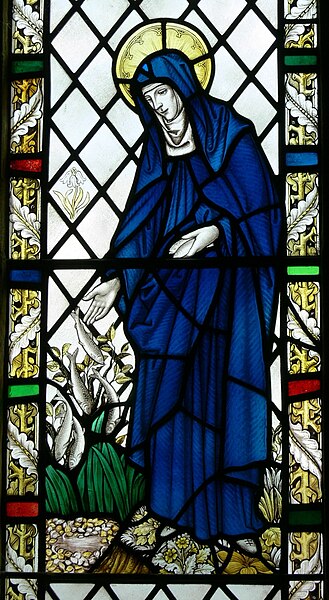
St Brigid  (c.451 - 525), St Non's Chapel, St David's, Wales

Today is observed in Ireland as Lá Fhéile Bhríde, the Feast of St Brigid of Kildare. She is one of the patrons of Ireland and is often referred to as 'Muire na nGael' or 'Mary of the Irish'.

You can find some prayers and resources for celebrating the Feast of St Brigid, including a video on how to make a St Brigid's Cross, on the website of the Diocese of Kildare and Leighlin in Ireland.

Cros BrídeSt Brigid's Cross

Collect

Merciful God,
origin and reward of all charity, 
you called Saint Brigid to teach the new commandment of love 
through her life of hospitality and her care of the needy; 
give to your people, by her intercession, 
a generous spirit, 
so that, with hearts made pure, 
we may show your love to all.
Through our Lord Jesus Christ, your Son, 
who lives and reigns with you in the unity of the Holy Spirit, 
one God, for ever and ever.

The first day of spring

According to the ancient Irish reckoning today, 1 February, is the first day of spring in the temperate regions of the Northern Hemisphere. In most places in those regions 21 March, the equinox, is considered the first day of that season of new growth and hope. Even after more than 41 years in the tropical Philippines the four seasons that I grew up with are still 'in my bones' and I always get a 'lift' when St Brigid's Day comes around. The very cold weather, at least in Ireland, is usually over and the days are growing longer.

The stained glass image of St Brigid above is in a chapel in the southwest of Wales, a country that you can see from parts of the east coast of Ireland on a clear day. In the video below is a singer from a tiny hamlet in the northwest of Wales, Bryn Terfel, with my wish for you whether or not you live in the temperate regions of the Northern Hemisphere or elsewhere, whether or not you consider 1 February or 21 March as the first day of spring. Well, It might as well be spring! 

I don't know of a better version of this classic, a combination of the clever lyrics of Oscar Hammerstein II and the tuneful music of Richard Rodgers.


01 February 2008

Setting out on the first day of spring

Anois teacht an Earraigh beidh an lá ag dul chun síneadh,
Is tar éis na Féile Bríde ardóidh mé mo sheol;
Ó chuir mé i mo cheann é, ní stopfaidh mé choíche
Go seasfaidh mé thíos i lár Chontae Mhaigh Eo.


Now that Spring is here and the days getting longer,
After the Feast of St Brigid I’ll hoist my sail.
Since I took the notion I won’t rest
Till I’m right in the heart of County Mayo.

That’s my rough, non-poetic and non-literal translation of the opening lines of a poem by Antaine Raifteirí (Ó Reachtúra), 1784-1835, that we learned in school in Ireland. The poet, illiterate and blind from childhood because of smallpox, was from County Mayo in the west of Ireland, the same county where Columban Co-founder Father John Blowick was born 53 years after the death of Raftery, as his name is anglicized.

The first day of February is the feast of St Brigid (c.451-525) in Ireland and is considered the first day of spring. In northern Europe this time of year is one of hope. The long, dark nights of winter are receding, even though wintry weather may still be there. Right now there’s very stormy weather in Ireland and Britain. Nature in the temperate areas of the northern hemisphere is in tune with Lent and Easter in a way that isn’t as evident in the tropics. And in the temperate regions in the southern hemisphere autumn reigns, with winter not far behind. Though I’ve been here in the Philippines most of the time since 1971 an ‘inner calendar’ still follows the rhythm of the four seasons I experienced as a child and young man in Ireland.

I don’t know what time of year it was when St Columban (Columbanus) and his twelve companions set off in a small boat from the monastery of Bangor in the present-day County Down in Northern Ireland, on the northeast coast of Ireland. They probably arrived in Gaul, which we now call France, around 590 or 591, though some say they arrived twenty years before that. His travels, during which he established a number of monasteries, through modern-day France, Germany, Switzerland and Austria, eventually led him to cross the Alps into northern Italy where he founded his last monastery in Bobbio, south of Milan, where he died on 23 November 615, the date now observed as his feast day, though some say 21 November. However, there’s no dispute about the year.

Columban lived out the motto of many Irish monks of his time, Peregrinari pro Christo, ‘to be a pilgrim/wanderer/traveller/ for Christ’. The other Co-founder of the Columbans, Bishop Edward Galvin, was born on the saint’s feast day in 1882 and chose this great missionary as the patron of the Society of St Columban, which was formally established on the Feast of Sts Peter and Paul, 29 June, in 1918 to spread the Gospel in China.

I joined the Columbans in 1961 was ordained on 20 December 1967 and, after studies in the USA, arrived in the Philippines on 3 October 1971. I’ve been here most of the time since.

The gospel readings at Mass this week have featured parables of Jesus about seeds, very appropriately for places where spring is beginning. My prayer is that this blog, and The Pilgrims’ Inn, being launched very soon on http://www.misyononline.com/ , the website of Misyon, the Columban magazine in the Philippines which I edit, may both bear fruit.

Last Tuesday, 29 January, Father Tim Finigan of the Archdiocese of Southwark, England, had the video below in his blog, which fits in beautifully with the theme of spring, seed, new life and Pro-Life Sunday here in the Philippines, 3 February.

Unlike Father Tim’s blog this probably won’t be updated (almost) every day. But I hope it will be both active and interactive in the service of the Gospel of our Lord Jesus Christ and of his Church.