20 December 2011

44th Ordination Anniversary

The graves of martyrs in front of the Pietá in Regina Martyrum (Queen of Martyrs) Church near Plotenzee Prison, Berlin, where many were executed by the Nazis, including Fr Alfred Delp SJ.

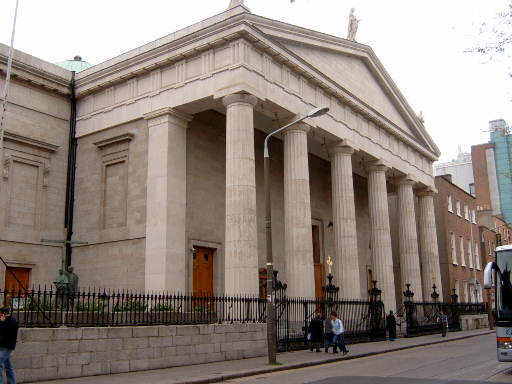
Today is the 44th anniversary of my ordination to the priesthood in St Mary's Pro-Cathedral, Dublin, my native city. Three days ago I posted about Fr Alfred Delp SJ, martyred by the Nazis on 2 February 1945. While doing research for that I came across a sermon he gave on the Sacrament of Holy Orders, one of a series on the Seven Sacraments in Munich in the autumn of 1941. I found it on the website of The Ignatius Press.


Here is the text of the sermon with some parts highlighted and [comments] added.

Holy Orders | by Fr. Alfred Delp, S.J. | Preached in Munich, Autumn 1941

"Let the grace that is in you through the laying on of hands be rekindled." (2 Timothy 1:8)

...First: In that great moment of our life when we go to be ordained, we kneel before the bishop and he silently lays his hands upon us. He is silent. You feel the blessed and creative burden of this hand through your entire being. And the congregation is silent. And this silence will surround the priest. This keeping silent, the still hands of the silent bishop, calls forth the priest from his former homeland. It calls him forth from his previous refuges, and sequesters him and encompasses him with this silence, this stillness in which he will be consecrated, so that it will accompany him all his life. This silence must surround us. We guard people's secrets in silence. We call our heart to be silent, so that it does not love where it should not love. Our will for power must be silent, because we are sent forth to be the hands of the Lord in blessing. Silent, too, must be our will for all the other things that, otherwise, could shelter and anchor and secure a life in this world. The silence accompanies us, because it is always the sign that the Lord God has come especially near. [Fr Delp's great emphasis on silence is striking. We don't live in a silent word. '
But Mary kept all these things, pondering them in her heart' (Luke 2: 19)].
Second: The second symbolic action tells us the meaning of this mission. This happens when our hands are anointed with the sign of the cross. Anointing is a sign of mission and authority, of stability and power. But our anointing is the anointing with a cross. It is, first of all, like that of the body of the Lord, an anointing to "passio", to the deepest participation in His vocation as Redeemer. Therefore, we are held and we are bound to give all we have, really to wear ourselves out, to give ourselves away completely. [As early as 1936, the year before he was ordained, Alfred Delp hinted in a letter to his mother that he might be asked to die for the faith]. Being silent must also be a silence before oneself and one's own will to live; an entering into the service, into the worship, and into the sacrifice. 

Third: And then we receive the chalice and the paten. With the chalice and the paten, we are commissioned to be guardians of the very holiest that mankind possesses, the body of the Lord and the holy chalice of His present sacrifice. [This to me speaks of the heart of the priesthood, something that has been lost to some degree, I think]. With the chalice and the paten, we are commissioned and sent--not to keep for ourselves the filled chalice--but to bear it onward, to share it, to give it away. With the chalice and the paten, we are commissioned and sent forth to gather together into this chalice the world's sorrow, sacrifices, and distress, and simultaneously to remove them--as much as that is possible to us--and to consecrate them in this sacrificial chalice of the Lord. [One of the situations in Ireland, where the Catholic faith has been lost by many in recent decades where people still look to the priest is when a tragedy occurs].

Fourth: Then there is another laying on of hands and we are told that we are to go forth and take away sin, that we are sent into this final dialogue, into the final duel with the demonical. [Living in Nazi Germany, Fr Delp had no illusions about the reality of sin, of evil]. With the guilty, the weak, and the sick, we must have an endless mercy. [In his prison writings Fr Delp showed great compassion for his fellow Germans caught up in the evil of Nazism]. There, where help is needed, it is really true [as Schiller wrote]: "Your duty and your vows are your rampart. And nothing more remains to you." [This is something that all who take vows, including married couples, need to take to heart. Our vows, when taken seriously, truly are a rampart and give strength in times when we are tempted to surrender to difficulties]. We must actually roam the outermost trenches, where it is imperative to take a stand against the demonical.

Fifth: And once again we turn to the consecrating bishop and extend our hands, and he takes our hands in his and asks us: "Do you promise?"

We answered: "Promitto" (I promise). That was the final commitment, that--with our very existence, our own salvation, and our eternal destiny--we bound ourselves to the fulfillment of this life. ['Commitment': have we lost that word and reality?] From this moment of consecration on, we must be under way, as long as our feet will still carry us, in order to bless and to help and to consecrate; to share the chalice of the Lord, and to bring light, and to ban the night and the darkness. [So often priests who focus on these things are dismissed as 'sacristy priests'. Father Delp is not calling for a retreat to the sacristy but to '
actually roam the outermost trenches, where it is imperative to take a stand against the demonical' (previous paragraph)]. That is the image, and the outline, and the duty, which we carried forward from our ordination day. 

...Seen from the perspective of what we priests should be and could be, we are an answer: the priest is a redemption and is a fulfillment. And look where you will, wherever people follow a man and follow him completely, finally and ultimately they expect him to be precisely what the priest should be and must be for them, if he does not want to betray his office and his consecration: One who is stable, completely helpful, really in possession of the ultimate in being; and also able to give, to communicate the great blessings, the great consecrations, the great graces. Therefore, the consciousness of the fact that in our community there are men who are ordained, who are blessed, should help you to stand with certainty, upright and unashamed in this life, whatever the effort, come what may. There are men placed in your midst whose only meaning and right to exist is that they be available, and give what they have--and more than they themselves have to give--the Lord God's entire abundance, which is entrusted to them. In the consciousness that such is among you, you can grow and be secure. [Surely this is a wonderful challenge not only to priests but to the wider community to support them in a way that will enable them to faithfully be what they are called to be].

However, you must always have the sense, as well, that you are helping us, so that the fire, which is in us through the laying on of hands and the consecration and anointing, does not does not go out. Rather, it should glow and blaze and burn, so that the seekers know where homeland is; and the erring know where counsel is; and the helpless know where blessing is; and those who have strayed know where the gates are for the return, which is awaiting them with the joy of the Lord. [A wonderful description of what a shepherd is called to be].


18 December 2011

Devastation in southern Philippines


Tropical storm 'Washi', Philippine name 'Sendong', devastated two major cities in northern Mindanao in the early hours of yesterday morning, Saturday, 17 December, killing hundreds of people. The two cities, Cagayan de Oro and Iligan, are very familiar to me and to many Columbans. We still have a house in Cagayan de Oro and a parish in the city, and at one time worked in all of the parishes in the Diocese of Iligan, including those in the city.

Mindanao isn't a small island. It is larger than Ireland.

The storm was initially forecast to strike the island of Negros, expected to affect Bacolod City where I live. But it changed course and hit an area of Mindanao that rarely if ever experiences a typhoon or tropical storm.

Some friends were directly affected but nobody that I know, as far as I am aware, was killed. The home of one of our household staff in the Columban house in Cagayan de Oro was very badly damaged. He and hiw family are now staying in the Columban house. In the video you can see St Augustin Cathedral at 1:44.

Here are some text messages I received from friends.

From a former Columban lay missionary who worked in Ireland and whose home was badly damaged: Thanks be to God He saved us! Many perished in our subdivision. We are staying in Vianney (a diocesan seminary) temporarily.

From a couple deeply involved in Worldwide Marriage Encounter (WWME): All WWME couples OK. No electricity or water to drink or for bathing and washing. Our place, all things upside down. The miracle is the images of Jesus, Mary and Joseph were still standing, and no mud. God is so good. This couple were in Cebu at the time of the rain, wind and flooding in Cagayan de Oro and their adult son had to flee for safety.

These text messages express the resilient faith and hope that so many Filipinos have.

Please pray for those who have lost family members and for those who have lost nearly all their possessions.

17 December 2011

An Advent Voice of Hope from Nazi Germany: Fr Alfred Delp SJ

Stamp issued in West Germany 1964

I used to own a copy of The Prison Meditations of Alfred Delp SJ but lost it somewhere along the way while being transferred from one place to another. Jenny Howell, of the Center for Christian Ethics, Baylor University, Waco, Texas, writes her reflections on these writings here. She uses the title under which Father Delp's writings have been more recently published by Ignatius Press, Advent of the Heart: Seasonal Sermons and Prison Writings.


I was born in Ireland on Hitler's birthday in 1943, just two years before World War II ended. Though independent Ireland wasn't involved directly in that conflict I have often wondered how the profoundly anti-Christian and anti-human Nazism took hold in a country that produced so many great saints and creators of beauty such as Beethoven, led by a man from the country that gave birth to Haydn and Mozart. (I once met a man in rural Kentucky who grew up in a community where Catholics were still perceived by some as having horns and cloven hooves and where classical music was hardly ever heard and who became a Catholic through the beauty of the music of those two composers when he discovered they were Catholics.)

This morning I received this article by email from a Columban colleague. I think it makes good Advent reading.

Father Alfred Delp, S.J.

Advent — A Season to Find Hope Amid Despair In The World

By Joseph F. Pisani [Editor, The Advocate and Greenwich Time]

On Christmas Eve 1944, shortly before the Allies began their final assault on Nazi Germany, a young Jesuit sat in solitary confinement in a Berlin prison, preparing a sermon he would never deliver.

Father Alfred Delp, 37, was an outspoken critic of the Nazis, who had been arrested five months before for treason and complicity in the July 20 plot to assassinate Hitler by exploding a bomb in his meeting room. For nine weeks, the priest endured interrogation and torture at the hands of the Gestapo, torture which he said left him little more than a "bleeding whimper."

Despite this degradation, he had perennial hope — a hope even the Nazis could not destroy — which he expressed in sermons that his friends smuggled out of prison.

Many of these essays were composed during his four months of solitary confinement in a small cubicle, where the guards constantly kept the lights on to compound his torment. But the priest didn't seem to care; strangely, adversity only made him stronger, and his example inspired other prisoners.

Delp, who was the rector of Saint George Church in Munich, had been a leader in the resistance movement, and worked as a link in an underground system that helped Jews flee the country. He was arrested following the failed attempt to assassinate Hitler, even though he wasn't part of the plot.

Despite his circumstances, he looked forward to celebrating Christmas Mass in his cell, and saw Advent as a reason to be hopeful in a terrorized world. To him, the season had special meaning, and he wrote, "Our hearts must be keenly alert for opportunities in our own little corners of daily life. May we stand in this world, not as people in hiding but as those who help prepare the way for the Son of God."

He often reflected on the need for courage in a world that had forgotten the meaning of Christmas. Isn't the same true today? Almost 65 years later, atrocities are still being committed, and hearts grow cold in the relentless pursuit of power, profit and possessions. We live in an age characterized by greed and gross insensitivity to suffering.

Delp was one of those principled men and women who appear in every generation and confront the insanity of a world dark with despair, illuminating the way for the rest of us. His example ignited the ideals of his fellow prisoners, who, by any reckoning, had no reason to be hopeful. The source of his strength was a realization that the child in the manger was greater than all the tyrants and totalitarian regimes in history.

In his last meditation, composed on Christmas Eve, a month before he would be hanged for treason, Delp wrote, "How many types of people today could honestly appear at the manger? Most of them have absolutely no desire to do so. The small, scanty door does not let anyone riding a high horse get through. ... How much of what we are living through today cannot stand in the presence of the Child!"

Even though the Nazis pressured him to leave the Jesuits, he resisted, and professed his final vows shortly before his execution on February 2, 1945. Facing death, he was in good spirits and joked with his confessor that, "In half an hour, I'll know more than you do."

During his last days, Delp wrote: "Whoever is true to life, however hard and barren it may be, will discover in himself fountains of very real refreshment. The world will give him more than he ever imagined possible. ... his burdens will turn to blessings because he recognizes them as coming from God and welcomes them as such. Let us trust in life because we do not have to live through it alone. God is with us."

+++

Jenny Howell quotes Father Delp's initial reaction to his death sentence: “To be quite honest I don’t want to die, particularly now that I feel I could do more important work and deliver a new message about values that I have only just discovered and understood. But it has turned out otherwise.” Jenny Howell further quotes the priest, who made his final vows as a Jesuit in his prison cell (the Nazis offered him a reprieve if he left the Jesuits): “This is seed-time, not harvest. God sows the seed and some time or other he will do the reaping. The only thing I must do is to make sure the seed falls on fertile ground.May others at some future time find it possible to have a better and happier life because we died in this hour of trial.”
 
I recall from memory that Father Delp, who was ordained priest in 1937, wrote in his final letter, to his parents, I think, 'I die because I am a Jesuit'. As a priest I have always been inspired by those words.
 
Like another great martyr, St Thomas More, he was able to joke as he was about to be executed, saying to the prison chaplain, 'In half an hour, I'll know more than you do!'

15 December 2011

‘Let what you have said be done to me.’ Sunday Reflections, 4th Sunday of Advent Year B

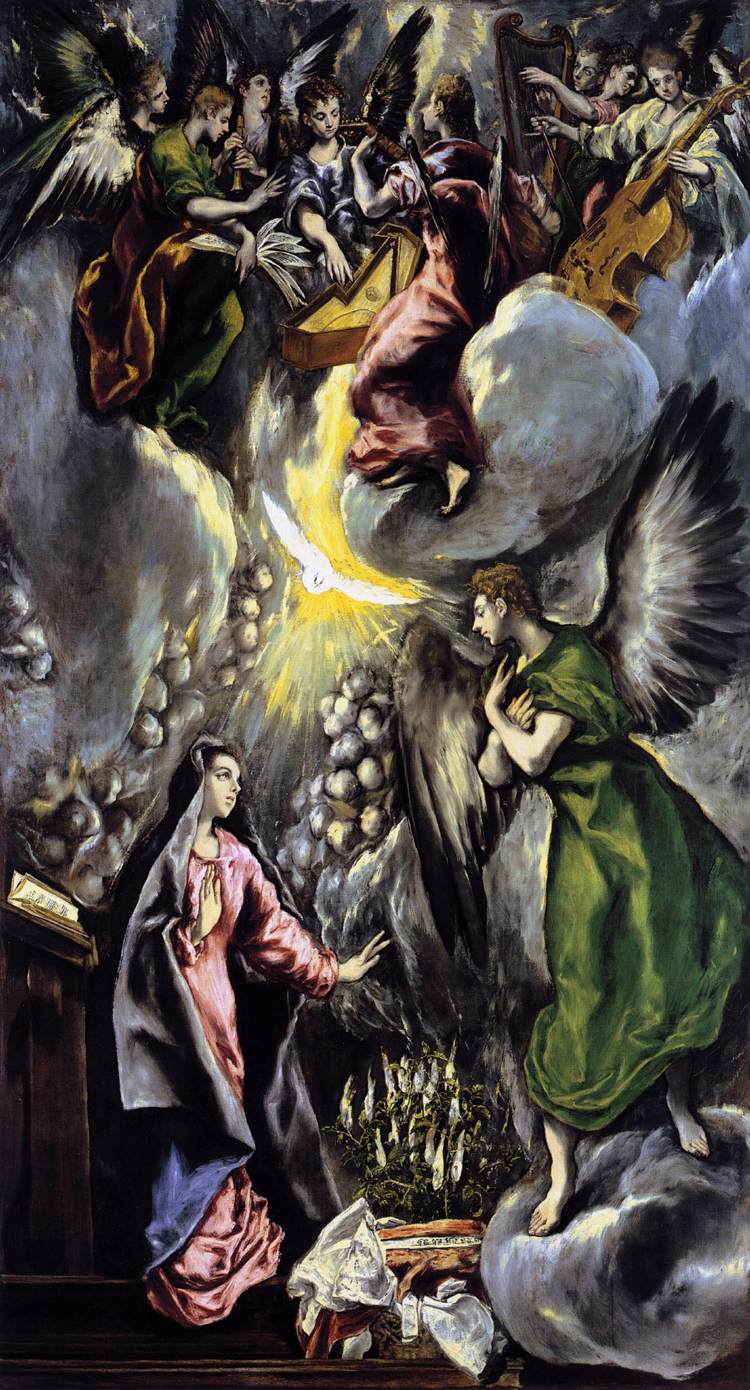
Annunciation, El Greco, painted 1596-1600

Readings (New American Bible: Philippines, USA)

Gospel Luke 1:26-38 (Jerusalem Bible: Australia, England & Wales, India [optional], Ireland, New Zealand, Pakistan, Scotland, South Africa)

The angel Gabriel was sent by God to a town in Galilee called Nazareth, to a virgin betrothed to a man named Joseph, of the House of David; and the virgin's name was Mary. He went in and said to her, 'Rejoice, so highly favoured! The Lord is with you.' She was deeply disturbed by these words and asked herself what this greeting could mean, but the angel said to her, 'Mary, do not be afraid; you have won God's favour. Listen! You are to conceive and bear a son, and you must name him Jesus. He will be great and will be called Son of the Most High. The Lord God will give him the throne of his ancestor David; he will rule over the House of Jacob for ever and his reign will have no end.' Mary said to the angel, 'But how can this come about, since I am a virgin?' 'The Holy Spirit will come upon you' the angel answered 'and the power of the Most High will cover you with its shadow. And so the child will be holy and will be called Son of God. Know this too: your kinswoman Elizabeth has, in her old age, herself conceived a son, and she whom people called barren is now in her sixth month, for nothing is impossible to God' 'I am the handmaid of the Lord,' said Mary 'let what you have said be done to me.' And the angel left her.

An Soiscéal Lúcás 1:26-38 (Gaeilge, Irish)

Cuireadh an t-aingeal Gaibriéil ó Dhia go dtí cathair sa Ghailíl darbh ainm Nazarat chun maighdine a bhí luaite le fear de theaghlach Dháiví darbh ainm Iósaef, agus b’é ab ainm don mhaighdean, Muire. Agus ar a theacht isteach chuici dúirt: “Sé do bheatha, atá lán de ghrásta, tá an Tiarna leat; is beannaithe tú idir mná.” Ach bhí buaireamh uirthi de chionn na cainte, agus bhí sí ag machnamh cén sort beannachadh é seo. Ach dúirt an t-aingeal léi: “Ná bíodh eagla ort, a Mhuire, óir fuair tú gean ó Dhia. Agus féach, gabhfaidh tú gin agus béarfaidh tú mac agus tabharfaidh tú Íosa mar ainm air. Beidh sé mór, agus glaofar Mac an Té is airde air, agus tabharfaidh an Tiarna Dia dó ríchathaoir Dháiví a athair, agus beidh sé ina Rí ar theaghlach Iacóib go brách, agus ní bheidh deireadh lena ríocht.” Dúirt Muire leis an aingeal: “Conas a bheidh seo amhlaidh, agus gan cuid agam d’fhear chéile?” Agus dúirt an t-aingeal á freagairt: “Tuirlingeoidh an Spiorad Naomh ort, agus beidh cumhacht an té is airde ina scáil anuas ort, agus sin é an fáth a mbeidh an leanbh naofa; glaofar Mac Dé air. Agus féach, Eiliosaibeit do bhean ghaoil, ghabh sise mac freisin ina seanaois, agus is é seo an séú mí aici siúd a dúradh a bheith aimrid. Óir níl ní ar bith dodhéanta ag Dia.” Dúirt Muire: “Féach, mise banóglach an Tiarna; déantar liom de réir d’fhocail.” Agus d’imigh an t-aingeal uaithi.

+++

Mollie was a cousin of my mother. She grew up near Tara, County Meath, where the high kings of Ireland once lived and which is in sight of St Columban’s, Dalgan Park, where I studied from 1961 until 1968. Mollie married Jimmy who was from the same area. He worked for the Land Commission.

After the birth of their second child Mollie was bedridden for three years, with a serious problem in her back. Though she recovered to some degree from that she never had good health again and went blind in the last few years of her life.

I had met Mollie and Jimmy as a child when I attended the funeral of Mollie’s mother. During my years in Dalgan Park I wrote them and renewed the contact between the families. I visited them regularly in the small cottage that was their home and always felt the warmth of their welcome along with their simplicity. Jimmy once said to me, ‘We couldn’t be happier here. We have the basic things we need. Lord Dunsany couldn’t have more than we have’. (The Dunsany ancestral castle is near where Jimmy and Mollie lived. The Dunsany family name is Plunkett and they are distantly related to St Oliver Plunkett.)

When Jimmy and Mollie exchanged their wedding vows they had no idea that ‘in sickness and in health’ would mean serious sickness and poor health for Mollie for most of their married life. With their simple, strong and deep faith they accepted what life brought. Their love for each other was something I felt drawn into each time I visited their home.

When Mary said 'yes' to God's message she had no idea what it would bring her. She accepted the future in total faith and draws us into the Love who is her Son, our Brother and Saviour, the Risen Lord.

‘Let what you have said be done to me.’


Un ángel vino de los cielos
y a María le anunció
el gran misterio de Dios hombre
que a los cielos admiró.

VIRGEN MADRE, SEÑORA NUESTRA
RECORDANDO LA ENCARNACIÓN,
TE CANTAMOS TUS HIJOS TODOS
COMO ESTRELLA DE SALVACIÓN.

Yo soy la esclava del Señor mi Dios,
la Virgen dijo, al contestar,
se haga en mí según has dicho,
se cumpla en mí tu voluntad.

VIRGEN MADRE, SEÑORA NUESTRA
RECORDANDO LA ENCARNACIÓN,
TE CANTAMOS TUS HIJOS TODOS
COMO ESTRELLA DE SALVACIÓN.

Y el Verbo para redimirnos
tomó su carne virginal
vivió hecho hombre entre nosotros
librándonos de eterno mal.

VIRGEN MADRE, SEÑORA NUESTRA
RECORDANDO LA ENCARNACIÓN,
TE CANTAMOS TUS HIJOS TODOS
COMO ESTRELLA DE SALVACIÓN.

TE CANTAMOS TUS HIJOS TODOS
COMO ESTRELLA DE SALVACIÓN.

The verses above follow the words of the Angelus (below). Here is my attempt at translating the refrain from Spanish to English:

VIRGIN MOTHER, OUR LADY,
REMEMBERING THE INCARNATION,
ALL YOUR CHILDREN SING TO YOU
AS THE STAR OF SALVATION.

The Angelus, Jean-François Millet (painted 1857-59)

V. The angel of the Lord declared unto Mary.
R. And she conceived by the power of Holy Spirit.

Hail Mary, full of grace, the Lord is with you. Blessed are you among women, and blessed is the fruit of your womb, Jesus.
Holy Mary, Mother of God, pray for us sinners, now and at the hour of our death. Amen.

V. Behold the handmaid of the Lord.
R. Be it done unto me according to your Word.

Hail Mary, full of grace, the Lord is with you. Blessed are you among women, and blessed is the fruit of your womb, Jesus.
Holy Mary, Mother of God, pray for us sinners, now and at the hour of our death. Amen.

V. And the Word was made flesh.
R. And dwelt among us.

Hail Mary, full of grace, the Lord is with you. Blessed are you among women, and blessed is the fruit of your womb, Jesus.
Holy Mary, Mother of God, pray for us sinners, now and at the hour of our death. Amen.

V. Pray for us, O Holy Mother of God.

R. That we may be made worthy of the promises of Christ.

Let us pray: Pour forth, we beseech thee, O Lord, Thy grace into our hearts, that we to whom the incarnation of Christ Thy Son was made known by the message of an angel, may by His Passion and Cross be brought to the glory of His resurrection; through the same Christ our Lord. Amen.

14 December 2011

Mass attendance in Dublin is down to 14 per cent


I was ordained in St Mary's Pro-Cathedral, known to Dubliners as 'The Pro', on 20 December 1967. A priest concelebrates at his ordination Mass, the only occasion in the old days when concelebration took place. I never had a chance to celebrate Mass again in 'The Pro' until 19 November this year where I was one of around 40 priests who concelebrated with Cardinal Seán Brady for the annual Mass for Frank Duff, founder of the Legion of Mary, who died on 7 November 1980. The church was packed but most of those present, including the priests, were on the older side. One exception was the young priest to my left, an Angolan studying in Dublin. I was a few young people in the congregation, some of them Filipinos.


I was shocked, to some degree, though not entirely surprised to read a story by Patsy McGarry in today's Irish Times, Archbishop says Dublin diocese facing crisis, in which he quotes Archbishop Diarmaid Martin as saying, The change that will take place between now and the year 2020 – just eight years away – will be enormous. I am more and more convinced that they will be the most challenging years that the diocese has had to face since Catholic Emancipation. Catholic Emancipation was the act of the Westminster Parliament in 1829 that lifted nearly all of the remaining anti-Catholic laws in the United Kingdom, which in those day included the whole of Ireland. One of the first churches built in Dublin after Emancipation was St Paul's, Arran Quay, where my parents were married in 1942, is now closed as a church of the archdiocese. I'm not sure if it is used on occasion.


Archbishop Martin was speaking a week after a report found that weekly Mass attendance in Dublin is down to 14 per cent (164,000 out of a Catholic population of 1,162,000). More than 30 years ago I heard such figures about some parishes in poorer parts of the city. The archbishop said some time ago that in such parishes now Mass attendance is about two or three per cent.

For someone who remembers packed churches on weekdays during Lent in the 1950s such figures are hard to take in, even though I've seen the decline over the past four decades. Mass attendance on Sundays in those days was probably more than 95 per cent.

The Irish Independent carried a story by Lynne Kelleher on 10 December, Archbishop urges lapsed Catholics to leave the faith. Archbishop Martin said, It requires maturity on those people who want their children to become members of the church community and maturity on those people who say 'I don't believe in God and I really shouldn't be hanging on to the vestiges of faith when I don't really believe in it'.

Two young persons close to me chose last May to have a civil wedding rather than a church one, even though they were raised as Catholics. But the Catholic faith doesn't play any part in their lives now, though I have never heard either of them say a word against the faith or the Church. They made the kind of choice that Archbishop Martin was speaking about. I also made my choice to attend the wedding, since the groom was my only nephew. Many of my generation in Ireland, especially parents, whose faith is strong are finding themselves having to make choices in situations that they never imagined in their younger days.

As I see it, there is a huge loss of faith in Ireland. I don't belong to the school that thinks some vague 'spirituality' is the same as faith in Jesus Christ, God who became Man, who died for us on Calvary and rose from the dead on Easter Sunday. I don't belong to the school that thinks you can be a good Catholic if you rarely go to Mass. Nor am I saying that such persons are bad. I see an integrity in the choice of someone who says clearly that he no longer believes in the Christian faith and lives with the consequences of that.

I pray each day that those close to me who have lost the faith will re-discover the precious gift they received at baptism. I have no doubt whatever that my prayers are fully in accord with God's will and that He will answer them in his own time and in his own way.

Pray for the Church in Ireland, especially in the Archdiocese of Dublin.


08 December 2011

'A witness to speak for the light'. Sunday Reflections, 3rd Sunday of Advent Year B

Preaching of St John the Baptist, Domenico Ghirlandaio, painted 1486-90

Readings (New American Bible: Philippines, USA)

Gospel John 1:6-8, 19-28 (Jerusalem Bible: Australia, England & Wales, India [optional], Ireland, New Zealand, Pakistan, Scotland, South Africa)

A man came, sent by God.
His name was John.
He came as a witness,
as a witness to speak for the light,
so that everyone might believe through him.
He was not the light,
only a witness to speak for the light.

This is how John appeared as a witness. When the Jews sent priests and Levites from Jerusalem to ask him, 'Who are you?' he not only declared, but he declared quite openly, 'I am not the Christ'. 'Well then,' they asked 'are you Elijah?' 'I am not' he said. 'Are you the Prophet?' He answered, 'No'. So they said to him, 'Who are you? We must take back an answer to those who sent us. What have you to say about yourself?' So John said, 'I am, as Isaiah prophesied:

a voice that cries in the wilderness:
Make a straight way for the Lord'.

Now these men had been sent by the Pharisees, and they put this further question to him, 'Why are you baptising if you are not the Christ, and not Elijah, and not the prophet?' John replied, 'I baptise with water; but there stands among you - unknown to you - the one who is coming after me; and I am not fit to undo his sandal-strap'. This happened at Bethany, on the far side of the Jordan, where John was baptising.

+++

An Soiscéal Eoin 1:6-8, 19-28 (Gaeilge, Irish)


Bhí fear a tháinig ina theachtaire ó Dhia,
agus Eoin a ba ainm dó.
Tháinig sé ag déanamh fianaise
chun fianaise a thabhairt i dtaobh an tsolais
chun go gcreidfeadh cách tríd.
Níorbh é féin an solas
ach tháinig ag tabhairt fianaise i dtaobh an tsolais.


Is í seo an fhianaise a thug Eoin nuair a chuir na Giúdaigh sagairt agus Léivítigh ó Iarúsailéim chuige á fhiafraí de: “Cé hé thusa?” D’admhaigh sé agus níor shéan agus d’admhaigh sé: “Ní hé an Críost mé.” D’fhiafraigh siad de: “Cad eile, más ea? An tú Éilias?” “Ní mé,” ar seisean. “An tú an fáidh?” Agus d’fhreagair: “Ní mé.” Dúirt siad leis mar sin: “Cé hé thú? – chun go mbeadh freagra againn dóibh seo a chuir chugat sinn. Cad tá le rá agat mar gheall ort féin?” Dúirt sé: “Is glór duine mé ag éamh san fhásach: ‘Déanaigí díreach bóthar an Tiarna,’ mar a dúirt Íseáia fáidh.” Ó na Fairisínigh a ba ea na teachtairí, agus chuir siad ceist air: “Cén fáth a mbíonn tú ag baisteadh más ea,” ar siad, “mura thú an Críost, nó Éilias, nó an fáidh?”


Thug Eoin freagra orthu: “Déanaim féin baisteadh le huisce,” ar seisean, “ach tá duine in bhur measc nach aithnid daoibh, an té atá ag teacht i mo dhiaidh, nach fiú mé iall a chuarán a scaoileadh.” I mBeatáine, taobh thall den Iordáin, a tharla an méid sin mar a raibh Eoin ag déanamh baiste.


+++
We were a group of nearly 70 boys in our last year of secondary school, 17 and 18 years of age. The A and B sections had the same set of teachers and Brother Mícheál S. Ó Flaitile, a member of the Irish Christian Brothers, now known as the Congregation of Christian Brothers, used to take the two sections together for religions class each day before lunch. At the time he was probably around 60 years of age. Our nickname for him was ‘Pancho’ because he bore a certain resemblance to a chubby cartoon character of that name. We all revered him, though that didn’t prevent us from playing the occasional trick on him.

 
One particular day is seared in my memory. ‘Pancho’ apologized to the two sections because the day before he had scolded a member of the B section in front of us all and later discovered that the student hadn’t done anything wrong. I hadn’t remembered the scolding from the day before nor the alleged misdemeanor, which was trivial anyway. I doubt if any of my classmates had remembered it either. But for ‘Pancho’ it was a matter of honour and justice to correct his mistake and to say to us, and especially to the student he had wrongly judged, that he was sorry.

Years later, when he was already in his 80s, I reminded Br Ó Flaitile of the incident. He said he didn’t remember it – but he smiled.

I have taught from time to time at various levels during my 44 years as a priest and the example of ‘Pancho’ that day has stayed with me and guided me on many an occasion.

Even as a student I saw ‘Pancho’ as a Christ-like person. He taught us about Jesus in our religions classes but I remember very little, if anything, of what he said. But I remember his example, not only on the occasion he apologized to us, but in everything I saw in him over the years. I first came to know him when I was still in elementary school and he was in charge of a student organization I joined. It was only in my last two years in secondary school that I had him as a teacher.

In Ghirlandaio’s painting above we see Jesus very clearly in the background. But the people are focused on St John the Baptist. Jesus is standing higher than his cousin. This is the painter’s way of illustrating the words of the Baptist in today’s gospel: but there stands among you - unknown to you - the one who is coming after me; and I am not fit to undo his sandal-strap.

None of us is fit to undo the sandal-strap of Jesus. But each of us is called to be, not the light, but a witness to speak for the light who is Jesus through the life we lead. ‘Pancho’ was such a witness to me.


Gisella is a young Indonesian singer (as far as I can make out from online research). In this recording of the old European Advent hymn, Veni, Veni, Emmanuel, or 'O Come, O Come, Emmanuel, she is accomapnied by a drummer from Senegal in west Africa. She sings the first verse and refrain in the original Latin and then the same verse and refrai, with another, in the 1851 English translation by John Mason Neale.
 
Veni, Veni, Emmanuel

Veni, veni Emmanuel;
Captivum solve Israel,
Qui gemit in exilio,
Privatus Dei Filio.

Refrain

Gaude! Gaude! Emmanuel,
Nascetur pro te, Israel!

O Come, O Come, Emmanuel

O come, O come, Emmanuel
And ransom captive Israel
That mourns in lonely exile here
Until the Son of God appear

Rejoice! Rejoice! Emmanuel
Shall come to thee, O Israel.

O come, Thou Day-Spring, come and cheer
Our spirits by Thine advent here
Disperse the gloomy clouds of night
And death's dark shadows put to flight.

Rejoice! Rejoice! Emmanuel
Shall come to thee, O Israel.

Request for prayers

I am posting this on the afternoon of 8 December, the Solemnity of the Immaculate Conception, and will be going on retreat later today until the morning of 14 December. May I ask your prayers for myself and I will be praying for you.


07 December 2011

Virgin of Advent, for the Feast of the Immaculate Conception


VIRGEN DEL ADVIENTO

Virgen del Adviento,
esperanza nuestra,
de Jesús, la aurora,
del Cielo, la puerta.

Madre de los hombres,
de la mar, estrella,
llévanos a Cristo,
danos sus promesas.

Virgen del Adviento,
esperanza nuestra,
de Jesús, la aurora,
del Cielo, la puerta.

Eres Virgen Madre,
la de gracia llena,
del Señor, la esclava,
del mundo, la Reina.

Virgen del Adviento,
esperanza nuestra,
de Jesús, la aurora,
del Cielo, la puerta.

Alza nuestros ojos
hacia tu belleza,
guía nuestros pasos
a la vida eterna.

Virgen del Adviento,
esperanza nuestra,
de Jesús, la aurora,
del Cielo, la puerta

While researching for Sunday Reflections I came across this Advent hymn by Antonio Alcalde. I know nothing about him nor where this was recorded. I suspect it was in one of the Spanish-speaking Latin American country  rather than in Spain. The music is by Fr Jose Cristo Rey Garcia Paredes CMF.

Here is my rough, non-poetic translation of the lyrics:

Virgin of Advent, / our hope, / Crown of Jesus, / Gate of heaven.

Mother of mankind, / Star of the sea, / lead us to Christ, / give us what he has promised.

Virgin of Advent, / our hope, / Crown of Jesus, / Gate of heaven.

You are the Virgin Mother, / full of grace, / handmaid of the Lord, / Queen of the world.

Virgin of Advent, / our hope, / Crown of Jesus, / Gate of heaven.

Raise our eyes / to your beauty / guide our steps / to eternal life.