15 December 2012

'What then shall we do?' Sunday Reflections, 3rd Sunday of Advent Year C


Misa de Gallo (pre-dawn Mass) Saturday, 17 December 2011, Church of the Holy Cross, Gango, Ozamiz City, Philippines, hours after tropical storm Washi/Sendong had hit the area. (Photo courtesy of Janet Paredes De Lara).

Readings (New American Bible: Philippines, USA)

Readings (Jerusalem Bible: Australia, England & Wales, India [optional], Ireland, New Zealand, Pakistan, Scotland, South Africa)

Gospel Luke 3:10-18 (Revised Standard Version – Catholic Edition)

And the multitudes asked John, "What then shall we do?"  And he answered them, "He who has two coats, let him share with him who has none; and he who has food, let him do likewise." Tax collectors also came to be baptized, and said to him, "Teacher, what shall we do?" And he said to them, "Collect no more than is appointed you." Soldiers also asked him, "And we, what shall we do?" And he said to them, "Rob no one by violence or by false accusation, and be content with your wages." As the people were in expectation, and all men questioned in their hearts concerning John, whether perhaps he were the Christ, John answered them all, "I baptize you with water; but he who is mightier than I is coming, the thong of whose sandals I am not worthy to untie; he will baptize you with the Holy Spirit and with fire. His winnowing fork is in his hand, to clear his threshing floor, and to gather the wheat into his granary, but the chaff he will burn with unquenchable fire." So, with many other exhortations, he preached good news to the people. 


The complete text of Gaudete, including the refrain:

LatinEnglish
Gaudete, gaudete! Christus est natus
Ex Maria virgine, gaudete!
Rejoice, rejoice! Christ is born
(Out) Of the Virgin Mary — rejoice!
Tempus adest gratiæ
Hoc quod optabamus,
Carmina lætitiæ
Devote reddamus.
The time of grace has come—
what we have wished for,
songs of joy
Let us give back faithfully.
Deus homo factus est
Natura mirante,
Mundus renovatus est
A Christo regnante.
God has become man,
To the wonderment of Nature,
The world has been renewed
By the reigning Christ.
Ezechielis porta
Clausa pertransitur,
Unde lux est orta
Salus invenitur.
The closed gate of Ezekiel
Is passed through,
Whence the light is born,
Salvation is found.
Ergo nostra contio
Psallat iam in lustro;
Benedicat Domino:
Salus Regi nostro.
Therefore let our gathering
Now sing in brightness
Let it give praise to the Lord:
Greeting to our King.
The various groups who approached St John the Baptist in today's gospel asked him, What then shall we do? He gave them practical answers in the context of their lives. To tax collectors: Collect no more than is appointed you. His answers to them, to soldiers and to people in general apply today as much as they did in his day.

The people at Mass in Holy Cross parish in the photo were answering John's first piece of advice: He who has two coats, let him share with him who has none; and he who has food, let him do likewise. They were bringing up their offerings to be shared later with those in need. Everybody at the Mass was suffering from the floods that had come during the night. They probably weren't yet aware of the many who had died in Iligan City and in Cagayan de Oro City, not all that far away, where some of them probably had relatives and friends.

But they believed in their hearts what the Entrance Antiphon for 17 December, based on Isaiah 49:13,  says:
 
Læténtur cæli et exsúltet terra, 
quia  Dóminus  noster  véniet, 
et páuperum suórum miserébitur.  
  
Rejoice, O heavens, and exult, O earth, 
for our Lord will come to show mercy to his poor.

The Entrance Antiphon for the Mass of the Third Sunday of Advent has a similar message. It is taken straight from the Second Reading for Year C, Philippians 4:4-5: 


Gaudéte in Dómino semper: íterum dico, gaudéte.  
Dóminus enim prope est.

Rejoice in the Lord always; again I say, rejoice. 
Indeed, the Lord is near. 

The first word of the Entrance Antiphon, Gaudete, gives its nickname to the Third Sunday of Advent, 'Gaudete Sunday'.


The monks of St Benedict's Monastery in São Paulo (Brazil) the expanded Introit or Entrance Antiphon as sung in the Mass in the Extraordinary Form:

Gaudéte in Dómino semper:íterum díco, gaudéte:
modéstia véstra
nóta sit ómnibus homínibus:
Dóminus prope est.
Nihil sollíciti sítis:
sed in ómni oratióne
petitiónes véstrae
innotéscant apud Déum. 

Benedixísti, Dómine,
térram túam:
avertísti captivitátem Jácob. 

V.Glória Pátri.

--------------------------------------------------------------------------------­--------------------------

Rejoice in the Lord always; again I say, rejoice. 
Let your forbearance be known to all men. 
The Lord is at hand. 
Do not be anxious over anything; 
but in all manner or prayer, 
let your requests be made known unto God.

Lord, you have blessed your land; 

you have put an end to Jacob's captivity. 

V. Glory be to the Father


Here in the Philippines this Sunday coincides with the beginning of the Misas de Gallo, the novena of pre-dawn Masses that run to Christmas Eve. The Spanish term could be translated as 'Masses at Cockcrow'. They are also known as Aguinaldo Masses, 'aguinaldo' being a Sp;anish word for 'gift'. The gift in question is the precious gift of faith. In Tagalog the Masses are called Simbang Gabi or 'Night Masses'. The Ordo for the Philippines reminds us that these Masses in honour of the Blessed Virgin Mary, are to be celebrated on the nine days before Christmas for the perseverance of the nation in faith. White vestments are worn and the Gloria is sung. The readings are those of the day but the weekday Masses have their own special prayers.

The mediaeval hymn Gaudete [first video]is a Christmas carol rather than an Advent hymn but it fits in with this Sunday's celebration and with the mood of the Misas de Gallo. In Advent while we prepare to celebrate the anniversary of the birth of Jesus we also prepare for his coming into our daily lives and for his coming at the end of time, a reality that each of us will anticipate at the moment of death.

Peter of Blois (c.1135 - c.1211) writes about these three comings:

How blessed are those who can confidently say: My heart is ready, O God, my heart is ready! Having gathered the fruit of grace from the Lord’s first coming, they will reap a harvest of salvation and glory from the second; for the first opens up the way for the second, and the second prepares us for the third. Lowly and unspectacular in his first coming, secret and gentle in his second, Christ will come openly the third time, and his final coming will fill the world with dread. He came to us at his first coming in order to come into us at the second, and he comes into us at his second coming in order not to have to come against us at the third. At his first coming he showed mercy, in the second he brings grace, at the third he will give glory, for Scripture says: The Lord will confer grace and glory.


At this final coming the Lord will reward his saints for their labours, as he himself promises: I am coming soon, bringing my recompense according to what each person has done. Oh that it may be in accordance with his great mercy that he treats us then, and not as our evil deeds deserve! Though we do indeed expect Christ Jesus to come to us as our judge, we know that he has com to us already and we have accepted him as our Saviour.
 
Though the overwhelming theme of the Mass today is 'Rejoice' there is a 'sting in the tail'. St John the Baptist says of the coming Messiah, His winnowing fork is in his hand, to clear his threshing floor, and to gather the wheat into his granary, but the chaff he will burn with unquenchable fire. The words of Peter of Blois have a similar message that emphasises God's loving mercy, as do the words of John, while acknowledging that we can reject it: At his first coming he showed mercy, in the second he brings grace . . . Oh that it may be in accordance with his great mercy that he treats us then, and not as our evil deeds deserve!

It is possible for an individual to reject God's love, to reject the joy he offers us.

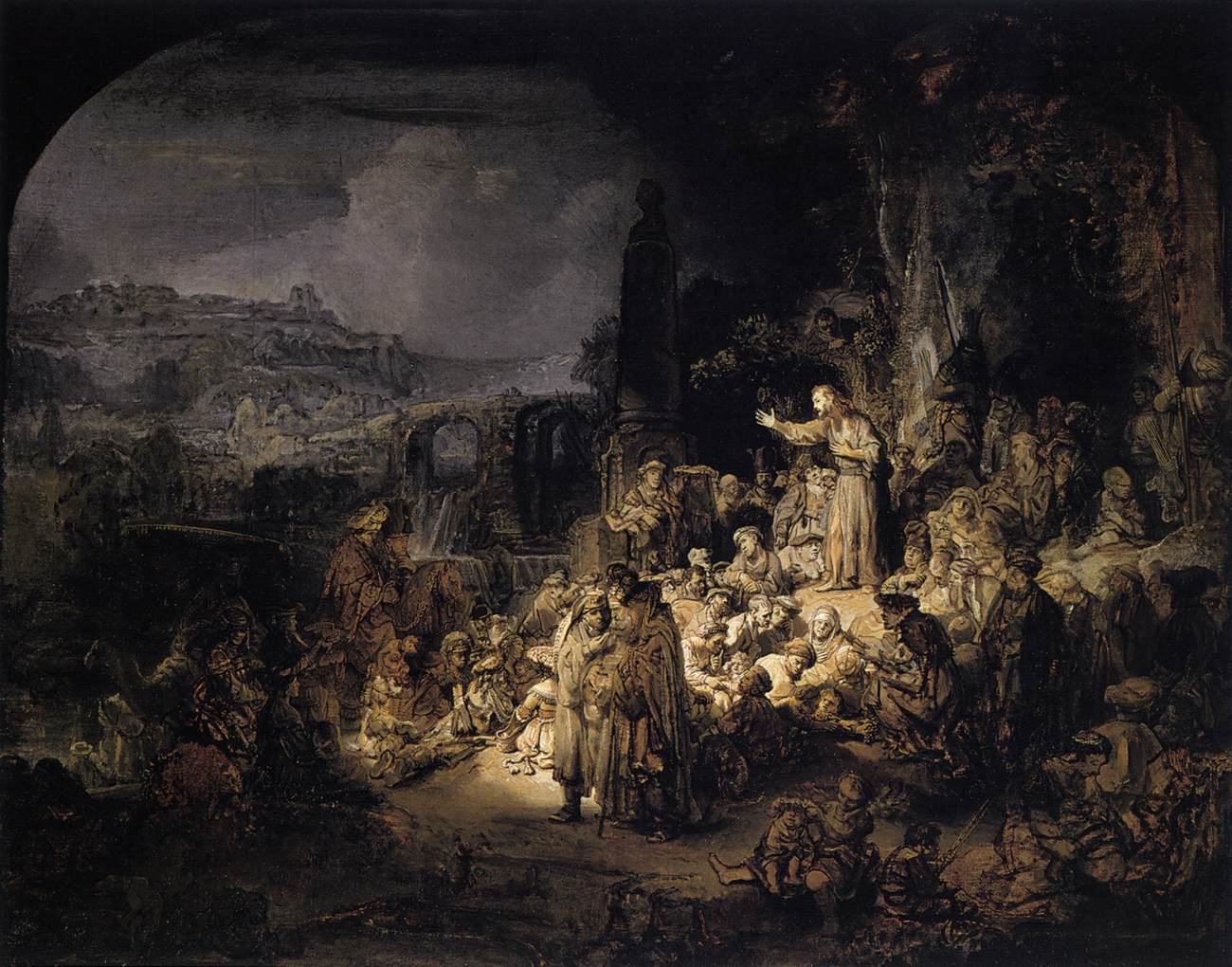
Massimo Stanzione, c.1634 (Web Gallery of Art)


Collect

O God, who see how your people 
faithfully await the feast of the Lord's Nativity, 
enable us, we pray, 
to attain the joys of so great a salvation 
and to celebrate them always
with solemn worship and glad rejoicing.
Through our Lord Jesus Christ, your Son, 
who lives and reigns with you in the unity of the Holy Spirit,
one God, for ever and ever.

order n

13 December 2012

St John of the Cross, 14 December


Del Verbo Divino
San Juan de la Cruz

Del Verbo divino
la Virgen preñada
viene de camino :
¡ si les dais posada !

Concerning the Divine Word
St John of the Cross

With the divinest Word, the Virgin
Made pregnant, down the road
Comes walking, if you'll grant her
A room in your abode 

Translation by Roy Campbell

A View of Toledo, El Greco, painted 1597-99 (Web Gallery of Art)

El Greco's landscape of Toledo depicts the Priory in which John was held captive, just below the old Muslim Alcazar and perched on the banks of the Tajo on high cliffs. (From Wikipedia).

From The Ascent of Mount Carmel by St John of the Cross
(Office of Readings, Advent Week 2, Monday)

When (God) gave us, as he did, his Son, who is his one Word, he spoke everything to us, once and for all in that one Word. There is nothing further for him to say.

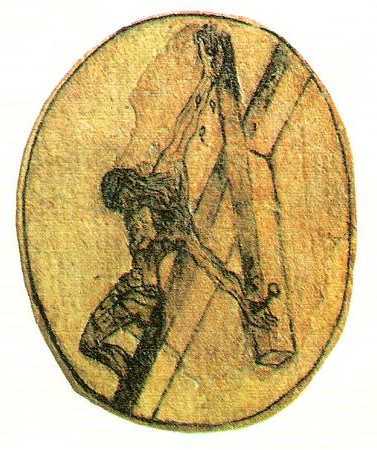
Drawing of the Crucifixion, St John of the Cross

From the Spiritual Canticle of St John of the Cross
(Office of Readings, Feast of St John of the Cross, 14 December)

There are depths to be fathomed in Christ. He is like a rich mine with many recesses containing treasures, and no matter how men try to fathom them the end is never reached. Rather, in each recess, men keep on finding here and there new veins of new riches.

St John wrote much of the Spiritual Canticle while he was imprisoned by other Carmelite friars.

The Weaver, Vincent van Gogh, painted 1883-84 (Web Gallery of Art)

When John's father Gonzalo, who came from a family that wasn't poor, married Catalina, an orphan who was, he was rejected and forced by circumstances to work with his wife as a weaver. When Gonzalo died Catalina continued in that line of work.

The Carmelite Monastery in Ozamiz City, where I worked during my early years in the Philippines, employs weavers. St John of the Cross is the patron of the monastery. Please remember the nuns in your prayers.

12 December 2012

Our Lady of Guadalupe; Nuestra Señora de Guadalupe


Collect

O God, Father of mercies, 
who placed your people under the singular protection 
of your Son's most holy Mother,
grant that all who invoke the Blessed Virgin of Guadalupe,
may seek with ever more lively faith
the progress of peoples in the ways of justice and of peace.
Through our Lord Jesus Christ, your Son,
who lives and reigns with you in the unity of the Holy Spirit,
one God, for ever and ever. Amen.

Oracion Colecta 
Señor, Dios nuestro, 
que has concedido a tu pueblo la protección
maternal de la siempre Virgen María, Madre de tu Hijo,
concédenos, por su intercesión, permanecer siempre firmes en la fe
y servir con sincero amor a nuestros hermanos.
Por nuestro Señor Jesucristo, tu Hijo,
que vive y reina contigo en la unidad del Espíritu Santo y es Dios,
por los siglos de los siglos. Amén.


As far as I can gather, every year in the morning of the Feast of Our Lady of Guadalupe there is a concert in her honour at the Basilica there in which top Mexican singers and musicians perform. It is called Las Mañanitas. Mañanita means 'daybreak'. The artists stand before the original image of the Virgin of Guadalupe and sing and play to her, not to the audience.

Perhaps we could learn something from that about the way we celebrate Mass.

The Diocese of Mexico was established in 1530 and it was the following year that San Juan Diego saw the Blessed Mother on the Hill of Tepeyac. The diocese became an archdiocese in 1546. It included the Philippines until the Diocese of Manila was set up in 1579, becoming and archdiocese 16 years later.
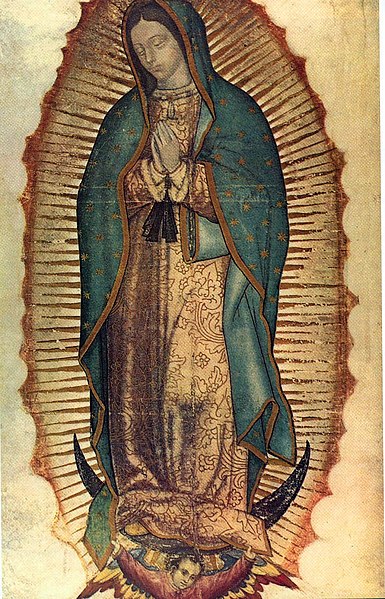
Detail of the face on the image of Our Lady of Guadalupe
Patron of the Pro-life Movement
Our Lady of Guadalupe is the Patron of the Pro-life movement. As it happens, it is expected that this afternoon the House in the Philippine Congress will vote on the controversial Reproductive Health Bill. The Catholic Church leadership has been strongly opposing this since it was first introduced about ten years ago. I'm not sure that the Church's approach has always been helpful. Friends have told me, and I've read in newspapers, that in parishes the priests speak about nothing else on Sunday. And last week a bishop is reported to have said that Typhoon Bopha/Pablo, which caused hundred of deaths in Mindanao, almost all of poor people, was a message from God about the RH Bill. This has given fodder to those who want to push contraception and abortion, though not all who support the former are in favour of the latter. Nor does everyone understand that some forms of 'contraceptives' are abortifacients, nor do they see that the wide availability of contraceptives in countries such as the UK or Britain, for example, has not led to fewer abortions. When you remove any activity from its proper context you are in trouble.
Perhaps we can pray to Our Lady of Guadalupe who, under that title, is a Patroness of the Philippines, that the vote today, if it goes ahead, will be in accordance with God's will.
Some Pro-life Websites
Choose Life 2012 (an initiative the Irish Catholic Bishops' Conference)
Life+Zone (Ireland)
Rachel's Vineyard, USA; Ireland (a ministry of healing to women and men directly affected by abortion)
Family & Life (Ireland)
LifeSiteNews (Canada)
The Visitation, El Greco 
I find myself constantly going back to El Greco's painting, such a wonderful 'Dance of Life'. Luke 1:39-47 is one of two suggested gospels for today's feast.
In those days Mary arose and went with haste into the hill country, to a city of Judah, and she entered the house of Zechariah and greeted Elizabeth. And when Elizabeth heard the greeting of Mary, the babe leaped in her womb; and Elizabeth was filled with the Holy Spirit and she exclaimed with a loud cry, "Blessed are you among women, and blessed is the fruit of your womb! And why is this granted me, that the mother of my Lord should come to me? For behold, when the voice of your greeting came to my ears, the babe in my womb leaped for joy. And blessed is she who believed that there would be a fulfilment of what was spoken to her from the Lord." 
And Mary said, "My soul magnifies the Lord, and my spirit rejoices in God my Savior.

En aquellos días, María partió y fue sin demora a un pueblo de la montaña de Judá. Entró en la casa de Zacarías y saludó a Isabel. Apenas esta oyó el saludo de María, el niño saltó de alegría en su seno, e Isabel, llena del Espíritu Santo, exclamó: «¡Tú eres bendita entre todas las mujeres y bendito es el fruto de tu vientre! ¿Quién soy yo, para que la madre de mi Señor venga a visitarme? Apenas oí tu saludo, el niño saltó de alegría en mi seno. Feliz de ti por haber creído que se cumplirá lo que te fue anunciado de parte del Señor». 

María dijo entonces: «Mi alma canta la grandeza del Señor, y mi espíritu se estremece de gozo en Dios, mi salvador.

+++

The English text of the gospel is from the Revised Standard Version, Catholic Edition and the Spanish text from the Vatican website.


08 December 2012

'Prepare the way of the Lord.' Sunday Reflections, 2nd Sunday of Advent Year C


Readings (New American Bible: Philippines, USA) 

Readings (Jerusalem Bible: Australia, England & Wales, India [optional], Ireland, New Zealand, Pakistan, Scotland, South Africa)

Gospel Luke 3:1-6 (Revised Standard Version – Catholic Edition)

In the fifteenth year of the reign of Tiberius Caesar, Pontius Pilate being governor of Judea, and Herod being tetrarch of Galilee, and his brother Philip tetrarch of the region of Ituraea and Trachonitis, and Lysanias tetrarch of Abilene, in the high-priesthood of Annas and Caiaphas, the word of God came to John the son of Zechariah in the wilderness; and he went into all the region about the Jordan, preaching a baptism of repentance for the forgiveness of sins. As it is written in the book of the words of Isaiah the prophet, "The voice of one crying in the wilderness: Prepare the way of the Lord, make his paths straight. Every valley shall be filled, and every mountain and hill shall be brought low, and the crooked shall be made straight, and the rough ways shall be made smooth;  and all flesh shall see the salvation of God." 


Charles Kuralt was an American journalist who worked for many years on the CBS TV network in the USA. He was especially noted for his 'On the Road' features on the CBS Evening News. These started in 1967, the year I was ordained, and I became familiar with them when I went to study in the USA the following year.

I vividly remember one particular story - they were never from the highways but from the byways of the Untied States - about a man somewhat on the older side who lived in a small town somewhere in the heartland of the country. I forget the particular state. The nearest town was only a few kilometres away but there was no road connecting the two. People had to take a very long way around to get from one to the other.

The residents of both houses tried for years to persuade their politicians to build a road between the towns, without success. So this particular elderly citizen decided he'd start to build a road himself. When Charles Kuralt caught up with him he hadn't got very far - but he had started.


This man was engaged in what the Handbook of the Legion of Mary calls Symbolic Action. The Handbook was written almost entirely by Frank Duff, the founder of the Legion.

The Handbook says, It is a fundamental Legion principle that into every work should be thrown the best that we can give. simple or difficult, it must be done in the spirit of Mary . . . 

But sometimes we are faced with works which are really impossible, that is to say, beyond human effort . . .

'Every impossibility is divisible into thirty-nine steps, of which each step is possible' - declares a legionary slogan . . .

Observe: the stress is set on action. No matter what may be the degree of the difficulty, a step must be taken. Of course, the step should be as effective as it can be. But if an effective step is not in view, then we must take a less effective one. And if the latter be not available, then some active gesture (that is, not merely a prayer) must be made which, though of no apparent practical value, at least tends towards or has some relation to the objective. This final challenging gesture is what the Legion has been calling 'Symbolic Action.' Recourse to it will explode the impossibility which is of our own imagining. And, on the other hand, it enters in the spirit of faith into dramatic conflict with the genuine impossibility.

The sequel may be the collapse of the walls of that Jericho.

I saw Charles Kuralt's broadcast some time between 1968 and 1971. In the autumn of 1982 I was working in a hospital in Minneapolis as a chaplain on a three-month Clinical Pastoral Education programme. Charles Kuralt came to town while I was there to give a lunchtime lecture in an auditorium near the hospital and I went along to hear him. When he invited questions from the very large audience someone asked him, What happened to that road the old man began to build? So I wasn't the only one who remembered the story.

Mr Kuralt told us that the man had since died - but that the road between the two towns had finally been built by the authorities.

The chances are that the man featured in Charles Kuralt's story, since he was from the heartland of the USA, was familiar with today's gospel. St John the Baptist is quoting the Prophet Isaiah and asking each of us to Prepare the way of the Lord, make his paths straight. He assures us that Every valley shall be filled, and every mountain and hill shall be brought low, and the crooked shall be made straight, and the rough ways shall be made smooth;  and all flesh shall see the salvation of God.

Jesus asks for our cooperation. When he was faced with the hungry crowds he asked the Apostles what food they had and then told them to feed the people. Their cooperation with their feeble resources enabled him to show God's bounty in a way they could not have imagined. At Cana Jesus told the servants to fill the water containers - and changed the water into the equivalent of about 600 bottles of the very best wine. (The other day I read a commentary that advised the reader to take that in a symbolic sense. I really don't see why we should diminish God's bounty!)


We have no idea what God can do with a seemingly insignificant or purely personal action. When the young St Anthony of the Abbot went of to live as a hermit in the desert, rather like St John the Baptist,  he had no idea that it would lead to the foundation of monasteries of contemplatives around the world. 


When in 1964 Jean Vanier, a former officer in the Royal Canadian Navy and a professor of philosophy, bought an old cottage in France, rebuilt it and invited Raphael Simi and Philippe Seux, two men with learning disabilities who were living in institutions, to live with him he had no idea that this would lead to L'Arche communities around the world. These are communities where persons with learning disabilities live with others like a family and are able to develop their abilities, sometimes to the extent of leaving and living on their own. Raphael or Philippe, I forget which one, was able to make such a decision after .

Jesus, through the words of Isaiah repeated by St John the Baptist is calling us to actively prepare for his coming, in so many unexpected ways in our daily lives, through joys and sorrows, through the Mass and the sacraments, and in glory at the end of time. We are also preparing to celebrate the birthday of Jesus. However, that First Coming in the flesh has already taken place. 

St John of the Cross wrote in The Ascent of Mount Carmel, When he (God) gave us, as he did, his Son, who is his one Word, he spoke everything to us, once and for all in that one Word. There is nothing further for him to say. This is part of the Second Reading in the Office of Readings for Monday in Week 2 of Advent.

There is nothing further for him to say.

St John of the Cross goes on to write in the same passage, Consequently, anyone who today would want to ask God questions or desire some vision or revelation, would not only be acting foolishly but would commit an offence against God by not fixing his eyes entirely on Christ, without wanting something new or something besides him.

God might give him this answer, 'This is my beloved Son, with whom I am well pleased; listen to him.' I have already told you all things in my Word. Fix your eyes on him alone, because in him I have spoken and revealed all. Moreover, in him you will find more than you ask or desire.

The writings of St John of the Cross and of other great theologians do not reveal to us anything new but rather bring us into a deeper understanding of the Word. Likewise, the messages that the Church recognises as having been received in such places as Lourdes, for example, do not reveal to us anything new but rather emphasise some aspect of the Word, usually a call to penance and to prayer, in other words, Prepare the way of the Lord. 

God asks us to look to the future in active, sometimes symbolically active, hope like the old man in Charles Kuralt's story. Be ready to meet Jesus in whatever guise he comes and whenever he comes, each day, at the hour of our death, at the end of time.


07 December 2012

'I am the Immaculate Conception'

The Virgin of the Immaculate Conception, El Greco, painted 1608-13


Introit

Gaudens gaudébo in Dómino,
et exsultábit ánima mea in Deo meo;
quia índuit me vestiméntis salútis,
et induménto iustítiæ circúmdedit me,
quasi sponsam ornátam monílibus suis.

Entrance Antiphon

I rejoice heartily in the Lord, 
in my God is the joy of my soul; 
for he has clothed me with a robe of salvation,
and wrapped me in a mantle of justice, 
like a bride adorned wit her jewels.

Collect

O God, who by the Immaculate Conception of the Blessed Virgin
prepared a worthy dwelling for your Son,
Grant, we pray,
that, as you preserved her from every stain
by virtue of the Death of your Son, which you foresaw,
so, through her intercession,
we, too, may be cleansed and admitted to your presence.
Through our Lord Jesus Christ, your son,
who lives and reigns with you in the unity of the Holy spirit,
one God, for ever and ever.


I never knew until now that the melody of the Lourdes Hymn is a traditional Pyreneean one.
Lourdes is at the foot of the Pyrenees and on my visits to the shrine there was always an 
afternoon trip to one of the towns in the mountains.

There are many different sets of lyrics to the melody. I had never heard these before. They
are from England and include a reference to that country as 'The Dowry of Mary'. The English
are second to none - except, perhaps, to their neighbours the Welsh - when it comes to 
hymn-singing.

06 December 2012

Irish bishops finding their voice again, in defence of life

The Visitation, El Greco, painted 1610-13

The bishops of Ireland have found their voice again, in defence of the life of the unborn child. The scandals of the abuse of children by priests and religious and the way bishops and superiors are perceived to have dealt with the situation, had all but crippled the ability of the Church in Ireland to proclaim the Gospel.


The above video carries an interview on national radio with Bishop Leo O'Reilly of Kilmore. The night before some bishops had taken part in a peaceful pro-life rally outside Leinster House, Dublin, where the Dáil and Seanad (parliament and senate) meet.

Yesterday the bishops, who have been holding their winter meeting this week, issued a statement yesterday: 

A society that believes the right to life is the most fundamental of all rights cannot ignore the fact that abortion is first and foremost a moral issue.
As a society we have a particular responsibility to ensure this right is upheld on behalf of those who are defenceless, voiceless or vulnerable.  This includes our duty as a society to defend and promote the equal right to life of a pregnant mother and the innocent and defenceless child in her womb when the life of either of these persons is at risk.
By virtue of their common humanity the life of a mother and her unborn baby are both sacred.  They have an equal right to life.  The Catholic Church has never taught that the life of a child in the womb should be preferred to that of a mother.  Where a seriously ill pregnant woman needs medical treatment which may put the life of her baby at risk, such treatments are morally permissible provided every effort has been made to save the life of both the mother and her baby.
Abortion, understood as the direct and intentional destruction of an unborn baby, is gravely immoral in all circumstances.  This is different from medical treatments which do not directly and intentionally seek to end the life of the unborn baby.
Current law and medical guidelines in Ireland allow nurses and doctors in Irish hospitals to apply this vital distinction in practice. This has been an important factor in ensuring that Irish hospitals are among the safest and best in the world in terms of medical care for both a mother and her unborn baby during pregnancy.  As a country this is something we should cherish, promote and protect.
The Report of the Expert Group on the Judgement in A, B and C v Ireland has put forward options that could end the practice of making this vital ethical distinction in Irish hospitals. Of the four options presented by the Report, three involve abortion – the direct and intentional killing of an unborn child.  This can never be morally justified.  The judgement of the European Court of Human Rights does not oblige the Irish Government to legislate for abortion.
Other aspects of the Report also give rise to concerns.  These include, but are not limited to the fact that:
  • The judgement of the European Court of Human Rights permits options on this matter of fundamental moral, social and constitutional importance that are not offered by this Report.  This includes the option of introducing a constitutional prohibition on abortion or another form of constitutional amendment to reverse the ‘X-case’ judgement.
  • The Report provides no ethical analysis of the options available, even though this is first and foremost a moral issue and consideration of the ethical dimension was included in the Terms of Reference.
  • The Report takes no account of the risks involved in trying to legislate for so-called ‘limited abortion’ within the context of the ‘X-case’ judgement.  The ‘X-case’ judgement includes the threat of suicide as grounds for an abortion.  International experience shows that allowing abortion on the grounds of mental health effectively opens the floodgates for abortion.
The Report also identifies Guidelines as an option.  It notes that Guidelines can help to ensure consistency in the delivery of medical treatment.  If Guidelines can provide greater clarity as to when life-saving treatment may be provided to a pregnant mother or her unborn child within the existing legislative framework, and where the direct and intentional killing of either person continues to be excluded, then such ethically sound Guidelines may offer a way forward.
A matter of this importance deserves sufficient time for a calm, rational and informed debate to take place before any decision about the options offered by the Expert Group Report are taken.  All involved, especially public representatives, must consider the profound moral questions that arise in responding to this Report. Abortion is gravely immoral in all circumstances, no matter how ‘limited’ access to abortion may be.
The bishops also announced that they had set up a new website, CHOOSE LIFE 2012. The site has links to Facebook and Twitter (I haven't tried the latter yet). This video is from the website, as is the prayer below.
Meanwhile, yesterday The Daily Telegraph (London) carried an article by Cristina Odone that highlights how the tragic deaths of a young Indian woman and her unborn child in a hospital in Galway have been exploited by pro-abortion advocates: Doubts over Savita's tragic death: she may not have been denied an abortion. The article has a link to an interview on Irish radio with Kitty Holland who broke this story. The interview is on the video below.
Choose Life: Prayer for the Child in the Womb

Lord Jesus, you are the source and lover of life.
Reawaken in us respect for every human life.
Help us to see in each child the marvellous
work of our Creator.

Open our hearts to welcome every child as a
unique and wonderful gift.

Guide the work of doctors, nurses and
midwives.

May the life of a mother and her baby in the
womb be equally cherished and respected.
Help those who make our laws to uphold the
uniqueness and sacredness of every human life,
from the first moment of conception to natural
death.

Give us wisdom and generosity to build a
society that cares for all.

Together with Mary, your Mother,
in whose womb you took on our human
nature,

Help us to choose life in every decision we
take.

We ask this in the joyful hope of eternal life
with you, and in the communion of the
Blessed Trinity.

Amen.

Our Lady of Knock, pray for us.

All the Saints of Ireland, pray for us.


04 December 2012

'Charity' at the expense of justice


Thanks for your prayers during my retreat last week.

I made my retreat in Cebu City where I was based from 1984 till 1993. One of the city's daily newspapers is The Freeman and for a number of years I wrote a weekly column for it, Under the Acacia.

Yesterday's issue had a fine editorial about the low pay of health workers while the government gives dole-outs to people who are poor. I think a more accurate term would be 'politicians' rather than 'government' giving these. Politics here is basically a form of feudalism with wealthy families holding power, sharing out offices between relatives and being 'generous' to people who have nothing but who will vote for them when they get something.

No doubt, the editorial is trying to make a political point but it raises a basic issue, one of social justice. the Catechism of the Catholic Church speaks about that here. Recently one of the dailies where I live featured an article about Operation Smile. The article was uplifting until it informed the readers that a woman who had had an operation courtesy of Operation Smile when she was a child was able to fulfil her ambition to become a nurse. But this 30-year-old fully qualified nurse is now working as a 'volunteer', ie an unpaid professional worker, in a government hospital in her local town. I wrote a letter to the paper pointing out that the many such 'volunteers' are basically slaves. The paper didn't publish my letter.

It is this kind of terrible injustice that The Freeman editorial is about.

The video above - thanks to Jane Frances on the Association of Catholic Women Bloggers - is related to the topic of the editorial.

Meanwhile, countless Filipino nurses are enabling people in such places as Ireland and Britain to have health services that they and their families back home can only dream of. I know that the Irish and British have legitimate criticisms about these services but they are far superior to those available to most Filipinos. The reality is that the poor of the Philippines are subsidising the health services in many Western and Middle Eastern countries. the vast majority of nurses come from families of very modest means, families that sacrifice much to put their sons and daughters through school.

Florence Nightingale (1820 - 1910)

EDITORIAL - Government inhumanity is corruption as well 

Former senator Ernesto Maceda is right in his Philippine Star column of November 29. If the Aquino administration can give billions of pesos in cash doleouts to the poor, why can it not give meaningful and beneficial salaries to the health workers who serve them?

Philippine government health workers — doctors, nurses, midwives, and health aides — receive among the most ridiculously low salaries in the world. Their monthly salaries cannot even pay for one dinner at some fine restaurant that high government officials frequent.

So negligent and cavalier has government been toward workers in the public health sector that there was a time when nurses worked without pay as volunteers, with government accepting the practice until it became such a hot issue in media.

But when it comes to the poor who do not even pay taxes, government is very liberal in giving cash doleouts, for reasons that are purely political — the poor are not likely to bite the hand that feeds them.

So ridiculous has the situation become that the monthly cash doleouts given to the poor who do not pay taxes are even higher than the monthly allowances barangay health workers receive before taxes. [Note: the barangay is the basic unit of local administration in the Philippines and may be a village or a district in a city or town.]

After taxes, government health workers are left with virtually no means to keep body and soul together. And yet this negligent, unconscionable and politically-motivated government keeps constant pressure on the public health sector to perform and deliver above-par.

How this government appreciates the value of its health workers speaks a million times louder than the motherhood statements it pays about straight and narrow leadership and ethical governance.

Neglecting health workers in favor of the poor from whom political favors can be curried during election time is a far worse form of corruption than stealing or taking money. Crippling the dignity of people steals the most basic sense of humanity from them.


Despite whatever hardships come their way, low pay or none, being far away from home or whatever, Filipinos have a remarkably hopeful disposition, rooted, I believe, in the Catholic faith of the majority, a belief in God's love for them. Here is a group of Filipino nurses doing a traditional dance at a programme in Belfast, Northern Ireland.