Since we are travellers and pilgrims in the world, let us ever ponder on the end of the road, that is of our life, for the end of our roadway is our home (St Columban, 8th sermon).
Last December, shortly before
his 18th birthday, Connor Eberhard (above), who lives in
Smithville, Ontario, Canada, not very far from Niagara Falls, got word that
he had a rare form of cancer and that he had only six months to live. Connor is
the only child of his parents Martin and Cathy. I’ve known Cathy and her
family, the Devlins, since she was only five.
Connor has been fighting
bravely and was on special treatment that might have prolonged his life by up
to 18 months. However, I had an email from Maeve Devlin, Cathy’s mother and
Connor’s grandmother, this morning in which she said, ‘Connor has slipped into
a coma and is not expected to last much longer’.
Please remember Connor and his
family in your prayers at this very difficult but blessed and precious time for
all of them.
My mother, with a smile, often mentioned Harold Lloyd, one of the biggest comedy stars in the era of silent movies. But I don't think she knew that her elder son came into the world the day that Harold Lloyd turned 50, 20 April 1943.
Above is an extract from what is perhaps his most famous scene where, in a sense, time almost does fly. 'Stewballmaxify', who posted this on YouTube, cleverly added Rock Around the Clock by Bill Haley and the Comets, which was a huge hit in 1956, when I became a teenager. Though it sounds very tame now, it was part of the beginnings of a new era in popular music and of adolescents becoming a special niche in the market, not only for music but for other commodities. Sometimes I think that this was when genuine popular music was 'mortally wounded'.
Fr George Hunt SJ, former editor of the North American Jesuit magazine, America, in an editorial on the 50th anniversary of the end of the Pacific War in August 1945 - World War II had ended in Europe in May - noted that in those days everyone listened to the same popular music, parents, children, grandparents. Whether or not they all liked a particular currently popular song they were all familiar with it. That's the way that it was when I was a child in the years after the War and Sister Stanislaus, principal of the boys' kindergarten I went to, would sometimes speak disapprovingly of certain 'adult songs'. That common experience of popular music has long ceased to be and there is a fragmentation in popular culture as a result.
The day my mother delivered me my mother delivered me Lionel Hampton was celebrating his 35th birthday. On this video he is with the Benny Goodman Quartet, playing the vibraphone, with Goodman himself on the clarinet, Teddy Wilson on the piano and Gene Krupa on the drums as they perform Avalon. [Since there is also a bass player, George Duvivier, I guess the group should be properly called the Benny Goodman Quintet.]
On this date in 1943 my mother, born Mary Collins, delivered me to her husband and my father, John Coyle. It was Tuesday of Holy Week the last time Easter fell on its latest possible date, 25 April. A few days later - it must have been Holy Saturday - I was baptised in St Joseph's Church, Berkeley Road, Dublin, just across the road from the small nursing home where I was born. Though my parents were living at the time on the south side of the River Liffey that runs through Dublin they had the good sense to let me be born north of the river and we moved to the north side three years later. So, like my father, and my mother for most of her life, I am a genuinely certified Northsider!
The next time that Eastert will fall on 25 April is 2038. If God spares me, I will then be 95 + five days.
And if God spares him, so too will noted conductor, Sir John Eliot Gardiner, born in Dorset, England, on the same day. So I 'invited' him to do a 'gig' on our joint 70th Birthday. Handel's delightful Arrival of the Queen of Sheba is a great favourite of mine and quite suitable for a birthday celebration. And Handel has connections with my native city, Dublin, as hisMessiah was first performed there.
The Bells of St Paul's Cathedral, London
I remember reading that on 20 April 1943 Prime Minister Winston Churchill of the United Kingdom announced in the House of Commons in London that church bells could be rung again in the UK. Their ringing had been forbidden for security reasons earlier in World War II. However, there was no such ban in the part of Ireland that I'm from as we were no longer in the United Kingdom.
Turning 90 today is Mother Angelica, Mother Mary Angelica of the Annunciation PCPA, born Rita Antoinette Rizzo, who founded EWTN, which now broadcasts around the world. May God continue to bless her and the work she began, with great vision and trust in God.
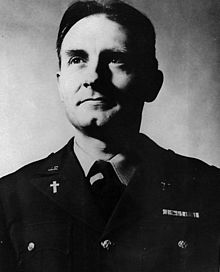
Servant of God, Fr Emil Kapaun (20 April 1916 - 23 May 1951
I've posted a number of times about Fr Emil Kapaun, who was posthumously awarded the Medal of Honor on 11 April by President Obama. I featured this great priest most recently inSunday Reflections for last Sunday. Easter was very late the year he was born and he arrived in the world on Holy Thursday.
I am also blessed to share my birthday with St Rose of Lima, who was born in 1586 and died on 24 August 1617.
The year my father was born, 1913, Easter was very early, 23 March. He was born on Thursday of Easter Week. He loved a 'good tune', especially from Italian Grand Opera. I grew up with the radio and the only station in the Republic of Ireland during my childhood was Radio Éireann. Every Wednesday at lunch time I used to listen to the first part of Hospitals' Requests before going back to school. Very often there was a request for Va' pensiero, from Giuseppe Verdi's opera Nabucco. The announcers usually used an English title for it, Go thoughts on Golden Wings or The Chorus of the Hebrew Slaves. Though my Dad was never home for lunch on working days he was very familiar with it and it certainly came into his 'good tune' category.
So my co-70th Birthday celebrant Sir John Eliot Gardiner agreed to conduct it for the occasion.
Please join me in praying with gratitude to God for my parents, John Coyle and Mary Collins, and for the repose of their souls. Without their cooperation with our loving Father this blog would not have been possible. And remember too their parents, Nicholas Coyle and Jane Hoare, both from Rush, County Dublin, a village by the sea north of the city where my paternal ancestors first arrived before 1800, and William Patrick Collins, from Dublin city, and Annie Dowd, born in Navan, County Meath, down the road from the Columban seminary where I spent seven happy years.
Collect from the Mass for Giving Thanks to God (B) O God, the Father of every gift, we confess that all we have and are comes down from you; teach us to recognise the effects of your boundless care and to love you with a sincere heart and with all our strength. Through our Lord Jesus Christ, your Son, who lives and reigns with you in the unity of the Holy Spirit, one God, for ever and ever.
Our life is over like a sigh.
Our span is seventy years
or eighty for those who are strong (Psalm 89[90], Grail translation, used in the Breviary).
Readings(Jerusalem Bible: Australia, England & Wales, India
[optional], Ireland, New Zealand, Pakistan, Scotland, South Africa)
Gospel
John 10:27-30 (Revised Standard
Version – Catholic Edition)
Jesus said: ‘My sheep hear my voice,
and I know them, and they follow me; and I give them eternal life, and they
shall never perish, and no one shall snatch them out of my hand. My Father, who
has given them to me, is greater than all, and no one is able to snatch them
out of the Father's hand. I and the Father are one.’
I know nothing about tending sheep and until I looked at the video above never quite understood the reality of the words of Jesus in today's gospel: ‘My sheep hear my voice, and I know them, and they follow me'.
An extraordinary example of the power of words is a story involving Fr Willie Doyle SJ, the army chaplain who was killed in 1917 in Belgium during the Great War. Some years before the War he was giving a retreat to a community of nuns in Ireland. He got a telegram on the last day from his Provincial Superior telling him to get back to Dublin immediately so that he could catch the boat for England that night. When Fr Doyle got to Dublin the Provincial showed him a telegram he had received from the governor of a prison in England: Please send Fr William Doyle SJ to D ___ Prison. Woman to be executed tomorrow asks to see him. The message was a mystery to both priests but Fr Doyle left for England immediately.
When he got to the prison at 5am the Governor told Fr Doyle that Fanny Cranbush wanted to talk to him. She was a prostitute who had got involved in a murder and was to pay the penalty. When she first arrived in jail she said she didn't need any minister of religion. But a few days before the execution she told the Governor that she wanted to see a particular priest. She didn't know his name or where he lived. All she could say was that a couple of years before this he had been in the town where the prison was giving some kind of 'mission'.
The good Governor asked local priests who this might be and this led to the two telegrams.
Fr William Doyle SJ (1873 - 1917)
Fanny herself, who welcomed Father Doyle with joy, reminded him that one night, during the mission, he had come across her on the street as he was heading back to where he was staying and she was looking for customers. He spoke to her kindly and said, My child, aren't you out very late? Won't you go home? Don't hurt Jesus. He loves you. He also gave her a book.
She did go home, gave up her 'trade' for a while but hunger drove her back to it and to worse. In prison, as her execution approached, the words Don't hurt Jesus. He loves you came back to her. When Fr Doyle arrived Fanny asked him to tell her more about Jesus. Won't you set me on the road that leads to him? she asked.
Fr Doyle baptised her and was then able to arrange to celebrate Mass with her, her first and last, and he accompanied Fanny to the scaffold.
You can read the full story here on pages 16 to 19 under the title Snatched From the Brink.
The story of Fanny finding her loving Saviour through the kind words of a stranger is to me a great expression of God's mercy, something that Pope Francis has spoken about a number of times. (I wonder if the Pope is familiar with the life and death of his saintly fellow Jesuit?) Fanny heard the voice of the Good Shepherd through the gentle words of Fr Doyle. His Provincial Superior and the Governor of the Prison were also 'Good Shepherds'. Fanny realised that Jesus really did know her and she wanted to follow him. She went joyfully to her death knowing that she was to experience the truth of the words Jesus speaks to us today: I give them eternal life, and they shall never perish, and no one shall snatch them out of my hand. Through God's loving mercy and Father Doyle's great love for sinners she was 'snatched by the hand of Jesus, not out of it.
And Jesus, the Risen Lord, speaks those same words to us in Mass and gives himself as the Bread of Life as he gave himself to Fanny when she made her First and Last Holy Communion before entering into the Eternal Communion that is heaven.
There's an old Irish ballad, The Wearin' of the Green, with its roots in the uprising in parts of Ireland against British rule in 1798 that has these words in the version written in the 1800s by Irish writer Dion Boucicault: I met with Napper Tandy And he took me by the hand And he said 'How's poor old Ireland? And how does she stand?' She's the most distressful country That ever you have seen . . . Some recent events in the country of my birth suggest that it may well be choosing to be the most distressful country that you have ever seen.
The government of the Republic of Ireland is introducing legislation to legalise abortion in certain circumstances. The Irish Times reported on 16 April, A Bill to legalise abortion in certain circumstances, including the risk of suicide, is included in the programme of legislation the Government intends to publish between now and the summer break. The report goes on to say: The Bill, which is still being drafted, will make abortion legally permissible in certain circumstances and give statutory backing to the Supreme Court decision in the X case in 1991. The legislation will permit abortion when there is a real and substantial risk to the life of the mother. That risk will include the threat of suicide or self-destruction. As the video above shows, there is no evidence whatever that an abortion is a 'cure' for a person with suicidal thoughts.
Sinn Féin claims on its website to be working for the establishment of a democratic socialist republic. Yet in March it blocked a cross-party proposal in the Northern Ireland Assembly to prevent Marie Stopes International from providing abortions in its clinic in Belfast. Marie Stopes International offers 'safe abortions'. Laws on abortion are much stricter in Northern Ireland than in the rest of the United Kingdom. Marie Stopes International claims to be working within the law, and they probably are, but their initiative is a private one. So much for Sinn Féin's policy of the establishment of a democratic socialist republic. Meanwhile, the government of the Republic of Ireland is introducing legislation to legalise abortion in certain circumstances. The Irish Times reported on 16 April, A Bill to legalise abortion in certain circumstances, including the risk of suicide, is included in the programme of legislation the Government intends to publish between now and the summer break. The report goes on to say: The Bill, which is still being drafted, will make abortion legally permissible in certain circumstances and give statutory backing to the Supreme Court decision in the X case in 1991. The legislation will permit abortion when there is a real and substantial risk to the life of the mother. That risk will include the threat of suicide or self-destruction. In the Republic of Ireland last weekend the ongoing Constitutional Convention voted to recommend that the constitution be amended to allow for same-sex marriage, with 19 per cent against and the remainder having no opinion. 79 per cent were in favour. The Irish Times report adds: Commenting on the outcome today, a spokesman for the Catholic Communications Office said: 'While the result of the constitutional convention is disappointing, only the people of Ireland can amend the constitution. The Catholic church will continue to promote and seek protection for the uniqueness of marriage between a woman and a man, the nature of which best serves children and our society.' The comment of the Church's spokesman is not quite accurate, It is only the people of the Republic of Ireland who can amend the Constitution, since those in Northern Ireland, even if they have Irish passports, don't have a vote in the Republic.
I don't look on Hollywood as a major source of wisdom or morality. But I think that its adaptation of Hans Christian Andersen's The Emperor's New Clothes should be listened to by anyone who buys into the utterly bizarre notion - and that's what it is - of 'marriage' between two people of the same sex. How has the Western world gone from the extreme of criminalising sexual activity between two adults of the same sex to the extreme of worshipping at the feet of the noisy 'gay lobby'?
By their very nature, the institution of matrimony itself and conjugal love are ordained for the procreation and education of children, and find in them their ultimate crown. Thus a man and a woman, who by their compact of conjugal love "are no longer two, but one flesh" (Matt. 19:ff), render mutual help and service to each other through an intimate union of their persons and of their actions. Through this union they experience the meaning of their oneness and attain to it with growing perfection day by day. As a mutual gift of two persons, this intimate union and the good of the children impose total fidelity on the spouses and argue for an unbreakable oneness between them.
I would suggest that the song and dance of Gene Kelly and Judy Garland is much closer to what the Vatican Council said about marriage than the recommendation of the delegates at the Constitutional Convention in the Grand Hotel, Malahide, County Dublin, last weekend.
I had my ordination reception in that same hotel on 21 December 1967. If anyone there on that occasion had suggested that one day a group of adults gathered in that same place would tell the Irish government that they should introduce 'marriage' for two men or two women that person would rightly have been deemed to be crazy.
To answer Napper Tandy's question about today's poor old Ireland, she is indeed the most distressful country that ever you have seen.
Readings(Jerusalem Bible: Australia, England & Wales, India
[optional], Ireland, New Zealand, Pakistan, Scotland, South Africa)
Gospel
John 21:1-19. [or 21:1-14] (Revised
Standard Version – Catholic Edition)
After this Jesus revealed himself again to the disciples by the
Sea of Tiberi-as; and he revealed himself in this way. Simon Peter, Thomas
called the Twin, Nathana-el of Cana in Galilee, the sons of Zebedee, and two
others of his disciples were together. Simon Peter said to them, "I am
going fishing." They said to him, "We will go with you." They
went out and got into the boat; but that night they caught nothing. Just as day
was breaking, Jesus stood on the beach; yet the disciples did not know that it
was Jesus. Jesus said to them,
"Children, have you any fish?" They answered him, "No." He
said to them, "Cast the net on the right side of the boat, and you will
find some." So they cast it, and now they were not able to haul it in, for
the quantity of fish. That disciple whom Jesus loved said to Peter, "It is
the Lord!" When Simon Peter heard that it was the Lord, he put on his
clothes, for he was stripped for work, and sprang into the sea.
But the other disciples came in the boat, dragging the net full of
fish, for they were not far from the land, but about a hundred yards off.
When they got out on land, they saw a charcoal fire there, with fish
lying on it, and bread. Jesus said to them, "Bring some of the fish that
you have just caught." So Simon Peter went aboard and hauled the net
ashore, full of large fish, a hundred and fifty-three of them; and although
there were so many, the net was not torn.
Jesus said to them, "Come and have breakfast." Now none
of the disciples dared ask him, "Who are you?" They knew it was the
Lord. Jesus came and took the bread and gave it to them, and so with the fish. This
was now the third time that Jesus was revealed to the disciples after he was
raised from the dead.
[When they had finished
breakfast, Jesus said to Simon Peter, "Simon, son of John, do you love me
more than these?" He said to him, "Yes, Lord; you know that I love
you." He said to him, "Feed my lambs." A second time he said to
him, "Simon, son of John, do you love me?" He said to him, "Yes,
Lord; you know that I love you." He said to him, "Tend my sheep."
He said to him the third time, "Simon, son of John, do you love me?"
Peter was grieved because he said to him the third time, "Do you love
me?" And he said to him, "Lord, you know everything; you know that I
love you." Jesus said to him, "Feed my sheep. Truly, truly, I say to
you, when you were young, you girded yourself and walked where you would; but
when you are old, you will stretch out your hands, and another will gird you
and carry you where you do not wish to go." (This he said to show by what
death he was to glorify God.) And after this he said to him, "Follow
me."]
When I turned 13 I wanted to be a pilot in the Irish Army Air Corps. With three or four classmates in O'Connell Schools, Dublin, run by the (Irish) Christian Brothers, I was enthralled by the exploits of Biggles, a fictitious character created by Captain W. E. Johns. Biggles started his career in the Royal Flying Corps in World War I and was still flying, in the Royal Air Force, during World War II.
When I discovered that you needed some proficiency in physics my interest in being a pilot waned but my desire to be a military officer was still there. But 'coming up from the rear' was a desire to be a missionary priest. By the time I was 14 I knew that that was what I wanted to be.
Around that time, or maybe when I was 15, I found a book in one of the branches of Dublin city's public libraries about a man who had combined being a priest and an army officer, Father Emil Kapaun of the Diocese of Wichita, Kansas, who served as a US army chaplain in World War II and in the Korean War (1950 - 53). When his unit retreated after being attacked by Chinese soldiers Father Kapaun stayed behind with the wounded, knowing he would be captured. I was truly inspired by the accounts of how he had helped so many soldiers, giving them hope, strengthening their faith, sharing his pipe with them, scrounging for food and medicines, ie, 'stealing' them. One of the veterans in the video above tells how Catholics, Protestants and Jews were all saying the rosary every night.
At the beginning of the video we hear the voice of Father Kapaun himself speaking of the choice we must make 'between being loyal to the true faith or of giving allegiance to something else'. His own choice led to his death in a North Korean prisoner of war camp, his last public act being a service at sunrise on 25 March 1951, Easter Sunday. One of those who carried him later to the camp 'hospital'from which no 'patient' ever returned alive, recounts in the video how he was blessing his captors.
The first time I visited Korea, towards the end of September 1971 on my way to the Philippines, I was very conscious of Fr Kapaun when I celebrated Mass in the chapel of the Columban house in Seoul.
Last Thursday, 11 April, nine days before the 97th anniversary of his birth, Fr Kapaun was posthumously awarded the Medal of Honor, the USA's highest award for valour, President Obama giving the medal to the priest's nephew at the White House.
In 1993 Fr Kapaun was declared a 'Servant of God', the first step towards possible canonization, and on 29 June 2008 the cause for his sainthood was officially opened. The Diocese of Wichita has a website dedicated to this.
In the gospel for this Sunday Jesus asks Peter three times, 'Do you love me?', adding 'more than these' the first time. When Peter professed his love each time Jesus told him to 'feed my lambs', 'feed my sheep'. His tending the flock was not to be a 'job' but something done joyfully and wholeheartedly out of his relationship with Jesus. Yet it was to lead to the cross, just as Father Kapaun's following of Jesus was to lead him to his death, which the Church may one day recognize as that of a martyr, like the death of St Martin I, who wasn't directly killed but whose harsh treatment led to his death and whom the Church honours on 13 April.
Fr Emil Joseph Kapaun is an outstanding example of one who allowed Jesus to ask him, 'do you love me?' and who answered 'Yes' with his very life, turning what was a man-made hell into a touch of heaven for the soldiers he was called to serve.
The Korean War began on 25 June 1950 and lasted till the ceasefire of 27 July 1953. Technically it has never ended and at this moment nobody is sure what North Korea is up to, having raised tensions considerably in recent weeks. Perhaps we can invoke the intercession of Father Kapaun for peace in the land where he is buried. This prayer is from the website dedicated to the cause of his canonization.
PRAYER
Lord Jesus, in the midst of the folly of war, your servant, Chaplain Emil Kapaun spent himself in total service to you on the battlefields and in the prison camps of Korea, until his death at the hands of his captors.
We now ask you, Lord Jesus, if it be your will, to make known to all the world the holiness of Chaplain Kapaun and the glory of his complete sacrifice for you by signs of miracles and peace.
In your name, Lord, we ask, for you are the source of peace, the strength of our service to others, and our final hope.
Readings(Jerusalem Bible: Australia, England & Wales, India
[optional], Ireland, New Zealand, Pakistan, Scotland, South Africa)
Gospel
John 20:19-31. (Revised Standard
Version – Catholic Edition)
On the evening of that day, the first day of the week, the doors
being shut where the disciples were, for fear of the Jews, Jesus came and stood
among them and said to them, "Peace be with you." When he had said
this, he showed them his hands and his side. Then the disciples were glad when
they saw the Lord. Jesus said to them again, "Peace be with you. As the
Father has sent me, even so I send you." And when he had said this, he
breathed on them, and said to them, "Receive the Holy Spirit. If you
forgive the sins of any, they are forgiven; if you retain the sins of any, they
are retained." Now Thomas, one of the twelve, called the Twin, was not
with them when Jesus came. So the other disciples told him, "We have seen
the Lord." But he said to them, "Unless I see in his hands the print
of the nails, and place my finger in the mark of the nails, and place my hand
in his side, I will not believe." Eight days later, his disciples were
again in the house, and Thomas was with them. The doors were shut, but Jesus
came and stood among them, and said, "Peace be with you." Then he
said to Thomas, "Put your finger here, and see my hands; and put out your
hand, and place it in my side; do not be faithless, but believing." Thomas
answered him, "My Lord and my God!" Jesus said to him, "Have you
believed because you have seen me? Blessed are those who have not seen and yet
believe." Now Jesus did many other signs in the presence of the disciples,
which are not written in this book; but these are written that you may believe
that Jesus is the Christ, the Son of God, and that believing you may have life
in his name.
On Holy Thursday Pope Francis 'gatecrashed' a lunch for seven priests hosted by Archbishop Angelo Becciu, Substitute for General Affairs of the Secretariat of State. Most of the priests work with the poor and under-privileged in the suburbs of Rome, according to Vatican Radio.
Monsignor Enrico Feroci, the Director of Caritas Rome and one of the guests quoted Pope Francis: Open the doors of the Church, and then the people will come in . . . if you keep the light on in the confessional and are available, then you will see what kind of line there is for confession. Msgr Feroci added that he (Pope Francis) was confident of the need of the people of God for priests to open the doors and allow the people to meet God.
Blessed John Paul named the Second Sunday of Easter - still its primary name - as 'Divine Mercy Sunday'. Pope Francis has spoken about God's mercy a number of times since he was elected. [Emphases added.]
In his very first homily as Pope, in St Anne's church, the parish church of the Vatican, Pope Francis spoke about confession and God's mercy: It is not easy to entrust oneself to God’s mercy, because it is an abyss beyond our comprehension. But we must! "Oh, Father, if you knew my life, you would not say that to me!" "Why, what have you done?" "Oh, I am a great sinner!" "All the better! Go to Jesus: he likes you to tell him these things!" He forgets, he has a very special capacity for forgetting. He forgets, he kisses you, he embraces you and he simply says to you: "Neither do I condemn you; go, and sin no more" (Jn 8:11). That is the only advice he gives you. After a month, if we are in the same situation ... Let us go back to the Lord. The Lord never tires of forgiving: never! It is we who tire of asking his forgiveness. Let us ask for the grace not to tire of asking forgiveness, because he never tires of forgiving. Let us ask for this grace.
In his general audience on Wednesday of Holy Week Pope Francis spoke again about God's mercy: God came out of himself to come among us, he pitched his tent among us to bring to us his mercy that saves and gives hope. The Pope said that Jesus brought God’s mercy and forgiveness; he healed, he comforted, he understood; he gave hope; he brought to all the presence of God who cares for every man and every woman, just as a good father and a good mother care for each one of their children.
God does not wait for us to go to him but it is he who moves towards us, without calculation, without quantification. That is what God is like. He always takes the first step, he comes towards us . . . There is such a great need to bring the living presence of Jesus, merciful and full of love!
During that same audience Pope Francis speaks of the father of the Prodigal Son: God always thinks with mercy: do not forget this. God always thinks mercifully. He is the merciful Father! God thinks like the father waiting for the son and goes to meet him, he spots him coming when he is still far off . . .
What does this mean? That he went every day to see if his son was coming home: this is our merciful Father. It indicates that he was waiting for him with longing on the terrace of his house.
Pope Francis emphasised the mercy of God again in his Urbi et Orbi message on Easter Sunday: Most of all, I would like it to enter every heart, for it is there that God wants to sow this Good News: Jesus is risen, there is hope for you, you are no longer in the power of sin, of evil! Love has triumphed, mercy has been victorious! The mercy of God always triumphs! The Holy Father returned to the theme of 'that beautiful mercy of God' next day at the Regina Coeli on Easter Monday: And with the grace of Baptism and of Eucharistic Communion I can become an instrument of God’s mercy, of that beautiful mercy of God. It would seem that the mercy of God is a central theme of Pope Francis, echoing what Jesus says to the Apostles in today's gospel: If you forgive the sins of any, they are forgiven. Our loving Father shows his mercy to us as sinners above all in the Sacrament of Reconciliation/Penance/Confession. Here Archbishop (now Cardinal) Luis Antonio G. Tagle of Manila explains this and the other healing sacraments, the Anointing of the Sick.




.jpg/482px-Francisco_(20-03-2013).jpg)
