21 March 2014

'Give me a drink.' Sunday Reflections, 3rd Sunday of Lent Year A

Bernardo Strozzi [Web Gallery of Art]

Readings (New American Bible: Philippines, USA)                               

Readings (Jerusalem Bible: Australia, England & Wales, India [optional], Ireland, New Zealand, Pakistan, Scotland, South Africa)

Gospel John 4:5-42 [or John 4: 5:15, 19B-26, 39A, 40-52] (New Revised Standard Version, Catholic Edition, Canada)  [Shorter form of the Gospel: omit what is in square brackets]

So Jesus came to a Samaritan city called Sychar, near the plot of ground that Jacob had given to his son Joseph. Jacob’s well was there, and Jesus, tired out by his journey, was sitting by the well. It was about noon.

A Samaritan woman came to draw water, and Jesus said to her, “Give me a drink.” (His disciples had gone to the city to buy food.) The Samaritan woman said to him, “How is it that you, a Jew, ask a drink of me, a woman of Samaria?” (Jews do not share things in common with Samaritans.)  Jesus answered her, “If you knew the gift of God, and who it is that is saying to you, ‘Give me a drink,’ you would have asked him, and he would have given you living water.”  The woman said to him, “Sir, you have no bucket, and the well is deep. Where do you get that living water?  Are you greater than our ancestor Jacob, who gave us the well, and with his sons and his flocks drank from it?”  Jesus said to her, “Everyone who drinks of this water will be thirsty again,  but those who drink of the water that I will give them will never be thirsty. The water that I will give will become in them a spring of water gushing up to eternal life.”  The woman said to him, “Sir, give me this water, so that I may never be thirsty or have to keep coming here to draw water.”

[Jesus said to her, “Go, call your husband, and come back.” The woman answered him, “I have no husband.” Jesus said to her, “You are right in saying, ‘I have no husband’; for you have had five husbands, and the one you have now is not your husband. What you have said is true!” The woman said to him,]

“Sir, I see that you are a prophet. Our ancestors worshiped on this mountain, but you say that the place where people must worship is in Jerusalem.”  Jesus said to her, “Woman, believe me, the hour is coming when you will worship the Father neither on this mountain nor in Jerusalem.  You worship what you do not know; we worship what we know, for salvation is from the Jews. But the hour is coming, and is now here, when the true worshipers will worship the Father in spirit and truth, for the Father seeks such as these to worship him. God is spirit, and those who worship him must worship in spirit and truth.” The woman said to him, “I know that Messiah is coming” (who is called Christ). “When he comes, he will proclaim all things to us.”  Jesus said to her, “I am he, the one who is speaking to you.”

[Just then his disciples came. They were astonished that he was speaking with a woman, but no one said, “What do you want?” or, “Why are you speaking with her?” Then the woman left her water jar and went back to the city. She said to the people, “Come and see a man who told me everything I have ever done! He cannot be the Messiah, can he?” They left the city and were on their way to him.

Meanwhile the disciples were urging him, “Rabbi, eat something.” But he said to them, “I have food to eat that you do not know about.”  So the disciples said to one another, “Surely no one has brought him something to eat?”  Jesus said to them, “My food is to do the will of him who sent me and to complete his work.  Do you not say, ‘Four months more, then comes the harvest’? But I tell you, look around you, and see how the fields are ripe for harvesting. The reaper is already receiving wages and is gathering fruit for eternal life, so that sower and reaper may rejoice together. For here the saying holds true, ‘One sows and another reaps.’  I sent you to reap that for which you did not labor. Others have labored, and you have entered into their labor.”]

Many Samaritans from that city believed in him because of the woman’s testimony.

[“He told me everything I have ever done.”] 

So when the Samaritans came to him, they asked him to stay with them; and he stayed there two days. And many more believed because of his word. They said to the woman, “It is no longer because of what you said that we believe, for we have heard for ourselves, and we know that this is truly the Savior of the world.”


I remember reading a story about Pope John Paul I when he was still known as Albino Luciani, Patriarch of Venice. One of his priests in a rural parish was known more for being absent from his parish than for being present. Cardinal Luciani went to visit the parish - and the priest was away. So the Cardinal covered for him until the priest returned some days later. The wayward parish priest got the shock of his life when his archbishop asked him to hear his confession.

Cardinal Luciani, who later became known as 'The Smiling Pope' and was with us for only 33 days in 1978 as Bishop of Rome, didn't scold the priest. He simply asked him to do for him what only a priest can do - forgive sins in God's name in the sacrament of confession.

Pope John Paul I, 26 August 1978

In the gospel Jesus asks the woman at the well directly, Give me a drink. As she was to point out to Jesus he didn't have the wherewithal to draw water himself from the well. She did.

More that twenty years ago I was at a sports-fest for children and young people with mental disabilities in the campus of a Catholic high school here in the Philippines. As I was leaving I saw a group of teenage boys, who hadn't been involved in the sports activity, lounging in the lobby. Behind my back they called Hey, Joe! a greeting that goes back to the last days of World War II when American soldiers, 'GI Joes', helped Filipinos to defeat the Japanese. The greeting lingered on for many years and you still hear it occasionally. Often it is well meant but sometimes there's a barb, or at least a lack of respect.

When I heard the Hey, Joe I got mad. Then I saw that my car, an old VW, had a flat tyre. I immediately turned to the boys with whom I was mad and asked, Can you help me change the tyre? Immediately they came to my aid and I didn't have to do anything. (Someone once asked me when I told this story if the boys had had anything to do with the flat tyre. They hadn't. It was just one of those things.) When I was leaving we were all smiling at each other and I was full of gratitude.

Many 'GI Joes' are buried here [photo: Wikipedia]

In the gospel Jesus gently leads the woman to acknowledge her sinful life, but not by humiliating her. He draws her into an expression of faith, a recognition that he might be the Messiah. Not only that, he leads her to being a missionary. She goes into town to tell others about Jesus.

In a commentary I read the other day the writer pointed out that the gospel doesn't tell us if the woman actually gave Jesus the drink he had asked for! But his physical thirst, which was real, was secondary to his thirst for the welfare of the woman and the people of Sychar. Jesus wasn't the only one to break the taboo of Jews and Samaritans not speaking to one another. So did the people who asked him to stay with them; and he stayed there two days. Presumably the disciples were included in the invitation. All were drawn into something higher than ancient divisions by the presence of Jesus. All were drawn into a relationship with Jesus and in that to a new way of relating to one another.

The teenage boys who said Hey, Joe behind my back were being teenage boys. While perhaps there was some lack of respect there was no real malice and it was more of adolescent bravado. But once I let them know my need they didn't see me anymore as some anonymous foreigner but as a person they could help. A personal relationship, even if fleeting, had been established, one that called on their generosity. When I left we were all smiling at one another and my heart was filled with gratitude.

Cardinal Luciani might well have berated the parish priest for having neglected his parishioners. Instead, he called him to be a priest in the deepest sense, hearing in his archbishop's request for confession the voice of Jesus asking the Samaritan woman, Give me a drink.

Servant of God Pope John Paul I (17 October 1912 - 28 September 1978)
[photo: Wikipedia] 


by Chris Kinsley & Drew Francis [2007]

I am a woman of no distinction
of little importance.
I am a women of no reputation
save that which is bad.

You whisper as I pass by and cast judgmental glances,
Though you don’t really take the time to look at me,
Or even get to know me.

For to be known is to be loved,
And to be loved is to be known.
Otherwise what’s the point in doing
either one of them in the first place?

I WANT TO BE KNOWN.

I want someone to look at my face
And not just see two eyes, a nose,
a mouth and two ears;
But to see all that I am, and could be
all my hopes, loves and fears.

But that’s too much to hope for,
to wish for,
or pray for
So I don’t, not anymore.

Now I keep to myself
And by that I mean the pain
that keeps me in my own private jail
The pain that’s brought me here
at midday to this well.

To ask for a drink is no big request
but to ask it of me?
A woman unclean, ashamed,
Used and abused
An outcast, a failure
a disappointment, a sinner.

No drink passing from these hands
to your lips could ever be refreshing
Only condemning, as I’m sure you condemn me now
But you don't.

You’re a man of no distinction;
Though of the utmost importance.
A man with little reputation, at least so far.

You whisper and tell me to my face
what all those glances have been about, and
You take the time to really look at me.
But don’t need to get to know me.

For to be known is to be loved and
To be loved is to be known.

And you know me.
You actually know me;
all of me and everything about me.
Every thought inside and hair on top of my head;
Every hurt stored up, every hope, every dread.

My past and my future, all I am and could be.
You tell me everything,
you tell me about me!

And that which is spoken by another
would bring hate and condemnation.
Coming from you brings love, grace,
mercy, hope and salvation.

I’ve heard of one to come
who could save a wretch like me
And here in my presence, you say
I AM He.

To be known is to be loved;
And to be loved is to be known.

And I just met you.
But I love you.
I don’t know you,
but I want to get to.

Let me run back to town
this is way to much for just me.
There are others: brothers,
sisters, lovers, haters.

The good and the bad, sinners and saints
who should hear what you’ve told me;
who should see what you’ve shown me;
who should taste what you gave me;
who should feel how you forgave me.

For to be known is to be loved;
And to be loved is to be known.
And they all need this, too.
We all do
Need it for our own.

17 March 2014

'Ego Patricius peccator rusticissimus . . . Mise Pádraig, peacach róthuatach . . . I Patrick, a sinner, a most simple countryman . . .'

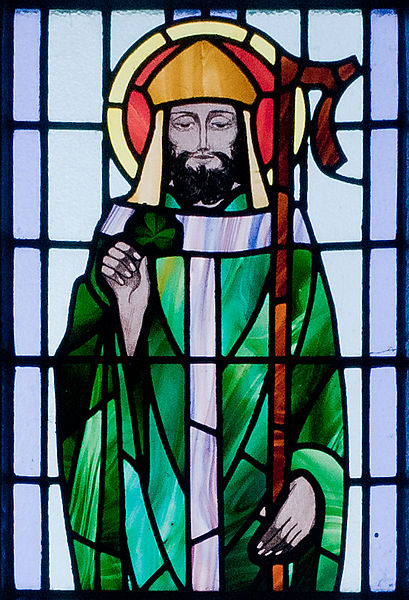
St Benin's Church, Kilbennan, County Galway, Ireland [Wikipedia]

'Ego Patricius peccator rusticissimus . . . Mise Pádraig, peacach róthuatach . . . I Patrick, a sinner, a most simple countryman . . .'

The opening words of St Patrick's Confession in Latin, Irish and English.

Please pray earnestly to St Patrick for a renewal of the Christian faith in Ireland. 

Extracts from St Patrick's Confessio 

I, Patrick, a sinner, a most simple countryman, the least of all the faithful and most contemptible to many, had for father the deacon Calpurnius, son of the late Potitus, a priest, of the settlement [vicus] of Bannavem Taburniae; he had a small villa nearby where I was taken captive. I was at that time about sixteen years of age. I did not, indeed, know the true God; and I was taken into captivity in Ireland with many thousands of people, according to our deserts, for quite drawn away from God, we did not keep his precepts, nor were we obedient to our priests who used to remind us of our salvation. And the Lord brought down on us the fury of his being and scattered us among many nations, even to the ends of the earth, where I, in my smallness, am now to be found among foreigners.

The Angel Victoricus over Glendalough, Ireland

One of a set of four airmail stamps used in Ireland between 1948 and 1965 featuring the Angel Victoricus  carrying the words of the beginning of the letter mentioned by St Patrick below, 'Vox Hiberniae', Latin for 'The Voice of Ireland'. The stamps were designed by Richard J. King who died in Dublin on St Patrick's Day 1974.

And after a few years I was again in Britain with my parents [kinsfolk], and they welcomed me as a son, and asked me, in faith, that after the great tribulations I had endured I should not go anywhere else away from them. And, of course, there, in a vision of the night, I saw a man whose name was Victoricus coming as if from Ireland with innumerable letters, and he gave me one of them, and I read the beginning of the letter: ‘The Voice of the Irish’; and as I was reading the beginning of the letter I seemed at that moment to hear the voice of those who were beside the forest of Foclut which is near the western sea, and they were crying as if with one voice: ‘We beg you, holy youth, that you shall come and shall walk again among us.’ And I was stung intensely in my heart so that I could read no more, and thus I awoke. Thanks be to God, because after so many years the Lord bestowed on them according to their cry.


St Patrick's Breastplate is attributed to the saint but was probably written some centuries after his death.

Collect of Mass on St Patrick's Day (in Ireland)

Lord, through the work of Saint Patrick in Ireland 
we have come to acknowledge the mystery of the one true God 
and give thank for our salvation in Christ; 
grant by his prayers 
that we who celebrate this festival 
may keep alive the fire of faith he kindled.
Through our Lord Jesus Christ, Your Son, 
who lives and reigns with you in the unity of the Holy Spirit, 
one God, for ever and ever.

Collect (elsewhere)

O God, who chose the Bishop Saint Patrick
to preach your glory to the peoples of Ireland,
grant through his merits and intercession,
that those who glory in the name of Christian
may never cease to proclaim your wondrous deeds to all.
Through our Lord Jesus Christ, your Son,
who lives and reigns with you in the unity of the Holy Spirit,
one God, for ever and ever.

Again I ask, please pray earnestly to St Patrick for a renewal of the Christian faith in Ireland. We contemporary Irish have not kept alive the fire of faith he kindled. We have to a great extent let die this precious gift given to our ancestors more than 1,500 years ago through a great missionary bishop who when a teenager had pretty much lost the faith, was kidnapped and taken to Ireland as a slave where he re-discovered it and later came back to preach the Gospel of Jesus Christ in answer to Vox Hiberniae, 'The Voice of Ireland'.


Dóchas Linn Naomh Pádraig: by Irish Philharmonic Orchestra and Chorus

Dóchas linn Naomh Pádraig,
St Patrick is our hope
Aspal mór na hÉireann,
The great apostle of Ireland
Ainm oirirc gléigeal,
A bright and splendid name
Solas mór an tsaoil é.
The great light of the world
D'fhill le soiscéal grá dúinn 
Returned with the gospel of loved
ainneoin blianta 'ngéibheann, 
despite years in captivity,

Grá mór Mhac na páirte 
The great love of the dear Son
d'fhuascail cách ón daorbhroid.
freed all from bondage


Sléibhte, gleannta, mánna.
The hills, glens and plains
'S bailte móra na h-Éireann,
And the towns of Ireland
Ghlan sé iad go deo dúinn
He cleansed them for ever for us
Míle glóir dár Naomh dhíl.
A thousand glories to our beloved saint
Iarraimíd ort, a Phádraig,
We ask you, Patrick,

Guí orainne, Gaela,
To pray for us, Irish
Dia linn lá 'gus óiche
May God be with us day and night
'S Pádraig Aspal Éireann.
And Patrick apostle of Ireland


Beannachtaí na Féile Pádraig!
Happy St Patrick’s Day!

14 March 2014

'This is my Son, the Beloved . . . listen to him!' Sunday Reflections, 2nd Sunday of Lent Year A

Paolo Veronese, 1555-56 [Web Gallery of Art]

Readings (New American Bible: Philippines, USA)  à                             

Readings (Jerusalem Bible: Australia, England & Wales, India [optional], Ireland, New Zealand, Pakistan, Scotland, South Africa)


Six days later, Jesus took with him Peter and James and his brother John and led them up a high mountain, by themselves. And he was transfigured before them, and his face shone like the sun, and his clothes became dazzling white. Suddenly there appeared to them Moses and Elijah, talking with him. Then Peter said to Jesus, “Lord, it is good for us to be here; if you wish, I will make three dwellings here, one for you, one for Moses, and one for Elijah.” While he was still speaking, suddenly a bright cloud overshadowed them, and from the cloud a voice said, “This is my Son, the Beloved; with him I am well pleased; listen to him!” When the disciples heard this, they fell to the ground and were overcome by fear. But Jesus came and touched them, saying, “Get up and do not be afraid.” And when they looked up, they saw no one except Jesus himself alone.

As they were coming down the mountain, Jesus ordered them, “Tell no one about the vision until after the Son of Man has been raised from the dead.”


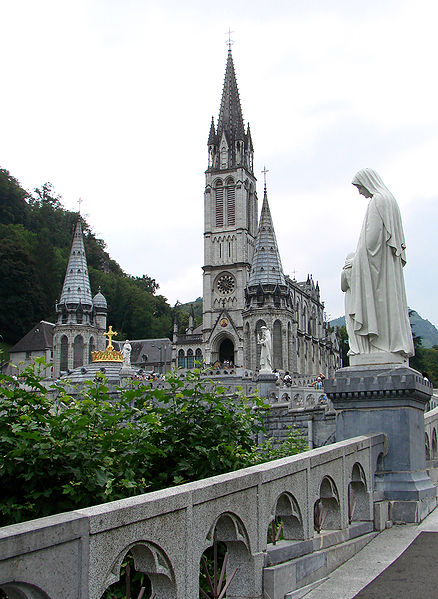
Basilica of the Immaculate Conception, Lourdes [Wikipedia]

Like Peter, James and John, I caught a glimpse of something of the Purity of God on a hill. Tradition tells us that Jesus was transfigured on Mount Tabor, Israel. My 'Mount Tabor' was a hotel at the top of a hill in Lourdes, France.

During Holy Week 2001 I took part in the international pilgrimage of Faith and Light to Lourdes which takes place every ten years. Faith and Light was born of a desire to help people with an intellectual disability and their families find their place within the Church and society. This was the main purpose of the organized pilgrimage to Lourdes at Easter of 1971. The founders of the movement were Jean Vanier and Marie-Hélène Mathieu.


A message from Jean Vanier to an international meeting of Faith and Light, 2013

I was based in Britain at the time and travelled with a group from the north of England. However, I had been invited to be chaplain to the small contingent from the Philippines, as I had been on the fringes of Faith and Light in the Philippines between 1992 and 2000.

The Filipinos were staying in a hotel at a distance from the shrine and at the top of a hill. There was also a group of Faith and Light pilgrims from Hong Kong in the same hotel. (I was with the English pilgrims in a hotel close to the shrine.)


One of those from Hong Kong was a girl of about eleven with Down Syndrome (Trisomy 21). Her face had the delicate beauty of Chinese ceramics. But she had an extraordinary inner beauty, a purity that could have come only from God. Though I had no Cantonese and she had no English, we were able to communicate simply by looking at one another. She showed complete trust in me. She had a vulnerability that called forth the deepest respect.

In Irish there's an expression used for a person with a severe mental or learning disability, duine le Dia, 'a person with God'. This young girl was such for me, in a very full sense of that phrase: she was a clear expression of the beauty and of the purity of God for me.

The Opening Prayer of today's Mass reads:

O God, who have commanded us
to listen to your beloved Son,
be pleased, we pray,
to nourish us inwardly by your word,
that, with spiritual sight made pure,
we may rejoice to behold your glory.
Through . . .

When Peter, James and John went up Mount Tabor with Jesus they had no idea that would see the divinity of Jesus there. They had no idea they would hear God the Father say This is my Son, the Beloved; with him I am well pleased; listen to him! The Entrance Antiphon [below], taken from Psalm 26 [27], prays, It is your face, O Lord, that I seek; hide not your face from me. I have no doubt that I saw the face of the Lord in that young girl with Down Syndrome from Hong Kong whom I met in Lourdes in Holy Week 2001.

Jesus may speak to us at any time, unexpectedly, as he revealed his presence to me in that hotel in Lourdes. May we make the Opening Prayer our own so that, with spiritual sight made pure, we may rejoice to behold your glory.

)


Antiphona ad introitum  Cf. Ps 26[27]:8-9; [1]

Tibi dixit cor meum:
quæsívi vultum tuum, 
vultum tuum, Dómine, requíram:
ne avértas fáciem tuam a me.

[Dóminus illuminátio mea, 
et salus mea: quem timébo?
Gloria Patri, et Filio, et Spiritui Sancto.
Sicut erat in principio, et nunc, et semper, 
et in saecula saeculorum. Amen.

Tibi dixit cor meum:
quæsívi vultum tuum, 
vultum tuum, Dómine, requíram:
ne avértas fáciem tuam a me.]

Entrance Antiphon

Of you my heart has spoken:
Seek his face.
It is your face, O Lord, that I seek;
hide not your face from me.

[The Lord is my light,
and my salvation. Whom should I fear?
Glory to the Father, and to the Son, and to the Holy spirit.
As it was, is now, and will be for ever.Amen.

Of you my heart has spoken:
Seek his face.
It is your face, O Lord, that I seek;
hide not your face from me.]


A younger Jean Vanier speaking about the early days of L'Arche

L'Arche and Faith & Light are sister movements where the VIPs are persons with learning disabilities.


Responsorial Psalm [New American Bible Lectionary]

07 March 2014

‘Worship the Lord your God, and serve only him.’ Sunday Reflections, 1st Sunday of Lent Year A


Landscape with the Temptation of Christ (detail)
Joos de Momper [Web Gallery of Art]

Readings (New American Bible: Philippines, USA)  à                             

Readings (Jerusalem Bible: Australia, England & Wales, India [optional], Ireland, New Zealand, Pakistan, Scotland, South Africa)

Gospel Matthew 4:1-11 (New Revised Standard Version,Catholic Edition, Canada)

Then Jesus was led up by the Spirit into the wilderness to be tempted by the devil. He fasted forty days and forty nights, and afterwards he was famished. The tempter came and said to him, “If you are the Son of God, command these stones to become loaves of bread.” But he answered, “It is written,

‘One does not live by bread alone,
    but by every word that comes from the mouth of God.’”

Then the devil took him to the holy city and placed him on the pinnacle of the temple, saying to him, “If you are the Son of God, throw yourself down; for it is written,

‘He will command his angels concerning you,’
    and ‘On their hands they will bear you up,

so that you will not dash your foot against a stone.’”


Jesus said to him, “Again it is written, ‘Do not put the Lord your God to the test.’”

Again, the devil took him to a very high mountain and showed him all the kingdoms of the world and their splendor; and he said to him, “All these I will give you, if you will fall down and worship me.” Jesus said to him, “Away with you, Satan! for it is written,
‘Worship the Lord your God, and serve only him.’”

Then the devil left him, and suddenly angels came and waited on him.


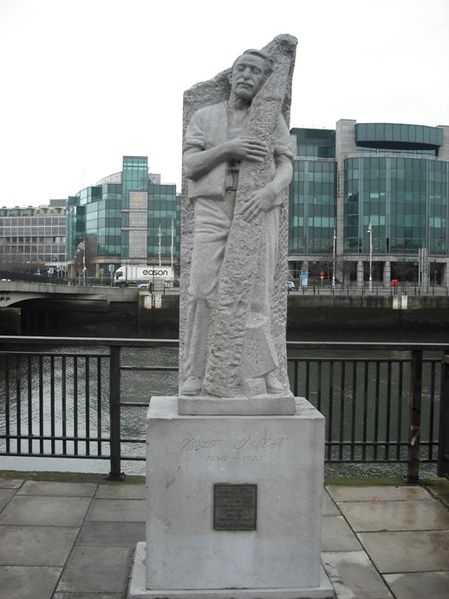
Statue of the Venerable Matt Talbot (1856 - 1925), Dublin [Wikipedia]

I remember vividly a homily given on the First Sunday in Lent in St Columban's College, Dalgan Park, the Columban seminary in Ireland where I studied from 1961 to 1968, by the late Fr Edward McCormack, who taught us Latin. We all recognised Father Ted, as we called him, as a saintly man. It was clear from his preaching that he was experiencing something of the horror of the very idea of the Devil tempting Jesus, God who became man. It was as if the very soul of Father Ted was shuddering.


Matt Talbot was a Dubliner who had become an alcoholic by the age of 13 or 14 and spent the next fourteen years as a drunkard. He went to the extreme once of stealing a fiddle from a beggar and pawne it to get money for drink. It was his only living, Matt tells us in the video, and I think that was the worst thing I ever did in my life. Matt made many efforts later to trace the beggar but never succeeded.

Yet during his fourteen years of drinking Matt hardly ever missed Sunday Mass, though he didn't receive Holy Communion, and always said a Hail Mary before sleeping. I think that's what saved me in the long run, he tells us.


At the beginning of the second video Matt, masterfully played by Irish actor Seamus Forde, goes through a soul-wrenching temptation right at Communion time, something that happens the same Sunday morning at Mass in three different churches, a temptation that drives him out of each, until he falls on his knees outside one of them and prays Jesus, mercy; Mary help, a prayer that most Dubliners would have been familiar with.

Matt Talbot [Wikipedia]

The second video shows Matt sending a donation to the Maynooth Mission to China, as the Columbans were first known in Ireland, some time in the mid-1920s. The note he enclosed is in the Columban archives in Ireland. The amount, one pound from himself and ten shillings (half of a pound) from his sister, was considerable for poor people.

Towards the end of the video Matt speaks of the things God had asked him to do. He put these thoughts in my mind when I was praying - and I knew they came from him. Only the priest in confession knew about these special things, small things God wanted me to do. They weren't for anybody else.

Among the special things, small things were the chains he wore on certain occasions. It was these very chains, found on his body when he died, that led to people asking questions about me . . . God must have wanted it that way . . . using me to say something to people today, now.

Lent is a gift that God gives the Church each year, a personal gift to each member of the Church, a time when he wants to put these thoughts in my mind when I am praying.

Matt Talbot was the farthest thing imaginable from the 'celebrities' of today during his life. In the nearly 90 years since his death he has given hope to many, especially persons struggling with alcoholism and other addictions. 

Will I allow God this Lent to put whatever thoughts he wants to in my mind by giving him time in prayer? Will I allow him, as Mary did when she said Here am I, the servant of the Lord; let it be with me according to your word, to use me to say something to people today, now?

Will I fall on my knees in moments of great temptation, as Matt did during the terrible struggle he had right at Communion time three times on the one Sunday morning, perhaps reflecting the three temptations of the Lord in today's gospel, and plead Jesus, mercy, Mary help?

They thought I was missing the good things in life. But God gave me the best part - and he never took it away.


+++

St Francis Xavier Church, Gardiner St, Dublin [Wikipedia]


Dubliners refer to churches by their street names rather than by their patronal names. The church above, which Matt calls 'Gardiner Street church', is that of the Jesuits. Matt also refers a number of times to the 'chapel' in Seville Place, the Church of St Laurence O'Toole, once Archbishop of Dublin. This is another old Dublin usage, calling a church a 'chapel'. The accent and idioms of Matt in the two videos are pure Dublin. 

When I was a child my mother, when 'going into town', ie into the city centre, would sometimes go through Granby Lane and we'd pray at the spot where Matt died. Everyone in Dublin then knew who Matt Talbot was. I'm not so sure about today.

You can discover more about this wonderful man at the Dublin Diocesan Matt Talbot website.

06 March 2014

Pope Francis' Prayer Intentions for March 2014


Universal Intention - Respect for Women

That all cultures may respect the rights and dignity of women. 


Evangelization Intention - Vocations

 That many young people may accept the Lord;s invitation to consecrate their lives to proclaiming the Gospel.


Videos from the website of the Apostleship of Prayer, Milwaukee, WI, USA.

04 March 2014

St Casimir, Prince, 'A shining example of faith, piety, humility, and chastity'.

St Casimir, Vilnius Cathedral, Lithuania [Wikipedia]

St Casimir (3 October 1458 - 4 March 1484), whose feast day is today, 4 March, is patron saint of Poland, of Lithuania and of the young.

He was noted for his great love for the poor and for his chastity. The biographical note in The CTS New Daily Missal says: His devotion to Our Lady was great; he was so fond of the twelfth-century hymn 'Daily, daily sing to Mary' that it is often attributed to him. The hymn - its Latin title is Omni die, dic Mariae - was written by St Bernard. You can find both the Latin and English lyrics on CatholicCulture.org. A note there says A copy of this hymn by Bernard of Cluny was found beneath the right temple of St Casimir's incorrupt body when his grave was opened.

The biographical note in the CTS New Daily Missal describes St Casimir as A shining example of faith, piety, humility, and chastity. A priest I met in Scotland last year kindly gave me a copy of the Missal and I can recommend it to anyone. It has the prayers and antiphons of all Masses in both English and Latin and the Scripture readings are from the Jerusalem Bible.


And here is a setting of the original Latin, Omni die, dic Mariae, sung, appropriately, by a Lithuanian choir, Schola Cantorum de Regina Pacis, Klaipėda, Lithuania.