02 May 2014

'Stay with us . . .' Sunday Reflections, 3rd Sunday of Easter Year A


Duccio di Buoninsegna, 1308-11, Museo del Opera del Duomo, Siena [Web Gallery of Art]

Readings (New American Bible: Philippines, USA)                                  

Readings (Jerusalem Bible: Australia, England & Wales, India [optional], Ireland, New Zealand, Pakistan, Scotland, South Africa)


Now on that same day two of them were going to a village called Emmaus, about seven miles from Jerusalem, and talking with each other about all these things that had happened. While they were talking and discussing, Jesus himself came near and went with them,  but their eyes were kept from recognizing him. And he said to them, “What are you discussing with each other while you walk along?” They stood still, looking sad. Then one of them, whose name was Cleopas, answered him, “Are you the only stranger in Jerusalem who does not know the things that have taken place there in these days?” He asked them, “What things?” They replied, “The things about Jesus of Nazareth,who was a prophet mighty in deed and word before God and all the people,  and how our chief priests and leaders handed him over to be condemned to death and crucified him. But we had hoped that he was the one to redeem Israel. Yes, and besides all this, it is now the third day since these things took place. Moreover, some women of our group astounded us. They were at the tomb early this morning,  and when they did not find his body there, they came back and told us that they had indeed seen a vision of angels who said that he was alive. Some of those who were with us went to the tomb and found it just as the women had said; but they did not see him.” Then he said to them, “Oh, how foolish you are, and how slow of heart to believe all that the prophets have declared!  Was it not necessary that the Messiah should suffer these things and then enter into his glory?” Then beginning with Moses and all the prophets, he interpreted to them the things about himself in all the scriptures.

As they came near the village to which they were going, he walked ahead as if he were going on. But they urged him strongly, saying, “Stay with us, because it is almost evening and the day is now nearly over.” So he went in to stay with them.  When he was at the table with them, he took bread, blessed and broke it, and gave it to them. Then their eyes were opened, and they recognized him; and he vanished from their sight. They said to each other, “Were not our hearts burning within us while he was talking to us on the road, while he was opening the scriptures to us?”  That same hour they got up and returned to Jerusalem; and they found the eleven and their companions gathered together.  They were saying, “The Lord has risen indeed, and he has appeared to Simon!”  Then they told what had happened on the road, and how he had been made known to them in the breaking of the bread.


Rembrandt, 1648, Musée de Louvre, Paris [Web Gallery of Art]

From 1968 until 1971 I studied music at Manhattanville College, Purchase, New York, not too far north of New York City. At the time it was run by the Religious of the Sacred Heart. In 1968 the college dropped 'of the Sacred Heart' from its name and for many years now has not been a Catholic institution, though that's another story.

One morning during Lent in 1969 I was walking across campus to class - I was a campus chaplain for my first two years there and lived in the chaplains' house - and met a student name Betty coming from one of her classes. We were in some classes together. Just to make small talk I asked her what she was planning to do during the Easter vacation. She told me that she and three or four other students were planning to go to a parish in rural Kentucky to help with various activities there. As I had no commitments for Easter Week I asked her if I could come along.

So I found myself travelling the 1,200 or so kilometres to Lancaster, Kentucky, on Easter Sunday or Easter Monday, and met for the first time a wonderful priest named Fr Ralph Beiting. His parish covered three and a half counties and the four county towns. There were only a handful of Catholics in the area and the remnants of anti-Catholic feeling. Most of the African-American people in the area were poor but so was a large percentage of the white people.

That Easter Week I spent most of my time cleaning the parish hall in St William Parish, Lancaster, and helping to get things ready for the summer programmes, which included Bible classes for children, summer camps for children outside two different towns, and home-to-home visitation. There were students, not all of them Catholic, from one or two other colleges in the north-eastern USA. All went about their menial tasks cheerfully.

I had no summer commitments that year and returned to Lancaster for six weeks when every thing was in full swing. I spent most of each week at the summer camp in Cliffview, which overlooked a narrow lake. Each week from Monday morning till Friday afternoon a group of children came to Cliffview, boys one week, girls the next, nearly all from poor families, black and white. Very few of these were Catholics. They had many activities, including trips on the pontoon boat. The person in charge while I was there was a religious brother taking a break from his academic work in another state. The rest of the staff were mostly college students who had come, some for a week, some for two, some for a month and some for most of the summer. 

There were some older volunteers involved in other activities, including office work. Much of that had to do with the Christian Appalachian Project (CAP) which Father Beiting had started in 1964. I spent part of the week in Lancaster helping in this and also on the home-to-home visitation, which we did in pairs, just as the Legion of Mary does. Now and again people turned us away but most were gracious as we told them we were from the Catholic Church and wanted them to know about the various activities in the parish.

CAP still serving the poor in the USA after 50 years

It was doing office work that I discovered something about myself that I had been unaware of. Some of the students and older volunteers, none of whom had met me before, felt free to open up with me. I also learned that I didn't have to have ready answers for them. I had an ability to listen to individuals and this was to become central to the way I have lived as a priest down the years, especially in counselling, in spiritual direction, in hearing confessions, in giving retreats.

I learned something else too. Each person has unique gifts and we're not meant to compete with one another, or to envy one another, or to dismiss the gifts that God has given each of us. One of the priests in the parish had a wonderful way of relating to children but was pretty hopeless with teenagers and young adults. Father Beiting was a great motivator and organiser of young people, calling on what was best in them, channeling their idealism and faith into activities that proclaimed the Gospel directly and indirectly. Without these God-given gifts of  his none of us would have been there.

Yet if you needed to speak to a priest to talk to at a very personal level you probably wouldn't go to Father Beiting. On the other hand, I realised that if I had been in charge of all the activities that he had organized they either would never have got off the ground or, if they had, would have collapsed rather quickly!

I made life-long friends through that summer in Kentucky. Some years later, by God's grace, I was able to intervene, perhaps the only person who could have done so, when one of those friends was attempting suicide. Those six weeks were a 'foundation' experience in my life. I discovered so much about the joy of being a priest, about the importance of friendship, and many other things besides. I'm not a person who wants to go back to the past and stay there. I'm quite happy living in the present. But if there was one event I could re-live it would be those six weeks in the summer of 1969.

The story of the two disciples on the Road to Emmaus, a road that can take us in many directions, all of them leading us to the Lord, reminded me of my experience 45 years ago. The two disciples welcomed the stranger they met on the road, not having the faintest idea who he was or of the grace they would receive.

When I stopped for that brief chat with Betty on my way to class I had no idea that it was to be a door to a whole direction in my life as a priest, a door to new discoveries.

We just never know when Jesus will join us in our daily activities. But if we want him to be part of our lives we will welcome him when he comes to us, even if at first we don't recognise him. It may be only when we look back and reflect on some event that we will have a 'Were not our hearts burning within us' moment.

The welcome of the two disciples extended to their persuading Jesus to eat with them: Stay with us, because it is almost evening and the day is now nearly over. I remember many years ago in Ireland when someone returning to Dublin from another part of Ireland where I was visiting not only offered to take me there but persuaded me to go to his place for something to eat, which I hadn't intended or desired as I was rather tired. But I agreed and it led to him opening up to me about many things and to going to confession. Again, the Lord joining two disciples, not on the road to Emmaus but on the road to Dublin.

It has been my experience that the Lord usually reveals himself in events that in themselves are not particularly significant. Most 'small talk' conversations are such. But it was through such a conversation that Jesus invited me to make a particular journey, from New York to Kentucky as I initially saw it, that has richly blessed me through others, and others through me. 

Fr Ralph W. Beiting (1 January 1924 - 9 August 2012)

This video was uploaded less than two months before Fr Beiting's death. He was still doing street preaching up to the summer of 2011. He was a wonderful priest.


Pied Beauty
by Gerard Manley Hopkins SJ


Glory be to God for dappled things —
  For skies of couple-colour as a brinded cow;
    For rose-moles all in stipple upon trout that swim;
Fresh-firecoal chestnut-falls; finches' wings;
  Landscape plotted and pieced — fold, fallow, and plough;
    And áll trádes, their gear and tackle and trim.

All things counter, original, spare, strange;
  Whatever is fickle, freckled (who knows how?)
    With swift, slow; sweet, sour; adazzle, dim;
He fathers-forth whose beauty is past change:
                Praise him.


26 April 2014

'My Lord and my God!' Sunday Reflections, 2nd Sunday of Easter Year A

Jusepe Martínez, c.1630, Szépmûvészeti Múzeum, Budapest [Web Gallery of Art]

Second Sunday of Easter (or of Divine Mercy) Year A

Readings (New American Bible: Philippines, USA)                                  

Readings (Jerusalem Bible: Australia, England & Wales, India [optional], Ireland, New Zealand, Pakistan, Scotland, South Africa)

  
When it was evening on that day, the first day of the week, and the doors of the house where the disciples had met were locked for fear of the Jews, Jesus came and stood among them and said, “Peace be with you.” After he said this, he showed them his hands and his side. Then the disciples rejoiced when they saw the Lord. Jesus said to them again, “Peace be with you. As the Father has sent me, so I send you.” When he had said this, he breathed on them and said to them, “Receive the Holy Spirit. If you forgive the sins of any, they are forgiven them; if you retain the sins of any, they are retained.”

But Thomas (who was called the Twin), one of the twelve, was not with them when Jesus came. So the other disciples told him, “We have seen the Lord.” But he said to them, “Unless I see the mark of the nails in his hands, and put my finger in the mark of the nails and my hand in his side, I will not believe.”

A week later his disciples were again in the house, and Thomas was with them. Although the doors were shut, Jesus came and stood among them and said, “Peace be with you.” Then he said to Thomas, “Put your finger here and see my hands. Reach out your hand and put it in my side. Do not doubt but believe.” Thomas answered him, “My Lord and my God!” Jesus said to him, “Have you believed because you have seen me? Blessed are those who have not seen and yet have come to believe.”

Now Jesus did many other signs in the presence of his disciples, which are not written in this book. But these are written so that you may come to believe that Jesus is the Messiah, the Son of God, and that through believing you may have life in his name.


We can read the words of Jesus to Thomas as a gentle rebuke that has led to the nickname he may carry for all eternity: 'Doubting Thomas'. But I prefer to see him as the one who understood that the Risen Lord must carry the scars of his crucifixion and who made the most explicit act of faith in the whole of Sacred Scripture: My Lord and my God!

The First Reading today (Ats 2:42-47) opens with the words They devoted themselves to the apostles’ teaching and fellowship, to the breaking of bread and the prayers. 'The breaking of the bread' is an expression used for the celebration of the Eucharist. We can see in this sentence the essence of the Mass as we celebrate it today: listening to God's word, praying and sharing in the Sacrifice of Jesus and sharing his Body and Blood.

Some commentators say that the failure of Thomas was not to listen to God's word as related by his companions. Maybe he did fail here but did the others have the same awareness as Thomas had that the Risen Lord must carry his scars for all eternity?

In Evangelii Gaudium No 7 Pope Francis writes: I never tire of repeating those words of Benedict XVI which take us to the very heart of the Gospel: 'Being a Christian is not the result of an ethical choice or a lofty idea, but the encounter with an event, a person, which gives life a new horizon and a decisive direction'.

Thomas had been a companion of Jesus for two to three years but what he experienced in today's gospel was precisely what Pope Benedict describes as the encounter with an event, a person, which gives life a new horizon and a decisive direction.


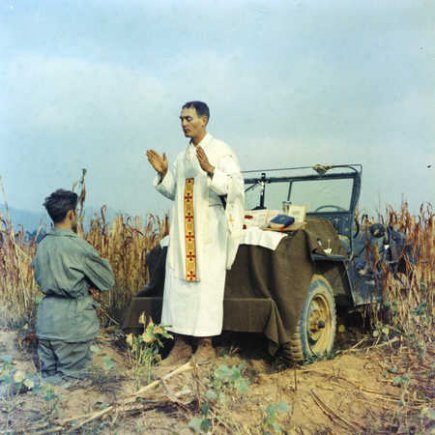
Servant of God, Fr Emil Joseph Kapaun (20 April 1916 - 23 May 1951)
Celebrating Mass with American soldiers during the Korean War [Wikipedia]

In his general audience in St Peter's Square on 31 October 2012 Pope Benedict said: I cannot build my personal faith in a private dialogue with Jesus, because faith is given to me by God through a community of believers that is the Church and projects me into the multitude of believers, into a kind of communion that is not only sociological but rooted in the eternal love of God who is in himself the communion of the Father and of the Son and of the Holy Spirit, it is Trinitarian Love. Our faith is truly personal, only if it is also communal: it can be my faith only if it dwells in and moves with the 'we' of the Church, only if it is our faith, the common faith of the one Church.

Pope Francis re-echoes this in Evangelii Gaudium Nos 264 - 268: We need to implore his grace daily, asking him to open our cold hearts and shake up our lukewarm and superficial existence . . . Sometimes we lose our enthusiasm for mission because we forget that the Gospel responds to our deepest needs, since we were created for what the Gospel offers us: friendship with Jesus and love of our brothers and sisters . . . The word of God also invites us to recognise that we are a people . . . Mission is at once a passion for Jesus and a passion for his people. When we stand before Jesus crucified, we see the depth of his love which exalts and sustains us, but at the same time, unless we are blind, we begin to realize that Jesus’ gaze, burning with love, expands to embrace all his people. We realize once more that he wants to make use of us to draw closer to his beloved people. He takes us from the midst of his people and he sends us to his people; without this sense of belonging we cannot understand our deepest identity.

What both Pope Benedict and Pope Francis are saying is that while our faith is in a person, Jesus Christ the Risen Lord, it can never be a question of 'Jesus and me'. Pope Benedict says, faith is given to me by God through a community of believers that is the Church and projects me into the multitude of believers and Pope Francis emphasises that He takes us from the midst of his people and he sends us to his people; without this sense of belonging we cannot understand our deepest identity.

In other words, I can only know myself as a brother or sister of Jesus, as a son or daughter of God the Father when I know myself as a member of their family, which I have become through my baptism.

And that awareness of who I am is strengthened when I join other members of God's family every Sunday as they devote themselves to the apostles’ teaching and fellowship, to the breaking of bread and the prayers.


British soldiers at Mass in the Netherlands during World War II. [Wikipedia]

Many Irish Columbans served as chaplains in the British Forces during World War II. One, Fr Patrick McMahon, died in action in Normandy, France, after rescuing a Canadian soldier on 14 August 1944.

In the Office of Readings, prayed by priests, monks, nuns and others as part of the Prayer of the Church, there are two readings. The first is from the Bible and the second usually from writers in the early centuries of the Church. On Thursday, Friday and Saturday of Easter Week the second reading is from Instructions to the Newly Baptized in Jerusalem also known as The Jerusalem Catechesis, written, as far as I know, by St Cyril of Jerusalem. The author says, Just as the bread of the Eucharist after the invocation of the Holy Spirit is no longer just bread, but the body of Christ, so when the Holy Spirit has been invoked on the holy chrism it is no longer mere or ordinary ointment; it is the gift of Christ, which through the presence of the Holy Spirit instils his divinity into us [Friday].


For the Saturday reading the author tells the newly-baptized: Do not, then, regard the bread and wine as nothing but bread and wine, for they are the body and blood of Christ as the master himself has proclaimed. Though your senses suggest otherwise, let faith reassure you. You have been taught and fully instructed that what seems to be bread is not bread, though it appears to be such to the sense of taste, but the body of Christ; that what seems to be wine is not wine, though the taste would have it so, but the blood of Christ


When I celebrate Mass with the Deaf here in Bacolod City, a group whose needs the late Columban Fr Joseph Coyle was the first priest to respond to and whose vision is being carried on now by many others, both Deaf and hearing, after the consecration of the bread and again of the wine, I hear from speaking people who are present the words of St Thomas, My Lord and my God. Just like St Thomas, they recognise the presence of the Risen Lord in the bread and the winde that have no become his Body and Blood.


Fr Emil Kapaun and Fr Patrick McMahon recognised the presence of Jesus in the bread and wine that became the Body and Blood of Christ each time they celebrated the Holy Sacrifice of the Mass. They also recognised the presence of Jesus in the wounds of the soldiers they tended and in whose service they sacrificed their lives - following the example of St Thomas who, according to tradition, was martyred in India.


+++

Regina caeli is sung during the Easter Season at the end of the Church's Night Prayer (Compline).

 Velásquez, 1645, Museo del Prado, Madrid [Web Gallery of Art]


Regina cæli, lætare, alleluia:
R. Quia quem meruisti portare, alleluia,
Resurrexit, sicut dixit, alleluia,
R. Ora pro nobis Deum, alleluia.
Gaude et lætare, Virgo Maria, alleluia.
R. Quia surrexit Dominus vere, alleluia.
Oremus.
Deus, qui per resurrectionem Filii tui, Domini nostri Iesu Christi,
mundum lætificare dignatus es:
præsta, quæsumus, ut per eius Genitricem Virginem Mariam,
perpetuæ capiamus gaudia vitæ.
Per eundem Christum Dominum nostrum. R. Amen.
Queen of Heaven, rejoice, alleluia.
The Son whom you merited to bear, alleluia.
Has risen, as He said, alleluia.
Pray for us to God, alleluia.
V. Rejoice and be glad, O Virgin Mary, alleluia.
R. For the Lord has truly risen, alleluia.
Let us pray.
O God, who through the resurrection of your Son Jesus Christ
gave rejoicing to the world,
grant, we pray, that through his Mother, the Virgin Mary,
we may obtain the joy of everlasting life.
Through Christ our Lord. Amen.


Our new saints

St John XIII, Angelo Giuseppe Roncalli (25 November 1881 - 3 June 1963)

St John Paul II, Karol Józef Wojtyła [2004] (18 May 1920 - 2 April 2005)

Photos from Wikipedia.


25 April 2014

ANZAC Day greetings to readers from Australia and New Zealand


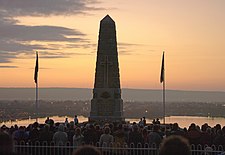
Anzac Day Dawn Service, King's Park, Western Australia, 25 April 2009

I posted this three years ago

The Columbans arrived in Australia in 1919 and in New Zealand two years later. Our arrival in those two countries was only a few years after the event in the Great War, World War I, that had a huge impact on their people of European origin, mainly British and Irish at the time, the landing in Gallipoli, Turkey, on 25 April 1915. Many of my confreres are from these two countries and because of that, their history is part of mine.

I paid my first visit to Australia just after Easter 1990. I was there for the 75th anniversary of the landing of the first members of the Australia and New Zealand Army Corps, the 'Anzacs', in Gallipoli. That particular anniversary generated new interest in this event. The Australian government flew a group of Gallipoli veterans, some of them aged more than 100, to Gallipoli to mark the event. Since then many young Australians have been going there for the anniversary ceremonies.

The landing at Anzac Cove, painting by George Lambert

On one TV discussion while I was there a participant pointed out that the iconic symbol of the Great War and Gallipoli for Australians wasn't one of soldiers killing or being killed, but of one saving lives: Private John Simpson, a stretcher-bearer, born in England, who was with the first group that landed, and his donkey, which he 'recruited' in Gallipoli and which acquired the name 'Duffy'. He had worked with donkeys as a youth during summers in England.

Private Simpson, centre, with his donkey and a wounded soldier (a Turk?)

John Simpson died on 15 May from machine gun fire, less than a month after he had arrived. He was 22. He quickly became a legend In Australia and his exploits were somewhat exaggerated, rather like some of the legends about the Church's martyrs. But there's no doubt about his bravery and that he saved many men.

Australian director Peter Weir's 1981 Gallipoli is one of the most memorable and moving films I have ever seen. It is built around the friendship of two young runners, Archy Hamilton, played by Mark Lee, and Frank Dunne, played by Mel Gibson. They meet as rivals in a 100-yard sprint but quickly become close friends or 'mates' and acquire more mates when they enlist in the army. Part of the movie's power is the detail paid to characters with small parts, every one a real human being, some attractive, some not.

Another is the wonderful use of music, especially of the Adagio in G minor by Venetian composer Tomaso Giovanni Albinoni (1671-1751). It is used with poignant effect at the end of the movie, with Frank  running back from the general to tell the major in charge of the group to which he and Archy belong that he was 're-considering the whole situation', ie, that he didn't want to have the soldiers go 'over the top' just yet. However, before he can reach the major a colonel has ordered that the soldiers go into attack immediately. The ending is unbearably sad,  the realisation of Frank that he is too late and his friend Archy going to his death.

The scenes in the trench before the soldiers go 'over the top' show their fear and their bravery. It shows them writing final letters, sharing a last cigarette and one praying the rosary. Archy recalls the words of his coach, his uncle. Here is that final scene.


Here is a beautiful video of Albinoni's Adagio played by the Franz Lizst Chamber Orchestra and recorded in Pannonhalma Archabbey, Hungary:


Eric Bogle, a Scottish singer-songwriter, wrote And the Band Played Waltzing Matilda in 1971, two years after he emigrated to Australia. The interpretation of Irish singer Liam Clancy is the best I have heard. War is not glorious for those who are maimed for life.


This year ANZAC Day falls on Easter Friday, but this song is more of a Good Friday one, recalling the words of Isaiah read on that day: He was despised and rejected by men; a man of sorrows, and acquainted with grief;  and as one from whom men hide their faces he was despised, and we esteemed him not.

23 April 2014

Kurt Carlsen, a captain who stayed with his ship, SS Flying Enterprise

MV Sewol, 16 April 2014 [Wikipedia]

The Holy Week ferry disaster has brought grief to the whole of the Republic of Korea, especially as so many lost were high school students. President Park Geun-hye described the actions of the captain and some crew members of the Sewol as 'akin to murder'. I wouldn't be inclined to so describe Captain Lee Joon-seok and his companions. What really happened will eventually come out in court or through official investigations. I'm certain that none of the crew intended that the ship would sink or that anyone would die as a result. But if the captain was among the first to leave the ship, as reported, that was inexcusable.


Costa Concordia during salvage operation [Wikipedia]

The trial of Captain Francesco Schettini of the Costa Concordia that foundered off the Italian coast with the loss of 32 lives on 13 January 2012 is still ongoing.


SS Flying Enterprise, 10 January 1952 [Wikipedia]

When I was in Grade 2, a time when few had telephones, Ireland had no TV, when the internet wasn't even a dream in someone's imagination, the national radio station broadcast only at certain times of the day and evening and people depended on newspapers as their major source of news, I along with everyone else was utterly enthralled by what was happening to the SS Flying Enterprise, a cargo ship that began to founder in stormy weather off the south coast of England.

On 21 December 1951 the Flying Enterprise left Hamburg, Germany, under Captain Kurt Carlsen, a Dane who lived in New Jersey, USA. It carried ten passengers. In those days many cargo ships were allowed to have up to twelve passengers.

On Christmas Night the ship ran into a storm as it approached England and and by 28 December was listing at an angle of 45 degrees. The crew and passengers were evacuated on the 29th, one passenger drowning but everyone else was rescued. Captain Carlsen remained on board. A number of ships came to accompany the distressed vessel. The tugboat Turmoil arrived on 3 January and its mate, Kenneth Dancy, who died last year at the age of 88, joined Captain Carlsen on the Flying Enterprise the following day.

The Turmoil took the distressed ship in tow on 5 January heading for Falmouth in the south-west of England, but five days later the cable broke at around 01:30 on 10 January. Captain Carlsen and Kenneth Dancy abandoned ship nearly 14 hours later. Within an hour the Flying Enterprise sank.

People, including children, were talking about nothing else. We waited anxiously for each bulletin on the radio, for each issue of our morning and evening newspapers.

Captain Carlsen became an international hero. He refused to let himself become a wealthy 'celebrity' and went back to sea. At a reception for him in Woodbridge, NJ, where he lived he said, My boss sent me out a few month ago with a beautiful ship and I come back without it.  He told the people that the warmth of their welcome had more than compensated for my little inconvenience out in the Atlantic the last three weeks. He died in 1989 at the age of 75.

Here is a contemporary newsreel of the saga of SS Flying Enterprise.


The Apostleship of the Sea, under the patronage of Our Lady Stella Maris, serves seafarers in many ports throughout the world.

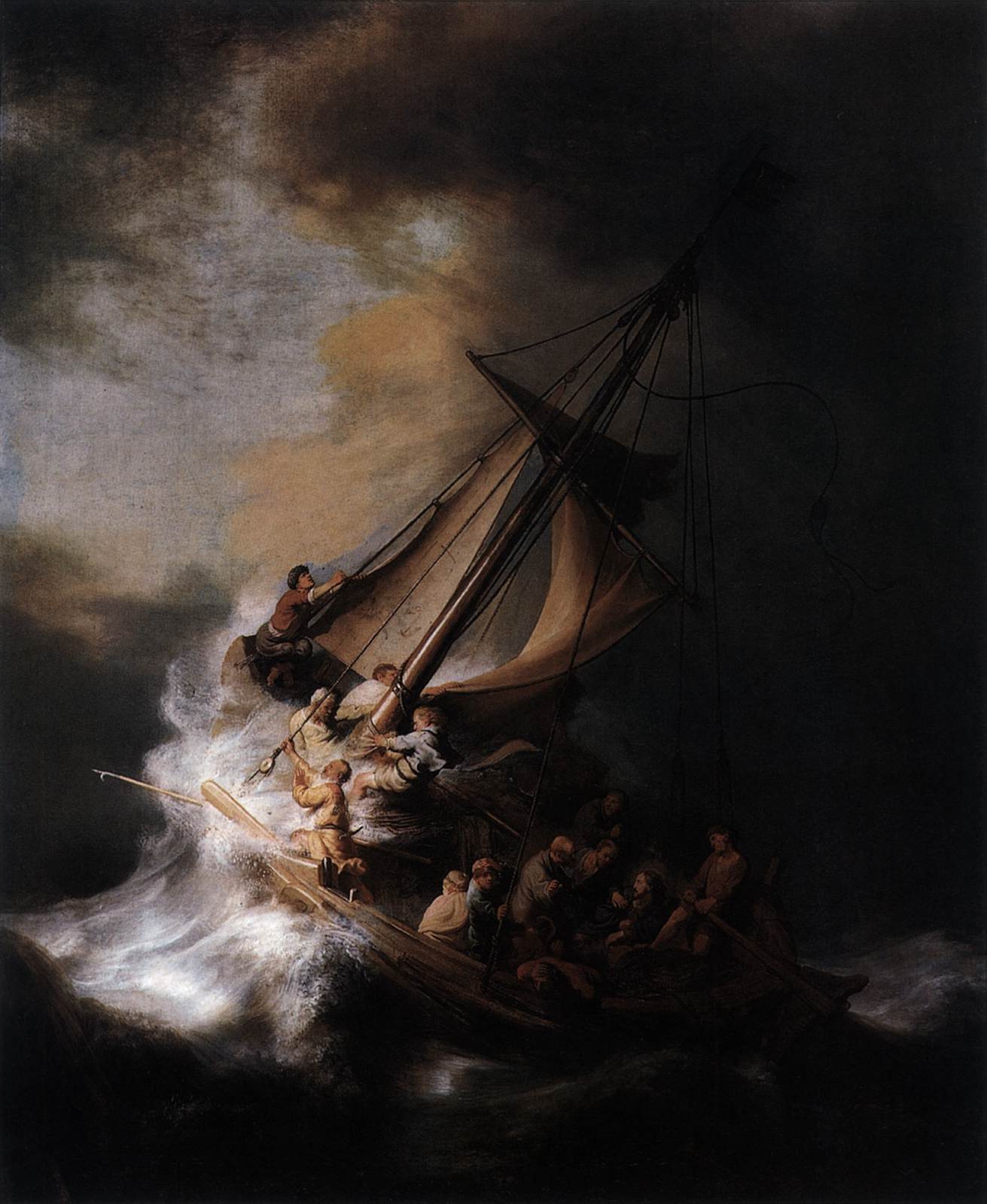
Christ in the Storm on the Sea of Galilee
Rembrandt, 1633. Isabella Stewart Gardner Museum, Boston [Web Gallery of Art]

19 April 2014

'He saw and believed.' Sunday Reflections, Easter Sunday

Passignano, 1600-25, Pinacoteca, Vatican [Web Gallery of Art]

The Easter Vigil in the Holy Night

Readings (New American Bible: Philippines, USA)

Readings (Jerusalem Bible: Australia, England & Wales, India [optional], Ireland, New Zealand, Pakistan, Scotland, South Africa) 

At the Mass During the Day

Readings (New American Bible: Philippines, USA)                                  

Readings (Jerusalem Bible: Australia, England & Wales, India [optional], Ireland, New Zealand, Pakistan, Scotland, South Africa)


Early on the first day of the week, while it was still dark, Mary Magdalene came to the tomb and saw that the stone had been removed from the tomb. So she ran and went to Simon Peter and the other disciple, the one whom Jesus loved, and said to them, “They have taken the Lord out of the tomb, and we do not know where they have laid him.” Then Peter and the other disciple set out and went toward the tomb. The two were running together, but the other disciple outran Peter and reached the tomb first. He bent down to look in and saw the linen wrappings lying there, but he did not go in. Then Simon Peter came, following him, and went into the tomb. He saw the linen wrappings lying there, and the cloth that had been on Jesus’ head, not lying with the linen wrappings but rolled up in a place by itself. Then the other disciple, who reached the tomb first, also went in, and he saw and believed; for as yet they did not understand the scripture, that he must rise from the dead.

From The Gospel of John 

I remember as a young priest, maybe in the summer of 1968 about six months after my ordination, celebrating Sunday Mass in the chapel of the Irish Sisters of Charity (now the Religious Sisters of Charity) in Stanhope Street, Dublin, where I had made my First Holy Communion on 20 May 1950. the beautiful chapel is no longer there.

I remember clearly that my mother was at the Mass and that I preached about the Resurrection, probably quite eloquently and certainly with conviction.

However, it was only when my mother died suddenly less that two years later that I got any real grasp of what the Resurrection is. Within hours of receiving the news at breakfast time in New York, where I was studying, I felt its truth in my very being.

I preached again about the Resurrection in the presence of my mother's remains at her funeral Mass, again with conviction and maybe with some eloquence as before. But my conviction, my faith in the Resurrection, was now rooted in my heart, not just in my head.

After the Mass my father, a man of deep quiet faith who went to Mass every day of his life right up to the day of his own sudden death in 1987, told me that he had felt utterly desolate going into the church but now felt at peace. A cousin's husband thanked me for speaking about what really matters. Nearly 40 years later a fellow Columban, who had been present
while a seminarian, told me that he still preaches in his funeral homilies in Japan whatever I had said at my mother's funeral Mass. I really have no idea what I said but I remember vividly the change in my understanding of the Resurrection during those days.

Anniversary of 1994 genocide in Rwanda

But the hope that the Death and Resurrection of Jesus is not only for us as individuals. It can bring hope and reconciliation to a whole nation. In 1994 in Rwanda, an  overwhelmingly Christian nation, more than half of its then between seven and eight million people Catholics, between 500,000 and 1,000,000, mostly members of the minority Tutsi people, were slaughtered between 7 April and the middle of July.

In the video above a man who lived through it, probably as a child, says outside a church in Kigali, the country's capital, Today's Mass was about Resurrection. And I believe that one day the souls of the people we lost will resurrect. Sister Mujawayezu Marie Anastasie, a survivor of the genocide,  says, I think now that things are like before, even better than before. People are good to each other, talking. People trust each other. For what I see it seems OK but I do not know what's inside a person's heart.

Sister Mujawayezu's words express some uncertainty but trust and hope win out. This is a fruit of the Resurrection, that God's love has conquered evil and death. And the Rwandan Genocide was the result mainly of neighbour killing neighbour. There have been reports and photos in the media in recent weeks of individuals who had killed other individuals not only asking forgiveness of someone they had widowed but working with that widow to enable her to have a livelihood.

It is acts such as these that remind us of the truth of the Resurrection, of the presence of the Risen Lord among us, still carrying the scars of his Crucifixion, as the people of Rwanda who have asked for forgiveness or who have forgiven their former enemies still carry the scars of 1994.


The civil war in Rwanda was short and brutal. That in Lebanon lasted from 1975 to 1990 with an estimated 120,000 deaths and about a million leaving the country. Today it is affected by the ongoing civil war in neighbouring Syria.

The people of Lebanon are Arabs, nearly 40 percent of them Christian. Most of those are Maronite Catholics who have always been in full communion with Rome. The vast majority of Christians in the Middle East are Arabs, in Egypt, Iraq, Israel, Palestine, Syria. They are descended from the very earliest Christians. Islam originated nearly six centuries after the death and Resurrection of Jesus.

Like the people of Rwanda, the people of Lebanon carry the scars of their civil war. But the Christians there also carry the living grace of the Resurrection of Jesus. I have used the video below a number of times before but I know of no more joyful proclamation of the Resurrection than Jesus is Risen, sung here in Arabic in a shopping mall in Beirut three years ago at Eastertime.

No translation is necessary, though you can switch on the English captions. You can see the look of surprise on the face of a Filipina taking caring of a child and the look of delight on the face of a young Muslim woman.


Resurrexit sicut dixit, Alleluia!

He is risen as he said, Alleluia!

Happy Easter!