Showing posts sorted by relevance for query Munich. Sort by date Show all posts

04 November 2011

'So stay awake . . .' Sunday Reflections, 32nd Sunday in Ordinary Time Year A

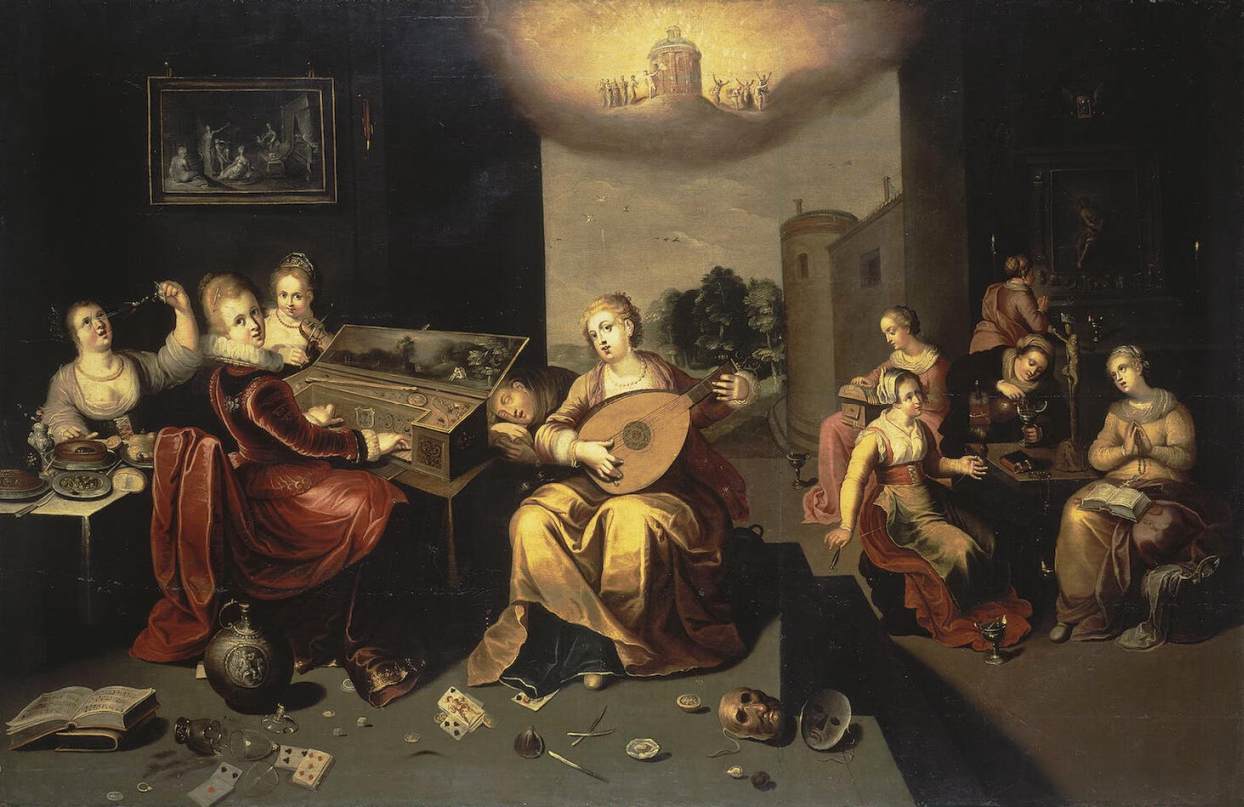
Parable of the Wise and Foolish Virgins, Hieronymus Francken II, c.1616

Readings (New American Bible: Philippines, USA)

Gospel Matthew 25:1-13 (Jerusalem Bible: Australia, England & Wales, India [optional], Ireland, New Zealand, Pakistan, Scotland, South Africa)

Jesus told this parable to his disciples: 'The kingdom of heaven will be like this: Ten bridesmaids took their lamps and went to meet the bridegroom. Five of them were foolish and five were sensible: the foolish ones did take their lamps, but they brought no oil, whereas the sensible ones took flasks of oil as well as their lamps. The bridegroom was late, and they all grew drowsy and fell asleep. But at midnight there was a cry, "The bridegroom is here! Go out and meet him." At this, all those bridesmaids woke up and trimmed their lamps, and the foolish ones said to the sensible ones, "Give us some of your oil: our lamps are going out". But they replied, "There may not be enough for us and for you; you had better go to those who sell it and buy some for yourselves". They had gone off to buy it when the bridegroom arrived. Those who were ready went in with him to the wedding hall and the door was closed. The other bridesmaids arrived later. "Lord, Lord," they said "open the door for us." But he replied, "I tell you solemnly, I do not know you". So stay awake, because you do not know either the day or the hour.

An Soiscéal Matha 25:1-13 (Gaeilge, Irish)

San am sin dúirt Íosa lena dheisceabail: “Is iad dála ríocht na bhflaitheas an uair sin mar a bhí ag deichniúr maighdean a chuaigh amach agus a lampaí acu in airicis an fhir nuaphósta. Cúigear díobh seo, bhí siad gan tuiscint agus bhí an cúigear eile ciallmhar; mar, thug na mná gan tuiscint na lampaí leo agus gan aon ola acu, ach thug na mná ciallmhara ola ina bpróiciní leo chomh maith leis na lampaí. Bhí an fear nuaphósta ag déanamh moille, agus tháinig sámhán orthu uile agus thit siad ina gcodladh. Ach glaodh i lár na hoíche: ‘Chugaibh an fear nuaphósta! Amach libh ina airicis!’ D’éirigh na maighdeana sin uile ina suí agus dheasaigh siad a lampaí. Ach dúirt na mná gan tuiscint leis na mná ciallmhara: ‘Tugaigí dúinn braon de bhur n-olasa, mar tá ár lampaíne in éag.’ D’fhreagair lucht na céille iad: ‘Le heagla,’ ar siad, ‘nach mbeadh ár ndóthain ann dúinn féin agus daoibhse, b’fhearr daoibhse dul go dtí lucht a díolta á ceannach daoibh féin.’ Bhí siad ag dul á ceannach nuair a tháinig an fear nuaphósta, agus iad seo a bhí ullamh, chuaigh siad isteach in éineacht leis chun na bainise, agus dúnadh an doras. Sa deireadh, tháinig na maighdeana eile freisin: ‘A thiarna, a thiarna,’ ar siad, ‘oscail dúinn!’ Ach d’fhreagair sé agus dúirt: ‘Deirim libh go fírinneach, níl aithne agam oraibh.’ Bígí ag faire, dá bhrí sin, mar níl a fhios agaibh an lá ná an uair.

+++

Entrance Antiphon

Let my prayer come before you, Lord; listen and answer me (Ps 87:3).
Intret orátio mea in conspéctu tuo; inclína aurem tuam ad precem meam, Dómine (Latin).


As we come towards the end of the liturgical year the them of vigilance and preparedness becomes prominent in the readings at Mass. Today's gospel highlights those two themes. The grave above is that of Liam Whelan, a 22-year-old man from the next parish to my own in Dublin, who died in an aircrash in Munich on 6 February 1958 with other members of the Manchester United soccer team, officials and journalists. Hearing the news of the disaster that evening from a street singer was my first experience, at 14, of what has been called a 'private public moment' when everyone remembers where they were when they heard of a tragedy.

For people of an older generation in Europe the word 'Munich' conjured up the picture of British Prime Minister Neville Chamberlain at an airport in London on 30 September 1938 waving a piece of paper signed by himself and Hitler in that German city, the Anglo-German Declaration, assuring 'peace for our time'. Less than a year later Germany and Britain were at war. For me Munich, which I have visited twice, will be for ever the place where Liam Whelan and his companions died so tragically.

But I remember being inspired when I read what Liam Whelan's last words were: 'If this is the end, then I'm ready for it'.

Here, slightly edited, is what I wrote in my blog on the 50th anniversary of the Munich disaster, because I think it powerfully brings out the meaning of today's parable.

A stamp with Liam Whelan's photo, issued by An Post, the Irish Postal Service, for the 50th anniversary of the Munich Disaster. The clock is in Old Trafford, the Manchester United stadium, shoing the time and dated of the crash.


'If this is the end, then I'm ready for it'. (Posted 6 February 2008).

These were the last words of Liam Whelan who died 50 years ago today and who is buried near my parents. Only last year I learned that when they were both around 14 Liam rescued a close friend of mine who had got into difficulties in a swimming pool. [I am baptising a grandson of that friend tomorrow, 5 November].

The average age of Manchester United's players was only 22. One who was only 21, Duncan Edwards, from the English Midlands, was considered by many to have the potential to become perhaps the greatest footballer ever. He died 15 days after the crash.

These young men were earning only £15 a week, about 25 percent more than a tradesman could earn. Endorsements could bring in a little more income for a few talented players whose career would end for most at 35, if not earlier. Their counterparts today are often spoiled millionaires. Imagine if the top players in the Philippine Basketball Association were paid only the same amount as a public school teacher, or if the members of the New York Giants or the Boston Red Sox were limited to earning little more than a bus-driver. That’s how it was with these young men who filled stadiums week after week.

Those who knew him describe Liam Whelan as a ‘devout Catholic’. I know that he sent his mother some money for her to go to Lourdes. 11 February 1958 was the centennial of the first apparition of our Blessed Mother to St Bernadette. Mrs Whelan, a widow since 1943 when Liam was 8, used the money instead towards a beautiful statue of Our Lady of Lourdes over the grave of her son. I pass it each time I visit my parents’ grave.

Clearly young Liam Whelan had his life focused on what was most important. He was ready to meet death. I spoke about him at Mass this morning. I see Lent as a time to focus on the essentials, God’s love for us sinners, the hope that the life and death of Jesus offer us, the necessity of acknowledging our sinfulness to enable God’s love to break through. [6 February 2008 was Ash Wednesday].

But the deaths of so many talented young men still leaves a deep sadness among those who saw them play and followed their fortunes. I was feeling that sadness quite heavily this last week but it has lifted now. The February issue of The Word has an article, A Sporting Tragedy, in which John Scally speaks for me : ‘Their funerals were like no other. Most funerals are a burial of someone or something already gone. These young deaths pointed in exactly the opposite direction and were therefore the more poignant. Normally we bury the past but in burying Liam Whelan and his colleagues, in some deep and gnawing way we buried the future’.

You can listen to a wonderful interview with Harry Gregg, one of the survivors, on Bowman Sunday Morning on 27 January. [This interview on RTÉ, Ireland’s national radio and TV service, is no longer available. Harry Gregg, who was a goalkeeper for Manchester United and Northern Ireland, survived the crash without injury and rescued a number of passengers. He has often told the story of Liam Whelan's last words. I think he was sitting next to the young Dubliner].

+++

'So stay awake, because you do not know either the day or the hour'.


.

08 August 2025

'You also must be ready.' Sunday Reflections, 19th Sunday in Ordinary Time, Year C


St Francis and Brother Leo Meditating on Death

El Greco [Web Gallery of Art]

Readings (Jerusalem Bible: Australia, Ireland, New Zealand, Pakistan,)

Readings (English Standard Version, Catholic Edition: England & Wales, India, Scotland) 

Readings (New American Bible: Philippines, USA)

Gospel Luke 12:32-48 (English Standard Version, Anglicised)

At that time: Jesus said to his disciples, ‘Fear not, little flock, for it is your Father’s good pleasure to give you the kingdom. Sell your possessions, and give to the needy. Provide yourselves with money bags that do not grow old, with a treasure in the heavens that does not fail, where no thief approaches and no moth destroys. For where your treasure is, there will your heart be also.

‘Stay dressed for action and keep your lamps burning, and be like men who are waiting for their master to come home from the wedding feast, so that they may open the door to him at once when he comes and knocks. Blessed are those servants whom the master finds awake when he comes. Truly, I say to you, he will dress himself for service, and have them recline at table, and he will come and serve them. If he comes in the second watch, or in the third, and finds them awake, blessed are those servants! But know this, that if the master of the house had known at what hour the thief was coming, he would not have left his house to be broken into. You also must be ready, for the Son of Man is coming at an hour you do not expect.’ 

Peter said, ‘Lord, are you telling this parable for us or for all?’ And the Lord said, ‘Who then is the faithful and wise manager, whom his master will set over his household, to give them their portion of food at the proper time? Blessed is that servant whom his master will find so doing when he comes. Truly, I say to you, he will set him over all his possessions. But if that servant says to himself, “My master is delayed in coming”, and begins to beat the male and female servants, and to eat and drink and get drunk, the master of that servant will come on a day when he does not expect him and at an hour he does not know, and will cut him in pieces and put him with the unfaithful. And that servant who knew his master’s will but did not get ready or act according to his will, will receive a severe beating. But the one who did not know, and did what deserved a beating, will receive a light beating. Everyone to whom much was given, of him much will be required, and from him to whom they entrusted much, they will demand the more.’

Léachtaí i nGaeilge

A stamp with Liam Whelan's photo issued in 2008 by An Post, the Irish Postal Service, for the 50th anniversary of the Munich Disaster. The clock is in Old Trafford, the Manchester United stadium, showing the time and date of the crash.

You also must be ready; for the Son of Man is coming at an hour you do not expect.

I've posted a number of times before about the death of Irish footballer Liam Whelan in a plane crash in Munich in 1958. His life and death for me show the meaning of the words of Jesus in the gospel today: You also must be ready; for the Son of man is coming at an hour you do not expect. 

I remember the moment I heard of the plane crash in Munich that killed so many young sportsmen in their prime. It was late afternoon and already dark and a man whom I knew as a street-singer, someone I had perceived, wrongly perhaps, to be a beggar, was running around, almost frantically, telling everyone the tragic news. I was 14 and it was my first experience of what some call 'a public private moment'.

If this is the end, then I'm ready for it. 

These were the last words of Liam Whelan who died more than 67 years ago and who is buried near my parents. Nearly 20 years ago  I learned that when they were both around 14 Liam rescued a close friend of mine who had got into difficulties in a swimming pool. [Brendan, my friend, celebrated his 89th birthday last Thursday. I have baptised two of his grandchildren and celebrated the funeral Mass of his dear wife Pat].

Most of of Manchester United's players were in their early twenties. One who was only 21, Duncan Edwards, from the English Midlands, was considered by many to have the potential to become perhaps the greatest footballer ever. He died 15 days after the crash.

These young men who filled stadiums were being paid only a little more than a tradesman could earn at the time, though very few played beyond the age of 35. Endorsements could bring in a little more income for a few talented players. Their counterparts today are often spoiled millionaires.

Those who knew him described Liam Whelan as 'a devout Catholic'. I know that he sent his mother some money for her to go to Lourdes. 11 February 1958 was the centennial of the first apparition of our Blessed Mother to St Bernadette. Mrs Whelan, a widow since 1943 when Liam was 8, used the money instead towards a beautiful statue of Our Lady of Lourdes over the grave of her son (photo below). I pass it each time I visit my parents’ grave.

Clearly young Liam Whelan had his life focused on what was most important. He was ready to meet death. I have often spoken about him at Mass and on retreats. Today's gospel invites us to focus on the essentials, God’s love for us sinners, the hope that the life and death of Jesus offer us, the necessity of acknowledging our sinfulness to enable God’s love to break through and the importance of being always prepared for death.

But the deaths of so many talented young men still leaves a deep sadness among those who saw them play and followed their fortunes. I feel that sadness when I recall the Munich crash. The February 2008 issue of The Word, a magazine that sadly no longer exists and that was published by the Divine Word Missionaries in Ireland and Britain, had an article, A Sporting Tragedy, in which John Scally spoke for me : Their funerals were like no other. Most funerals are a burial of someone or something already gone. These young deaths pointed in exactly the opposite direction and were therefore the more poignant. Normally we bury the past but in burying Liam Whelan and his colleagues, in some deep and gnawing way we buried the future.

I remember the evening that Liam Whelan's remains were brought to his parish church, Christ the King, Cabra, Dublin, very near to where our family lived. There were thousands outside the church. My brother Paddy went with our Dad - I had gone separately, on my way to a Legion of Mary meeting. He told me just a few years ago that it was the only time he ever saw Dad cry.

I remember reading about Liam Whelan's last words in a newspaper a few days after the tragedy. I've heard Harry Gregg, the Manchester United goalkeeper who survived the crash and who died in 2020, speaking about them. They still move me and challenge me to be ready whenever death may come. Jesus isn't trying to frighten us in today's gospel but to keep us focused on the supremely important realities of
 The Four Last Things: Death, Judgment, Heaven and Hell. (That article by Monsignor Charles Pope is well worth reading).

Jesus tells us that when we are honestly trying to follow him in doing the Father's will we are blessed: Blessed are those servant whom the master finds awake when he comes.

You also must be ready; for the Son of man is coming at an hour you do not expect.

Liam Whelan's grave, Glasnevin Cemetery, Dublin

Pope Benedict XVI opens his encyclical Spe Salvi  with these words:  'SPE SALVI facti sumus'—in hope we were saved, says Saint Paul to the Romans, and likewise to us' (Rom 8:24). He has a beautiful passage about praying for the dead in No 48 of the encyclical, a passage I have often used at funerals. In it he quotes from John Donne's poem No Man is an Island (quotation highlighted below). 

The belief that love can reach into the afterlife, that reciprocal giving and receiving is possible, in which our affection for one another continues beyond the limits of death—this has been a fundamental conviction of Christianity throughout the ages and it remains a source of comfort today. Who would not feel the need to convey to their departed loved ones a sign of kindness, a gesture of gratitude or even a request for pardon?

. . . We should recall that no man is an island, entire of itself. Our lives are involved with one another . . . The lives of others continually spill over into mine: in what I think, say, do and achieve. And conversely, my life spills over into that of others: for better and for worse. So my prayer for another is not something extraneous to that person, something external, not even after death. In the interconnectedness of Being, my gratitude to the other—my prayer for him—can play a small part in his purification. And for that there is no need to convert earthly time into God's time: in the communion of souls simple terrestrial time is superseded. It is never too late to touch the heart of another, nor is it ever in vain. In this way we further clarify an important element of the Christian concept of hope. Our hope is always essentially also hope for others; only thus is it truly hope for me too.

No Man is an Island
by John Donne, read by Peter Baker

Traditional Latin Mass

Ninth Sunday after Pentecost

The Complete Mass in Latin and English is here. (Adjust the date at the top of that page to 10-08-2025 if necessary).

Epistle: 1 Corinthians 10:6-13. Gospel: Luke 19:41-47.

The Purification of the Temple

Jesus entered the temple and began to drive out those who sold, saying to them, “It is written, ‘My house shall be a house of prayer’; but you have made it a den of robbers” (Luke 19:45-46; today's Gospel).


05 August 2022

'If this is the end, then I'm ready for it.' Sunday Reflections, 19th Sunday in Ordinary Time, Year C


St Francis and Brother Leo Meditating on Death

El Greco [Web Gallery of Art]


Readings (Jerusalem Bible: Australia, England & Wales, India [optional], Ireland, New Zealand, Pakistan, Scotland, South Africa)

Readings (New American Bible: Philippines, USA)

Gospel Luke 12:32-48 (English Standard Version Anglicised: India). Shorter form, Luke 12:35-40. Omit [text in square brackets]. 

Jesus said to his disciples:

[“Fear not, little flock, for it is your Father's good pleasure to give you the kingdom. Sell your possessions, and give to the needy. Provide yourselves with money bags that do not grow old, with a treasure in the heavens that does not fail, where no thief approaches and no moth destroys. For where your treasure is, there will your heart be also.]

“Stay dressed for action and keep your lamps burning, and be like men who are waiting for their master to come home from the wedding feast, so that they may open the door to him at once when he comes and knocks. Blessed are those servants whom the master finds awake when he comes. Truly, I say to you, he will dress himself for service and have them recline at table, and he will come and serve them. If he comes in the second watch, or in the third, and finds them awake, blessed are those servants! But know this, that if the master of the house had known at what hour the thief was coming, he would not have left his house to be broken into. You also must be ready, for the Son of Man is coming at an hour you do not expect.”

[Peter said, “Lord, are you telling this parable for us or for all?” And the Lord said, “Who then is the faithful and wise manager, whom his master will set over his household, to give them their portion of food at the proper time? Blessed is that servant whom his master will find so doing when he comes. Truly, I say to you, he will set him over all his possessions. But if that servant says to himself, ‘My master is delayed in coming’, and begins to beat the male and female servants, and to eat and drink and get drunk, the master of that servant will come on a day when he does not expect him and at an hour he does not know, and will cut him in pieces and put him with the unfaithful. And that servant who knew his master's will but did not get ready or act according to his will, will receive a severe beating. But the one who did not know, and did what deserved a beating, will receive a light beating. Everyone to whom much was given, of him much will be required, and from him to whom they entrusted much, they will demand the more.]

Léachtaí i nGaeilge  

A stamp with Liam Whelan's photo issued in 2008 by An Post, the Irish Postal Service, for the 50th anniversary of the Munich Disaster. The clock is in Old Trafford, the Manchester United stadium, showing the time and date of the crash.

You also must be ready; for the Son of Man is coming at an hour you do not expect.

I've posted a number of times before about the death of Irish footballer Liam Whelan in a plane crash in Munich in 1958. His life and death for me show the meaning of the words of Jesus in the gospel today: You also must be ready; for the Son of man is coming at an hour you do not expect. 

I remember the moment I heard of the plane crash in Munich that killed so many young sportsmen in their prime. It was late afternoon and already dark and a man whom I knew as a street-singer, someone I had perceived, wrongly perhaps, to be a beggar, was running around, almost frantically, telling everyone the tragic news. I was 14 and it was my first experience of what some call 'a public private moment'.

If this is the end, then I'm ready for it. 

These were the last words of Liam Whelan who died more than 64 years ago and who is buried near my parents. Fifteen or sixteen years ago  I learned that when they were both around 14 Liam rescued a close friend of mine who had got into difficulties in a swimming pool. [Brendan, my friend, celebrates his 86th birthday this Sunday. I have baptised two of his grandchildren].

The average age of Manchester United's players was only 22. One who was only 21, Duncan Edwards, from the English Midlands, was considered by many to have the potential to become perhaps the greatest footballer ever. He died 15 days after the crash.

These young men who filled stadiums were being paid only a little more than a tradesman could earn at the time, though very few played beyond the age of 35. Endorsements could bring in a little more income for a few talented players. Their counterparts today are often spoiled millionaires.

Those who knew him described Liam Whelan as 'a devout Catholic'. I know that he sent his mother some money for her to go to Lourdes. 11 February 1958 was the centennial of the first apparition of our Blessed Mother to St Bernadette. Mrs Whelan, a widow since 1943 when Liam was 8, used the money instead towards a beautiful statue of Our Lady of Lourdes over the grave of her son (photo below). I pass it each time I visit my parents’ grave.

Clearly young Liam Whelan had his life focused on what was most important. He was ready to meet death. I have often spoken about him at Mass and on retreats. Today's gospel invites us to focus on the essentials, God’s love for us sinners, the hope that the life and death of Jesus offer us, the necessity of acknowledging our sinfulness to enable God’s love to break through and the importance of being always prepared for death.

But the deaths of so many talented young men still leaves a deep sadness among those who saw them play and followed their fortunes. I feel that sadness when I recall the Munich crash. The February 2008 issue of The Word, a magazine that sadly no longer exists and that was published by the Divine Word Missionaries in Ireland and Britain, had an article, A Sporting Tragedy, in which John Scally spoke for me : Their funerals were like no other. Most funerals are a burial of someone or something already gone. These young deaths pointed in exactly the opposite direction and were therefore the more poignant. Normally we bury the past but in burying Liam Whelan and his colleagues, in some deep and gnawing way we buried the future.

I remember the evening that Liam Whelan's remains were brought to his parish church, Christ the King, Cabra, Dublin, very near to where our family lived. There were thousands outside the church. My brother Paddy went with our Dad. Just recently  he told me that it was the only time he ever saw Dad cry.

I remember reading about Liam Whelan's last words in a newspaper a few days after the tragedy. I've heard Harry Gregg, the Manchester United goalkeeper who survived the crash and who died in 2020, speaking about them. They still move me and challenge me to be ready whenever death may come. Jesus isn't trying to frighten us in today's gospel but to keep us focused on the supremely important realities of
 The Four Last Things: Death, Judgment, Heaven and Hell. (That article by Monsignor Charles Pope is well worth reading).

Jesus tells us that when we are honestly trying to follow him in doing the Father's will we are blessed: Blessed are those servant whom the master finds awake when he comes.

You also must be ready; for the Son of man is coming at an hour you do not expect.

Liam Whelan's grave, Glasnevin Cemetery, Dublin

Pope Benedict XVI opens his encyclical Spe Salvi  with these words:  'SPE SALVI facti sumus'—in hope we were saved, says Saint Paul to the Romans, and likewise to us (Rom 8:24). He has a beautiful passage about praying for the dead in No 48 of the encyclical, a passage I have often used at funerals. In it he quotes from John Donne's poem No Man is an Island (quotation highlighted below). 

The belief that love can reach into the afterlife, that reciprocal giving and receiving is possible, in which our affection for one another continues beyond the limits of death—this has been a fundamental conviction of Christianity throughout the ages and it remains a source of comfort today. Who would not feel the need to convey to their departed loved ones a sign of kindness, a gesture of gratitude or even a request for pardon?

. . . We should recall that no man is an island, entire of itself. Our lives are involved with one another . . . The lives of others continually spill over into mine: in what I think, say, do and achieve. And conversely, my life spills over into that of others: for better and for worse. So my prayer for another is not something extraneous to that person, something external, not even after death. In the interconnectedness of Being, my gratitude to the other—my prayer for him—can play a small part in his purification. And for that there is no need to convert earthly time into God's time: in the communion of souls simple terrestrial time is superseded. It is never too late to touch the heart of another, nor is it ever in vain. In this way we further clarify an important element of the Christian concept of hope. Our hope is always essentially also hope for others; only thus is it truly hope for me too.

No Man is an Island
by John Donne, read by Peter Baker

Traditional Latin Mass

Ninth Sunday after Pentecost

The Complete Mass in Latin and English is here. (Adjust the date at the top of that page to 8-07-2022 if necessary).

Epistle: 1 Corinthians 10:6-13. Gospel: Luke 19:41-47.

The Purification of the Temple

Jesus entered the temple and began to drive out those who sold, saying to them, “It is written, ‘My house shall be a house of prayer’; but you have made it a den of robbers” (Luke 19:45-46; today's Gospel).


04 February 2020

‘You are the light of the world.' Sunday Reflections, 5th Sunday in Ordinary Time, Year A

A View of Toledo (detail)
El Greco [Web Gallery of Art]

'A city built on a hill cannot be hidden' (Mt 5:14).

Readings (New American Bible: Philippines, USA)

Readings (Jerusalem Bible: Australia, England & Wales, India [optional], Ireland, New Zealand, Pakistan, Scotland, South Africa)

Gospel Matthew 5:13-16 (New Revised Standard Version, Anglicised Catholic Edition, Canada)  

Jesus said to his disciples:

‘You are the salt of the earth; but if salt has lost its taste, how can its saltiness be restored? It is no longer good for anything, but is thrown out and trampled under foot.
‘You are the light of the world. A city built on a hill cannot be hidden. No one after lighting a lamp puts it under the bushel basket, but on the lampstand, and it gives light to all in the house. In the same way, let your light shine before others, so that they may see your good works and give glory to your Father in heaven.


Matthew 5:13-16 in Filipino Sign Language

Childhood of Christ
Gerrit van Honthorst [Web Gallery of Art]

'Let your light shine before others . . .' (Mt 5:16).


One of the darkest periods in the history of the world was 1939 to 1945 when much of the world was at war. At the heart of the darkness was Nazi Germany, where freedom had been almost entirely suppressed. But not quite. Between June 1942 and February 1943 a small group of students at the University of Munich with their philosophy professor Kurt Huber formed The White Rose, a non-violent resistance group working against Hitler and the Nazi regime. 

Sophie Scholl in 1942 
(9 May 1921 - 22 February 1943) [Wikipedia]

Among the leaders were Sophie Scholl and her older brother Hans. They were executed together. Both were devout Lutherans. It is said that she was influenced by the writings of St John Henry Cardinal Newman. Others in the group, such as Willi Graf, were devout Catholics. Not all were Christians but they shared a commitment to speaking the truth, even if it cost them their young lives. Most were in their early 20s.

Blessed Clemens August Graf von Galen [Wikipedia]

One German Catholic who had a great impact on the group was Blessed Clemens August Graf von Galen, Bishop of Münster, Germany, who died just after being made a cardinal in 1946, a giant of a man physically (6 feet 7 inches /2.01 m tall), morally and spiritually. He was known as 'The Lion of Münster'. In a series of sermons in 1941 he denounced some of the policies of Hitler, including that of euthanasia. Hans and Sophie Scholl used one of these in a leaflet that The White Rose printed and distributed secretly.

It was while distributing leaflets - the movement produced a total of six, their only means of communication - at the University of Munich, that Hans and Sophie were caught and then executed.


The members of The White Rose are remembered and honoured today and a number of films have been made about them. The video above contains footage from one of those.

White Rose Memorial, University of Munich

Hans and Sophie Scholl and their companions knew that their lives were in danger. But their Christian faith led them to be the salt of the earth . . . the light of the world. Through them at least some experienced the truth of the words of Isaiah 9:2 quoted in Matthew 4:16, the people who sat in darkness have seen a great light, and for those who sat in the region and shadow of death light has dawned. 

Salt is of use only when it is mixed with other things. The light of the sun doesn't exist for itself, for us to look at it. If we did we would be blinded. It is meant to light up everything around us, as we are meant by being salt and light to bring others to taste and see the joy of knowing Jesus the Risen Lord.

Not many are called, as some of the members of The White Rose were, to be the salt of the earth . . . the light of the world by laying down their lives. But those in The White Rose got their Christian faith, their moral values from others who for them were the salt of the earth . . . the light of the world. Some of them had belonged to various Nazi movements for young people but saw through the false values being promoted and left. In other words, they had been formed in solid values by others, older persons such as parents, some teachers perhaps. others trying to live honest and upright lives as followers of Jesus, 'missionary disciples', as Pope Francis calls us to be in Evangelii Gaudium No 120, without even being aware that they were such. The Pope reminds us there: In virtue of their baptism, all the members of the People of God have become missionary disciples.

+++ 

If you google 'Sophie Scholl' or 'The White Rose' on YouTube you will find many videos about the movement. The Film Sophie Scholl - the Final Days  (with English subtitles), directed by Marc Rothemund, was made in 2005. The trailer is below.