The Solemnity of Corpus Christi is on the Universal Calendar of the Church for the Thursday after Trinity Sunday, this year 19 June, and is a holy day of obligation. However, in the Philippines and in many other countries it has been transferred to the following Sunday.
Readings (New American Bible: Philippines, USA)
Readings (Jerusalem Bible: Australia, England & Wales, India [optional],
Ireland, New Zealand, Pakistan, Scotland, South Africa) [This link is to the readings for the Vigil Mass and for the Mass on
Sunday]
Jesus said to the Jews:
I am the living bread that came down from heaven. Whoever eats of
this bread will live forever; and the bread that I will give for the life of
the world is my flesh.”
The Jews
then disputed among themselves, saying, “How can this man give us his flesh to
eat?” So Jesus said to them, “Very truly, I tell you, unless you eat the
flesh of the Son of Man and drink his blood, you have no life in you. Those who eat my flesh and drink my blood
have eternal life, and I will raise them up on the last day; for
my flesh is true food and my blood is true drink. Those who
eat my flesh and drink my blood abide in me, and I in them. Just as the
living Father sent me, and I live because of the Father, so whoever eats me
will live because of me. This is the bread that came down from heaven, not like that which
your ancestors ate, and they died. But the one who eats this bread will live
forever.”
Corpus Christi Procession, Bamberg, Germany [Wikipedia]
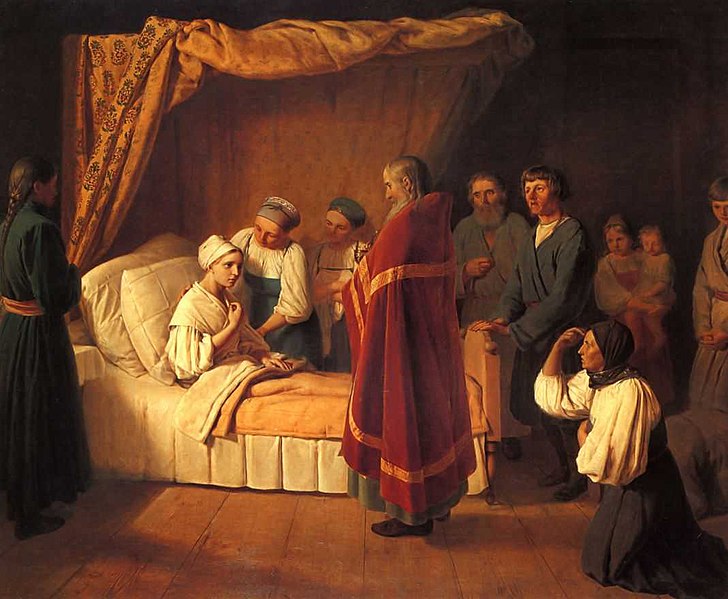
Twenty years ago, when I was a parish priest in Mindanao, one of our volunteer catechists came to me one Saturday afternoon and said, 'My father would like to receive the Bread of Life'. She told me that though he was gravely ill he was fully conscious and so I prepared to to hear his confession, celebrate the Sacrament of the Sick with him and to give him Holy communion.
On the way to the house I learned that the sick man had been married three times, having been widowed twice. When I arrived there were children from his three marriages and grandchildren from at least two. All who were present gathered around, except when I was hearing the man's confession. He was fully alert, knew he was near the end of his life and participated joyfully.
At the very end I asked some of the family to lay hands on him as we said a final prayer. However, the dying man turned this into something far more beautiful. He took one of his grandchildren, an infant only a few months old, and embraced it. Then he embraced each of his children and grandchildren in turn.
There was a tangible sense of joy about the house and afterwards the family served me a snack. This is not the usual practice when the priest makes a sick call.
The following morning, Sunday, the catechist came to tell me that her father had died during the night.
What really struck me was the fact that the dying man had asked for 'The Bread of Life'.
Today's feast, the Solemnity of Corpus Christ, is a celebration of the Body of Christ as the Bread of Life. I am the living bread that came down from heaven. Whoever eats of this bread will live forever; and the bread that I will give for the life of the world is my flesh. These words of Jesus caused many to walk away - because they understood what he was saying, but couldn't accept it. Others could and did.
Catholics believe, in the words of the Catechism of the Catholic Church (CCC) No 1374, In the most blessed sacrament of the Eucharist 'the body and blood, together with the soul and divinity, of our Lord Jesus Christ and, therefore, the whole Christ is truly, really, and substantially contained the Body and Blood, soul and divinity' of Christ'.

The CCC clearly states in No 1376 what the Church teaches: The Council of Trent summarizes the Catholic faith by declaring: 'Because Christ our Redeemer said that it was truly his body that he was offering under the species of bread, it has always been the conviction of the Church of God, and this holy Council now declares again, that by the consecration of the bread and wine there takes place a change of the whole substance of the bread into the substance of the body of Christ our Lord and of the whole substance of the wine into the substance of his blood. This change the holy Catholic Church has fittingly and properly called transubstantiation.'
The Catechism goes on to explain in Nos 1378 and 1379 two developments in the life of the Church: In the liturgy of the Mass we express our faith in the real presence of Christ under the species of bread and wine by, among other ways, genuflecting or bowing deeply as a sign of adoration of the Lord. 'The Catholic Church has always offered and still offers to the sacrament of the Eucharist the cult of adoration, not only during Mass, but also outside of it, reserving the consecrated hosts with the utmost care, exposing them to the solemn veneration of the faithful, and carrying them in procession.'
The tabernacle was first intended for the reservation of the Eucharist in a worthy place so that it could be brought to the sick and those absent outside of Mass. As faith in the real presence of Christ in his Eucharist deepened, the Church became conscious of the meaning of silent adoration of the Lord present under the Eucharistic species. It is for this reason that the tabernacle should be located in an especially worthy place in the church and should be constructed in such a way that it emphasizes and manifests the truth of the real presence of Christ in the Blessed Sacrament.
There is an intimacy and a real 'communion' between people when they are together in adoration before the Blessed Sacrament, whether they are just 'dropping in' to be in the presence of the Lord for a while or engaged in a more solemn form of adoration when the Blessed Sacrament is exposed, such as in the photo above taken in Mexico. And no matter where in the world we are, we are in the presence of the same Lord, Jesus Christ, Second Person of the Blessed Trinity, God who became Man.

I recall when I studied for a year in Toronto, Canada, in 1981-82 being inspired, when I used to visit a particular chapel of adoration, by the presence of university students, men and women, some spending long periods in prayer. I remember staying on a number of occasions in a home for children run by Sisters in Iriga City, in the Bicol Region of the Philippines, to see young boys and girls, all of them from a background of brokenness of one kind or another, praying in perfect silence before the Blessed Sacrament as they waited for Mass to begin.
So the Bread of Life is kept in the tabernacle of a church for two purposes: to enable the priest or an extraordinary minister of Holy Communion bring the Blessed Sacrament to someone who is sick and to allow people to adore Jesus Christ in the Blessed Sacrament.
It is customary for priests in parishes to bring Holy Communion to sick parishioners on the First Friday of each month. Pope Francis has spoken of the need for priests in particular to 'know the smell of the sheep'. When a priest brings Holy Communion to a sick person he often enough encounters the smell of illness, of poverty. And yet he is bringing the Saviour himself, the Bread of Life to someone who takes him at his word: I am the living bread that came down from heaven. Whoever eats of this bread will live forever; and the bread that I will give for the life of the world is my flesh.
Irish poet Seán Ó Liocháin captures something of this, of the journey of the Lord from the tabernacle to the home of a sick person, using whatever transport is available, in his poem An Chéad Aoine, 'The First Friday'. [The not very poetic English translation is mine.]
An Chéad Aoine The First Friday
le/by Seán Ó Liocháin
Nuair a tháinig an sagart
When the priest came
chuig m’athair inniu,
to my father today
mar a thagann de ghnáth
as he usually comes
i dtús na míosa,
at the start of the month
le lón na beatha
with the food of life
a thabhairt d’fhear t
to give to a man
nach bhfágann an chlúid
who’s been bed-ridden
in aon chor le tamall,
for some time now,
ní hé an gnás ab ait liom féin.
It wasn't the ritual that was strange to me.
me.
Ní hé ba mhó
What really
ba bhun le m’iontas
caused my wonder wasn't
fear dá chlú,
a man of such repute,
dá chleacht, dá éirim
of such experience, of such learning
ar cuairt na sean
visiting the old
i dtús na míosa
at the beginning of the month
le comhairle a leasa
with good counsel
a chur ar dhream
to give to those
nach bhfágfadh clúid na haithrí choíche,
who would never leave the cover of repentance again,
ach Críost a theacht
but Christ coming
i gcarr athláimhe
in a second-hand car
a cheannaigh an sagart
the priest bought
ó fhear i Ros Comáin.
from a man in Roscommon.
Ford Escort, European model (1974-80). [Wikipedia]
Antiphona ad introitum Entrance Antiphon Cf. Psalm 80:17
Cibavit eos ex adipe frumenti, [alleluia],
et de petra melle saturavit eos, [alleluia, alleluia, alleluia].
[Exultate Deo adiutori nostro: iubilate Deo Jacob.
Gloria Patri et Filio et Spiritu Sancto:
sicut erat in principio et nunc et semper. Amen.
Cibavit eos ex adipe frumenti, alleluia,
et de petra melle saturavit eos, alleluia, alleluia, alleluia].
He fed them with the finest wheat, [alleluia],
and satisfied them with honey from the rock, [alleluia, alleluia, alleluia].
[Sing joyfully to God our strength: acclaim the God of Jacob.
Glory to the Father, and to the Son, and to the Holy Spirit:
as it was in the beginning, is now, and will be for ever. Amen.]
The texts in [squared brackets] are from the fuller version of the Entrance Antiphon used in the Extraordinary Form of the Mass, ie, as in the Missal promulgated by Pope St John XXIII in 1962, an updating of the Missal used since the Council of Trent. In Summorum Pontificum, issued in 2007, Pope Benedict XVI encouraged the celebration of the 'Old Mass' or 'Tridentine Mass', using the term 'Extraordinary Form' for it and 'Ordinary Form' for the Mass as it has been widely celebrated since 1969.
A setting of the Entrance Antiphon by an anonymous composer.
From Sacrosanctum Concilium, Constitution on the Sacred Liturgy, proclaimed by Pope Paul VI during Vatican II:
116. The Church acknowledges Gregorian chant as specially suited to the Roman liturgy: therefore, other things being equal, it should be given pride of place in liturgical services.
But other kinds of sacred music, especially polyphony, are by no means excluded from liturgical celebrations, so long as they accord with the spirit of the liturgical action, as laid down in Art. 30.