Showing posts with label Mass. Show all posts

21 April 2015

George Clooney on how to celebrate Mass


Maybe the heading to this post is slightly misleading, since George Clooney is talking about his aunt, Rosemary Clooney, as a singer, not about the Mass. But what he says about her (0:21 - 0:33) is something that we priests can take to heart: She served the song probably better than any singer I’ve ever seen. At some point in her career she decided she didn’t have to show off as a singer and she would just serve the song. And that’s what she does.

When I was a child growing up in Aughrim Street Parish in Dublin, newly-ordained priests from Kimmage Manor would often say the later Masses on Sunday morning. People would say, One of the Holy Ghost Fathers (now known as 'The Spiritans') said the eleven o'clock Mass yesterday'. It didn't matter who he was or what his name was. What was important was that he had celebrated Mass. That's what mattered.

Each priest in those days had his own 'style', which he was probably not conscious of. Some tended to celebrate Mass quickly, some slowly. But every Mass was essentially the same and there were no 'surprises'. A young altar-boy in Scotland two years ago said to me, It's hard serving at Mass since each priest is so different. I don't think he was referring to anything weird or off-the-wall. But there is more room for 'surprises' in the Mass now than in the old days. And some of these can drive and have driven people away from the Church, and maybe even away from the Faith.

Rosemary Clooney surely serves the beautiful 1938 song by Sammy Fain (music) and Irving Kahal (lyrics), I'll Be Seeing You, in the video above, even though her voice wasn't as fresh or as supple as when she was younger. But she brings something of the experience of the difficult life that her nephew refers to in his introduction to her interpretation of the song, with only a pianist to accompany her. He in turn serves the singer and the song. Rosemary doesn't have to show off as a singer.

And neither do we priests have to show off when we celebrate the Holy Sacrifice of the Mass.


A much younger Rosemary Clooney (1928 - 2002) singing the same song, without its introduction, on a TV show in the 1950s. Clearly she had already decided that she didn’t have to show off as a singer and she would just serve the song.

26 April 2014

'My Lord and my God!' Sunday Reflections, 2nd Sunday of Easter Year A

Jusepe Martínez, c.1630, Szépmûvészeti Múzeum, Budapest [Web Gallery of Art]

Second Sunday of Easter (or of Divine Mercy) Year A

Readings (New American Bible: Philippines, USA)                                  

Readings (Jerusalem Bible: Australia, England & Wales, India [optional], Ireland, New Zealand, Pakistan, Scotland, South Africa)

  
When it was evening on that day, the first day of the week, and the doors of the house where the disciples had met were locked for fear of the Jews, Jesus came and stood among them and said, “Peace be with you.” After he said this, he showed them his hands and his side. Then the disciples rejoiced when they saw the Lord. Jesus said to them again, “Peace be with you. As the Father has sent me, so I send you.” When he had said this, he breathed on them and said to them, “Receive the Holy Spirit. If you forgive the sins of any, they are forgiven them; if you retain the sins of any, they are retained.”

But Thomas (who was called the Twin), one of the twelve, was not with them when Jesus came. So the other disciples told him, “We have seen the Lord.” But he said to them, “Unless I see the mark of the nails in his hands, and put my finger in the mark of the nails and my hand in his side, I will not believe.”

A week later his disciples were again in the house, and Thomas was with them. Although the doors were shut, Jesus came and stood among them and said, “Peace be with you.” Then he said to Thomas, “Put your finger here and see my hands. Reach out your hand and put it in my side. Do not doubt but believe.” Thomas answered him, “My Lord and my God!” Jesus said to him, “Have you believed because you have seen me? Blessed are those who have not seen and yet have come to believe.”

Now Jesus did many other signs in the presence of his disciples, which are not written in this book. But these are written so that you may come to believe that Jesus is the Messiah, the Son of God, and that through believing you may have life in his name.


We can read the words of Jesus to Thomas as a gentle rebuke that has led to the nickname he may carry for all eternity: 'Doubting Thomas'. But I prefer to see him as the one who understood that the Risen Lord must carry the scars of his crucifixion and who made the most explicit act of faith in the whole of Sacred Scripture: My Lord and my God!

The First Reading today (Ats 2:42-47) opens with the words They devoted themselves to the apostles’ teaching and fellowship, to the breaking of bread and the prayers. 'The breaking of the bread' is an expression used for the celebration of the Eucharist. We can see in this sentence the essence of the Mass as we celebrate it today: listening to God's word, praying and sharing in the Sacrifice of Jesus and sharing his Body and Blood.

Some commentators say that the failure of Thomas was not to listen to God's word as related by his companions. Maybe he did fail here but did the others have the same awareness as Thomas had that the Risen Lord must carry his scars for all eternity?

In Evangelii Gaudium No 7 Pope Francis writes: I never tire of repeating those words of Benedict XVI which take us to the very heart of the Gospel: 'Being a Christian is not the result of an ethical choice or a lofty idea, but the encounter with an event, a person, which gives life a new horizon and a decisive direction'.

Thomas had been a companion of Jesus for two to three years but what he experienced in today's gospel was precisely what Pope Benedict describes as the encounter with an event, a person, which gives life a new horizon and a decisive direction.


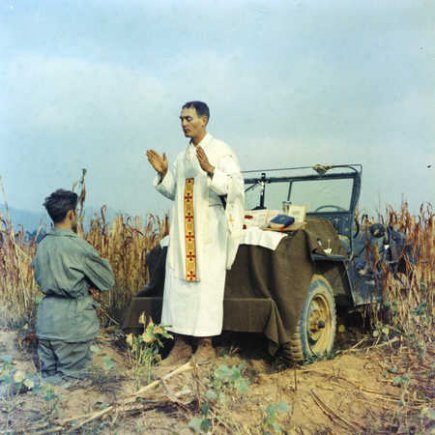
Servant of God, Fr Emil Joseph Kapaun (20 April 1916 - 23 May 1951)
Celebrating Mass with American soldiers during the Korean War [Wikipedia]

In his general audience in St Peter's Square on 31 October 2012 Pope Benedict said: I cannot build my personal faith in a private dialogue with Jesus, because faith is given to me by God through a community of believers that is the Church and projects me into the multitude of believers, into a kind of communion that is not only sociological but rooted in the eternal love of God who is in himself the communion of the Father and of the Son and of the Holy Spirit, it is Trinitarian Love. Our faith is truly personal, only if it is also communal: it can be my faith only if it dwells in and moves with the 'we' of the Church, only if it is our faith, the common faith of the one Church.

Pope Francis re-echoes this in Evangelii Gaudium Nos 264 - 268: We need to implore his grace daily, asking him to open our cold hearts and shake up our lukewarm and superficial existence . . . Sometimes we lose our enthusiasm for mission because we forget that the Gospel responds to our deepest needs, since we were created for what the Gospel offers us: friendship with Jesus and love of our brothers and sisters . . . The word of God also invites us to recognise that we are a people . . . Mission is at once a passion for Jesus and a passion for his people. When we stand before Jesus crucified, we see the depth of his love which exalts and sustains us, but at the same time, unless we are blind, we begin to realize that Jesus’ gaze, burning with love, expands to embrace all his people. We realize once more that he wants to make use of us to draw closer to his beloved people. He takes us from the midst of his people and he sends us to his people; without this sense of belonging we cannot understand our deepest identity.

What both Pope Benedict and Pope Francis are saying is that while our faith is in a person, Jesus Christ the Risen Lord, it can never be a question of 'Jesus and me'. Pope Benedict says, faith is given to me by God through a community of believers that is the Church and projects me into the multitude of believers and Pope Francis emphasises that He takes us from the midst of his people and he sends us to his people; without this sense of belonging we cannot understand our deepest identity.

In other words, I can only know myself as a brother or sister of Jesus, as a son or daughter of God the Father when I know myself as a member of their family, which I have become through my baptism.

And that awareness of who I am is strengthened when I join other members of God's family every Sunday as they devote themselves to the apostles’ teaching and fellowship, to the breaking of bread and the prayers.


British soldiers at Mass in the Netherlands during World War II. [Wikipedia]

Many Irish Columbans served as chaplains in the British Forces during World War II. One, Fr Patrick McMahon, died in action in Normandy, France, after rescuing a Canadian soldier on 14 August 1944.

In the Office of Readings, prayed by priests, monks, nuns and others as part of the Prayer of the Church, there are two readings. The first is from the Bible and the second usually from writers in the early centuries of the Church. On Thursday, Friday and Saturday of Easter Week the second reading is from Instructions to the Newly Baptized in Jerusalem also known as The Jerusalem Catechesis, written, as far as I know, by St Cyril of Jerusalem. The author says, Just as the bread of the Eucharist after the invocation of the Holy Spirit is no longer just bread, but the body of Christ, so when the Holy Spirit has been invoked on the holy chrism it is no longer mere or ordinary ointment; it is the gift of Christ, which through the presence of the Holy Spirit instils his divinity into us [Friday].


For the Saturday reading the author tells the newly-baptized: Do not, then, regard the bread and wine as nothing but bread and wine, for they are the body and blood of Christ as the master himself has proclaimed. Though your senses suggest otherwise, let faith reassure you. You have been taught and fully instructed that what seems to be bread is not bread, though it appears to be such to the sense of taste, but the body of Christ; that what seems to be wine is not wine, though the taste would have it so, but the blood of Christ


When I celebrate Mass with the Deaf here in Bacolod City, a group whose needs the late Columban Fr Joseph Coyle was the first priest to respond to and whose vision is being carried on now by many others, both Deaf and hearing, after the consecration of the bread and again of the wine, I hear from speaking people who are present the words of St Thomas, My Lord and my God. Just like St Thomas, they recognise the presence of the Risen Lord in the bread and the winde that have no become his Body and Blood.


Fr Emil Kapaun and Fr Patrick McMahon recognised the presence of Jesus in the bread and wine that became the Body and Blood of Christ each time they celebrated the Holy Sacrifice of the Mass. They also recognised the presence of Jesus in the wounds of the soldiers they tended and in whose service they sacrificed their lives - following the example of St Thomas who, according to tradition, was martyred in India.


+++

Regina caeli is sung during the Easter Season at the end of the Church's Night Prayer (Compline).

 Velásquez, 1645, Museo del Prado, Madrid [Web Gallery of Art]


Regina cæli, lætare, alleluia:
R. Quia quem meruisti portare, alleluia,
Resurrexit, sicut dixit, alleluia,
R. Ora pro nobis Deum, alleluia.
Gaude et lætare, Virgo Maria, alleluia.
R. Quia surrexit Dominus vere, alleluia.
Oremus.
Deus, qui per resurrectionem Filii tui, Domini nostri Iesu Christi,
mundum lætificare dignatus es:
præsta, quæsumus, ut per eius Genitricem Virginem Mariam,
perpetuæ capiamus gaudia vitæ.
Per eundem Christum Dominum nostrum. R. Amen.
Queen of Heaven, rejoice, alleluia.
The Son whom you merited to bear, alleluia.
Has risen, as He said, alleluia.
Pray for us to God, alleluia.
V. Rejoice and be glad, O Virgin Mary, alleluia.
R. For the Lord has truly risen, alleluia.
Let us pray.
O God, who through the resurrection of your Son Jesus Christ
gave rejoicing to the world,
grant, we pray, that through his Mother, the Virgin Mary,
we may obtain the joy of everlasting life.
Through Christ our Lord. Amen.


Our new saints

St John XIII, Angelo Giuseppe Roncalli (25 November 1881 - 3 June 1963)

St John Paul II, Karol Józef Wojtyła [2004] (18 May 1920 - 2 April 2005)

Photos from Wikipedia.


07 May 2013

An Emmaus experience in Dublin


This morning after Mass two men, both in their 60s, came to see me in the sacristy. I'll call them Luke and Mark. Luke knows my brother and introduced himself as such before introducing me to Mark, who had once been a professional footballer. Luke told me that they had come to know each other through their common widowerhood.

Luke also told me that he had been away from the Church for more than 20 years but decided to go to Mass on Ash Wednesday this year. Afterwards Mark said to him, 'Welcome back!' Luke didn't quite understand at first that Mark was aware that he'd been away from the sacraments for a long time and he was welcoming him back to the Catholic Christian community.

Since then Luke has been going to Mass every day, as does Mark, and his joy was evident.

It was through welcoming Jesus to join them on the road to Emmaus and later to supper when they arrived there that the two disciples came to recognise the Risen Lord. I don't know what prompted Luke to go to Mass on Ash Wednesday but the welcome he received from Mark has led him to throw in his lot again with the Church.

I've been home in Dublin only a few days. There are many things in contemporary Ireland that discourage me but the Road to Emmaus is still there and individuals walking on it are still helping others to discover or re-discover the Lord by the simple act of welcoming them.

25 December 2012

A Midnight Mass during the Great War in 1916

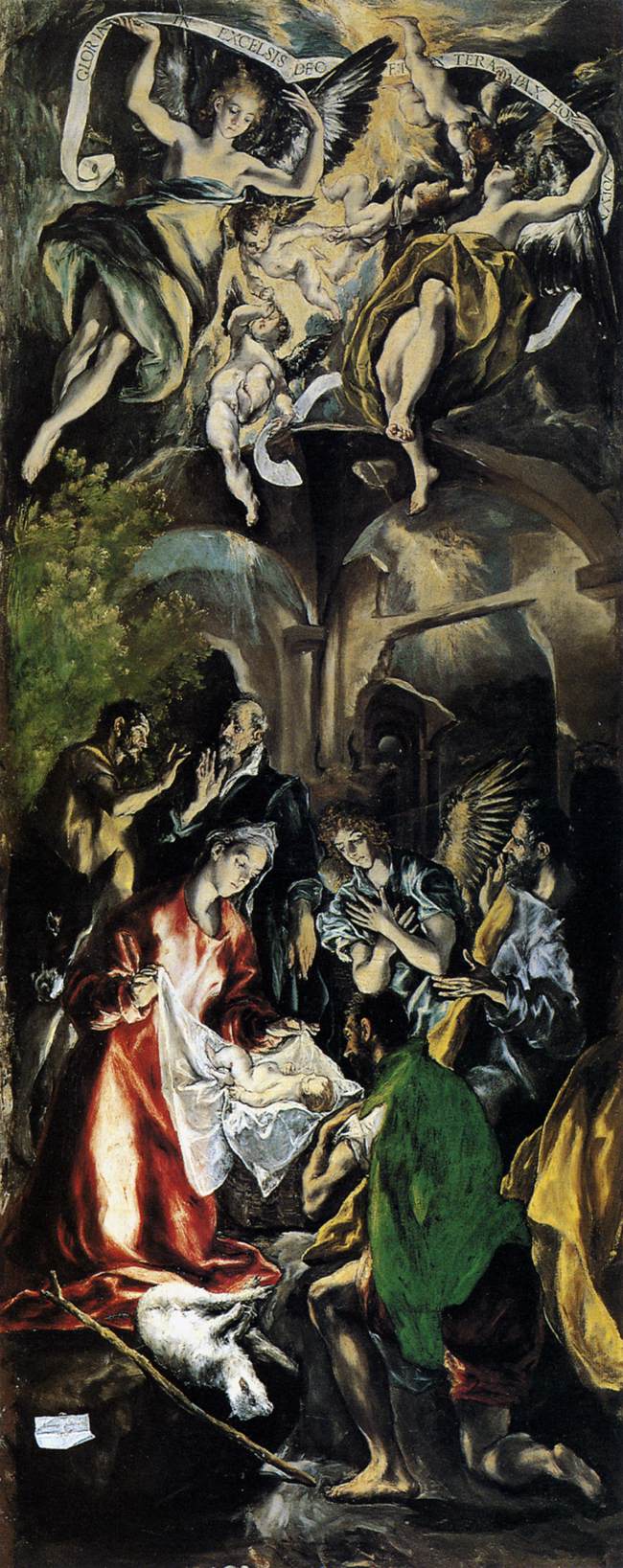
Adoration of the Shepherds, El Greco, painted 1596-1600 (Web Gallery of Art)

Fr William Doyle SJ (3 March 1873 - 16 August 1917)

Remembering Fr William Doyle SJ is an inspiring blog worth exploring. My kindergarten principal in Stanhope St, Dublin, Sr Margaret Stanislaus, was for ever talking to us about two priests, Fr Damien de Veuster SsCc, a Belgian, now St Damien of Molokai, and Fr Willie Doyle SJ, a Dubliner who died in Belgium during the Great War (1914-1918).

The posts in the blog usually feature an extract from writings of Father Doyle, very often letters he wrote from the trenches, or from Father William Doyle SJ by Professor Alfred O'Rahilly, who later became a priest.


Here are extracts from yesterday's post describing Father Willie's last Christmas on earth.

Christmas itself Fr. Doyle had the good luck of spending in billets. He got permission from General Hickie to have Midnight Mass for his men in the Convent. The chapel was a fine large one, as in pre-war times over three hundred boarders and orphans were resident in the Convent; and by opening folding-doors the refectory was added to the chapel and thus doubled the available room. An hour before Mass every inch of space was filled, even inside the altar rails and in the corridor, while numbers had to remain in the open. Word had in fact gone round about the Mass, and men from other battalions came to hear it, some having walked several miles from another village. Before the Mass there was strenuous Confession-work. “We were kept hard at work hearing confessions all the evening till nine o’clock” writes Fr. Doyle, “the sort of Confessions you would like, the real serious business, no nonsense and no trimmings. As I was leaving the village church, a big soldier stopped me to know, like our Gardiner Street friend, ‘if the Fathers would be sittin’ any more that night.’  He was soon polished off, poor chap, and then insisted on escorting me home. He was one of my old boys, and having had a couple of glasses of beer — ‘It wouldn’t scratch the back of your throat, Father, that French stuff’ — was in the mood to be complimentary . . . 

I reached the Convent a bit tired, intending to have a rest before Mass, but found a string of the boys awaiting my arrival, determined that they at least would not be left out in the cold. I was kept hard at it hearing Confessions till the stroke of twelve and seldom had a more fruitful or consoling couple of hours’ work, the love of the little Babe of Bethlehem softening hearts which all the terrors of war had failed to touch.”

Father Doyle described his experience:

“I sang the Mass, the girls’ choir doing the needful. One of the Tommies, from Dolphin’s Barn, sang the Adeste beautifully with just a touch of the sweet Dublin accent to remind us of home, sweet home, the whole congregation joining in the chorus. It was a curious contrast: the chapel packed with men and officers, almost strangely quiet and reverent (the nuns were particularly struck by this), praying and singing most devoutly, while the big tears ran down many a rough cheek: outside the cannon boomed and the machine-guns spat out a hail of lead: peace and good will — hatred and bloodshed!
“It was a Midnight Mass none of us will ever forget. A good 500 men came to Holy Communion, so that I was more than rewarded for my work.”
What comes through is Father Willie's great zeal, especially for the sacrament of confession, and his love for the men he served, with a strong flavour of a sense of humour that shows an understanding of human nature, especially in the midst of danger.
Yesterday I featured the Christmas Truce along parts of the Western Front in 1914. I found this extract from a French movie inspired by that in which a German soldier walks across No Man's Land singing Adeste Fideles. I can't remember not knowing this great Christmas hymn and have always preferred the original Latin. Father Willie was clearly touched by hearing the Adeste sung by a 'Tommy' (the generic nickname for the ordinary soldier in the British army) with just the touch of the sweet Dublin accent. (Not too many, including Dubliners themselves, of which I'm proudly one, would describe what we call the real Dublin accent as 'sweet'! Father Willie himself, being from a middle-class family, would have had a somewhat different Dublin accent). Perhaps Father Willie was unwittingly expressing his loneliness being far away from home and caught up in the horror of war.  
The subtitles in this video are Korean. That, and the fact that a Mexican singer, Rolando Villazón, now a French citizen, plays a German soldier singing a Christmas hymn in Latin, one known to soldiers on both sides of that awful war, symbolises the truth in the last line of the song Christmas in the Trenches, 'And on each end of the rifle we're the same'.
(With Father Willie's gentle sense of understanding of the Irish soldier with the couple of glasses of beer, that French stuff that wouldn't scratch the back of your throat, we can forgive the singer's mispronunciation of 'adoremus', which he pronounces 'adoramus'!)

I'm not sure if Father Willie was familiar with this traditional carol in Irish Gaelic, Don Oíche Úd i mBeithil, To That Night in Bethlehen.

22 August 2012

'Do you also wish to go away?' Sunday Reflections, 21st Sunday in Ordinary Time Year B

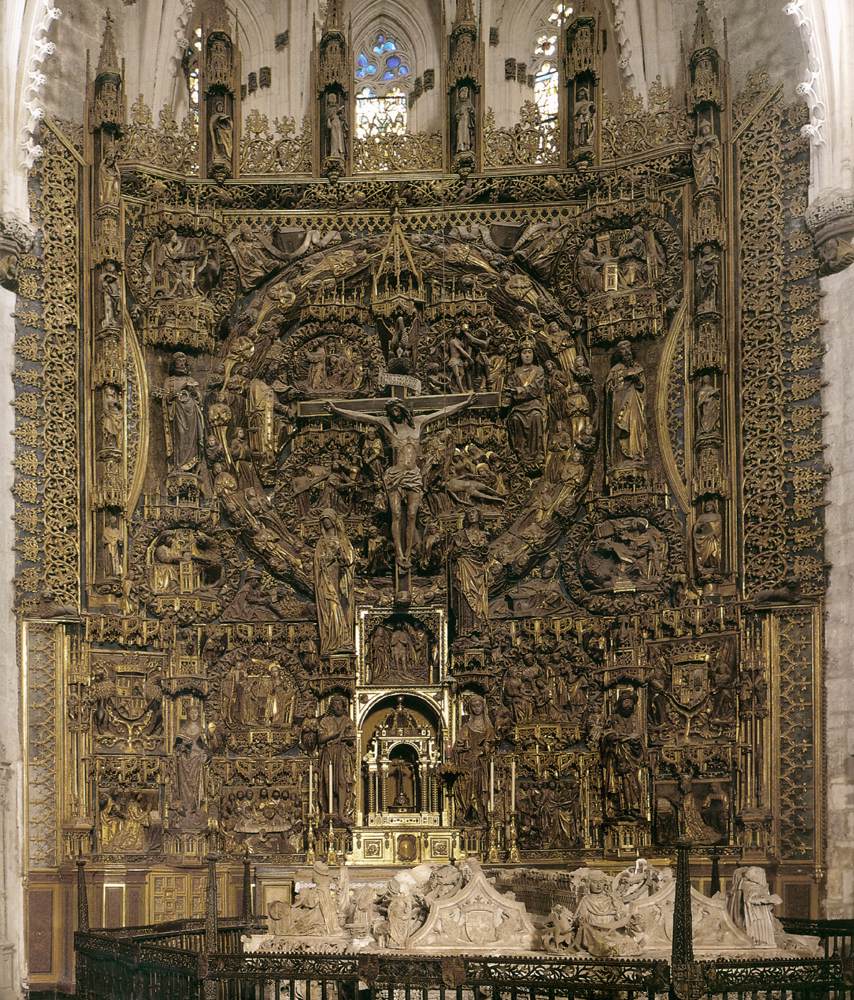
Main Altar, Monastery of Miraflores, Burgos, Gil de Siloé (1496-99)


Readings (New American Bible: Philippines, USA) 

Readings (Jerusalem Bible: Australia, England & Wales, India [optional], Ireland, New Zealand, Pakistan, Scotland, South Africa) 

Gospel John 6:60-69 (Revised Standard Version – Catholic Edition)

Many of the disciples of Jesus, when they heard it, said, "This is a hard saying; who can listen to it?" But Jesus, knowing in himself that his disciples murmured at it, said to them, "Do you take offense at this? Then what if you were to see the Son of man ascending where he was before? It is the spirit that gives life, the flesh is of no avail; the words that I have spoken to you are spirit and life. But there are some of you that do not believe." For Jesus knew from the first who those were that did not believe, and who it was that would betray him. And he said, "This is why I told you that no one can come to me unless it is granted him by the Father." After this many of his disciples drew back and no longer went about with him. Jesus said to the twelve, "Do you also wish to go away?" Simon Peter answered him, "Lord, to whom shall we go? You have the words of eternal life; and we have believed, and have come to know, that you are the Holy One of God." 


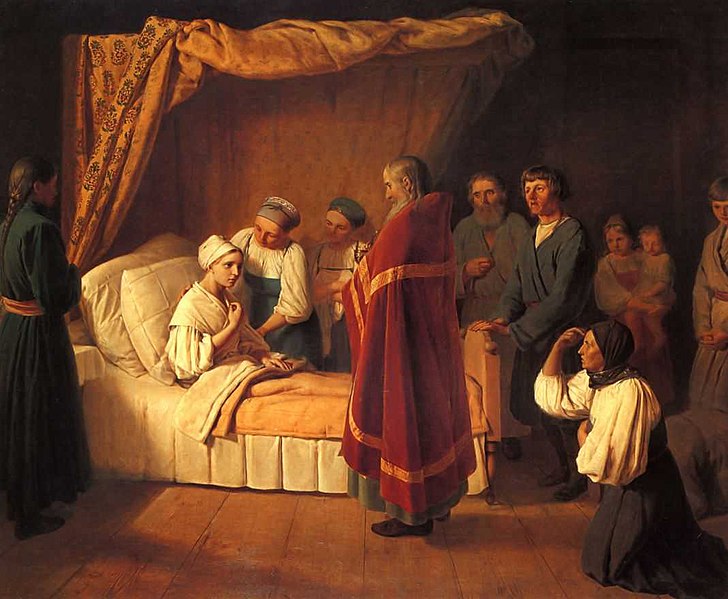
Alexey Venetsianov, 19th century

Some time before Easter 1993 when I was in the relatively remote parish of Lianga, Surigao del Sur, on the east coast of Mindanao, one of our volunteer catechists came on a Saturday afternoon to tell me that her father was asking for the Bread of Life. She told me he was fully conscious. I went immediately to the house, heard his confession, gave him the Sacrament of the Sick and Holy Communion in the presence of his family. The man himself participated fully and joyfully.

I discovered that his family was somewhat unusual. He had been widowed twice and married three times. There were children from his three marriages there, some with their children, including a babe in arms.

At the end of the celebration of the three sacraments I asked those who were closest to the sick person to lay hands on him so that we could continue with our own prayer over him. But he turned this into something far more beautiful. He took his youngest grandchild to his breast and embraced him before embracing each of his family who were present. It was an occasion where the joy was tangible.

It is not usual in the Philippines to offer the priest something to eat when he goes on a sick call. But on this occasion the family did and it was fitting.

Next morning, before Sunday Mass, the catechist came to tell me that her father had just died. along with her sadness she felt greatly consoled because her father had received the Bread of Life as his last meal before he died.

During these last five Sundays the Church has been proclaiming Chapter Six of St John's Gospel when Jesus teaches us very clearly that he is the Bread of Life. The Church has always understood that each time we celebrate the Eucharist the bread and wine, through the power of the Holy Spirit working in the priest, who is called to be an alter Christus, another Christ, become the Body and Blood of Christ. As the Catechism of the Catholic Church No 1374 teaches, In the most blessed sacrament of the Eucharist 'the body and blood, together with the soul and divinity, of our Lord Jesus Christ and, therefore, the whole Christ is truly, really, and substantially contained'.

There were many listening to Jesus who couldn't accept his teaching. This is a hard saying; who can listen to it? many asked. They walked away, probably in good faith. But when Jesus asked the twelve, Do you also wish to go away? Peter answered on behalf of the group, Lord, to whom shall we go? You have the words of eternal life; and we have believed, and have come to know, that you are the Holy One of God.

Our faith is pure gift from God, not a reward for 'being good'. It is a gift that a person may lose. It is a gift that a whole community may lose. It would seem that in the last few decades that gift has been lost by many in the Western world, places such as Ireland, Belgium, the Netherlands, Quebec, all of them sending missionaries to the ends of the earth until recently and now with their seminaries empty and their churches bereft of young people on Sundays.

Our faith, especially our faith in the Eucharist, is something we must thank God for each day.  In my Reflections for the 15th Sunday I featured a video of an 87-year-old priest, Fr Ralph Beiting, preaching on a street last summer in Kentucky. I learned only last Sunday that Father Beiting died after a short illness on 9 August. On the website of the Father Beiting Appalachian Mission Center there is a recording of him saying, It’s not been an easy road. It’s been for a little  hardship, headaches, anxieties and the desire to quit. But the joy has been overwhelming, to be able to say Mass every day in these hills and offer it up for the good and benefit of its people. That gives me power that I never have any other way.

Father Beiting made his own the choice his bishop made for him more than 60 years ago when he assigned the young priest to an area as big as the state of Rhode Island in eastern Kentucky, an area where there was widespread poverty among both black and white people, an area where there were only a handful of Catholics, an area where there was great ignorance about Catholics. Father Beiting once told me that when he built the church in Mount Vernon, where I served during Holy Week and Easter Week in 1970, he deliberately had clear windows from the ground up so that people could see that Catholics didn't sacrifice children, that they didn't have cloven hooves. I think that those days have long gone, largely because of the daily choices Father Beiting made to be a faithful priest, working for all the people, working so that each family could put bread on the table each day, working so that the Catholics could receive the Bread of Life every Sunday, working so that others might see the truth of the Catholic faith.

The first reading today is about making a choice for God. Jesus asks each of us directly to make a choice: Do you also wish to go away? My parishioner in an out of the way place in the Philippines knew the choice he should make before he died: to ask for the Bread of Life.


Communio

Qui manducat carnem meam

et bibit sanguinem meum
in me maneat, et eo in ego, dicit Dominus.

Communion Antiphon  Cf John 6:54

Whoever eats my flesh and drinks my blood
has eternal life, says the Lord,
and I will raise him up on the last day.

20 August 2012

'To be able to say Mass every day . . . gives me power that I never have any other way': Fr Ralph W. Beiting RIP

Monsignor Ralph W. Beiting (1 January 1924 - 9 August 2012)

On 16 July I posted Fr Ralph Beiting, an outstanding priest. Four days before that I had featured in Sunday Reflections a video of him street-preaching last summer, something he had been doing for years.

I learned yesterday from a friend in Chicago of Father Beiting's death on 9 August after a brief illness.

On the home page of the website of Father Beiting Appalachian Mission Center you can hear his voice: It’s not been an easy road. It’s been for a little  hardship, headaches, anxieties and the desire to quit. But the joy has been overwhelming, to be able to say Mass every day in these hills and offer it up for the good and benefit of its people. That gives me power that I never have any other way.

This short video of Father Beiting preaching last summer, aged 87, shows the kind of priest he was. It also expresses an awareness of his own mortality. 


I worked with Father Beiting on four occasions as a young priest when, a greenhorn from Ireland, I was studying near New York City. I wrote about that on my post on 16 July. I remember him very much as a 'man's man'. He loved his street-preaching missions accompanied by seminarians. I recall that a favourite song of his was Stouthearted Men. Like the character Charles Vizier in New Moon he had the ability to inspire young people, men and women, to give themselves generously in the service of others.


When Father Beiting started his ministry in Easter Kentucky more than 60 years ago there were very few Catholics and quite a bit of anti-Catholic sentiment. Yet the people, part of the 'American Bible-belt' were deeply religious. Father Beiting had great respect for them, one of the reasons he began his street-preaching, an old Protestant tradition that was beginning to die out. On one occasion he was driven out of a town at gunpoint but appeared again the following day, though not to preach. He preached the basics of the Creed that most Christians subscribe to.

He had  a love too for the popular hymns of the people he served. One of these was The Old Rugged Cross, written by George Bennard, a Methodist evangelist. Here it is sung by Johnny Cash, another 'man's man' and a singer whom I have discovered is a favourite of men and women from very diverse backgrounds.


May our loving and merciful God grant to this stouthearted priest, who joyfully and generously clung to the old rugged cross for so many years, the crown for which he hoped to exchange it some day

17 August 2012

'The strength that empowered me was the Eucharist.' Sunday Reflections, 20th Sunday in Ordinary Time Year B

Sandhill Mass Rock ('Carraig an Aifrinn', in Irish), County Donegal, Ireland.

During the 17th century, when Catholics in Ireland were persecuted, Mass was often celebrated in remote places, with a Mass rock as the altar.

Readings (New American Bible: Philippines, USA) 

Readings (Jerusalem Bible: Australia, England & Wales, India [optional], Ireland, New Zealand, Pakistan, Scotland, South Africa) 

Gospel John 6:51-58 (Revised Standard Version – Catholic Edition)

Jesus said to the crowds: “I am the living bread which came down from heaven; if any one eats of this bread, he will live for ever; and the bread which I shall give for the life of the world is my flesh." The Jews then disputed among themselves, saying, "How can this man give us his flesh to eat?" So Jesus said to them, "Truly, truly, I say to you, unless you eat the flesh of the Son of man and drink his blood, you have no life in you; he who eats my flesh and drinks my blood has eternal life, and I will raise him up at the last day. For my flesh is food indeed, and my blood is drink indeed. He who eats my flesh and drinks my blood abides in me, and I in him. As the living Father sent me, and I live because of the Father, so he who eats me will live because of me. This is the bread which came down from heaven, not such as the fathers ate and died; he who eats this bread will live for ever." 


The Holy Sacrifice of the Mass has been central to the lives of Catholic Christians from the very beginning. The Catechism of the Catholic Church, in Article 3, The Sacrament of the Eucharist, No 1382 says The Mass is at the same time, and inseparably, the sacrificial memorial in which the sacrifice of the cross is perpetuated and the sacred banquet of communion with the Lord's body and blood. But the celebration of the Eucharistic sacrifice is wholly directed toward the intimate union of the faithful with Christ through communion. To receive communion is to receive Christ himself who has offered himself for us.

Mass stone, Scotland

Some are called to share in the sacrifice in a very real way. In the video above there is a scene of a priest in mid-17th century Ireland celebrating Mass on a Mass rock. In Scotland these were known as Mass stones.

A Mass in the trenches during the Great War (1914-18)


Fr William Doyle SJ (3 March 1873 - 16 August 1917)

In a letter to his father in Dublin Father William Doyle SJ, a chaplain with the British Army in Belgium wrote about one of the last times he celebrated the Holy Sacrifice of the Mass. He himself was killed by a German shell on 16 August 1917.

Close beside us I had found the remains of a dug-out which had been blown in the previous day and three men killed. I made up my mind to offer up Mass there for the repose of their souls. In any case I did not know a better hole to go to, and to this little act of charity I attribute the saving of my life later on in the day. I had barely fitted up my altar when a couple of shells burst overhead, sending the clay tumbling down. For a moment I felt very tempted not to continue as the place was far from safe. But later I was glad I went on for the Holy Souls certainly came to my aid as I did to theirs.


Death at the end of Mass in China


In his book The Laughter and the Weeping Columban Fr Luke O'Reilly describes the last Mass of Fr Timothy Leonard (photo above), the first Columban to die violently. Father time was ordained for the Diocese of Limerick in 1918 and immediately joined the newly established Society of St Columban. He was a member of the first group of Columbans to go to China in 1920.

(Fr) Tim Leonard, the first Columban martyr, was killed by the communists in July 1929. He was pastor of Nanfeng, about 30 miles from Nancheng. the communist guerrillas had made a raid on the town and his information seemed to have been that they had left at dawn on this particular day in July (17 July). He decided to ring the bell to inform that people that morning Mass would take pace as usual. The bell attracted the attention of some of the communist stragglers and they decided to fire shots through a window into the church. (Father) Mick Moran, who was a curate (assistant priest) in the Nanfeng area at the time, told me afterwards that Mao Tse Tung (Mao Zedong) was in the party who fired the shots that July morning. Anyhow, some of the party entered the church, around the time of Communion, presumably, because they scattered the Sacred Hosts on the floor and Tim Leonard tried to prevent them physically from desecrating the Blessed Sacrament. the communists stabbed him and took him away and we do not know how long he lived but it does seem that they hacked him to death. The Nanfeng Catholics regarded Tim Leonard as a martyr.

A Mass in Belsen Concentration Camp


Memorial Stone at Bergen-Belsen Concentration Camp, Germany

Retired Northern Ireland politician James Molyneaux, now Lord Molyneaux, was among the British soldiers who liberated Bergen-Belsen concentration camp in May 1945. He wrote about this in The Daily Telegraph (London) on 27 January 2004. I have seldom read a more powerful testimony to the centrality of the Mass in our lives than what he wrote:

The most moving experience came on the second morning as I was walking from what had been the luxury SS barracks which our troops had transformed into a hospital. My attention was drawn to two packing cases covered by a worn red curtain. A young Polish priest was clinging to this makeshift altar with one hand, while celebrating Mass. Between his feet lay the body of another priest who probably died during the night. No one had had the energy to move the body.

I had no difficulty in following the old Latin Mass, having been educated at St James's Roman Catholic School in County Antrim, and, although an Anglican, I had gained a working knowledge of all the rituals. Still supporting himself against the altar, the young priest did his best to distribute the consecrated elements. Some recipients were able to stumble over the rough, scrubby heathland. Others crawled forward to receive the tokens and then crawled back to share them with others unable to move. Some almost certainly passed on to another - probably better - world before sunset. Whatever one's race or religion one can only be uplifted and impressed by that truly remarkable proof of the ultimate triumph of good over evil

As an Anglican James Molyneaux has a different understanding of 'the consecrated elements' than Catholics have. We believe that the bread and wine become the Body and Blood of Christ. But his deep reverence for what he saw - prisoners who had been starved sharing the Body of Christ with one another - is very evident.

Celebrating Mass in a Vietnamese Prison
'The strength that empowered me was the Eucharist'


In Preaching Hope from Prison François-Xavier Cardinal Nguyên Van Thuán, Coadjutor Archbishop of Thành-Phô Hô Chí Minh (formerly Saigon), writes about celebrating Mass in prison:

The day I was arrested I had to leave everything behind me. The following day I was allowed to write and ask my friends to bring my clothes, toothpaste and other personal needs. I also asked them to include some wine ‘as medicine.’ My friends understood. They sent me a little bottle of Mass-wine labeled ‘Medicine for Stomach Aches’ and also some hosts hidden in a little burner used to keep the humidity at bay.


Every night I kept a tiny piece of bread for the following day’s Eucharist. And so every day for many years I had the joy of celebrating Mass with three drops of wine and one of water in my palm. This was my altar, my cathedral. For me it was the true medicine of body and soul something to stave off death in order to live for ever in Christ.

A Joyful Celebration of Mass Amidst Drug Wars in Mexico

Fr Kevin Mullins is an Australian Columban who is parish priest of our only parish in Mexico, in Ciudad Juarez, just over the border from El Paso, Texas, USA, where the Columbans also work. Father Kevin was featured recently on the news in Australia.


For my flesh is food indeed, and my blood is drink indeed. He who eats my flesh and drinks my blood abides in me, and I in him.