Readings (New American Bible: Philippines, USA)
Readings (Jerusalem Bible: Australia, England & Wales, India [optional],
Ireland, New Zealand, Pakistan, Scotland, South Africa)
No one has ascended into heaven except the one
who descended from heaven, the Son of Man. And just as Moses lifted up the serpent
in the wilderness, so must the Son of Man be lifted up, that whoever believes in him
may have eternal life.
“For God so
loved the world that he gave his only Son, so that everyone who believes in him
may not perish but may have eternal life.
“Indeed, God did not send the Son into the world
to condemn the world, but in order that the world might be saved through him.

The Catholic Bishops' Conference of the Philippines has designated the Feast of the Exaltation of the Holy Cross this year as National Day of Prayer for Peace in Iraq and Syria. Archbishop Socrates B. Villegas of Lingayen-Dagupan, President of the CBCP, wrote to his fellow bishops: In all our Masses on the feast of the Holy Cross, let us unite ourselves with our suffering brothers and sisters, commending to the God who is our hope their pains, their shattered lives and dreams, their bereavement and their loss. He also asked for a special collection at all Masses, the money to be sent by the CBCP to the charity aid of the Apostolic Nunciatures in Iraq and Syria.
Fr Ragheed Aziz Ganni
(20 January 1972 - 3 June 2007)
For me the face of the suffering Christians in Iraq and Syria, Catholic and Orthodox, is that of Fr Ragheed Ganni. This article by Ed West published in the Catholic Herald, a weekly in England, on 20 December 2013 and that has a very personal dimension, gives as good an account of Father Ragheed as any I've read.
Ed West writes: Fr Ragheed was one of 1,000 Iraqi Christians murdered during the pogrom that began after the Coalition invasion of 2003. The persecution culminated in October 31 2010, with the massacre of 52 worshippers at a Catholic church in Baghdad. In the words of one Chaldean bishop, this is a 'Calvary' that has largely been ignored in the western media, outside of the Christian press . . .
It has been a shocking and horrific ordeal for one of the world’s oldest Christian communities, which has been all but driven out of its homeland. A pre-war population of a million is now somewhere in the region of 150,000, many of them elderly, and more than 60 churches have been bombed. That figure has got smaller in recent months and the ancient city of Mosul, in many ways the heart of the Christian faith in Iraq and Syria, has been emptied of its Christians by ISIS.
The article describes First Holy Communion day in Father Ragheed's parish in 2006: The atmosphere in Ragheed’s home town had become terrifying. On 4 August 2006, when 80 children of his parish of the Holy Spirit received their first Holy Communion, battles broke out in the street outside, and the children cowered from the sounds of guns and rockets.
The good shepherd helped them through. He told AsiaNews: 'Although people are used to it and remained reasonably calm, they started to wonder whether they were going to make it back to their homes or not. I was aware of the immense joy of the 80 children receiving their first Communion so I turned the subject into a joke and said to them: "Do not panic, these are fireworks. The city is celebrating with us." And at the same time I gave them instructions to leave the church quietly and quickly.'
The author further notes: Friends later recalled that he had become increasingly weary and broken by the demands of the priesthood amid such terror. After an attack on his parish, on Palm Sunday 2007, he wrote: 'We empathise with Christ, who entered Jerusalem in full knowledge that the consequence of His love for mankind was the cross. Thus while bullets smashed our church windows, we offered up our suffering as a sign of love for Christ.'
Shortly before his death Fr Ganni wrote in an email: 'Each day we wait for the decisive attack, but we will not stop celebrating Mass; we will do it underground, where we are safer. I am encouraged in this decision by the strength of my parishioners. This is war, real war, but we hope to carry our cross to the very end with the help of Divine Grace.'
This young Iraqi priest of the Chaldean Catholic Church, an engineer by profession, was murdered on Trinity Sunday, 3 June 2007, along with three subdeacons, Basman Yousef Daud, Gassan Isam Bidawed and Wahid Hanna Isho after he had celebrated Mass in Mosul, the city of his birth.
At a Eucharistic Congress in Bari, Italy, in 2005 Father Ragheed said, There are days when I feel frail and full of fear. But when, holding the Eucharist, I say ‘Behold the Lamb of God Behold, who takes away the sin of the world’, I feel His strength in me. When I hold the Host in my hands, it is really He who is holding me and all of us, challenging the terrorists and keeping us united in His boundless love. He also said, Without Sunday, without the Eucharist, the Christians in Iraq cannot survive.
To put some time perspective on the Christian faith in Iraq and Syria: in 2021 the Church in the Philippines will celebrate 500 years of the Catholic Christian faith in this country, a great occasion for thanking God for that precious gift. The Christian faith has been lived in Iraq and Syria for four times as long as that, since the time of the Apostles. Mass was celebrated for 2,000 years in Mosul until a couple of months ago when Christians were driven from their ancestral homeland by ISIS.
Father Raqheed's words, But when, holding the Eucharist, I say ‘Behold the Lamb of God Behold, who takes away the sin of the world’, I feel His strength in me, reflect the words of Jesus to Nicodemus in today's Gospel: And just as Moses lifted up the serpent in the
wilderness, so must the Son of Man be lifted up, that
whoever believes in him may have eternal life.
A Muslim friend of Fr Ragheed, Adnam Mokrani, professor of Islamic Studies at the Pontifical Gregorian University in Rome, said that on his ordination day, 13 October 2001, recalled that the new priest said, Today, I have died to self. St Paul in today's Second Reading tells us, Christ Jesus, who, though he was in the form of God did not regard equality with God has something to be exploited, but emptied himself, taking the form of a slave and that he became obedient to the point of death—even death on a cross.
As we celebrate the Exaltation of the Holy Cross and as we pray for persecuted Christians, particularly in Iraq and Syria, may we thank God for the gift of our Christian faith and ask him for the courage to live it as Father Ragheed and countless others have done, becoming obedient to the point of death.
From what I understand, this hymn to Our Blessed Mother in Arabic is sung by Father Ragheed and was played during his funeral procession. This is the translation given with the video: We honor you with hymns O Mother of God, you are the pride of the whole earth, because the Word of God whom the Father sent, chose to take His human body from you. The generations call you blessed, all nations and people's honor you and ask for mercy by your prayers. You are a generous earth in which plants of joy always grow.
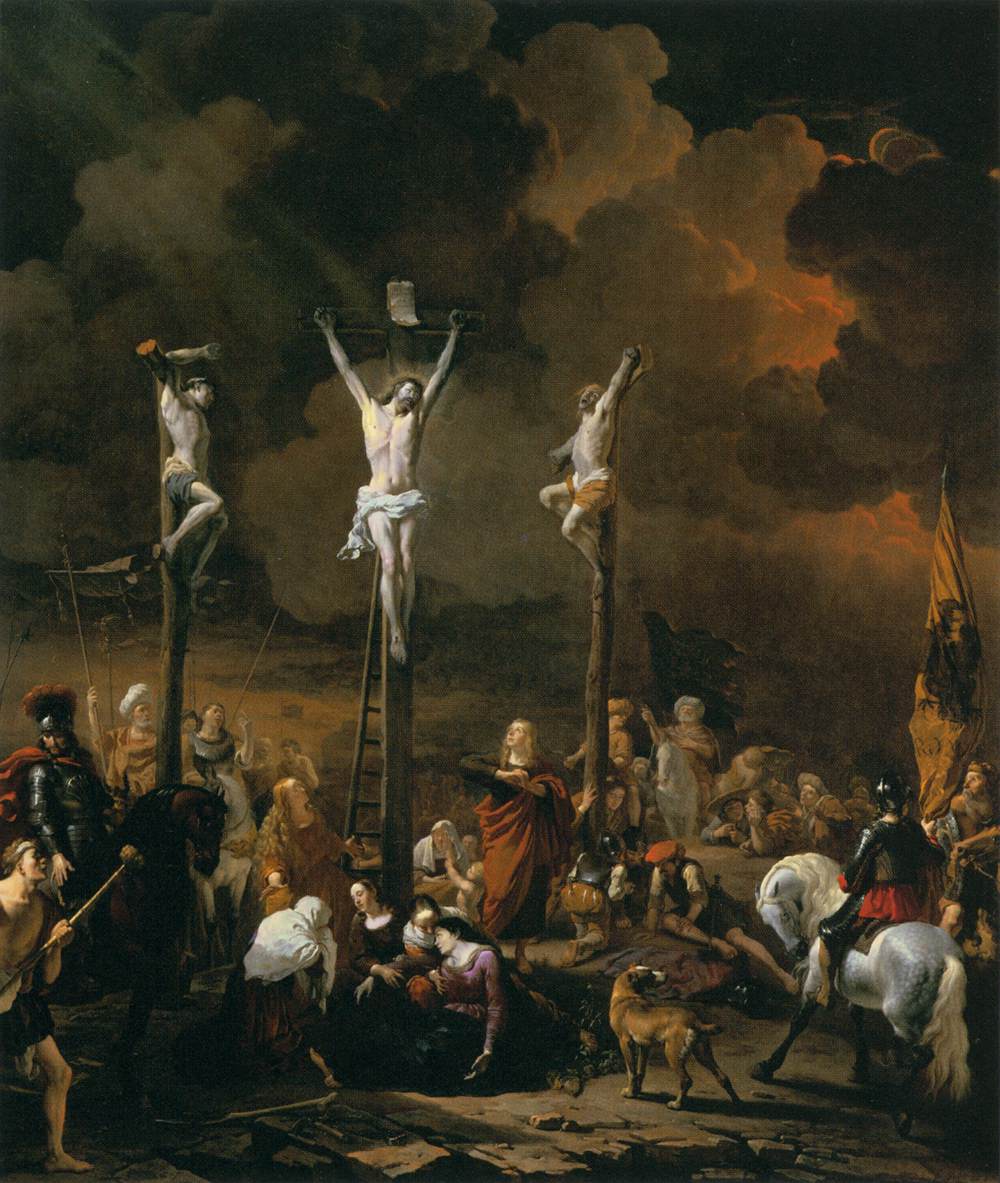
Calvaire
Calvary
le/by Pádraig
Ó Croiligh
Ag barr
na gcéimeanna
In
Eaglais an tSlánaitheora
Tá
séipéal tógtha ar rian na croise.
An dara
stáisiún déag dearaithe ar a chúl
Agus
poll sa talamh faoi
San áit
a mbíodh an chrois
Ag an
am ar tharla an crith talún.
Ach níl
an tarlú féin ná an duine
I
láthair anseo anois,
Ach in
áiteanna brúite buartha
Ár fud
na cruinne
Agus i láthair
an uaignis.
An fear
a fuair bás anseo,
Den
bhás a rinneadh anseo,
Tá sé
beo agus aiséirithe.
Tá Íosa
ina Chríost go fóill!
At the top of the steps
In the Church of the Saviour
There’s a chapel built on the site of the cross.
The twelfth station painted at the back
And a hole in the ground underneath
In the place where the cross was
At the time of the earthquake.
But neither the event itself nor the person
Are present here now,
But in crushed sorrowful places
Throughout the world
And in the midst of loneliness.
The man who died here,
From the death that was wrought here,
He is alive and risen.
Jesus is still the Christ!
The poet is a priest of the Diocese of Derry, Ireland. The non-poetic English translation from the Irish (Gaelic) is my own. The poem is taken from Brúitíní
Creidimh
(Mashed Potatoes of Faith) by Pádraig Ó Croiligh, published by Foilseacháin Ábhair Spioradálta, Dublin,
2006.
Antiphon ad introitum Entrance Antiphon Cf Galatians 6:14
Nos autem gloriari oportet
We should glory
in cruce Domini Nostri Jesu Christi,
in the Cross of our Lord Jesus Christ,
in quo est salus, vita et resurrectio nostra,
in whom is our salvation, life and resurrection,
per quem salvati et liberati sumus.
through whom we are saved and delivered.