Showing posts with label Columban Sisters. Show all posts

25 June 2020

‘Whoever loves father or mother more than me is not worthy of me.' Sunday Reflections, 13th Sunday in Ordinary Time, Year A


The Calling of Saint Matthew (detail)
Caravaggio [Web Gallery of Art]

Readings (New American Bible: Philippines, USA)

Readings (Jerusalem Bible: Australia, England & Wales, India [optional], Ireland, New Zealand, Pakistan, Scotland, South Africa)

Gospel Matthew 10:37-42 (New Revised Standard Version, Anglicised Catholic Edition)

Jesus said to his Apostles:
Whoever loves father or mother more than me is not worthy of me; and whoever loves son or daughter more than me is not worthy of me; and whoever does not take up the cross and follow me is not worthy of me. Those who find their life will lose it, and those who lose their life for my sake will find it.
‘Whoever welcomes you welcomes me, and whoever welcomes me welcomes the one who sent me. Whoever welcomes a prophet in the name of a prophet will receive a prophet’s reward; and whoever welcomes a righteous person in the name of a righteous person will receive the reward of the righteous; and whoever gives even a cup of cold water to one of these little ones in the name of a disciple—truly I tell you, none of these will lose their reward.’


England and Wales, Scotland
Solemnity of St Peter and St Paul 
Transferred from Monday 29 June

Saints Peter and Paul 
El Greco [Web Gallery of Art]

Readings (Jerusalem Bible: Australia, England & Wales, India [optional], Ireland, New Zealand, Pakistan, Scotland, South Africa).

Sunday Reflections for the Solemnity of Saints Peter and Paul.


Post-World War II Japan [Source]

Whoever loves father or mother . . . son or daughter more than me . . . and whoever does not take up the cross and follow me is not worthy of me.

These words of Jesus in today's Gospel speak to the hearts of missionaries who leave their homelands and who give up the right to have their own families. Up to maybe a hundred years or so ago it was not uncommon for missionaries, and emigrants, never to return home. When I entered the Columban seminary in Ireland in 1961 our priests came home only after seven years. And they travelled by ship across the Atlantic and Pacific. We were, and are, inspired by our patron saint, St Columban, whose motto was Peregrinari pro Christo, 'To be an exile/pilgrim for Christ'.

Times have changed and long-distance travel by plane has replaced journeys on ocean liners and freighters and is much cheaper. People fly across the Atlantic for weekends. And people are living much longer, which has led to many missionaries spending their latter days in the country of their birth. For some, this is a second experience of going into exile.

My Columban confrere Fr Eamonn Horgan, who died on 21 January 2019, went to Japan as a young priest in 1954 and came back to Ireland for good in 2013. He writes about these two experiences in his article Two Sorrows.

Fr Eamonn Horgan with Japanese friends

Father Eamonn writes: The months since my ordination the previous December (1953) had been pleasantly spent finishing my seminary course and visiting friends and relatives. My mission destination was to be Japan, where, God willing, I would spend the rest of my active life as a Columban missionary.  

But then: The year since ordination had slipped by without much concern on my part about facing the ordeal of leaving kin, friends and country. Exile was something I had only read about, but here I was about to embark on my own. I’m afraid that during those final months before leaving, the missionary spirit in me had noticeably faded. Any tint of glamour attached to a missionary career suddenly grew dim. I had heard many tales of missionaries who, through accident, sickness or even martyrdom, had never come home. Would I someday find myself joining that brave company?

However, his experience in Japan gradually lifted his spirits: Little by little the clouds of melancholy began to lift. It has been said that Japanese have difficulty understanding foreigners. My experience of them belies that opinion. On so many occasions I have found the Japanese understanding my peculiarities and idiosyncrasies better than I understood them myself. Their loyalty was inspiring and the virtues they displayed at every turn would match or surpass those of many ‘official’ Christians.

A farewell party


Father Eamonn gradually found that he had a new homeland: Time and again, when overseas folk came to visit me, local friends or mere acquaintances insisted that I bring them to their homes. The welcome was ever genuine, the hospitality lavish. Over the years as Japan ‘grew on me’, I learned to appreciate more and more how kind the Lord had been to me, in bringing me to so charming a land and so loving a people. Almost imperceptibly I found myself feeling more and more at home among them. They seemed to reciprocate the feeling.

Minimata Railway Station [Wikipedia]

But then came the second sorrow, 'exile' once again: Forward to April 2013: the scene, a train station in Minamata City, South Japan. A group of 40 or so Japanese, men and women, baptised and non-baptised, bidding farewell to their pastor as he departs for retirement to the land of his birth. As the train pulls out, copious tears, theirs and mine, flow freely.

This scene is similar to that in Acts 20:36-37When he had finished speaking, he knelt down with them all and prayed. There was much weeping among them all; they embraced Paul and kissed him.

Another Farewell

The pain, though mixed with joy, continues: The heartbreak of separation still persists, not just on my side but on theirs too I think. Frequent letters and emails, genuinely nostalgic, continue to arrive here. January 1, 2016 brought two members of an English conversation group of mine [Father Eamonn used to teach English to adults] who had sacrificed their Japan New Year festivities, the biggest of the year, to fly all the way here to visit their departed friend.

Irish airmail stamp, 1948-9 [Wikipedia]

Richard King's set of four Irish airmail stamps published in 1948-9 feature the Angel Victor over four sacred sites bringing the 'Voice of Ireland' to St Patrick asking him to come among the Irish once again as an exile, this time freely as a missionary unlike his first six years in Ireland when he was kidnapped and brought here as a slave. The great saint let go of all the pain of his first exile and embraced the pain of his second at the call of Jesus in order to bring the Gospel to the Irish people.

Crypt of St Columban, Bobbio, Italy [Wikipedia]

St Columban for many years begged his abbot in Bangor, Ireland, to allow him to go into exile to the European continent. His abbot finally relented and twelve other monks, including St Gall went with the great missionary. St Columban was driven out of a number of places by various authorities who did not like the demands of the Gospel. But he brought a renewal of the Catholic Christian faith to much of western Europe because he had embraced the grace of the call to be an exile/pilgrim for Christ.

Father Eamonn followed the example of the patron saint of the Missionary Society of St Columban in embracing his first exile from Ireland in going to Japan and his second 59 years later when leaving Japan in order to return to the land of his birth.

Please pray for all overseas missionaries and for the millions of people who have been forced from their home places by war or by economic necessity. We missionaries have been able to make a choice and accept or reject God's invitation. For far too many refugees there has been no choice.


Calon Lân (A Pure Heart)
Words by Daniel James, music by John Hughes

A pure heart create for me, O God,
put a steadfast spirit within me (Psalm 51 [50]: 12).


Wales is famous for its male choirs but choral singing is not confined to men. It is part of the 'DNA' of Welsh culture. This hymn has become associated with the Welsh Rugby Union team and the video was recorded on the occasion of a game between Scotland and Wales, hence so many of the singers wearing red shirts. The Welsh language, which is much older than and not related to English, is the mother-tongue of about one fifth of the country's population of three million or so. Wales is part of the United Kingdom. Its choral tradition largely grew from Methodist chapels and from choirs started by coal-miners.

22 June 2017

'Do not fear those who kill the body but cannot kill the soul.' Sunday Reflections, 12th Sunday in Ordinary Time, Year A

Jeremiah Lamenting the Destruction of Jerusalem, Rembrandt [Web Gallery of Art]
First Reading, Jeremiah 20:10-13

Gospel Matthew 10:26-33 (New Revised  Standard Version, Anglicised Catholic Edition)

Jesus said to the Twelve:
 ‘So have no fear of them; for nothing is covered up that will not be uncovered, and nothing secret that will not become known. What I say to you in the dark, tell in the light; and what you hear whispered, proclaim from the housetops. Do not fear those who kill the body but cannot kill the soul; rather fear him who can destroy both soul and body in hell. Are not two sparrows sold for a penny? Yet not one of them will fall to the ground unperceived by your Father. And even the hairs of your head are all counted. So do not be afraid; you are of more value than many sparrows.
‘Everyone therefore who acknowledges me before others, I also will acknowledge before my Father in heaven; but whoever denies me before others, I also will deny before my Father in heaven.
I think it was during the summer of 1968, a few months after my ordination, that my parents and I visited the motherhouse of the Columban Sisters in Magheramore, County Wicklow, on the east coast of Ireland. We were deeply struck by the extraordinary gentle warmth of Sister Joan Sawyer from Country Antrim, Northern Ireland, who showed us around. 
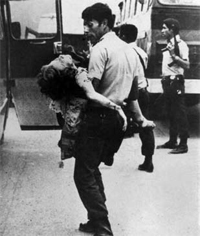
In December 1983 when I was giving a retreat to Columban Sisters in their convent in San Juan, Metro Manila, we got the shocking news of her violent death in Lima, Peru.
Sister Joan with friends in Peru
Joan Sawyer was a Columban Sister who was shot dead in Lima, Peru, in December 1983. She used to go to the Lurigancho Prison in Lima three or four days a week to visit the prisoners there. The prison held over 5,000 men. Conditions were bad. Out of 5,000 prisoners only 1,000 were sentenced. The rest were pending sentence or perhaps innocent. Joan used try to bring them some relief - medicines for some, a kind word for others, news about how she was progressing with their legal papers in the ministry for Justice, etc. 
The large majority of prisoners came, in her own words, 'from the poor sectors of Lima where they never had enough to eat, didn't finish school and couldn't find decent work'. On the morning of 14 December 1983 a group of prisoners decided that at all costs they were going to escape. They took as hostages Joan Sawyer, three Marist Sisters and social workers. After all-day negotiations with the prison authorities it was agreed that the prisoners and their hostages would be allowed leave the prison in the evening in an ambulance, the most inconspicuous mode of travel for getting out unnoticed. 
They were no sooner outside the prison gate than waiting police riddled the ambulance with bullets from all sides. Four bullets struck Joan, one through the back of the neck, two through her leg and one through her finger. When removed from the ambulance she was dead. Joan Sawyer was born in Donegore, County Antrim, in 1932. She entered the Columban Sisters in 1949 having previously worked as a secretary in Belfast. Subsequently she took her BA degree in Mundelein College, Chicago. She went to Peru in 1977 and was 51 years old at the time of her death. [Source].


Hilary Cross, Sr Joan's niece, visited Lima for the 30th anniversary of the death of her Aunty Joan. In an article in the English newspaper The Guardian she tells of the two great sacrifices made her grandfather, George Sawyer, Sister Joan's father. George was a Protestant who married a Catholic, Brigid Deegan, in the 1920s in the newly independent Irish Free State, now the Republic of Ireland. They had a mixed marriage in the 1920s, and it was hard to find their place in a free state that wasn't really so free. So they moved north; my grandfather, George, the eldest son, losing his family farm for love of a sweet girl, Brigid, from 'the other side'. They settled in Donegore, near Antrim, where George's love of the land led him to labour on another man's farm.
The article continues: Joan was the youngest of seven. Although all were much loved, it was said that 'wee Joan' held a special place in her father's heart. Gentle, slight, spirited and with a deep faith, she left at the age of 17 to join a convent in the remote west of Ireland. That day George retreated to the land, unable to say goodbye. A man of great faith himself, he must have struggled to reconcile whose sacrifice this was, his love of a Catholic girl had lost him more than just his farm.
Hilary Cross at her Aunty Joan's grave
The Story of Sister Joan Sawyer on the website of her native parish in Northern Ireland quotes from a letter written by a prisoner named Julio in Lurigancho Prison: Minutes before Sister Juanita [as she was known in Peru] was taken hostage I was speaking to her when she came with a packet sent in with her by my mother. I can still see her eyes which reached to eternity. Her love, pure and gentle, which reflected her great love for people. Her spirit of kindness and sacrifice towards us prisoners will be my most precious memory.
Do not fear those who kill the body but cannot kill the soul.
You may read more about Sister Joan on the website of the Columban Sisters here, here, here and here. The website is also the source of the photos above.
Columban Sisters carrying Sister Joan's coffin [Source]

03 March 2016

Columban Fr Patrick Donohoe RIP

Fr Patrick Donohoe
(1932 - 2016)

Fr Patrick ('Pat') Donohoe died rather suddenly in Dublin’s Mater Misericordia Hospital on 28 February, 2016. Born at Derryheen, Cavan on 20 May 1932, he was educated at Cavan Convent School, Drumcrave National School and St Patrick’s College, Cavan. He went to St Columban's, Dalgan Park, Ireland, in 1950 and was ordained priest on 21 December 1956. 

Cathedral of St Patrick and St Felim, Cavan [Wikipedia]

His first appointment was to Korea where he would spend the next twenty-three years. He served in Kwangju (now Gwangju) Vicariate before being appointed Regional Bursar for three years. Then he was appointed to the island of Cheju (now Jeju), where he spent five years keeping the books at the St Isidore Development Association and a further ten years in pastoral work.

Jeju Seashore [Wikipedia]

In 1980 he was assigned to the US Region in order to pursue studies in economics at Creighton University, Omaha, Nebraska, USA.  This led in 1981 to an appointment to the Bursar’s office in Ireland and in the following year to becoming Bursar of the District of Britain. After seven years in that position, he felt the need of a fresh challenge and  was assigned to Jamaica where he again served as Bursar in Montego Bay.

Montego Bay pushcart vendor [Wikipedia]

At the end of 1991, he was assigned the Region of Ireland and served in pastoral ministry in the Diocese of Clonfert. In May 1998 he was assigned as Chaplain to the Missionary Sisters of St Columban in Magheramore. He spent almost eighteen happy years in this final appointment until he was confined to hospital with chest pains and died within twenty-four hours.

Logo of the Columban Sisters

As a Bursar, Father Pat was known to be friendly, thorough and competent.

His ability to prime a conversation, his gift for repartee, together with his wide interest in social, economic and political affairs made him  good company. He will be missed by all of his Columban colleagues and by the Columban Sisters whom he served faithfully until the end.

May he rest in peace. 

St Columban's Cemetery, Dalgan Park, Ireland

Fr Patrick Raleigh, Regional Director of the Columbans in Ireland, in his covering letter when emailing the obituary of Fr Donohoe noted that 'at the end of the meal one of Pat's friends from Cavan sang a few Cavan songs.' It is becoming a very praiseworthy practice to have a few songs at the post-funeral lunch in Dalgan Park, something that reflects our hope as believers in the Resurrection. And I cannot imagine that the song below, written by Percy French and the best known Cavan song of all, was omitted. 

It is said too that this was the favourite Irish song of Pope Pius XII and that he was introduced to it by a priest from Ballyjamesduff who was helping him with his English. I don't know if His Holiness spoke English with a Cavan accent!


10 September 2014

Prayer Intentions of Pope Francis for September 2014


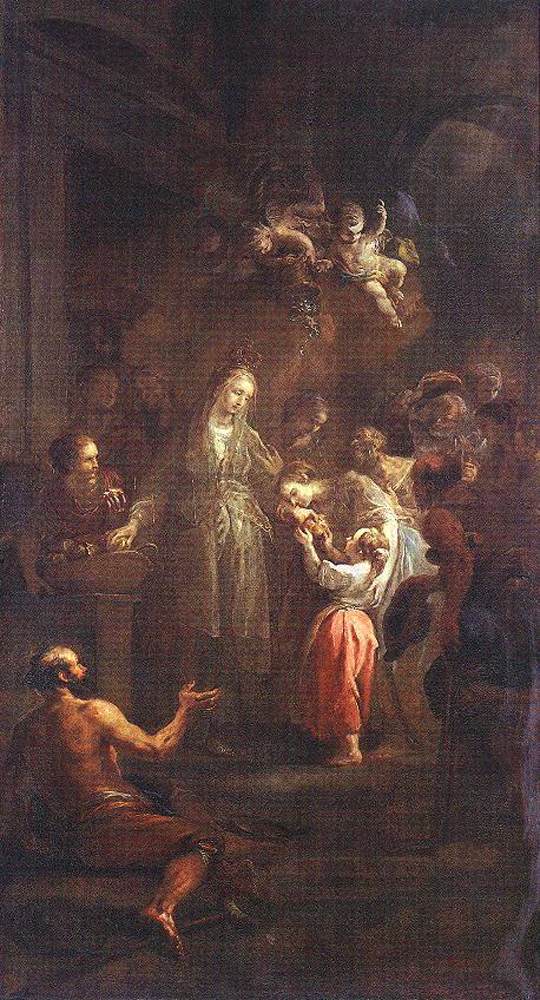
St Elizabeth (of Hungary) Distributing Alms, Martin Johann Schmidt, c.1778
Parish Church, Veresegyhás, Hungary [Web Gallery of Art]

Universal Intention - Mentally Disabled

That the mentally disabled may receive the love and help they need for a dignified life.


Read Another Myeong Sek: the Road to Emmaus by Columban Fr Noel O'Neill in the current issue of MISYONonline.com.

Fr O’Neill with Myeong Sek

With Myeong Sek at the grave of You Ha

Myeon Sek's funeral Mass


 Evangelization Intention - Service to the Poor

That Christians, inspired by the Word of God, may serve the poor and suffering

Death is Stark for the Poor(MISYONonline.com, November-December 2013) Columban Sr Mary Dillon (right) from Ireland, tending to a person with AIDS.

What Comes After Dusk(MISYONonline.com, July-August 2014)
Kwaderno, an initiative started by the staff of MISYONonline.com, reaches out to children in the Philippines who cannot afford to buy notebooks.

Rattno's Story (MISYONonline.com, March-April 2014)
Australian Columban Fr Robert McCulloch with 12-year-old Rattno, a Hindu in predominantly Muslim Pakistan.

'The hope of Shivji and Shonti, Rattno's parents, turned to disaster when their children were lighting a kerosene pressure lamp which exploded. Saiba, Lakhnu and Shonti, aged from 7 to 15, died in the fire. Rattno survived.' 

Beauty in Suffering (MISYONonline.com September-October 2007) 
Columban Sr Anne Carbon, a mental health nurse from the Philippines, with children traumatized by years of terrorism in Peru.


27 April 2013

'By this all men will know that you are my disciples . . .' Sunday Reflections, Fifth Sunday of Easter Year C

Father (later Bishop) Edward Galvin (1882-1956) Co-founder of the Columbans.
Photo taken in China between 1912 and early 1916


Fr Patrick Hurley (centre, seated) on his ordination day, 21 December 1948
Family complete, except for Fr Dermot Hurley, ordained 1944

Fr Hurley will turn 89, God willing, in June. Two of his brothers, Father Dermot (1920-1999) and Father Gerard (1926-2002), were part of the pioneering group of Columbans who went to Fiji in 1952. Sister Catherine Hurley, their sister and now retired, served as Superior General of the Columban Sisters from 1970 to 1981.

Readings (New American Bible: Philippines, USA)

Readings (Jerusalem Bible: Australia, England & Wales, India [optional], Ireland, New Zealand, Pakistan, Scotland, South Africa) 

Gospel John 13:31-33a, 34-35 (Revised Standard Version – Catholic Edition)

When Judas had gone out, Jesus said, "Now is the Son of man glorified, and in him God is glorified; if God is glorified in him, God will also glorify him in himself, and glorify him at once. Little children, yet a little while I am with you.

A new commandment I give to you, that you love one another; even as I have loved you, that you also love one another. By this all men will know that you are my disciples, if you have love for one another."


Fr John Blowick (1888-1972) Co-founder of the Columbans (centre)
China 1920 with (L) Fr Owen McPolin and (R) Fr Edward Galvin

On the evening of 29 January 1918 an extraordinary event took place in Dalgan Park, Shrule, a remote village on the borders of County Mayo and County Galway in the west of Ireland. At the time Ireland was part of the United Kingdom, which was engaged in the Great War. Thousands of Irishmen were fighting in the trenches in France and Belgium. Many never came home. There was a movement for independence in Ireland that led to the outbreak of guerrilla warfare in Ireland later in 1918. There was widespread poverty in the country, particularly acute in the cities.

Despite all of that, on 10 October 1916 the Irish bishops gave permission to two young diocesan priests, Fr Edward J. Galvin and Fr John Blowick, to have a national collection so that they could open a seminary that would prepare young Irish priests to go to China. The effort was called the Maynooth Mission to China, because Maynooth, west of Dublin, is where St Patrick's National Seminary is, where Fr Galvin had been ordained in 1909 and Fr Blowick in 1913.

The seminary opened that late winter's evening with 19 students and seven priests. Many of the students were at different stages of their formation in Maynooth but transferred. The seven priests belonged to different dioceses but threw in their lot with this new venture which, on 29 June 1918, would become the Society of St Columban.

This Sunday's gospel was part of what the new group reflected on as they gathered in the makeshift chapel in Dalgan Park, the name of the 'Big House' and the land on which it was built. Among the seven priests was Fr John Heneghan, a priest from the Archdiocese of Tuam, as was Fr Blowick, and a classmate of Fr Galvin. Fr Heneghan never imagined that despite his desire to be a missionary in China he would spend many years in Ireland itself teaching the seminarians and editing the Columban magazine The Far East. But his dream was to take him to the Philippines in 1931 and to torture and death at the hands of Japanese soldiers during the Battle of Manila in February 1945, when 100,000 people, mostly civilians, were killed and most of the old city destroyed.

Fr John Blowick emphasised the centrality of the words of Jesus in this Sunday's gospel, A new commandment I give to you, that you love one another; even as I have loved you, that you also love one another. By this all men will know that you are my disciples, if you have love for one another. The second sentence there was written into the Constitutions of the Society, drawn up the following year.

To this particular Columban these words of Jesus from the Gospel of St John are the greatest legacy of Fr John Blowick to the many men from different countries who have shared his dream and that of Bishop Galvin to this day. 

And not only men, but women too, as Columban Sisters and as Columban Lay Missionaries

The Society of St Columban was born in the middle of the First World War because of the vision of two young men who saw beyond that awful reality and who took Jesus at his word. Down the years Columbans have lived through wars, in remote areas where their lives and the lives of the people they served were often in danger. Some have been kidnapped and not all of those survived. Among those who did was Fr Michael Sinnott, kidnapped in the southern Philippines in October 2009 when he was 79 and released safely a month later on 12 November.

Fr Michael Sinnott in Manila on the day of his release.

With his sisters, Mrs Aine Kenny, left, and Mrs Kathleen O'Neill, right, at Dublin Airport, 3 December 2009

Father John Blowick's insistence on the words of Jesus in this Sunday's gospel becoming part of the very fibre of the being of Columbans sustained Fr John Heneghan, Fr Patrick Kelly, Fr John Lalor and Fr Peter Fallon, as Japanese soldiers took them away from Malate Church, Manila, on 10 February 1945, and their companion Fr John Lalor who was working in a makeshift hospital nearby who with others was killed there by a bomb three days later. 

The words By this all men will know that you are my disciples, if you have love for one another are not only the hallmark of Columbans but of countless other groups, of countless families. They are meant to be the hallmark of every Christian.

Fr John Blowick accompanied the first group of Columbans to China in 1920 but didn't stay there as he was needed in Ireland as Superior General and as a teacher in the seminary. In 1965 he visited the Columban missions. 

Thine be the Glory, music by George Frederick Handel, original French lyrics by Edmond Budry

St Thomas' Anglican Church, Belfast, Northern Ireland