Since we are travellers and pilgrims in the world, let us ever ponder on the end of the road, that is of our life, for the end of our roadway is our home (St Columban, 8th sermon).
GospelMatthew 10:26-33 (English Standard Version, Anglicised)
At that
time: Jesus instructed his Apostles: ‘Have no fear of them, for nothing is
covered that will not be revealed, or hidden that will not be known. What I
tell you in the dark, say in the light, and what you hear whispered, proclaim
on the housetops. And do not fear those who kill the body but cannot kill the
soul. Rather fear him who can destroy both soul and body in hell. Are not two
sparrows sold for a penny? And not one of them will fall to the ground apart
from your Father knowing. But even the hairs of your head are all numbered.
Fear not, therefore; you are of more value than many sparrows. So everyone who
acknowledges me before men, I also will acknowledge before my Father who is in
heaven, but whoever denies me before men, I also will deny before my Father who
is in heaven.’
I think it was during the summer of 1968, a few months after my ordination, that my parents and I visited the motherhouse of the Columban Sisters in Magheramore, County Wicklow, on the east coast of Ireland. We were deeply struck by the extraordinary gentle warmth of Sister Joan Sawyer from Country Antrim, Northern Ireland, who showed us around.
In December 1983 when I was giving a retreat to Columban Sisters in their convent in San Juan, Metro Manila, we got the shocking news of her violent death in Lima, Peru.
Joan Sawyer was a Columban Sister who was shot dead in Lima, Peru, in December 1983. She used to go to the Lurigancho Prison in Lima three or four days a week to visit the prisoners there. The prison held over 5,000 men. Conditions were bad. Out of 5,000 prisoners only 1,000 were sentenced. The rest were pending sentence or perhaps innocent. Joan used try to bring them some relief - medicines for some, a kind word for others, news about how she was progressing with their legal papers in the ministry for Justice, etc.
The large majority of prisoners came, in her own words, 'from the poor sectors of Lima where they never had enough to eat, didn't finish school and couldn't find decent work'. On the morning of 14 December 1983 a group of prisoners decided that at all costs they were going to escape. They took as hostages Joan Sawyer, three Marist Sisters and social workers. After all-day negotiations with the prison authorities it was agreed that the prisoners and their hostages would be allowed leave the prison in the evening in an ambulance, the most inconspicuous mode of travel for getting out unnoticed.
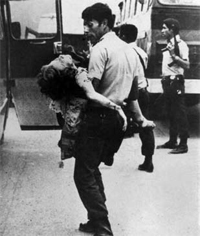
They were no sooner outside the prison gate than waiting police riddled the ambulance with bullets from all sides. Four bullets struck Joan, one through the back of the neck, two through her leg and one through her finger. When removed from the ambulance she was dead. Joan Sawyer was born in Donegore, County Antrim, in 1932. She entered the Columban Sisters in 1949 having previously worked as a secretary in Belfast. Subsequently she took her BA degree in Mundelein College, Chicago. She went to Peru in 1977 and was 51 years old at the time of her death.
Hilary Cross, Sr Joan's niece, visited Lima for the 30th anniversary of the death of her Aunty Joan. In an article in the English newspaper The Guardian she tells of the two great sacrifices made by her grandfather, George Sawyer, Sister Joan's father. George was a Protestant who married a Catholic, Brigid Deegan, in the 1920s in the newly independent Irish Free State, now the Republic of Ireland. They had a mixed marriage in the 1920s, and it was hard to find their place in a free state that wasn't really so free. So they moved north; my grandfather, George, the eldest son, losing his family farm for love of a sweet girl, Brigid, from 'the other side'. They settled in Donegore, near Antrim, where George's love of the land led him to labour on another man's farm.
The article continues: Joan was the youngest of seven. Although all were much loved, it was said that 'wee Joan' held a special place in her father's heart. Gentle, slight, spirited and with a deep faith, she left at the age of 17 to join a convent in the remote west of Ireland. That day George retreated to the land, unable to say goodbye. A man of great faith himself, he must have struggled to reconcile whose sacrifice this was, his love of a Catholic girl had lost him more than just his farm.
Hilary Cross at her Aunty Joan's grave
The Story of Sr Joan Sawyer, formerly on the website of her native parish in Northern Ireland, quotes from a letter written by a prisoner named Julio in Lurigancho Prison: Minutes before Sister Juanita [as she was known in Peru] was taken hostage I was speaking to her when she came with a packet sent in with her by my mother. I can still see her eyes which reached to eternity. Her love, pure and gentle, which reflected her great love for people. Her spirit of kindness and sacrifice towards us prisoners will be my most precious memory.
Do not fear those who kill the body but cannot kill the soul (today's Gospel).
You may read more about Sister Joan on the website of the Columban Sisters here, here, here and here. The website is also the source of the photos above.
GospelMatthew 10:26-33 (English Standard Version
Anglicised, India)
Jesus
said to the Twelve:
So
have no fear of them, for nothing is covered that will not be revealed, or
hidden that will not be known.What I tell you in the dark, say in the light, and what
you hear whispered, proclaim on the housetops.And do not fear those who kill the
body but cannot kill the soul. Rather fear him who can destroy both soul
and body in hell.Are not two sparrows sold for a penny?[b] And not one of them will fall to
the ground apart from your Father.But even the hairs of your head are all numbered.Fear not, therefore; you are of more
value than many sparrows.So everyone who acknowledges me before men, I also will
acknowledge before my Father who is in heaven,but whoever denies me before
men, I also will deny before my Father who is in heaven.
I think it was during the summer of 1968, a few months after my ordination, that my parents and I visited the motherhouse of the Columban Sisters in Magheramore, County Wicklow, on the east coast of Ireland. We were deeply struck by the extraordinary gentle warmth of Sister Joan Sawyer from Country Antrim, Northern Ireland, who showed us around.
In December 1983 when I was giving a retreat to Columban Sisters in their convent in San Juan, Metro Manila, we got the shocking news of her violent death in Lima, Peru.
Joan Sawyer was a Columban Sister who was shot dead in Lima, Peru, in December 1983. She used to go to the Lurigancho Prison in Lima three or four days a week to visit the prisoners there. The prison held over 5,000 men. Conditions were bad. Out of 5,000 prisoners only 1,000 were sentenced. The rest were pending sentence or perhaps innocent. Joan used try to bring them some relief - medicines for some, a kind word for others, news about how she was progressing with their legal papers in the ministry for Justice, etc.
The large majority of prisoners came, in her own words, 'from the poor sectors of Lima where they never had enough to eat, didn't finish school and couldn't find decent work'. On the morning of 14 December 1983 a group of prisoners decided that at all costs they were going to escape. They took as hostages Joan Sawyer, three Marist Sisters and social workers. After all-day negotiations with the prison authorities it was agreed that the prisoners and their hostages would be allowed leave the prison in the evening in an ambulance, the most inconspicuous mode of travel for getting out unnoticed.
They were no sooner outside the prison gate than waiting police riddled the ambulance with bullets from all sides. Four bullets struck Joan, one through the back of the neck, two through her leg and one through her finger. When removed from the ambulance she was dead. Joan Sawyer was born in Donegore, County Antrim, in 1932. She entered the Columban Sisters in 1949 having previously worked as a secretary in Belfast. Subsequently she took her BA degree in Mundelein College, Chicago. She went to Peru in 1977 and was 51 years old at the time of her death.
Hilary Cross, Sr Joan's niece, visited Lima for the 30th anniversary of the death of her Aunty Joan. In an article in the English newspaper The Guardian she tells of the two great sacrifices made by her grandfather, George Sawyer, Sister Joan's father. George was a Protestant who married a Catholic, Brigid Deegan, in the 1920s in the newly independent Irish Free State, now the Republic of Ireland. They had a mixed marriage in the 1920s, and it was hard to find their place in a free state that wasn't really so free. So they moved north; my grandfather, George, the eldest son, losing his family farm for love of a sweet girl, Brigid, from 'the other side'. They settled in Donegore, near Antrim, where George's love of the land led him to labour on another man's farm.
The article continues: Joan was the youngest of seven. Although all were much loved, it was said that 'wee Joan' held a special place in her father's heart. Gentle, slight, spirited and with a deep faith, she left at the age of 17 to join a convent in the remote west of Ireland. That day George retreated to the land, unable to say goodbye. A man of great faith himself, he must have struggled to reconcile whose sacrifice this was, his love of a Catholic girl had lost him more than just his farm.
Hilary Cross at her Aunty Joan's grave
The Story of Sr Joan Sawyer, formerly on the website of her native parish in Northern Ireland, quotes from a letter written by a prisoner named Julio in Lurigancho Prison: Minutes before Sister Juanita [as she was known in Peru] was taken hostage I was speaking to her when she came with a packet sent in with her by my mother. I can still see her eyes which reached to eternity. Her love, pure and gentle, which reflected her great love for people. Her spirit of kindness and sacrifice towards us prisoners will be my most precious memory.
Do not fear those who kill the body but cannot kill the soul (today's Gospel).
You may read more about Sister Joan on the website of the Columban Sisters here, here, here and here. The website is also the source of the photos above.
Gospel Matthew 10:26-33 (New Revised Standard Version, Anglicised Catholic Edition)
Jesus said to the Twelve:
‘So have no fear of
them; for nothing is covered up that will not be uncovered, and nothing secret
that will not become known.What I say to you in the dark, tell in the
light; and what you hear whispered, proclaim from the housetops.Do not fear those who kill the body but cannot
kill the soul; rather fear him who can destroy both soul and body in hell.Are
not two sparrows sold for a penny? Yet not one of them will fall to the ground
unperceived by your Father.And even the hairs of your head are all counted.So do not be afraid; you are of more value than
many sparrows.
‘Everyone
therefore who acknowledges me before others, I also will acknowledge before my
Father in heaven;but whoever denies me before others, I also will
deny before my Father in heaven.
I think it was during the summer of 1968, a few months after my ordination, that my parents and I visited the motherhouse of the Columban Sisters in Magheramore, County Wicklow, on the east coast of Ireland. We were deeply struck by the extraordinary gentle warmth of Sister Joan Sawyer from Country Antrim, Northern Ireland, who showed us around.
In December 1983 when I was giving a retreat to Columban Sisters in their convent in San Juan, Metro Manila, we got the shocking news of her violent death in Lima, Peru.
Sister Joan with friends in Peru
Joan Sawyer was a Columban Sister who was shot dead in Lima, Peru, in December 1983. She used to go to the Lurigancho Prison in Lima three or four days a week to visit the prisoners there. The prison held over 5,000 men. Conditions were bad. Out of 5,000 prisoners only 1,000 were sentenced. The rest were pending sentence or perhaps innocent. Joan used try to bring them some relief - medicines for some, a kind word for others, news about how she was progressing with their legal papers in the ministry for Justice, etc.
The large majority of prisoners came, in her own words, 'from the poor sectors of Lima where they never had enough to eat, didn't finish school and couldn't find decent work'. On the morning of 14 December 1983 a group of prisoners decided that at all costs they were going to escape. They took as hostages Joan Sawyer, three Marist Sisters and social workers. After all-day negotiations with the prison authorities it was agreed that the prisoners and their hostages would be allowed leave the prison in the evening in an ambulance, the most inconspicuous mode of travel for getting out unnoticed.
They were no sooner outside the prison gate than waiting police riddled the ambulance with bullets from all sides. Four bullets struck Joan, one through the back of the neck, two through her leg and one through her finger. When removed from the ambulance she was dead. Joan Sawyer was born in Donegore, County Antrim, in 1932. She entered the Columban Sisters in 1949 having previously worked as a secretary in Belfast. Subsequently she took her BA degree in Mundelein College, Chicago. She went to Peru in 1977 and was 51 years old at the time of her death. [Source].
Hilary Cross, Sr Joan's niece, visited Lima for the 30th anniversary of the death of her Aunty Joan. In an article in the English newspaper The Guardian she tells of the two great sacrifices made her grandfather, George Sawyer, Sister Joan's father. George was a Protestant who married a Catholic, Brigid Deegan, in the 1920s in the newly independent Irish Free State, now the Republic of Ireland. They had a mixed marriage in the 1920s, and it was hard to find their place in a free state that wasn't really so free. So they moved north; my grandfather, George, the eldest son, losing his family farm for love of a sweet girl, Brigid, from 'the other side'. They settled in Donegore, near Antrim, where George's love of the land led him to labour on another man's farm.
The article continues: Joan was the youngest of seven. Although all were much loved, it was said that 'wee Joan' held a special place in her father's heart. Gentle, slight, spirited and with a deep faith, she left at the age of 17 to join a convent in the remote west of Ireland. That day George retreated to the land, unable to say goodbye. A man of great faith himself, he must have struggled to reconcile whose sacrifice this was, his love of a Catholic girl had lost him more than just his farm.
Hilary Cross at her Aunty Joan's grave
The Story of Sister Joan Sawyeron the website of her native parish in Northern Ireland quotes from a letter written by a prisoner named Julio in Lurigancho Prison: Minutes before Sister Juanita [as she was known in Peru] was taken hostage I was speaking to her when she came with a packet sent in with her by my mother. I can still see her eyes which reached to eternity. Her love, pure and gentle, which reflected her great love for people. Her spirit of kindness and sacrifice towards us prisoners will be my most precious memory.
Do not fear those who kill the body but cannot kill the soul.
You may read more about Sister Joan on the website of the Columban Sisters here, here, here and here. The website is also the source of the photos above.
Fr Maurice
Foley was born at Castlefinn, County Donegal, Ireland on 2 February 1933. He
was educated at Dunbeacon National School, Ballydehob, County Cork, Belvedere College
Preparatory School and Belvedere College, Dublin, St Patrick’s College, Armagh,
and University College Dublin. He entered St Columban’s, Dalgan Park, Navan, in
1952 and was ordained priest there on 21 December 1958.
Appointed
to Korea in 1959, Father Maurice was assigned to Ulchin and Chunchon after language studies.
After the division of the Diocese of Chunchon, he was assigned
to the new Diocese of Wonjuand to the
new parish of Tokgae.
He ministered there for most of the remainder of his years in Korea
during the difficult period of the military dictatorship.
By
1977, it was clear to him that the Church in Korea was growing rapidly
and producing enough priests to cater to its own needs. He asked
the Superior General to be assigned to Peru; as he wrote himself ‘I saw
space for my missionary zeal in the land of the Incas’. After language
studies his initial assignment was to Huancavalica, working at high
altitude in the Sierra, until he was advised that working at sea-level
would be easier on his health.
Assignments
in the Lima area included the parishes of Santíssimo Redentor,
Santa María de la Reconciliación and Nuestra Señora de la Paz. In
all these areas he enjoyed a happy and successful ministry. He could
come across at times as rather abrupt, and could be impetuous, especially
when the poor were being treated unjustly. However nobody could
doubt his goodness and kindness, and the love that he lavished on the
people was repaid with interest.
In 2012
his health had begun to deteriorate and he returned to Ireland.
For a short period he had enough energy to ride his beloved bicycle
but in recent months his illness confined him to his room. There
he loved to welcome visitors. Father Maurice
was blessed with a childlike
simplicity, a generous heart and a quality of being so genuine
that his sincerity could not be doubted. We will miss his truly
unique presence.
Father Maurice was buried in St Columban's Cemetery, Dalgan Park, on 21 December, the 58th anniversary of his ordination to the priesthood.
May he
rest in peace.
Crucifix, St Columban's Cemetery, Dalgan Park
Silent Night / Sumaq Tuta
Sung in Quechua, the mother-tongue of the majority of people in Huancavalica, where Father Maurice first worked in Peru.


 Hilary Cross at her Aunty Joan's grave
 Columban Sisters carrying Sister Joan's coffin [Source]