Readings (Jerusalem Bible: Australia, Ireland, New Zealand)
Readings (English Standard Version, Catholic Edition: England & Wales, Scotland, India)
Readings (New American Bible: Philippines, USA)
Gospel John 9:1-41 (English Standard Version, Anglicised)
[For the shorter form (9:1, 6-9, 13-17, 34-38) omit the text in brackets and italics.]
At that time: As Jesus passed by, he saw a man blind from birth. [And his disciples asked him, ‘Rabbi, who sinned, this man or his parents, that he was born blind?’ Jesus answered, ‘It was not that this man sinned, or his parents, but that the works of God might be displayed in him. We must work the works of him who sent me while it is day; night is coming, when no one can work. As long as I am in the world, I am the light of the world.’ Having said these things,] he spat on the ground and made mud with the saliva. Then he anointed the man’s eyes with the mud and said to him, ‘Go, wash in the pool of Siloam’ (which means Sent). So he went and washed and came back seeing.
The neighbours and those who had seen him before as a beggar were saying, ‘Is this not the man who used to sit and beg?’ Some said, ‘It is he.’ Others said, ‘No, but he is like him.’ He kept saying, ‘I am the man.’ [So they said to him, ‘Then how were your eyes opened?’ He answered, ‘The man called Jesus made mud and anointed my eyes and said to me, “Go to Siloam and wash.” So I went and washed and received my sight.’ They said to him, ‘Where is he?’ He said, ‘I do not know.’]
They brought to the Pharisees the man who had formerly been blind. Now it was a Sabbath day when Jesus made the mud and opened his eyes. So the Pharisees again asked him how he had received his sight. And he said to them, ‘He put mud on my eyes, and I washed, and I see.’ Some of the Pharisees said, ‘This man is not from God, for he does not keep the Sabbath.’ But others said, ‘How can a man who is a sinner do such signs?’ And there was a division among them. So they said again to the blind man, ‘What do you say about him, since he has opened your eyes?’ He said, ‘He is a prophet.’
[The Jews did not believe that he had been blind and had received his sight, until they called the parents of the man who had received his sight and asked them, ‘Is this your son, who you say was born blind? How then does he now see?’ His parents answered, ‘We know that this is our son and that he was born blind. But how he now sees we do not know, nor do we know who opened his eyes. Ask him; he is of age. He will speak for himself.’ His parents said these things because they feared the Jews, for the Jews had already agreed that if anyone should confess Jesus to be Christ, he was to be put out of the synagogue. Therefore his parents said, ‘He is of age; ask him.’
So for the second time they called the man who had been blind and said to him, ‘Give glory to God. We know that this man is a sinner.’ He answered, ‘Whether he is a sinner I do not know. One thing I do know, that though I was blind, now I see.’ They said to him, ‘What did he do to you? How did he open your eyes?’ He answered them, ‘I have told you already, and you would not listen. Why do you want to hear it again? Do you also want to become his disciples?’ And they reviled him, saying, ‘You are his disciple, but we are disciples of Moses. We know that God has spoken to Moses, but as for this man, we do not know where he comes from.’ The man answered, ‘Why, this is an amazing thing! You do not know where he comes from, and yet he opened my eyes. We know that God does not listen to sinners, but if anyone is a worshipper of God and does his will, God listens to him. Never since the world began has it been heard that anyone opened the eyes of a man born blind. If this man were not from God, he could do nothing.’] They answered him, ‘You were born in utter sin, and would you teach us?’ And they cast him out.
Jesus heard that they had cast him out, and having found him he said, ‘Do you believe in the Son of Man?’ He answered, ‘And who is he, sir, that I may believe in him?’ Jesus said to him, ‘You have seen him, and it is he who is speaking to you.’ He said, ‘Lord, I believe’, and he worshipped him. [Jesus said, ‘For judgement I came into this world, that those who do not see may see, and those who see may become blind.’ Some of the Pharisees near him heard these things, and said to him, ‘Are we also blind?’ Jesus said to them, ‘If you were blind, you would have no guilt; but now that you say, “We see”, your guilt remains.’]

Jesus heard that they had cast him out, and having found him he said, ‘Do you believe in the Son of Man?’ He answered, ‘And who is he, sir, that I may believe in him?’ Jesus said to him, ‘You have seen him, and it is he who is speaking to you.’ He said, ‘Lord, I believe’, and he worshipped him (John 9:35-38; Gospel).
The blind man met Jesus, heard him and believed. When St John wrote his gospel his purpose was that we, like the blind man, would meet Jesus, hear him and believe.
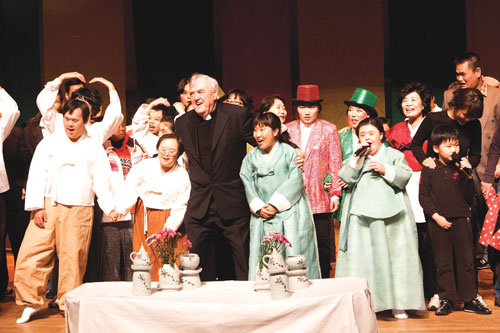
Fr Noel O’ Neill, a Columban priest from Limerick, Ireland, who died last year aged 92, went to Korea in 1957, four years after the war had ended there. Working in Gwangju he became involved with the Mudeong Institution, also known as the Beggars' Camp, which housed 600 people from the margins, including persons with learning disabilities. He noticed that there were not able to speak for themselves and felt drawn to these ‘forgotten ones’.

Fr One of these 'forgotten ones' was a young woman named You Ha. Father Noel was called to visit her when she was dying in a nearby hospital. He arrived just in time to hear her say Kamsahamnida, ‘Thank you’, her last words. You Ha had no family and the hospital was going to use her body for medical research. But Father Noel bought a grave for her in the Catholic cemetery and took care of the funeral expenses. He had these words inscribed on the tombstone: Will you forgive society? Will you forgive the Church? For too long have we ignored you.
This
experience led to Father Noel’s discovering his ‘vocation within a vocation’:
to spend the rest of his life enabling persons with learning disabilities to
live in small family-like homes in the wider community. He saw this not just as a matter of charity but
of justice.
The first person to join him in such a community was Myeong Sek. Here are Father Noel's own words.
Myeong Sek had been abandoned by her parents when she was a few years old and ended up in ‘The Beggars Camp’, Mudeong Institution, which I frequently visited while in parish ministry. After much negotiation with the authorities there I succeeded in getting permission for Myeong Sek to leave and to join with me and a volunteer as we moved into a two-storey house in a residential part of the city. It was October 1981. This was the first attempt in Korea of offering people with special needs the opportunity of living in the local community.
Early in 2012 Myeong Sek was diagnosed with cancer. She spent the last ten days of her life in a hospice. A hospice and Emmaus [the name Father Noel had chosen for the small communities] have something in common. A hospice is for people dying whose ailment cannot be cured. Emmaus is for intellectually disabled people whose disability cannot be cured. A visit to either one alerts us to the preciousness of each moment of life; it arouses within us a sense of gratitude.
While Myeong Sek was in the hospice I visited her every day. As I sat beside her bedside and held her tiny hand, we reminisced about the funny incidents we had shared together throughout the previous 30 years, the times we used to sing Kaptori Wa Kapsoni (a popular Korean action song) and dance the hokey pokey.
As she laid back on her bed she would break into a broad
smile, a loving smile, sending me a message that no words could express. They
were happy moments, happy days, happy years.
That
smile also hid the many wounds and hurts she had endured in her lifetime. I was
only too well aware of those painful wounds. Watching the peaceful look on her
face I felt she already sensed the heavenly welcome. She could almost make the
dying words of St Thérèse, the Little Flower, her own: ‘I am not dying, I am
entering into life’.
Myeong
Sek was waked for three days at the funeral home. Those who had lived with her
in the group home were dressed in mourning black dress, and they greeted those
who came to pay their respects, present and former staff members who had known
her for many years. Many Catholic friends and sponsors came who were touched and
moved by their relationship with Myeong Sek. This tiny, fragile woman had the
gift to make them feel loved and at peace with themselves as they struggled
with their problems.
Myeong Sek often said, ‘When I die, those who come to the
wake, feed them well’. They came in large numbers to pay their respects and all
ate well. Before leaving as each one ate and departed you could almost sense
the presence of Myeong Sek as she said kamsahamnida, ‘thank you, thank
you’.
The funeral Mass was held at the parish church Myeong Sek used
to attend. Six priests concelebrated for a packed congregation. I chose for the
Gospel the story of the two disciples on the Road to Emmaus. As the two
disciples eyes were opened at seeing Jesus break the bread, so also my eyes
were opened by my relationship with Myeong Sek. This tiny, fragile woman, who
could not read or write, who had no concept of time or money, was my teacher,
my professor. We need to invite and welcome more Myeong Seks into our society
because they will surprise us with the manner they can touch our inner selves
and help us to welcome our weaknesses, our old age with graceful and peaceful
courage. Yes, Myeong Sek was differently abled.
To slightly adapt the words of Jesus in today's gospel: It was not that You Ha or Myeong Sek sinned, or their parents, but that the works of God might be displayed in them.
And may the Myeong Seks in our own lives display the works of God to us and open our eyes as Jesus opened the eyes of the blind man in today’s gospel, bringing us to say, ‘Lord, I believe’ and to worship him.


Fourth Sunday in Lent
The Complete Mass in Latin and English is here. (Adjust the date at the top of that page to 03-15-2026 if necessary).
Epistle: Galatians 4:22-31. Gospel: John 6:1-15.