Showing posts with label Learning disabilities. Show all posts

05 May 2017

Sunday Reflections, Fourth Sunday of Easter, Year A. Columban ordination to diaconate.

The Good Shepherd, Martin van Cleve the Elder [Web Gallery of Art]

Readings (New American Bible: Philippines, USA)
                
Readings (Jerusalem Bible: Australia, England & Wales, India [optional], Ireland, New Zealand, Pakistan, Scotland, South Africa)


Jesus said:

"Very truly, I tell you, anyone who does not enter the sheepfold by the gate but climbs in by another way is a thief and a bandit. The one who enters by the gate is the shepherd of the sheep. The gatekeeper opens the gate for him, and the sheep hear his voice. He calls his own sheep by name and leads them out. When he has brought out all his own, he goes ahead of them, and the sheep follow him because they know his voice. They will not follow a stranger, but they will run from him because they do not know the voice of strangers.” Jesus used this figure of speech with them, but they did not understand what he was saying to them.

So again Jesus said to them, “Very truly, I tell you, I am the gate for the sheep. All who came before me are thieves and bandits; but the sheep did not listen to them. I am the gate. Whoever enters by me will be saved, and will come in and go out and find pasture.  The thief comes only to steal and kill and destroy. I came that they may have life, and have it abundantly.

You'll find the Reflections here.


+++

Columban Ordination to Diaconate


Bishop Honesto F. Ongtioco of Cubao ordained Erl Dylan J. Tabaco to the diaconate on 30 April in the Columban House of Studies, Cubao, Quezon City. The new deacon is from Holy Rosary Parish, Agusan, Cagayan de Oro City. He spent two years, 2014 to 2016, on First Mission Assignment in Peru as part of his preparation for the Columban missionary priesthood. You can read about his work there with children who are profoundly deaf and with young persons with intellectual disabilities here. 

Erl Dylan J. Tabaco with youngsters in Peru

+++


Bring Flowers of the Fairest, also known as Queen of the May, a very popular Marian hymn in Ireland, especially during the month of May, was written by Mary E. Walsh and is sung here by the late Irish tenor, Frank Patterson.

09 September 2014

Another Myeong Sek: The Road to Emmaus

Columban Fr Noel O'Neill with Myeong Sek in Korea

The Universal Prayer Intention of Pope Francis for September is That the mentally disabled may receive the love and help they need for a dignified life.

Fr Noel O'Neill is a Columban priest from Limerick, Ireland, who has been in Korea since 1957. In this article from the September-October 2014 issue of MISYONonline.com, the magazine of the Columbans in the Philippines that I have been editing for 12 years now, he shows how he has been living this prayer intention - and how he himself has received love and help for a dignified life from two persons in particular, among others, whom he describes as 'differently abled' and who were on the fringes of society because others didn't recognise the gifts that God had given them.

Myeong Sek, Theresa, was special. She was special because she was differently abled.
She was special because it was she who accompanied me as together we first began to walk the Road to Emmaus. After 25 years in parish ministry I sought permission from my superiors to begin a new apostolate, a ministry to persons with special needs.
With Myeong Sek at the grave of You Ha
Myeong Sek had been abandoned by her parents when she was a few years old and ended up in ‘The Beggars Camp’, Mudeong Institution, which I frequently visited while in parish ministry. After much negotiation with the authorities there I succeeded in getting permission for Myeong Sek to leave and to join with me and a volunteer as we moved into a two-story house in a residential part of the city. It was October 1981. This was the first attempt in Korea of offering people with special needs the opportunity of living in the local community.
Myeong Sek’s funeral Mass
Early in 2012 Myeong Sek was diagnosed with cancer. She spent the last ten days of her life in a hospice. A hospice and Emmaus have something in common. A hospice is for people dying whose ailment cannot be cured. Emmaus is for intellectually disabled people whose disability cannot be cured. A visit to either one alerts us to the preciousness of each moment of life; it arouses within us a sense of gratitude.
While Myeong Sek was in the hospice I visited her every day. As I sat beside her bedside and held her tiny hand, we reminisced about the funny incidents we had shared together throughout the previous 30 years, the times we used to sing Kaptori Wa Kapsoni (a Korean popular duet) and dance the hokey pokey.

Kaptori Wa Kapsoni
As she laid back on her bed she would break into a broad smile, a loving smile, sending me a message that no words could express. They were happy moments, happy days, happy years.
That smile also hid the many wounds and hurts she had endured in her lifetime. I was only too well aware of those painful wounds. Watching the peaceful look on her face I felt she already sensed the heavenly welcome. She could almost make the dying words of St Thérèse, the Little Flower, her own: ‘I am not dying, I am entering into life’.
Myeong Sek was waked for three days at the funeral home. Those who had lived with her in the group home were dressed in mourning black dress, and they greeted those who came to pay their respects, present and former staff members who had known her for many years. Many Catholic friends and sponsors came who were touched and moved by their relationship with Myeong Sek. This tiny, fragile woman had the gift to make them feel loved and at peace with themselves as they struggled with their problems.
Myeong Sek often said, ‘When I die, those who come to the wake, feed them well’. They came in large numbers to pay their respects and all ate well. Before leaving as each one ate and departed you could almost sense the presence of Myeong Sek as she said kamsahamnida,’thank you, thank you’.

At the cemetery
The funeral Mass was held at the parish church Myeong Sekused to attend. Six priests concelebrated for a packed congregation. I chose for the Gospel the story of the two disciples on the Road to Emmaus. As the two disciples eyes were opened at seeing Jesus break the bread, so also my eyes were opened by my relationship with Myeong Sek. This tiny, fragile woman, who could not read or write, who had no concept of time or money, was my teacher, my professor. We need to invite and welcome more Myeong Seks into our society because they will surprise us with the manner they can touch our inner selves and help us to welcome our weaknesses, our old age with graceful and peaceful courage. Yes, Myeong Sek was differently abled.
Mass with the Emmaus Community, Myeong Sek in grey

09 May 2014

'I came that they may have life, and have it abundantly.' Sunday Reflections, 3rd Sunday of Easter Year A

Murillo, c.1660, Museo del Prado, Madrid [Web Gallery of Art]

Readings (New American Bible: Philippines, USA)                                  

Readings(Jerusalem Bible: Australia, England & Wales, India [optional], Ireland, New Zealand, Pakistan, Scotland, South Africa)


Jesus said:

"Very truly, I tell you, anyone who does not enter the sheepfold by the gate but climbs in by another way is a thief and a bandit. The one who enters by the gate is the shepherd of the sheep. The gatekeeper opens the gate for him, and the sheep hear his voice. He calls his own sheep by name and leads them out. When he has brought out all his own, he goes ahead of them, and the sheep follow him because they know his voice. They will not follow a stranger, but they will run from him because they do not know the voice of strangers.” Jesus used this figure of speech with them, but they did not understand what he was saying to them.

So again Jesus said to them, “Very truly, I tell you, I am the gate for the sheep. All who came before me are thieves and bandits; but the sheep did not listen to them. I am the gate. Whoever enters by me will be saved, and will come in and go out and find pasture.  The thief comes only to steal and kill and destroy. I came that they may have life, and have it abundantly.


And the sheep follow him because they know his voice.

Last week I wrote about the great influence of Fr Ralph Beiting, a diocesan priest in rural Kentucky, USA, on me when I was a young priest, though we never met again after 1970 except through occasional letters.

Fr Noel O'Neill is a Columban priest from the city of Limerick in Ireland who has been in Korea for most of 60 years now. I met him there in 2002 but had exchanged emails with him a number of times before that because I was inspired by his involvement with persons who have learning disabilities. One of the great blessings of being a missionary priest is that you come to know or know of so many priests who are Good Shepherds. Today is often called 'Good Shepherd Sunday' and It is truly right and just to acknowledge what so many priests - and others too - have been and are doing in serving those who are often forgotten or not even seen by others.

Fr Peter Woodruff is an Australian Columban who worked in Peru for many years. Here he tells part of the story of Father Noel.


Fr Noel O'Neill with friends in Korea


Fr Noel O'Neill arrived in South Korea in 1957, four years after the Korean War ended in 1953. The whole country had been devastated by war and was still in the throes of reconstruction.

Like most Columbans at that time in Korea, Fr O'Neill began his mission work building up and running parishes - this was his mission for 24 years.

During his time in Kwangju, he became involved with the Mudeong Institution, also known as the Beggars' Camp, which gave support to needy and marginalised people. The Institution was located on half an acre and housed 600 people of all ailments: alcoholics, psychiatric patients, orphans, homeless people and physically and intellectually impaired people.

When Fr O'Neill visited the Institution he saw that the intellectually impaired were not able to speak up for themselves and it was during this time that he felt drawn to do something positive for them, 'the forgotten ones'.

Then an incident occurred. Fr O'Neill was called to the hospital to visit You Ha, a gravely ill intellectually impaired young woman from the Mudeong Institution. He rushed to the hospital and arrived  just in time to hear You Ha utter one word 'Kamsahamnida' which means 'thank you' and she breathed her last.'

As You Ha had no family, the hospital was going to use her body for medical research. On hearing this, Fr O'Neill took on the responsibility of the funeral expenses and bought a grave in the Catholic cemetery. On the tombstone he had the following inscribed: 

Will you forgive society?
Will you forgive the Church?
For too long have we ignored you.

Father Noel visiting You Ha's grave

Fr O'Neill became increasingly involved with the intellectually impaired and won support from the Columbans and the local bishop to dedicate himself full-time to working with them.

He travelled to Australia to look for ideas and was introduced to L'Arche in Sydney. He later travelled to Canada and experienced living in one of Jean Vanier's L'Arche communities. (Jean Vanier is the founder of L'Arche Communities).


With Myeong Sek

With the support from government, religious organisations and individuals, he has been able to bring the intellectually impaired out of isolation. They now live in apartment blocks with the rest of the community, work alongside others who are not impaired and participate in religious activities. He has successfully challenged the accepted wisdom of keeping 'them' hidden; he has made 'them' visible.

Fr O'Neill clearly states, All that is required is that we respond positively to the questions that intellectually impaired people ask us:
Do you love me?
Will you come out for a meal?
Will you come for a walk?

It's the fundamental question of the Gospel, Do you love me?


+++

Fr O'Neill speaking in Australia in 2011

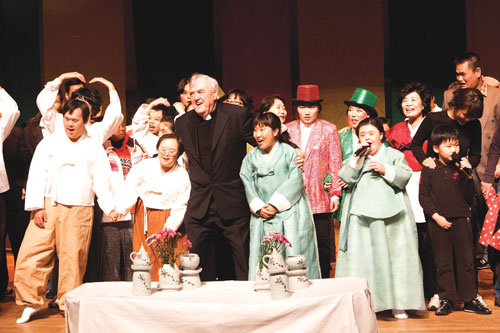
Fr O 'Neill founded Emmaus Welfare Center in 1981 to serve persons in Korea with learning disabilities. The video below was made to mark the 30th anniversary of one of the communities Father Noel started - the first? - in which persons with intellectual disabilities and others live together the kind of life that Jesus the Good Shepherd lived for 30 years before starting his public mission, which lasted but three years. 

I came that they may have life, and have it abundantly.


Pope Francis frequently asks people to pray for him. May I, as a priest, ask you to pray that all of us who have been called by God to the priesthood will truly be Good Shepherds.

16 September 2009

Hurtful terms in Philippine movie, Kimmy Dora, for persons with disabilities

The letter below, from Ms Landa A. Bautista (in photo below), Curriculum Director of The Learning Center, Inc (TLC), was sent to me by email today. I haven't seen the movie Kimmy Dora and am unlikely to do so. This is not in any way a review of the film but I agree very much with the central point that Ms Bautista is making.

I know that many people use the terms 'retarded','mentally retarded', 'MR' and 'mongoloid' with no desire whatever to hurt anyone. All of these terms have been in use for a long time but are better dropped at this stage. I'll highlight parts of the letter and add some [comments].

The Learning Center, Inc. (TLC) is deeply saddened by the demeaning language used in the movie “Kimmy Dora”. I appeal to everyone to please stop the derogatory use of the words “retarded” and “mongoloid”. Remember, it only seems like a funny & petty joke until you yourself have a child with special needs.

As a Special Educator and as someone who advocates the universal acceptance of differences, this comes with a call that you help ban the movie "KimmyDora". Or, AT THE VERY LEAST, help educate people on the hurtful consequences of ignorance and insensitivity to people with developmental conditions. [As I haven't seen the movie I can't ask that it be banned].

Help speak up for the many members of the special needs community who cannot speak out for themselves.

Our thoughts shape our words and eventually, our actions. How we initially see individuals with special needs is primarily reflected by our language. We can use it to discriminate against special people OR dispel negative stereotypes about them....

I sincerely pray we choose, and likewise tell everyone we know, to do the latter.

WE CELEBRATE THE MIRACLE THAT WE ARE BY CELEBRATING THE MIRACLE THAT THEY ARE.

Just this weekend, I've observed a rise in the disturbingly nonchalant and offensive use of these terms. It truly hurts me that a single movie can erase the hard work involved in removing the social stigma associated with these terms.

Entertainment need not be insensitive to be funny. This is an appeal to local producers to research and use acceptable, politically correct terms for membersof the differently-abled special population AND portray them in a positivelight. [I don't like the term 'politically correct' since it has become a form of censorship in many ways but I see the need for language that it accurate and without negative or derogatory overtones. Nor do I particularly like the term 'differently-abled' though it is a positive term reminding us that everyone has some ability. But we have to face the reality that there are many people, not only those with learning disabilities, who need the practical support of others to use their abilities, no matter how limited, to the full]. Please do not put the influence of media to waste. Use it to educate people, not pull them into the dark ages of ignorance and apathy. [I like this. The media, in whatever form, can be used for good or bad purposes].

We pray for everyone's enlightenment. Please help us spread theword. Godspeed!

All good wishes,
Ms. Landa A. Bautista, M.A.Ed.
Curriculum Director
The Learning Center, Inc. (TLC)

I came across this video on the L'Arche community in Cainta, Rizal, the only one in the Philippines, a home where persons with mental and learning disabilities, some of them with severe physical disabilities as well, are given a chance to develop their abilities. Over the years Columban seminarians have gone their regularly. Maira San Juan, a Columban lay missionary in Korea, lived there before as an assistant.

The photos of the two young men were taken at a celebration for the 80th birthday of Marie-Hélène Mathieu who, with Jean Vanier, founded Faith and Light. Jean also founded L'Arche. Both movements have persons with learning disabilities as their 'VIPs'.

02 February 2008

The face of evil

Pope Benedict's General Prayer Intention for February is:

Mentally Handicapped. That the mentally handicapped may not be marginalized, but respected and lovingly helped.

(An alternative English version is: That people with learning disabilities be loved and respected so that they can live life to the full.)


The urgency of this intention is seen in today's news in The Daily Telegraph and other news sources:

Baghdad market bombers 'mentally impaired'

By Damien McElroy in Baghdad
Last Updated: 3:24am GMT 02/02/2008

Two women with Down's Syndrome were used to deliver remote-controlled bombs to the heart of Baghdad's thriving markets, killing at least 93 people and shattering the Iraqi capital's fragile peace.

Disturbing details of the "brutal and barbaric" attacks emerged last night, with Iraqi officials claiming the women may not have known they were on a suicide mission.

Instead, they may have unwittingly become part of al-Qa'eda's campaign to kill off any semblance of normality in the Iraqi capital. Read the full story here.

This is surely the face of evil. In Irish someone with Down's Syndrome is spoken of as 'duine le Dia', ' a person with God'. If this report is accurate the incident can only be described as diabolical in the full sense of that word.

Related to this is a debate in the House of Lords in London a few days ago (H/T to Fr Tim Finigan, 31 January, 'Life unworthy of life?' with a link to the blog of John Smeaton, Director of the Society for the Protection of Unborn Children (SPUC).

Hitler's ideology is now respectable.