Showing posts with label Gerard Manley Hopkins SJ. Show all posts

10 July 2026

Sunday Reflections, 15th Sunday in Ordinary Time, Year A, 12 July 2026


The Sower, June 1888, Arles
Vincent van Gogh [Web Gallery of Art]

A sower went out to sow . . .

Readings (Jerusalem Bible: Australia, Ireland, New Zealand)

Readings (English Standard Version, Catholic Edition: England & Wales, Scotland, India)

Readings (New American Bible: Philippines, USA)  

Gospel Matthew 13:1-23 (English Standard Version)

At that time: Jesus went out of the house and sat beside the lake. And great crowds gathered about him, so that he got into a boat and sat down. And the whole crowd stood on the beach. And he told them many things in parables, saying: ‘A sower went out to sow. And as he sowed, some seeds fell along the path, and the birds came and devoured them. Other seeds fell on rocky ground, where they did not have much soil, and immediately they sprang up, since they had no depth of soil, but when the sun rose they were scorched. And since they had no root, they withered away. Other seeds fell among thorns, and the thorns grew up and choked them. Other seeds fell on good soil and produced grain, some a hundredfold, some sixty, some thirty. He who has ears, let him hear.’

Then the disciples came and said to him, ‘Why do you speak to them in parables?’ And he answered them, ‘To you it has been given to know the secrets of the kingdom of heaven, but to them it has not been given. For to the one who has, more will be given, and he will have an abundance, but from the one who has not, even what he has will be taken away. This is why I speak to them in parables, because seeing they do not see, and hearing they do not hear, nor do they understand. Indeed, in their case the prophecy of Isaiah is fulfilled that says: “You will indeed hear but never understand, and you will indeed see but never perceive.” For this people’s heart has grown dull, and with their ears they can barely hear, and their eyes they have closed, lest they should see with their eyes and hear with their ears and understand with their heart and turn, and I would heal them. But blessed are your eyes, for they see, and your ears, for they hear. For truly, I say to you, many prophets and righteous people longed to see what you see, and did not see it, and to hear what you hear, and did not hear it.

‘Hear then the parable of the sower: When anyone hears the word of the kingdom and does not understand it, the evil one comes and snatches away what has been sown in his heart. This is what was sown along the path. As for what was sown on rocky ground, this is the one who hears the word and immediately receives it with joy, yet he has no root in himself, but endures for a while, and when tribulation or persecution arises on account of the word, immediately he falls away. As for what was sown among thorns, this is the one who hears the word, but the cares of the world and the deceitfulness of riches choke the word, and it proves unfruitful. As for what was sown on good soil, this is the one who hears the word and understands it. He indeed bears fruit and yields, in one case a hundredfold, in another sixty, and in another thirty.’ 

Léachtaí i nGaeilge


Green Wheat Fields
Vincent van Gogh [Web Gallery of Art]

. . . Other seeds fell on good soil , , ,

Wheatfield with Reaper at Sunrise
Vincent van Gogh [Web Gallery of Art]

. . . and produced grain . . .

Harvest at La Crau (The Blue Cart)
Vincent van Gogh [Web Gallery of Art]

. . . some a hundredfold, some sixty, some thirty . . .

Wheat Field with a Lark
Vincent van Gogh [Web Gallery of Art]

. . . He who has ears, let him hear

In the spring of 1982 I made the Spiritual Exercises of St Ignatius at Loyola House, Guelph, Ontario, Canada. We spent 40 days there, a few days of preparation for the Thirty-Day Retreat proper and five days of reflection on the experience afterwards. One of the spiritual directors, though not my own, was an American Jesuit priest named George. He was probably in his 60s at the time. He had worked for some years in South America and he was a recovering alcoholic.

One evening I saw Father George come out of the Jesuit residence dressed very nattily, wearing a rather nice sports jacket and hat, his pipe in one hand - and his rosary beads in the other. I said to myself, 'That man has it all together!'


Head of a Young Peasant with Pipe
Vincent van Gogh [Web Gallery of Art]

He gave unusual homilies, laced with a delightfully dry and ironic humour. One was simply about a tiny bird - I think it was a species of hummingbird - that migrates each year in both directions between Alaska and Tierra del Fuego at the southern tip of South America, without stopping. All of us listening were filled with awe at God's creation, at the power and endurance of one of God's creatures, one that didn't have the power of reasoning but that knew how to get from one end of the landmass of the Americas to the other and to know where to go.

The First Reading and its Responsorial Psalm along with the Gospel invite us to reflect on how God's word takes root in our hearts. But they also invite us to reflect on God's bounty as revealed in nature itself. Isaiah tells us in the First Reading that it is impossible for the rain and snow that God sends not to bear fruit: For as the rain and the snow come down from heaven, and do not return there but water the earth, making it bring forth and sprout, giving seed to the sower and bread to the eater; so shall my word be that goes out from my mouth; it shall not return to me empty, but it shall accomplish that which I purpose, and succeed in the thing for which I sent it (Isaiah 55:10-11).

Sunny Lawn in a Public Park
Vincent van Gogh [Web Gallery of Art]

Psalm 64 [65], the Responsorial Psalm, echoes this:

You crown the year with your bounty

 your wagon tracks overflow with richness.
The pastures of the wilderness overflow,
the hills gird themselves with joy,
the meadows clothe themselves with flocks,
the valleys deck themselves with grain,
they shout and sing together for joy.

Jesus takes something simple in nature as an example of how God's word, God's very life, takes root in our lives. But we can see God's loving power, presence and bounty in the seed itself, without drawing any analogies or other meanings from it. Those of us who aren't from a farming background can take for granted the food that lands on our table. All the nourishment that we find in a loaf of bread or in a bowl of rice is there already in the grains the farmer sows. The seed of a husband fertilized by the egg of his wife becomes a new human being containing already in its microscopic size all that will be evident when that person is born and grows to maturity.

There is great emphasis today on the urgency of respecting nature and of not abusing it, in order to avoid possible disastrous consequences.

But the basic reason we should respect all of nature is that it is an expression of God's infinite bounty 'singing' in its own way: the valleys . . . shout and sing together for joy.

Father George conveyed something of that to all of us on retreat in Guelph 44 years ago. Another Jesuit priest, Gerard Manley Hopkins, captured that in some of his poems, including Pied Beauty, published 29 years after his death and 41 years after he wrote it, rather like the seed being buried in the ground in spring and bearing fruit at harvest-time.

+++

In your charity pray for the soul of Vincent van Gogh who, through his paintings, revealed so much of the beauty of God in nature and in people and yet suffered greatly in his own life. Pray for all who are walking in darkness. And pray for the souls of all who, like Vincent, have taken their own lives.

Pied Beauty
by Gerard Manley Hopkins SJ
Read by Kristin Scott Thomas


Traditional Latin Mass

Seventh Sunday After Pentecost

The Complete Mass in Latin and English is here. (Adjust the date at the top of that page to 07-12-2026 if necessary).

Epistle: Romans 6:19-23. Gospel: Matthew 7:15-21.

Peach Tree in Blossom

Vincent van Gogh [Web Gallery of Art]

A sound tree cannot bear evil fruit, nor can a bad tree bear good fruit (Matthew 7:18; Gospel).




22 May 2026

Sunday Reflections, Pentecost, Year A, 24 May 2026


Pentecost

Sir Anthony van Dyck [Web Gallery of Art]


Pentecost Sunday, at the Vigil Mass . 

NB: The Vigil Mass has its own prayers and readings. Those for the Mass During the Day on Sunday should not be used – though some priests seem to be unaware of this. It is incorrect to refer to this Vigil Mass as an ‘anticipated Mass’. It is a celebration proper to the evening before Pentecost Sunday and may be celebrated in an extended form. It also fulfils the Sunday obligation.  

Readings (New American Bible: Philippines, USA

Gospel John 7:37-39 (English Standard Version, Anglicised) 

On the last day of the feast, the great day, Jesus stood up and cried out, “If anyone thirsts, let him come to me and drink. Whoever believes in me, as the Scripture has said, ‘Out of his heart will flow rivers of living water.’” Now this he said about the Spirit, whom those who believed in him were to receive, for as yet the Spirit had not been given, because Jesus was not yet glorified.

Mass During the Day, Year A

Readings (Jerusalem Bible: Australia, Ireland, New Zealand)

Readings (English Standard Version, Catholic Edition: England & Wales, Scotland, India)

Readings (New American Bible: Philippines, USA)

Gospel John 20:19-23 (English Standard Version, Anglicised)

On the evening of that day, the first day of the week, the doors being locked where the disciples were for fear of the Jews, Jesus came and stood among them and said to them, ‘Peace be with you.’ When he had said this, he showed them his hands and his side. Then the disciples were glad when they saw the Lord. Jesus said to them again, ‘Peace be with you. As the Father has sent me, even so I am sending you.’ And when he had said this, he breathed on them and said to them, ‘Receive the Holy Spirit. If you forgive the sins of any, they are forgiven them; if you withhold forgiveness from any, it is withheld.’

Léachtaí i nGaeilge


Confession
Giuseppe Maria Crespi [Web Gallery of Art]

In the summer of 1982 I did a number of short supplies for priests in parishes in a diocese in the western USA. In one parish where I spent only a weekend I found a note that had been shoved under the front door on Monday morning and addressed to me. There was no signature but it was written in the style of a teenage girl.

Very often anonymous letters are negative and condemnatory of the receiver. This was the very opposite. I don’t remember what the gospel reading of the Sunday was but it highlighted the mercy of God and that is what I had preached about. Whatever I said touched the writer of the note profoundly. She wrote that for years she had hated God. I’ve no idea why or of what had been troubling her. She might well have been the victim of some awful act of another. But when at that Sunday Mass she heard the Good News that God is a forgiving God and that he loves each of us individually and unconditionally she was able to let go of the hatred, if that is what it really was, and of the anger in her heart and accept God’s love. She wrote that for the first time in years she went to Holy Communion.

As we celebrate the Descent of the Holy Spirit the gospel today tells us that the Risen Lord, appearing to the Apostles, breathed on them and said to them, Receive the Holy Spirit. If you forgive the sins of any, they are forgiven them; if you withhold forgiveness from any it is withheld. 

One of the greatest gifts of the Holy Spirit to the Church is the power to forgive in God’s name, to enable us to hear Jesus say to us what he said to the Apostles twice in today’s short gospel reading, Peace be with you. This is the gift he offered at the Last Supper.

This is the gift God gives us most especially in the Sacrament of Reconciliation, what many of us still call Confession or Penance.   It is the way in which God, through the Church and specifically through the sacrament of Holy Orders, brings back into communion with him those who have turned away from him through mortal sin, that is a sin involving grave matter, a clear awareness that it is such and full and deliberate consent to the act. To go to confession in that situation is a matter of urgency, to be done before we go to Holy Communion again. Then Holy Communion becomes a true celebration of the full communion that God wants each of us to have with him.

But the sacrament is also a great help to those who are faithfully following Jesus but who sometimes take to byways down which God is not calling them, byways that lead into sin. Though the Sacrament of Reconciliation is not essential for the forgiveness of such sins it is the special way given by God through the Holy Spirit for that. If you forgive the sins of any, they are forgiven them.

The priest too is a sinner and each time he goes to confession himself he understands the struggle to overcome shame of those who come to him to confess their sins and to receive from him the forgiveness of a merciful and understanding God.

I left that parish on Monday morning and did not know who had shoved the note under the door. I’ve no idea what became of the writer. Perhaps she went to confession shortly after. Very likely she hadn’t committed any grave sin but had suffered greatly because of the actions of another; But whatever the situation was she had a profound experience of God’s mercy that Sunday, something like that of Zacchaeus, like that of the woman caught in adultery, like that of the Prodigal Son.

The gospels don’t tell us what subsequently became of Zacchaues or of the woman caught in adultery. But we know that the Holy Spirit profoundly touched their hearts, healed their wounds and changed their lives as Jesus passed by. And I know that the Holy Spirit profoundly touched the heart and healed the wounds of that young woman in the western USA parish as Jesus ‘passed by’ that Sunday morning through a priest who spent only two nights there.

The Sequence in today’s Mass, Veni Sancte Spiritus, ‘Come, Holy Spirit’, expresses something of that in the seventh stanza:

Lava quod est sordidum, Heal our wounds, our strength renew,

Riga quod est aridum, On our dryness pour your dew,
Sana quod est saucium. Wash the stains of guilt away.


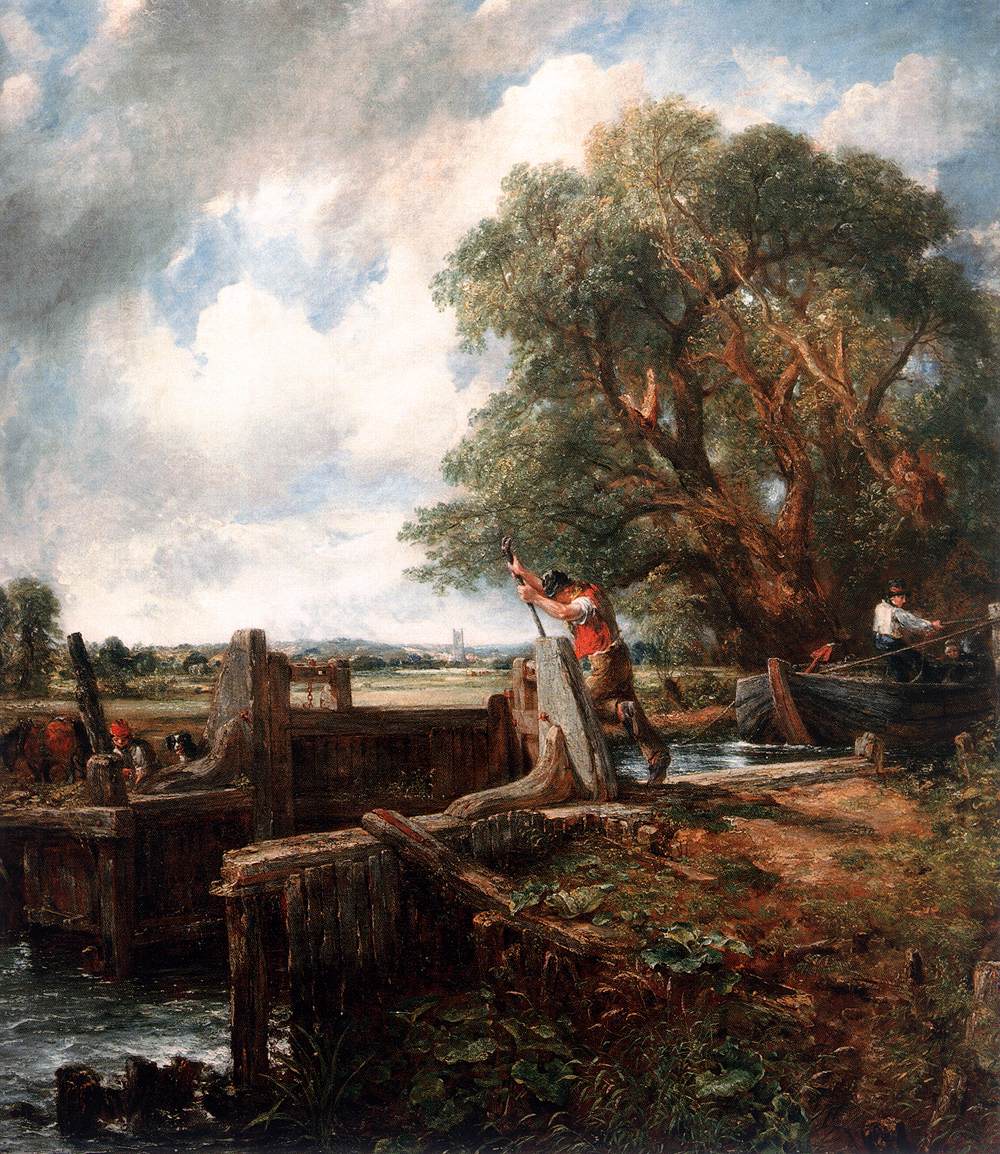
The Lock
John Constable [Web Gallery of Art]

The response for the Responsorial Psalm in the Sunday Mass is: Send forth your Spirit, O Lord, and renew the face of the earth. This is from Psalm 103 [104], the great psalm of creation, verses from which are used in the Responsorial Psalm, which includes these words: You send forth your spirit, they are created; and you renew the face of the earth. This is a reminder to us that as Christians we are called by the Holy Spirit to respect and take care of everything that God has created so that it may continue to bring life and not death. Six times in the account of creation in Genesis 1:1-31 we read, And God saw that it was good. The seventh time we read, And God saw everything that he had made, and behold, it was very good.

English poet Gerard Manley Hopkins SJ captures something of the presence of the Holy Spirit in every aspect of creation and life in the closing lines of his poem God’s Grandeur:

Because the Holy Ghost over the bent 
World broods with warm heart and with ah! Bright wings.


God's Grandeur
by Gerard Manley Hopkins, read by Jonathan Roumie


Traditional Latin Mass

Pentecost

The Complete Mass in Latin and English is here. (Adjust the date at the top of that page to 05-24-2026 if necessary).

Lesson: Acts 2:1-11. Gospel: John 14:23-31.


Pentecost

And there appeared to them tongues as of fire, distributed and resting on each one of them (Acts 2:3; Lesson).


06 June 2025

'The world is charged with the grandeur of God.' Sunday Reflections, Pentecost, Year C


Pentecost

Pentecost Sunday, at the Vigil Mass 

(Saturday evening), Years ABC

NB: The Vigil Mass has its own prayers and readings which should be used at the Vigil Mass. The prayers and readings for the Mass During the Day on Sunday should not be used only on Sunday, not at the Vigil Mass, though some priests seem to be unaware of this. It is incorrect to refer to this Vigil Mass as an ‘anticipated Mass’. It is a celebration proper to the evening before Pentecost Sunday and may be celebrated in an extended form. It also fulfils the Sunday obligation.

Readings (Jerusalem Bible: Australia, Ireland, New Zealand, Pakistan, Scotland)

Readings (English Standard Version, Catholic Edition: England & Wales, India, Scotland) 

Readings (New American Bible: Philippines, USA)

Gospel John 7:37-39 (English Standard Version, Anglicised) 

On the last day of the feast, the great day, Jesus stood up and cried out, “If anyone thirsts, let him come to me and drink. Whoever believes in me, as the Scripture has said, ‘Out of his heart will flow rivers of living water.’” Now this he said about the Spirit, whom those who believed in him were to receive, for as yet the Spirit had not been given, because Jesus was not yet glorified.

Mass During the Day, Year C

Readings (Jerusalem Bible: Australia, Ireland, New Zealand, Pakistan, Scotland)

Readings (English Standard Version, Catholic Edition: England & Wales, India, Scotland) 

Readings (New American Bible: Philippines, USA

Gospel John 14:15-16, 23-26 (English Standard Version Anglicised: England & Wales, India, Scotland)  

Jesus said to his disciples:

‘If you love me, you will keep my commandments. And I will ask the Father, and he will give you another Helper, to be with you for ever,

‘If anyone loves me, he will keep my word, and my Father will love him, and we will come to him and make our home with him. Whoever does not love me does not keep my words. And the word that you hear is not mine but the Father's who sent me.

These things I have spoken to you while I am still with you. But the Helper, the Holy Spirit, whom the Father will send in my name, he will teach you all things and bring to your remembrance all that I have said to you.’

Or

GospelJohn 20:19-23 (English Standard Version Anglicised: India)  

On the evening of that day, the first day of the week, the doors being locked where the disciples were for fear of the Jews, Jesus came and stood among them and said to them, “Peace be with you.” When he had said this, he showed them his hands and his side. Then the disciples were glad when they saw the Lord. Jesus said to them again, “Peace be with you. As the Father has sent me, even so I am sending you.” And when he had said this, he breathed on them and said to them, “Receive the Holy Spirit. If you forgive the sins of any, they are forgiven them; if you withhold forgiveness from any, it is withheld.”

Léachtaí i nGaeilge

Pentecost
Master of the Dominican Effigies [Web Gallery of Art]

Here is what Pope Benedict XVI said in his Regina Caeli talk on Pentecost Sunday, 27 May 2007, to the people in St Peter's SquareThe emphases are mine.

Dear Brothers and Sisters,

Today, we celebrate the great feast of Pentecost, in which the liturgy has us relive the birth of the Church, according to what St Luke narrates in the book of the Acts of the Apostles (2: 1-13).

Fifty days after Easter, the Holy Spirit descended on the community of disciples - 'with one accord devoted themselves to prayer' - gathered with 'Mary, the mother of Jesus' and with the Twelve Apostles (cf. Acts 1: 14; 2: 1). We can therefore say that the Church had its solemn beginning with the descent of the Holy Spirit.

In this extraordinary event we find the essential and qualifying characteristics of the Church: the Church is one, like the community at Pentecost, who were united in prayer and 'concordant': 'were of one heart and soul' (Acts 4: 32).

The Church is holy, not by her own merits, but because, animated by the Holy Spiritshe keeps her gaze on Christ, to become conformed to him and to his love.

The Church is catholic, because the Gospel is destined for all peoples, and for this, already at the beginning, the Holy Spirit made her speak all languages.

The Church is apostolic, because, built upon the foundation of the Apostles, she faithfully keeps their teaching through the uninterrupted chain of episcopal succession.

What is more, the Church by her nature is missionary, and from the day of Pentecost the Holy Spirit does not cease to move her along the ways of the world to the ends of the earth and to the end of time.

This reality, which we can verify in every epoch, is already anticipated in the Book of Acts, where the Gospel passage from the Hebrews to the pagans, from Jerusalem to Rome, is described. Rome represents the pagan world, and hence, all people who are outside of the ancient People of God. Actually, Acts concludes with the arrival of the Gospel to Rome.

It can be said, then, that Rome is the concrete name of catholicity and missionary spirit, it expresses fidelity to the origins, to the Church of all times, to a Church that speaks all languages and extends herself to all cultures.

Dear brothers and sisters, the first Pentecost took place when Mary Most Holy was present amid the disciples in the Upper Room in Jerusalem and prayed. Today, too, let us entrust ourselves to her maternal intercession, so that the Holy Spirit may descend in abundance upon the Church in our day, fill the hearts of all the faithful and enkindle in them the fire of his love.

+++

Pope Benedict notes: the first Pentecost took place when Mary Most Holy was present amid the disciples in the Upper Room in Jerusalem and prayed. In the three paintings I have chosen for this post  Mary is in the centre. We must never forget that from all eternity God the Father had chosen Mary to be the one to bring the Divine Word, the Second Person of the Holy Trinity, into the world as Jesus Christ, God who became Man. John 1: 14 tells us: the Word became flesh and dwelt among us. In Luke 1:34-35 Mary asks How will this be, since I am a virgin? and the angel replies, The Holy Spirit will come upon you, and the power of the Most High will overshadow you; therefore the child to be born will be called holy—the Son of GodLuke 2:51 states: And he went down with them and came to Nazareth and was submissive to them, 'them' being Mary and her husband St Joseph.

The Nicene Creed and the Apostles' Creed are shared by all Christians. In the former we pray and by the Holy Spirit was incarnate of the Virgin Mary, and became man; in the latter we proclaim I believe . . . in Jesus Christ, his only Son, our Lord, who was conceived by the Holy Spirit, born of the Virgin Mary . . .

God's Grandeur
by Gerard Manley Hopkins SJ, read by Samuel West 

Because the Holy Ghost over the bent

World broods with warm breast and with ah! bright wings.

Ordinary Time resumes on 9 June: Monday in the Tenth Week of Ordinary Time. That day is the Memorial of Mary Mother of the Church, established by Pope Francis in 2018. The special readings are here and here.

In Ireland and Scotland Monday is the Feast of St Columba (Colum Cille).


Traditional Latin Mass

Pentecost or Whitsunday

The Complete Mass in Latin and English is here. (Adjust the date at the top of that page to 06-08-2023 if necessary).

Lesson: Acts 2:1-11Gospel: John 14:23-31.

The Octave of Pentecost runs from the Vigil of Pentecost till the Saturday after Pentecost.

Pentecost

These things I have spoken to you, while I am still with you. But the Counselor, the Holy Spirit, whom the Father will send in my name, he will teach you all things,[and bring to your remembrance all that I have said to you (John 14:25-26; Gospel).