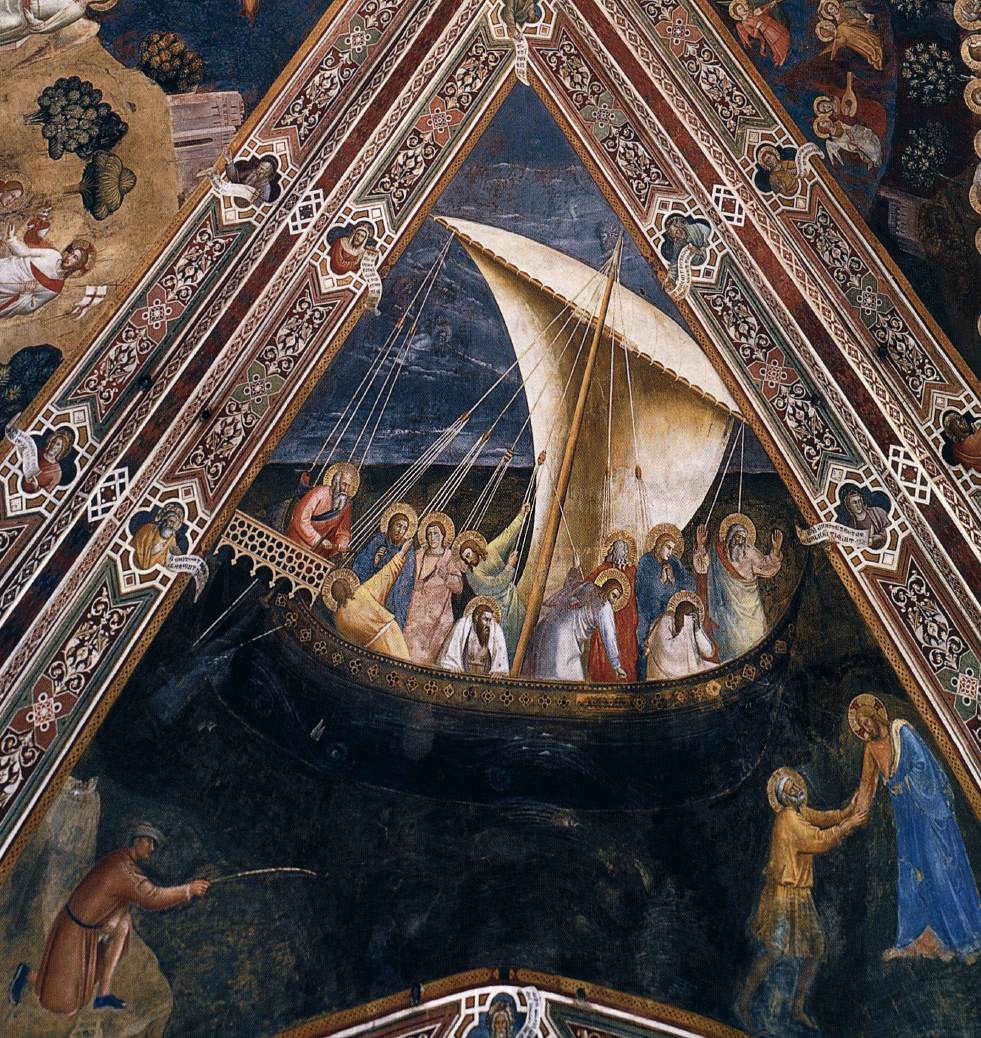
Cappellone
degli Spagnoli, Santa Maria Novella, Florence [Web Gallery of Art]
Readings (New American Bible: Philippines, USA)
Readings (Jerusalem Bible: Australia, England & Wales, India [optional],
Ireland, New Zealand, Pakistan, Scotland, South Africa)
Gospel Matthew 14:22-33 (New Revised Standard Version,
Catholic Edition, Canada)
Immediately Jesus made the disciples get into
the boat and go on ahead to the other side, while he dismissed the crowds. And after he had dismissed
the crowds, he went up the mountain by himself to pray. When evening came, he
was there alone, but by this time the boat, battered by the waves, was far from the
land, for the wind was against them. And early in the morning he
came walking toward them on the sea. But when the disciples saw
him walking on the sea, they were terrified, saying, “It is a ghost!” And they
cried out in fear. But immediately Jesus spoke to them and said, “Take heart, it is
I; do not be afraid.”
Peter answered him, “Lord, if it is you, command me to come to you
on the water.” He said, “Come.” So Peter got out of the boat, started walking on
the water, and came toward Jesus. But when he noticed the
strong wind, he became
frightened, and beginning to sink, he cried out, “Lord, save me!” Jesus immediately reached out
his hand and caught him, saying to him, “You of little faith, why did you
doubt?” When they got into the boat, the wind ceased. And those in the boat
worshiped him, saying, “Truly you are the Son of God.”

(3 March 1873 - 16 August 1917)
During the last week or two there have been many commemorative events recalling the beginning of the Great War one hundred years ago. 97 years ago, on the Feast of the Transfiguration, 6 August, Corporal Lawrence Dowd (37), an older half-brother of my maternal grandmother, Annie Dowd Collins, was killed near Ieper (Ypres), Belgium, in the Third Battle of Ypres, often referred to simply as 'Passchendaele'. I was the first relative to locate his grave, in 2001, 84 years after his death.

At my great-uncle's grave, September 2001
Ten days later Fr William Doyle SJ was killed in the same battle. When I was in kindergarten in Stanhope St, Dublin, Sr Stanislaus of the Irish Sisters of Charity, who was principal of the boys' kindergarten and who prepared us for First Confession and First Holy Communion, spoke to us many times about Fr Willie Doyle and about Father Damien, now St Damien of Molokai.
Fr Doyle wrote many letters to his father in Dalkey, a village by the sea south of Dublin, from the trenches of Flanders. What he wrote about 6 August 1917, ten days before his death, reflects for me different aspects of today's gospel. His writings and writings about him can be found on Remembering Fr William Doyle SJ, a truly inspiring blog.
Today's gospel tells us that after Jesus had dismissed the crowds, he went up the mountain by himself to pray. When evening came, he was there alone. Fr Doyle writes about the morning of 6 August: For once getting out of bed was an easy, in fact, delightful task, for I was stiff and sore from my night’s rest. My first task was to look round and see what were the possibilities for Mass. As all the dug-outs were occupied if not destroyed or flooded, I was delighted to discover a tiny ammunition store which I speedily converted into a chapel, building an altar with the boxes. The fact that it barely held myself did not signify as I had no server and had to be both priest and acolyte, and in a way I was not sorry I could not stand up, as I was able for once to offer the Holy Sacrifice on my knees.
It is strange that out here a desire I have long cherished should be gratified, viz. : to be able to celebrate alone, taking as much time as I wished without inconveniencing anyone. I read long ago in the Acts of the Martyrs of a captive priest, chained to the floor of the Coliseum, offering up the Mass on the altar of his own bare breast, but apart from that, Mass that morning must have been a strange one in the eyes of God's angels, and I trust not unacceptable to Him.
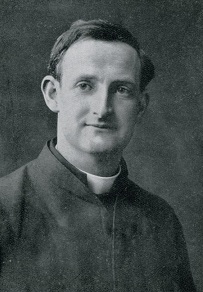
Fr Willie Doyle SJ
In the First Reading we see how the prophet Elijah was called by God to stay in a cave where the Lord is about to pass by. Father Doyle's 'cave' was a tiny ammunition store which he converted into a chapel. Elijah didn't find the Lord in a great wind, an earthquake or a fire. But after the fire a sound of sheer silence. When Elijah heard it, he wrapped his face in his mantle and went out and stood at the entrance of the cave. What the NRSV translates as a sound of sheer silence the Jerusalem Bible describes as the sound of a gentle breeze and the New American Bible as a tiny whispering sound.
That particular morning things were relatively quiet in the area where Father Willie served and yet my great-uncle was killed that day. But yet this great chaplain was able to find some space and time for himself to be with the Father, as Jesus did on the mountain.
St Matthew tells us how difficult things were for the Apostles: but by this time the boat, battered by the waves, was far from the land, for the wind was against them.
Father Willie tells us about his relatively 'quiet' day: I spent a good part of the day, when not occupied with the wounded, wandering round the battle-field with a spade to bury stray dead. Though there was not very much infantry fighting owing to the state of the ground, not for a moment during the week did the artillery duel cease, reaching at times a pitch of unimaginable intensity, I have been through some hot stuff at Loos, and the Somme was warm enough for most of us, but neither of them could compare to the fierceness of the German fire here. For example, we once counted fifty shells, big chaps too, whizzing over our little nest in sixty seconds, not counting those that burst close by. In fact you became so accustomed to it all that you ceased to bother about them, unless some battery started strafing your particular position when you began to feel a keen personal interest in every new comer. I have walked about for hours at a time getting through my work, with crumps of all sizes bursting in dozens on every side.

Potijze Chateau Cemetery, near Ieper (Ypres) where Corporal Lawrence Dowd is buried.
The Gospel: But when the disciples saw him walking on the sea, they were terrified, saying, “It is a ghost!” And they cried out in fear . . . So Peter got out of the boat, started walking on the water, and came toward Jesus. But when he noticed the strong wind, he became frightened, and beginning to sink, he cried out, “Lord, save me!”
Fr Doyle: More than once my heart has nearly jumped out of my mouth from sudden terror.
The Gospel: Jesus immediately reached out his hand and caught him, saying to him, “You of little faith, why did you doubt?”
Father Willie: Not once during all these days have I had what I could call a narrow escape, but always a strange confident feeling of trust and security in the all powerful protection of our Blessed Lord. You will see before the end that my trust was not misplaced. All the same I am not foolhardy nor do I expose myself to danger unnecessarily, the coward is too strong in me for that.
St Matthew: When they got into the boat, the wind ceased. And those in the boat worshiped him, saying, “Truly you are the Son of God.”
Fr Doyle: When duty calls I know I can count on the help of One Who has never failed me yet.
This great priest, who attended many soldiers as they lay dying, including Germans, truly knew 'the smell of the sheep', to use the words of his fellow Jesuit, Pope Francis. On 16 August, having run 'all day hither and thither over the battlefield like an angel of mercy' was hit by a shell. His body was never recovered.
Today bishops and priests in a number of troubled countries, and the people they serve, are faced with situations that surely cause them fear, the kind of fear the Apostles in the boat felt, the kind of fear Fr Doyle felt. Yet they make choices to stay with their people.

Catholic Cathedral in Tripoli, 1960s, later converted into a mosque [Wikipedia]
One such is Filipino Fr Allan Jose L. Arcebuche OFM, Vicar General of the Vicariate Apostolic of Tripoli, Libya. He said in an interview on 6 August, Although some local militia members have warned Christians to leave Libya, many Muslims are reassured by our presence here. We've promised the Church will stay with them in their struggles and difficulties.
Bishop Giovanni Innocenzo Martinelli OFM of Tripoli, who was born in El Khadra, Libya, though clearly of Italian origin, told the Vatican's Fides news agency 4 August he was determined to stay 'even if only one Christian remains'. He added that Libya's Catholics were now 'reduced to a minimum' and facing 'a time of strong ordeal', but said he was 'confident a group of people will be here to serve the Church'.
Bishop Martinelli added: In Cyrenaica there are no nuns while the majority of Filipinos are leaving the region, who are the heart of the Christian community in Libya. In Tripoli, there is still a good presence of Filipinos but even here many of them are leaving. The Church lives in relationship with this presence of lay people who work in the health sector and given the situation this is really a time of strong ordeal. I do not know where we will end up but I am confident that a group of people will be here to serve the Church.
Bishop Martinelli, like Fr Willie Doyle, trusts in Jesus (who) immediately reached out his hand and caught Peter. I still have confidence in the future of Libya but we are in God's hands. I cannot leave the few remaining Christians. Bishop Martinelli has launched an appeal for prayer because prayer alone can solve difficult situations like the one in Libya today.
May we join in that prayer to Jesus who immediately reached out his hand.
Kyrie, Missa de Angelis
Kyrie, eleison; Christe, eleison; Kyrie, eleison is Greek for 'Lord, have mercy; Christ, have mercy; Lord, have mercy'. It is the only part of the Mass of the Roman or Latin Rite in the Greek language, the rest being in Latin. (Translations of the Mass into other languages are from the Greek/Latin version) The Good Friday liturgy of the Roman or Latin Rite, to which most Catholics belong, also has some Greek chants.
The Missa de Angelis is probably the best known of the settings of the Mass in Gregorian chant and was widely known and sung throughout the Church before Vatican II. Below is a setting based on the Missa de Angelis by Domenico Cardinal Bertolucci (1917 - 2013), director of the Sistine Chapel Choir for many years. It is sung here by the Capella Victoria, Jakarta, Indonesia.
Here is a setting by Claudio Monteverdi (1567 - 1643) sung by the Ensemble Vocal Européen, directed by Philippe Herreweghe, a Belgian.
Missa in illo tempore, Kyrie, Monteverdi


