Showing posts with label Jusepe de Ribera. Show all posts

17 July 2026

Sunday Reflections, 16th Sunday in Ordinary Time, Year A, 19 July 2026


Sheaves of Wheat
Vincent van Gogh [Web Gallery of Art]

Readings (Jerusalem Bible: Australia, Ireland, New Zealand)

Readings (English Standard Version, Catholic Edition: England & Wales, Scotland, India)

Readings (New American Bible: Philippines, USA)

Gospel Matthew 13:23-43  [Shorter version: 24-30] (English Standard Version)

At that time: Jesus put another parable before the crowd, saying, ‘The kingdom of heaven may be compared to a man who sowed good seed in his field, but while his men were sleeping, his enemy came and sowed weeds among the wheat and went away. So when the plants came up and bore grain, then the weeds appeared also. And the servants of the master of the house came and said to him, “Master, did you not sow good seed in your field? How then does it have weeds?” He said to them, “An enemy has done this.” So the servants said to him, “Then do you want us to go and gather them?” But he said, “No, lest in gathering the weeds you root up the wheat along with them. Let both grow together until the harvest, and at harvest time I will tell the reapers, ‘Gather the weeds first and bind them in bundles to be burned, but gather the wheat into my barn.’ ” ’

[He put another parable before them, saying, ‘The kingdom of heaven is like a grain of mustard seed that a man took and sowed in his field. It is the smallest of all seeds, but when it has grown it is larger than all the garden plants and becomes a tree, so that the birds of the air come and make nests in its branches.’

He told them another parable. ‘The kingdom of heaven is like leaven that a woman took and hid in three measures of flour, till it was all leavened.’

All these things Jesus said to the crowds in parables; indeed, he said nothing to them without a parable. This was to fulfil what was spoken by the prophet: ‘I will open my mouth in parables; I will utter what has been hidden since the foundation of the world.’

Then he left the crowds and went into the house. And his disciples came to him, saying, ‘Explain to us the parable of the weeds of the field.’ He answered, ‘The one who sows the good seed is the Son of Man. The field is the world, and the good seed is the sons of the kingdom. The weeds are the sons of the evil one, and the enemy who sowed them is the devil. The harvest is the end of the age, and the reapers are angels. Just as the weeds are gathered and burned with fire, so will it be at the end of the age. The Son of Man will send his angels, and they will gather out of his kingdom all causes of sin and all law-breakers, and throw them into the fiery furnace. In that place there will be weeping and gnashing of teeth. Then the righteous will shine like the sun in the kingdom of their Father. He who has ears, let him hear.’]

Léachtaí i nGaeilge


Reaper from Behind
Vincent van Gogh [Web Gallery of Art]

At harvest time I will tell the reapers, Gather the weeds first and bind them in bundles to be burned, but gather the wheat into my barn (Matthew 13:30; today’s Gospel). 

In 1997 while on a visit to Toronto I read in a newspaper about a woman from the Philippines  who had been found guilty of embezzling about Can$250,000 over a period of time from the company for which she worked. The judge had no alternative but to send her to prison. However he was a very compassionate man. 

The judge was aware that the woman was no Al Capone. She had spent the money on surgery for her father in the Philippines, on improving her family's house there and on other family needs.

 She was also pregnant.

 The judge delayed the woman's imprisonment until six months after the birth of her child. She was also to serve her time in a women's prison near where she lived so that her family and friends could visit her easily.

 The First Reading gives context to the parable of the good seed and the weeds: Through such works you have taught your people that the righteous must be kind, and you have filled your children with good hope, because you give repentance for sins (Wisdom 12:19; First Reading). 

The judge in this case was both righteous and kind. As one implementing justice on behalf of the state he had to punish the person before him because she had committed a serious crime. But he also filled her with good hope and, I've no doubt, gave her an opportunity to repent of her sins.

The parable shows once again God's mercy, God's desire to be merciful. He doesn't want to destroy what is good. He wants what is good to grow. He wants to cultivate the virtues in our lives by nourishing them through his grace and with our cooperation. 

But the parable also acknowledges the reality of evil. Gather the weeds first and bind them in bundles to be burned, the householder instructs his workers. We can choose to be 'weeds', to spurn God's mercy. The consequences are the result of our choice, not of God's. The author of the Book of Wisdom says to God, you give repentance for sins. God himself offers the grace of sorrow for our sins, the grace to ask God for forgiveness, won for us by Jesus on the Cross. Then Jesus said, 'Father, forgive them; for they do not know what they are doing' (Luke 23:34).

The greatest expression of the God's mercy, given as a gift to the Church, is the Sacrament of Reconciliation, which we often call confession or penance. In his Letter to Priests for Holy Thursday 2001 Pope St John Paul II wrote: Dear priests, let us make regular use of this Sacrament, that the Lord may constantly purify our hearts and make us less unworthy of the mysteries which we celebrate. Since we are called to show forth the face of the Good Shepherd, and therefore to have the heart of Christ himself, we more than others must make our own the Psalmist's ardent cry: 'A pure heart create for me, O God, put a steadfast spirit within me' (Ps 51:12). The Sacrament of Reconciliation, essential for every Christian life, is especially a source of support, guidance and healing for the priestly life.

Three Columban priests whom I knew in Mindanao, Fr Frank Chapman from Australia, Fr John Meaney from Ireland and Fr Jim Moynihan from New Zealand, lived this very fully in their latter years in Cagayan de Oro. They used to spend hours in the confessional in the Cathedral every weekday and people came from all over to avail of the sacrament of reconciliation. Fr Chapman was still hearing confessions a few weeks before his death in 2004 at the age of 91. He spent the years of World War II in the mountains of Mindanao where he shared all the hardships of the people. 

The judge in Canada, though he had to be primarily a judge, also showed the charity of God, as many judges do. He showed compassion, which was expressed not only in the respect he showed the woman from the Philippines, but also in the respect he showed to her unborn child.

And St John Paul II shows how priests are called to show forth the face of the Good Shepherd, and therefore to have the heart of Christ himself so that all of us will meet the Good Shepherd and experience in the merciful heart of Christ himself in confession.

An Phaidir
The Lord’s Prayer in Irish
Setting composed by Seán Ó Riada

Maith dúinn ár bhfiacha . . . Forgive us our trespasses . . .


Traditional Latin Mass

Eighth Sunday After Pentecost

The Complete Mass in Latin and English is here. (Adjust the date at the top of that page to 07-19-2026 if necessary).

Epistle: Romans 8:12-17. Gospel: Luke 16:1-9.

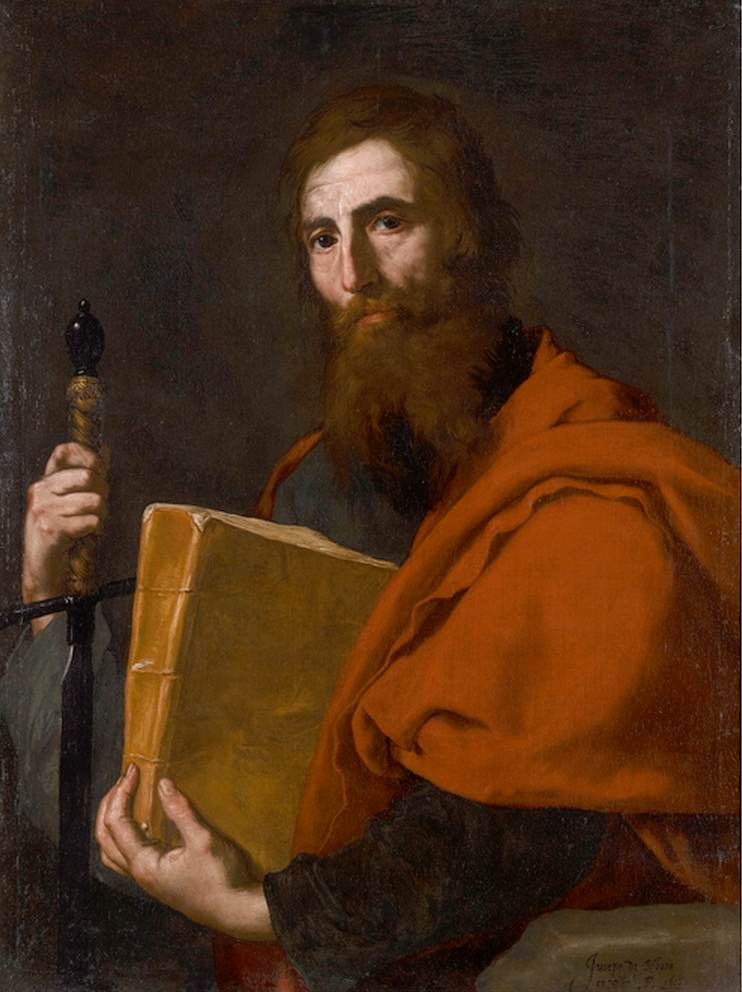
St Paul
Jusepe de Ribera [Web Gallery of Art]

When we cry, 'Abba! Father!' it is the Spirit himself bearing witness with our spirit that we are children of God (Romans 8:15-16; today's Epistle).




01 August 2025

'Christ is all, and in all.' Sunday Reflections, 18th Sunday in Ordinary Time, Year C


Altar of St Ignatius of Loyola, Il Gesù, Rome
Andrea Pozzo SJ [Web Gallery of Art]

Very rightly the fine arts are considered to rank among the noblest activities of man's genius, and this applies especially to religious art and to its highest achievement, which is sacred art. These arts, by their very nature, are oriented toward the infinite beauty of God which they attempt in some way to portray by the work of human hands; they achieve their purpose of redounding to God's praise and glory in proportion as they are directed the more exclusively to the single aim of turning men's minds devoutly toward God (Vatican II, Sacrosanctum Concilium, No 122).

Readings (Jerusalem Bible: Australia, Ireland, New Zealand, Pakistan,)

Readings (English Standard Version, Catholic Edition: England & Wales, India, Scotland) 

Readings (New American Bible: Philippines, USA)

Gospel Luke 12:13-21 (English Standard Version, Anglicised)

At that time: Someone in the crowd said to Jesus, ‘Teacher, tell my brother to divide the inheritance with me.’ But he said to him, ‘Man, who made me a judge or arbitrator over you?’ And he said to them, ‘Take care, and be on your guard against all covetousness, for one’s life does not consist in the abundance of one’s possessions.’ And he told them a parable, saying, ‘The land of a rich man produced plentifully, and he thought to himself, “What shall I do, for I have nowhere to store my crops?” And he said, “I will do this: I will tear down my barns and build larger ones, and there I will store all my grain and my goods. And I will say to my soul, ‘Soul, you have ample goods laid up for many years; relax, eat, drink, be merry.’ ” But God said to him, “Fool! This night your soul is required of you, and the things you have prepared, whose will they be?” So is the one who lays up treasure for himself, and is not rich towards God.’

Léachtaí i nGaeilge


St Paul
Jusepe de Ribera [Web Gallery of Art]

Second Reading Colossians 3:1-5; 9-11 (English Standard Version Anglicised: India)  

Brothers and Sisters: If you have been raised with Christ, seek the things that are above, where Christ is, seated at the right hand of God. Set your minds on things that are above, not on things that are on earth. For you have died, and your life is hidden with Christ in God. When Christ who is your life appears, then you also will appear with him in glory. Put to death, therefore, what is earthly in you: sexual immorality, impurity, passion, evil desire, and covetousness, which is idolatry. Do not lie to one another, seeing that you have put off the old self with its practices and have put on the new self, which is being renewed in knowledge after the image of its creator. Here there is not Greek and Jew, circumcised and uncircumcised, barbarian, Scythian, slave, free; but Christ is all, and in all.

+++

I will give some quotations from The Presence of God, a 68-page astonishingly rich booklet, by Fr Anselm Moynihan OP that for me are connected with the Second Reading. They are from Chapter 7, The Hidden Sanctuary.

It cannot be overstressed that the presence of God in the soul by grace is a real and substantial presence. God is present in the tabernacle of the heart as really and truly and substantially as he is present in the tabernacle of the altar, although in a different manner . . .

If I fail to honour the Son of God as he is present with the Father and Holy Spirit in the Tabernacle of my own heart, no man can compensate for my indifference. The inner sanctuary of my own heart is utterly and eternally inaccessible to any except myself and God . . .

Yet without devotion to the real presence of God within our souls there can be no full development of our spiritual life, which is essentially an interior life . . .

God's real presence in the inner sanctuary of my soul imposes on me a threefold duty. I must defend the sanctuary: I must adorn and enable it; I must enter frequently to worship him who dwells there . . .

I must, first of all, defend the inner sanctuary of my soul, for during this life it is always under siege . . . Mortal sin destroys the sanctuary completely, leaving the soul ruined and desolate.

God in his mercy has given the Church the beautiful Sacrament of Reconciliation / Penance / Confession so that that sanctuary can be restored.

In Chapter 6, Guest of Our Soul, Father Anselm tells the beautiful story of St Leonidas, martyred in 202. He was the father of Origen, the great theologian of the early Church. Every night, we are told, Leonidas used to kiss the breast of his sleeping child out of reverence for God who was really present in the living tabernacle of the child's heart.

What a beautiful expression of faith and of fatherhood!

It is only through Jesus Christ that we can be saved. Christ is all, and in all.


Deus in adiutorium meum intende

Deus in adiutorium meum intende; Domine ad adiuvandum me festina.

O God come to my assistance; O Lord make haste to help me!

Gloria Patri, et Filio, et Spiritui Sancto, sicut erat in principio, et nnc, et semper, et in saecula saeculorum. Amen. Alleluia.

Glory be to the Father, and to the Son, and to the Holy Spirit; as it was in the beginning, is now and ever shall be, world without end. Amen. Alleluia.

 s+++

The text in bold above, the first verse of Psalm 69 [70], is the opening of today's Entrance Antiphon. We pray these words at the beginning of the Rosary and also at the beginning of most of the hours of the Divine Office (Breviary).

What struck me about this video is that some of the singers are Muslims, singing in Latin a verse from the Psalms with a prayer in honour of the Blessed Trinity.

The Batavia Madrigal Singers are based in Jakarta, Indonesia. Batavia was the name for Jakarta until 1945 when independence from the Dutch was declared.

Traditional Latin Mass

Eighth Sunday after Pentecost

The Complete Mass in Latin and English is here. (Adjust the date at the top of that page to 08-03-2025 if necessary).

Epistle: Romans 8:12-17Gospel: Luke 16:1-9.


Sheaves of Wheat
Vincent van Gogh [Web Gallery of Art]

Then he said to another, ‘And how much do you owe?’ He said, ‘A hundred measures of wheat.’ He said to him, ‘Take your bill, and write eighty’  (Luke 18:7; Gospel).


13 June 2025

'God is the Trinity, he is a communion of love; so is the family.' Sunday Reflections, Trinity Sunday, Year C


The Two Trinities 

Readings (Jerusalem Bible: Australia, Ireland, New Zealand, Pakistan,)

Readings (English Standard Version, Catholic Edition: England & Wales, India, Scotland) 

Readings (New American Bible: Philippines, USA)

Gospel John 16:12-15 (English Standard Version, Anglicised) 

My apologies for having printed the wrong gospel earlier. Here is the correct gospel.

Brothers and Sisters: Since we have been justified by faith, we have peace with God through our Lord Jesus Christ. Through him we have also obtained access by faith into this grace in which we stand, and we rejoice in hope of the glory of God. Not only that, but we rejoice in our sufferings, knowing that suffering produces endurance, and endurance produces character, and character produces hope, and hope does not put us to shame, because God’s love has been poured into our hearts through the Holy Spirit who has been given to us.

Léachtaí i nGaeilge


Holy Family and Trinity
Jacob de Wit [Web Gallery of Art]

During my kindergarten, primary and secondary school years, 1947 to 1961, on schooldays my brother Paddy and I had breakfast and dinner - a midday meal for almost everybody in Ireland in those days - with our mother. In the evening we had 'tea', as that lighter meal is known in some English-speaking countries. The four of us were together for tea, my father having his dinner and tea combined. I often heard my mother 'complain' about having to prepare two dinners on weekdays. It would never have occurred to her or to any other working-class housewife in urban Ireland in those days to have dinner for the whole family in the evening. Now that is the norm.

However, we did have dinner together on Saturdays and Sundays. My father, like other construction workers, had a half-day on Saturday. Saturday was the only day when we had soup, usually barley soup, served in cups, not in bowls. Sunday dinner was special and the only day when we had dessert.


People's Gardens, Phoenix Park, Dublin

Sunday dinner was special, as it was for all families, and meant extra work for my mother who would spend the whole morning after Mass and breakfast preparing it. My father would take the two of us to meet our paternal grandfather and then for a walk in the nearby Phoenix Park. 

I don't ever recall my parents telling us that we were a family. We just knew. But it was only as an adult and after ordination that I realised that it was at our evening meals on weekdays and at our midday meals on Saturdays and Sundays that I experienced, without being aware of it, what family is. And our Sunday walks with my father were what is now called 'bonding'. Another part of that was Dad taking us to soccer games from time to time in nearby Dalymount Park. 

When in 1968 I went as a young priest to the USA to study I discovered that families there had to really work at being families, as the family couldn't be taken for granted, as it still could be in Ireland at that time.

Pope Benedict XVI was probably familiar with Murillo's painting above, The Two Trinities. In his Angelus talk on 27 December 2009, the Feast of the Holy Family, he said, The first witnesses of Christ's birth, the shepherds, found themselves not only before the Infant Jesus but also a small family: mother, father and newborn son. God had chosen to reveal himself by being born into a human family and the human family thus became an icon of God! God is the Trinity, he is a communion of love; so is the family despite all the differences that exist between the Mystery of God and his human creature, an expression that reflects the unfathomable Mystery of God as Love. In marriage the man and the woman, created in God's image, become 'one flesh' (Gen 2: 24), that is a communion of love that generates new life. The human family, in a certain sense, is an icon of the Trinity because of its interpersonal love and the fruitfulness of this love. [Emphases added above and below].


Pope Leo XIV

Two weeks ago in his homily during the Holy Mass on the occasion of the Jubilee of Families, Pope Leo XIV said: Christ prays that we may 'all be one' (John 17: 21). This is the greatest good that we can desire, for this universal union brings about among his creatures the eternal communion of love that is God himself: the Father who gives life, the Son who receives it and the Spirit who shares it

Further on Leo XIV speaks of marriage and the family in this way: For this reason, with a heart filled with gratitude and hope, I would remind all married couples that marriage is not an ideal but the measure of true love between a man and a woman: a love that is total, faithful and fruitful (cf. St Paul VI, Humanae Vitae, 9). This love makes you one flesh and enables you, in the image of God, to bestow the gift of life.

And in this sentence the Pope summarises my own experience and that of so many others: In the family, faith is handed on together with life, generation after generation. It is shared like food at the family table and like the love in our hearts. In this way, families become privileged places in which to encounter Jesus, who loves us and desires our good, always.


Holy Family with the Infant St John 

Almost every Catholic in Ireland went to Sunday Mass when I was growing up and our Protestant neighbours also went to church. When I was a small child it was usually my father who took me to Mass on Sunday morning. My mother, who had to take care of my baby brother Paddy went to a later Mass. (Paddy is 79 this Sunday and is now in a nursing home. You might say a prayer for him. I remember my Dad taking me up to my parents' bedroom to see my baby brother the day he was born.) And on special days such as Easter Monday, Whit (Pentecost) Monday, which were public but not Church holidays, Dad would take me to High Mass in one of the churches in Dublin belonging to religious orders such as the Capuchins and the Dominicans. 

Before Pope Pius XII changed the Holy Week liturgies in 1955 the ceremonies on Holy Thursday, Good Friday and Holy Saturday were held in the morning. Not too many would attend these. But on the afternoon of Holy Thursday my mother would take my brother and me to visit seven churches for adoration of the Blessed Sacrament at the Altar of Repose. That practice disappeared after 1954 in Dublin but is alive and well in the Philippines in the larger cities where it is called Visita Iglesia and is done at night with thousands of young people walking from one church to the next. On those childhood Holy Thursdays I experienced, as I look back, being drawn into the wider family that is the Church and into the life of the Trinity.

I must confess that as a child I didn't appreciate too much my father bringing me to High Masses or my mother bringing me to visit seven churches on Holy Thursday. But I could see clearly how Dad loved the solemnity of the High Mass and how central the Mass was to his life. He went to Mass every day of his life right up to the day he died. I am grateful now for the way my parents brought me into the life of the Blessed Trinity in this way. But I am also grateful for the way they drew me into the life of the Trinity, without my being aware of it, through our daily family life, especially our evening meals together.

Judaism, Christianity and Islam are often referred to as the three monotheistic faiths. Those who belong to these three faiths believe in only One God. I have often heard Catholics say in a well-meaning way, 'We all believe in the same God.' But that is not so. Only Christians believe in a God who is a communion of persons. And only Christians believe that Jesus Christ is the Second Person of the Blessed Trinity, God who became Man, who died for us on the Cross and rose again from the dead on Easter Sunday.

Firmly I believe and truly
Words by St John Henry Newman


Traditional Latin Mass

Sunday of the Most Holy Trinity

The Complete Mass in Latin and English is here. (Adjust the date at the top of that page to 06-15-2025 if necessary).

Epistle: Romans 11:33-36. Gospel: Matthew 28:18-20.

Holy Trinity
Jusepe de Ribera [Web Gallery of Art]

Go therefore and make disciples of all nations, baptizing them in the name of the Father and of the Son and of the Holy Spirit (Matthew 28:19; Gospel).


24 May 2024

'Salamat sa Ginoo - Thanks to the Lord!' Sunday Reflections, Trinity Sunday, Year B


Holy Trinity
Jusepe de Ribera [Web Gallery of Art]

Readings (Jerusalem Bible: Australia, England & Wales, Ireland, New Zealand, Pakistan, Scotland)

Readings (New American Bible: Philippines, USA)

Gospel  Matthew 28:16-20  (English Standard Version, Anglicised)

Now the eleven disciples went to Galilee, to the mountain to which Jesus had directed them. And when they saw him they worshipped him, but some doubted. And Jesus came and said to them, “All authority in heaven and on earth has been given to me.  Go therefore and make disciples of all nations, baptizing them in the name of the Father and of the Son and of the Holy Spirit, teaching them to observe all that I have commanded you. And behold, I am with you always, to the end of the age.”

Léachtaí i nGaeilge


Antiphona ad introitum  Entrance Antiphon

Benedictus sit Deus Pater, Unigenitusque Dei Filius, Sanctus quoque Spiritus, quia fecit nobiscum misericordiam suam.

Blest be God the Father, and the Only Begotten Son of God, and also the Holy Spirit, for he has shown us his merciful love.

This is also the Offertory Verse in the Traditional Latin Mass on Trinity Sunday.

Twelve years ago around this time I gave a retreat to a group of Canossian Daughters of Charity in the Philippines. They included four novices and seven professed Sisters, including one from Malaysia. Their foundress, St Magdalene of Canossa bequeathed to the Sisters the mission of 'making Jesus known and loved above all'. This comes from a stance of standing at the foot of the Cross with Mary.

During my talks each morning I shared many stories of individuals who had made Jesus known to me, usually with no awareness that they were doing so. Some were persons I knew. Some are now dead. Some I met only once in passing, never learning their names. Most were poor. I know that my stories triggered off similar memories among the Sisters of people who had made Jesus known to them as the Sisters in turn had made him known to those they were serving.

I see this in the context of the Communion of Saints, the angels and saints in heaven, the members of the Church on earth, the souls in purgatory. The story of creation tells us that we are made in the image of God. But what the author of that first account of creation didn't know is that God is a Community of Three Persons. Made in God's image, we are made to be in community with others.

Jusepe de Ribera's painting of the Holy Trinity above, like a number of other paintings, shows the dead Christ. The expression on the face of the Father shows suffering. It is very similar to the face of the father in Rembrandt's The Return of the Prodigal Son, painted about thirty years later. I don't know if Rembrandt was familiar with de Ribera's painting.

Return of the Prodigal Son [detail]
Rembrandt [Wikipedia]

The Blessed Trinity call us into the circle of their life through suffering. We know the suffering of Jesus. Some of the great artists show to us something of the suffering of the Father.

Peasant Girl Bringing Basket
Adolf Fényes [Web Gallery of Art]

One of the stories I told involved two persons I met only once, a mother and her daughter aged about 13 or 14. When they first approached me outside a retreat house in Cebu City on the morning of Holy Thursday 1990. I made an excuse that I was only visiting. While inside I saw the two of them sitting on the steps. The daughter had her head on her mother's shoulder. Clearly, they were tired and hungry. When I was leaving I gave them enough to buy breakfast. The young girl looked at me with the most beautiful smile I've ever seen and said to me, Salamat sa Ginoo! 'Thanks to the Lord!' She wasn't thanking me but inviting me to thank the Lord with her and her mother for his goodness. Through her hunger and tiredness she had come to know something of God's bountiful love, the love of the Father that Rembrandt reveals so powerfully.

As I reflect on this incident now, 34 years later, I see it in the light of today's Second Reading, Romans 8:14-17. St Paul writes, For all who are led by the Spirit of God are children of God . . . When we cry, ‘Abba! Father!’ it is that very Spirit bearing witness. That young girl was led by the Spirit of God to thank the Father for having provided her and her mother with breakfast that day, for having listened to their prayer, Give us this day our daily bread. And she invited me as her brother in Christ to do the same. Without being aware of it she was celebrating the reality of the Holy Trinity.

And she has been calling me into the life of the Holy Trinity for all those year. I've no idea what became of her. I went to the Philippines in 1971 to do my part in making disciples of all nations and have baptised many in the name of the Father and of the Son and of the Holy Spirit. But that young girl, and many others like her, have been constantly teaching me to observe all that I have commanded you and assuring me in the name of Jesus, I am with you always, to the end of the age.


Benedictus sit Deus

This is Mozart's setting of today's Entrance Antiphon, composed when he was twelve.

3 May 1991 - 12 October 2006
Beatified 10 October 2020 [Wikipedia; photo]

On Thursday 23 May Pope Francis cleared the way for the canonisation of Blessed Carlo Acutis. He died from leukaemia at the age of 15. He was a computer 'geek', a skill which he used to be a 'web missionary', as the title of the video below states. If you google his name on YouTube you will find a number of videos about him, most of them short. The one below is just over 30 minutes but is very comprehensive, showing many aspects of his life as seen by others, young people of his own age who were friends of his, and others, young and older, on whose life Blessed Carlo had a huge influence, some while he was alive, others who came to know about him after his death, people drawn closer to Jesus Christ because of him. I've watched the video a number of times and each time it has been a prayerful experience, of being closer to God and with a sense of wonder at how the Blessed Trinity invites us into eternal life.

Young people can draw us into the life of the Holy Trinity, as did the 13- or 14-year old girl in Cebu City with me, as does the 12-year-old Mozart with his setting of Benedictus sit Deus, as has Blessed Carlo Acutis been doing before and after his death. Mozart and Blessed Carlo are known internationally, the young girl known only by her family and neighbours. We never know who may be drawing us into the eternal life of the Blessed Trinity.

Blessed Carlo, pray for us!

Blessed Carlo Acutis

Traditional Latin Mass

Trinity Sunday

The Complete Mass in Latin and English is here. (Adjust the date at the top of that page to 05-26-2024 if necessary).

Epistle: Romans 11:33-36. Gospel: Matthew 28:18-20.

Baptism
Giuseppe Maria Crespi [Wikipedia]

Go therefore and make disciples of all nations, baptizing them in the name of the Father and of the Son and of the Holy Spirit (Matthew 28:19; Gospel).